Introduction
In this paper, we analyse to what extent the housing preferences of older people are linked to age, gender, socio-economic status and, in addition, to type of geographical area. We confirm in this study that age is the most important factor in explaining housing preferences, both with respect to the design of the dwelling and environmental amenities. In addition, gender is important for housing preferences. There are differences between socio-economic groups but they are much less pronounced. We also find large differences in housing preferences among the elderly persons depending on the type of area, a finding that, to our knowledge has not been published before. The study shows a large diversity in housing preferences among older people. This, in turn, will have major policy implications, as this diversity is a major challenge for policy makers and housing market actors.
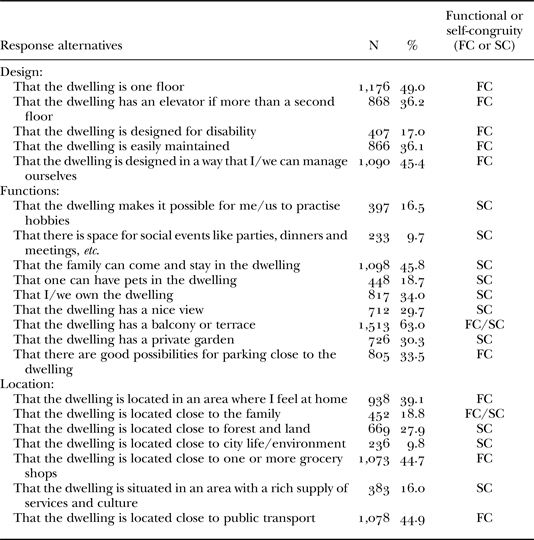
To measure age-related and spatial variation in housing preferences, we have used data from the Survey of Housing Intentions among the ELDerly in Sweden (SHIELD) (March to May 2013) directed at a stratified sample of the 55+ population in Sweden, with questions about residential status, residential preferences and residential plans (cf. Ytrehus Reference Ytrehus2004). In the survey, the general question of ‘In a dwelling, what is most important to you?’ was asked. The respondent could choose seven items from a list of 21 alternatives that were related to the design and function (has one floor, elevator, designed for disability, easily maintained, support independence), purpose (enable hobbies, space for social events, family can stay, have pets, ownership, nice view, balcony, garden, parking) and location (in an area where I feel at home, close to family, forest, city life, grocery shops, service and culture, public transport) of a future dwelling. These items are used as the independent variables in our analysis of housing preferences. The theoretical reasoning behind the possible responses stands in earlier literature.
In order to interpret the survey responses, we will rely on self-congruity theory as it has been applied to residential preferences (Sirgy, Grzeskowiak and Su Reference Sirgy, Grzeskowiak and Su2005). This theory makes a distinction between functional congruity linked to a utilitarian evaluation of a dwelling, and self-congruity which is determined by to what extent the image of the dwelling corresponds to the self-image of the dweller. Self-congruity can relate both to a person's actual self-image (e.g. being working class or being an academic), but it can also be based one's ideal self-image (who you would like to be), or to one's social self-image (how you want to be seen by others). According to Sirgy, Grzeskowiak and Su (Reference Sirgy, Grzeskowiak and Su2005), having a dwelling with an image that corresponds to one's actual self-image provides self-consistency, having a dwelling with an image that corresponds to one's ideal self-image provides self-esteem and a dwelling that matches one's social self-image can satisfy one's need for social approval. Of the response alternatives, some clearly refer to functions (in particular the design questions), and others can be seen as expressing self-congruity (responses concerning the purpose of the dwelling), even though responses to a specific item are open to alternative interpretation.
In relation to an analysis of age-related and spatial variation in housing preferences, the self-congruency approach is helpful in three ways. First, it can be hypothesised that with increasing age and frailty it is possible that functional congruity can become a more important determining factor for housing preferences, the reason being that there is more need for matching a dwelling's characteristics with one's physical abilities than for matching between the dwelling's image and one's self-image. Second, it can be fruitful to analyse spatial variations in housing preferences and neighbourhood preferences as linked to self-congruity. The hypothesis here is that differences in the self-image of social groups will be reflected in what qualities a dwelling should represent, and that this will show up as correlations between the socio-demographic composition of residential areas and the expressed housing preferences of elderly persons living in those areas. Third, we propose that functional congruity and self-congruity can be helpful for discussing housing changes among the elderly persons. Could it be that such adaptations become more difficult if, with increasing age, functional congruity comes into conflict with self-congruity? For example, moving into an apartment adapted for people with disabilities could be difficult if one's self-image is that of being a home-owner.
Thus, the self-congruity approach makes it possible to see survey responses as reflecting the self-images of individuals, and also provides a starting point for a discussion on how housing preferences are influenced by situational and personal characteristics, such as age, gender and geographical location (Sirgy, Grzeskowiak and Su Reference Sirgy, Grzeskowiak and Su2005: 338).
A summarised literature review on the topic of housing choice and residential reasoning among older people is provided in the following section. Our empirical approach is outlined in the methods and data section, along with a more detailed presentation of the SHIELD survey. This section is followed by a presentation of the results and a concluding discussion.
Housing choice and residential reasoning among older people
Below we will first account for earlier research on variation in residential preferences with an emphasis on variations depending on age and geographical location. In addition to this often cognitive-behavioural research, we will conclude the section with psychological motives for housing preferences through the self-congruity approach.
Housing preferences can be said to change with age, as with the advancement in age more convenient and supportive housing is preferred or found necessary. Such preferences or housing choices can be expressed as residential mobility (Litwak and Longino Reference Litwak and Longino1987; Mulder and Hooimeijer Reference Mulder, Hooimeijer, van Wissen and Dykstra1999) or in the residential reasoning of older people as shown by Granbom (Reference Granbom2014) and Koss and Ekerdt (Reference Koss and Ekerdt2017), where older people tend to consider future health conditions when discussing future housing choices (Litwak and Longino Reference Litwak and Longino1987; Mulder and Hooimeijer Reference Mulder, Hooimeijer, van Wissen and Dykstra1999).
One way to understand the housing preferences of older people is to study their actual residential mobility patterns, as the moves undertaken for the most part can be assumed to be a result of current or changing housing preferences. Housing preferences may change as a result of lifecourse events, such as retirement, the loss of a partner or declining health, events that are well known to influence mobility rates as well as the destination of moves (Helderman Reference Helderman2007; Litwak and Longino Reference Litwak and Longino1987; Painter and Lee Reference Painter and Lee2009; Sergeant and Ekerdt Reference Sergeant and Ekerdt2008; Tatsiramos Reference Tatsiramos2006). Upon retirement, the reasons for moving are usually different to the reasons for moves conducted later in life or in relation to declining health. When performing the latter types of move, smaller dwellings in rental tenure that are more easily maintained are preferred, and these dwellings might also be preferred following the loss of a partner (Abramsson, Elmqvist and Magnusson Turner Reference Abramsson and Andersson2012; Angelini and Laferrère Reference Angelini and Laferrère2012; Bonnet, Gobillon and Laferrère Reference Bonnet, Gobillon and Laferrère2010; Chevan Reference Chevan1995; Litwak and Longino Reference Litwak and Longino1987; Tatsiramos Reference Tatsiramos2006). Among the young old, on the other hand, moves can be expected to result from a preference to change housing area, housing type or tenure. In Norway, a move to an apartment is more commonly a preference held by owner-occupiers with higher incomes than by low-income owners (Ytrehus and Fyhn Reference Ytrehus and Fyhn2006). The former group is more likely to be able to afford a better quality apartment in a housing market dominated by home-owners.
The changing importance, with age, of different features in relation to the home is evident in studies that show older people's concerns about the structural design, location and aspects of maintenance (Erickson et al. Reference Erickson, Krout, Ewen and Robison2006; Fausset et al. Reference Fausset, Kelly, Rogers and Fisk2011; Hillcoat-Nallétamby and Ogg Reference Hillcoat-Nallétamby and Ogg2014; Painter and Lee Reference Painter and Lee2009; Perry, Andersen and Kaplan Reference Perry, Andersen and Kaplan2014). With the advancement in age, a move to a more easily maintained and accessible dwelling can be an option for the older individual to increase quality of life (Hillcoat-Nallétamby and Ogg Reference Hillcoat-Nallétamby and Ogg2014). Moves from large to small dwellings are often from owner-occupation to rental housing in more central locations, close to public service functions (Herbers, Mulder and Mòdenes Reference Herbers, Mulder and Mòdenes2014). Among older Canadians, Ostrovsky found a higher transition rate from single-family housing to apartments than for moves in the opposite direction. This indicates a shifting preference towards apartments in old age, although this preference is limited in scope (Ostrovsky Reference Ostrovsky2004; Tatsiramos Reference Tatsiramos2006). European research shows similar results (Angelini and Laferrère Reference Angelini and Laferrère2012), as do results from the United States of America where James (Reference James2008) showed that the preference for apartment housing, expressed as residential satisfaction, dramatically increases with age, even exceeding that of tenants in single-family housing as well as owner-occupiers. Swedish and Norwegian studies similarly indicate a growing interest among elderly persons for more comfortable housing involving less maintenance. In Norway, this is evident only after the age of 80 (Abramsson and Niedomysl Reference Abramsson and Niedomysl2008; Wimark and Andersson Reference Wimark and Andersson2015).
In Norway, Ytrehus (Reference Ytrehus2004) showed that most older people expressed a wish to remain in a current large dwelling in order to have space for their own activities and family life. They were prepared to live less comfortably in order to maintain the space as they argued that they might be unhappier in a smaller dwelling. However, the youngest age groups, in their fifties and sixties, anticipated that they would have to live in a smaller dwelling in future, whether they wanted to or not. A majority preferred to own their dwelling also in the future (Ytrehus Reference Ytrehus2004).
Increased longevity in general may result in changing preferences as more years are spent in retirement and in the third age, a time in life that follows family upbringing and working life while the individual remains in good health (Laslett Reference Laslett1989; Nilsson, Hagberg and Jeppsson Grassman Reference Nilsson, Hagberg and Jeppsson Grassman2013; Warnes Reference Warnes, Champion and Fielding1992). New social and recreational activities can be planned for these years, also influencing the choice of housing and preferences held. At the same time, as reported by Koss and Eckert (Reference Koss and Ekerdt2017), among the third agers, anticipation of the fourth age and the functional loss it may bring can influence the housing preferences of those making housing decisions in the third age.
One important conclusion from the literature is that general trends are not necessarily valid across geographical contexts (Abramsson and Andersson Reference Abramsson and Andersson2012). The choice of tenure when moving from owner-occupation shows marked differences. In the more urbanised municipalities, a larger proportion of older people moved to tenant co-operative apartments, whereas in municipalities with a rural character, moves into rental tenure were more frequent (Abramsson, Elmqvist and Magnusson Turner Reference Abramsson, Elmqvist and Magnusson Turner2012). This is assumed to be a result of variations in the housing market supply between different types of geographical areas (Abramsson and Andersson Reference Abramsson and Andersson2015b) and not necessarily a result of the preferences of the older individuals themselves.
Strong links can thus be expected among where you live (geographical location), age and what you see as important about your dwelling (housing preferences) (Niedomysl Reference Niedomysl2008; Vasanen Reference Vasanen2012). On the one hand, geographical context can be assumed to play an important role because values are influenced or reinforced by the local housing market structure (Abramsson and Andersson Reference Abramsson and Andersson2015b; Mulder and Hooimeijer Reference Mulder, Hooimeijer, van Wissen and Dykstra1999; van der Vlist et al. Reference van der Vlist, Gorter, Nijkamp and Rietveld2002) and the social norms that prevail in the area where one resides (Hedman, van Ham and Manley Reference Hedman, van Ham and Manley2011; Malmberg, Andersson and Bergsten Reference Malmberg, Andersson and Bergsten2014). On the other hand, it can be assumed that individuals’ choice of location has been influenced by their preferences, e.g. in Devlin's (Reference Devlin1994) study the participants showed a preference for the type of location in which their family resided. All the above will generate a correlation between location and stated housing preferences. Either way, assessing how housing preferences are linked to location is of interest since it will shed light on spatial variation in the way individuals evaluate different housing opportunities.
All of the reasons for residential mobility and housing preferences above relate to utility, function and economic reasons for residential preferences found in the large field of cognitive and behavioural research. As stated in the introduction, psychological motives for housing preferences can also be taken into consideration. That is, self-congruity as the stereotypical image of a typical dweller in a certain dwelling also plays a part in preferences. The house is thus a symbol of the self. The authors Sirgy, Grzeskowiak and Su (Reference Sirgy, Grzeskowiak and Su2005: 339) claim that failing to take self-congruity into consideration while analysing residential mobility and housing preferences ‘biases’ the analysis of functional congruity. In turn, functional congruity is the typical evaluation of functions of what a home is supposed to be, including an individualised utilitarian evaluation of the dwelling.
A first hypothesis is that, for several reasons, increased age will put emphasis on functional congruity rather than self-congruity. Preparing for old age usually includes a move to an apartment, which is easier to maintain than the owner-occupied house. Also, old-age disability stresses the need to see functional congruity as the most important housing characteristic. However, a contradicting view on residential mobility in old age is possible, that is, elderly individuals that are now independent of demands from children, and mid-life needs, can move to match their self-congruity, moves that were not possible at a younger age.
A second hypothesis regarding self-congruity theory is spatial variation in preferences linked to self-congruity. That is, people segregate themselves into different geographical locations to match the ideal self-congruity to the highest degree possible (Sirgy, Grzeskowiak and Su Reference Sirgy, Grzeskowiak and Su2005). Since the degree to which the ideal self-congruity is matched will boost self-esteem, according to the same authors, a consequence is that there is a smaller boost if an older person is forced to move according to functional congruity. This self-congruity in a dwelling and a neighbourhood might be expressed in the age-in-place frequency. Many studies have also found evidence of the oldest old's low intention and readiness to move (Abramsson and Andersson Reference Abramsson and Andersson2015a).
The third hypothesis in the introduction stated that residential mobility in old age may be more difficult since functional congruity and self-congruity risk matching to a lesser extent than earlier during the lifecourse. The reason for this is that housing plans and housing preferences as well as neighbourhood preferences have to include a preparedness for old-age disability or other functional needs. This adaptation of moving to an apartment might not follow the idea of what a house expresses about its owner in the form of social class, personality, preferences or personal history (Sirgy, Grzeskowiak and Su Reference Sirgy, Grzeskowiak and Su2005). Thus, there is a possible conflict between the self-congruity of being a home-owner but understanding the functional need of an easily maintained dwelling in old age.
Data and method
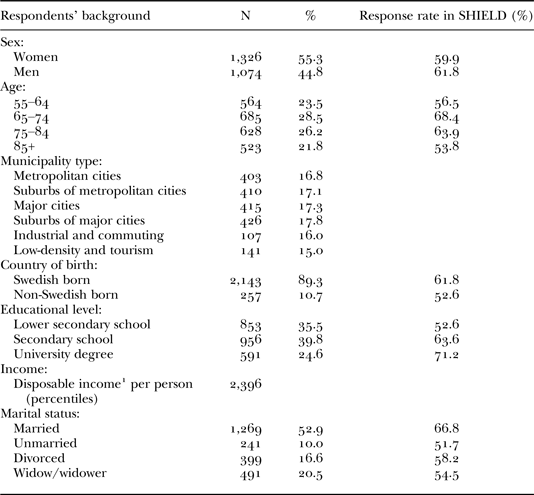
SHIELD, used for the analysis of this paper, was conducted within a research project on housing preferences and mobility patterns of older people. It was designed by two of the authors of this paper in collaboration with Statistics Sweden, which distributed the survey and collected the survey data. The survey contained 54 questions on the current housing situation of older people, and on their plans and preferences for the future (Abramsson and Andersson Reference Abramsson and Andersson2015a). The survey was sent out in the spring of 2013 to a national sample of 4,000 individuals aged 55 years and older. The sampling frame was the total population register of Statistics Sweden. Previous Swedish studies have mostly focused on the young-old but our oldest respondent was 103 years old. The survey was stratified on age and on municipality typeFootnote 1 to analyse age groups as well as geographical differences in attitudes among older people in Sweden (see Table 1). The response rate was 60.7 per cent, or 2,400 respondents.
Composition of respondents
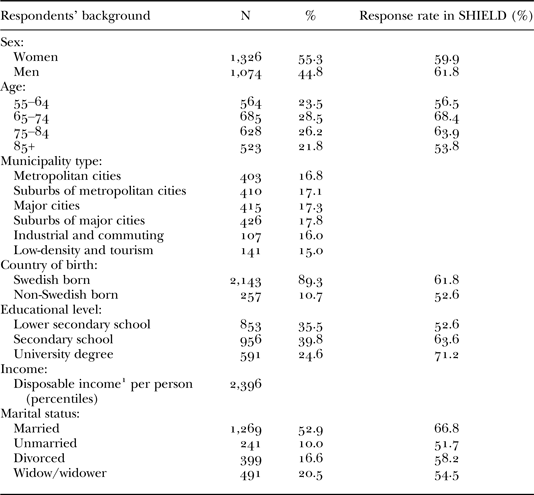
Notes: N = 2,400. SHIELD: Survey of Housing Intentions among the ELDerly in Sweden. 1. Disposable income includes income from employment and capital and transfers, and is the actual amount that can be used for consumption once taxes are deducted.
Housing preferences in survey question 32 (Table 2; 21 dependent variables) were assessed by a model that analysed to what extent answers to this question were linked to the respondent's age, gender, income, education, area type and municipality type (six independent variables). Question 32 asked the respondents to select seven of 21 response alternatives to the question ‘In a dwelling, what is most important to you?’ The response alternatives included aspects of the dwelling's design (has one floor, elevator, designed for disability, easily maintained, support independence), what functions it offered (enable hobbies, space for social events, family can stay, have pets, ownership, nice view, balcony, garden, parking), its location (in an area where I feel at home, close to family, forest, city life, grocery shops, service and culture, public transport) (see Table 2).
Question and response alternatives used as dependent variables. Survey question Q32: In a dwelling, what is most important to you? (choice of seven most important properties in the dwelling)
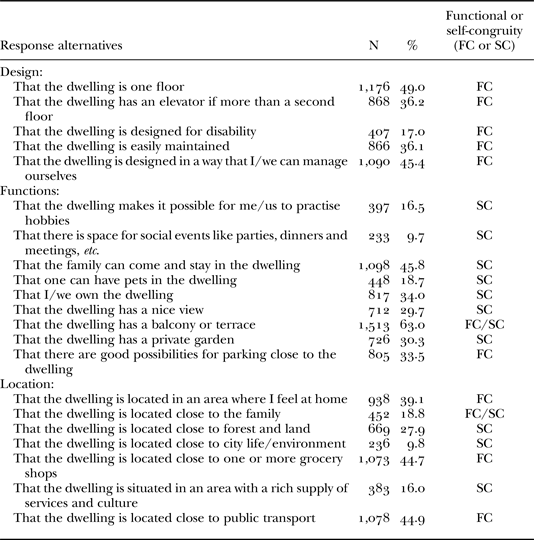
In Table 2 there is also a column that suggests if the response alternative can be interpreted as reflecting functional congruity or self-congruity. Clearly, these interpretations can be discussed and in a number of cases a specific response could be given both a functional and self-congruity interpretation. The guiding principle for the interpretations given here is that responses that can be seen as expressing preference for a specific lifestyle or way of life have been classified as being related to self-congruity.
The question was formulated to capture individual's preferences in general and was placed under the heading ‘Your future residential situation’ in the questionnaire. However, we interpreted the question as generating answers providing information on preferences held among the old in general and not in particular about the current or future residence. For each response alternative we estimated a logistic regression with selected/not selected for this particular preference, as the dependent variable. This resulted in 21 different estimated models. Data were analysed using the statistical packages JMP 11 (SAS Institute Inc., Cary, NC).
To the survey data, register data from Statistics Sweden were added by individual linkage records. Respondents were informed about the addition of register data when answering the survey. The register data consisted of information on the respondent's gender, year of birth, country of birth, year of immigration, educational level, household income, disposable income, municipality and local SAMS area.Footnote 2 Table 1 shows the variables available, of which six were used as independents in this study, the exception being marital status.
We used six types of municipalities for stratification in the survey and as independent variables in the analysis, that is (a) metropolitan cities, (b) suburbs of metropolitan cities, (c) major cities, (d) suburbs of major cities, (e) industrial and commuting municipalities and (f) low-density and tourism municipalities (see Table 1). The types were based on the classification of municipalities made by the Swedish Association of Local Authorities and Regions (SALAR 2013).
Geographical context
Earlier research suggests there is a geographic component in residential preferences that deserves to be analysed in more detail. To do this we will take advantage of a method for exploring the influence of geographical location on survey responses. In short, this method analyses the extent to which survey responses are similar for respondents that live in the same type of socio-demographic environments, controlling for other background variables (Malmberg, Andersson and Bergsten Reference Malmberg, Andersson and Bergsten2014).
The importance of geographical context for housing preferences will be analysed using the classification of municipalities described above and, in addition, a more detailed classification of residential locations. The locations are based on the socio-demographic composition of the surrounding area using indicators of education, income, family status, employment, migration status and economic vulnerability (separately from the survey, accessed through the online service of Statistics Sweden). These indicators were selected to capture the general socio-demographic structure of neighbourhoods, and were not specifically selected for analysis of elderly persons’ housing preferences. The classification has been done using a multi-scalar approach, described in Clark et al. (Reference Clark, Anderson, Östh and Malmberg2015) as a method for measuring geographical context that largely avoids the uncertainties that are associated with using aggregates for fixed, administratively defined geographical sub-divisions Kwan (Reference Kwan2012). With a multi-scalar approach, the geographical context of a specific location is classified in a way that both considers the closest context, e.g. the nearest 100 neighbours, and broader geographical contexts, such as the 1,600 or 6,400 nearest neighbours. For more details, see the Appendix in the online supplementary material.
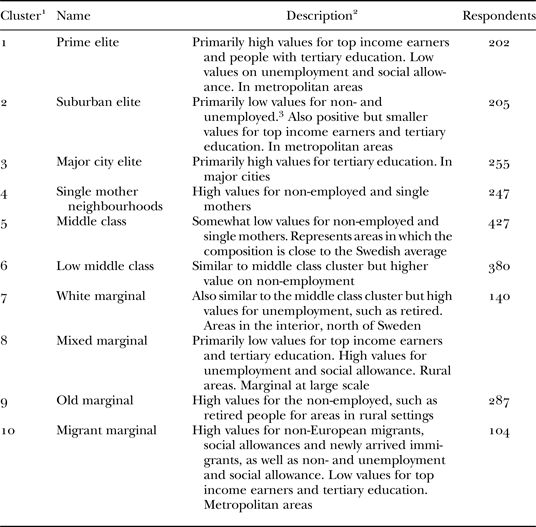
The area types we have identified are presented in Table 3. The area types can, with one exception, be characterised as belonging to broadly defined status groups ranging from elite areas (high income and many with tertiary education), middle-class areas (not elite but with high employment and relatively few disadvantaged groups), to areas characterised by the presence of different marginal groups (high unemployment, low employment rates, few with high income, few with tertiary education, many non-European migrants, many newly arrived migrants and many receiving social allowances). Within each broadly defined status group the different area types do, however, display differences.
Area types resulting from a multi-scalar classification of the socio-demographic composition of individualised neighbourhoods
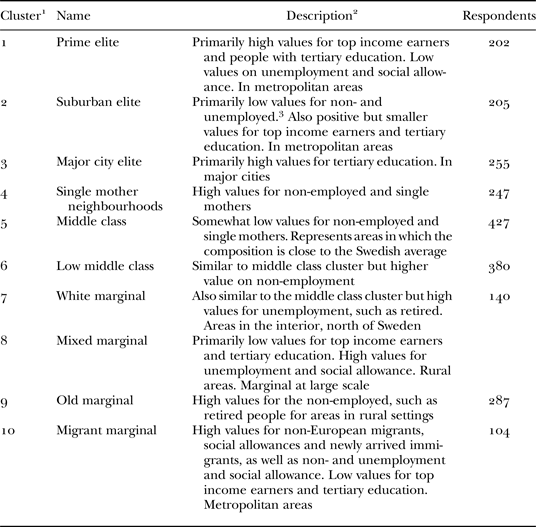
Notes: 1. The clustering is based on the composition of individualised neighbourhoods that range in size from including the 12 to 12,800 nearest neighbours. Eight different socio-demographic indicators were used to characterise these neighbourhood: share of unemployed, share with tertiary education, share of single-mother households, share of individuals in top-ten per cent income bracket, share of newly immigrated in Sweden (during the last five years), share with social allowance, share without employment during the entire year, and share Asian, African or Latin American country of birth. Values for the individualised neighbourhoods have been aggregated to the SAMS (Small Area Market Statistics) level. 2. Descriptions are based on averages, z-scores across different scale levels for six socio-demographic indicators: education, income, family status, employment, migration status and economic vulnerability. 3. Non-employed equals no employer reported employment, unemployed equals having received unemployment allowance.
The prime elite area type is high on both top income and tertiary education, low on unemployment and social allowance, but is somewhat diverse in terms of non-European migrants and employment status. Suburban elite is also high on income but not as high on tertiary education and is less diverse than prime elite with respect to employment status and the proportion of newly arrived. Major city elite, on the other hand, is not as high on income but high on tertiary education. Major city elite areas are also quite diverse with respect to unemployment, employment status and non-European migrants. These differences are helpful since they make it possible to explore whether there are subtle differences in self-image between the three elite area types.
In terms of income and education, the single mother neighbourhood area type is relatively close to the elite areas but it is more diverse than the middle-class areas with respect to unemployed, non-employed, social allowance and non-European migrants.
The two middle-class area types are relatively similar. They have low values for social allowance, relatively low values for unemployment and average levels of income. Moreover, they have very low values for non-European migrants and for single mothers. Generally, compared to the middle class area type, values for low middle class on income, employment, etc., are closer to the marginal area types. As can be seen in Table 3, the number of respondents living in these two area types is large.
Among the marginal area types, the migrant marginal area type stands out, with low values on income and tertiary education, but with high values on social allowance, non-employment, unemployment, newly arrived and non-European migrants. These areas are clearly the most disadvantaged. White marginal areas are very low on income and tertiary education, and they have the highest unemployment rates of all area types. But they also have the smallest presence of non-European migrants of all area types. These different marginal area types point to a strong spatial segregation of marginal groups according to foreign-born status. There is, however, one area type, mixed marginal, that provides a potential for interchange. Like the other marginal area types, mixed marginal is low on income and tertiary education, and relatively high on unemployment, non-employment and social allowance. Moreover, in mixed marginal areas, relatively few of the nearest neighbours are non-European migrants but in the wider geographical context (nearest 1,600 and 3,200 neighbours) there is considerable diversity in country of birth. Old marginal is the fourth marginal area type. Again, this marginal type is characterised by low values for tertiary education and income, and high values for unemployment and social allowance, but this is also an area type where the rate of non-employment is very high, reflecting a relatively large retired population. This relative diversity of area types that can be characterised as marginal from a social status point of view will enable an analysis of the extent to which residential preferences in different areas reflect social status and will also show whether there is a diversity of preferences across such areas.
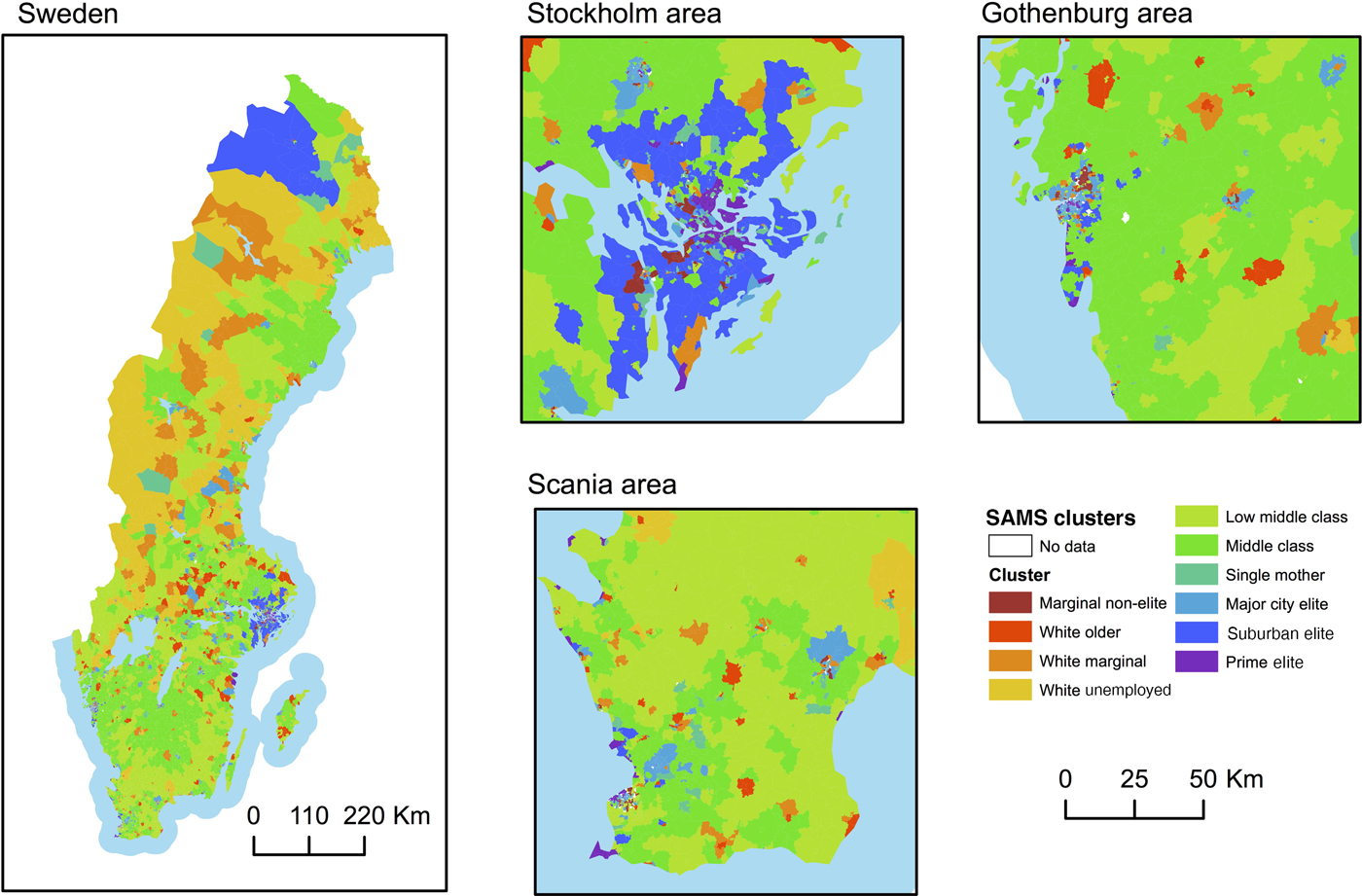
The geographical locations of these area types are shown in Figure 1. The prime elite area type is found in the metropolitan cities and in major cities, as well as in attractive coastal locations. The suburban elite area type is mainly found in the suburban parts of metropolitan Stockholm and metropolitan Göteborg. Major city elite areas are found in Sweden's second and third largest metropolitan regions as well as in major cities such as Uppsala, Västerås, Örebro, Lund and Linköping, but this type is less well represented in Stockholm, Sweden's largest metropolitan region. A similar location pattern is found for single mother neighbourhoods.
Classification of Swedish SAMS (Small Area Market Statistics) areas into ten socio-demographic area types.
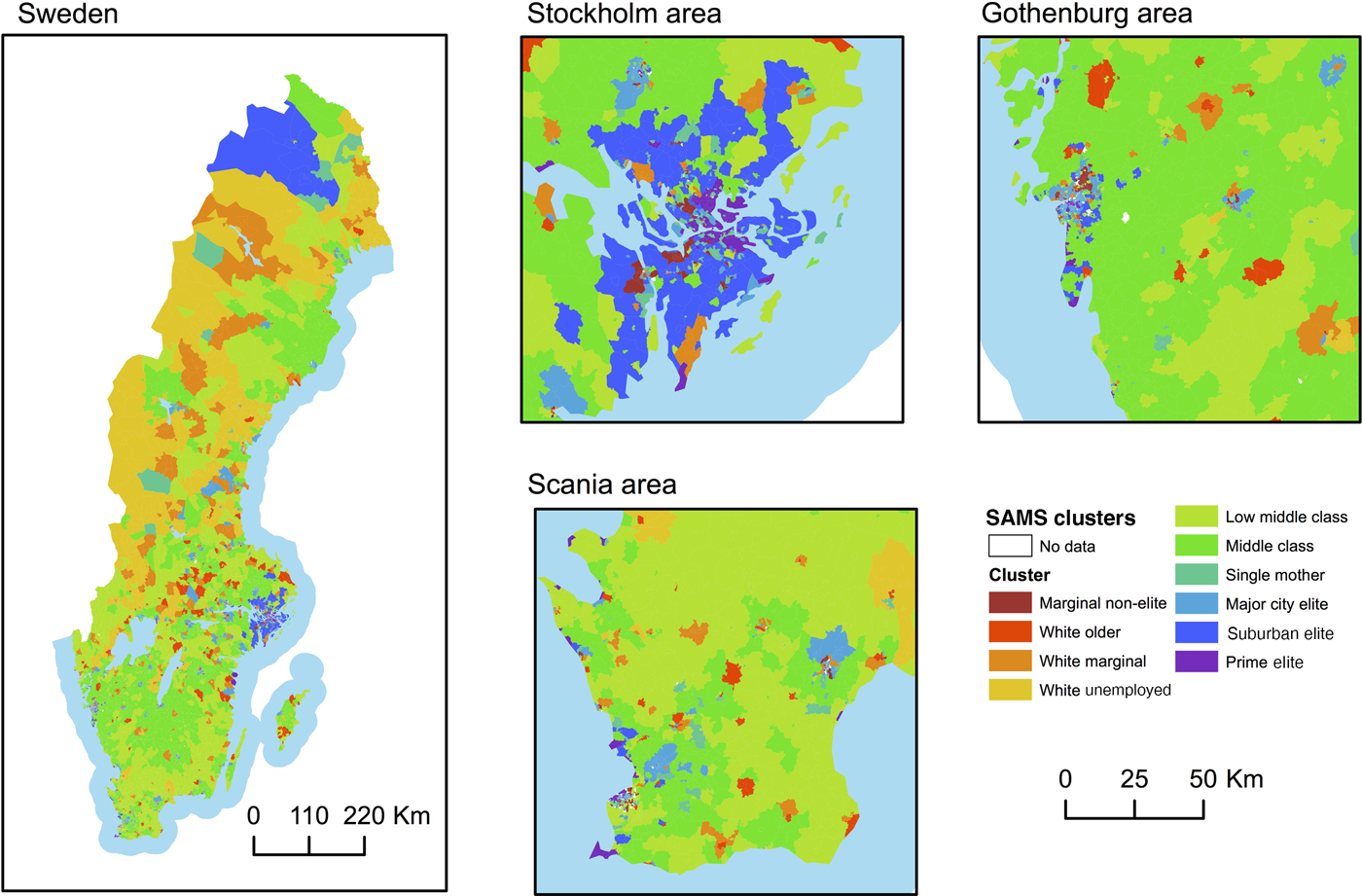
Areas belonging to the middle class area type tend to be found in rural areas under the influence of the metropolitan regions or major cities. Low middle class areas instead tend to be located at greater distances from major urban centres, in border areas between more central regions and in areas specialising in agriculture.
Of the marginal area types it is white marginal that has the most peripheral location pattern. This area type is found in the more sparsely populated, forested areas of northern and north-western Sweden, as well as in areas that are distant from the metropolitan areas and other major cities. Mixed marginal areas also have relatively peripheral locations but are often close to small or medium-sized urban settlements, whereas the old marginal area type tends be located in smaller, often industrial settlements. The migrant marginal area type, in contrast, is found in the metropolitan areas and also in some major cities and is often linked to large public housing estates established during the 1960s and 1970s.
The area type classification has been linked to the respondents based on the code for the SAMS area in which they live. Figure 1 presents a map of the geographical location of the different area types, which helps to explain the results of the preferences in different area types.
As explained above, we will estimate 21 different logit models using responses to the preference questions as the dependent variable. The independent variables will be age group, gender, education, income, municipality type and area type. No interactions will be included in the model. We acknowledge that interactions would have been of interest but to include them would have increased the number of parameters to be estimated and, thus, may have led to reduced precision.
Results: influences on housing preferences
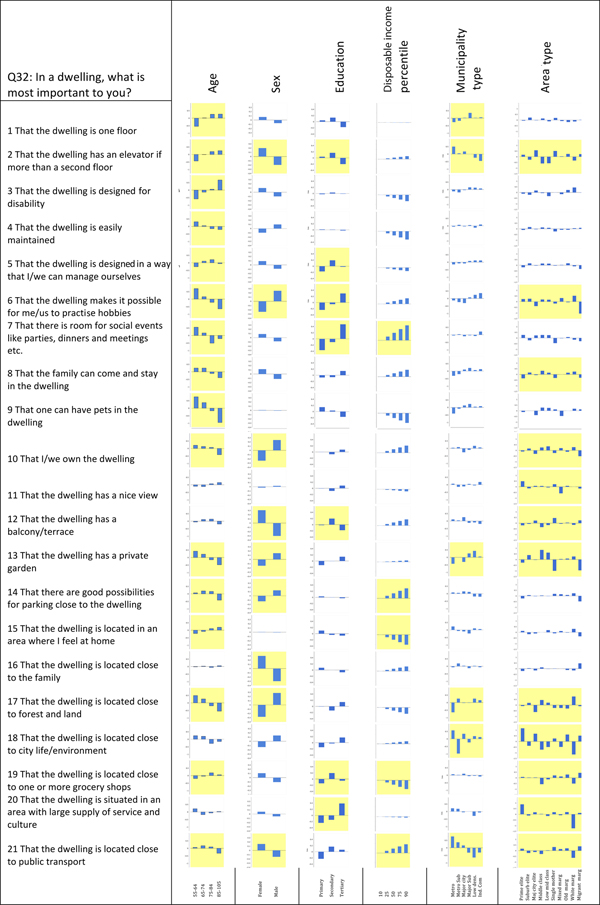
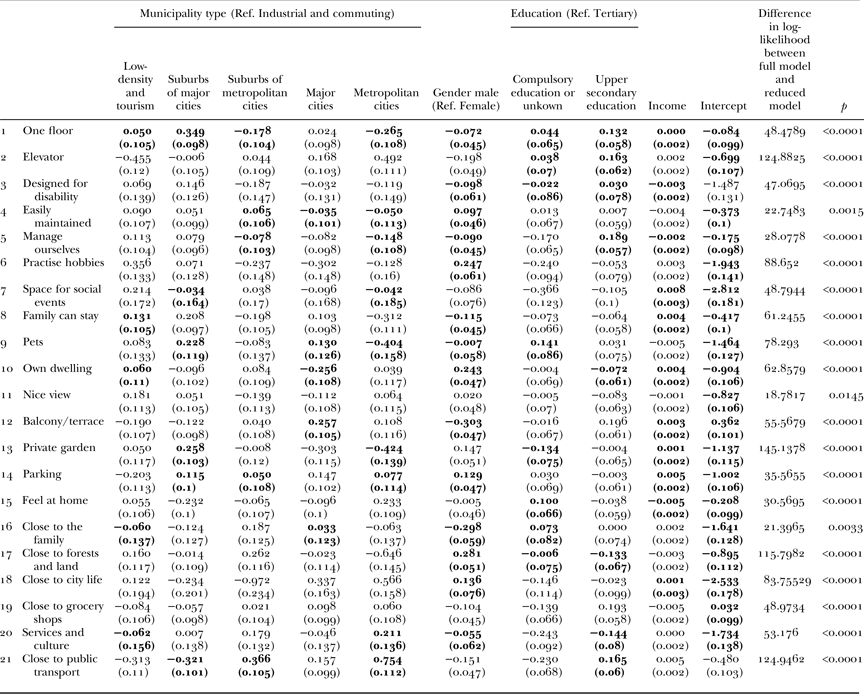
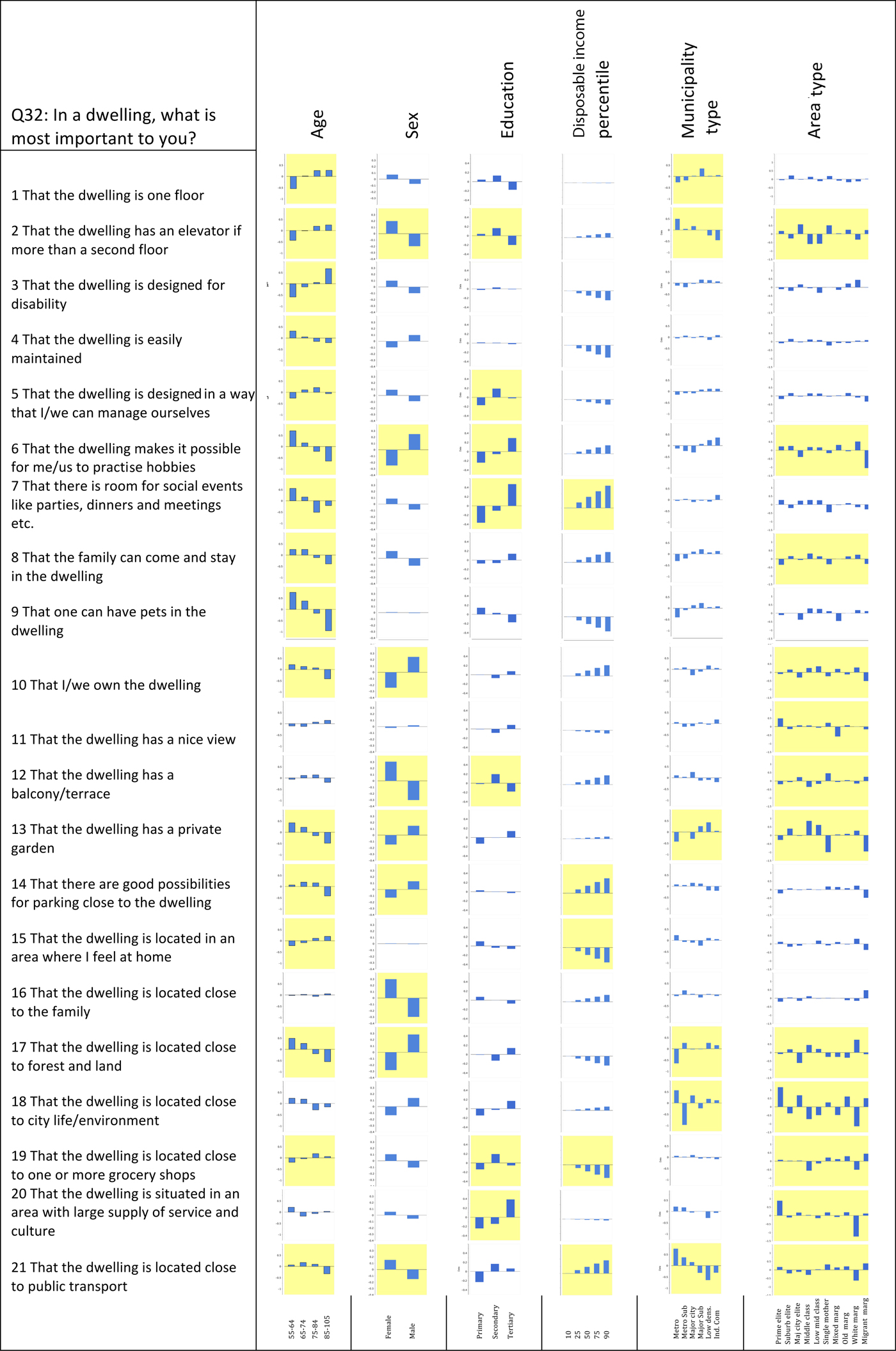
The estimation results for the 21 logit models are presented in Table 4 and Figure 2. Table 4 is a traditional presentation of regression results, whereas Figure 2 provides a graphical illustration of the same results. The rows in Figure 2 relate to one estimated model, with the dependent variable in the furthest left column. The other columns present the parameter estimates for age group, gender, education, income, municipality type and area type, respectively, using miniature bar charts. The categories used for the bar charts are presented below each column of charts. Significant effects (1% level) are indicated by shading. We have chosen these levels of significance in order to reduce problems of mass-significance given that we present a large number of parameter estimates. Figure 2 graphically presents the point estimates for the different levels of the explanatory variables. Table 4 presents the parameter estimates and standard errors. In the JMP software used for the statistical analysis, categorical factors are coded with an indicator variable for each categorical level except the last. For observations that belong to this last level, a one is subtracted from the indicator variables of the factor. This implies that the parameter estimates for the indicator variables represent the differences in the predicted response for that level from the average predicted response over all levels; and the estimate for the last variable is the negative sum of the other levels.
Effect of age, sex, education, income, municipality type and area type on responses to the question: ‘In a dwelling, what is most important for you?‘
Parameter estimates for logistic regressions with survey responses as outcomes
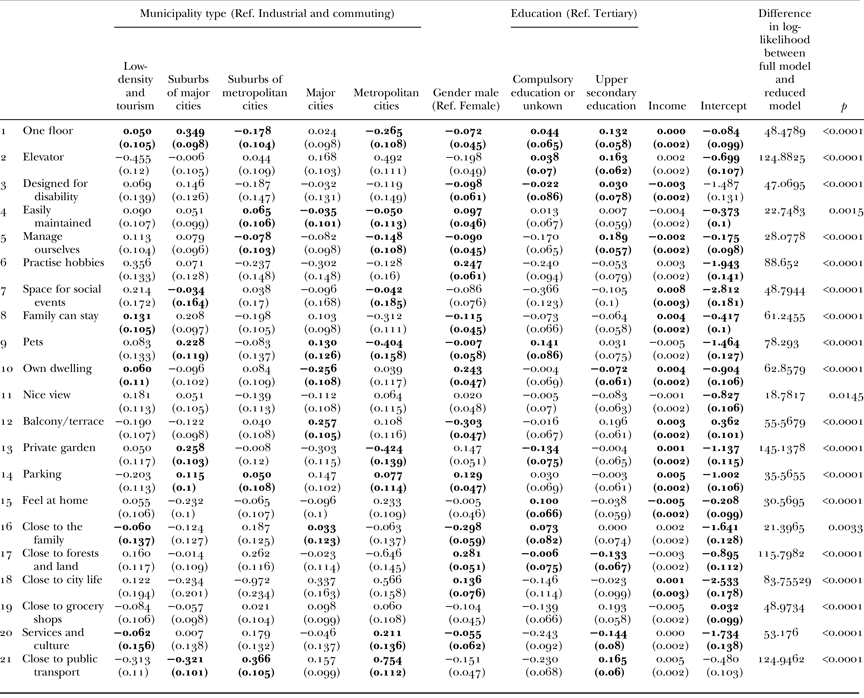
Notes: Ref.: reference category. Standard errors are given in parentheses.
Significance level: Significances below 1 per cent are bold.
The response pattern in the survey related to age, sex, education, income and geographical location of the respondents was further analysed in detail to examine how these factors affect housing preferences. This is detailed in Figure 2 and Table 4. It should be noted that not all the point estimates discussed in the text below are necessarily significantly different from zero at conventional test levels. In the interpretation of the results presented below, it should be remembered that this is a cross-sectional study and it could be that the parameter estimates represent cohort effects and not age effects.
Age effects on preferences
As can be seen in Figure 2, the respondent's age has a significant effect on most of the 21 different indicators of housing preferences. None of the other independent variables (sex, age, education, income, municipality type and area type) has such a pervasive effect on what qualities of the dwelling the respondent marks as important. For likelihood ratio chi-square values for the age variable, see Table A1 in the online supplementary material. These values are based on the change in model log-likelihood when the variable is introduced, and a high value indicates a large change in the fit of the model. The highest relative chi-square values are found for views on how the dwelling should be designed, but also the functions the respondents see as important, and the qualities they look for in terms of location and environment are strongly influenced by age.
Preferences that are increasing with age include: the dwelling is located in an area where the respondent feels at home, that the dwelling is designed for disability, that the dwelling (if higher than on the second floor) has an elevator, and that the dwelling has one floor (Figure 2, first column, age). These are response alternatives that can be seen as related to functional congruity (see Table 2). Up to the age 75–84 there is also a greater preference for the dwelling to be designed in a way that respondents can manage themselves. Taking into consideration the effect on health of ageing, we take this difference to represent age effects and not cohort effects.
Thus, the results for the latter outcomes, options 16–21, show age effects in several response alternatives (see Figure 2 and Table 4). Public transport in the vicinity is less important with increasing age, except for the youngest, 55–64 years old. Also, response alternatives decreasing with age are preferences for closeness to forests and land, that the dwelling has a garden, that the respondent owns the dwelling, that one can have pets, that the family can come and stay, that there is space for social events such as parties, dinners and meetings, that the respondent can practise hobbies and that the dwelling is easily maintained (Figure 2, first column, age). These are all alternatives that can be interpreted as related to the self-image of the respondents. Shifts in the importance of ownership also reflect that the best housing type has been found to depend on lifestage and lifestyle (Clark and Onaka Reference Clark and Onaka1983; Granbom Reference Granbom2014; Herbers, Mulder and Mòdenes Reference Herbers, Mulder and Mòdenes2014).
In many ways, these age effects support the idea of shifts in housing preference to more functional congruity and from peripheral to central locations in the 55+ population. Preferences emphasised by the youngest part of the 55+ population (close to forests and land, garden, ownership, pets, space for family, social events, hobbies) are typically easier to meet in single-family dwellings located in more peripheral locations (suburban parts of major cities, rural and semi-rural locations). These stated preferences can be seen as an expression of the self-image held by respondents residing in single-family dwellings and, hence, related to self-congruity. As the preferences are weakened with increasing age, more centrally located dwellings can become increasingly attractive for the elderly population. Self-congruity is out-weighed by functional congruity when it comes to the age variable. On the other hand, preferences that become more accentuated with age (building designed for disabled access, elevator, support for independent living) are also functions that are typically easier to accommodate in multi-family dwellings that are more readily available in central locations (central parts of large cities, medium-sized urban areas and smaller towns in the countryside).
Geographical context, area types
The assessed results for the different area types are presented in Table 4 and are also illustrated in Figure 2. In Figure 2, preferences for which area type has a significant effect are shaded and, as can be seen from the figure, such effects of area type are found for 11 of 21 alternatives. The significance of area type suggests that residential preferences are strongly associated with area type, although not as strongly as for age. Moreover, comparing with the effects of age, it appears that area type is less important with respect to preferences for dwelling design but, perhaps not unexpectedly, important for location-related preferences.
Since there are ten different area types and 21 different alternatives, it can be difficult to provide an overview of the estimates presented in Table 4. We will, therefore, concentrate on a selection of them, starting with the elite area types, followed by the middle-class area types and the marginal area types.
With respect to the elite area types, an initial observation is that there are few similarities in the estimated preference parameters.
Elderly persons in prime elite areas state that the most important aspects of the dwelling are a location close to a rich supply of services and culture, and close to city life/city environment, and that it should have a nice view. If these preferences are seen as reflections of the respondents’ self-image and how their present dwelling is consistent with their self-image, this suggests that elderly persons in prime elite areas can, in the Swedish context, be seen as prototypical urban dwellers. In Sweden, metropolitan inner cities are dominated by tenant co-operatives and offer few housing opportunities for low-income groups. Also the negative point estimates, that is the preferences not important for elderly persons in the prime elite area type (having a garden, that the dwelling is located close to family, and that the family can come and stay), can be seen as reflecting elite attitudes and hence align with the self-image of the upper class.
Respondents living in suburban elite areas, on the other hand, value having a garden and having a dwelling that includes space for hobbies. Less stress is given to having an urban environment and good communications. A dwelling designed for disabilities and having an elevator are also of less importance. Instead, people living in these areas think that having a dwelling on one floor only is a plus. Also in this case, the stated preferences are easy to understand as an expression of the actual self-image or ideal self-image of suburban dwellers. Building on Sirgy, Grzeskowiak and Su (Reference Sirgy, Grzeskowiak and Su2005: 336), it could be that having a garden and room for hobbies is important for the self-esteem of suburban elderly persons; this in contrast to the valuations expressed by respondents in prime elite areas.
Turning, then, to the preferences expressed by elderly persons in major city elite areas we find, again, few similarities with the other elite area types. Individuals in this area type put great emphasis on living in an urban environment but do not put stress on living near nature, owning their own dwelling, and having a dwelling suited for hobbies and pets. Instead, they stress the importance of having an elevator if there are more than two floors and, according to the point estimate, they also prefer an area with a rich supply of services and culture. Thus, with respect to the attitude to the urban environment and possibly service and culture, they have some similarities with respondents in prime elite areas. Otherwise, they have a distinct preference profile and an interesting feature of these respondents is that they have similarities with respect to what they do not see as important: ownership, room for hobbies and pets. This can be interpreted as reflecting that being different from suburban dwellers is an important part of their self-image, maybe to the extent that by expressing, through their choice of dwelling, a disdain for ownership, hobbies and pets, they could earn social approval from the people they have as neighbours (Sirgy, Grzeskowiak and Su Reference Sirgy, Grzeskowiak and Su2005: 338). The fact that elderly persons in these areas do not stress home-ownership confirms that tenures other than ownership are not considered as subordinate (Andersson Reference Andersson, Elsinga, Decker, Teller and Toussaint2007). In Sweden, rented housing is not generally stigmatised and the rights of tenants are comparatively strong, as is security of tenure. As a result, the different types of tenure are attractive (Andersson Reference Andersson2008).
Individuals living in the single mother neighbourhood area type very rarely stress the importance of having a garden. Neither is it important to have space for social events or space for family members to stay. Likewise, being close to forests and owning one's own dwelling are not emphasised (point estimate). What is important is instead to have a balcony or terrace, an elevator, good communications, an urban environment (point estimate) and, to some extent, a great view. This can be seen as an expression of a more modest self-image than those described above, but still expressing an urban identity in how they value their dwelling.
This divergence in response patterns found between the different elite areas is in contrast to a pattern of convergence in the preferences expressed by elderly residents in middle class and low middle class area types. Individuals in the middle class area types express a strong preference for having a garden and a preference for having access to forests and nature. They also have a tendency to stress owning their dwelling, and having a dwelling suitable for pets and where family can stay. Little emphasis is given to living in an urban environment, good communications, availability of grocery stores, or having a terrace or elevator. Similar preferences for access to forests and nature, owning, dwelling suitable for pets, as well as a tendency not to value an urban environment and elevator are expressed by residents in low middle class area types. It could be that these similarities indicate a tendency towards stronger conformity among middle-class groups than between different elite area type residents. Again, it is easy to see the response patterns of individuals in low middle class and middle class area types as reflecting their self-image and how their dwelling has characteristics that conform to that self-image.
If the focus is shifted to the marginal area types there is again less correspondence in the preferences expressed by residents living in different area types.
Preferences for elderly persons residing in old marginal area type, instead, have some similarities with preferences in the major city elite area type. For example, emphasising being close to city life, and elevators, but de-emphasising being close to forests and land. Given that these areas typically are found in small urban settlements, it is interesting that these respondents express preferences that point to an urban-dweller self-image. Elderly persons residing in the white marginal area type, on the other hand, have some similarities in preferences with middle class area type residents: de-emphasising the importance of elevators, being close to city life, being close to grocery shopping, and being close to public transport, and emphasising being close to forests and land.
Preferences found among elderly persons living in migrant marginal area types are that the dwelling should be located close to public transportation, grocery shops and city life/city environment. Most importantly, migrant marginal areas are the only ones with high positive estimates for the dwelling to be located close to the family. This could correspond to an ideal self-image that puts a high valuation on family solidarity. Clearly not important in this geographical context is to feel at home in the area, possibilities of parking, having a garden or that the dwelling makes it possible to practise hobbies. (Since this is the reference category for area type in Table 4, the estimates can be obtained by adding the point estimates for the other area types and multiplying by −1.)
If it is accepted that the response patterns found for elderly persons living in different geographical contexts could reflect differences in self-image, the results presented point to large geographical differences in how elderly persons see themselves and, thus, to large differences in what their dwellings signify.
A preliminary analysis using a split sample does not indicate that the effects of geographical context on preferences are not strongly dependent on age (available from the authors on request). This suggests that elderly persons’ place-specific preferences can be similar to those of other age groups living in the same area and, thus, that place-specific self-congruity is shared between different adult age groups.
Municipality type
Six housing preferences differed significantly with municipality type (see Table A1 in the online supplementary material). An association between the preference of the dwelling to be located close to public transport and the municipality type according to population density/urbanity could be observed. Continuing with reference to Figure 2, the metropolitan cities and major cities were the location of respondents answering that public transport nearby was important. However, public transport was not important to those living in suburbs of major cities, industrial and commuting municipalities, and low-density and tourism-type municipalities. In the same way, having an elevator if the dwelling was situated higher than the second floor was only important to those living in the three most urban types of municipality but not in the three less population-dense types of rural municipality. Of course, public transportation and elevators are inherent aspects of urban areas, whereas the same preferences would not naturally show among respondents living in rural/sparsely populated areas. Here we can thus observe sorting according to preferences and/or adjusted preferences. An additional sorting according to preferences is that those living in the more rural and sparsely populated municipality types preferred having a garden of their own to a higher degree than others. Also connected to the urban–rural divide but with mixed results were respondents in metropolitan cities preferring the dwelling to be located close to city life or city environment, whereas they did not prefer forests and land to be close to the dwelling.
Gender differences
There is general evidence of differences in how men and women relate to their dwellings. Devlin (Reference Devlin1994) and Hartig, Lindblom and Ovefelt (Reference Hartig, Lindblom and Ovefelt1998) concluded that the restorative quality of the home was given lower ratings by women than by their husbands despite the fact that women reported higher levels of stress (Hartig, Lindblom and Ovefelt Reference Hartig, Lindblom and Ovefelt1998; Ytrehus Reference Ytrehus2004). Women to a larger extent emphasise the importance of maintaining relationships with children and grandchildren, and an important aspect of the dwelling is to have room for family members to come and visit (Ytrehus Reference Ytrehus2004).
Nine housing preferences that were significant (at the 0.01% level) for gender were found (see Table A1 in the online supplementary material). The preferences primarily concerned the whereabouts of the dwelling. The most important one was that the dwelling, according to women, should be located close to the family. Secondly, the dwelling should have a balcony or terrace. Women also preferred the dwelling to have an elevator if located higher than the second floor, and liked closeness to public transportation. Women in our study, thus, can be seen as emphasising functional congruity.
Men, on the other hand, answered that owning the dwelling was important, as well as having a location close to forests and land. Also important was having a private garden as well as parking facilities and the possibility to practise hobbies in the dwelling. All of these preferences suggest higher self-congruity among men than among women. Acknowledging that this might create a stereotyped picture of preferences held by women and men, this might as well be a result of elderly women adapting their housing situation in an earlier phase of life than do men. As an example, upon widowhood, women to a somewhat larger extent than men who become widowers move to different housing (Abramsson and Andersson Reference Abramsson and Andersson2015b).
Education and income
The results presented in Figure 2 show that those with higher education valued a rich supply of services and cultural facilities, and preferred that the dwelling should have space for social events like parties, dinners and meetings, and should provide the possibility to practise hobbies. The preference for space for social events was also associated with higher income, similar to the preferences that the family could come and stay and that the dwelling was owned. In terms of self-congruity, these preferences do not come as a surprise since they express social class and in some ways the dweller's personality.
Those with lower incomes preferred the dwelling to be designed in such a way that one could manage without help from others. Significant preferences among lower-income groups were also the fact that the dwelling was located in an area where the respondents felt at home, which was close to forests and land, had space for pets, where they could manage for themselves and was close to grocery shops.
These findings are interesting since they show that there are significant differences in what individuals with high and low income consider important in their dwelling, and that it could be of interest to explore these further. But as stated above, these effects are not as clear as those of age.
Concluding discussion
In this paper, we have used self-congruity theory in order to interpret variation in housing preferences across ages, gender, socio-economic status and geographical context. Our study, based on a survey of 2,400 individuals aged 55 years and over, shows that age stands out as the strongest determinant of housing preferences. We also find strong indications that with increasing age, preferences linked to functional congruity (one-floor dwelling, elevator, designed for disability, support self-management) become more important than preferences linked to self-congruity and lifestyle (dwelling suited for practising hobbies, social events, family can stay, pets, ownership, having garden, being close to forest and land, close to city life, service and culture).
Besides age differences, there are, as discussed below, large differences in housing preferences between area types. Applying self-congruity theory as a tool for understanding these differences, we argued that the housing preferences typically expressed by respondents in a specific area type can be interpreted as reflecting the self-image of elderly persons living in this area. For example, elderly persons living in the middle class area type emphasise the importance of owning the dwelling, being close to forest and land, having a private garden, room for pets and a dwelling where family can stay. According to self-congruity theory, this suggest that these elderly persons identify themselves as home-owners, interested in nature and gardening, and pet-owners that put value on having family come and visit. Residents in major city elite areas, in contrast, express a different self-image in having a response pattern that indicates that ownership, room for pets and being close to nature is unimportant. Thus, based on self-congruity theory, it can be argued that difference in housing preferences that we find between different geographical contexts demonstrate that there is strong geographical variation in the self-images held by elderly persons.
Comparing how response patterns vary with age and across geographical contexts, one can observe that the older the respondent, the more likely she or he was to have preferences more readily realisable in urban areas, such as a dwelling designed for disability, having an elevator and designed in such a way that one could manage for oneself. That is, functions and utility in the dwelling were stressed. Among the young-old, preferences were found to correspond better to rural or suburban living, such as closeness to forests and land, having a garden, space for social events and owning the dwelling. The latter preferences are also corresponding to self-congruity to a larger extent than preferences held by the oldest old.
This finding is interesting in relation to earlier studies that have demonstrated that there might exist a late-adulthood lifecycle pattern in residential mobility (Abramsson and Andersson Reference Abramsson and Andersson2015a). Thus, there is a tendency for young elderly persons to move to more peripheral locations whereas older elderly persons tend to move to more central locations. The above results concerning preferences for housing at different ages, and preferences that differ by area type, can be seen as shaping this late-adulthood mobility transition. Whereas young elderly persons express preferences that can be characterised as associated with country-living ideals, older parts of the elderly population appear to be less inclined to evaluate their residence in terms of self-congruity (Sirgy, Grzeskowiak and Su Reference Sirgy, Grzeskowiak and Su2005) or a positional good (see Hoggart and Buller Reference Hoggart and Buller1995). Instead, they value dwellings that meet more basic needs related to psychological functional congruity. Thus, the mobility patterns of the elderly population can be understood as the first movements towards peripheral location governed by lifestyle considerations and, in older age, movements towards more central locations governed by concerns about liveability and function. Moreover, rented housing, as opposed to housing in owner-occupation, is more often located in central areas within a municipality, whereas single-family, owner-occupied housing dominates peripheral areas. Thus, the availability of different housing types varies between different geographical areas. Some preferences may as a result be easier to realise than others in a particular type of local housing market (Schwanen and Mokhtarian Reference Schwanen and Mokhtarian2004; Vasanen Reference Vasanen2012).
Bearing in mind that differences still exist within the different age groups and geographical contexts, the mobility transition of elderly persons is likely to have strong effects on the future demand for housing. In both high- and medium-income countries, the most important demographic trend in the coming decades will be the growth of the 55+ population (Christensen et al. Reference Christensen, Doblhammer, Rau and Vaupel2009; Thorslund and Parker Reference Thorslund and Parker2007). This implies that future shifts in housing demand will to a large extent be influenced by the housing preferences of and subsequent housing choices made by the older part of the population. It can be hypothesised that the ageing of the baby-boom generation will lead first to a surge in demand for and investment in lifestyle-oriented housing types, fulfilling the self-image of the dweller, and later to an increased demand for more mundane but practical housing options according to functional congruity. Moreover, it will be the case that elderly people living in areas with little urban-style housing will have more difficulties in meeting housing preferences that, according to this study, become more pronounced with age (Christensen et al. Reference Christensen, Doblhammer, Rau and Vaupel2009; Thorslund and Parker Reference Thorslund and Parker2007). This implies that future shifts in housing demand will to a large extent be influenced by the housing preferences of and subsequent housing choices made by the older part of the population. It can be hypothesised that the ageing of the baby-boom generation will lead first to a surge in demand for and investment in lifestyle-oriented housing types, even now fulfilling the self-image of the dweller, and later to an increased demand for more mundane but practical housing options related to functional congruity. Moreover, it will be the case that elderly people living in areas with little urban-style housing will have more difficulties in meeting housing preferences that, according to this study, become more pronounced with age.
In our empirical study we have also found clear gender-related differences in housing preferences that fit almost too well with stereotypical ideas about male and female value orientations. The same can be said of differences related to class (income and education). Although not as important as the age and area type differences, contrasts in housing preferences by income correspond well with notions about how elite groups build cultural capital and their psychological self-congruity in terms of preferences. Low-income groups, instead, stress factors that are less associated with high social status.
As stated above, an important question was whether age is a more important determinant of housing preferences than socio-economic status. This issue is important because a differentiation in housing for the elderly population is claimed on the basis of socio-economic groups having different preferences. Also, if socio-economic status is persistently more important than age, this would support the ageing-in-place argument (Costa-Font, Elivar and Mascarillo-Miró Reference Costa-Font, Elivar and Mascarillo-Miró2009; de Jong, Brouwer and Rouwendal Reference de Jong, Brouwer and Rouwendal2012). If, on the other hand, there are important shifts in housing preferences across the late-adulthood lifespan, this would point to a need for housing adjustment in old age and would be an argument against ageing in place (Hillcoat-Nallétamby and Ogg Reference Hillcoat-Nallétamby and Ogg2014).
Supplementary material
To view supplementary material for this article, please visit https://doi.org/10.1017/S0144686X18000259.
Acknowledgements
This work was supported by the Swedish Research Council (Vetenskapsrådet) under Grant 421-2010-2068; and the Swedish Research Council via the Linnaeus Center for Social Policy and Family Dynamics in Europe (SPaDE) (Grant 349-2007-8701). The Equipop software used for computing contextual variables was developed by John Östh, Uppsala University. Neither the register data nor the survey data used for this paper contain information that is deemed as sensitive by the Swedish Personal Data Act (1998). Therefore, no ethical approval is required according to the Swedish Ethical Review Act (2003:460).