Introduction
Tropical rainforest is the richest habitat for lichen diversity (Sipman & Aptroot Reference Sipman and Aptroot2001; Lücking et al. Reference Lücking, Rivas Plata, Chaves, Umaña and Sipman2009). Diversity is especially high in corticolous and foliicolous groups, and generally much lower in saxicolous species (Lücking Reference Lücking2008). Terricolous lichens are usually absent in tropical rainforests, because the soil is often densely covered by leaf litter, the soil itself is often unstable and light conditions are poor. Most reports of terricolous lichens from tropical rainforest areas are from road-side banks or landslides. Characteristic species of road banks are Cladonia spp. and the basidiolichen genus Multiclavula. Landslides can occasionally be largely covered with the generally short-living Gyalidea spp.
The rainforests of Rondônia and adjacent Amazonas are lichenologically largely unknown. However, a recent project to survey the lichens in these still mostly primary forests has started and the first results show that the region is among the richest sites for lichen diversity in the world, in particular with many still undescribed species which can be locally abundant (Aptroot et al. Reference Aptroot, Sipman and Cáceres2013).
During fieldwork it was noticed that a Multiclavula species found occasionally on road banks in the area was also present on some termite nests inside the rainforest. These termite nests are built from the local soil, but differ in two important aspects: 1) the surface is slightly more stable and water-resistant because the soil has been agglutinated by a termite exudate, and 2) the mounds are raised above the surface and mostly devoid of leaf litter that tends to fall off the sides.
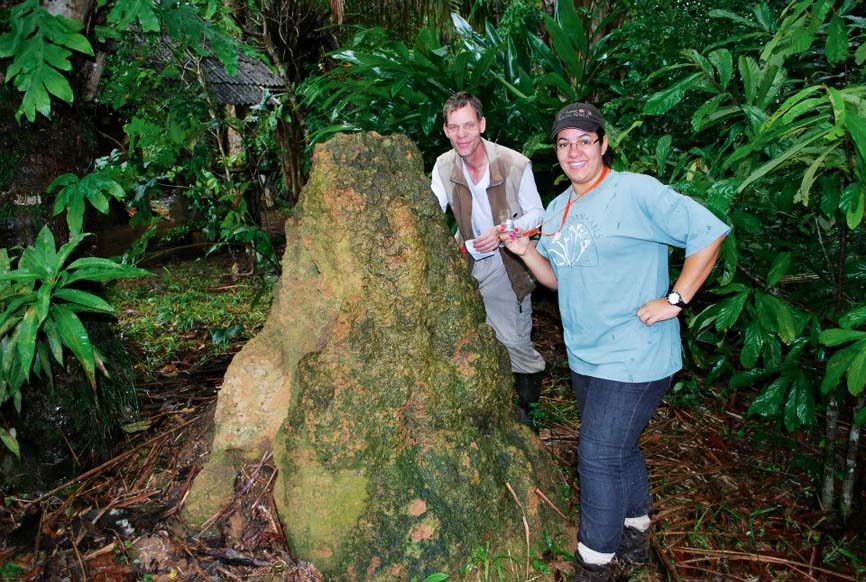
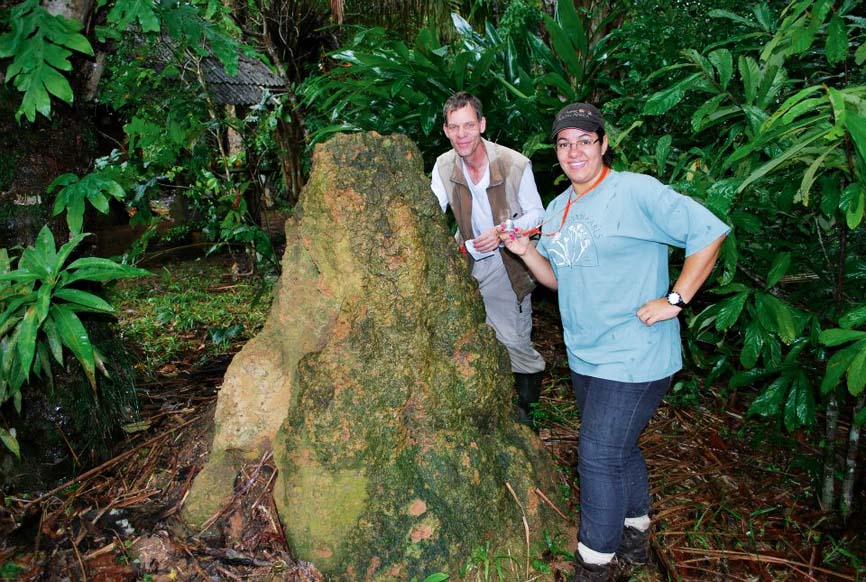
Termite nests (also called termitaria) can be both terrestrial and epiphytic. Terrestrial termitaria are free-standing structures of c. 1 m width and height, occasionally reaching 2 m (Fig. 1). They are composed of soil and cement (produced by the termite workers) and their colour is reddish brown. These structures can last for several years and are inhabited not only by termites, but generally (in c. 70% of the termitaria; Mill Reference Mill, Chadwick and Sutton1984) also by ants and other arthropods, and regularly also by mammals and parrots. Older termitaria often do not even house termites anymore. The hardest termitaria are made by the common Cornitermes spp. Terrestrial termitaria are usually associated with open, savannah-like vegetation, but in Rondônia and adjacent Amazonas they are locally very common inside the rainforest, with densities of at least one nest/100 m2.
Terrestrial termitarium in Rondônia with several lichen species being collected by the authors (picture by Elton Bill Souza). In colour online.
Epiphytic nests are either black carton-like and made from semi-digested plant material and cement, or brown and made from soil and cement similar to the terrestrial nests. The most common builders are Nasutitermes spp. (Mill Reference Mill, Chadwick and Sutton1984).
In practice, most terrestrial nests display various shades of green, because they are mostly covered by a range of organisms. Algae are always present, cyanobacteria regularly so (at least inside the forest), species of the moss genus Fissidens quite often present, and, surprisingly, lichens proved to be present on most of the terrestrial and some of the epiphytic termitaria. Interactions between termites and lichens have been reported previously (Collins Reference Collins1979) and are currently studied in Brazil, but are so far restricted to termites feeding on lichens (Silva et al. Reference Silva, Farias, Mello, Costa and Bezerra-Gusmão2012).
The hypothesis was thus formed that termite nests may provide the natural habitat in rainforests for terricolous lichens, which are usually only found on artificial road banks. Consequently, some effort was put into searching for lichens on termite nests. Besides the Multiclavula, several other, all quite inconspicuous, species were found. All species share a green thallus and tiny (generally c. 0·3 mm wide, at most 0·6 mm wide) apothecia, but they belong to four species in four different genera, and in three families (Coenogoniaceae, Pilocarpaceae, and Ramalinaceae). Although most of the species were known from one or a few collections, these collections were usually rather large, as often a sizeable part of the termite nest was covered with a single species.
Lichens have been collected on termite nests before, but reports are scarce and seem to refer exclusively to open areas where, for example, species of Cladonia can regularly be found on termite mounds. At least three lichens were previously first described from termite nests, interestingly all from more open or subtropical areas in Brazil: Buellia termitum Vain. (Vainio Reference Vainio1890), Buellia termitophila Malme (Malme Reference Malme1928) and Lecidea termitophila Malme (Malme Reference Malme1936). Bacidia rufocarnea (Müll. Arg.) Zahlbr. was reported from the same habitat by Malme (Reference Malme1935). Although the exact identity and correct genus assignment of these earlier species is not clear at present, they are all different to the species found in our study.
In the rainforests of Rondônia and adjacent Amazonas, lichens were not only found on termite mounds on the soil, but also on epiphytic termite nests, where altogether even more species were found than on the mounds on the ground. These epiphytic nests are partly made from local soil, partly mixed with wood pulp and richer in organic matter. The latter type of nest is generally black. Lichens were found on both types. Interestingly, these were partly the same species. The aim of the present paper is to describe the species of lichenized ascomycetes found on termite mounds during this research, and to draw attention to this habitat, as its whole lichen diversity seems to be so far unknown.
Material and Methods
Identification and descriptive work was carried out in Itabaiana, Universidade Federal de Sergipe, using a Leica EZ4 stereomicroscope and a Leica DM500 compound microscope, and also in Soest using an Olympus SZX7 stereomicroscope and an Olympus BX50 compound microscope with interference contrast, connected to a Nikon Coolpix digital camera. All measurements were made on sections mounted in tap water. The chemistry of the type specimen was investigated by thin-layer chromatography (TLC) using solvent A (Orange et al. Reference Orange, James and White2001).
The Species
Bacidia termitophila Aptroot & M. Cáceres sp. nov.
MycoBank No.: MB 801918
Bacidia on soil of termite nest with smooth green thallus, convex chocolate brown apothecia with little internal pigmentation and fusiform 3-septate ascospores, 17–20×4–5 µm.
Type: Brazil, Rondônia, Porto Velho, Parque Natural Municipal de Porto Velho, 8°41′10″S, 63°52′05″W, alt. c. 100 m, in primary rainforest, on soil of old termite nest on the ground, 9–12 March 2012, M. Cáceres & A. Aptroot 11596 (ISE—holotype; ABL—isotype).
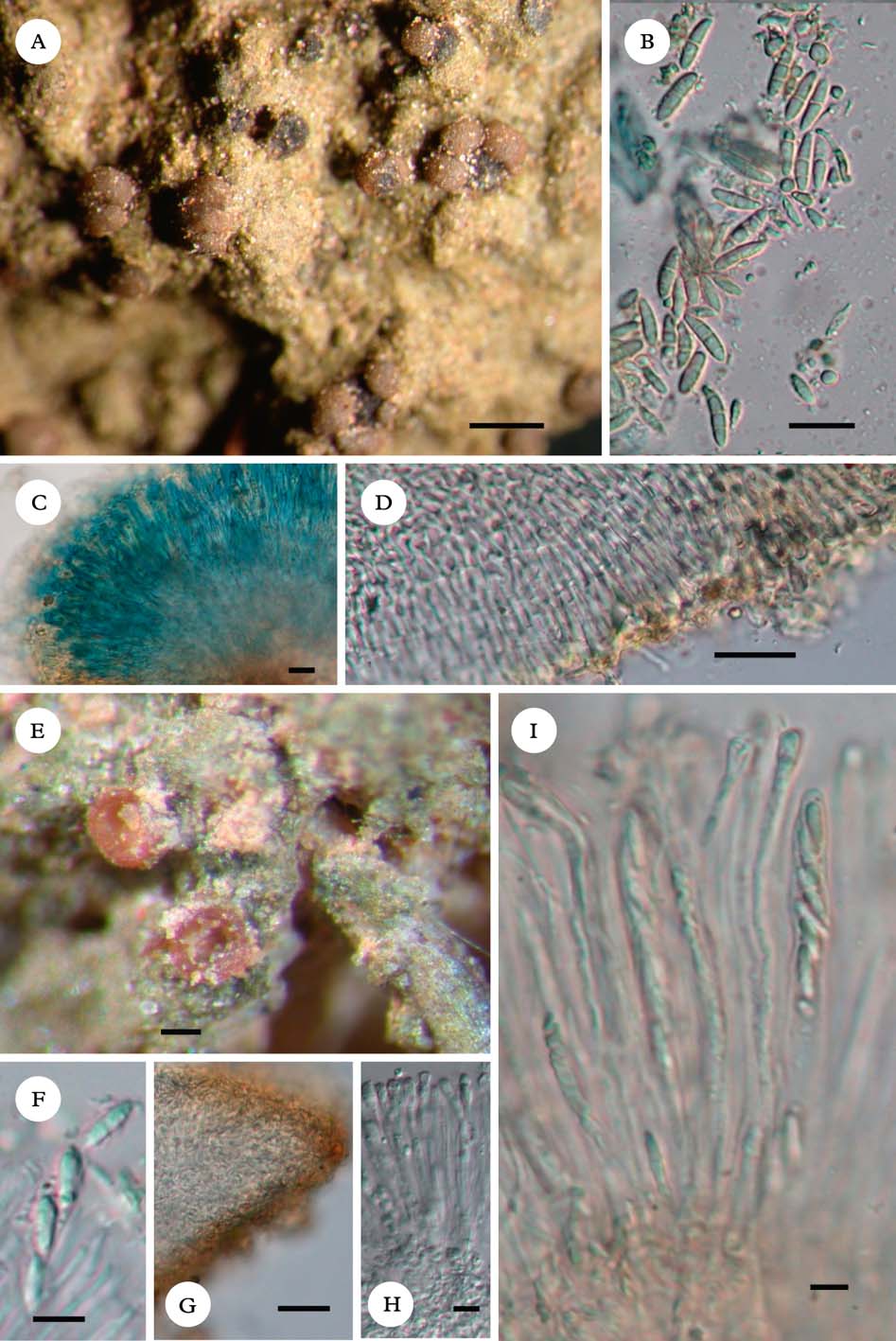
A–D, Bacidia termitophila (holotype). A, habitus; B, ascospores; C, hymenium with asci in IKI; D, section through excipulum margin. E–I, Coenogonium coppinsii (holotype). E, habitus; F, ascospores; G, section through excipulum margin; H, paraphyses; I, hymenium with asci and ascospores. Scales: A=0·5 mm; B–D & G=20 µm; E=0·1 mm; F, H & I=5 µm. In colour online.
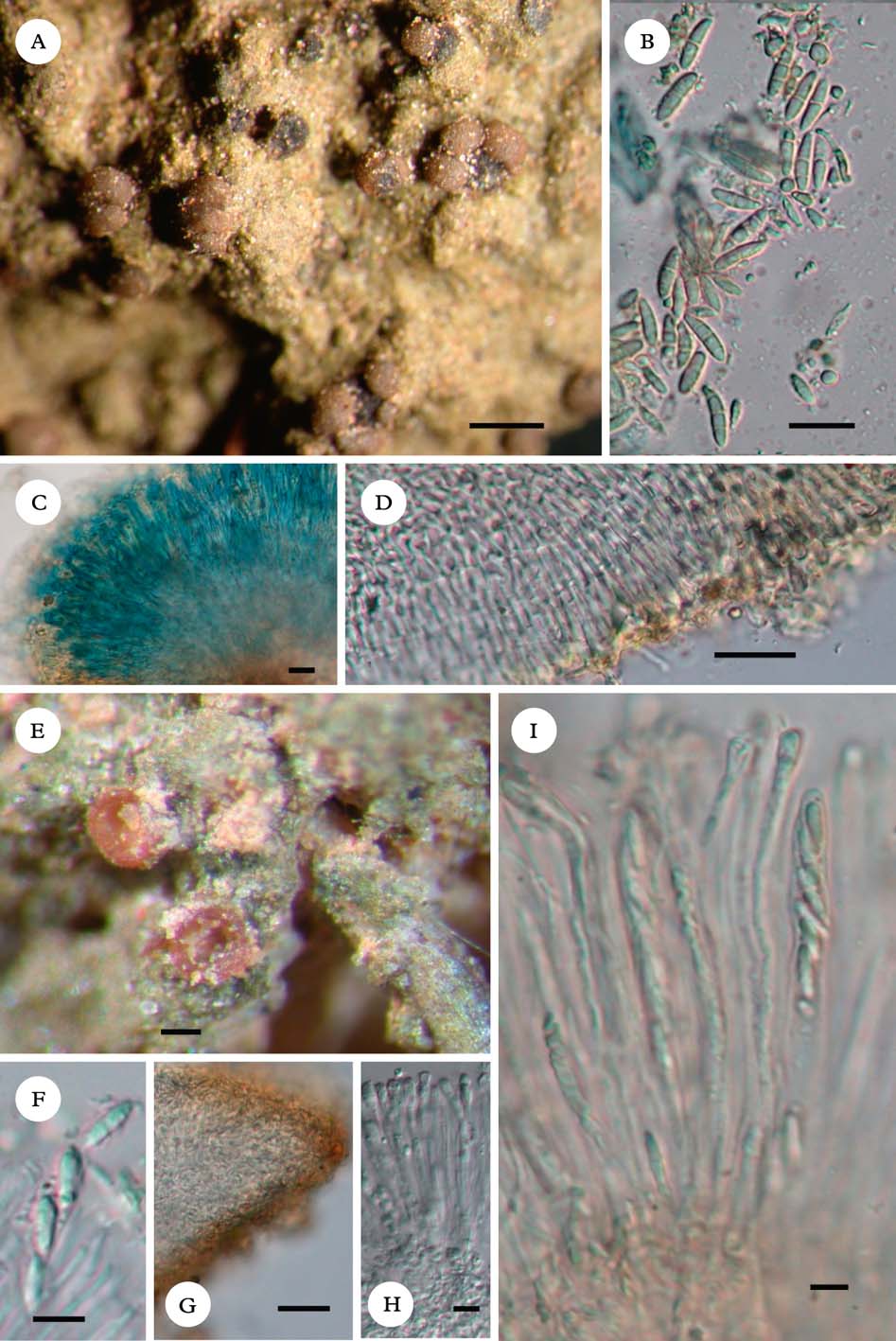
Thallus very thin, smooth and patchily shiny, continuous, green, without cortex. Algae chlorococcoid, c. 5–10 µm diam.
Apothecia appressed, 0·3–0·6 mm diam., solitary or a few together, especially when rejuvenating from old apothecia, convex; disc dull, chocolate brown, becoming black when old; margin not visible from above, covered by the convex disc. Hymenium hyaline, 85–105 µm high, IKI+ bluish in most parts; paraphyses without clear septa towards the tips, which are not thickened and c. 1 µm wide; epithecium hyaline, gelatinous; hypothecium pale brownish; excipulum hyaline except for the outer cells which have a pale brown incrustation, composed of rows of elongated cells with rather angular lumina 5–10×2·5–3·5 µm. Ascus of the Bacidia-type, 8-spored, c. 65–75×9·0–13·5 µm. Ascospores hyaline, fusiform, 3-septate, 17–20×4–5 µm, with pointed ends and without a gelatinous sheath.
Pycnidia not observed.
Chemistry
Thallus UV−, C−, K−, KC−, P−. No lichen substances detected with TLC.
Ecology and distribution
On termite nests in primary rainforest, both on the ground and on a tree. Known only from Brazil.
Discussion
This species differs from and does not even seem close to any of the Bacidia species treated in either Vainio (Reference Vainio1890), Malme (Reference Malme1935), Ekman (Reference Ekman1996), Cáceres (Reference Cáceres2007) or Lücking (Reference Lücking2008). It is characterized by the smooth green thallus, the convex chocolate brown apothecia with little internal pigmentation, and the fusiform 3-septate ascospores. The general aspect somewhat resembles a diminutive Malmidea hypomela (Nyl.) Kalb & Lücking. The species is described in the genus Bacidia, although it does not seem to belong to the core group of this genus, which is probably polyphyletic in the current sense. The fusiform ascospores resemble those of the recently resurrected genus Bilimbia, but the new species lacks the particular character that all species currently assigned to this genus share, viz. the warted epispore. That the ascospore shape is not definitive is shown by the recent new combination of Bacidia corcovadensis Malme (Malme Reference Malme1935) into Bilimbia. This species has acicular ascospores, but with the warted epispore characteristic of Bilimbia.
Additional material seen. Brazil: Rondônia: same as the type, on lateritic rock in old termite nest on the ground, 2012, M. Cáceres & A. Aptroot 15616 (ISE, ABL). Amazonas: Fazenda São Francisco off BR319, 30 km N of Porto Velho, 8°24′33″S, 63°58′56″W, alt. c. 100 m, in primary rainforest, on soil of termite nest on tree, 2012, M. Cáceres & A. Aptroot 11805 (ISE, ABL).
Coenogonium coppinsii Aptroot & M. Cáceres sp. nov.
MycoBank No.: MB 801919
Coenogonium on soil of termite nest with a smooth green thallus, concave, cartilaginous, fuscous brown apothecia and long, ellipsoid ascospores 6·0–9·5×2·5–3·0 µm.
Type: Brazil, Amazonas, Fazenda São Francisco off BR319, 30 km N of Porto Velho, 8°24′33″S, 63°58′56″W, alt. c. 100 m, in primary rainforest, soil of termite nest on the ground, 15 March 2012, M. Cáceres & A. Aptroot 11802 (ISE—holotype; ABL—isotype).
Thallus very thin, smooth and patchily shiny, continuous, green, ecorticate. Algae trentepohlioid, c. 5–10 µm diam.
Apothecia sessile, cupuliform, cartilaginous, appearing waxy, 0·2–0·3 mm diam., solitary, slightly to deeply concave; disc pale fuscous brown; margin concolorous or paler, up to 0·1 mm thick. Hymenium hyaline, 70–85 µm high; paraphyses with few septa towards the tips, which are clavate and c. 3 µm wide; epithecium hyaline, gelatinous; hypothecium hyaline; excipulum hyaline on the inside, fuscous brown in the outer zone, composed of irregular cells. Ascus with 8 irregularly biseriate ascospores, c. 60–80×5·0–7·5 µm. Ascospores hyaline, elongated ellipsoid, 1-septate, 6·0–9·5×2·5–3·0 µm, with rounded ends, lacking a gelatinous sheath.
Pycnidia not observed.
Chemistry
Thallus UV−, C−, K−, KC−, P−. No lichen substances detected.
Ecology and distribution
On termite nests in primary rainforest, both on the ground and on a tree. Known only from Brazil.
Discussion
This species has minute apothecia that give the impression of it being a diminutive Gyalidea. It differs from all species known in the genus Coenogonium (Rivas Plata et al. Reference Rivas Plata, Lücking, Aptroot, Sipman, Umana, Chaves and Lizano2006). Although this treatment was based largely on the literature, it should be noted that it seems to be quite complete, as during a recent examination of over 200 additional, mostly corticolous, specimens of this genus from various tropical regions, almost all specimens could be identified with the key. The new species would key out to couplet 71 in Rivas Plata et al. (Reference Rivas Plata, Lücking, Aptroot, Sipman, Umana, Chaves and Lizano2006). However, there are no other corticolous Coenogonium species with slender ascospores and small apothecia known from the Neotropics. All three species with these two characters are either known from Africa or from New Zealand. The only species which combines these characters and occurs in the Neotropics is the foliicolous Coenogonium lisowskii (Vězda) Lücking, which differs by the very pale, wax-coloured apothecia. A rather similar species was recently found on trees in montane forest in NE Brazil (Xavier-Leite et al. Reference Xavier-Leite, Menezes, Aptroot and Cáceres2014). It differs by the wide open apothecium discs, the corticolous habitat and the even more slender ascospores, which are less than 2·5 µm wide. The new species is the first Coenogonium described from soil.
Additional material seen. Brazil: Amazonas: same as the type, M. Cáceres & A. Aptroot 11807 (ISE, ABL). Rondônia: Porto Velho, Parque Natural Municipal, 8°41′10″S, 63°52′05″W, alt. c. 100 m, in primary rainforest, on soil of termite nest on tree, 2012, M. Cáceres & A. Aptroot 11565 (ISE, ABL); ibid., on soil of old termite nest on the ground, 2012, M. Cáceres & A. Aptroot 11588 (ISE, ABL).
Fellhanera termitophila Aptroot & M. Cáceres sp. nov.
MycoBank No.: MB 801920
Fellhanera on soil of termite nest with pale green soredia, chocolate brown apothecia with dark internal pigmentation, and fusiform 3-septate ascospores 10·0–12·5×2·5–3·5 µm.
Type: Brazil, Amazonas, Fazenda São Francisco off BR319, 30 km N of Porto Velho, 8°24′33″S, 63°58′56″W, alt. c. 100 m, in primary rainforest, on soil of termite nest on tree, 15 March 2012, M. Cáceres & A. Aptroot 11806 (ISE—holotype; ABL—isotype).
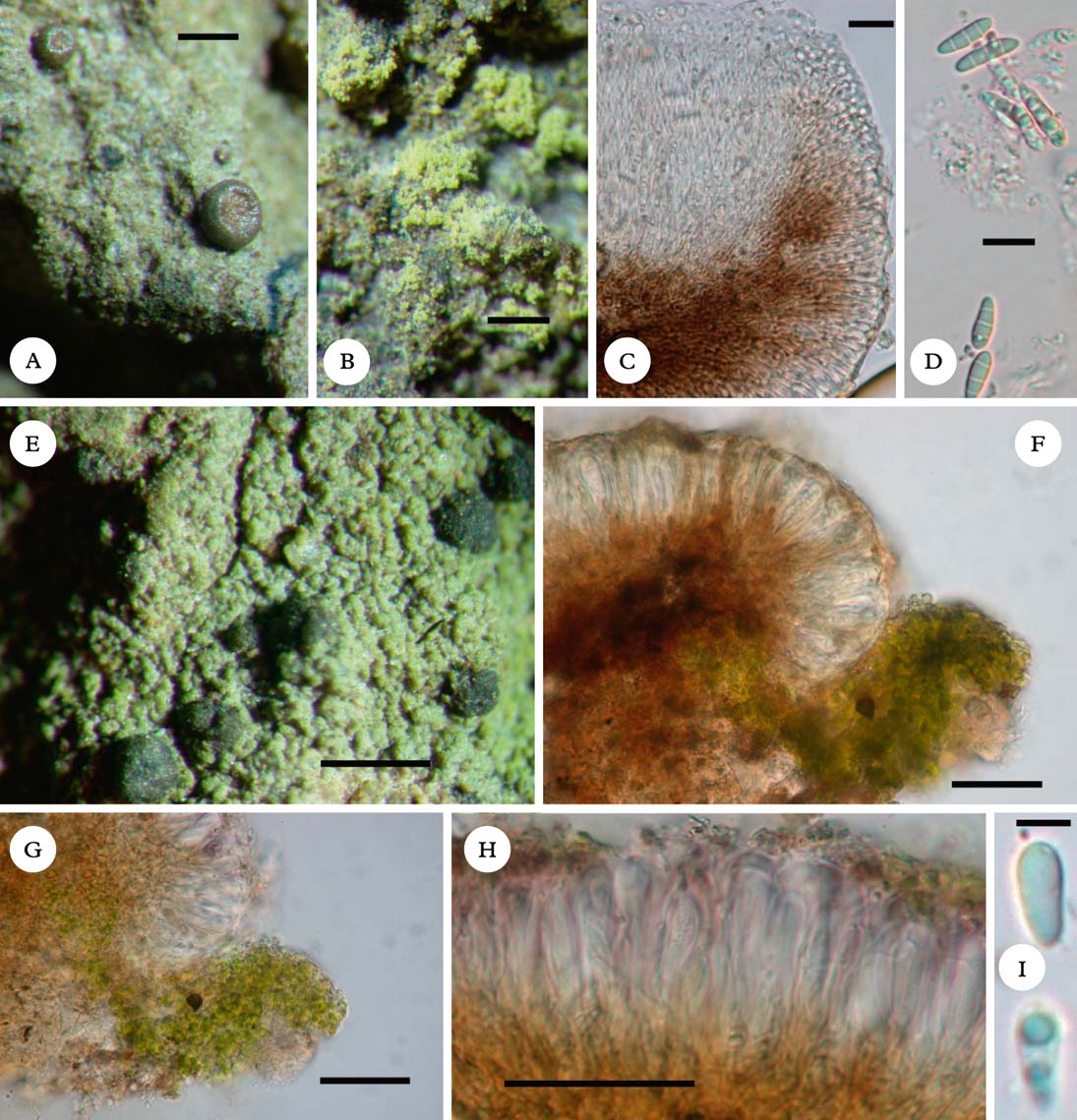
A–D, Fellhanera termitophila (holotype). A, habitus with apothecia; B, habitus with soredia; C, section through excipulum margin; D, ascospores. E–I, Micarea termitophila (holotype). E, habitus; F, section through ascoma; G, section through thallus; H, hymenium in KOH; I, ascospores. Scales: A, B & E=0·5 mm; C & F–H=50 µm; D=10 µm; I=5 µm. In colour online.
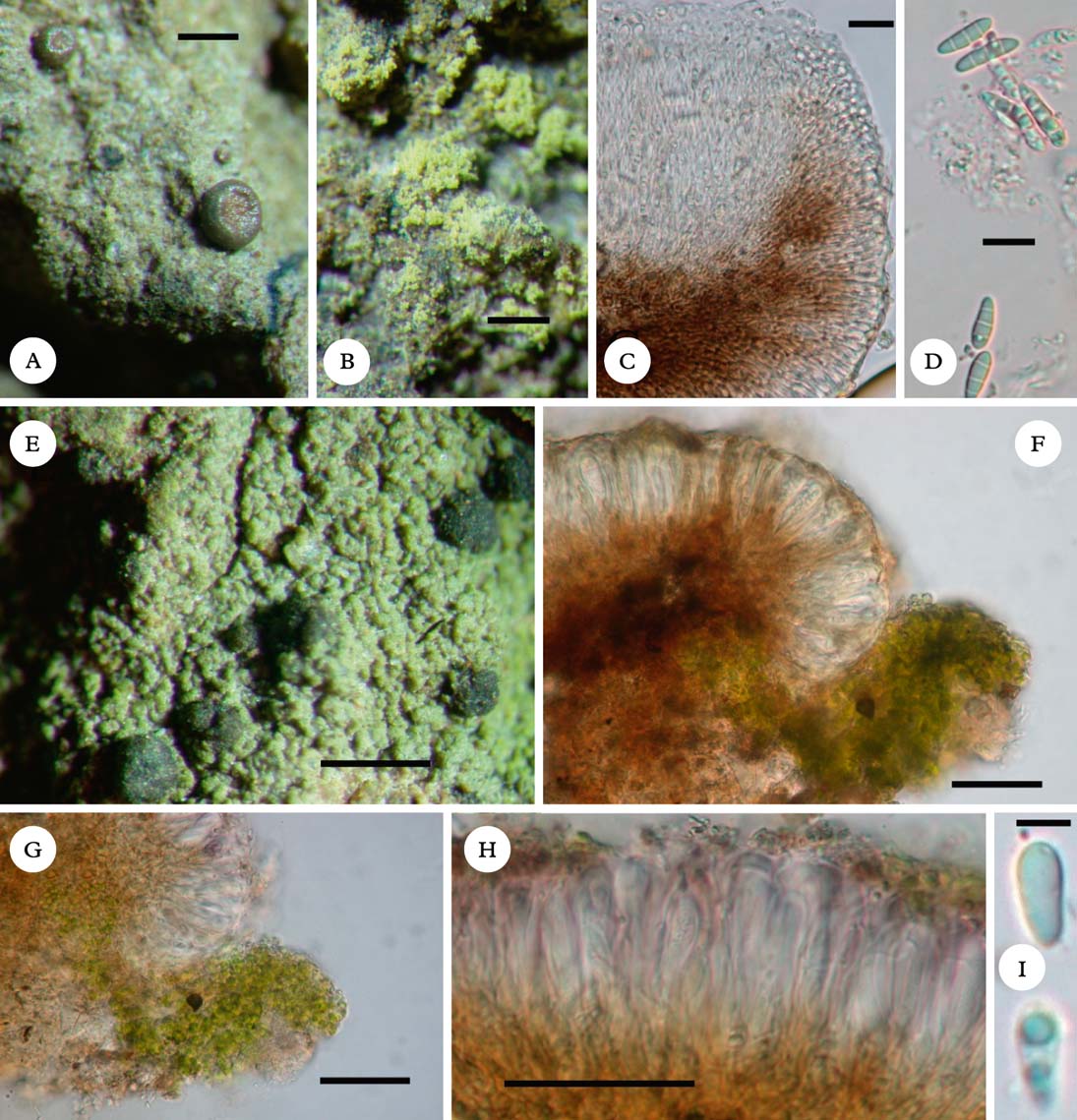
Thallus thin, finely granular, green, ecorticate. Soredia bright yellowish green, farinose, often in rather high mounds, formed in punctiform to confluent soralia initially c. 0·1 mm diam. Algae chlorococcoid, c. 5–10 µm diam.
Apothecia sessile, 0·2–0·6 mm diam., round, the larger ones lobate, solitary; disc flat, shiny, chocolate brown; margin generally darker, sometimes almost black, higher than the disc, c. 0·1 mm wide. Hymenium hyaline, 55–75 µm high, IKI− except for the ascus tips; paraphyses without clear septa towards the tips, which are somewhat clavate and up to c. 3 µm wide; epithecium hyaline, gelatinous; hypothecium purplish-brownish, in thick section black; excipulum hyaline except for the interior part which is continuous with the hypothecium and shares the pigment, composed of rows of elongated cells with rather angular lumina of 5–10×2·0–2·5 µm. Ascus of the Pilocarpaceae-type, 8-spored, c. 45–60×6·0–9·5 µm. Ascospores hyaline, fusiform to clavate, 3-septate, 10·0–12·5× 2·5–3·5 µm, with somewhat rounded ends, and with a smooth gelatinous sheath c. 1 µm wide.
Pycnidia not observed.
Chemistry
Thallus UV−, C−, K−, KC−, P−. No lichen substances detected with TLC.
Ecology and distribution
On termite nest on a tree in primary rainforest. Known only from Brazil.
Discussion
This species differs from all Fellhanera species treated in either Malme (Reference Malme1935; those species in Bacidia sect. Bilimbia), Cáceres (Reference Cáceres2007) or Lücking (Reference Lücking1997, Reference Lücking2008). It is characterized by the bright yellowish green soredia, the chocolate brown apothecia with dark (but not aeruginose) internal pigmentation and the fusiform, 3-septate ascospores. There are at least six sorediate species known in the genus (Sérusiaux Reference Sérusiaux1996; Aptroot et al. Reference Aptroot, Brand and Spier1998; Lücking Reference Lücking2008), but all differ by either the colour of their soredia, internal pigmentation, apothecium colour and/or ascospore septation. None are likely to be conspecific or even to be confused with the new species. Even sterile specimens of the new species would be recognizable because of the powdery bright yellowish green soredia on a finely granular, green, ecorticate thallus.
Additional material seen. Brazil: Rondônia: Estação Ecológica de Cuniã, km 760 on road BR 319 N of Porto Velho, 8°02′44″S, 63°29′11″W, alt. c. 100 m, in primary rainforest, on soil of termite nest on tree, 2012, M. Cáceres & A. Aptroot 15739 (ISE, ABL).
Micarea termitophila Aptroot & M. Cáceres sp. nov.
MycoBank No.: MB 801921
Micarea on soil of termite nest with corticate, plicate, green thallus, convex black apothecia, hyaline, K+ violet hymenium, brown, K+ orange hypothecium, and pyriform, aseptate ascospores 7–9×3·0–3·5 µm.
Type: Brazil, Amazonas, Fazenda São Francisco off BR319, 30 km N of Porto Velho, 8°24′33″S, 63°58′56″W, alt. c. 100 m, in primary rainforest, on black termite nest with a high content of organic matter on tree, 15 March 2012, M. Cáceres & A. Aptroot 11804 (ISE—holotype; ABL—isotype).
Thallus dull, continuous but with surface plicate and roughened, c. 50 µm thick, with a thin, hyaline cortex. Algae probably myrmecioid, c. 2–4 µm diam.
Apothecia appressed, initially between the thallus granules, later often emergent, 0·2–0·3 mm diam., round or usually lobate; disc convex, dull, black. Hymenium hyaline, 30–50 µm high, K+ violet, especially in the upper part; paraphyses numerous, c. 1 µm wide; hypothecium purplish brownish, K+ orange-brown; excipulum absent. Asci 8-spored. Ascospores hyaline, pyriform, simple, 7–9×3·0–3·5 µm, with rounded ends, lacking a gelatinous sheath.
Pycnidia on the same thallus as the apothecia, often somewhat in separate groups, black, c. 0·1 mm diam. Conidia hyaline, bacilliform, 4–5×1 µm.
Chemistry
Thallus UV−, C−, K−, KC−, P−. No lichen substances detected with TLC.
Ecology and distribution
On termite nest on a tree in primary rainforest. Known only from Brazil.
Discussion
This species differs from, and is unlikely to be confused with, any of the Micarea species treated in Vainio (Reference Vainio1890), Malme (Reference Malme1936), Coppins (Reference Coppins1983), Aptroot (Reference Aptroot2002), Cáceres (Reference Cáceres2007) or Lücking (Reference Lücking2008). It is characterized by the corticate, plicate, green thallus, the convex black apothecia, the internal pigmentation pattern with its reactions (hymenium hyaline, KOH+ violet, hypothecium brown, KOH+ orange) and the pyriform aseptate ascospores. The thallus is especially characteristic, as all the Micarea species known to us are either ecorticate or, when a cortex is present, the thallus is areolate rather than effuse and never folded. The thallus of the new species is somewhat reminiscent of a crustose Stereocaulon. There are only a few species of Micarea known with simple ascospores, a KOH+ violet hymenium and a dark brown hypothecium. Micarea paratropa (Nyl.) Alstrup has these characters, but differs markedly by the whitish thallus and longer (9–17 µm) ascospores.
The CNPq (Conselho Nacional de Desenvolvimento Científico e Tecnológico) is thanked for a research grant to M.E.S.C. (Processo 501633/2009-0). The collecting expedition was financed by CNPq (CNPq-Simbiota Processo 563.342/2010-2). Leo Spier is thanked for performing thin-layer chromatography. Elton Bill Souza and Allyne Christina Gomes Silva are thanked for logistic support and for organizing the collecting trips. AA is grateful to the Stichting Hugo de Vries-Fonds for a travel grant.