As the editor of this volume makes clear in her Introduction, there has been no shortage of work on (English) negation over the last decade and a half. This has led to a growing degree of specialization and consequently a need on the part of editors and publishers to ensure that volumes made up of separate articles on the topic have enough coherence and focus to appeal to an identifiable audience. In the volume under consideration, the coherence mainly lies in the authors’ shared concern with the issue of variability. Part I contains six papers focused on (changes in) negation in historical stages of the English language, where variation is evident from a comparison of older and newer forms. Part II has five papers, focused on negation in present-day English; variability here means differences in negation between different varieties of the language (except for the last paper, which addresses differences between two semantically related expressions). A further shared element in the papers is the fact that they all have an important empirical component, reporting on newly collected sets of data and their patterning. In what follows, I first briefly summarize the individual contributions and then comment on some characteristics of the volume as a whole.
After a brief introduction in which Iyeiri sketches the main lines of inquiry to be found in the volume and sets the articles in the context of a useful bibliographical overview of recent work on negation, there follow six articles in Part I, entitled ‘Aspects of negation in the history of English’. Yun Terasawa, in ‘Negative constructions in Old English: The question of Cynewulf's authorship’, starts by giving a brief overview of Old English negation and then embarks on an inspection of various negative facts in the Cynewulf canon. He is able to establish that there are some differences with regard to these between the poems Elene and Juliana on the one hand and the Fates of the Apostles and Christ II on the other hand. I represent them in table 1.
Two negative phenomena partitioning the Cynewulf canon

Another set of negation facts, involving the frequency of ne – V – SUBJ and SUBJ – ne – V orders in main clauses, leads to another cut, with Elene behaving differently from the other poems in favouring SUBJ – ne – V order. Nevertheless, Terasawa argues that the negative phenomena support earlier suggestions, made on the basis of auxiliary verb behaviour, that Cynewulf composed only Elene and Juliana. Also on the topic of Old English negation is Michiko Ogura's ‘Variable features of negative elements in Old English psalter glosses’. Drawing on data from some 12 psalter glosses she investigates patterns of negative contraction, the rendering of Latin constituent negation, lexical semantic negatives and the constructions used to gloss Latin ne functioning as a negative subordinating conjunction. The findings are exemplified and tabulated; conclusions drawn mainly have to do with the degree to which individual glosses resemble each other. The ultimate aim of course is to come to a characterization of each gloss in terms of the stemmatic development of dialect and text-typical features – but at this moment, there is too much as yet unmapped individual variability to make this possible.
A third Old English piece is Masayuki Ohkado's ‘On grammaticalization of negative adverbs, with special reference to Jespersen's cycle recast’. Ohkado's main purpose is to argue that van Kemenade (Reference Kemenade, Pintzuk, Tsoulas and Warner2000 and subsequent work) is wrong in claiming the sequence of events in (1):
(1) The development of Old English negatives according to van Kemenade (Reference Kemenade, Pintzuk, Tsoulas and Warner2000):


In (1a), the negator has its presumed original form, no. In (1b), verb second has taken place and the negator, as a phonological clitic to the finite verb, has been reduced to ne. In (1c), ne has become a syntactic clitic. However, Ohkado presents empirical evidence from the Old English poem Beowulf showing that the relation between the forms no and ne cannot be so straightforward. The form ne can be found in initial position in clauses without verb-second while no can be found preverbally in clause-medial position. Both of these facts are unexpected under the account given in (1). Moreover, the above development would entail that there should also be an intermediate stage (1a´), at which no is followed by a fronted V. But no such stage is attested in Beowulf, even though this text is generally assumed (also by van Kemenade) to be an example of early Old English. Ohkado's conclusion is therefore that ne and no are not developmentally related.
The editor's own contribution, ‘“I not say” once again: A study of the early history of the “not + finite verb” type in English’, addresses the question of how frequent negative clauses with preverbal not were in earlier English. Previous work had suggested that this order was moderately to fairly frequent in Early Modern English, but Iyeiri shows that, if it is compared with the alternative V + not order, it can be seen to be absent from prose texts, be concentrated in a few writers of verse (in particular Shakespeare and Ben Jonson) and, even in those, occur in no more than 1 or 2 per cent of all cases. Interestingly, the not-V order already occurs in Old English (taking the form naht ne + V). Examination by Iyeiri of a large corpus of texts suggests that its heyday was in the Middle English period. In prose texts, it declines towards the end of this period but in verse texts it keeps being used in up to 8 per cent of all cases. Structurally too, it had wider distribution in Middle English than in Early Modern English, since it could be found (though not very often) in clauses with an auxiliary. Although Iyeiri is at some pains to avoid confrontational statements, her findings clearly show up the incompleteness of earlier studies of this interesting word order.
Hideo Nishimura's ‘Decline of multiple negation revisited’ first notes two problems in earlier studies of multiple negation (the wide variability in definitions and categories that are employed and the lack of sufficient care in distinguishing usage in different text types) and then goes on to consider two specific types of multiple negation in two specific text types (legal and instructional texts) in late Middle English and Early Modern English. The results show that legal texts tend to avoid multiple negation already in the fifteenth century (a firm finding) while instructional texts keep using multiple negation somewhat longer (though there are insufficient data from these texts to go beyond a tentative statement). To explain the facts, Nishimura appeals to a suggestion made in Rissanen (Reference Rissanen and Wright2000) that legal texts might show an early avoidance of multiple negation due to a desire for unambiguous expression.
Also focusing on two specific text types is Fujio Nakamura's ‘A history of the negative interrogative do in seventeenth- to nineteenth-century diaries and correspondence’. Following up on the author's earlier work on affirmative interrogatives and well-known work on negative declaratives, which shows that DO-less constructions in those clause types persist into the Late Modern period, Nakamura here investigates sentences such as (2) in the period 1650–1900.
(2) . . .. why went not thy endeavour along with thy prayer? (1734, J. Wesley)
The findings are as follows: among the 500+ tokens of negative interrogatives found in the texts examined, there are no more than two that lack DO – the example in (2) and one further instance, which similarly shows clear signs of an attempt at biblical style.
Of the five papers in Part II of this volume, entitled ‘Aspects of negation in present-day English’, four focus on negation in specific varieties of English. Liselotte Anderwald's ‘Negative concord in British English dialects’ explores the 5 million words of unplanned informal speech included in the British National Corpus (BNC). Since the speakers’ geographical origins are known, Anderwald is able to use the data to plot the regional distribution of multiple negation, defined as any occurrence of no(-) or never in a clause clause negated by not/n't (or never), where standard English would require any(-). After aggregating the various dialect areas into three overall groups (North, Midlands and South), it appears that the use of multiply negated clauses as against negated clauses containing any(-) elements is more frequent in the South (at around 19 per cent of all possible cases) than in the North and Midlands (both at around 9 per cent), thus confirming a tentative earlier suggestion in the literature. Anderwald points out that the British National Corpus cannot be taken as an unproblematic source of dialect data and that data from some areas do not fit the general pattern (e.g. North-East speakers show more, and Home Counties speakers less, multiple negation than expected). However, examination of a newly compiled dialect corpus with data from the 1970s and 80s strikingly confirms the overall BNC picture. With respect to the causes of the dialect difference, Anderwald puts forward the interesting hypothesis that the absence of multiple negation is due to influence from Old Norse.
In their article ‘No, nay, never: Negation in Tyneside English’, Joan Beal and Karen Corrigan offer an in-depth study of negation patterns in the Newcastle−Gateshead conurbation in north-east England. Drawing on (part of) a newly compiled corpus of Tyneside speech, they investigate several variable negative features. Among these are the occurrence of never as a nontemporal negator, the occurrence of multiple negation (found to be less frequent than in Anderwald's study of North-East data in the BNC, perhaps because BNC methodology promoted greater use of nonstandard features – though Beal and Corrigan themselves identify social class as the important factor), the patterning of auxiliary contraction, as in they haven't seen it, versus negative contraction, as in they've not seen it (with the former strongly favoured by have and the latter by will and be) and usage in negative interrogatives (with Tyneside English featuring a rather complicated system which includes forms like can't (s)he not). The article discusses the findings in the context of other recent studies of dialectal and diachronic patterning of negation and emphasizes the need in such studies to take into account social and pragmatic factors.
Wider in geographical scope but more narrowly focused in linguistic terms is Noahiro Takizawa's ‘A corpus-based study of the haven't NP pattern in American English’. In spite of numerous statements in the literature that this pattern is not used in American English, the author finds plenty of attestations in a 126 million-word corpus. But it is also clear that the pattern is collocationally restricted: it occurs often when the object NP is the faintest/foggiest/slightest/vaguest (idea), sometimes when the object is a clue, the courage/heart/strength/wit (to VP) or any choice/comment/idea/intention/plans and very occasionally when it is (the) time (to VP). Takizawa shows that the pattern is similarly restricted in British English, though occurring at somewhat higher frequencies in each of the collocations. A comparison with the pattern have no N shows that this too has some frequent collocations (in particular with idea, but also choice, intention, plans and doubt) but at the same time allows a wide variety of other nouns.
Darin Howe contributes an article on ‘Negation in African American Vernacular English’, which uses as its main source of data black rap music. One of the features investigated is the use of ain't. It is found to be very frequent especially for HAVE NOT and BE NOT in the present (but not past) tense. In addition, it is also prominent as an alternative to didn't, a usage that appears to be a post-World War II development. Another feature found to be frequent in the data is multiple negation/concord. In the variety studied, this extends to negative verb concord, as in don't in (3a), non-finite clauses, as in nothing and nobody in (3a), and finite clauses in neg-raising constructions, as in nothing in (3b).
- (3)
(a) Nobody don't want to have nothing to do with nobody that ain't hot right now.
(Kool G Rap)
(b) And I don't think there is nothing I can do now to right my wrongs.
(Kanye West)
The third feature of AAVE discussed is negative inversion, with a negative auxiliary in initial position followed by a negated subject. For each of the features investigated, a description is also given of the results of some earlier work, based on a variety of sources (such as the ex-slave recordings and data from diasporic varieties of AAVE).
The final paper, ‘Subjective meanings of except-linkage in present-day English in comparison with including’, is by Mitsume Uchida. It compares and contrasts the uses of the two antonyms except and including in several present-day corpora. The data show that except has undergone a process of grammaticalization, from expressing conceptual meaning to textual and sometimes expressive meaning. For the word including, no such development is found. The reason for the difference, Uchida suggests, lies in the fact that except, but not including, expresses contrast and/or negation, a domain of meaning which has been found quite generally to promote semantic and pragmatic shift. Further data show that the grammaticalization of except is notable in particular in less informationally oriented texts, an environment where including is less frequent.
As will be clear from the above brief summaries, the papers in this volume deal with a wide range of negative phenomena in earlier and present-day English. One respect in which they nevertheless form a unified collection is their very data-focused nature: the volume could in fact have had as a subtitle, Empirical Studies. In some cases, as in the contributions by Ogura and Nakamura, the main point indeed seems to be the categorization of the data investigated. In other cases, such as Beal and Corrigan's and Howe's papers, the aim is to present an overview of the negative structures used in one specific variety of English. In some further cases, such as Iyeiri's, Nishimura's, Anderwald's and Takizawa's papers, the data are used to take issue with empirical claims made in earlier studies. Only in two papers is there a significant leap from data to interpretation: Terasawa uses negation data to assess claims of authorship and Ohkado presents data that cast doubt on an earlier claim about the nature of diachronic change involving negatives. Inevitably, the single-minded focus on descriptive matters in some of the papers, where issues of analysis or wider implications are down-played or ignored, will be disappointing to some readers. Thus, the editor's introduction includes mention of theoretical work on negation since the early 1990s, but such work is virtually absent in most of the articles. If it is believed that the relation between theory and data is a bidirectional one, this must be considered a problematic aspect of the collection.
At a practical level, it means that references are missing to some theoretical work which also includes data that are directly relevant to the topic at hand. Thus, Howe's discussion of negative concord in AAVE fails to reference Coles (Reference Coles1998), which investigates the acquisition of data as in (3) and proposes a Barriers-type of account in order to explain the empirical restrictions on this phenomenon. The same article does not pick up on Ingham (Reference Ingham2000, Reference Ingham2002), who presents a NegP-type of account of the following medieval English pattern:
(4) There schulde no man sey nay to it (Paston Letters I, 647,45 (1461))
‘Nobody should say no to it.’
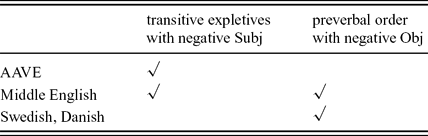
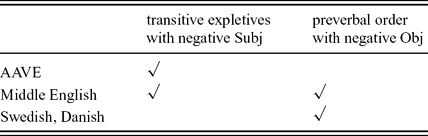
This is an example of a transitive expletive sentence (Bobaljik & Jonas Reference Jonas, Abraham, Epstein, Thráinsson and Zwart1996), which Ingham shows late Middle English allowed just in case the clause had a negative subject. In his analysis, he assimilates the pattern to structures such as (5), which feature a preverbal negative object. In both, he argues, the negative phrase is in SpecNegP, preceding VP, with SpecTP being available to host another phrase (there in (4), I in (5)).
(5) I may no leysour haue (Paston Letters I, 182,48 (1465))
‘I can have no leisure.’
The AAVE negative inversion cases noted by Howe, as in (there) wouldn't nobody interfere with me, look similar to the pattern in (4), suggesting a NegP analysis may be appropriate for them as well. Yet the absence of sentences like (5) from AAVE shows that such an analysis should differentiate – in a way it does not in Ingham (Reference Ingham2000, Reference Ingham2002) – between the patterns in (4) and (5). Further data supporting such differentiation come from modern Swedish and Danish, which allow preverbal negative objects (Svenonius Reference Svenonius and Svenonius2000: 259) but not transitive expletives with a negative subject (Jonas Reference Jonas, Abraham, Epstein, Thráinsson and Zwart1996: 168). The empirical situation is summarized in Table 2.
Two grammatical patterns with a negative constituent in four Germanic languages
In this way material such as that presented by Howe for AAVE, when viewed in the context of further data relevant to its theoretical analysis, can lead to a fuller empirical picture and more accurate ideas about the structures underlying it. It would therefore be a pity if, because of its strong descriptivist slant, this volume was ignored by more theoretically minded scholars: they would miss a great amount of theoretically relevant data – whether or not these are highlighted as being such by the authors themselves. Unfortunately, the historical data in the volume are not made easier for nonspecialists by the absence of glosses and translations for the Old and Middle English examples. The only exception is the article by Ohkado, but this is marred by several typesetting errors in the examples, with Old English thorn, <þ>, appearing as <fl> on pages 40, 49 and 50, and the PDE words tree's as trees on p. 41 and through, weakened, harp's, failed as throuh, weaken, heaps’, fell on p. 43. These quibbles aside, this is overall a well-produced book, which deserves to be read by all scholars with an interest in English diachronic or synchronic syntax. Without advertising the fact, it also presents enough material to interest those working on the phenomenon of negation more generally.