Introduction
Cardiovascular diseases (CVD) are the leading cause of death globally and the main responsible for years of life lost worldwide. (Collaborators, Reference Collaborators2017) Hypertension is the principal risk factor for CVD, and the leading single risk factor for the overall global burden of diseases. (Collaborators, Reference Collaborators2016) Given the magnitude of the global problem of hypertension, there are imperative calls to increase the control efforts of hypertension (Fisher and Curfman, Reference Fisher and Curfman2018; Mills et al., Reference Mills, Bundy, Kelly, Reed, Kearney, Reynolds, Chen and He2016; Perel et al., Reference Perel, Bianco, Poulter, Prabhakaran, Pais, Ralston, Wood and Yusuf2015), especially in low and middle-income countries (MICs) where blood pressure (BP) control is a cost-effective strategy to dramatically reduce mortality and the burden of diseases associated with hypertension. (Bress et al., Reference Bress, Bellows, King, Hess, Beddhu, Zhang, Berlowitz, Conroy, Fine, Oparil, Morisky, Kazis, Ruiz-Negron, Powell, Tamariz, Whittle, Wright, Supiano, Cheung, Weintraub, Moran and Group2017; Moran et al., Reference Moran, Odden, Thanataveerat, Tzong, Rasmussen, Guzman, Williams, Bibbins-Domingo, Coxson and Goldman2015) Despite the availability of treatments, the global level of BP control is still low and variable, ranging from 24.3% in low-income countries to 73.6% to 90% in high-income countries. (Egan et al., Reference Egan, Sutherland, Rakotz, Yang, Hanlin, Davis and Wozniak2018; Jaffe and Young, Reference Jaffe and Young2016; Mills et al., Reference Mills, Bundy, Kelly, Reed, Kearney, Reynolds, Chen and He2016; Moran et al., Reference Moran, Odden, Thanataveerat, Tzong, Rasmussen, Guzman, Williams, Bibbins-Domingo, Coxson and Goldman2015) The reasons for low BP control are multiple and not very well understood, and they include factors related to the patient, physician, and health system. Behind patient-related causes, nonadherence is the leading cause for lack of BP control. (Tomaszewski et al., Reference Tomaszewski, White, Patel, Masca, Damani, Hepworth, Samani, Gupta, Madira, Stanley and Williams2014) However, there is a group of patients, around 10% to 15% for which BP is not controlled, despite good adherence (true resistant hypertensive patients).
Social and personal traits may play a role in determining BP control in no adherent and true resistant hypertensive patients. (Carey et al., Reference Carey, Muntner, Bosworth and Whelton2018) Social determinants of health (SDOH) have been recognized as an important factor in determining health in addition to traditional medical care. The SDOH refer to any nonmedical factors influencing health and include education, wealth, attitudes, beliefs, and behaviors. (Braveman, Egerter and Williams, Reference Braveman, Egerter and Williams2011) Income and education as well as health literacy have been associated with health outcomes and mortality, particularly in CVD. (Alicandro et al., Reference Alicandro, Frova, Sebastiani, Boffetta and La Vecchia2018; Masters, Hummer and Powers, Reference Masters, Hummer and Powers2012; Pandit et al., Reference Pandit, Tang, Bailey, Davis, Bocchini, Persell, Federman and Wolf2009) Other SDOH, such as age, perceived discrimination, employment status, and other medical reasons have been associated with BP control. (Beune et al., Reference Beune, Nieuwkerk, Stronks, Meeks, Schulze, Mockenhaupt, Danquah, Klipstein-Grobusch, Agyei-Baffour, Spranger, Addo, Smeeth and Agyemang2019) More specific theoretical behavioral models has been proposed to explain health behaviors, including medication adherence. Thus, Social Cognitive Theory (SCT) through the combination of personal, behavioral and environmental factors may act a whole in determine a health outcome, such as blood pressure control. SCT operates under five main constructs that are determinant but also actionable. Of those constructs, perceived self-efficacy, defined as the confidence and ability to adopt a health change, and outcome expectations are the main drivers of a health behavior, and the foundation of a health change motivation. Other important constructs such as knowledge, goal formation and social structural factors that facilitate or imped the health change are considered. SDOH are close related to these constructs, thus education is closely related to the constructs of self-efficacy, knowledge and outcome expectations. Combination of these scenarios may bring different outcomes, for example, the presence of a universal health care may mitigate the described association between low income and health outcomes.
Argentina is an upper-middle-income country (UMIC) in South America with universal health system. (Bello and Becerril-Montekio, Reference Bello and Becerril-Montekio2011; Rubinstein et al., Reference Rubinstein, Zerbino, Cejas and Lopez2018) The Argentinian population have access to free education, including tertiary education. However, there is a considerable socioeconomic inequality expressed as a GINI index of 40.6. (World_Bank, 2017) In Argentina, similar to the global indicators, the leading causes of mortality are CVDs, and hypertension is the leading risk factor for disability-adjusted life year and years of life lost. (Collaborators, Reference Collaborators2016) Limited data show that BP control in Argentina is low, ranging from 17% to 56.4% between antihypertensive medicated patients. (Delucchi, Reference Delucchi, Majul, Vicario, Cerezo and Fábregues2017; He et al., Reference He, Irazola, Mills, Poggio, Beratarrechea, Dolan, Chen, Gibbons, Krousel-Wood, Bazzano, Nejamis, Gulayin, Santero, Augustovski, Chen, Rubinstein and Investigators2017; Marin et al., Reference Marin, Garcia Vasquez, Martinez Marissi, Diaz, Iturzaeta, Becerra, Resin, Romero, Irusta, Gaydou, Cianfagna, Diaz, Grosse, Rodriguez, Beaney, Kobeissi, Poulter, Zilberman, Argentinian Society Of and The2019) There are no data evaluating the reasons behind the lack of BP control in Argentina and the role of SDOH in BP control. Our objective was to evaluate the relationship between education, household income, gender, and age on BP control in Córdoba, the second-largest city in Argentina.
Methods
Population
During May 2017, a hypertension screening campaign was performed in Córdoba, Argentina, following a worldwide screening initiative led by the International Society of Hypertension (ISH) and World Hypertensive League, and adhered to by the Argentine Society of Hypertension. (Beaney et al., Reference Beaney, Schutte, Tomaszewski, Ariti, Burrell, Castillo, Charchar, Damasceno, Kruger, Lackland, Nilsson, Prabhakaran, Ramirez, Schlaich, Wang, Weber, Poulter and Investigators2018; Marin et al., Reference Marin, Garcia Vasquez, Martinez Marissi, Diaz, Iturzaeta, Becerra, Resin, Romero, Irusta, Gaydou, Cianfagna, Diaz, Grosse, Rodriguez, Beaney, Kobeissi, Poulter, Zilberman, Argentinian Society Of and The2019) The screening was performed on the public in the main entrances and hallways of two private tertiary care hospitals. Most of the patients visiting the hospitals had health insurance from the private and public sectors (social security) and all society income and education statuses were represented, including people from rural areas, although less frequently. Investigators invited ambulatory persons older than 18 years old to participate, including patients, its relatives, and health care workers. Verbal consent was obtained from each participant. After 5 minutes in a seated position, the BP measurements were obtained followed by a survey questionnaire. Those patients found to be hypertensive under antihypertensive drug therapy were included in this analysis.
The identity of the research subject was not acquired during the survey and verbal consent was obtained. The Hospital Privado Universitario Teaching and Research committee reviewed and approved the protocol (ref. # 2017-19)
Blood pressure measurements
Blood pressure measurements were performed using automated oscillometric devices (OMROM HEM-705 CP) according to the protocol provided by the ISH. (Beaney et al., Reference Beaney, Schutte, Tomaszewski, Ariti, Burrell, Castillo, Charchar, Damasceno, Kruger, Lackland, Nilsson, Prabhakaran, Ramirez, Schlaich, Wang, Weber, Poulter and Investigators2018) Briefly, after 5 minutes of rest on a sitting position, three separated BP measurements were performed, the average of the last two was used for the analysis. Hypertension was defined with the average systolic/diastolic BP greater than 140/90 mmHg, according to the Argentinian and International Society of Hypertension guidelines. (Delucchi A Reference Delucchi A, Páez, Bendersky and Rodríguez2018; Unger et al., Reference Unger, Borghi, Charchar, Khan, Poulter, Prabhakaran, Ramirez, Schlaich, Stergiou, Tomaszewski, Wainford, Williams and Schutte2020) Blood pressure control was defined in those medicated patients with an average systolic/diastolic BP less than 140/90 mmHg. Patients with atrial fibrillation or those who consumed coffee or who smoked in the previous hour of the screening were excluded.
Survey
The detailed survey has been published. (Beaney et al., Reference Beaney, Schutte, Tomaszewski, Ariti, Burrell, Castillo, Charchar, Damasceno, Kruger, Lackland, Nilsson, Prabhakaran, Ramirez, Schlaich, Wang, Weber, Poulter and Investigators2018) In addition, the investigator asked about the highest education level achieved, which was categorized as elementary school or less (less than 6 years of education), high school (less than 12 years), or superior (more than 12 years, including tertiary and university). Household income was categorized as low (less than USD 12,000/year), medium (USD 12,000 to 37,000/year), and high (greater than USD 37,000/year). Household income was documented in Argentinian pesos (ARS) per month, which was translated to US dollars per year, according to the exchange on May 2017 (1 USD= 17.8 ARS). The household income categories were defined according to the poverty index, reported by the National Institute of Statistic and Census of Argentina on April 2017, which was less than USD12,000 per year, the poverty line. The average family income of the top 15% richest households in the population (85thpercentile) was USD 37,000 per year, and that was chosen as a high-income status.
Statistical analysis
Quantitative data are expressed as the mean ± standard deviation. Qualitative data are expressed as a percentage. Controlled and uncontrolled patients were compared using the t-test or Mann–Whitney U test according to the data distribution. Chi-square test was used for qualitative data. A P value of less than .05 was considered statistically significant. Univariate and multivariate logistic regression models were performed. All covariates with P < 0.10 were included in the analysis, as well as those that have been reported before. We fitted our models including each sociodemographic variable (age, gender, income and education attained) step by step to discuss the contribution and changes of estimates in each one. The interaction between variables was also tested. The statistical analysis was calculated using IBM SPSS statistics (v24.0) software (Armonk, NY: IBM Corp, USA).
Results
Population
During the month of May in 2017, 1184 people were evaluated. The prevalence of hypertension was 54% (638 individuals). Of those hypertensive patients, 25% (161 individuals) did not have history of hypertension, and 477 (75%) patients were hypertensive and receiving antihypertensive drugs. The present analysis was performed on these medicated hypertensive patients.
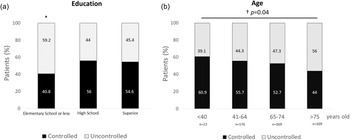
All hypertensive medicated patients were reported to be white Latinos. The mean age was 65.3 years (20-90), 55% were female, and the BMI was 28.8 ± 5.5 kg/m2. Most of the patients (76.9%) received more than 6 years of education (367/477), and 183 (38.5%) achieved superior education. Table 1 shows the characteristic of controlled vs. uncontrolled patients. Patients with uncontrolled BP had 32.5/15.1 mmHg higher systolic/diastolic BP than the well-controlled patients. Higher rates of low education were observed in patients with uncontrolled BP (25.3 vs. 16.1; uncontrolled vs. controlled; P = .01). Thus, in those who had completed only elementary school level or less, the rate of BP control was 40.8% (40/98), whereas the rate of controlled BP was 55% (83/183; P = .03) for those who had the highest education level (Figure 1A). Figure 1B shows lower rates of controlled BP in older people, at 44% (48/109) for those patients older than 75 years and at 61% (14/23) for those younger than 40 years.
Characteristics of medicated hypertensive patients and comparison between those with controlled and uncontrolled blood pressure

BMI, body mass index; SBP, systolic blood pressure; DBP, diastolic blood pressure; HR, heart rate; MI, myocardial infarction;
Effect of education and age on blood pressure (BP) control. A) Low education is associated with low BP control. B) Older patients have less BP control. *p = .01; † = p for trend.

Blood pressure control in males
Table 2 show the characteristic of the male population (n = 213). In accordance with the general population, male patients with uncontrolled BP were older and less educated than patients with controlled BP; however, the differences did not reach statistical significance. Low income was more frequent in uncontrolled patients in comparison to the well-controlled ones (28.4% vs. 15.4%. P = .02). Thus, in the univariate analysis, the presence of an income of less than USD 12,000/year was a predictor of uncontrolled BP in males (OR 2.2; [1.1, 4.3]; P = .02). However, that prediction was blunted when the income was adjusted to the level of education. Male patients with controlled BP reported higher rates of stroke than the uncontrolled patients (6.7% vs 0.9%; P = .03). In a multivariate analysis including income, age, education level, and history of stroke, only young age (OR 0.97; [0.95, 0.99]; P = .02) and history of stroke (OR 0.8; [0.01, 0.75]; P = .03) were predictors of well-controlled BP.
Male medicated hypertensive patients

BMI, body mass index; SBP, systolic blood pressure; DBP, diastolic blood pressure; HR, heart rate; MI, myocardial infarction;
Blood pressure control in female patients
Table 3 shows the characteristics of the 264 medicated women. The history of myocardial infarction (4.2% vs. 12.2%; P = .001) and alcohol consumption (42.9% vs. 61.7%; P < .001) was less frequent in women than men. The smoking rate was similar between females and males. Blood pressure control in females was similar to that of males (54.9% vs. 48.8%; P = .18). Women with uncontrolled BP were older and had more diabetes than well-controlled hypertensive women (Table 3). There was a tendency to be less educated than well-controlled patients; however, the difference did not reach statistical differences. Low income was not associated with uncontrolled BP in women, and the positive effect of stroke history was not observed in women. In fact, there was a tendency to have a history of stroke between those patients with uncontrolled BP. In females, younger age was the only independent predictor of BP control (OR 0.97; [0.95, 0.99]; P = .02).
Female medicated hypertensive patients with uncontrolled blood pressure

BMI, body mass index; SBP, systolic blood pressure; DBP, diastolic blood pressure; HR, heart rate; MI, myocardial infarction;
Social determinants of uncontrolled hypertension
Table 4 shows the univariate and multivariate analysis of the independent predictors of uncontrolled BP. Low education was the strongest predictor of uncontrolled BP, followed by older age. No association was found with low income and gender. In the multivariate analysis, low education still was a strong social determinant of BP control; thus, after adjusting for income and age, having elementary school or less education was associated with 71% more risk to have uncontrolled BP.
Predictors of uncontrolled blood pressure

Uncontrolled blood pressure in high-income and highly educated patients
Finally, to explore BP control in the ideal situation of high education and high income, we select those patients with the highest education and income (n = 160), and we compare controlled versus uncontrolled BP (Table 5). Blood pressure control was observed in 86 patients (53.7%). There were no differences in gender, age, frequency of diabetes, myocardial infarction, stroke, smoke status, or alcohol use between the patients with well-controlled and uncontrolled BP in the high-income and highly educated patients (all P > .05).
Blood pressure control in highly educated and high-income patients

BMI, body mass index; SBP, systolic blood pressure; DBP, diastolic blood pressure; HR, heart rate; MI, myocardial infarction;
Discussion
There are urgent calls to increase BP control as one of the priorities to reduce the CVD mortality by 25% by 2025 in MIC, according to the World Health Organization initiative. (Perel et al., Reference Perel, Bianco, Poulter, Prabhakaran, Pais, Ralston, Wood and Yusuf2015)
In this study, we evaluated the rates of BP control and the social factors associated in two urban hospitals in Argentina. Our main findings show low BP control rates between antihypertensive medicated patients, although they are higher than in other MICs. (Basu and Millett, Reference Basu and Millett2013; Lamelas et al., Reference Lamelas, Diaz, Orlandini, Avezum, Oliveira, Mattos, Lanas, Seron, Oliveros, Lopez-Jaramillo, Otero, Camacho, Miranda, Bernabe-Ortiz, Malaga, Irazola, Gutierrez, Rubinstein, Castellana, Rangarajan and Yusuf2019) Low attained education and older patients had a higher risk to have uncontrolled BP. In this population, from an UMIC with a universal health system, we did not find any association between income and gender with BP control.
Low education was the strongest predictor of uncontrolled BP in this study. We found ∼15% difference in BP control rates between low educated people and those with superior education. Several studies have shown the association between low education and mortality. (Alicandro et al., Reference Alicandro, Frova, Sebastiani, Boffetta and La Vecchia2018; Masters, Hummer and Powers, Reference Masters, Hummer and Powers2012) Previous studies have shown that low education is associated with more hypertension prevalence in several countries, including Argentina. (Delucchi, Reference Delucchi, Majul, Vicario, Cerezo and Fábregues2017; Fleischer et al., Reference Fleischer, Diez Roux, Alazraqui and Spinelli2008; Lamelas et al., Reference Lamelas, Diaz, Orlandini, Avezum, Oliveira, Mattos, Lanas, Seron, Oliveros, Lopez-Jaramillo, Otero, Camacho, Miranda, Bernabe-Ortiz, Malaga, Irazola, Gutierrez, Rubinstein, Castellana, Rangarajan and Yusuf2019) However, no studies have explored BP control and education in Argentina. In the US and South Asia, the level of education was associated with BP control. (Gupta et al., Reference Gupta, Kaur, Islam, Mohan, Mony, Kumar, Kutty, Iqbal, Rahman, Deepa, Antony, Vijaykumar, Kazmi, Yusuf, Mohan, Panwar, Rangarajan and Yusuf2017; Pandit et al., Reference Pandit, Tang, Bailey, Davis, Bocchini, Persell, Federman and Wolf2009) In South America, low education was associated with less BP control in Colombia(Camacho et al., Reference Camacho, Gomez-Arbelaez, Molina, Sanchez, Arcos, Narvaez, Garcia, Perez, Hernandez, Duran, Cure, Sotomayor, Rico, David, Cohen, Rangarajan, Yusuf and Lopez-Jaramillo2016) but not in a study including Chile, Uruguay, and Argentina. (Rubinstein et al., Reference Rubinstein, Irazola, Calandrelli, Chen, Gutierrez, Lanas, Manfredi, Mores, Poggio, Ponzo, Seron, Bazzano and He2016) The Pure study, which included Latin-American countries, reported that education level was not associated with BP control in high-income countries and UMICs; however, they did observe the association in lower-middle-income and low-income countries. (Chow et al., Reference Chow, Teo, Rangarajan, Islam, Gupta, Avezum, Bahonar, Chifamba, Dagenais, Diaz, Kazmi, Lanas, Wei, Lopez-Jaramillo, Fanghong, Ismail, Puoane, Rosengren, Szuba, Temizhan, Wielgosz, Yusuf, Yusufali, Mckee, Liu, Mony, Yusuf and Investigators2013)
Thus, the association between education and BP control is controversial. These controversial findings may be explained on methodological issues of how education was measured. In general, these previous studies asked about the highest educational degree obtained. In Latin America, a considerable number of people abandon high school before graduation. Thus, for most studies, people with more than 9 to 10 years of formal education are considered as well educated as those who have 6 years or less, or even no education at all. In Argentina, the percentage of the population that have abandoned high school is near 16%. (INDEC, Reference Indec2019) That missed classification may blunt the differences because only 4 to 6 years of education may have positive effects on health outcomes. (Alicandro et al., Reference Alicandro, Frova, Sebastiani, Boffetta and La Vecchia2018; Chor et al., Reference Chor, Pinho Ribeiro, Sa Carvalho, Duncan, Andrade Lotufo, Araujo Nobre, Aquino, Schmidt, Griep, Molina Mdel, Barreto, Passos, Bensenor, Matos and Mill2015)
In agreement with our findings, in Brazil, an UMIC, low education (less than 4 years) was independently associated with uncontrolled BP. (Chor et al., Reference Chor, Pinho Ribeiro, Sa Carvalho, Duncan, Andrade Lotufo, Araujo Nobre, Aquino, Schmidt, Griep, Molina Mdel, Barreto, Passos, Bensenor, Matos and Mill2015) These results highlight the importance of elementary education for BP control and may be related to the literacy of the patients. However, the education and BP relationship is not fully explained by literacy. (Pandit et al., Reference Pandit, Tang, Bailey, Davis, Bocchini, Persell, Federman and Wolf2009) Thus, is possible that the years of education have an effect on other dimensions, such as psychological beliefs that affect self-care, responsibility, and independence or effects on behavior. (Cohen and Syme, Reference Cohen and Syme2013; Herrera, Moncada and Defey, Reference Herrera, Moncada and Defey2017; Skalamera and Hummer, Reference Skalamera and Hummer2016) Particularly, in the context of the SCT, education may affect three mains construct of the theory such as knowledge, perceived self-efficacy and outcomes expectations. In our study, we observed a negative effect on BP control with less than 6 school years (primary school) but no effect was observed after that, even if high school was not complete.
The second main finding in this study was that older people tend to have less BP control. These results agree with previous studies in Latin America. (Chor et al., Reference Chor, Pinho Ribeiro, Sa Carvalho, Duncan, Andrade Lotufo, Araujo Nobre, Aquino, Schmidt, Griep, Molina Mdel, Barreto, Passos, Bensenor, Matos and Mill2015; Rubinstein et al., Reference Rubinstein, Irazola, Calandrelli, Chen, Gutierrez, Lanas, Manfredi, Mores, Poggio, Ponzo, Seron, Bazzano and He2016) However, other studies did not find any effect of age on BP control. (Basu and Millett, Reference Basu and Millett2013; Feldstein et al., Reference Feldstein, Garrido, Chavin, Liendo and De Los Santos2010) In our cohort, the oldest people had less education than younger people; however, after a statistical adjustment, there was a minor but independent effect on BP control. The effect of age on BP control can be related to mild cognitive impairment, polypharmacy, or the presence of comorbidities, such as diabetes and renal disease. The white coat effect is more common in older patients, and we cannot rule out this phenomenon. (Muxfeldt et al., Reference Muxfeldt, Bloch, Nogueira Ada and Salles2005) Additionally, medical inertia may play a role, since data shows that older patients in Argentina, tend to be treated only with monotherapy against national and international guidelines.
There is a tendency to consider that income affects BP control. However, that assumption came from the association of low-income countries with low BP control or from studies that calculate the income based on the average neighborhood or residency incomes. (Chow et al., Reference Chow, Teo, Rangarajan, Islam, Gupta, Avezum, Bahonar, Chifamba, Dagenais, Diaz, Kazmi, Lanas, Wei, Lopez-Jaramillo, Fanghong, Ismail, Puoane, Rosengren, Szuba, Temizhan, Wielgosz, Yusuf, Yusufali, Mckee, Liu, Mony, Yusuf and Investigators2013; Shahu et al., Reference Shahu, Herrin, Dhruva, Desai, Davis, Krumholz and Spatz2019) In addition, many studies did not consider the strong relationship between education, income, and social status. Other studies only analyzed the wealth status, where income is one of the variables. In our study, after adjusting for education, income (even very low income) was not associated with BP control. Argentina has a mixed health care system, with universal health care (public), a private health system, and social security, which includes people working for federal or provincial governments and retired employees that can access either private or public hospitals. (Bello and Becerril-Montekio, Reference Bello and Becerril-Montekio2011; Chiara, Crojethovic and Ariovich, Reference Chiara, Crojethovic and Ariovich2017) Several assistance programs for ensuring medication access are present in Argentina, which include generic medications, discounts for chronic disease therapy, and even free medication for very low-income patients. (Chiara, Crojethovic and Ariovich, Reference Chiara, Crojethovic and Ariovich2017) In this scenario, income has no effect on BP control. Thus, from the SCT perspective, universal health care may be an important part of the socio-structural construct, acting as a supporting factor for blood pressure control. Similar results have been reported in Hispanic individuals living in the USA and in Europe, where the specific household income was analyzed. (Guessous et al., Reference Guessous, Bochud, Theler, Gaspoz and Pechere-Bertschi2012; Sorlie et al., Reference Sorlie, Allison, Aviles-Santa, Cai, Daviglus, Howard, Kaplan, Lavange, Raij, Schneiderman, Wassertheil-Smoller and Talavera2014) Thus, we believe that when medical treatment access is facilitated, such as in countries with a universal health care system, household income is not a barrier for BP control.
In our study, we did not find differences in BP control according to gender. Universal literature supports gender differences in BP control, even in Argentina. (Delucchi, Reference Delucchi, Majul, Vicario, Cerezo and Fábregues2017; Rubinstein et al., Reference Rubinstein, Irazola, Calandrelli, Chen, Gutierrez, Lanas, Manfredi, Mores, Poggio, Ponzo, Seron, Bazzano and He2016) It has been proposed that part of the gender differences in health status is related to the lower compulsion to obtain routine health control for males. (Bertakis et al., Reference Bertakis, Azari, Helms, Callahan and Robbins2000) Thus, our population may have a bias because it was a hospital population where people who were coming for a medical checkup were screened, and other hypertensive patients that may not have regular controls were not considered. Regarding gender differences, we found an ambiguous significance of having a history of stroke and its effects on BP control. In males, a previous stroke history was positively associated with controlled BP; the fact that the stroke modified the rate of BP control may be related to some constructs of the SCT, such as outcome expectation. Thus, the patient may now clearly expect to avoid an additional cardiovascular outcome by controlling blood pressure. Additionally, the history of Stroke may affect the environmental supporting factors for BP control, such as more frequent health checkup and less clinical inertia from physicians. However, the inverse effect was observed in women. Future works need to evaluate this sex difference and the possible participation of other SCT constructs such as self-efficacy after stroke
A sub-analysis considering those patients who have high income and high education revealed that BP control is achieved in only 53% of patients, which is a very low rate considering that these patients have access to health care and medication and have good literacy and socioeconomic welfare. No differences were found in gender, smoking, obesity, and alcohol consumption between those with controlled and uncontrolled BP in this subpopulation. These results indicate that other variables must be investigated to improve BP control in UMIC, such as perceived self-efficacy for diet, salt consumption, physical activity, and adherence. We did not investigate the intensity of treatment (number of drugs and dose) or medical inertia as a cause of uncontrolled BP. Recently, we described a very low rate of blood pressure measurement in health centers from Argentina. These factors need to be specifically addressed in future work (socio-structural factors). The data provided in this investigation has important implications for researchers, clinicians and policy makers. Researchers need to incorporate systematically the education variable in investigating drug adherence, since modify the effect of economic income, and measured as years of educations seems to be the best way to quantify against completed education cycles. Clinicians must know the education level of its patients and expect less BP control in those with less than 6 years of education. This needs to motivate further actions to assure self-efficacy and outcome expectation. Policy markers and public health officials need to develop specific strategies for this vulnerable population in order to help them to control BP and prevent cardiovascular outcomes. Such strategies may include personalized coaches, more frequent checkups and incorporating family members to the goal formation.
Our study has some limitations due to the opportunistic screening in two health facilities, without a randomized sample that may bias the hypertension prevalence, awareness, and treatment rates, which were not the focus of this study. However, the sample represents hypertensive medicated patients with universal health care access from two health care communities. The lack of adherence measurement as well as drug prescription intensity are limitation of our research that would have been helpful to understand some intermediary outcomes related to SDOH. This study highlights the scenario of BP control after the health care access barrier has been solved. This is the situation of almost 65% of the population in Argentina (Rubinstein et al., Reference Rubinstein, Zerbino, Cejas and Lopez2018) and in many Latin-American countries. Nevertheless, the relatively small sample size, the opportunistic sample selection and the fact that is a health center population prevent for a generalized conclusion for middle income countries. The strength of our analysis is to expose the situation of BP control when the health system’s related factors have been at least partially solved, focusing on the SDOH that affect BP control. The reasons for low BP control include factors related to the patients, physicians, and health systems. More studies are necessary to evaluate the patient’s adherence and health behavior. Future studies also need to explore the physician’s side of this important problem, which includes therapeutic inertia, lack of office and ambulatory BP measurements, and polypharmacy and drug interactions.
We conclude that low education is a strong social determinant on BP control in UMICs from South America with a universal health care system. Older patients have a higher tendency to have less BP control.
Acknowledgments
We thank all the medical and nursing students and the internal medicine residents that participated in this study.
Sources of Funding
This study was funded by Beca Estimulo en Investigacion Epidemiólogica, Argentine Society of Hypertension (SAHA).
Conflict of Interest:
All the authors declare no competing financial interest to this work.
Disclosures
none