INTRODUCTION
The eastern half of the Indo-Malay-Papua archipelago lies within the Coral Triangle, a biogeographical region where the marine life is highly diverse (Roberts et al., Reference Roberts, McClean, Veron, Hawkins, Allen, McAllister, Mittermeier, Schueler, Spalding, Wells, Vynne and Werner2002; Hoeksema, Reference Hoeksema and Renema2007). Yet the large-vertebrate fauna of these seas remains poorly understood. Published research in the archipelago includes sightings and an investigation of cetacean catches in the Lamalera area, Sawu Sea (Barnes, Reference Barnes, Leatherwood and Donovan1991, Reference Barnes1996; Rudolph et al., Reference Rudolph, Smeenk and Leatherwood1997), miscellaneous observations gathered throughout Indonesia (Rudolph et al., Reference Rudolph, Smeenk and Leatherwood1997), opportunistic sightings off Komodo Island (Hoffmann, Reference Hoffmann1998), sightings from a transect through the Java Sea and the South China Sea (De Boer, Reference De Boer2001), a dedicated cetacean survey off eastern Kalimantan (Kreb & Budiono, Reference Kreb and Budiono2005), and a partial compilation of stranding records throughout Indonesia (Mustika et al., Reference Mustika, Hutasoit, Madusari, Purnomo, Setiawan, Tjandra and Prabowo2009). Branch et al. (Reference Branch, Stafford, Palacios, Allison, Bannister, Burton, Cabrera, Carlson, Galletti Vernazzani, Gill, Hucke-Gaete, Jenner, Jenner, Matsuoka, Mikhalev, Miyashita, Morrice, Nishiwaki, Sturrock, Tormosov, Anderson, Baker, Best, Borsa, Brownell, Childerhouse, Findlay, Gerrodette, Ilangakoon, Jørgensen, Kahn, Ljungblad, Maughan, McCauley, McKay, Norris, Rankin, Samaran, Thiele, van Waerebeek and Warneke2007) reported opportunistic sightings and strandings of blue whales, Balaenoptera musculus (Linnaeus, Reference Linnaeus1758). Also, a series of reports has been produced from cetacean sighting surveys in the waters of Komodo National Park (Kahn et al., Reference Kahn, James-Kahn and Pet2000).
A four-week expedition at sea, on board the research vessel ‘KR Baruna Jaya VIII’ (LIPI, Jakarta), provided a rare opportunity, the first to our knowledge, to take a census of marine mammals in the seas around Raja Ampat, West Papua, at the core of the Coral Triangle.
MATERIAL AND METHODS
The Raja Ampat archipelago at the western extremity of Bird's Head Peninsula (West Papua) is made up of the four large islands of Batanta, Misool, Salawati and Waigeo, plus a myriad of smaller islands scattered around them (Figure 1).
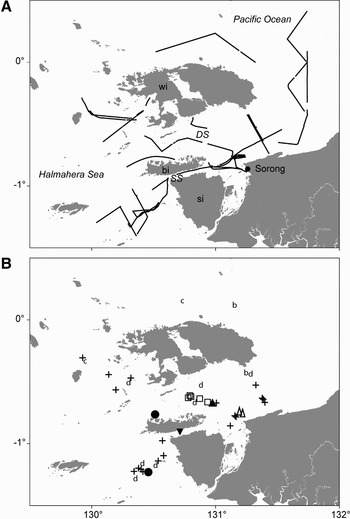
(A) Track of ‘KR Baruna Jaya VIII’ across the Raja Ampat archipelago, 15 November–5 December 2007. DS, Dampier Strait; SS, Sagewin Strait; bi, Batanta Island; si, Salawati Island; wi, Waigeo Island; (B) distribution of cetacean sightings. +, spinner dolphin; ▾, bottlenose dolphin; ▴, short-finned pilot whale; ▵, Risso's dolphin; •, false killer whale; □, sperm whale; b, unidentified blackfish; c, unidentified cetacean; d, unidentified dolphin.

Observations of marine mammals were made during daytime, continuously (15–24 November 2007) or intermittently (27 November–5 December 2007), from the upper deck or from the wheelhouse of the 50-m long ‘KR Baruna Jaya VIII’ (~10 m above sea surface) by two observers equipped with binoculars and a reflex camera fitted with a 300-mm lens. The average speed of the vessel, whose multi-beam vertical sonar was in use during the whole survey, was 6.7 knots (12.4 km/hour). The total sighting effort is shown graphically in Figure 1 and quantitatively in Table 1. For each sighting event we recorded the precise time and location, determined the species occurring, and estimated the group size of each species. Species names follow Rice (Reference Rice1998).
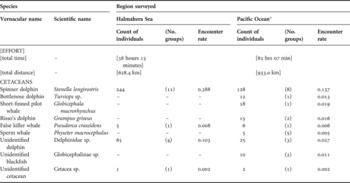
Cetacean species sighted in Raja Ampat waters during the EWiN expedition on board ‘KR Baruna Jaya VIII’, 15 November–5 December 2007. Searching effort and sighting frequency (with number of groups sighted in square brackets) are reported. Encounter rate is number of individuals/km.

*includes Dampier Strait and Sagewin Strait.
RESULTS AND DISCUSSION
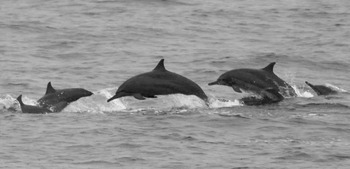
Six cetacean species were identified during this survey. The precise location of sightings is given in Figure 1. The total encounter rate was 0.501 individual/km in the Halmahera Sea and 0.237 individual/km in the Pacific Ocean waters of Raja Ampat (Table 1). The most commonly encountered cetacean was the spinner dolphin, Stenella longirostris (Gray, Reference Gray1828) (Table 1). Spinner dolphins occurred in compact pods of eight to over 50 individuals, generally of 15–20 individuals, and frequently exhibited conspicuous behaviour. In several instances, individuals with pink bellies were noted. Raja Ampat lies midway between the Philippines, where the subspecies reported is the pelagic spinner dolphin (S. l. longirostris), and northern Australia, where the dwarf form (S. l. roseiventris) occurs (Perrin, Reference Perrin, Perrin, Würsig and Thewissen2009a). Both inshore, reef, and deep-pelagic habitats exist in Raja Ampat, making it eventually possible that the two subspecies co-occur there. Therefore, the question arises of whether the spinner dolphins sighted in Raja Ampat waters were of the dwarf or of the pelagic subspecies. Clues for the distinction of the two subspecies have been provided by Perrin et al. (Reference Perrin, Dolar and Robineau1999, Reference Perrin, Aquino, Dolar and Alava2007): useful parameters are body length and the relative sizes of appendages. Measurements of total body length of the individuals were not available, but from the photographs taken, the dorsal fin height can be measured as a proportion of the distance from beak tip to dorsal fin tip. The dorsal fin height of all individuals recorded on photographs and on which measures could be taken (N=14, from four separate sighting events, i.e. 21% occurrences) comprised between 14.5% and 19.1% of the dorsal-fin/beak-tip length, indicating they were of the pelagic subspecies. Those individuals possessed the distinctive, tripartite colour pattern characteristic of pelagic spinner dolphins (Figure 2). Spinner dolphins occurred in waters 134–560 m deep in the Halmahera Sea and 82–2310 m deep in the Pacific Ocean waters of Raja Ampat. Encounter rates were of the same order as those reported by Kreb & Budiono (Reference Kreb and Budiono2005) off eastern Kalimantan or by Ballance et al. (Reference Ballance, Anderson, Pitman, Stafford, Shaan, Waheed and Brownell2001) in the Maldives archipelago, where spinner dolphin density was deemed to be high. Pelagic spinner dolphins feed on small mesopelagic fish and squids, diving to 600 m or more (Perrin et al., Reference Perrin, Dolar and Robineau1999; Perrin, Reference Perrin, Perrin, Würsig and Thewissen2009b). Hence, the relatively high abundance of pelagic spinner dolphins in the Halmahera Sea is an indication of abundant mesopelagic resources.
Pelagic spinner dolphins (Stenella longirostris longirostris) exhibiting the relatively short appendages and the tripartite colour pattern characteristic of the subspecies (Halmahera Sea, 01°00′S 130°28′E; depth 612 m; 13 November 2007).

All five sperm whales (Physeter macrocephalus Linnaeus, Reference Linnaeus1758) sighted during the survey (Table 1) were encountered at the western extremity of the deeper part of Dampier Strait (22 November: 00°37–40′S 130°47–56′E; depth 585–745 m). They were solitary, of large size, and appeared to be in foraging mode, i.e. alternating long dives and surface-resting with frequent blowing. A single pod of >18 short-finned pilot whales (Globicephala macrorhynchus Gray, Reference Gray, Richardson and Gray1846) was observed, swimming parallel to a pod of spinner dolphins, also in the deep waters of the Dampier Strait (22 November: 00°39′S 130°58′E; depth 820 m). Two small, separate groups of Risso's dolphins, Grampus griseus (Cuvier, Reference Cuvier1812) totalling 15 individuals were sighted in the deep waters immediately north-west of Sorong (22 November: 00°45–46′S 131°11–13′E; depth 485–513 m). False killer whales, Pseudorca crassidens (Owen, Reference Owen1846), were sighted twice, each time a pod of 5–6 individuals, in relatively shallow (100–190 m deep) waters of the sill at the western side of Dampier Strait, at the entrance of the Halmahera Sea (01°13′S 130°25′E; 23 November); and off Salawati Island (00°45′S 130°30′E; 4 December). Pilot whales and sperm whales mainly feed on deep-sea squid (Aguilar Soto et al., Reference Aguilar Soto, Johnson, Madsen, Díaz, Domínguez, Brito and Tyack2008; Olson, Reference Olson, Perrin, Würsig and Thewissen2009; Whitehead, Reference Whitehead, Perrin, Würsig and Thewissen2009). Risso's dolphins are thought to feed on neritic and oceanic squid (Baird, Reference Baird, Perrin, Würsig and Thewissen2009).
Although the overall encounter rate, all species combined, was higher in the Halmahera Sea (Table 1), species diversity was higher in Pacific Ocean waters, with 6 species positively identified (versus only two, in the Halmahera Sea). The close-to-shore occurrence of deep-sea foraging cetaceans, such as the sperm whale and the short-finned pilot whale, is made possible by the steep transition from shore to deep-sea, as in Dampier Strait and elsewhere in the Raja Ampat archipelago. The present results indicate that Raja Ampat waters are a feeding area for various cetacean species, that occur in relatively high densities, at least during the period surveyed (late November–early December), thus providing indirect evidence of abundant and diverse resources, at least during that period.
ACKNOWLEDGEMENTS
We are grateful to Captain I. Daniel and to the crew of ‘KR Baruna Jaya VIII’ for their excellent assistance. The research presented here was sponsored by LIPI (Ekspedisi Widya Nusantara) and by IRD. The field work of P.B. was conducted under Surat Izin Penelitihan No. 5936/SU/KS/2007 issued by LIPI, and MLD/OD No. 19750 issued by IRD Director General.