


Introduction
Post-traumatic stress disorder (PTSD) is a highly impairing mental health condition, with prevalence estimated at 8.3% in the general population (Kilpatrick et al., Reference Kilpatrick, Resnick, Milanak, Miller, Keyes and Friedman2013), and as high as 38.7% in military and veteran samples (Miller et al., Reference Miller, Wolf, Kilpatrick, Resnick, Marx and Holowka2013). PTSD is associated with reduced quality of life and difficulty in various domains of functioning, including employment, memory, physical health, and social support and relationships (Boscarino, Reference Boscarino2004; Burriss et al., Reference Burriss, Ayers, Ginsberg and Powell2008; King et al., Reference King, Taft, King, Hammond and Stone2006b; Monson et al., Reference Monson, Taft and Fredman2009; Schnurr et al., Reference Schnurr, Lunney, Bovin and Marx2009). Other difficulties associated with PTSD include increased severity of pain (Otis, Keane and Kearns, Reference Otis, Keane and Kerns2003), suicide (Gradus et al., Reference Gradus, Qin, Lincoln, Miller, Lawler, Sørensen and Lash2010), diagnostic co-morbidity with depression and anxiety (Gros et al., Reference Gros, Magruder, Ruggiero, Shaftman and Frueh2012), and substance use disorders (McCauley et al., Reference McCauley, Killeen, Gros, Brady and Back2012). The two-year direct cost to society for PTSD has been estimated at between 4 and 6.2 billion dollars (2007) in recent combat veterans alone, with higher estimates with the inclusion of indirect costs, such as loss in productivity (Tanielian and Jaycox, Reference Tanielian and Jaycox2008).
Given the high prevalence of psychiatric symptomatology, severe impairment, and large societal costs associated with PTSD, emphasis has been placed on the development, refinement, and dissemination of evidence-based psychotherapies for PTSD. Several evidence-based psychotherapies are effective in treating PTSD, including cognitive behavioural treatments such as prolonged exposure therapy for PTSD (PE) and cognitive processing therapy for PTSD in veterans and military personnel (CPT), as well as effective alternatives such as eye movement desensitization and reprocessing (Foa et al., Reference Foa, Hembree and Rothbaum2007, Reference Foa, Keane, Friedman and Cohen2008; Gros et al., Reference Gros, Tuerk, Yoder and Acierno2011a; Resick et al., Reference Resick, Monson and Chard2007; Shapiro and Solomon, Reference Shapiro and Solomon1995). These psychotherapeutic interventions are administered by highly trained providers for 8–16 weekly sessions, guided by a treatment protocol that includes specific session-by-session psychoeducation, skills training, and between-session practices. The two primary mechanisms of these treatments are exposure techniques, involving both situational and imaginal exposures, and cognitive restructuring (Gros et al., Reference Gros, Tuerk, Yoder and Acierno2011a).
Despite their efficacy and effectiveness, a large proportion of participants discontinue, or drop out of, evidence-based psychotherapies for PTSD prematurely, potentially preventing the required time and practice necessary for sustained symptom remission. Across studies, a pooled discontinuation rate of 36.0% has been reported, with an average of 42.0% discontinuation in clinical care settings and 28.0% discontinuation in clinical trials (Goetter et al., Reference Goetter, Bui, Ojserkis, Zakarian, Weintraub Brendel and Simon2015). Although discontinuation rates have been reported in many outcome studies (Goetter et al., Reference Goetter, Bui, Ojserkis, Zakarian, Weintraub Brendel and Simon2015), there have been far fewer studies to specifically investigate predictors of treatment discontinuation in either in-patient (Szafranski et al., Reference Szafranski, Gros, Wanner, Menefee and Norton2014, Reference Szafranski, Smith, Gros and Resick2016) or out-patient settings (Erbes et al., Reference Erbes, Curry and Leskela2009; Garcia et al., Reference Garcia, Kelley, Rentz and Lee2011; Gros et al., Reference Gros, Yoder, Tuerk, Lozano and Acierno2011b, Reference Gros, Price, Yuen and Acierno2013b; Szafranski et al., Reference Szafranski, Smith, Gros and Resick2016). Across the few studies to date, findings are inconsistent, with each study highlighting different variables that predict treatment discontinuation (e.g. age and combat theatre, disability status, marital status and social support, employment, and PTSD symptom severity).
There are several explanations for the inconsistent pattern of findings in the PTSD treatment discontinuation literature. First, there may be slight differences in the evidence-based psychotherapies delivered in these studies. However, the majority of investigated interventions all fall within the umbrella of cognitive behavioural therapies, and contain overlapping treatment components (Gros et al., Reference Gros, Tuerk, Yoder and Acierno2011a). Moreover, discontinuation rates do not differ between psychotherapy protocols (Goetter et al., Reference Goetter, Bui, Ojserkis, Zakarian, Weintraub Brendel and Simon2015). A second explanation for inconsistent findings relates to differences in how discontinuation is defined across studies (Schottenbauer et al., Reference Schottenbauer, Glass, Arnkoff, Tendick and Gray2008). In some studies, participants are considered to have discontinued psychotherapy if they did not complete 100% of the protocol-based number of sessions (Gros et al., Reference Gros, Price, Yuen and Acierno2013b). In contrast, other studies have created their own definitions for discontinuation based on number of sessions completed (Tuerk et al., Reference Tuerk, Yoder, Ruggiero, Gros and Acierno2010), clinical judgement of the treating provider (Garcia et al., Reference Garcia, Kelley, Rentz and Lee2011), or chart review of past patients (Erbes et al., Reference Erbes, Curry and Leskela2009). In addition, discontinuation is typically dichotomized, further complicating explanations for potential differences between studies and reducing power to find differences between those who discontinue and those who remain in treatment. For example, patients discontinuing treatment after two out of 12 sessions are typically coded the same as patients leaving treatment after seven out of 12 sessions (Goetter et al., Reference Goetter, Bui, Ojserkis, Zakarian, Weintraub Brendel and Simon2015).
The present study sought to address these gaps in the treatment discontinuation literature in veterans receiving an evidence-based psychotherapy for PTSD in a clinical trial testing treatment delivery method (i.e. PE delivered via telehealth technology vs in-person procedures). The parent trial demonstrated non-inferiority between in-person and telehealth delivery of a number of predictors (Acierno et al., Reference Acierno, Knapp, Tuerk, Gilmore, Lejuez and Ruggiero2017). Given the Veterans Affairs (VA) guidelines of eight sessions as a minimally effective dose (Veterans Health Administration Handbook 1160.01, amended 16 November 2015), the study protocol targeted 8–12 sessions and we therefore investigated predictors of treatment discontinuation up through session 8 of the protocol. Survival analyses bypass the need to define discontinuation dichotomously, thereby allowing us to capture predictors of discontinuation with greater statistical power and sensitivity (Singer and Willett, Reference Singer and Willett1993). Discontinuation predictors included in our models were based on the existing literature (Goetter et al., Reference Goetter, Bui, Ojserkis, Zakarian, Weintraub Brendel and Simon2015), as well as factors unique to the procedures of the present study (i.e. treatment delivery). As each of these predictors have been supported in separate studies (Goetter et al., Reference Goetter, Bui, Ojserkis, Zakarian, Weintraub Brendel and Simon2015), no specific hypotheses were made to favour a predictor(s) over the others.
Method
Participants
One hundred and fifty participants were recruited via referrals from medical staff at a large southeastern Veterans Affairs Medical Center (VAMC) and its affiliated community-based out-patient clinics, as well as self-referrals resulting from flyers, billboards, health fairs, online advertisements and media announcements. Eligibility was determined by an in-person intake assessment delivered by masters-level clinicians. Combat veterans and military personnel, from any conflict, meeting DSM-IV-TR criteria for PTSD as per the Clinical Administered PTSD Scale (CAPS; Blake et al., Reference Blake, Weathers, Nagy, Kaloupek, Gusman, Charney and Keane1995) were eligible. Exclusion criteria included active alcohol or substance dependence within the past 6 months and/or an active psychotic disorder (from chart review), and severe suicidal ideation with plan and intent (from baseline interview and Beck Depression Inventory-II; Beck et al., Reference Beck, Steer and Brown1996). Alcohol dependence was assessed using the Alcohol Use Disorders Identification Test (AUDIT; Babor et al., Reference Babor, Higgins-Biddle, Saunders and Monteiro2001; score of 21 or higher) and substance dependence was assessed using the Drug Abuse Screening Test (DAST-10; Skinner, Reference Skinner1982). To maximize the generalizability of results, the presence of other forms of psychopathology (e.g. mood disorders or anxiety disorders) and/or use of a psychiatric medication, after a 21 day stabilization period, were not a basis for exclusion.
Measures
Structural clinical interviews
Clinician Administered PTSD Scale
The CAPS is a clinician-administered scale designed to diagnose current and lifetime PTSD (Blake et al., Reference Blake, Weathers, Nagy, Kaloupek, Gusman, Charney and Keane1995). The CAPS targets the 17 specific PTSD symptoms from the DSM-IV (American Psychiatric Association, 2000) to assess the intensity and frequency of each symptom on a five-point Likert scale. Although a full assessment of past trauma was completed, active combat-related PTSD was the focus of the symptom assessments and related diagnosis. The CAPS has been shown to have adequate internal consistency (α values ranged from .73 to .95), inter-rater reliability on the same interview (r values ranged from .92 to .99), and test–retest reliability over a 2–3 day period across different interviewers (r values ranged from .77 to .98; Orsillo, Reference Orsillo2002).
Structured Clinical Interview for DSM-IV
The SCID-IV is a semi-structured clinician-administered, diagnostic interview designed to assess the DSM-IV diagnostic criteria for axis I disorders (American Psychiatric Association, 2000; First et al., Reference First, Spitzer, Gibbon and Williams1996). The SCID has shown adequate inter-rater reliability for all disorders (r value range: .69 to 1.0) and adequate test–retest reliability over a 1–3 week interval in patient samples (r value range: .40 to 1.0; Zanarini and Frankenburg, Reference Zanarini and Frankenburg2001).
Self-report measures
Beck Depression Inventory – 2nd edition
The BDI-II is a 21-item self-report measure designed to assess the cognitive, affective, behavioural, motivational and somatic symptoms of depression in adults and adolescents (Beck et al., Reference Beck, Steer and Brown1996). All items are scored on a different four-point Likert severity scale. The scale score is sum of all items with a range of 0 to 63. Sample items include: ‘sadness’, ‘loss of pleasure’ and ‘self-dislike’. The BDI-II has demonstrated excellent test–retest reliability over a 1-week interval (r = .93), excellent internal consistency (α < .92), and convergent and discriminant validity in multiple samples (Beck et al., Reference Beck, Steer and Brown1996). The internal consistency of the BDI-II in the present findings was high (α = .94).
Deployment Risk and Resiliency Inventory
The DRRI consists of 13 subscales to assess pre-deployment, active duty, and post-deployment factors in recently returning combat veterans (King et al., 2006a). For the current study, the social support subscale was of interest – the DRRI-L (Post-Deployment Support; items include: ‘I am carefully listened to and understood by family members or friends’ and ‘Among my friends or relatives, there is someone I go to when I need good advice’). Work with veterans has shown the DRRI to demonstrate acceptable internal consistency for the subscales (α > .81) and convergent and discriminative validity (Vogt et al., Reference Vogt, Proctor, King, King and Vasterling2008). The internal consistency in the present study was α = .85.
PTSD Checklist-Military
The PCL-M is a 17-item self-report measure designed to assess DSM-IV PTSD symptom severity related to military/combat-related trauma (Blanchard et al., Reference Blanchard, Jones-Alexander, Buckley and Forneris1996). Respondents are presented with 17 specific symptoms of PTSD and asked to rate ‘how much you have been bothered by that problem in the last month’ on a five-point Likert scale, ranging from 1 (not at all) to 5 (extremely). The scale score is sum of all items with a range of 17 to 85. Sample items include: ‘feeling very upset when something reminded you of a stressful military experience from the past’, ‘avoid activities or situations because they remind you of a stressful military experience from the past’ and ‘feeling jumpy or easily startled’. The PCL has been shown to have excellent internal consistency in veterans, victims of motor vehicle accidents, and sexual assault survivors (α > .94) and excellent test–retest reliability in civilians and veterans (r = .96). In addition, the PCL-M has demonstrated excellent convergent validity with alternative measures of PTSD (r values range from .77 to .93; Orsillo, Reference Orsillo2002). The internal consistency of the PCL-M in the present findings was high (α = .91).
Procedures
The authors assert that all procedures contributing to this work comply with the ethical standards of, and was approved by, the local VAMC Research and Development committee (1695) as well as the Institutional Review Board at the affiliated university (1695) and with the Helsinki Declaration of 1975, and its most recent revision. Participants meeting eligibility requirements were block randomized to the home-based telehealth and in-person conditions. After intake, participants in both conditions received a binder of PE handouts and assessment materials to complete during treatment (e.g. exposure recording forms, PCL, BDI-II). Participants in the telehealth condition had several home-based videoconferencing service options, including: (1) use of their own computer or tablet and high-speed internet connection with encrypted videoconferencing software (e.g. AK Summit), (2) use of a study-provided tablet with Jabber, Facetime or Skype on a 3G or 4G wireless network, or (3) analogue videophone with a built-in camera and video screen that operated through an analogue telephone line. Participants in the telehealth condition received assistance from research staff in setting up their software and hardware before their first treatment session (e.g. a test call). Greater detail on the telehealth set-up and related procedures are described elsewhere (Acierno et al., Reference Acierno, Knapp, Tuerk, Gilmore, Lejuez and Ruggiero2017; Strachan et al., Reference Strachan, Gros, Yuen, Ruggiero, Foa and Acierno2012; Yuen et al., Reference Yuen, Gros, Price, Zeigler, Tuerk, Foa and Acierno2015).
All participants were scheduled to receive PE administered by three masters-level therapists, all with experience in conducting exposure-based therapy for PTSD in prior clinical trials. Therapists were licensed master's level counsellors who completed a 32-hour workshop-training programme in PE and observed a senior-level clinician throughout a complete course of PE. Therapists met weekly with a senior-level PE trainer/therapist for supervision throughout the duration of the study. Treatment fidelity was maintained at or above 90% across and within conditions, assessed through random sampling of 20% of therapy session audiotapes rated according to session-specific procedures directly corresponding to the PE treatment manual (Acierno et al., Reference Acierno, Knapp, Tuerk, Gilmore, Lejuez and Ruggiero2017). Each therapist was randomly assigned to provide treatment to participants in both the in-person and telehealth conditions. The main components of PE are described by Foa et al. (Reference Foa, Hembree and Rothbaum2007) and included psychoeducation, situational (in vivo) exposure, and imaginal exposures that involved recounting aloud the most upsetting traumatic memory followed by processing of the imaginal exposure experience. Participants in the telehealth condition sent their homework forms to their therapist via pre-addressed stamped envelopes that were provided when they received their initial PE binder after the intake. After completing treatment, participants were administered a 1-week post-treatment assessment that consisted of a structured clinical interview (CAPS and SCID) and a battery of self-report measures (PCL and BDI-II). Clinical assessors were blind to participant condition.
Consistent with standard PE treatment procedures, the specific number of sessions for each participant was determined on a case-by-case basis, dependent on participant–therapist agreement on participant's progress/readiness for treatment completion. In later sessions, the therapist and participant discussed the participant's Subjective Units of Discomfort Scale scores for exposure exercises, as well as their scores on the BDI-II and PCL in order to mutually agree on how many more sessions were necessary. The mean number of sessions completed was 10.25 (SD = 1.22) with 25% of participants receiving the maximum of 12 sessions.
Data analytic plan
Discrete time survival analysis (Muthén and Masyn, Reference Muthén and Masyn2005; Singer and Willett, Reference Singer and Willett1993, Reference Singer and Willett2003) was used to examine treatment discontinuation. Survival analysis was conducted in Mplus version 7.4 (Muthén and Muthén, Reference Muthén and Muthén2012). The Cox proportional model assumes that rate of treatment discontinuation was relatively stable across time. For all analyses, treatment session was used as the time metric. Remaining in treatment was scored as 0, discontinuation as 1, and data were coded as missing following treatment discontinuation. Baseline predictors were entered as bivariate predictors due to sample size restrictions. Discontinuation was calculated based on individuals attending at least the first treatment session, as is recommended in the literature (Goetter et al., Reference Goetter, Bui, Ojserkis, Zakarian, Weintraub Brendel and Simon2015). Life tables were first constructed providing information regarding survival probability, hazard ratios, and cumulative survival rates. Predictors of treatment discontinuation were then examined. To compare PCL scores at discontinuation versus when eight sessions were completed (considered a treatment completer), the last session for which PCL data was available was indicated as the PCL score for a participant who did not complete treatment, and the session 8 score was indicated as the PCL score for treatment completers. For one participant, data from session 8 were not available and so data from session 10 were used instead.
Results
Demographics and group assignment
A total of 150 veteran participants completed the baseline assessment and were randomized to a treatment condition. Participants had a mean age of 41.4 years (SD = 14.1), ranging from 20 to 75 years old. The majority of participants were male (98.1%), mostly White (59.3%) or Black (34.7%) with 4.7% identifying as Hispanic, and exactly half reporting positive VA disability status (50.0%). Combat theatres included Operations Iraqi Freedom, Enduring Freedom, and New Dawn (OIF/OEF/OND; 63.3%), Vietnam (20.7%), and Persian Gulf (16.0%). Given the variation in combat theatre, much variability was observed in the self-reported duration in months of PTSD symptomatology (mean = 118.5; SD = 147.8). Approximately half of the sample endorsed co-morbid major depressive disorder (53.9%) on the SCID-IV. Additionally, approximately a quarter of the sample endorsed co-morbid panic disorder (22.7%). Participants were equally randomized into the telehealth (50.0%) and in-person (50.0%) conditions.
Treatment discontinuation
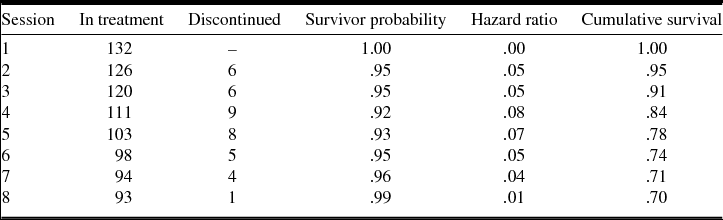
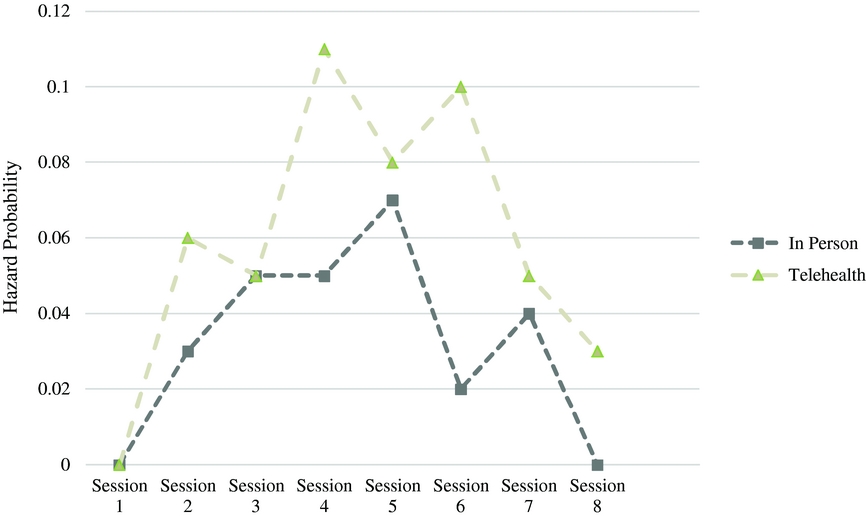
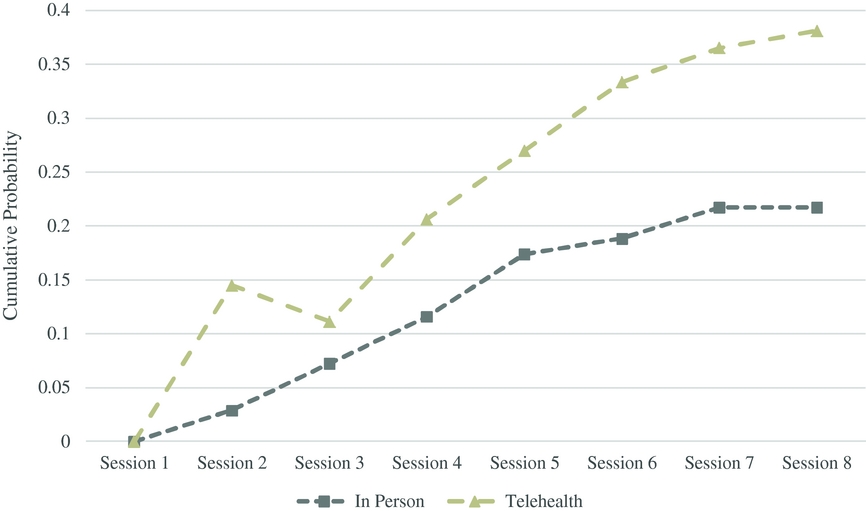
A life table was constructed prior to survival analysis to quantify the number of people who discontinued treatment at each session (see Table 1). The hazard ratio and cumulative survival analysis function plots are provided in Figs 1 and 2. Results of the life table revealed that 63% of participants who were assigned to a treatment condition completed treatment and 71% of participants who attended the first treatment session completed treatment. Rates of discontinuation were fairly stable across sessions.
Life table displaying treatment discontinuation and corresponding survival and hazard probabilities

Note. People are considered to have discontinued treatment if they failed to return for the indicated session. For example, six people who showed for session 1 did not return for session 2.
Hazard function demonstrating proportion of participants who discontinued at each session, based on those remaining in treatment at that time

Survival probability function demonstrating cumulative proportion of participants discontinuing treatment across sessions

Survival analysis
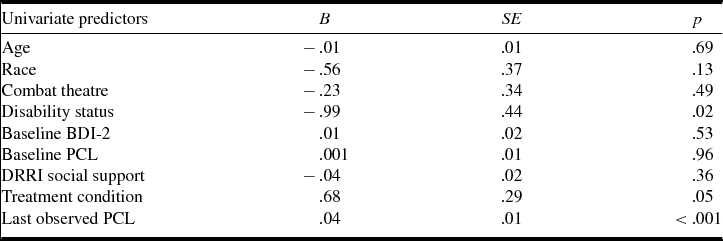
The impact of predictors on treatment discontinuation is provided in Table 2. Disability status significantly predicted treatment discontinuation (coded as 0 = on disability, 1 = no disability; B = –.99, p < .05) with an odds ratio of .36 [95% confidence interval (CI): .16, .88], indicating that the discontinuation rate was greater in those on disability compared with those not on disability. Treatment condition significantly predicted treatment discontinuation (coded as 0 = in-person, 1 = telehealth; B = .68, p < .05) with an odds ratio of 1.97 (95% CI: 1.02, 3.82). To examine differences in discontinuation rates across treatment conditions, hazard ratios and cumulative survival analysis plots by condition are also provided in Figs 1 and 2. As displayed in the figures, the discontinuation rate was greater in the telehealth condition compared with the discontinuation rate in the in-person condition. Of the 69 who attended the first treatment session in the in-person condition, 54 (78%) completed treatment. Of the 63 who attended the first treatment session in the telehealth condition, 39 (62%) completed treatment. PCL scores at discontinuation also significantly predicted treatment discontinuation (B = .04, p < .001) with an odds ratio of 1.04 (95% CI: 1.02, 1.06). PCL scores for those who remained in treatment (mean = 48.17, SD = 18.27) were lower than PCL scores for those who discontinued treatment (mean = 62.87, SD = 12.74). Given these significant predictors, a model including an interaction between PCL scores and condition was examined. This interaction term was not significant.
Baseline predictors of treatment discontinuation

Note. Predictors were first entered individually, with all marginal predictors entered in a final model. Race was coded as 0 = white, 1 = other. Combat theatre was coded as 0 = OEF/OIF, 1 = Persian Gulf or Vietnam. Disability was coded as 0 = on disability, 1 = not on disability. BDI-2 = Beck Depression Inventory-2. PCL = PTSD checklist. DRRI = Deployment Risk and Resilience Inventory. Treatment condition was coded as 0 = in person, 1 = telehealth. Last observed PCL is the last PCL score recorded prior to discontinuing, or, if participant completed session, first recorded PCL score at session 8 and beyond.
Discussion
The present study investigated the discontinuation of PE within a clinical trial comparing telehealth and in-person delivery methods. The study expanded upon previous research in that discontinuation, as opposed to previous studies with dichotomous definitions of discontinuation, was investigated as a continuous variable based on session attendance via survival analyses. Among the previously identified predictors (Goetter et al., Reference Goetter, Bui, Ojserkis, Zakarian, Weintraub Brendel and Simon2015), only disability status was found to be a significant predictor of discontinuation in the present analyses. In addition, treatment condition (telehealth vs in-person) also was found to be a significant predictor of treatment discontinuation during the course of treatment. More specifically, participants that self-identified as having a VA service connected disability and participants in the telehealth treatment condition were at significantly higher risk for discontinuing PE prior to session 9. In addition, treatment discontinuation was associated with greater PTSD symptomatology, suggesting that it may be associated with poorer outcomes. Although the telehealth finding was unexpected and the variable was primarily included due to the design of the parent study (Acierno et al., Reference Acierno, Knapp, Tuerk, Gilmore, Lejuez and Ruggiero2017; Strachan et al., Reference Strachan, Gros, Yuen, Ruggiero, Foa and Acierno2012), this finding has important implications for the research and current dissemination efforts of telehealth delivery of care.
The overall discontinuation rate of 29% (of those completing the first session) in the study was roughly consistent with reported overall pooled rate of 36% found across 20 studies and 1191 overall veteran participants (Goetter et al., Reference Goetter, Bui, Ojserkis, Zakarian, Weintraub Brendel and Simon2015). Interestingly, discontinuation rates do not vary across the most common psychotherapeutics, such as exposure and cognitive therapies (Goetter et al., Reference Goetter, Bui, Ojserkis, Zakarian, Weintraub Brendel and Simon2015). However, of note, there may be promising discontinuation findings in alternative PTSD treatments, still yet to be studied in veterans. One such example is cognitive therapy for PTSD (CT-PTSD), for which a discontinuation rate as low as 13.9% has been demonstrated (Duffy et al., Reference Duffy, Gillespie and Clark2007; Ehlers et al., Reference Ehlers, Grey, Wild, Stott, Liness and Deale2013). Although participant selection criteria and treatment discontinuation/completion definitions differed significantly from the present study, CT-PTSD still holds promise for lower discontinuation rates and should be investigated in veteran samples. In addition, newer technology-based treatments, such as internet-delivered cognitive therapy (Wild et al., Reference Wild, Warnock-Parkes, Grey, Stott, Wiedemann and Canvin2016) and PTSD Coach mobile application (Kuhn et al., Reference Kuhn, Kanuri, Hoffman, Garvert, Ruzek and Taylor2017), also may provide improved discontinuation rates upon further study.
Delivering evidence-based psychotherapies through telehealth services has been growing in popularity over the past decade, spurred on by patient demand and improvements to technology and bandwidth capability (Gros et al., Reference Gros, Morland, Greene, Acierno, Strachan and Egede2013a; Wangelin et al., Reference Wangelin, Szafranski and Gros2016). In general, telehealth may have numerous advantages over standard in-person care, such as decreasing patients’ and providers’ costs (e.g. transportation costs, travel time, missed work) and increasing system coverage area to providers, and is equally well received by patients (Dunn et al., Reference Dunn, Hongyung and Almagro2000; Gros et al., Reference Gros, Lancaster, López and Acierno2017; Trott and Blignault, Reference Trott and Blignault1998). Although the telehealth studies have yet to report differences in treatment discontinuation across conditions (Gros et al., Reference Gros, Yoder, Tuerk, Lozano and Acierno2011b; Tuerk et al., Reference Tuerk, Yoder, Ruggiero, Gros and Acierno2010), this study included a much larger sample, random assignment, and more sensitive analyses to detect said differences and included random assignment. Survival analyses should be completed in similarly powered evidence-based psychotherapy telehealth studies to determine if this finding replicates (Acierno et al., 2016; Morland et al., Reference Morland, Mackintosh, Greene, Rosen, Chard and Resick2014).
It is challenging to hypothesize the reason for the differences across treatment conditions, especially with evidence of equal treatment effectiveness, satisfaction (Gros et al., Reference Gros, Lancaster, López and Acierno2017) and lack of influence of past experience and comfort with technology in telehealth treatments (Price and Gros, Reference Price and Gros2014). Possible candidates proposed elsewhere in the literature include inconsistency of equipment and/or signal stability, poorer rapport, more difficult communication, and general dissatisfaction with the telehealth procedures (Gros et al., Reference Gros, Morland, Greene, Acierno, Strachan and Egede2013a; Sabesan et al., Reference Sabesan, Allen, Caldwell, Loh, Mozer and Komesaroff2014). An alternative explanation involves the time and commitment necessary for the two treatment conditions. More specifically, the home-based telehealth condition is designed to address obstacles to treatment completion by eliminating travel time, expense, and related logistical stressors. In effect, home-based telehealth made receipt of evidence-based psychotherapy for PTSD as simple as turning on a computer or tablet. However, researchers have long hypothesized that incurring less expense and effort could actually devalue psychotherapy, in line with cognitive dissonance theory (Clark and Kimberly, Reference Clark and Kimberly2014). Or, more directly, participants in the home-based telehealth condition may not have taken treatment as seriously as those who had to go through tremendously increased effort and expense to obtain it. Indeed, the casual approach that some participants adopted with respect to their treatment is evidenced by the fact that a ‘dress code’ rule had to be put into effect after treatment started for telehealth participants. Although effort and expense required to obtain treatment has not been shown to influence therapy attendance or outcomes within in-person therapy conditions (Clark and Kimberly, Reference Clark and Kimberly2014; Jensen and Lowry, Reference Jensen and Lowry2012), time, expense and effort in telehealth studies should be considered for further study.
The second identified predictor of treatment discontinuation was disability status, in that disabled participants were more likely to discontinue treatment than participants that were not disabled. These findings are consistent with a previous study on treatment discontinuation during exposure therapy for PTSD (Gros et al., Reference Gros, Price, Yuen and Acierno2013b). In that study, two primary interpretations were presented for the finding. The first interpretation is that disability status is associated with more severe symptoms (PTSD and depression), and more severe symptoms are associated with treatment discontinuation (Garcia et al., Reference Garcia, Kelley, Rentz and Lee2011). This interpretation is limited by the null findings for the symptoms of PTSD and depression in the present study, and their limited/marginal support previously (Gros et al., Reference Gros, Price, Yuen and Acierno2013b). A second interpretation is related to the potential unintentional influence of disability on full participation in treatment programmes (Frueh et al., Reference Frueh, Grubaugh, Elhai and Buckley2007), and therefore result in higher rates of treatment discontinuation. Interestingly, this interpretation is quite similar to the hypotheses regarding the home-based telehealth finding and the related lower motivation to complete services.
From a clinical implications perspective, the present studies for treatment condition should be interpreted with caution pending replication. While the initial reaction may be to move away from psychotherapies delivered via telehealth, there are components of the present study that should be highlighted first. Primarily, the present study randomized largely local participants into the in-person and home-based telehealth conditions. Although home-based telehealth was more convenient, in-person services also were likely to be possible for these patients due to their proximity to the VAMC. Based on this design and past hypotheses (Gros et al., Reference Gros, Morland, Greene, Acierno, Strachan and Egede2013a), telehealth services may be most effective with, and more valued by patients in rural and underserved areas who are unable to seek services elsewhere, whereas very proximally residing patients receiving telehealth services may be at greater risk to prematurely discontinue services. These are, of course, empirical questions for future investigations. Other related limitations of the present design include: (1) limiting the sample to combat veterans with PTSD, (2) inclusion of a single evidence-based psychotherapy for PTSD, (3) lack of a measure of treatment credibility, and (4) not recording zip code or geographic region to allow for urban/rural comparisons. Of note, if replication reveals that motivation is in fact contributing to treatment discontinuation, in terms of influences from telehealth and disability status, motivation building techniques, such as motivational interviewing (MI) (Miller and Rollnick, Reference Miller and Rollnick2002), could be incorporated into evidence-based psychotherapy protocols to improve treatment completion. In fact, there is preliminary support for the use of telephone MI to enhance treatment engagement in veterans (Seal et al., Reference Seal, Abadjian, McCamish, Shi, Tarasovsky and Weingardt2012).
The present study investigated predictors of treatment discontinuation during a trial of evidence-based psychotherapy for PTSD via an alternative and more sensitive analysis. In contrast to the previously identified predictors (Goetter et al., Reference Goetter, Bui, Ojserkis, Zakarian, Weintraub Brendel and Simon2015), the present study only identified disability status and treatment condition. Possible examples for these limited findings could include a larger sample, survival analyses, inclusion of all variables entered at once, and relative influence of treatment condition variable. As for the variables identified, the reasons for their heightened risk could involve poorer rapport and communication difficulties related to technology (telehealth) as well as less commitment to or motivation in the treatment (telehealth and disability status). Together, the finding for telehealth was unexpected, but potentially valuable, in informing future study and related dissemination of the rapidly growing technology.
Acknowledgements
Financial support: This work was supported by grants from Veterans Affairs Health Services Research and Development awarded to R. Acierno (NCT01102764) and from Veterans Affairs Clinical Sciences Research awarded to D. Gros (CX000845), as well as by the South Carolina Clinical & Translational Research (SCTR) Institute, with an academic home at the Medical University of South Carolina (NIH - NCATS UL1 TR001450). The views expressed in this article are those of the authors and do not necessarily reflect the position or policy of the Department of Veterans Affairs or the United States government.
Conflicts of interest: The authors have no conflicts of interest with respect to this publication.



Comments
No Comments have been published for this article.