The significance of the work of monk and theorist Hermann of Reichenau (d. 1054), also known as Hermannus Contractus, on southern German monasteries is amply documented and may be gauged in the vita written by a fellow monk on the Reichenau, Berthold.Footnote 1 This vita, appended to Hermann's Chronicle, lists the Offices Hermann composed. Here Berthold used two interesting verbs, neumatizavit and composuit,Footnote 2 suggesting that Hermann wrote both the chant texts and the melodies. Although Berthold neglected to mention Hermann's treatise Musica, the didactic songs E voces unisonas and Ter tria iunctorum, or interval notation, these are attributed to him elsewhere.Footnote 3 The interval notation, which used Latin and Greek letters to indicate nine intervals from the unison to the major sixth, and its practical use are of particular interest for this study.Footnote 4
Hermann's ideas about music theory were taken up by the Michelsberger theorist Frutolf (d. 1103) in his treatise Breviarium de musica. A rubric in the Munich copy (Clm 14965b) attributes to Hermann a song describing the intervals, Ter tria iunctorum,Footnote 5 and Frutolf's text indicates that Hermann had ‘described the nine intervals in verses which he wrote’.Footnote 6 E voces unisonas follows two other songs written in interval notation.Footnote 7 E voces unisonas is preceded by the rubric, ‘What these signs indicate and how they are used.’Footnote 8
According to Frutolf's understanding of Hermann's interval theory, Hermann allowed the unison but not the tritone; the seventh and octave were allowed as they were sometimes used, but were uncommon.Footnote 9 Frutolf appears to have based this understanding on the didactic songs; Hermann did not list intervals in his treatise though he mentioned some of them in the context of species theory. Interestingly, Hermann included the tritone in E voces unisonas, but only in the context of describing another interval. (The interval of the tritone is neither counted among the nine nor does it have its own sign in Hermann's interval notation.) Frutolf's own opinions seem to have allowed for the octave, the unison and the diapente cum semiditono, and he provided descriptions of the latter two.Footnote 10
Although book lists compiled by Burchard, librarian at St Michelsberg in the first half of the twelfth century, do not include Hermann's Musica, the monastery certainly had copies of E voces unisonas and Ter terni. Footnote 11 Among these are a recently discovered copy of the former with marginal signs corresponding to each interval, and a simplified version of the text found in D-KA, Cod. K504 (hereafter: Karlsruhe 504).Footnote 12 Burchard's lists further indicate that other works by Hermann were known at St Michelsberg. Thiemo left the library a copy a ‘historia sancti Gregoii cum tonario’, and both Thiemo and Frutolf left copies of Hermann's Computus.Footnote 13 It is possible that the historia for St Gregory was that composed by Hermann, but the source does not survive.Footnote 14
As we shall see, interval notation made its way out of the didactic songs and music theory texts and into St Michelsberg's chantbooks through scribes working with an interest in correcting and clarifying the melodies.Footnote 15 Indeed the group of fragments from the monastery in which the notation is found represents the largest number of scribes using it in one institution to date. The notation was used after Frutolf, indicating that its transmission continued for at least a generation.
The fragments
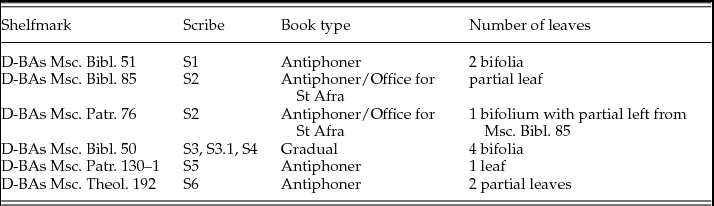
Among the surviving fragments from St Michelsberg are heretofore unexamined practical examples of the interval notation, including some in which the interval notation has been used to clarify Hermann's own melodies. The interval notation is the work of a number of twelfth-century scribes who used it to varying degrees. Those who wrote the fragments found in D-BAs Msc. Bibl. 50 used the signs frequently, as did the scribe of the Office for St Afra in D-BAs Msc. Bibl. 85 and D-BAs Msc. Patr. 76.Footnote 16 The scribes of the other fragments are more sparing in their usage. The following is an examination of the use of interval notation at St Michelsberg in the twelfth century. It is not an exhaustive catalogue of each instance of the interval notation, but rather a consideration of cases in which it was used alongside neume notation. Table 1 provides an overview of the fragments and the manuscripts in which they are currently found.
Sources of the St Michelsberg fragments, scribal hands and book types.

Msc. Bibl. 50
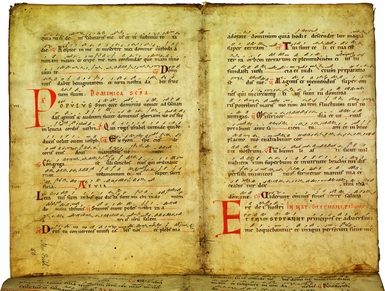
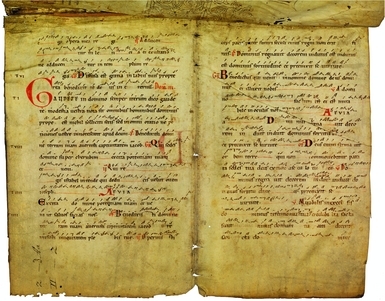
The fragment in Msc. Bibl. 50 is the most extensive that has been identified so far. It consists of four conjunct bifolia, of which six sides are visible; two are pastedowns. The front pastedown (scribe S3) begins with offertory verses for the first Sunday of Advent, followed by the communion Dominus dabit, and then the beginning of the second Sunday of Advent through the beginning of the offertory Deus tu convertens (see Plate 1). This side is likely to have been the verso of the first folio of a gradual and perhaps the outer leaf of a quire. The facing (recto) side of the bifolium contains the latter portion of the alleluia verse Dies sanctificatus, the offertory Tui sunt celi and the communion Viderunt omnes from the Third Mass for Christmas, and the opening of the St Stephen introit Etenim sederunt.
D-BAs Msc. Bibl. 50, front pastedown (Staatsbibliothek Bamberg, Gerald Raab).

The front flyleaf (S3) continues the Second Mass for Christmas on the recto side as currently bound, with the beginning of the Third Mass for Christmas, the end of the second Sunday of Advent and the feast of St Lucia following. The verso side as currently bound contains the communion for St Lucia, the Second Sunday of Advent and part of the Second Mass for Christmas. The rear pastedown (S3) contains chants suitable for a virgin, the beginning of the Mass for Sts Fabian and Sebastian, the end of a Mass for St John and the beginning of the feast of the Holy Innocents.
The rear flyleaf, from a different part of the liturgical year, contains chants for Holy Week. Karen Dengler-Schreiber identified the scribe (S4) as Hermann the Younger and dated his activity to the middle or second half of the twelfth century.Footnote 17 Despite only having one leaf among these fragments ascribed to him, it would appear that the other scribes could have been roughly contemporary with S4, making these the youngest of the fragments with interval notation.Footnote 18
There are few differences between the work of scribes S3 and S4. The three bifolia written by the former contain eighteen lines of text and neumes whilst the bifolium written by scribe S4 contains nineteen lines of text and neumes. This does not necessarily indicate that the leaves came from separate books, although the possibility that they did must remain.
The reconstructed structure of the first two quires is thus:Footnote 19
-
1r 1st Sunday of Advent (front pastedown, not visible)
-
1v 2nd Sunday of Advent (front pastedown left)
-
2r St Lucia (front flyleaf recto right)
-
2v 3rd Sunday of Advent (front flyleaf verso left)
-
3r–6v (lacuna)
-
7r Second Mass for Christmas (front flyleaf verso right)
-
7v Third Mass for Christmas (front flyleaf recto left)
-
8r St Stephen (front pastedown right)
-
8v St John (front pastedown, not visible)
-
9r Holy Innocents (rear pastedown right)
-
9v (rear pastedown, not visible)
-
10r–16r (lacuna)
-
16v St Prisce, Sts Fabian and Sebastian (rear pastedown left)Footnote 20
This repertoire can easily be compared to those in contemporary southern German sources, including the tonary in Clm 14965b. The fragment also conveniently provides a wide variety of chant types and is large enough that the scribes’ techniques for writing neumes can be observed. What is particularly interesting about the work of S3 and S4 is the way in which they combine interval and letter notations. Both used southern German neumes and included a square clivis in addition to a round clivis, but not the horizontal climacus commonly found in chantbooks from both St Michelsberg and Bamberg cathedral copied in the second half of the twelfth century.Footnote 21 Each chant and most verses have letters indicating the starting pitch; some designations of mode survive in the margins.Footnote 22 Occasionally, further pitch letters are given. The combination of pitch letters and interval notation serves to clarify melodic passages rather than to provide information for a complete pitch- or interval-specific reading. This is in keeping with the pitch-clarifying techniques used elsewhere in manuscripts made in Bamberg.
It should also be observed that there are two layers of interval notation in the verse Respice in me, from the first Sunday of Advent offertory Ad te domine (front pastedown); a second layer of interval notation appears to have been added by another scribe (S3.1). The signs are written in a slightly larger hand and in considerably lighter ink than the first layer (see Plate 1, left, lines 3–4). This is one of few examples of such layering of interval signs by different scribes and suggests that someone later felt further clarification of the chant was needed.Footnote 23 The use of interval signs within chants as opposed to the letters which begin them may represent a particular way of thinking about the melodies: the scribe may have been thinking directly in terms of intervals, and not in assigning a pitch letter to each note which might then require a translation of the interval between each pair of letters.
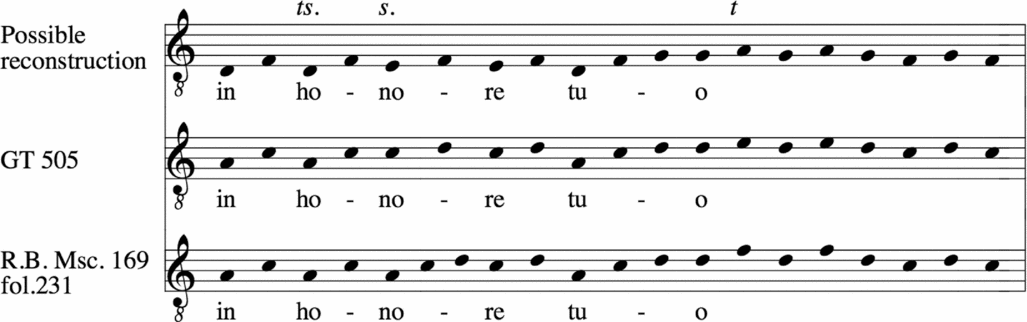
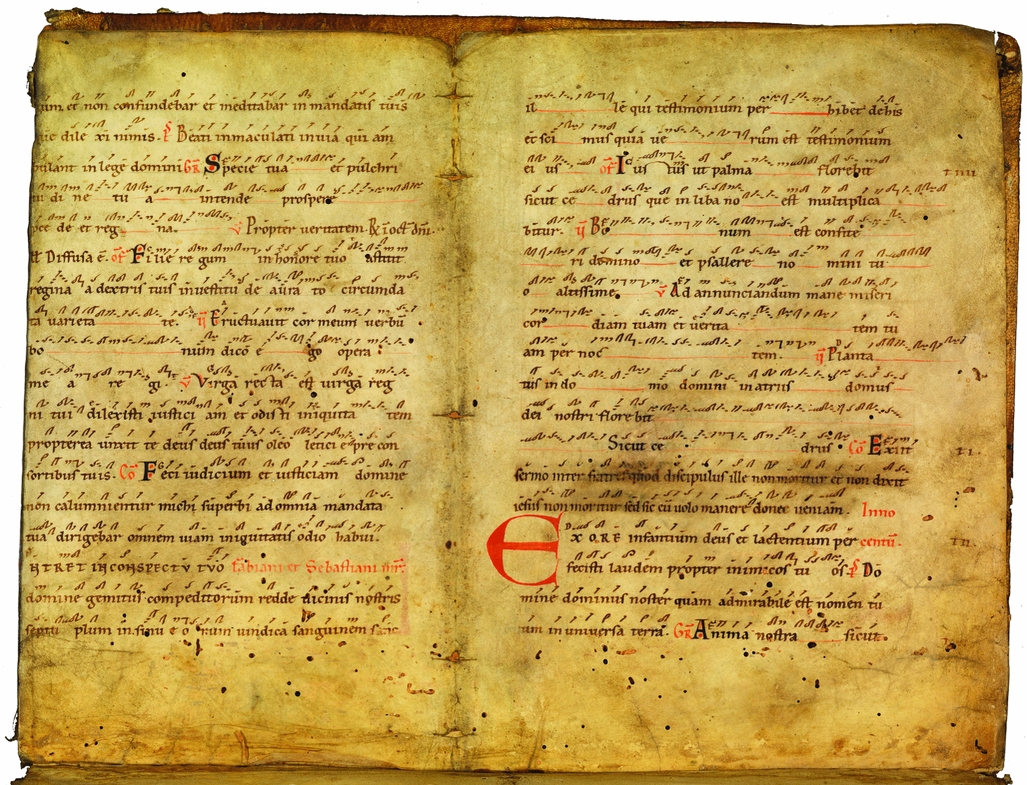
A further interesting example is found at the beginning of the offertory Filie regum (rear pastedown). The scribe (S3) has indicated that the offertory begins on c and ends with the descent a–g–f.Footnote 24 (See Plate 2, left, lines 6–8.) This differs from the melody found in the Graduale Triplex, which begins on g and ends on e and therefore cannot be a pure transposition.Footnote 25 The interval notation indicates that a descent of a semitone should be found between the higher note of the pes on the first syllable of ‘honore’ and the first note of the next on the second syllable. I have offered a possible realisation in Example 1 alongside readings from the Graduale Triplex and D-BAs R.B. Msc. 169, a fourteenth-century gradual from Bamberg cathedral. Another way to approach this chant, however, would be to question whether the c in Msc. Bibl. 50 refers to the first note of the chant or to the tristropha that directly follows; the melody in R.B. Msc. 169 begins on a and progresses to c for the tristropha, whilst the intonarius in Karlsruhe 504 begins on G and progresses to c.Footnote 26
Offertory Filie regum.

D-BAs Msc. Bibl. 50, rear pastedown (Staatsbibliothek Bamberg, Gerald Raab).

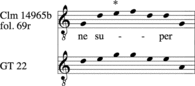
A delta found in the gradual respond Qui sedes for the Third Sunday of Advent suggests a melody strikingly different from that in the Graduale Triplex.Footnote 27 The delta is found between the first and second neumes over ‘super’ (see Plate 3, left, line 11). The placement of the delta is indicated by an asterisk in Example 2. The interval of a minor third is indicated in the Graduale Triplex and a tone is indicated in the tonary attributed to Frutolf of Michelsberg in Clm 14965b.Footnote 28 However, in what may be a simple case of displacement, the interval between the final neume of ‘domine’ and the first neume of super in Clm 14965b is a fifth.
Gradual Qui sedes.

D-BAs Msc. Bibl. 50, front flyleaf verso (Staatsbibliothek Bamberg, Gerald Raab).

Finally, a stroke of luck has meant that some of the chants preserved in the Basel fragment Ch-Bu N I 6 Nr. 63, described by Arlt, are also preserved on the rear flyleaf of Msc. Bibl. 50.Footnote 29 More interval signs are found in the Basel fragment than in the fragment from St Michelsberg, but there are a few instances in which they overlap – and occasionally disagree. The beginning of the offertory Eripe me is noted in Msc. Bibl. 50 as beginning on E. The first sign in Msc. Bibl. 50 comes between ‘me’ and ‘de’, indicating an ascent of a minor third (ts), which disagrees with the fourth (d) found in the Basel fragment.Footnote 30 A second example is found in the communion Erubescant. Two interval signs are found in Msc. Bibl. 50: between ‘revereantur’ and ‘simul’, and at the final neume of the chant, a square clivis. The sign at ‘simul’ indicates an ascent of a minor third (ts) whilst the sign at the final clivis indicates a descent of a fourth (d). The Basel fragment indicates an ascent of a fourth (d) at ‘simul’.Footnote 31
An Office for St Afra
Two fragments from an Office for St Afra by Hermann of Reichenau are found as pastedowns in Msc. Bibl. 85 and Msc. Patr. 76. These fragments are part of the same leaf; each shows a different side of the folio and thus no complete chants are visible. What is visible, however, is a group of partial antiphons and responsories from Matins in which the interval notation attributed to Hermann has been used. It is likely that removing these pastedowns from the boards to which they are attached would reveal parts missing from the surviving chants; the narrow piece in Msc. Bibl. 85 was cut from the bifolium in Msc. Patr. 76, and shows the left margin of the verso of that folio. However, since we can see half of the recto and half of the verso of the same folio at the moment, it is unlikely that any complete chants currently missing would be uncovered. Leaving aside the question of whether or not Hermann was the inventor of the interval notation – he seems to have been thought of in this capacity at St Michelsberg – this is, to my knowledge, the first instance of the use of interval notation in an office composed by Hermann. Additionally, this office seems to be the group of chants with the most extensive use of interval notation among the fragments from St Michelsberg.
Using the edition of the Office for St Afra by David Hiley and Walter Berschin,Footnote 32 I have identified the chants that survive in the two Bamberg fragments and determined that the Office was recorded in a different form at St Michelsberg. Remnants of ten responsories survive: missing (compared to the Hiley-Berschin edition) are Regnum mundi and Veni sponsa Christi. Footnote 33 A close examination of the surviving chants in these fragments suggests that the Office was transmitted with only ten responsories in this source. Because Hostis antiquus begins as the first responsory of the second nocturn directly after the final antiphon of the same nocturn, Auditis praesul, it is extremely unlikely that Veni sponsa Christi is hidden somewhere – and it certainly could not serve as the first responsory of the second nocturn.Footnote 34 Nor, indeed, could it be the final responsory of the first nocturn as Sancto praesule ends and is followed directly by a sign indicating the beginning of the following nocturn. Only seven of twelve antiphons are visible: those from the second nocturn (Msc. Patr. 76), and Gratias tibi (Msc. Bibl. 85).
We cannot be certain of when this Office came to St Michelsberg. The hand that recorded it on the surviving fragments is probably from the late eleventh or early twelfth century. Interestingly, however, many – although not all – of the antiphons and responsories for Matins are found in the Munich copy of Frutolf of Michelsberg's Tonary in Clm 14965b.Footnote 35 None of the chants from the Office have been clarified in this copy of the tonary. It is unfortunate that the sole visible marginal ‘euouae’ in the St Michelsberg fragments is from the antiphon Gratias tibi, which is not found in Clm 14965b, and therefore no comparison of differentiae can be done.
David Hiley mentions the importance of the monastery of Hirsau in the transmission of the historia.Footnote 36 St Michelsberg, however, was not reformed until 1112, during the episcopate of Otto II, some years after the death of Frutolf of Michelsberg.Footnote 37 Thus, if we accept that the list of chants in Clm 14965b was set by Frutolf, who died in 1103, then the historia must have been part of the corpus of chants known at St Michelsberg well before the impact of the Hirsau reform was felt there. Certainly, other texts by Hermann circulated at St Michelsberg before Frutolf's death and, consequently, before the reforms.Footnote 38
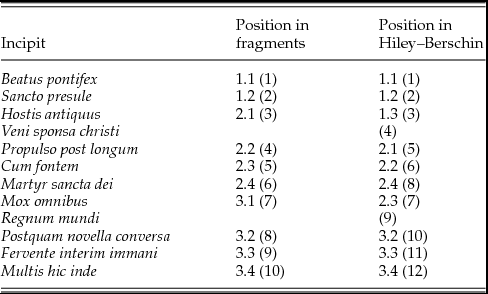
The ordering of the chants in the St Michelsberg fragments does not exactly correspond to the Hiley–Berschin edition. In Msc. Patr. 76, two responsories, Beatus pontifex Narcissus and Sancto praesule, are followed by the six antiphons for the second nocturn of Matins, whilst Hostis antiquus is the first responsory for the second nocturn (Veni sponsa Christi does not appear at any point), rather than the third responsory of the first nocturn. In Msc. Bibl. 85, three responsories appear together (Propulso post longum, Cum fontem vitae and Martyr sancta dei). Mox omnibus, Postquam novellam conversa, Fervente interim immani and Multis hic inde appear together after the antiphon Gratias tibi domine Iesu referimus. The displacement of both Hostis antiquus and Mox omnibus and the grouping of the antiphons and responsories as observed in the fragments may suggest that this Office was copied with only ten responsories at St Michelsberg. Table 2 suggests that the version of the office transmitted in the fragments probably had grouped the ten responsories into three groups: 2+4+4.Footnote 39 A number of signs from Hermann's interval notation are visible on these fragments. The signs have again been used for clarification; they do not provide the complete melody of any chant. Further, none of the visible incipits has been provided with a starting pitch, unlike the leaves found in Msc. Bibl. 50.
Responsories for St Afra at Michelsberg.

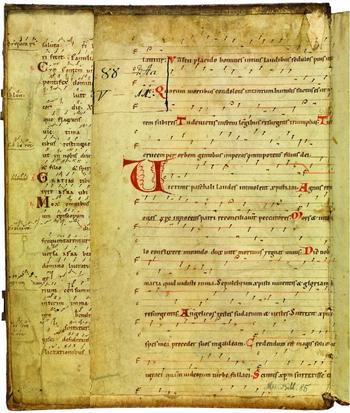
In the responsory Propulso post longem, line 1 of Msc. Bibl. 85 (Plate 4), two letters are found among the neumes over ‘salutari’. The first, d, with a punctum, indicates a descent of a fourth. This complements the extended right arm of the quilisma, which generally indicates a deeper descent in southern German neume notation. The quilisma and d are followed by a t, also with a punctum, preceding a scandicus. This t indicates a descent of a tone between the final note of the quilisma and the first note of the scandicus. Similarly, in the following responsory Cum fontem, a clivis is drawn with a long right arm and a d with a punctum. In this case, both the elongated arm and the d reinforce the difference between this neume and the preceding neume, which is also a clivis.
D-BAs Msc. Bibl. 85, front pastedown (Staatsbibliothek Bamberg, Gerald Raab).

In lines 21 and 23 of Msc. Bibl. 85 are two occasions where a delta has been used: in the responsories Postquam novellam conversa and Fervente immani. The first, at ‘consummavit’, is written next to a square clivis and beneath a liquescent pes. Since there is no punctum beneath the delta, we can assume that it refers to an ascending interval. Its placement probably indicates a leap between the second note of the square clivis and the first note of the pes. The second example, at ‘comprehenditur’, comes between a torculus resupinus and a liquescent pes. In this case, the delta is accompanied by a punctum, and thus indicates a descent of a fifth between the final note of the syllable ‘pre-’ and the first of the syllable ‘hen-’. This is in disagreement with all three sources of the Hiley–Berschin edition, which have moved the second note of this pair to the syllable ‘pre-’.Footnote 40
Similar examples are found on the pastedown in Msc. Patr. 76; the signs from the interval notation were used to clarify a single interval where desired. Examples from Msc. Patr. 76 include a descent of a tone in the antiphon Sancto pontifice, between the second and third syllables of ‘pernoctante’ (line 9); a descent of a major third between the second and third syllables of ‘doctrine’ (line 11) in the antiphon Cumque dulcem, and an ascent of a fourth between ‘eas’ and ‘ad’ (line 12) in the same antiphon.
The scribe who copied this Office consistently used several techniques to relate neumes to the interval notation. In general, the interval sign is placed between single pitch neumes and closer to the second neume. A similar placement is used when the interval sign clarifies the relationship between the final pitch of one neume and the first pitch of a second. In the case of a clivis, the interval sign is usually placed alongside the right arm of the clivis. For a pes and other ascending neumes, the sign is placed to the left of the neume.
Conclusions
I have tried to raise two main points in this study. First, that the role of interval notation in liturgical books from St Michelsberg is a clarifying one. Second, that there is a relationship between the notation of chantbooks and activities in music theory at St Michelsberg. The examples from the Office for St Afra, as well as those from Msc. Bibl. 50 show that Hermann's interval notation at St Michelsberg was not used to provide an interval-specific record of an entire chant, but rather to clarify some parts of chants. This confirms what is found in the other sources that are known to have interval notation and underlines something extremely important about the place of neumes in southern German liturgical books at the end of the eleventh century. We have, perhaps, been misled into expecting that the notation was intended to provide an interval-specific record of chants by the didactic songs written in manuscripts such as Clm 14965b, in which both neumes and interval notation have been provided.Footnote 41
Considering the interaction between music theory and practice as well as the role of Frutolf's treatise on the reception of interval notation at St Michelsberg, it is noteworthy that E voces unisonas survives in two sources from St Michelsberg – with a simplified text in Karlsruhe 504, which in and of itself is noteworthy, and in a fragment of an antiphoner in the binding of Msc. Bibl. 79. If each copy of the Breviarium mentioned by Burchard also contained a copy, as is the case in Clm 14965b, then two further copies were available.
The interval notation worked its way out of a didactic song and into liturgical books. How exactly this happened is not easily resolvable, but the number of scribes who used the notation suggests that it was readily understood. Although not all scribes active at Michelsberg used interval notation and we do not have access to all the liturgical books mentioned by Burchard, the number of scribes involved is striking, as is the span of time in which they appear to have been active. This is certainly not simply the result of one particularly keen scribe editing the monastery's collection, nor are the surviving fragments the result of an intentional programme to save leaves with interval notation.