Introduction
Sweet potato is the dominant root crop in Papua New Guinea (PNG), replacing other widely cultivated root crops, including taro (Colocasia esculenta [L.] Schott) and yam (Dioscorea alata L. and Dioscorea esculenta L.) (Bourke and Ramakrishna, Reference Bourke, Ramakrishna and Kirchhof2009 ). The crop is grown at a subsistence level with low to medium agricultural inputs. The sweet potato weevil (SPW), Cylas formicarius (Fabricius) (Coleoptera: Brentidae), which can cause yield losses of up to 50% (Sar, Reference Sar and Price2006 ), seriously impacts sweet potato production. Furthermore, feeding injury on storage roots or tubers can lead to fungal infection, downgrading the quality of the crop (Wamalwa et al., Reference Wamalwa, Cheseto, Ouna, Kaplan, Maniania, Machuka, Torto and Ghislain2014 ). The adult SPW is nocturnal and completes its life cycle on the crop. Generally, the female oviposits eggs singly, either on the vines or on the crown, and the larvae then burrow down and into the tubers (Sutherland, Reference Sutherland1986a). When infestations are at their peak in the drier months, adults access the tubers through soil cracks, with the female ovipositing directly into the tubers. The larval stage spends 3–4 weeks inside the tuber feeding before pupation and adult emergence.
In PNG, farmers depend exclusively on cultural control practices for SPW management, including crop rotations, intercropping, good sanitation, destruction of old vines and selection of deep-rooted cultivars (Coleman et al., Reference Coleman, Hughes, Jackson, Komolong, Guaf and Kirchhof2009 ; Hughes et al., Reference Hughes, Coleman, Taraken and Igua2009 ). Although the larvae mainly cause the damage, the primary target for insecticidal control is the adult (Sutherland, Reference Sutherland1986a ). However, the use of insecticides is often impractical as SPW spends most of its life cycle underground, and insecticide resistance has also been demonstrated (Sutherland, Reference Sutherland1986b; Collins et al., Reference Collins, Treverrow and Lambkin1991 ). Employing environmentally friendly approaches (such as biological control) may be a sustainable option for SPW control in the longer term. Recently, use of the entomopathogenic fungi Metarhizium anisopliae (Metschnikoff) Sorok. and Beauveria bassiana (Bals.-Criv.) Vuill. has been a focus of attention for microbial insect control. Unlike other microbial agents that require ingestion, the entomopathogenic fungi provide several practical advantages, as the infective propagules or spores grow upon contact with the target (Lomer et al., Reference Lomer, Bateman, Johnson, Langewald and Thomas2001 ). In addition, the infected targets may act as a primary source of inoculum for secondary infection, and spores can persist in the soil (Moorhouse et al., Reference Moorhouse, Gillespie and Charnley1993 ; Milner, Reference Milner1997 ; Boothe et al., Reference Boothe, Tanigoshi and Dewes2000 ). Metarhizium anisopliae and B. bassiana are naturally associated with SPW and have been reported to cause 70–80% mortality (Su et al., Reference Su, Tzean and Ko1988 ; Rana and Villacarlos, Reference Rana and Villacarlos1991 ; Ondiaka et al., Reference Ondiaka, Maniania, Nyamasyo and Nderitu2008 ). In PNG, field infections of M. anisopliae have been reported on coconut pests (Prior and Arura, Reference Prior and Arura1985 ), sugarcane borer (Sesamia grisescens) (Arzumanov et al., Reference Arzumanov, Jenkins and Roussos2005 ) and taro beetles (Papuana uninodis) (Theunis and Aloali'i, Reference Theunis and Aloali'i1998 ). In the Bundaberg area of Queensland, Australia, where sweet potato is cultivated commercially, natural infection by M. anisopliae has been associated with sugarcane white grubs (Antitrogus consanguineus) (Allsopp et al., Reference Allsopp, McGill, Licastro and Milner1994 ). However, the infectivity and deliberate use of this entomopathogenic fungus against SPW has not been investigated in either of these regions. In this study, we evaluate the potential of tropical strains of M. anisopliae obtained from Queensland as microbial control agents for adult SPW.
Materials and methods
Insect cultures
A SPW colony was cultured from insects collected in 2010 from infested sweet potato plants in Bundaberg (Queensland, Australia) and maintained in the laboratory at Yanco Agricultural Institute, NSW, Australia. Part of the colony was transferred to Charles Sturt University in Wagga Wagga (NSW, Australia) in 2011 for further culturing and experimentation. Insects were reared on the tubers of the sweet potato variety ‘Beauregard Gold’, maintained at 23–30 °C, 60% relative humidity (RH) with a 12 L:12 D photoperiod. Infested tubers were replaced every 2 to 3 weeks and placed in clean plastic containers (30 cm × 15 cm × 10 cm) for adult emergence. Two- to three-week-old males and females (post-emergence) were used in all bioassays.
Fungal isolates
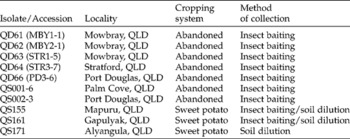
Isolates of M. anisopliae were obtained directly from soil samples collected in Queensland, Australia (Table 1 ), with the exception of isolates QD61–QD64 and QD66. Dr Ian Newton from the Queensland Department of Agriculture, Fisheries and Forestry supplied these isolates that also originated from Queensland. Thirty percent of the samples were obtained from cultivated sweet potato fields, whereas the remaining samples were from abandoned lands. Three isolates, QD66, QS001-6 and QS155, have been lodged in the New South Wales Department of Primary Industries Herbarium with the accession numbers DAR 82478, DAR 82479 and DAR 82480, respectively.
Source of Metarhizium anisopliae isolates tested against adult SPW. All insect baiting was conducted using Tenebrio molitor larvae

The ‘Galleria bait method’ (Zimmerman, Reference Zimmerman1986 ), using larvae of the mealworm beetle, Tenebrio molitor (Coleoptera: Tenebrionidae), was used to isolate the fungi from soil samples. Between 200 to 300 g of air-dried soil was placed in a clear resealable plastic bag before releasing 10 to 12 T. molitor larvae. The bags were sealed and placed in the dark at 25 ± 2 °C and the soil turned weekly for 2 to 3 weeks. Dead larvae were removed, surface sterilized with 70% alcohol and rinsed three times in distilled water. To stimulate mycosis, larvae were placed on moistened Whatman No. 1 filter papers in 90-mm Petri plates and incubated at 26 °C. After sporulation, a sterilized micro-needle probe was used to gently touch the cadaver surface and then the conidia were inoculated onto Sabouraud dextrose with yeast extract (SDY) media. A loopful of conidia from 3-week-old cultures of each fungal isolate was inoculated into 150 ml SDY broth and placed in an orbital shaker in the dark for 5–6 days.
For culture on rice, 1 kg of long-grain rice in Microsac® gas-permeable bags (32 cm × 57 cm, Mycelia, Belgium) was heat sterilized for 15 min at 121 °C. Sterilized water was then added at a ratio of 1:2 before autoclaving again. Bags were cooled to room temperature and shaken well before being inoculated with 10 ml of SDY broth and sealed. Cultures were maintained at 25 °C for 3 to 4 weeks. The bags were shaken well to promote even sporulation a few days after the start of incubation. The contents of the bags were emptied into aluminium trays (45 cm × 25 cm × 5 cm) to dry at room temperature, and covered with a muslin cloth. The spores were harvested using a mechanical sieve shaker (Endecotts EFL2000/1; Endecotts Ltd., UK) fitted with a nest of sieves (1 mm, 120 μm and 32 μm). The spores were weighed to determine the decrease in initial moisture content weekly for 4 to 5 weeks until 30% of the moisture content was achieved. The dry-sieved conidia were stored at 4 °C in sterile 100 ml Schott bottles until required.
Morphology and growth assessments
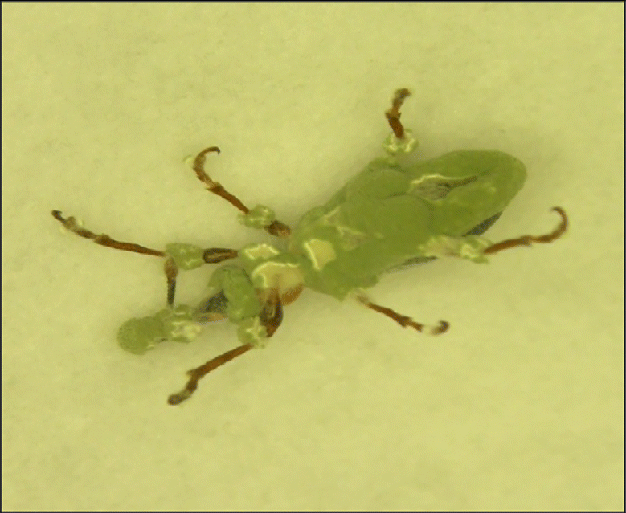
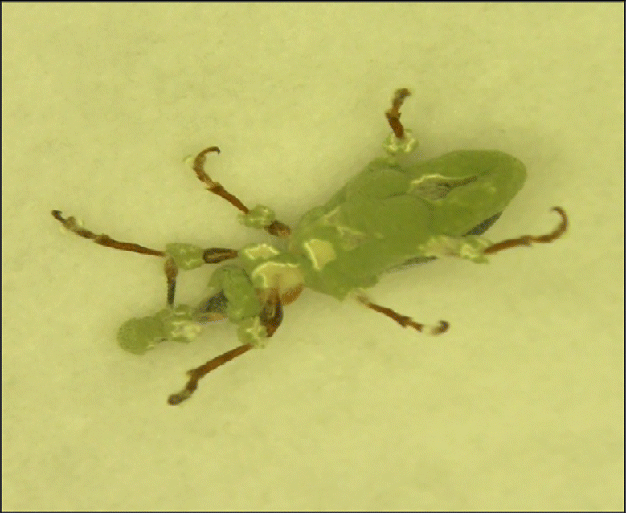
Sporulation colour in Metarhizium can be light to very dark green (Bischoff et al., Reference Bischoff, Rehner and Humber2006 ), and while green sporulation is characteristic of Metarhizium spp. (Fig. 1 ), it cannot be considered as diagnostic, because other fungi also produce green spores. To assess the cultures for germination, approximately 0.1 ml of a 1 × 10⁷conidia/ml suspension of each isolate was spread on four Sabouraud dextrose agar with yeast extract (SDAY) Petri plates and incubated in the dark for 18–24 h at 25 °C. A total of 100 conidia per plate were then examined under an inverted Epi-fluorescence compound microscope (Olympus IX70-S8F; Olympus Optical Co., Japan) at × 400 magnification. The conidia with a visible germ tube were regarded as germinating conidia. The plates were replaced in the incubator and then re-examined daily until the first spores were produced. To determine the radial growth rate of each isolate, cultures were spread plated on SDAY and maintained at 15 °C for 4 days. Four round agar plugs (c. 5 mm diameter) were cut from these plates using a 5 mm diameter cork borer. Each plug was placed upside down in the centre of a new SDAY plate with pre-marked intercepting lines on the underside of each plate to assist in assessing colony diameter. The plates were sealed and incubated in the dark at constant temperatures of 15, 20, 25, 30 and 35 °C. Radial growth was assessed at 6 and 12 days. Individual plates were treated as replicates.
Cadaver of a female Cylas formicarius infected with Metarhizium anisopliae isolate QS155. Green conidia observed on the cuticle at 3 days after treatment.
DNA extraction and sequencing
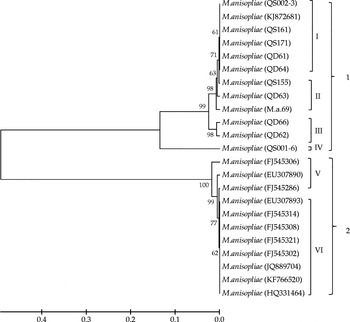
Conidia from 2-week-old cultures were grown in 150 ml SDY broth, and harvested after 4 days using a vacuum pump and Buchner flasks. The mycelial mats were dried at room temperature for 1 h, wrapped with aluminium foil then frozen in liquid nitrogen for 5 min. The samples were stored at − 80 °C. The phenol/chloroform method (Raeder and Broder, Reference Raeder and Broda1985 ; Al-Samarrai and Schmid, Reference Al-Samarrai and Schmid2000 ) was used to extract genomic DNA from the ground mycelium. Samples of genomic DNA from the 10 isolates were prepared for amplification with the internal transcribed spacer (ITS) primers ITS1 and ITS4 (ITS1 5′-TCCGTAGGTGAACCTGCGG-3′; ITS4 5′-TCCTCCGCTTATTGATATGC-3′) (White et al., Reference White, Bruns, Lee, Taylor, Innis, Gelfand, Sninsky and White1990 ). Each 54-μl reaction contained: 25 μl of Invitrogen 1x DNA SuperMix X, 12 μl of each forward and reverse primers (10 mm), and 5 μl of template DNA (diluted to a final concentration of 25 ng/μl). DNA from Zymoseptoria tritici was used as a positive control. A thermal cycler (Hybaid Express C3000; Thermo Hybaid, UK) was programmed for the following conditions: initial denaturation at 94 °C for 60 s; followed by 35 cycles of: denaturation at 94 °C for 30 s; annealing at 55 °C for 30 s; extension at 68 °C for 30 s; and final extension at 68 °C for 3 min. The PCR products were purified using the Axygen Purification kit (Corning, Australia) following the manufacturer's protocol. The samples were sent to the Australian Genome Research Facilities (Brisbane) for sequencing. Sequence editing and alignment was achieved with the BioEdit sequence alignment editor (version 7.0.0, Ibis Biosciences, Carlsbad, California) and BLASTN to query the GenBank database (National Centre for Biotechnology Information) to determine similarity between the sequences of Metarhizium spp. isolated from this study and those represented in GenBank. ITS sequences from 13 additional M. anisopliae isolates, including two from northern Australia (M.a. 69 and KJ872681), were included in a dendrogram based on the UPGMA method (unweighted pair group method with arithmetic mean) using MEGA version 6 (Tamura et al., Reference Tamura, Stecher, Peterson, Filipski and Kumar2013 ; Centre for Evolutionary Medicine and Informatics, Tempe, Arizona) and tested using the bootstrap method with 1000 replications.
Single-concentration screening bioassay
To screen the M. anisopliae strains against SPW, we used spore suspensions of each isolate with a uniform concentration of 1 × 10⁷conidia/ml. Dry fungal conidia (0.25 g) of each isolate harvested from rice grain cultures were suspended into 10 ml of sterile distilled water containing 0.05% Tween® 80 in 50 ml screw-capped specimen containers, and vortexed. Initial conidial concentrations were determined with a Neubauer haemocytometer and adjusted to 1 × 10⁷conidia/ml. The fungus was applied by individually dipping (Ansari and Butt, Reference Ansari and Butt2012 ) five male and five female SPW adults into the conidial suspension for 10–12 s. Weevils were removed with sterile tweezers and each group of 10 placed in a 750 ml clear plastic container with 50 g of diced sweet potato tuber. The top of each container was covered with white cheese cloth fastened with rubber bands. At each inoculation, the suspension was agitated for 2–3 s. For the control treatments, adult SPW were dipped in 10 ml sterile distilled water containing 0.05% Tween® 80 solution. After inoculation, all insects were incubated at 26 ± 1 °C and 60–70% RH. Tubers were replaced every 3 days and mortality was recorded daily for 10 days. Dead SPW were removed and transferred to 90-mm Petri plates with moistened Whatman No. 1 filter papers to encourage mycosis and sporulation. Mycosed weevils were recorded and regarded as killed by the fungus. Five replicates were conducted for each isolate.
Dose–mortality relationships
Based on the screening bioassay and growth data, two fast growing and virulent isolates (QS155 and QS001-6) were selected for further testing. Isolate QD66 was also included as it caused moderate SPW mortality at 5 DAI. The procedure followed the same basic protocol used for the single-concentration screening assay. To determine the LC values at lower conidial concentrations, five concentrations (1 × 10³, 1 × 10⁴, 5 × 10⁴, 1 × 10⁵, 1 × 10⁶conidia/ml) were prepared, and five male and five female weevils inoculated with each concentration as described previously. Control weevils were dipped in 0.05% Tween® 80 solution without conidia, and each treatment was replicated five times, giving a total of 50 SPW exposed to each concentration of each isolate. Treated insects incubated at 26 ± 1 °C and 60–70% RH. Tubers were replaced every 3 days. Mortality was recorded daily for 20 days.
Statistical analyses
One-way analysis of variance (ANOVA) was used to analyse germination and hyphal length data. The Nemenyi test, a non-parametric Tukey-type multiple comparison test (Zar, Reference Zar1984 ) was used to analyse time to sporulation data. Radial growth was assessed using Restricted Maximum Likelihood (REML). For the single-concentration bioassay, mortality was corrected using Abbott's formula (Abbott, Reference Abbott1925 ). Data collected at 5 DAI were arcsine transformed to remove variance heterogeneity before analysis using ANOVA. Mortality data at 10 DAI were analysed using the Nemenyi test, since many isolates caused 100% mortality at 10 DAI and the data could, therefore, not be transformed to meet the criteria for ANOVA. All of these analyses were performed with Genstat 14th Edition (VSN International Ltd., UK). For the multiple dose rate bioassays, data were analysed without replicate pooling using a stand-alone probit program, following the approach developed by Barchia (Barchia, Reference Barchia, Dogan, Mayer and Swain2001 ) for use in the GenStat statistical environment. The program applies the method outlined in Finney ( Reference Finney1971 ), including data adjustment for natural mortality using Abbott's formula (Abbott, Reference Abbott1925 ). This approach was taken to ensure variability between replicates was taken into account during the analysis. Significant heterogeneity was identified using a χ2 test of residual deviance. When heterogeneity was significant (5% level), the variance of the estimated parameters was scaled by the corresponding heterogeneity factor equal to the residual mean deviance (Finney, Reference Finney1971 ). Lethal concentration (LC) ratios, plus the associated 95% confidence intervals calculated as described by Robertson et al. (Robertson et al., Reference Robertson, Russell, Preisler and Savin2007 ), were used to determine the significance of differences between LC values.
Results
Morphology and growth assessments
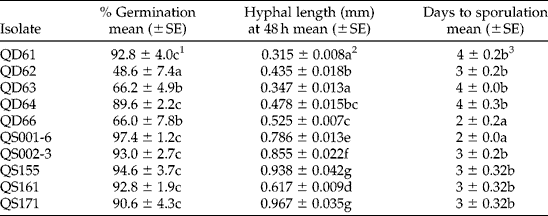
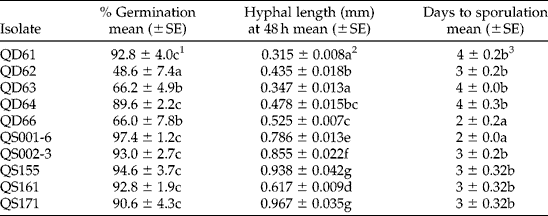
Green sporulation was evident in all the isolates; however, isolates QD61–QD63 were substantially darker in colour compared with the remaining isolates. The shape of conidia from each isolate was strongly similar to those illustrated by Bischoff et al. ( Reference Bischoff, Rehner and Humber2006 ), providing additional evidence to support the assertion that all isolates belong to the genus Metarhizium. Significant differences (P< 0.05) were recorded in time to sporulation, which ranged from 2 to 4 days (Table 2 ). Isolates QD66 and QS001-6 took the least time to sporulate, with all other isolates taking significantly (P< 0.05) longer. There were no further significant differences in time to sporulation detected between isolates. For percentage germination, significant differences (P< 0.05) were also found between isolates (Table 2 ). The highest germination (89.6 to 97.4%) was recorded for isolates QD61, QD64, QS001-6, QS002-3, QS155, QS161 and QS171, which did not differ significantly from each other. The lowest germination (48.6%) was recorded with isolate QD62, which differed significantly from all other isolates. Significant differences (P< 0.05) were also recorded for hyphal length (Table 2 ). The greatest hyphal length was measured in isolates QS155 and QS171, which differed significantly from all other isolates (Table 2 ). Isolates QD61 and QD63 had the shortest hyphal length.
Percentage germination, hyphal length and days to sporulation for Metarhizium anisopliae isolates
1 Means with the same letter within a column do not differ significantly at P< 0.05 (ANOVA and LSD test; n= 4).
2 Means with the same letter within a column do not differ significantly at P< 0.05 (ANOVA and LSD test; n= 3).
3 Means with the same letter within a column do not differ significantly at P< 0.05 (Nemenyi test; n= 4).
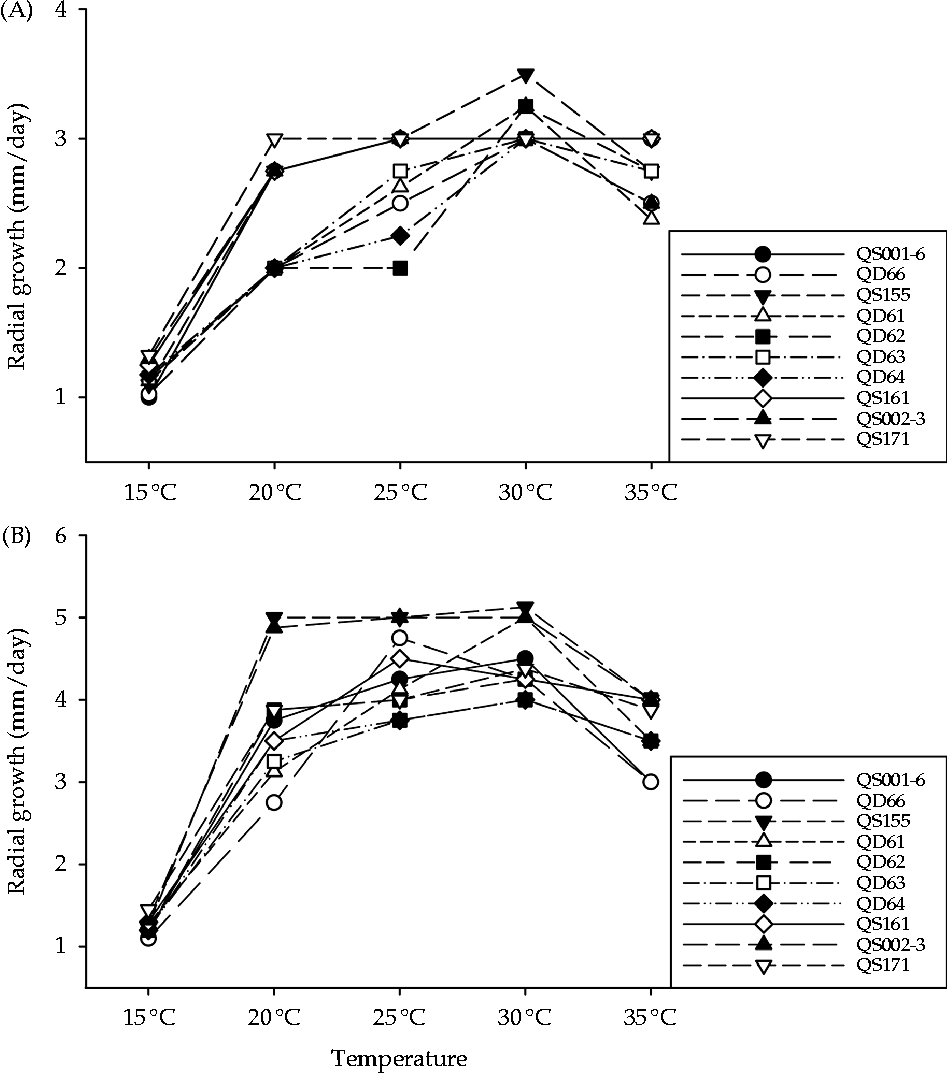
Radial growth increased by at least 50% as temperatures rose from 15 to 35 °C (Fig. 2 ). At 6 DAI, the interaction between isolate and temperature was significant (P< 0.05) for radial growth. At 15 °C growth was poor and there were no differences between isolates; however, at 20 °C, the isolates were separated into two groups. Isolates QS002-3, QS001-6, QS155, QS161 and QS171 had significantly greater growth compared with all other isolates. As the temperature increased, the differences in radial growth declined and were almost absent at 30 °C as the rate of increase in growth of these isolates decreased. The optimal temperature for all isolates was 30 °C, except for the isolate QS171 that had a broad temperature tolerance range between 20 and 35 °C. The greatest radial growth was recorded for the isolate QS155 at 30 °C.
The effect of temperature on radial growth (mm/ day) of Metarhizium anisopliae isolates at (A) 6 DAI and (B) 12 DAI. The interaction between isolate and temperature was significant at both 6 and 12 DAI (P< 0.05, REML). Values are the means of four replicates.
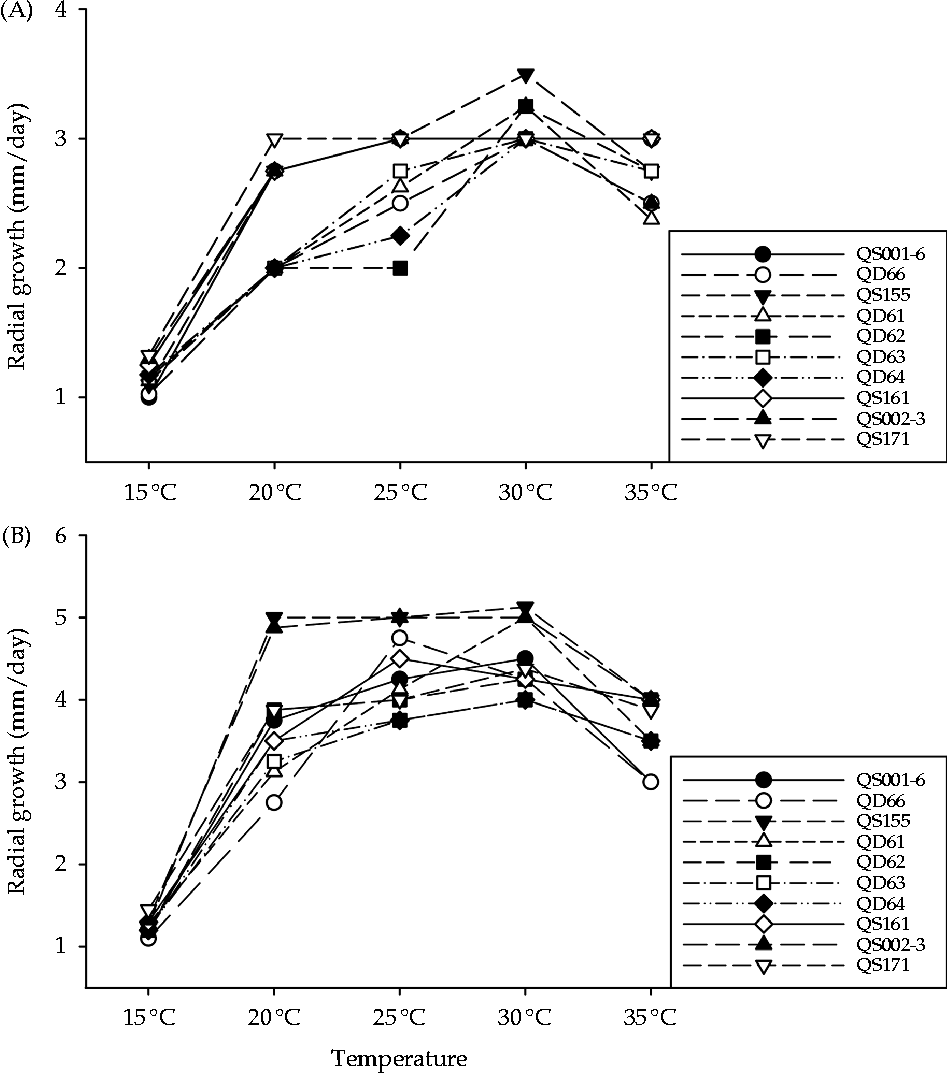
At 12 DAI, the interaction between isolate and temperature was also significant (P< 0.05). At 15 °C, the growth continued to be poor and there were no differences between isolates. At 20 °C, isolates QS002-3 and QS155 showed rapid growth and were significantly (P< 0.05) different to all other isolates. The poorest growth at 20 °C was observed in isolates QD66 and QD61. The majority of isolates showed optimal growth at 30 °C with the exception of isolates QD66 and QS161, which showed a decline in growth. The growth of all isolates decreased at the highest temperature with isolates QD66 and QS001-6 showing the least growth.
Molecular identification of Metarhizium isolates
The dendrogram divided into two distinct clades (1 and 2) at a dissimilarity of 0.4744 (Fig. 3 ). The first clade contained the ITS sequences of the isolates in this study and two other isolates from northern and south-eastern Australia (M.a. 69 and KJ872681, respectively). Isolates QS002-3 through to QD64 are identical (cluster 1). Clade 1 is made up of three additional clusters, in which isolates QD62 and QD66 show a high similarity (cluster III) and isolate QS001-6 represents the cluster IV alone. Cluster IV separates from the other clusters at a similarity of 0.1336. Clade 2 is represented by two large clusters (V and VI); these sequences show the lowest similarity to the ITS sequences of the isolates used in this investigation. Sequences FJ545306, FJ545286, FJ545302 and JQ889704 are of Chinese origin, EU307893 and HQ331464 are of Australian origin, FJ545314 and FJ545308 are of Laotian origin, EU307890 is of Canadian origin, KF766520 is of Indian origin and FJ545321 is of Dutch origin.
Dendrogram showing the relative genetic distances resulting from alignment of the 10 tested experimental isolates of Metarhizium anisopliae, plus 13 additional isolates (GenBank data) (5.8S rDNA-ITS sequences). The analyses were conducted using the UPGMA method in MEGA 6.0 (Tamura et al., Reference Tamura, Stecher, Peterson, Filipski and Kumar2013 ).

Single-concentration screening bioassay
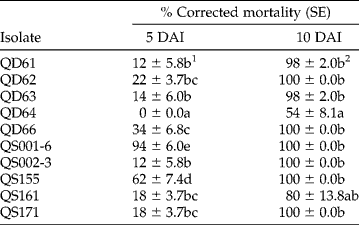
At 5 DAI, the effect of isolate on SPW mortality was significant (P< 0.05). Mortality ranged from 0% (isolate QD64) to 94% (QS001-6). However, the majority of isolates (8 of 10) caused < 35% mean corrected mortality (Table 3 ). At 10 DAI, the effect of isolate on SPW mortality was also significant (P< 0.05). With the exception of isolates QD64 and QS161, which caused 54 and 80% mortality, respectively, all other isolates caused ≥ 98% mortality (Table 3 ).
Corrected mortality of adult SPW after inoculation (1×10⁷conidia/ml) with Metarhizium anisopliae isolates and incubation at 26±1 °C. DAI, days after inoculation. n=5 with 10 SPW (five males and five females) per replicate
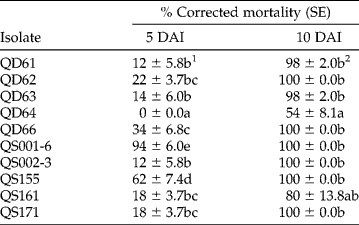
1 Means with the same letter within a column do not differ significantly at P< 0.05 (ANOVA and LSD test).
2 Means with the same letter within a column do not differ significantly at P< 0.05 (Nemenyi test).
Dose–mortality relationships
In the dose–mortality bioassay, isolate QS155 had the lowest LC50 and LC90 values (1.7 × 10⁵ and 5.0 × 10⁶conidia/ml, respectively) and isolate QS001-6 had the highest (2.4 × 10⁷ and 3.2 × 10¹¹conidia/ml, respectively). However, there were no significant differences between any of the isolates when pair-wise comparisons were made (Table 4 ).
LC50 and LC90 values and associated 95% fiducial limits for Metarhizium anisopliae isolates tested against adult SPW. Mortality assessed 20 DAI, incubation at 26±1 °C. n=5 with 10 SPW (five males and five females) per replicate

Discussion
Metarhizium anisopliae has a worldwide distribution and has been recovered from a variety of soils (St. Leger et al., Reference St. Leger, May, Allee, Frank, Staples and Roberts1992 ). Previous work by several authors (Vänninen, Reference Vänninen1996 ; Vänninen et al., Reference Vänninen, Tyni-Juslin and Hokkanen2000 ; Quesada-Moraga et al., Reference Quesada-Moraga, Navas-Cortés, Maranhao, Ortiz-Urquiza and Santiago-Alvarez2007 ) has shown the association between the abundance of M. anisopliae and crop cultivation. The M. anisopliae isolates tested here have been sourced from soils with a history of cultivation, and varied significantly in their germination, time to sporulation and response to temperature, as determined in radial growth studies. These factors, however, did not always closely correlate with one another. While some isolates showed high germination, fast hyphal growth and moderate to rapid sporulation (e.g. QS155, QS171 and QS001-6), others, for example, showed high germination combined with slow hyphal growth and relatively slower sporulation (e.g. QD61). Characteristics such as fast growth rate and sporulation are considered important for virulence and dispersal (Ekesi et al., Reference Ekesi, Maniania and Ampong-Nyarko1999 ). Entomopathogenic fungi tolerate a wide range of temperatures up to 35 °C beyond which germination is reduced (Sun et al., Reference Sun, Fuxa and Henderson2003 ). Lomer et al. ( Reference Lomer, Bateman, Johnson, Langewald and Thomas2001 ) reported growth and sporulation of M. anisopliae on locusts at 35 °C. The isolates studied here exhibited slow growth at low temperatures (15 °C), as did those studied by Arthurs and Thomas ( Reference Arthurs and Thomas2001 ) and Yeo et al. ( Reference Yeo, Pell, Alderson, Clark and Pye2003 ). Although the entomopathogenic fungi tolerate varying temperature regimes, the optima for growth ranges between 20 and 30 °C, and temperature does influence virulence (Goettel et al., Reference Goettel, Inglis, Wraight, Lacey and Kaya2000 ). Our test isolates were sourced from tropical Queensland, Australia, and high temperatures (typically 30 °C for most isolates) increased their radial growth, indicating these isolates are well adapted to the tropical conditions where they were originally found. Since SPW is primarily a problem for sweet potato production in tropical areas, M. anisopliae strains adapted to tropical climates are more likely to be effective control agents than those isolated from more temperate environments. However, if tropical isolates are used at lower temperatures, suboptimal germination and slow growth may lead to reduced efficacy, as demonstrated by Ekesi et al. ( Reference Ekesi, Maniania and Ampong-Nyarko1999 ) who found reduced virulence of tropical M. anisopliae strains against thrips (Megalurothrips sjostedti) at 15 °C. For an insect pest of tropical origin like SPW with an optimum development temperature of between 27 and 30 °C (Sutherland, Reference Sutherland1986a ), it is essential to select isolates of entomopathogenic fungi (such as M. anisopliae) for biological control purposes that thrive at the optimal temperatures for host development.
The phylogenetic analysis of ITS sequences of isolates used in this study suggests that the isolates are relatively closely related. These isolates clustered more closely to M. anisopliae isolated from agricultural soils in Queensland and New South Wales, Australia (M.a. 69 and KJ872681, respectively) than to M. anisopliae isolated from China, Laos, India, Canada or the Netherlands. Further analysis using techniques such as AFLPs (amplified fragment length polymorphisms) would better characterize the genetic relationships between geographically disparate isolates. This technique has been reportedly used with reproducible results, distinguishing M. anisopliae var. anisopliae from other pathogenic fungal isolates (Inglis et al., Reference Inglis, Duke, Goettel and Kabaluk2008 ).
The isolates screened had varying degrees of virulence to adult SPW. At 5 DAI, isolate QS001-6 exhibited high virulence (94% mortality) and isolate QS155 exhibited moderate virulence (62% mortality) at 107conidia/ml. These isolates were obtained using mealworms as bait in soil samples obtained from abandoned lands and sweet potato fields, respectively. At 107conidia/ml, other researchers were able to perform initial pathogenicity screening of M. anisopliae isolates using varied modes of infection against a range of Coleoptera (including Cylas puncticollis) (Ondiaka et al., Reference Ondiaka, Maniania, Nyamasyo and Nderitu2008 ) and larvae of the black vine weevil (Bruck, Reference Bruck2004 ). The data generated in this work demonstrate that this concentration is useful for screening and differentiating highly virulent from less virulent strains at 5 DAI. Although different life stages of a target insect vary in susceptibility to entomopathogens (Ekesi and Maniania, Reference Ekesi and Maniania2000 ), this study concentrated on the infection of the adult stage of SPW, as other life stages are spent within the storage roots of the host plant.
In the dose–mortality bioassay, isolate QS155 had the lowest LC50 and LC90 values, followed by QD66 then QS001-6. However, there were no significant differences between isolates for the LC50 or LC90 values when pair-wise comparisons were made, in part owing to the broad fiducial limits, which reflect the relatively high variability between replicates. Our most virulent isolate, QS155, has lower LC50 and LC90 values than the virulent M. anisopliae isolate tested and found effective against C. puncticollis by Ondiaka et al. ( Reference Ondiaka, Maniania, Nyamasyo and Nderitu2008 ), although the LC values were generated using different application methods in the two studies, making direct comparisons problematic. The three isolates tested in the 20-day dose–mortality experiments showed a different order of activity against SPW than in the shorter term single-concentration screening assay. At five DAI with 107conidia/ml, isolate QS001-6 produced the highest SPW mortality (Table 3 ), while in the 20-day experiment this isolate produced the lowest response (highest LC50 and LC90 estimates; Table 4 ). Since the 20-day dose–response bioassays did not identify statistically significant differences between isolates, care must be taken in comparing the two experiments; however, it should be noted that of the two isolates that showed high initial germination rates, QS001-6 had the fastest time to sporulation. This may account for the stronger response to this isolate in the shorter-term test. We believe that isolate QS155 has the greatest potential to be used as a biological control agent based on its fast growth rate, relatively rapid sporulation, high germination rate and high virulence.
The effects of infection preceding mortality, such as reduced feeding, restlessness and susceptibility to predators at lower Metarhizium dosages, have been reported in studies on other coleopterans (Hajek et al., Reference Hajek, Lund and Smith2008 ), and should be evaluated in relation to the response of SPW adults to virulent Metarhizium isolates (such as QS155). Additional information on the potential for horizontal transmission of M. anisopliae, and on the efficacy of conidial treatments under glasshouse and field conditions, is also required to determine whether isolate QS155 has the potential to provide effective SPW control in commercial and subsistence sweet potato production.
Acknowledgements
The senior author received financial support from the Australian Centre for International Agricultural Research through a John Allwright Fellowship to conduct this study at Charles Sturt University. The authors thank Ian Newton and Russell McCrystal, both of the Queensland Department of Agriculture, Fisheries and Forestry, for providing Metarhizium isolates and SPW cultures, respectively. Benjamin Stodart and Julie Pattemore assisted in the molecular work, while Idris Barchia generously provided us with a copy of his probit analysis program.