INTRODUCTION
Many plants have trichomes, but their significance is not always clear. In many species they are thought to provide physical protection from attack by predators (Johnson et al. Reference Johnson, Kolevski and Smyth2002). Grains have trichomes on their kernels; for example the oat kernel, also termed the caryopsis or groat, is generally covered with trichomes. Trichomes are also present at the non-embryo end of wheat, rye, barley and triticale grains. They are collectively known as the ‘brush’ and have a high silicon content (Evers et al. Reference Evers, Blakeney and O'Brien1999). The protective function of the trichomes in groats is likely to be minor and could be negative. Groat trichomes collect dust and probably also attract pathogens (Forsberg & Reeves Reference Forsberg, Reeves, Marshall and Sorrells1992).
The occurrence of trichomes is species- and cultivar-specific, but among cereals all oat cultivars have some trichomes on their grains. A Chinese study (Yang Reference Yang2006) from 1981 to 1984 investigated the genetics of oat, examining more than 160 common genotypes of mostly wild oat and classifying them into 21 different types. Almost all of the 21 types had spikelets with trichome-covered primary and secondary grains, which is not unusual for wild oats.
In conventional oats, the trichomes are covered by the lemma and palea when the grains are processed. The oat trichomes do not emerge until the grain is processed, e.g. in the milling process (Hoseney Reference Hoseney and Hoseney1998). The trichomes of naked oat are partially lost during threshing and grain handling as the lemma and palea are shed and the surface of the grains becomes exposed. Trichomes can cause itchiness and also more serious reactions in those handling the grains. A brochure for an Australian cultivar of naked oat, Numbat, informs that the grains are covered with a mass of fine hairs that detach at threshing. Descriptions of the oat life cycle use the term pubescent to describe the grains. Trichomes are extremely irritating and can cause allergic reactions, hay fever and asthma. Therefore, it is strongly advised that the skin should be protected and that air extraction and a suitable airflow helmet that complies with health and safety legislation should be used in the threshing room.
Trichomes, as they accumulate and form fine dust, also block up grain-handling machinery. The registration description of cv. Lamont naked oats cautions producers about thin hairs that cause itchiness and notes that the hairs tend to block machinery (Erikson et al. Reference Erikson, Wesenberg, Burrup and Whitmore2003). Trichomes clearly represent a disadvantage and growers are eager to have trichome-free cultivars.
Researchers have searched for the genes controlling trichome number and length. Burrows et al. (Reference Burrows, McDiarmid and Marder2001) were the first to discover a single recessive gene, Gt-1, which reduces trichome number in naked oats. This gene had only a small effect on reducing the number and length of the trichomes at the brush end of the groat. Apparently, an additional gene controls the degree of coverage. However, the Gt-1 gene reduced the total number of trichomes. The UK Institute of Grassland and Environmental Research (IGER) set a short-term goal to develop a naked-oat cultivar with a trichome density (pubescence) as low as possible (IGER 2007). Canadian scientists at the Ontario Ministry of Agriculture, Food and Rural Affairs (OMAFRA) are also working towards the same goal, developing a naked-oat variety that loses its hull as well as its trichomes at threshing (OMAFRA 2002).
With the naked-oat cultivars currently available all around the world, the trichomes are only partially removed during threshing. In order to maximize trichome removal, it is advised that the concave clearance of the thresher is reduced (Valentine Reference Valentine and Welch1995). This, however, can damage the grain and cause reduced germination capacity (Kirkkari et al. Reference Kirkkari, Peltonen-Sainio and Rita2001; Peltonen-Sainio et al. Reference Peltonen-Sainio, Muurinen, Vilppu, Rajala, Gates and Kirkkari2001). In practice, it is difficult to separate the trichomes by adjusting the thresher settings because the lemma and palea of naked oat do not always detach after either narrowing the concave clearance or by increasing cylinder speed (Kirkkari et al. Reference Kirkkari, Peltonen-Sainio and Lehtinen2004). Usually the trichomes are removed by polishing the grain after threshing, especially when the grain is to be used for human consumption (Valentine Reference Valentine and Welch1995).
When Burrows et al. (Reference Burrows, McDiarmid and Marder2001) discovered the gene controlling trichome growth, they studied the gene's effect by measuring the hectolitre (test) weight of grains. Test weight is the most commonly used method to evaluate oat quality (Forsberg & Reeves Reference Forsberg, Reeves and Welch1995). The gene reduced the number of trichomes and the test weight of the threshed material clearly increased (Burrows et al. Reference Burrows, McDiarmid and Marder2001). It seemed that trichomes, despite being thin and feathery, prevented naked oat from packing tightly and therefore when present in large amounts reduced test weight.
Since further efforts are needed to reduce trichome numbers in naked oat, the present study aimed to evaluate the differences in trichome densities among cultivars and variation within cultivars by studying grains from different positions on a panicle, i.e. representing differences in time of grain set and maturation. Additional experiments focussed on comparing the impact of threshing adjustments on removal of trichomes.
MATERIALS AND METHODS
The data used in the current experiment came from the experimental farm of the Work Efficiency Institute (TTS Institute), Finland, from cultivar and threshing experiments carried out in 2004. The oat cultivars were all sown at the same time (15 May) in randomized plots. The seeding rate was 550 viable seeds/m2 for naked oat and 500 seeds/m2 for conventional oat (Peltonen-Sainio Reference Peltonen-Sainio1997). The field plots received a basal fertilizer application at sowing (90 kg N/ha, 18 kg P2O5/ha, 41 kg K2O/ha), weeds were controlled with a mixture of MCPA (a.i. 450 g/ha) and triasulfuron (a.i. 4 g/ha) and aphids were controlled with dimethoate (a.i. 200 g/ha) as necessary.
The study was divided in two different parts: the cultivar experiment and the threshing experiment. The cultivar experiment comprised five cultivars, four naked and one conventional oat. Naked cultivars were NK 00117, Polar, Lisbeth and Bullion, and the conventional cultivar was Salo. The threshing experiment used only Lisbeth and Bullion. Each cultivar was sown in two 100 m2 plots. The samples from the cultivar experiment were hand-harvested when the crops were fully mature. Several bunches of panicles were collected evenly from each plot. They were dried at room temperature in a well-ventilated area. Individual panicles from each bunch were selected for further study. A spikelet was selected from the top and bottom of each panicle. The lemma and palea were gently removed by hand, so the grain was untouched. The number and orderliness of trichomes on the grains were determined using a light microscope.
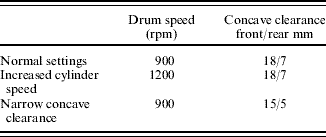
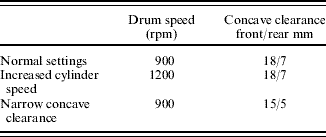
In the threshing experiment, threshing was carried out using a standard farm machinery (combine harvester) at three different threshing settings. For the normal setting, the cylinder (diameter 450 mm) speed was 900 rpm (21 m/s; recommended in the user manual for threshing conventional oat) and with the front concave clearance set at 18 mm and the rear concave clearance at 7 mm. The increased cylinder speed setting 1200 rpm (28 m/s) was used as a second setting. For the third setting the concave clearance was reduced, with the front concave clearance set at 15 mm and the rear at 5 mm (Table 1). Samples of threshed grain, which were free from both lemma and palea, were examined under a light microscope to allow a visual estimate to be made of the pubescence of the grains and the impact of threshing settings on the amount of trichomes.
The threshing settings used in this experiment
Statistical analyses
Pubescence was estimated visually and data were recorded on an ordinal scale, i.e. records indicated the relative order, but not the magnitude of differences. Data were gathered for five cultivars and four grain positions on the spikelet (primary, secondary, tertiary and quaternary), allowing data to be expressed in a three-dimensional contingency table. The Cochran–Mantel–Haenszel statistic (Agresti Reference Agresti1990) was appropriate for this analysis: it addresses whether two variables are associated after controlling for the stratification variable. The Cochran–Mantel–Haenszel statistic was used to analyse the data and the stratification variable was the position when association between the cultivar and the pubescence was tested. Correspondingly, cultivar was used as the stratification variable when association between the position and the pubescence was tested.
Furthermore, the Cochran–Mantel–Haenszel statistic was used to compare the pubescence of grains from the base and apex of the panicle. Cultivar was used as a stratification variable and analyses were made separately for three grain positions on the spikelet (primary, secondary and tertiary).
The effect of three different threshing settings on pubescence was statistically tested using the Pearson's chi-square test (Agresti Reference Agresti1990), making separate analyses for two cultivars (Lisbeth and Bullion). Finally, all data were analysed using the Cochran–Mantel–Haenszel statistic with cultivar as a stratification variable.
RESULTS
Trichomes ranged in length from 1 to 2·5 mm for the four naked-oat cultivars and one dehulled conventional cultivar. They ranged from being well-ordered to completely tangled on the groat surface. Also the sturdiness of the trichomes varied; some were very thin and prone to break and generate dust, while others were more robust.
Number of grains per spikelet
No cultivars had more than four fertile grains per spikelet. Cultivar Polar had the highest number of grains per spikelet with cv. Bullion next. Spikelets at the top of the panicle averaged three grains per spikelet, while those at the base of the panicle had two grains. In oat inflorescences, the top of the panicle develops first and the spikelet and floret set continues downwards to the base of the panicle. Hence, the upper parts of the panicle are most advanced, having time and resources to set and develop more grains (Rajala & Peltonen-Sainio Reference Rajala and Peltonen-Sainio2004).
Pubescence
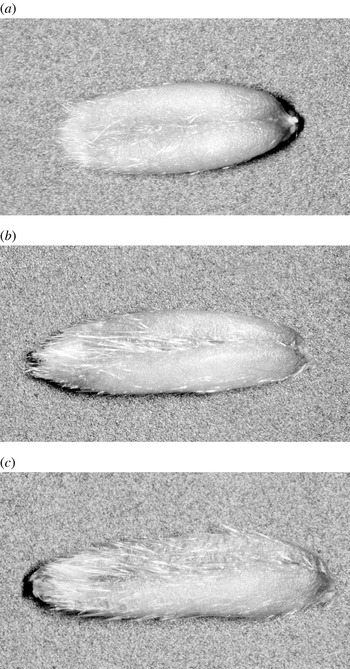
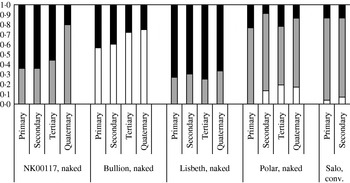
Pubescence was estimated visually using a light microscope. Grains were classified into three groups: 1 – slightly pubescent, 2 – moderately pubescent or 3 – very pubescent (Fig. 1). The cultivars showed considerable differences in pubescence (χ 42=193·6, P<0·001). The hairiest cultivars were the Finnish cv. Lisbeth (test weight 62·7 kg, 1000 seed weight 27·9 g) and cv. NK 00117. Cultivar Bullion (test weight 68·6 kg, 1000 seed weight 29·5 g) had the fewest trichomes (Fig. 2). Completely trichome-free or polished grains were not recorded. The pubescence did not seem to correspond with the weight of 1000 grains or test weight; Bullion had the highest hectolitre weight and the fewest trichomes, which is in accordance with the finding of Burrows et al. (Reference Burrows, McDiarmid and Marder2001).
Examples of pubescence: (a) slightly pubescent, (b) moderately pubescent and (c) very pubescent.

Proportions of caryopses in different pubescence classes in different oat cultivars (n, caryopsis=30) measured from hand-threshed, intact grains: □, slightly pubescent;  , moderately pubescent; ▪, very pubescent.

Major differences were found in pubescence of naked-oat cultivars (Fig. 2). Lisbeth had most trichomes, with 0·70 of the grains having high pubescence and the rest moderate. The least pubescent oat was Bullion, with approximately 0·006 of primary and secondary grains showing slight pubescence and the rest moderate. Up to 0·70 of the tertiary and quaternary grains of Bullion had only low pubescence. NK 00117 was also quite pubescent, with more than 0·60 of the primary, secondary and tertiary grains being very pubescent, while only 0·20 of the quaternary grains were very pubescent, and the rest of them were moderately pubescent. Polar showed the greatest within-cultivar variation, with all pubescence groups occurring for all grains except primary grains, which did not include any slightly pubescent grains. More than 0·60 of grains in Polar were moderately pubescent. The conventional oat cultivar Salo also showed variation, although most of its grains were moderately pubescent.
The significance of the position of the grain on a panicle
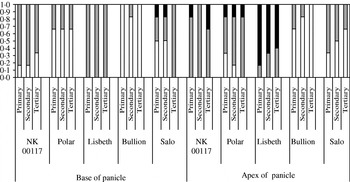
The position of the grain on a panicle influences the degree of trichome coverage. Primary (χ 12=9·73, P<0·01), secondary (χ 12=4·66, P=0·03) and tertiary grains (χ 12=3·96, P=0·05) from the base of a panicle had fewer trichomes than those from the top (Fig. 3). Polar, NK 00117 and Lisbeth had more trichomes on grains from the upper part of a panicle than those from the basal area. Bullion had nearly equal numbers of trichomes on grains from the top and base of the panicle and Salo, the conventional dehulled oat, had more trichomes on grains from the base of the panicle. There were few differences in pubescence among primary, secondary and tertiary grains from a spikelet (Figs 2 and 3). When the grain position was analysed as a nominal level variable, differences were not statistically significant (χ 32=5·68, P=0·13). If the order of positions was taken into account, differences between positions were statistically significant (χ 12=5·48, P=0·02). In practice, there was a clear tendency for fewer trichomes on tertiary and quaternary grains than on primary and secondary grains. However, the differences were mainly due to the cultivar and not the grain position on the spikelet. Many grains had a tuft of trichomes at the non-embryo end. Some cultivars, such as Lisbeth, had a prominent tuft, while others, such as Bullion, had only a sparse one.
Degree of pubescence of different grains from oat spikelets, from the base and apex of the panicles of different cultivars: □, slightly pubescent; , moderately pubescent; ▪, very pubescent.

Threshing experiment
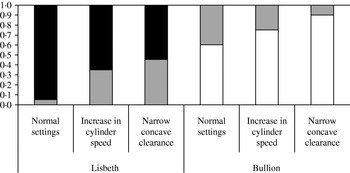
The threshing experiment of 2004 included the cvs Bullion and Lisbeth. The results showed that Bullion grains had fewer trichomes than Lisbeth and that this was also the case after threshing. For Bullion, an increase in cylinder speed slightly increased grain polishing, so that the grains had completely bare areas. Reduction of the concave clearance had a similar effect. Threshing settings did not affect the trichome number of Lisbeth to the same extent (Fig. 4). Grains of Lisbeth are narrow and small and the removal of lemma and palea is difficult (Kirkkari et al. Reference Kirkkari, Peltonen-Sainio and Lehtinen2004). The threshing settings had a statistically significant effect on the cultivars (χ 12=10·94, P<0·01).
Effect of threshing settings on the degree of pubescence of the naked-oat cultivars Lisbeth and Bullion: normal, and increased cylinder speeds and narrow concave clearance. □, Slightly pubescent; , moderately pubescent; ▪, very pubescent.

DISCUSSION
The present findings show that different cultivars had distinctive pubescence characteristics. This suggests that there is likely to be potential for reducing grain pubescence in naked cultivars. However, complete absence of trichomes represents a challenge to plant breeders.
In addition to cultivar differences, within-cultivar variation for pubescence was noted in the present study. The position of the grain on the spikelet influenced pubescence. The primary grains were always relatively pubescent, while the tertiary and quaternary grains were generally the least pubescent. Such a trend was found in all cultivars. Under Finnish growing conditions, numerous multi-floret spikelets, exceeding four grains per spikelet, are rare, while primary and secondary grains are the main contributors to grain yield of naked oat under northern growing conditions (Peltonen-Sainio Reference Peltonen-Sainio1994, Reference Peltonen-Sainio1997; Peltonen-Sainio et al. Reference Peltonen-Sainio, Kirkkari and Jauhiainen2004). This might slightly emphasize the average pubescence of the harvested yield. The position of a grain within the panicle also contributed to the pubescence. All the grains, irrespective of being primary, secondary or tertiary, were significantly more pubescent from the apex of the panicle compared with the base.
Oat grains first develop at the top of the panicle, spikelet and floret set progressing then to the lower parts of the inflorescence (Bonnet Reference Bonnett1961). Likewise within a spikelet, the primary floret initiates first, is most advanced in development, has the highest sink capacity as well as capacity for transportation of photoassimilates and thus becomes the prominent grain on the spikelet (Rajala & Peltonen-Sainio Reference Rajala and Peltonen-Sainio2004). Therefore, grains at the top of a panicle and the primary grains within a spikelet have more resources and time to fill and ripen, but as a result they are not only larger but also, according to the present findings, better able to develop higher pubescence on the grain.
There was little that could be done to reduce the pubescence of naked oat through adjustments to the threshing machinery. When using more coarse settings, increase in cylinder speed or narrow concave clearance, pubescence decreased by 30–40% in cv. Lisbeth and by 15–30% in cv. Bullion when compared with standard harvester settings. It is likely that removing all trichomes from the grains would require the addition of polishing equipment to the thresher. Adding such equipment would not be economically feasible if the machinery were not used for additional purposes. Furthermore, polishing grains in the thresher could reduce germination capacity of naked oat and thereby have negative effects on the cultivation chain. Many of the additional handling stages of naked-oat grains do have such an effect as naked grains are prone to various mechanical stresses (Kirkkari et al. Reference Kirkkari, Peltonen-Sainio and Rita2001, Reference Kirkkari, Peltonen-Sainio and Lehtinen2004; Peltonen-Sainio et al. Reference Kirkkari, Peltonen-Sainio and Lehtinen2004).
The present results provide new information and indicate marked differences among and variation within naked-oat cultivars in grain pubescence. Nevertheless, these results do not point to instant solutions for the trichome problem, especially as adjustments to combine harvester settings were not particularly effective and could result in negative effects on grain characteristics and quality. While the disadvantages represented by trichomes may seem small, they could significantly affect growers’ decisions on whether to produce naked oat and influence the decision which cultivar to grow. As an example, letting grains run through one's fingers will already cause unpleasant and sometimes long-lasting itching, which is why addressing the problem as early in the cultivation chain as possible would be most effective. This means that trichome problems should be an important trait assessed in breeding and selecting new naked-oat material.