Cognitive theories of depression assert that cognitive vulnerabilities, including biased self-schemas, play a causal role in the development of depression (Beck, Reference Beck2008; Gotlib & Joormann, Reference Gotlib and Joormann2010). Self-schemas, also referred to self-schematic processing or self-referential processing, are early emerging, latent cognitive constructs that guide the processing of positive and negative personal information as related to the self (Northoff et al., Reference Northoff, Heinzel, de Greck, Bermpohl, Dobrowolny and Panksepp2006). Decades of research show that depressogenic patterns of self-referential processing (i.e., more negative and/or less positive self-schemas) are associated with both concurrent and prospective depressive symptoms in clinical samples of depressed adults and adolescents (e.g., Auerbach, Stanton, Proudfit, & Pizzagalli, Reference Auerbach, Stanton, Proudfit and Pizzagalli2015; Dobson & Shaw, Reference Dobson and Shaw1987; Kuiper & Derry, Reference Kuiper and Derry1982; Prieto, Cole, & Tageson, Reference Prieto, Cole and Tageson1992) and in nonclinical samples of youth (Goldstein, Hayden, & Klein, Reference Goldstein, Hayden and Klein2015; Gotlib, Joormann, Minor, & Cooney, Reference Gotlib, Joormann, Minor, Cooney and Canli2006; Hayden et al., Reference Hayden, Olino, Mackrell, Jordan, Desjardins and Katsiroumbas2013, Reference Hayden, Hankin, Mackrell, Sheikh, Jordan, Dozois and Badanes2014; Jacobs, Reinecke, Gollan, & Kane, Reference Jacobs, Reinecke, Gollan and Kane2008). Overall, these data support the utility of self-referential processing as an early predictor of depression and its potential as a target for early prevention.
Self-referential processing is typically assessed by the self-referent encoding task (SRET), one of the best-established paradigms for assessing cognitive risk related to self-schemas (Derry & Kuiper, Reference Derry and Kuiper1981; Kuiper & Derry, Reference Kuiper and Derry1982). While there is some variation in how the SRET is implemented, typically, the task involves a self-endorsement phase followed by a free recall phase (Auerbach et al., Reference Auerbach, Stanton, Proudfit and Pizzagalli2015; Goldstein et al., Reference Goldstein, Hayden and Klein2015; Gotlib et al., Reference Gotlib, Joormann, Minor, Cooney and Canli2006; Hammen & Zupan, Reference Hammen and Zupan1984; Hayden et al., Reference Hayden, Olino, Mackrell, Jordan, Desjardins and Katsiroumbas2013, Reference Hayden, Hankin, Mackrell, Sheikh, Jordan, Dozois and Badanes2014; Jacobs et al., Reference Jacobs, Reinecke, Gollan and Kane2008; Prieto et al., Reference Prieto, Cole and Tageson1992; Zupan, Hammen, & Jaenicke, Reference Zupan, Hammen and Jaenicke1987). More specifically, participants view a series of positive and negative trait words (typically adjectives), indicating whether each word is self-descriptive (“Is this like you?”); this is followed by an unexpected recall period, when children are asked to recall as many of the presented words as possible. Positive and negative self-schemas are then indexed by calculating positive and negative SRET scores as the proportion of positive and negative words both endorsed and recalled, with lower positive and higher negative SRET scores reflecting heightened cognitive risk for depression. By incorporating the free recall component, this approach is believed to tap the implicit, latent construct, of self-schemas. Given that young children may be unable to accurately report on complex aspects of self-knowledge, this paradigm has been particularly useful for studying depressive cognition in children as young as age 6 (Goldstein et al., Reference Goldstein, Hayden and Klein2015).
Research on the neural correlates of self-referential processing is limited in children, although this knowledge may be useful for several reasons. First, neural markers of cognitive risk may emerge earlier than overt manifestation of depressive disorders, thus facilitating early detection of risk in children not yet experiencing serious impairment or distress (Manoach & Agam, Reference Manoach and Agam2013). Neural indices may also be more sensitive than behavioral measures in tapping individual differences during development; neural features have been related to children's risk for disorder even in the absence of behavioral effects (Fu, Taber-Thomas, & Pérez-Edgar, Reference Fu, Taber-Thomas and Pérez-Edgar2017; Hardee et al., Reference Hardee, Benson, Bar-Haim, Mogg, Bradley, Chen and Pérez-Edgar2013; Liu et al., Reference Liu, Vandermeer, Joanisse, Barch, Dozois and Hayden2020a; Thai, Taber-Thomas, & Pérez-Edgar, Reference Thai, Taber-Thomas and Pérez-Edgar2016). A better understanding of the early neural underpinnings of depressogenic self-schemas may also inform brain-based prevention and intervention for depression. Descriptive studies of associations between depressogenic self-schemas and neural correlates, such as the current study, are an important first step in laying the groundwork for more nuanced hypothesis testing aimed at understanding etiological pathways between the brain and self-cognition.
Hypotheses concerning the neural functional substrates of the development of self-referential processing can be drawn from the functional magnetic resonance imaging (fMRI) literature using the SRET and similar paradigms. These studies, which are primarily of adults, indicate that self-referential (vs. other-referential) processing activates a network including cortical midline structures (e.g., medial prefrontal cortex [mPFC], cingulate cortex, precuneus) as well as regions within the frontolimbic system (see meta-analyses Denny, Kober, Wager, & Ochsner, Reference Denny, Kober, Wager and Ochsner2012; Hu et al., Reference Hu, Di, Eickhoff, Zhang, Peng, Guo and Sui2016; Northoff et al., Reference Northoff, Heinzel, de Greck, Bermpohl, Dobrowolny and Panksepp2006). The relatively smaller number of studies on normative self-referential processing in typically developing youth implicates similar brain regions (Barendse et al., Reference Barendse, Cosme, Flournoy, Vijayakumar, Cheng, Allen and Pfeifer2020; Pfeifer et al., Reference Pfeifer, Masten, Borofsky, Dapretto, Fuligni and Lieberman2009; Pfeifer & Blakemore, Reference Pfeifer and Blakemore2012; Pfeifer & Peake, Reference Pfeifer and Peake2012; Pfeifer, Lieberman, & Dapretto, Reference Pfeifer, Lieberman and Dapretto2007; Romund et al., Reference Romund, Golde, Lorenz, Raufelder, Pelz, Gleich and Beck2017), although differences from adults have also been noted, which may reflect different neurocognitive strategies used in self-reflection and different neural maturation status in children versus adults (e.g., Pfeifer et al., Reference Pfeifer, Lieberman and Dapretto2007).
With regard to self-referential processing in depression, altered activation patterns in the aforementioned cortical midline structures and frontolimbic regions have been reported. Adults with current or lifetime depression show greater activation within cortical midline structures and frontolimbic regions such as amygdala during negative self-judgment (see review Nejad, Fossati, & Lemogne, Reference Nejad, Fossati and Lemogne2013). Compared to control groups, clinically depressed adolescents show heightened activation in posterior cingulate cortex and precuneus during positive self-judgements (Bradley et al., Reference Bradley, Colcombe, Henderson, Alonso, Milham and Gabbay2016), although Quevedo et al. (Reference Quevedo, Ng, Scott, Smyda, Pfeifer and Malone2017) found that depressed adolescents showed decreased activity in dorsal anterior cingulate cortex during positive versus negative self-referential processing. These inconsistent findings may stem from the heterogeneity of participants (e.g., severity of depression, treatment, age). Further, given that these are studies of depressed individuals, it is unclear whether the neural alterations reported are markers of early risk or consequence of depressive disorder. Our group recently investigated neural correlates of self-referential processing in a group of never-depressed preadolescents with a maternal history of depression, finding that high-risk youth showed heightened activation in ventrolateral PFC (vlPFC) and ventromedial PFC (vmPFC) during positive self-referential processing, even though high- and low-risk youth did not differ in positive SRET scores. These findings suggest that high-risk youth may have to mobilize greater PFC-mediated, higher-order cognitive resources to achieve similar SRET performance as low-risk youth (Liu et al., Reference Liu, Vandermeer, Joanisse, Barch, Dozois and Hayden2020a).
Compared to the fMRI literature, much less is known about the structural neural correlates of normative or depressogenic self-schemas, particularly in youth. Neurocognitive functions are subserved by the neuroanatomical architecture of the brain (Stiles & Jernigan, Reference Stiles and Jernigan2010); structural variations in regions supporting self-referential processing may also contribute to depressogenic self-schemas in important ways. The paucity of work in this area is surprising given the methodological advantages of structural MRI (sMRI), especially for studying children. During task-fMRI, it can be challenging for children to stay still while performing a task; sMRI, however, does not involve tasks and thus is likely to be less impacted by head motion and to generate more reliable data (De Bie et al., Reference De Bie, Boersma, Wattjes, Adriaanse, Vermeulen, Oostrom and Delemarre-Van De Waal2010; Raschle et al., Reference Raschle, Zuk, Ortiz-Mantilla, Sliva, Franceschi, Grant and Gaab2012). sMRI also avoids the problem that specific tasks often fail to consistently elicit the expected activation, which is even more likely in children, given their greater inter-individual variability (Church, Petersen, & Schlaggar, Reference Church, Petersen and Schlaggar2010).
We recently conducted the first sMRI study investigating the association between depressogenic self-schemas indexed by SRET and regional gray matter volume (GMV) in a group of never-depressed preadolescents with heightened familial depression risk (Liu et al., Reference Liu, Vandemeer, Joanisse, Barch, Dozois and Hayden2020b). We found that youth's depressogenic (i.e., less positive or more negative) self-referential processing was associated with smaller regional GMV within vlPFC and posterior cingulate cortex, areas critical for emotion regulation, and self-related processes. This finding in nondepressed youth suggests that lower regional GMV within these regions may be a neurobiological marker of early cognitive vulnerability to depression (Liu et al., Reference Liu, Vandemeer, Joanisse, Barch, Dozois and Hayden2020b). In addition, our findings are consistent with the sMRI literature on associations between GMV and depression, which typically reports smaller GMV in distributed regions including PFC, cingulate cortex, amygdala, and hippocampus in clinically depressed youth and adults (Arnone et al., Reference Arnone, Job, Selvaraj, Abe, Amico, Cheng and McIntosh2016; Bora, Harrison, Davey, Yücel, & Pantelis, Reference Bora, Harrison, Davey, Yücel and Pantelis2012; Lai, Reference Lai2013; Peng, Chen, Yin, Jia, & Gong, Reference Peng, Chen, Yin, Jia and Gong2016; Sacher et al., Reference Sacher, Neumann, Fünfstück, Soliman, Villringer and Schroeter2012; Schmaal et al., Reference Schmaal, Hibar, Sämann, Hall, Baune, Jahanshad and Veltman2017) and youth with heightened depressive symptoms (Boes, McCormick, Coryell, & Nopoulos, Reference Boes, McCormick, Coryell and Nopoulos2008; Vulser et al., Reference Vulser, Lemaitre, Artiges, Miranda, Penttilä, Struve and Stephens2015). Importantly, these regions overlap with those reported in fMRI studies of self-schemas, which subserve self-referential processing and show altered activation in individuals with clinical depression (e.g., Bradley et al., Reference Bradley, Colcombe, Henderson, Alonso, Milham and Gabbay2016; Nejad et al., Reference Nejad, Fossati and Lemogne2013; Ramel et al., Reference Ramel, Goldin, Eyler, Brown, Gotlib and McQuaid2007) and heightened depression risk (Liu et al., Reference Liu, Vandermeer, Joanisse, Barch, Dozois and Hayden2020a).
Although findings from our recent sMRI study support the potential role of GMV as a neurobiological marker of early cognitive risk, the cross-sectional design captures only a “snap-shot” of self-schemas across development. Longitudinal studies have reported that positive and negative self-referential processing show moderate stability and mean-level growth during middle childhood (age 6/7–age 9; Goldstein et al., Reference Goldstein, Hayden and Klein2015; Hayden et al., Reference Hayden, Olino, Mackrell, Jordan, Desjardins and Katsiroumbas2013) and adolescence (age 13–age 19; McArthur et al., Reference McArthur, Burke, Connolly, Olino, Lumley, Abramson and Alloy2019). The rate of growth (indexed by the slope) is associated with other relevant variables; for example, maternal criticism at child age 7 predicted faster increase of negative self-schemas from age 7 to age 9 (Hayden et al., Reference Hayden, Olino, Mackrell, Jordan, Desjardins and Katsiroumbas2013). However, none of the extant longitudinal studies of SRET in youth collected neural measures, nor have these studies examined the development of self-schemas in children approaching adolescence, a time of marked changes in self-schemas and brain maturation, and just prior to sharp increases in depressive symptoms (Abela & Hankin, Reference Abela, Hankin, Abela and Hankin2008; Hankin & Abramson, Reference Hankin and Abramson2001).
The current study addresses these gaps. Specifically, we examined the GMV correlates of children's trajectories of depressogenic patterns of self-schemas using three waves of SRET data and one wave of sMRI data. SRET data were collected from a community sample of 79 children at ages 6, 9, and 12, who were recruited based on having heightened early temperamental risk for internalizing disorders. sMRI data were collected from these children at age 10, with 74 out of the 79 children contributing usable sMRI data. This study focused on the SRET and sMRI data of the 74 children. Specifically, the three-wave SRET data allowed us to characterize the developing patterns of self-schemas from age 6 to age 12 by estimating the slope (rate of change) of positive and negative SRET scores for each child as a function of age.
In analyses aimed at describing associations between GMV and the development of depressogenic self-schemas, we characterized descriptive associations between rate of growth of self-schemas and GMV by running linear regression models in voxel-based morphometry analysis, with the slope of self-schemas from age 6 to age 12 as the regressor and regional GMV at age 10 as the outcome. To enhance the sensitivity of analyses, we ran voxel-based morphometry in conjunction with small volume correction within a single composite mask consisting of seven a priori regions of interest (ROIs), including three cortical midline structures important for self-referential processing (cingulate cortex, vmPFC, precuneus) and four bilateral frontolimbic regions commonly involved in emotion processing and emotion regulation (amygdala, hippocampus, vlPFC, and dlPFC). The selection of ROIs was directly informed by our recent MRI studies in a different youth sample (Liu et al., Reference Liu, Vandermeer, Joanisse, Barch, Dozois and Hayden2020a, Reference Liu, Vandemeer, Joanisse, Barch, Dozois and Hayden2020b) and the neuroimaging literature on youth depression (e.g., Boes et al., Reference Boes, McCormick, Coryell and Nopoulos2008; Lai, Reference Lai2013; Vulser et al., Reference Vulser, Lemaitre, Artiges, Miranda, Penttilä, Struve and Stephens2015).
Based on these studies, we hypothesized that smaller regional GMV within a priori ROIs would be associated with depressogenic slopes of self-referential processing; that is, slower growth of positive self-schemas and faster increase of negative self-schemas. To test this hypothesis, we conducted voxel-based morphometry within a composite mask including all seven a priori ROIs. While traditional volumetric analysis requires manual delineation of anatomical ROIs and indexes the global volume of gross anatomical regions, voxel-based morphometry provides an automated, unbiased, and more efficient approach with greater sensitivity to individual differences in whole-brain and regional GMV characteristics (Kurth, Gaser, & Luders, Reference Kurth, Gaser and Luders2015).
Method
Participants and procedure
Data reported in this study were drawn from a larger longitudinal study of early risk for internalizing psychopathology (Goldstein et al., Reference Goldstein, Hayden and Klein2015; Olino, Klein, Dyson, Rose, & Durbin, Reference Olino, Klein, Dyson, Rose and Durbin2010). Initially, 559 3-year-old children and their families were recruited from a suburban community. Eligible children had no major medical conditions or developmental disabilities and were of average cognitive development indicated by the Peabody Picture Vocabulary Test (Dunn & Dunn, Reference Dunn and Dunn2007; M = 102.9, SD = 13.9). Most families (86.9%) were White and middle class as measured by Hollingshead's Four Factor Index of Social Status (M = 45.1; SD = 1.9; Hollingshead, Reference Hollingshead1975), and both biological parents were usually living in the home (95.0%). Study procedures were approved by the university research ethics review committee.
The current study used data of four waves of assessment from a sample of 74 children. Data included three waves of SRET data collected at ages 6 (M = 6.08, SD = .42), 9 (M = 9.18, SD = .40), and 12 (M = 12.66, SD = .46), and one wave of MRI data collected at an average age of 10 (M = 10.27, SD = .90; Huang, Klein, & Leung, Reference Huang, Klein and Leung2016; Kann, O'Rawe, Huang, Klein, & Leung, Reference Kann, O'Rawe, Huang, Klein and Leung2017; Kopala-Sibley et al., Reference Kopala-Sibley, Cyr, Finsaas, Orawe, Huang, Tottenham and Klein2020). Children were recruited based on having heightened temperamental risk for internalizing disorders assessed at age t3. At that time, children completed the Laboratory Temperament Assessment Battery (Goldsmith, Reilly, Lemery, Longley, & Prescott, Reference Goldsmith, Reilly, Lemery, Longley and Prescott1995), a series of laboratory tasks designed to elicit a range of behavioral and emotional responses. Child behavior in these tasks was videotaped, and their emotional responses (e.g., sadness, anger, fear, and positive affect) in facial, vocal, and bodily modalities were rated by trained coders. These ratings were then computed to form composite scores to indicate negative emotionality (NE), positive emotionality (PE), and temperamental fear. These measures showed good interrater reliability within this cohort (see Olino et al., Reference Olino, Klein, Dyson, Rose and Durbin2010 for details). Participants in the current study were recruited based on temperamental models of depression risk that posit that high of NE, low PE, and high fear may be relevant to depression's etiology (Rothbart & Bates, Reference Rothbart, Bates, Eisenberg and Lerner2006).Footnote 1, Footnote 2
At the MRI assessment, we also measured children's depressive symptoms via self-report using the Child Depression Inventory (Kovacs & Staff, Reference Kovacs and Staff2003; Cronbach's α = .87). Of the 74 children with usable MRI data, two were diagnosed as having a lifetime history of major depressive disorder or dysthymia by age 12 via the Kiddie Schedule for Affective Disorders and Schizophrenia, Present and Lifetime version (Kaufman et al., Reference Kaufman, Birmaher, Brent, Rao, Flynn, Moreci and Ryan1997), conducted at age 9 and age 12. In subsequent analyses, we repeated voxel-based morphometry with these two children removed to examine if the observed results were driven by the presence of depressive disorders. Finally, in comparing children who did and did not participate in MRI assessment, children who participated in MRI assessment were younger than those who did not participate in MRI data collection at the age-6 assessment (p = .03).
The SRET
Prior to the SRET, a negative mood induction was conducted to induce a dysphoric mood, which is thought necessary to activate latent cognitive vulnerability for depression (Abela & Hankin, Reference Abela, Hankin, Abela and Hankin2008). At ages 6, 9, and 12, children watched a sad film clip followed by sad music. The clip at age 6 was a funeral scene from the film My Girl. The clip at age 9 was a scene from The Dead Poets Society where a young boy was told about a friend passing away. For age 12, the clip was a scene from Marley and Me in which a boy and his family say goodbye to their pet dog before they put him to sleep. All clips lasted less than 3 min and were of comparable duration. After the clip, Adagio for Strings, which has been shown to evoke sad emotion (Siemer, Reference Siemer2005), was played on a 10-min loop until the end of the recall task. Children rated their mood before and after watching the clip on a 5-point scale (1 = very sad, 3 = neutral, 5 = very happy). Paired-samples t tests comparing mood ratings pre- and postinduction indicated that negative mood induction was effective at all ages (ps < .02). Please see details of the results of mood induction at all three ages in the Supplementary (Table S1).
Following the mood induction, children completed the SRET as a measure of self-schemas. To keep the task consistent across ages, the same paradigm and stimuli was used for the three time points. In the SRET, children were shown a series of positive (e.g., smart) and negative (e.g., lazy) trait adjectives printed on 5 × 7 cards while the experimenter read the words aloud. For each word, children were asked if they wanted to endorse this trait for themselves (“Is this like you or not like you?”). To ensure that they understood the task, children first practiced by seeing cards printed with “boy” and “girl.” During the SRET, 14 positive and 14 negative words were presented randomly. Two neutral words were presented at the beginning and the end of the task to reduce primacy and recency effects and were not included in analyses. The words were selected based on their usage in Grade 3 texts or lower, with age-specific word frequency matched across valences (Warren, Carroll, Davies, & Richman, Reference Warren, Carroll, Davies and Richman1973). After completing the endorsement task, children were unexpectedly asked to recall as many of the trait words that had been presented as possible for up to 3 min. Following standard practice (Auerbach et al., Reference Auerbach, Bondy, Stanton, Webb, Shankman and Pizzagalli2016; Derry & Kuiper, Reference Derry and Kuiper1981; Dobson & Shaw, Reference Dobson and Shaw1987; Goldstein et al., Reference Goldstein, Hayden and Klein2015; Gotlib et al., Reference Gotlib, Joormann, Minor, Cooney and Canli2006; Hayden et al., Reference Hayden, Olino, Mackrell, Jordan, Desjardins and Katsiroumbas2013, Reference Hayden, Hankin, Mackrell, Sheikh, Jordan, Dozois and Badanes2014; Jacobs et al., Reference Jacobs, Reinecke, Gollan and Kane2008; Kuiper & Derry, Reference Kuiper and Derry1982; Prieto et al., Reference Prieto, Cole and Tageson1992; Wisco, Reference Wisco2009), we calculated indices of self-schemas as the proportion of positive or negative words both endorsed and recalled to the number of words endorsed (positive SRET score = number of positive words endorsed and recalled/all words endorsed; negative SRET score = number of negative words endorsed and recalled/all words endorsed).
Estimation of intercepts and slopes of SRET performance
We first examined the distribution patterns of positive and negative SRET scores at all three assessments and identified an outlier (> five SDs above the group mean) for negative SRET scores at age 12. The outlier was Winsorized (i.e., replaced by the value of group mean + 3SD) and retained in the subsequent analysis. Next, we conducted two unconditional linear mixed-effects models (SPSS 24.1, IBM, Armonk, NY) on positive and negative SRET scores (N = 74), respectively, with group-level intercept as the fixed-effects factor and subject as the random-effects factor (including both random intercepts and random slopes). Age was centered such that the intercept reflected self-schemas assessed at age 6. Results demonstrated significant group-level intercept and random effect for both positive and negative SRET scores (Table 1), indicating that the group means of positive and negative SRET scores at the starting point (age 6) were significantly larger than zero and that there was significant inter-individual and intra-individual variability in these constructs over time. Finally, we extracted the coefficients of intercept (initial level) and standardized slope (rate of change) for each participant based on individual linear regression models on positive and negative SRET scores as a function of age, which were entered into subsequent voxel-based morphometry of the sMRI data.
Results of unconditional mode

Note. SE, standard error; CI, confidence interval; ***, p < .001.
sMRI data acquisition, processing, and analysis
sMRI data were acquired using a Siemens Trio 3T scanner (Siemens Healthcare, Malvern, PA). T1-weighted, high-resolution structural images were collected using the magnetization prepared rapid gradient echo sequence, slices = 176, slice thickness = 1 mm, TR = 2,400 ms, TE = 3.16 ms, flip angle = 8°, matrix size = 256 × 256, FOV = 256 × 256, voxel resolution = 1 × 1 × 1 mm3. sMRI processing and analysis were conducted using the Computational Anatomy Toolbox (Dahnke & Gaser, Reference Dahnke and Gaser2017) of SPM12 (Wellcome Trust Center for Neuroimaging, London, UK). T1-weighted structural images were first corrected for bias, noise, and global intensity; corrected images were then spatially normalized to the Montreal Neurological Institute (MNI) 152 template using the DARTEL algorithm (Ashburner, Reference Ashburner2007). Next, normalized images were segmented into gray matter, white matter, and cerebrospinal fluid (Ashburner & Friston, Reference Ashburner and Friston2005). Total intracranial volume was calculated for each individual during segmentation and was included as a covariate in the subsequent analysis to control for head size (Greve, Reference Greve2011). Finally, all scans were smoothed with a 6-mm Gaussian kernel and resampled into 1.5 mm3 voxel size. Quality assurance was conducted via visual inspection and an automated quality check protocol embedded in CAT12. Usable sMRI data were available for 74 of the 79 children (two children withdrew; three children had data of poor quality).
In voxel-based morphometry analysis, we ran two regression models to examine associations between regional GMV and rate of change of positive or negative self-schemas, respectively, with each child's standardized slope of positive or negative SRET scores treated as the regressor. We included the intercept of positive or negative SRET scores as a covariate in each model to control for the initial level of self-schemas at age 6.Footnote 3 Youth's depressive symptoms assessed concurrently with sMRI data were treated as a covariate to remove variance in GMV related to co-occurring depressive symptoms. Child age, sex, and total intracranial volume were included as other covariates.Footnote 4
We conducted hypothesis-driven small volume correction analysis within a composite anatomical mask including all a priori ROIs (Automated Anatomical Labeling; Tzourio-Mazoyer et al., Reference Tzourio-Mazoyer, Landeau, Papathanassiou, Crivello, Etard, Delcroix and Joliot2002), including cortical midline (vmPFC, cingulate cortex, precuneus) and bilateral frontolimbic regions (amygdala, hippocampus, vlPFC, dlPFC). Results were first thresholded at whole-brain level at uncorrected p < .001, followed by small volume correction within the composite mask; clusters that survived a family-wise error (FWE) correction with p < .05 at the cluster level were identified as significant. Values of parameter estimates of the model were extracted from each significant cluster for post-hoc analysis (SPSS 24.1, IBM, Armonk, NY). Finally, we re-ran the two regression models within the whole brain as exploratory analyses controlling for the same covariates (intercept, depressive symptoms, age, sex, and total intracranial volume), again using FWE correction (p < .05) to correct for multiple comparisons. The same analyses were also repeated excluding the two children with diagnosable depressive disorders by age 12 (n = 72) to ensure that any findings were not driven solely by clinically significant depression in the sample.
Results
Descriptive statistics and bivariate correlations for main study variables
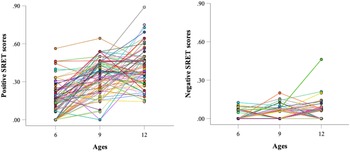
Figure 1 presents scatter plots of positive and negative SRET scores of each child at mean ages of 6, 9, and 12. Visual inspection of the figure suggests that both positive and negative SRET scores showed growth patterns from age 6 to age 12 at the group level. Compared to negative SRET scores, positive SRET scores appeared to be higher, increase faster, and show greater inter-individual variabilities overall. These patterns were confirmed by examining the descriptive statistics for the variables.
Scatter plots of each child's positive and negative self-referent encoding task (SRET) scores at mean ages of 6, 9, and 12 (n = 79).
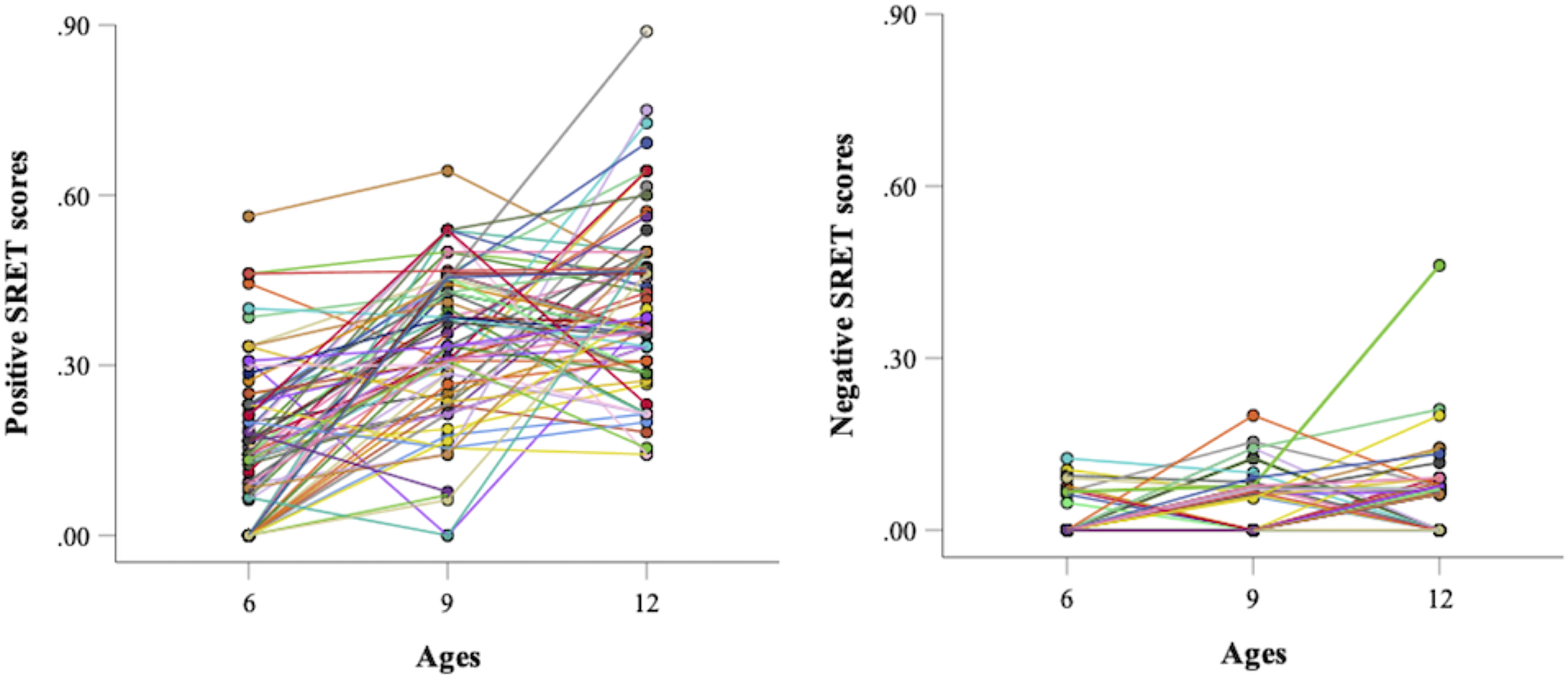
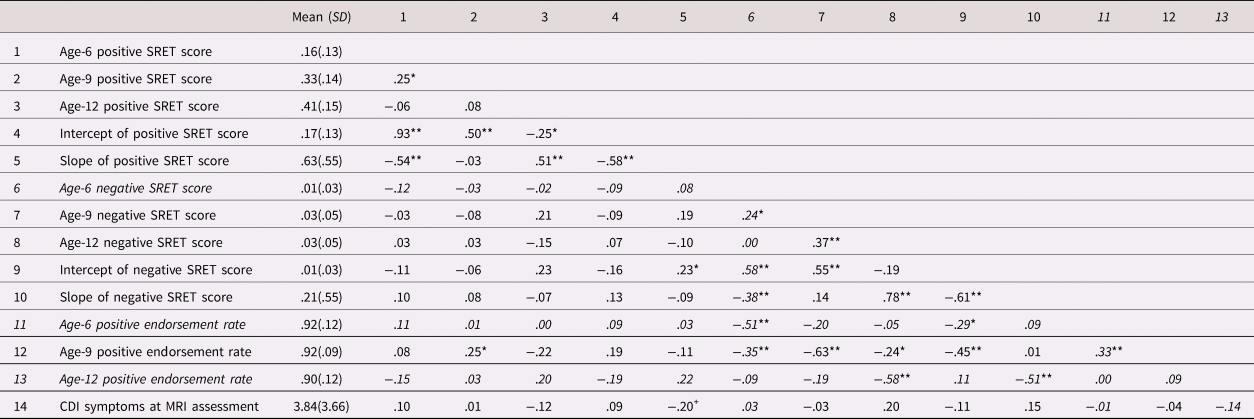
Table 2 presents the means, standard deviations, and bivariate correlations of the main variables for descriptive purpose, including SRET scores at each time point, the intercepts and standardized slopes of SRET scores, positive endorsement rates,Footnote 5 and depressive symptoms. For both positive and negative SRET scores, positive correlations were found between age 6 and age 9; negative SRET scores also showed a positive correlation between age 9 and age 12. These patterns demonstrated a modest stability of both positive and negative self-schemas during mid-to-late childhood. As indicated by the means of standardized slopes, positive and negative SRET scores increased from age 6 to age 12. Paired sample t test of the slope coefficients showed that positive SRET scores increased faster than negative scores, t(74) = 4.24, p < .001, confidence interval = [0.21, 0.59]. For both positive and negative SRET scores, intercept and slope estimates were negatively correlated with each other; that is, children with lower initial positive (or negative) SRET scores showed a faster increase over time. The standardized slope of positive SRET scores also showed a marginal negative association with depressive symptoms at the MRI assessment (p = .08), suggesting that slower growth of positive self-schemas may be depressogenic. Finally, at age 9, positive endorsement rates were positively correlated with positive SRET scores; across all three time points, positive endorsement rates were negatively related to negative SRET scores. Positive endorsement rates at age 12 were negatively correlated with the slope of negative SRET scores, indicating that greater endorsement of positive traits at age 12 was associated with slower increase of negative SRET scores from age 6 to age 12.
Mean, standard deviation, and bivariate correlation for main study variables
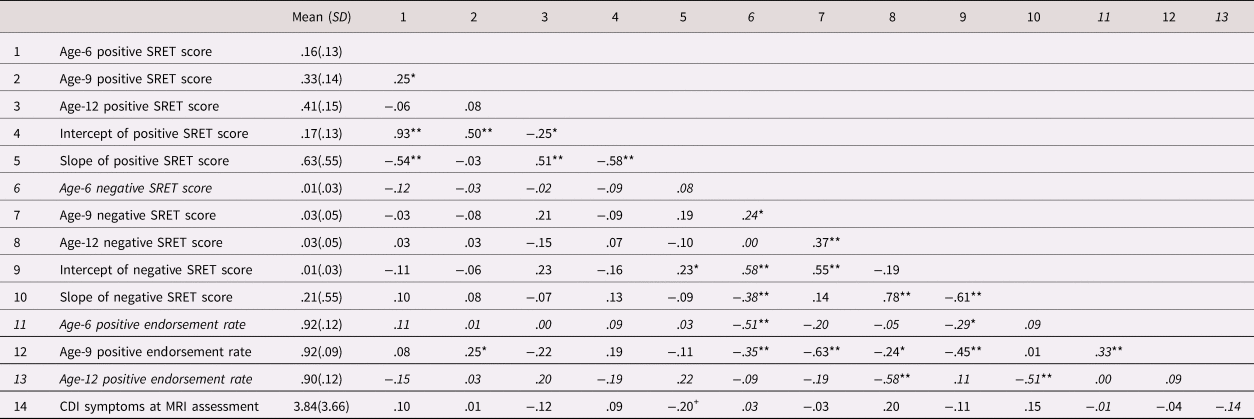
Note. SD: standard deviation; SRET: self-referent encoding task; CDI: Child Depression Inventory.
Italic font indicates nonparametric correlation used for nonnormally distributed variables (6, 11, 13).
* *p < .01; *p < .05; +p < .10.
Voxel-based morphometry analysis
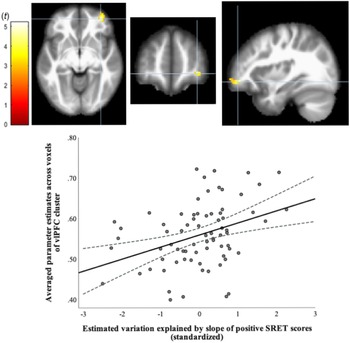
Voxel-based morphometry analysis was conducted with the standardized slope of positive (or negative) SRET scores as the regressor (N = 74). In the models with the standardized slope of positive SRET scores as the regressor, small volume correction within the composite mask of seven a priori ROIs identified a significant cluster located in vlPFC: MNI coordinates of peak voxel = [35, 51, −8], number of voxels = 215, t(67) = 5.22, cluster-level p-FWE = .017. Figure 2 illustrates this cluster and plots the averaged parameter estimates across voxels of the cluster (i.e., indices of GMV) against the regressor, demonstrating a positive association between the regressor and the regional GMV of this vlPFC cluster. In other words, faster increases of positive SRET scores from age 6 to age 12 were associated with greater regional GMV of this cluster. The standardized slope of negative SRET scores was unrelated to GMV of any clusters. In whole-brain analyses including the same covariates as the small volume correction analysis, no clusters survived multicomparison correction (see Supplementary Tables S2 and S3 in the supplement for uncorrected results of whole-brain analysis).
Top: a significant cluster within ventrolateral prefrontal cortex (vlPFC) identified in voxel-based morphometry with the standardized slope of positive self-referent encoding task (SRET) scores as the regressor (intercept, total intracranial volume, age, sex, and concurrent depressive symptoms at magnetic resonance imaging (MRI) assessment as covariates). Bottom: the mean parameter estimates of the vlPFC cluster plotted against the estimated variation explained by the regressor (dashed lines: 95% confidence interval).
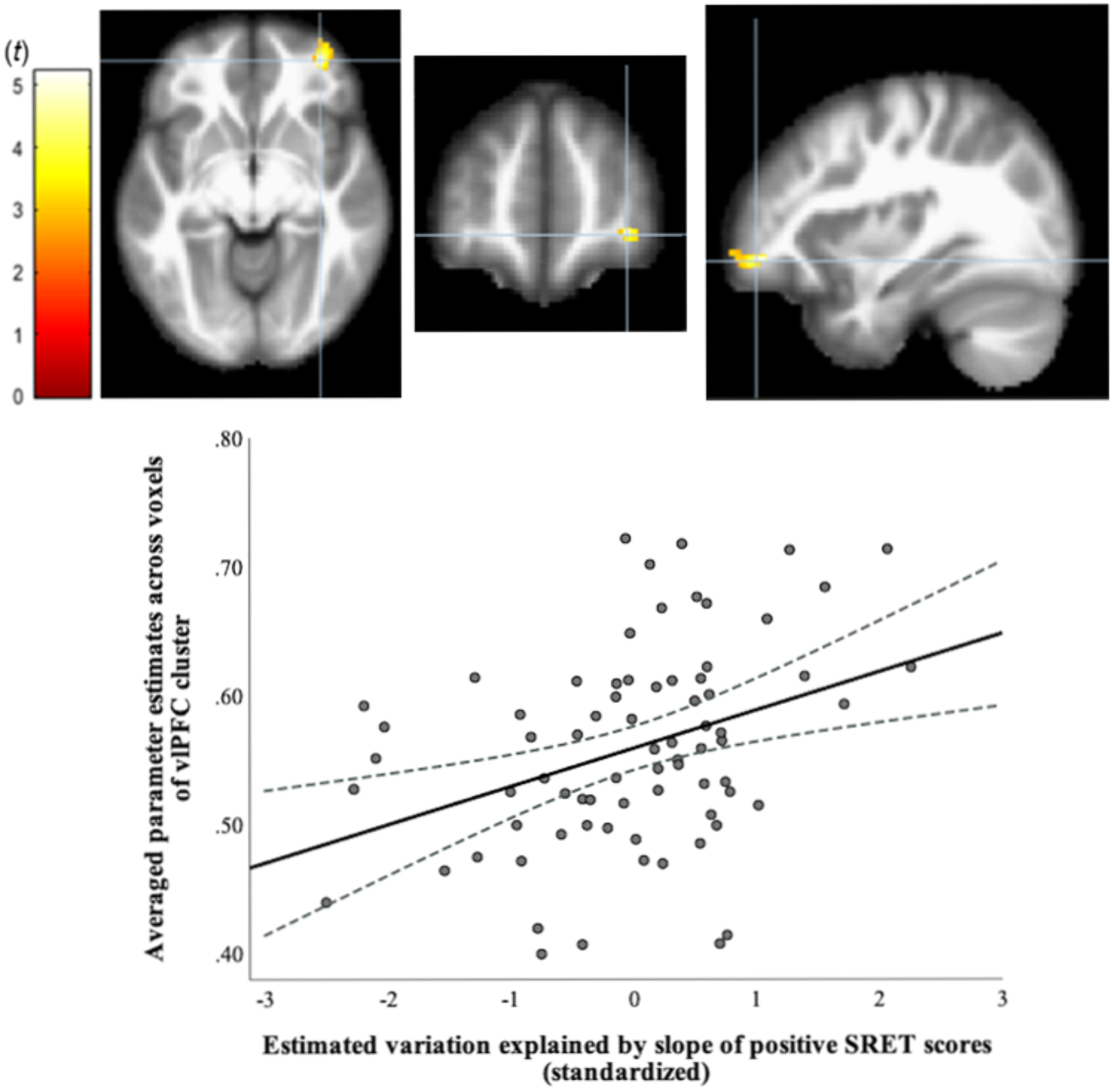
Of note, the bivariate correlation between the slope of positive SRET scores and the mean parameter estimates of this significant vlPFC cluster was not significant (r = .10, p = .40). This may reflect statistical suppression in regression models. Specifically, the association between the slope of SRET scores (i.e., the regressor) and GMV (i.e., the dependent variable) was strengthened by including the intercept of SRET scores (i.e., the suppressor variable which reduced irrelevant variance for the regressor [Tzelgov & Henik, Reference Tzelgov and Henik1991]). Therefore, in the scatter plot of Figure 2, we plotted the parameter estimates of GMV against the estimated variation explained by the slope of positive SRET scores after accounting for the intercept in the model (rather than plotting the GMV against the original values of the slope) to better illustrate the positive association between the regressor and the GMV of the vlPFC cluster.
Finally, we re-ran the voxel-based morphometry analysis excluding the two children with diagnosed depressive disorders and found highly similar results: the slope of positive SRET scores was positively associated with the GMV of a vlPFC cluster (MNI coordinates of peak voxel = [35, 51, −8], number of voxels = 141, t(65) = 4.99, cluster-level p-FWE = .037), suggesting that the observed brain–behavior association was not driven by the presence of clinical depression. We also re-ran the analysis without including concurrent depressive symptoms as a covariate and again identified a similar vlPFC cluster that was positively associated with the slope of positive SRET scores (MNI coordinates of peak voxel = [35, 53, −9], number of voxels = 207, t(68) = 5.18, cluster-level p-FWE = .018). These results further support the robustness of our findings. No significant clusters were identified for the slope of negative SRET scores in either analysis.
Discussion
The extant literature indicates that negatively biased patterns of self-schemas are an early emerging, latent cognitive risk factor for depression (Goldstein et al., Reference Goldstein, Hayden and Klein2015; Gotlib et al., Reference Gotlib, Joormann, Minor, Cooney and Canli2006; Hayden et al., Reference Hayden, Olino, Mackrell, Jordan, Desjardins and Katsiroumbas2013, Reference Hayden, Hankin, Mackrell, Sheikh, Jordan, Dozois and Badanes2014; Jacobs et al., Reference Jacobs, Reinecke, Gollan and Kane2008); however, their neural correlates in the developing brain are not well understood. To address this gap in knowledge we used descriptive analyses to relate children's regional GMV assessed at a mean age of 10 to the development of self-schemas from age 6 to age 12. Growth of children's positive SRET scores was positively associated with the GMV of a cluster within vlPFC. Put differently, slower growth of positive self-schemas was correlated with smaller regional GMV within vlPFC. The design of our study does not permit conclusions regarding causal relationships; however, our findings implicating the vlPFC cluster in depressogenic self-schemas are consistent with the literature highlighting this region in emotion regulation and affective processing (e.g., Dolcos & McCarthy, Reference Dolcos and McCarthy2006; Iordan & Dolcos, Reference Iordan and Dolcos2017; Iordan, Dolcos, & Dolcos, Reference Iordan, Dolcos and Dolcos2013; Wager, Davidson, Hughes, Lindquist, & Ochsner, Reference Wager, Davidson, Hughes, Lindquist and Ochsner2008), including self-referential processing (Liu et al., Reference Liu, Vandermeer, Joanisse, Barch, Dozois and Hayden2020a). The current descriptive findings provide important information that can be used to refine hypothesis testing in study designs better equipped to speak more conclusively to the role of the brain and cognition in depression's etiology.
Our findings also converge with recent work from our group in a different sample of 11-year-old youth, where we found a positive association between GMV of a vlPFC cluster and concurrent positive SRET scores (Liu et al., Reference Liu, Vandemeer, Joanisse, Barch, Dozois and Hayden2020b). The current findings provide additional support for the notion that GMV alterations within vlPFC are related to the development of positive self-schemas. These findings also complement the sMRI literature in youth showing associations between smaller GMV in regions including PFC and youth depressive symptoms in both depressed (Arnone et al., Reference Arnone, Job, Selvaraj, Abe, Amico, Cheng and McIntosh2016; Schmaal et al., Reference Schmaal, Hibar, Sämann, Hall, Baune, Jahanshad and Veltman2017) and nondepressed youth (Boes et al., Reference Boes, McCormick, Coryell and Nopoulos2008; Vulser et al., Reference Vulser, Lemaitre, Artiges, Miranda, Penttilä, Struve and Stephens2015). In the present study, this association between GMV within vlPFC and the growth of positive self-schemas was only significant when including the intercept of positive SRET scores as a covariate, highlighting the importance of controlling for the initial level of self-schemas when studying the development of this construct over time. Further, this association remained significant even after partialling out youth's depressive symptoms concurrent to sMRI data collection, as well as after removing two participants with diagnosed depressive disorders, suggesting that the observed GMV correlates may be a neurobiological marker of maladaptive development of positive self-schemas rather than a correlate or consequence of depressive symptoms per se.
Specifically, the observed associations between regional GMV and self-schemas suggest that smaller regional GMV in vlPFC might reflect a less adaptive pattern of GMV development in youth. Longitudinal neuroimaging studies suggest that the maturation of GM follows a curvilinear trajectory, roughly characterized by an early, rapid growth, followed by a plateau and subsequent decrease that reflects synaptic and neuronal pruning (Giedd, Reference Giedd2004; Giedd et al., Reference Giedd, Blumenthal, Jeffries, Castellanos, Liu, Zijdenbos and Rapoport1999; Giorgio et al., Reference Giorgio, Watkins, Chadwick, James, Winmill, Douaud and James2010; Paus, Reference Paus2005; Tanaka, Matsui, Uematsu, Noguchi, & Miyawaki, Reference Tanaka, Matsui, Uematsu, Noguchi and Miyawaki2013). Further, these developmental trajectories appear to vary across brain regions; for example, compared to subcortical structures (e.g., amygdala) that tend to mature earlier, cortical regions such as PFC typically show a prolonged, extended course of maturation that continues through early adulthood (Casey, Jones, & Hare, Reference Casey, Jones and Hare2008; Giedd, Reference Giedd2004; Giedd & Rapoport, Reference Giedd and Rapoport2010; Somerville, Jones, & Casey, Reference Somerville, Jones and Casey2010). Although we cannot draw firm inferences concerning the developing patterns of GMV with one wave of sMRI data, we speculate that the regional GMV of vlPFC in our youth sample may be still increasing or approaching peak, followed by subsequent, prolonged pruning; thus, lower GMV of vlPFC at this point may index a less adaptive pattern of GM maturation, which is further associated with suboptimal functions served by this region. Our findings highlight that late childhood is a critical period to study the neurodevelopment related to depressogenic self-schemas, and this can only be fully understood by collecting longitudinal imaging data in future research.
Less adaptive patterns of GMV in a given brain region may be associated with suboptimal functioning of the processes or behaviors subserved by this region (Stiles & Jernigan, Reference Stiles and Jernigan2010). vlPFC is implicated in regulatory control of affective processing (e.g, Iordan et al., Reference Iordan, Dolcos and Dolcos2013; Iordan & Dolcos, Reference Iordan and Dolcos2017; Wager et al., Reference Wager, Davidson, Hughes, Lindquist and Ochsner2008). During self-referential processing, our recent fMRI work suggests that vlPFC may help downregulate task-irrelevant, distracting emotions elicited by self-reflection during trait endorsement (e.g., youth may experience negative emotions when endorsing a negative trait or uncertainty when endorsing positive traits; Liu et al., Reference Liu, Vandermeer, Joanisse, Barch, Dozois and Hayden2020a). Therefore, suboptimal vlPFC-mediated regulatory function may result in greater cognitive interference and emotion dysregulation, which are generally irrelevant and disruptive to long-term goals. Over time, this interference may compromise the development and consolidation of adaptive self-schemas and result in slower growth of positive self-schemas. We acknowledge that the current data are not well suited to testing this causal model given that we had no fMRI data and only one wave of sMRI data. In future research, collecting structural and functional imaging data from the same sample at multiple time points is necessary to draw conclusions about the longitudinal associations between GMV, neural function, and self-schemas.
For the slope of positive self-schemas, we identified a significant cluster in the right, but not the left, vlPFC. This is incompatible with our recent work in a different sample of youth, in which we found a significant concurrent association between positive SRET scores and the GMV of a left vlPFC cluster (Liu et al., Reference Liu, Vandemeer, Joanisse, Barch, Dozois and Hayden2020b). The reason for this inconsistency is unclear. One possibility is that our relatively modest sample size in both studies is somewhat underpowered to detect effects in bilateral regions, given the relatively “noisy” nature of youth MRI data and the stringency of statistical correction for voxel-wise analyses. Future research in larger samples characterized by both sMRI and fMRI assessments is needed to more conclusively characterize patterns of laterality in neural structure and function in the context of depressogenic self-referential processing.
We did not find associations between the slope of negative SRET scores and GMV within a priori ROIs. At all three waves, children showed lower negative SRET scores with limited inter-individual variability compared to positive SRET scores (Table 2). These patterns are consistent with the notion that for younger children, positive self-schemas may play a more important role in risk compared to negative self-schemas, while negative self-schemas may become more prominent as they grow older (Felton, Cole, & Martin, Reference Felton, Cole and Martin2013; Leitenberg, Yost, & Carroll-Wilson, Reference Leitenberg, Yost and Carroll-Wilson1986). Future studies examining older adolescents, who may show greater variability in negative self-schematic processing, may be useful toward clarifying associations between negative self-schemas and GMV.
We also found that positive SRET scores showed modest stability (significant correlation) from age 6 to age 9, but not from age 9 to age 12. The observed stability from age 6 to age 9 is consistent with previous findings on the stability of positive self-schemas during a similar age range (e.g., age 7–age 9, Hayden et al., Reference Hayden, Olino, Mackrell, Jordan, Desjardins and Katsiroumbas2013). However, to our knowledge, no previous work has examined the stability of self-schemas from age 9 to age 12, a critical developmental stage characterized by rapid changes in socioemotional functioning and increased depressive symptoms as children approach adolescence (Abela & Hankin, Reference Abela, Hankin, Abela and Hankin2008; Hankin & Abramson, Reference Hankin and Abramson2001). The lack of stability of positive SRET scores from age 9 to age 12 may reflect the marked changes and increased individual variability in self-schemas as children are transitioning into adolescence. Further, while negative SRET scores did show greater stability, this may have been driven by the more positively skewed distribution of negative SRET scores (skewness at ages 6, 9, 12 = 2.54, 1.42, 1.47) compared to positive SRET scores (skewness at ages 6, 9, 12 = 0.73, −0.37, 0.61). Future studies examining a wider age range, including mid-to-late adolescence, will provide a fuller characterization of the developmental trajectory of both positive and negative self-schemas.
This study has several strengths. By using three waves of SRET data spanning 6 years, we were able to characterize the developing patterns of children's self-schemas from mid-to-late childhood and examine how these patterns were related to GMV characteristics in the developing brain. The low rate of clinical depression in our sample allowed us to run sensitivity analysis excluding participants with diagnosed depressive disorders while maintaining sufficient power, providing further support that the observed alteration of GMV within vlPFC may be an early risk mark rather than a scar of disorder. A primary limitation, however, is that our sMRI data (and depressive symptoms) were collected at one time point only prior to the last wave of SRET data. This may explain the weak (marginally significant) association between depressive symptoms and the slope of positive SRET scores. This also prevented us from addressing the potential directional associations between GMV and self-schemas over time. It is possible that GMV maturation within specific brain regions may provide a neuroanatomical foundation upon which neurocognitive functions emerge and develop; hence, less adaptive patterns of GM maturation may predict the development of depressogenic self-schemas, which in turn potentiate depressive outcomes. On the other hand, alterations in cognitive processes may also reinforce or impact existing patterns of GMV maturation in the developing brain. To test these hypotheses, it is necessary to collect longitudinal neuroimaging data along with assessments of self-schemas and depressive symptom at multiple time points across a wider age range. Finally, the effect size of our results is modest, requiring future replications in different youth samples of larger sample sizes.
In summary, our study contributes novel evidence for brain–behavior associations in the context of early depression risk, such that smaller regional GMV within vlPFC assessed in late childhood is associated with slower growth of positive self-schemas from age 6 to age 12. For a more conclusive examination of the putative neurocognitive mechanism associated with the development of depression, future studies will benefit from causally informative data generated by longitudinal designs as well as experimental manipulation of youth self-schemas. Supporting the plausibility of the latter point, previous research has reported that cognitive or behavioral training is associated with posttraining changes in brain structure and function, in both youth (e.g., Liu, Taber-Thomas, Fu, & Pérez-Edgar, Reference Liu, Taber-Thomas, Fu and Pérez-Edgar2018) and adults (Lumma, Valk, Böckler, Vrtička, & Singer, Reference Lumma, Valk, Böckler, Vrtička and Singer2018). Such work may inform the development of cognitive prevention or early intervention strategies for youth depression and contribute to further refinements of cognitive theories of depression.
Supplementary Material
The supplementary material for this article can be found at https://doi.org/10.1017/S0954579421000341
Acknowledgments
The authors want to thank the families who participated in our studies, and the many individuals who contributed to data collection.
Funding Statement
This work is supported by a National Institute of Mental Health grant to DNK (R01 MH45757) and a BrainsCAN postdoctoral fellowship to PL from Canada First Research Excellence Fund.
Conflicts of Interest
None.