Many plant–ant interactions are either facultative or obligatory symbioses that provide benefits to both partners (extensively reviewed by Beattie Reference BEATTIE2010 and Rico-Gray & Oliveira Reference RICO-GRAY and OLIVEIRA2007). Ants can obtain nutrients from their plant partner by harvesting the food bodies or secretions of extrafloral nectaries and use their host as a nesting space for colony development and the farming of fungi, scale insects and/or aphids. At the same time, plants can gain nutrients; gain protection against herbivores, pathogens and/or competitors; and disperse their seeds by associating with ants. Among tropical palms, many species engage in partnerships with ants, but information on such partnerships is primarily anecdotal (Chung Reference CHUNG1995, Mattes et al. Reference MATTES, MOOG, WERNER, FIALA, NAIS and MASCHWITZ1998, Moog et al. Reference MOOG, FIALA, WERNER, WEISSFLOG, GUAN, MASCHWITZ, Okuda, Manokaran, Matsumoto, Niiyama, Thomas and Ashton2003, but see Edwards et al. Reference EDWARDS, ANSELL, WOODCOCK, FAYLE, CHEY and HAMER2010 and Rickson & Rickson Reference RICKSON and RICKSON1986). Here, we report the results of a comparative study in a lowland tropical rain forest in Malaysian Borneo, conducted on Korthalsia furtadoana, a climbing rattan palm (Arecaceae). Some rattans, including K. furtadoana, produce inflated extensions of leaf sheaths called ocrea, which are used as nesting spaces (domatia) by ants (Figure 1; Dransfield Reference DRANSFIELD1984). Domatia evolved independently in 10 out of 27 rattan species of Korthalsia (Dransfield Reference DRANSFIELD, Trucchi, Littardi and Campodonieo2003), suggesting that their formation is not a derived trait of all Korthalsia rattans but, rather, an adaptation of some species. If this is the case, the selective advantage of domatia depends on the cost of their production, the likelihood of attracting ants with domatia, and the benefit brought to a plant by the ant partner. Our study aimed to identify potential benefits to K. furtadoana from the partnership with ants. We hypothesized that ants protect a host plant against herbivores and epiphylls, two types of ecological agents that can limit photosynthetic activity. Although the role of ants in herbivory protection is well documented in plants other than palms (Beattie Reference BEATTIE2010, Rico-Gray & Oliveira Reference RICO-GRAY and OLIVEIRA2007), there are only a few examples of the removal of epiphylls by the ant partner (Coley et al. Reference COLEY, KURSAR and MACHADO1993, Davidson et al. Reference DAVIDSON, LONGINO and SNELLING1988, Dutra et al. Reference DUTRA, FREITAS and OLIVEIRA2006, Fiala et al. Reference FIALA, MASCHWITZ, THO and HELBIG1989, Suarez et al. Reference SUAREZ, DE MORAES and IPPOLITO1998).
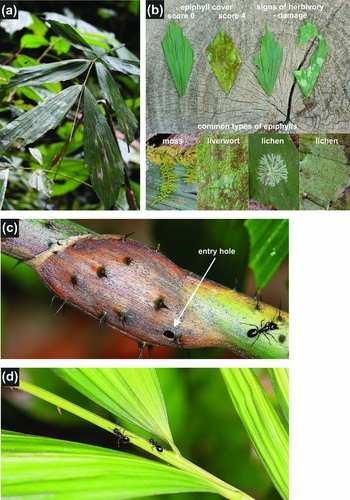
Korthalsia furtadoana palms in the study area of Danum Valley often showed signs of herbivory and exhibited epiphyll-covered leaflets (a). Each studied leaflet was classified as either damaged or undamaged and was scored on a scale of 0–4 according to the level of epiphyll cover. The epiphylls comprised three major organismal groups: mosses, liverworts and lichens (b). Korthalsia furtadoana develops hollow structures called domatia, which are used by ants as nesting spaces (c). Our physical disturbance of plants provoked the appearance of patrolling Camponotus sp. ants in approximately 40% of the studied plants (d).

Our study was performed in July–August 2014 in a protected area of the secondary dipterocarp forest 2 km north of the Danum Valley Field Centre, Sabah. We surveyed the forest along a distance of c. 4 km to identify individuals of K. furtadoana that were at least 2 m high; smaller plants were not included in the study. We examined any domatia in the lower part of a stem of each rattan to evaluate the possibility of the presence of ants. To produce entry points to a future nest in K. furtadoana, ants make holes in the domatium wall (Edwards et al. Reference EDWARDS, ANSELL, WOODCOCK, FAYLE, CHEY and HAMER2010); therefore, we considered holes as an indication of either present or past occupation of domatia by ants (Figure 1c). For practical reasons (protected conservation area, the size of rattans), we were unable to examine all domatia of each plant for their occupancy by nesting ants. Instead, we tested each plant for signs of the current presence of ants. If patrolling ants appeared in response to vigorous physical disturbance of a stem, then the plant was classified as currently associated with ants (Figure 1d). Note that we observed nesting ants in plants with patrolling ants but not in plants without patrolling ants. In total, we found 41 individuals of K. furtadoana, all of which had domatia with entry holes, and our disturbance procedure provoked the appearance of patrolling ants in 14 plants. A sample of three ants was taken from each inhabited plant for identification. The ants were recognized as a single ant species of the genus Camponotus (Formicinae), with reference to Bolton (Reference BOLTON1994, Reference BOLTON2003) and the ant collection of the Institute for Tropical Biology and Conservation, Universiti Malaysia Sabah. To evaluate the levels of leaf damage and epiphyll overgrowth, we collected 40 leaflets from each plant, taken from five or six leaves within reach. Then, leaflets from each plant were pooled together and a random sample of 25 leaflets was taken for further analysis. We investigated the surface and edges of each sampled leaflet to sort leaflets into damaged and undamaged groups (Figure 1b). A leaflet was considered to be damaged if we found missing parts, mines or signs of biting. We calculated the proportion of damaged leaflets per plant and used this measure as an index of herbivore damage. Leaflets were commonly colonized by three groups of epiphyll (Figure 1b). We scored each leaflet according to the level of epiphyll overgrowth. We used the following scale: 0 – clean leaflet with no signs of epiphylls; 1 – epiphylls present on < 25% of the leaflet surface; 2 – epiphylls present on 25–50% of the leaflet surface; 3 – epiphylls present on 50–75% of the leaflet surface; 4 – epiphylls present on > 75% of the leaflet surface. The mean value of the overgrowth scores per plant was our index of epiphyll overgrowth. We used a t-test (Statistica 10, StatSoft, USA) to compare the damage and epiphyll cover in leaflets of plants classified as presently inhabited or not inhabited by ants. Prior to the analysis, the index of leaflet damage was arcsine transformed and the index of epiphyll overgrowth was natural-log transformed. Due to the heterogeneity of variance (Levene's test, P = 0.013), the index of leaflet damage was analysed with a t-test with separate variance estimates and approximate degrees of freedom.
Overall, the results of our comparative study clearly show that K. furtadoana commonly associates with domatia-nesting ants. Nevertheless, our physical disturbance of plants provoked the appearance of the patrolling Camponotus sp. ants in only c. 40% of plants. Camponotus ants are recognized as obligate symbionts of K. furtadoana (Edwards et al. Reference EDWARDS, ANSELL, WOODCOCK, FAYLE, CHEY and HAMER2010). These findings suggest that the association between Camponotus ants and Korthalsia rattans can be established temporarily and that the ants eventually abandon their plant partner. Another intriguing possibility is that many of the studied rattans harboured ants that did not respond protectively to our disturbance. Supporting this idea, Edwards et al. (Reference EDWARDS, ANSELL, WOODCOCK, FAYLE, CHEY and HAMER2010) observed that among different species of domatia-nesting ants that associate with K. furtadoana, only one species of Camponotus responded protectively to signs of herbivory. Our examination of leaf quality revealed notable differences between plants classified as associated and not associated with ants. On average, 19% of leaflets were physically damaged in plants that had patrolling ants compared with 52% in rattans without the patrolling ants (t-test: t1,38.4 = 6.85; P = 0.0000001). Moreover, the mean scores of the epiphyll cover of leaflets were 0.2 in plants with patrolling ants and 1.3 in plants without patrolling ants (t-test: t1,39 = 7.69; P = 0.00000001). This pattern is consistent with the hypothesis that ant partners of K. furtadoana either actively or passively deter herbivores, reducing leaf damage caused by grazers and miners. Similar effects of ants have been reported for many other plants that associate with ants (see examples provided by Beattie Reference BEATTIE2010, Rico-Gray & Oliveira Reference RICO-GRAY and OLIVEIRA2007), but they have remained largely unknown in palms. Our findings also suggest that the partner ant removes epiphylls, which would otherwise reduce the photosynthetic activity of leaves (Coley et al. Reference COLEY, KURSAR and MACHADO1993). Importantly, this effect of ants has never been demonstrated in palms and only occasionally in other plant–ant systems (Coley et al. Reference COLEY, KURSAR and MACHADO1993, Davidson et al. Reference DAVIDSON, LONGINO and SNELLING1988, Dutra et al. Reference DUTRA, FREITAS and OLIVEIRA2006, Fiala et al. Reference FIALA, MASCHWITZ, THO and HELBIG1989, Suarez et al. Reference SUAREZ, DE MORAES and IPPOLITO1998). Certainly, an alternative mechanism, not mutually exclusive with the protective effects of ants, might underlie the patterns revealed by our study. If leaf health affects the capacity of a plant to support ant colonies, then ants would benefit from preferentially nesting in the domatia of plants that have less-damaged and less-epiphyll-covered leaves.
How a mutualistic relationship with ants might have evolved in K. furtadoana remains an open question. Plants such as K. furtadoana are especially prone to exploitation by non-cooperative partners because they constitutively form domatia (Dransfield Reference DRANSFIELD, Trucchi, Littardi and Campodonieo2003). As described above, Edwards et al. (Reference EDWARDS, ANSELL, WOODCOCK, FAYLE, CHEY and HAMER2010) observed different levels of cooperativeness in different ant partners of K. furtadoana. Other plants can decrease the provision of resources when ants provide little protection, increasing the available resources when protection is more effective (Brouat & McKey Reference BROUAT and MCKEY2000). A large-scale comparison of the associations of plants with ants showed that ants typically do cooperate with their host plants, although their partnership is less rewarding to plants offering only nesting space compared with plants that offer both domatia and food (Chamberlain & Holland Reference CHAMBERLAIN and HOLLAND2009). Certainly, the fitness consequences of ant partners depend not only on their cooperativeness but also on how costly this partnership is to a plant. In K. furtadoana, domatia impose a constant cost regardless of ant presence, in contrast to benefits that occur only if the plant succeeds in attracting a proper ant partner. Rattans, which include K. furtadoana, lack secondary growth, and their leaf ocrea play a crucial role in the mechanical properties of the stems (Isnard & Rowe Reference ISNARD and ROWE2007); thus, the transformation of ocrea to a domatium can affect the resistance of K. furtadoana to physical forces. This potential cost of domatia production, and thus the cost of partnership with ants, awaits attention in future studies. In some plants, the development of domatia incurs a direct physiological cost (Blatrix et al. Reference BLATRIX, RENARD, DJIETO-LORDON and MCKEY2012, O'Connell et al. Reference O'CONNELL, MONKS, LEE, DOWNS and DICKINSON2010). For example, a reduction of reproductive costs associated with the castration of host plants by symbiotic ants resulted in the increased production of domatia (Frederickson Reference FREDERICKSON2009). Although the physiological cost of producing domatia was not measured in palms, it seems reasonable to expect that such production in K. furtadoana competes for resources with other fitness-related functions such as shoot growth, leaflet production and reproduction.
Our evidence shows that palms of Korthalsia commonly associate with domatia-nesting ants for an unknown duration. Clearly, the occupation of domatia by ants can bring considerable benefits to the host palms in the form of improving the condition of their photosynthetic apparatus, although the costs of this association remain undiscovered. Nevertheless, we can imagine that this positive effect of the symbiotic ants is especially crucial for plants that are constantly competing for light. Similar to lianas, rattans evolved the ability to climb up other plants and gain access to sun in the light-limited and highly competitive environment of tropical rain forest understoreys (Isnard & Rowe Reference ISNARD and ROWE2007). Given this evolutionary perspective, the findings of our study suggest that the effects of symbiotic ants on the photosynthetic performance of host plants fuelled the evolution of domatia-forming rattans. Considering the comparative nature of our evidence, we recommend that future studies examine the deeper evolutionary outcomes of the association of palms with ants.
ACKNOWLEDGEMENTS
This study was performed as part of the Tropical Ecology Field Course of the Jagiellonian University and was supported by the Institute of Environmental Sciences of JU (grants: DS/WBIONOZ/INOS/757/2015 and DS/WBIONOZ/INOS/761/2015). We thank J. Weiner, G. Reynolds, A. Karolus and M. Bernadus Bala Ola for help provided at different stages of this project. B. Cykowska and A. Flakus helped with epiphyll identification, and S. Yamane helped with the taxonomic identification of ants. We also thank the three anonymous reviewers for their stimulating comments and ideas.