INTRODUCTION
The major histocompatibility complex (MHC) comprises a family of closely related genes and it is considered the most gene-dense and polymorphic region of the human genome. There are 224 genes in this region, and nearly half of the 128 expressed genes are related to immune responses (MHC Sequence Consortium, 1999). The highly polymorphic MHC molecules are expressed in cell surface and play a key role in the initiation and in the maintenance of immune responses by presenting antigens to the effectors cells (Kumánovics et al., Reference Kumánovics, Takada and Lindhal2003). There are two major subfamilies of MHC genes (classes I and II), whose products are involved in distinct antigen presentation pathways. In humans, the classical class II genes (DP, DQ and DR) are constitutively expressed basically in professional antigen-presenting cells (such as macrophages, dendritic cells, B cells and on the thymic epithelium).
In marine mammals, studies focusing on the genomic organization and levels of diversity of the MHC system have been conducted with increased interest in the last years (Lehman et al., Reference Lehman, Decker and Stewart2004; Yang et al., Reference Yang, Yan, Zhou and Wei2005; Baker et al., Reference Baker, Vant, Delabout, Lento, O'Brien and Yuhki2006). The reduced MHC diversity described for some cetaceans and pinnipeds is approached sometimes as an indication of a less effective immune system as compared to terrestrial mammals (Slade, Reference Slade1992; Murray et al., Reference Murray, Malik and White1995). Nevertheless, more information about the expression of MHC genes is essential to characterize the immune system of marine mammals as well as to improve our understanding of the interactions between these animals and their environment. One of the most studied cetaceans in Brazil is the franciscana, Pontoporia blainvillei (Gervais & D'Orbigny, 1844), a small coast dolphin. The population inhabiting the coast of Rio Grande do Sul (the southernmost state of Brazil) and Uruguay has been recently classified as vulnerable by the IUCN Red List of Threatened Species (IUCN, 2006). Studies about the behaviour and ecology of P. blainvillei have been conducted (e.g. Siciliano et al., Reference Siciliano, Di Beneditto and Ramos2002; Secchi et al., Reference Secchi, Ott, Danilewicz, Gales, Hindell and Kirkwood2003; Danilewicz et al., Reference Danilewicz, Claver, Pérez Carrera, Secchi and Fontoura2004), but limited data are available about the genetic diversity and phylogenetic relationships of this species (e.g. Secchi et al., Reference Secchi, Wang, Murray, Rocha-Campos and White1998; Lázaro et al., Reference Lázaro, Lessa and Hamilton2004). Another cetacean observed in southern Brazil is the southern right whale, Eubalaena australis (Desmoilins, 1822), a conservation dependent species (IUCN, 2006). This is a migratory large whale, mating and calving off Brazil during winter and part of spring (IWC, 2001).
Analyses of MHC class II gene expression in cetacean skin were initially performed in Tursiops truncatus (bottlenose dolphin) using immunohistochemistry by Zabka & Romano (Reference Zabka and Romano2003). Their study revealed a pattern of DQB genes expression that reflected the cellular structural and functional characteristics expected to this kind of protein. Besides this work, analyses of MHC expression in cetaceans were basically performed in lymphatic tissues in the harbour porpoise Phocoena phocoena (Beineke et al., Reference Beineke, Siebert, Stott, Muller and Baumgärtner2007) and in blood lymphocytes from beluga whale Delphinapterus leucas (Bernier et al., Reference Bernier, De Guise, Martineau, Beland, Beaudet and Fournier2000). In the present study skin samples from franciscana dolphin and right whale were used in order to test the MHC class II DQB gene expression in cetacean skin using a more accurate method.
MATERIALS AND METHODS
Collecting samples
Samples from both cetacean species described in the present study were collected on the northern coast of Rio Grande do Sul, southern Brazil. In a rare event of live stranded animal (January, 2005), a skin sample (~5 mm) of a newborn franciscana dolphin was collected (Tramandaí, 29º58′S 50º07′W). Skin samples (~10 mm) from a free-ranging mother and calf pair of southern right whales were collected with a biopsy dart on July 2004 (Torres, 29º19′S 49º43′W). The samples from both species were stored in 4 ml of RNAlater solution (Ambion, Tx, USA) at 4ºC until processing (ranging from 2–3 weeks).
RNA extraction and amplification protocols
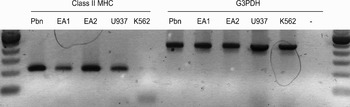
Total cellular RNA was isolated by silica-based gel membranes combined with microspin technology to skin samples (RNeasy Mini Kit, QIAGEN, Germany) and stored at –20°C. The full length cDNA synthesis was performed using a SMART PCR cDNA Synthesis Kit (Clontech, Palo Alto, CA) according to the manufacturer's specifications. Universal primers were used to amplify a fragment of 212 base pairs of the DQB exon 2 peptide-binding region (PBR) as described by Murray et al. (Reference Murray, Malik and White1995). Briefly, the PCR reactions were carried out on 50 ng of cDNA in a total volume of 50 µl containing 20 pmol of each primer, 1.5 mM MgCl2, 20 mM Tris pH8.4, 50 mM KCl, 1.5 units of recombinant Taq DNA polymerase (Invitrogen, Carlsbad CA, USA) and 2.5 mM of each dNTP. The amplification followed a touchdown protocol, starting with 94ºC for 5 minutes, followed by 20 cycles with 94ºC for 1 minute, 65ºC for 1 minute, 72ºC for 1 minute, decreasing 1ºC at each two cycles, followed by 20 cycles with 94ºC for 1 minute, 55ºC for 1 minute, 72ºC for 1 minute, and ending with an extension step of 72ºC for 5 minutes. Glyceraldehide-3P-dehydrogenase (GAPDH) gene amplification was used as a positive control of expression, since it is considered to be a reliable control for gene expression studies on samples from cetacean skin biopsies (Spinsanti et al., Reference Spinsanti, Panti, Lazzeri, Marsili, Casini, Frati and Fossi2006). To confirm the absence of DNA on the purified samples, the RNA from each specimen was used as template for amplification, prior to the cDNA synthesis. Also, as a negative control, RNA purified from K562, a cell lineage defective on MHC expression, was used in each test. The amplification products were loaded in a 1% agarose gel and visualized under UV by ethidium bromide staining (Figure 1). A unique fragment of 212 bp, corresponding to the DQB exon 2, was amplified from each cDNA sample, excised from the gel and purified by GFX PCR DNA Purification Kit (GE Healthcare, NJ, USA). Purified PCR products were cloned into TOPO TA vector (Invitrogen). To confirm the sequences, 5 colonies per each sample were picked directly from the LB agar plate and the insert was amplified using the M13 primers (Invitrogen). Amplified fragments of the correct size were sequenced in a MegaBACE 1000 (Amersham Pharmacia Biotech, NJ, USA) (Figure 2). Data were confirmed by sequencing in both directions.
Amplification of MHC fragments from franciscana and right whale cDNA. Exon 2 DQB amplified from franciscana (Pbn), right whale (mother identified as EA1 and her calf identified as EA 2), cDNA from cell lineage U937, corresponding to 212 bp. K562 cell lineage defective to MHC expression. Positive control was primers to human GAPDH (440 bp). Ladder 100 bp.

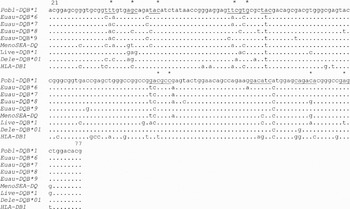
DQB nucleotide sequences. In non-variable codons a dot is used to display identity. Abbreviations for individual species MHC sequences are as follows: Pobl, franciscana (Pontoporia blainvillei); Euau, right whale (Eubalaena australis); Live, baij (Lipotes vexilifer); Dele, beluga whale (Delphinapterus leucas); Meno, humpback whale (Megaptera novaengliae); HLA-DQB (Homo sapiens). Underlined codons indicate positions polymorphic in human MHC molecules and an asterisk (*) indicates codons postulated to be important to peptide binding (Brown et al., Reference Brown, Jardetzhy, Gorga, Stern, Urban, Strominger and Wiley1993).

Statistical analyses
Several analyses were performed in order to establish if sequences corresponded to functional genes. The nucleotide sequences were analysed using the sequence alignment software programs CHROMA (Goodstadt & Ponting, Reference Goodstadt and Ponting2001) and STADEN (Bonfield et al., Reference Bonfield, Smith and Staden1995), and compared using the NCBI BLAST program (Altschul et al., Reference Altschul, Gish, Miller, Myers and Lipman1990). To detect molecular-level evidence of selection, pairwise comparisons of nucleotide substitutions between alleles were conducted on a segment of 171 bp (57 complete codons) and relative frequencies of non-synonymous (d N) and synonymous (d S) substitutions were calculated following the Jukes & Cantor correction of modified Nei & Gojobori (Reference Nei and Gojobori1986) in MEGA4 (Tamura et al., Reference Tamura, Dudley, Nei and Kumar2007). The ratio of non-synonymous to synonymous divergence was tested for departure from the neutral expectation of unity using the z statistic available in MEGA4. The amino acids’ physicochemical properties were analysed using a ProtParam program from ExPASy (Gasteiger et al., Reference Gasteiger, Gattikerm, Hoogland, Ivanvi Appel and Bairoch2003) and their conservation properties followed Taylor's classification (Taylor, Reference Taylor1986).
RESULTS
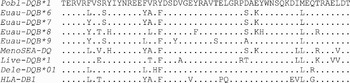
The analyses concerned evidence of selection and departures from neutrality for d N/d S ratio were carried out to southern right whale. Since we have just one franciscana sample we preferred not to include that in these analyses. The remaining analyses were conducted among the three individuals (all alleles) with the aim to identify characteristics expected to functional MHC sequences. We followed the standard four-letter abbreviations for species recommended for MHC nomenclature and adapted from Baker et al. (Reference Baker, Vant, Delabout, Lento, O'Brien and Yuhki2006). We observed five alleles, one from franciscana (Pobl-DQB*1) and four different alleles from right whales (Euau-DQB* 6–9). The mother and calf southern right whales shared one allele (Euau-DQB*7). Besides that, both have exclusive alleles, the calf has Euau-DQB*9 and the mother has Euau-DQB* 6 and 8. The sequences were deposited in the GeneBank (access numbers EU048216–EU048220). This elevated number of alleles found in right whale was expected since the existence of three copies of the DQB gene in the southern right whale genome was already suggested (Baker et al., Reference Baker, Vant, Delabout, Lento, O'Brien and Yuhki2006). The nucleotide and deduced amino acid sequences of the amplified products were typical of transcripts from mammalian class II genes (Figures 2 & 3). The five alleles identified in the two species do not show insertions, deletions or stop codons, suggesting a functional role in vivo. Nevertheless, we were able to identify nucleotide substitutions in all possible three codon positions. Nine nucleotide substitutions could be assigned to both first and second bases and four to the third base of codons. Pairwise comparisons of nucleotide substitutions also indicated a functional status of southern right whales alleles. The average of d N and d S 0.075 and 0.027, respectively, resulting in a ratio of d N /d S =2.77 significantly different from unity (P = 0.03). This high substitution ratio suggests a balancing selection pressure (positive Darwinian selection), which was expected from this particular region of the gene as shown in the functional PBR in humans (Huges & Nei, Reference Huges and Nei1988). There are 14 predicted positions as important to peptide binding (28, 30, 32, 37, 38, 47, 56, 60, 61, 65, 68, 70, 71 and 74) in humans (Brown et al., Reference Brown, Jardetzhy, Gorga, Stern, Urban, Strominger and Wiley1993). As expected, the sequences derived from P. blainvillei and E. australis differed from other MHC sequences mainly in and around the sites predicted to be important to peptide binding and recognition (Figures 2 & 3). The franciscana and right whale amino acid sequences correspond to sites 21–77 of the beluga DQB1 sequences (Murray et al., Reference Murray, Malik and White1995). Polymorphism was observed in residues 28, 37, 38, 47, 60, 65, 68 and 71, as well as in positions considered polymorphic within human PBR but not described as relevant to peptide recognition and binding (26, 29, 39, 40, 43, 51, 58 and 59). This same situation was previously described in other marine mammal sequences (Murray et al., Reference Murray, Malik and White1995; Yang et al., Reference Yang, Yan, Zhou and Wei2005).
Predicted amino acid sequences of DQB alleles. To ease comparison no character is used to display identity. The identification of sequences follows the abbreviations used for DQB nucleotide sequences. For physiochemical characteristics information see the text.

Two of the most important physiochemical amino acid characteristics that determine the protein structure are volume and type (hydrophobicity). In the positions 29 (Arg/Ser), 38 (Val/Ala/Leu), 40 (Tyr/Arg) and 43 (Asp/Tyr) the different amino acids observed at the different alleles presented a weak conservation of these physiochemical characteristics. In positions 28 (Ser/Thr), 30 (Tyr/His), 57 (Asp/Ser/Ala) and 59 (Gln/Lys) the replacements lead to a conservation degree varying from moderate to weak, concerning type and volume of amino acid, whereas in positions 26 (Phe/Leu/Tyr) and 37 (Phe/Leu/Tyr) the substitutions involved amino acid residues with quite similar characteristics (strong conservation). The strong conservation of physiochemical amino acid characteristics was also observed in the predicted positions outside the peptide recognition sites. A similar comparison clustering the four alleles from the southern right whale provided similar results, suggesting that this substitution pattern is related to the MHC molecule itself, reinforcing that the described alleles will lead to functional MHC molecules. This pattern suggests that the bias in amino acid usage with less conserved physiochemical characteristics is important to the molecule function. It is expected in a functional system that these sites influence the diversity of molecules’ topologies allowing a less restrictive interaction with antigens within a population. The five new alleles were compared to previously published DQB exon 2 sequences of mammals and revealed a high sequence similarity with human (88%), bovine (91%) and canine (89%) as well as with sequences derived from other marine mammals: Delphinapterus leucas (94%), Balaenoptera musculus (94%) and Zalophus californianus (91%).
DISCUSSION
Marine mammals are subject to characteristic selective pressures in the sea environment, such as physiological constraints due to the availability of oxygen, low temperatures and high pressure that are considered to be immunosuppressive to other species (King et al., Reference King, Aldridge, Kennedy-Stoskopf and Stott2001). In addition, over the last decades, these species have been subjected to environmental degradation, exposure to contaminants and climate changes that have been implicated in the emergence of new marine diseases (Harvel et al., Reference Harvel, Kim, Burkholder, Colwel, Epstein, Grimes, Hofmann, Lipp, Osterhaus, Overstreet, Porter, Smith and Vasta1999). In a study with two species of southern American river dolphins, Inia geoffrensis and Inia boliviensis (Martínez-Agüero et al., Reference Martínez-Agüero, Flores-Ramírez and Ruíz-Garcia2006), the authors observed different sequences, identified as DQB alleles, on each species. The authors hypothesized that the difference observed could reflect a different selection pressure generated by differences in environment, as well as distinct parasite diversity, virulence and load. Nevertheless this can be corrected; it is necessary to improve the knowledge about marine mammals' immune system and its potential to elicit a response against pathogens and in developing resistance to them before more assumptions can be made. There is little information about MHC class II expression in marine mammals. The skin is a natural barrier against injuries and pathogens and it is known that important genes related to immunity can be expressed at this tissue, e.g. classical class I MHC genes. Even considering the scarcity of studies demonstrating association between specific MHC alleles and diseases or parasite prevalence in wild populations, the identification of new alleles as well as the analysis of MHC gene expression will provide important tools for population management. The knowledge about marine mammals’ immune system will be useful to identify the diversity of natural populations, explain such specific immune processes and to perform comparative evolutionary studies. In conclusion, the detection of MHC class II genes expression in skin of cetaceans by molecular methods provides an accurate tool for immunological studies with cetaceans and gives support to the utilization of skin when the use of other tissues are less feasible.
ACKNOWLEDGEMENTS
We would like to thank Daniel Danilewicz, Lizandra Robe, Fabiano Torres and Alexandre Zerbini for help in collecting samples and kindly providing constructive suggestions on the manuscript. One anonymous referee provided valuable comments on an earlier draft of the manuscript. The Fundo Nacional do Meio Ambiente (FNAMA/MMA), the Yaqu Pacha Foundation and Conselho Nacional de Desenvolvimento Científico e Tecnológico (CNPq) provided funds to the Grupo de Estudos de Mamíferos Aquáticos do Rio Grande do Sul that contributed to this projetct. L.H. and I.M.B. received a scholarship from CNPq, respectively, Grants 141610/2003-4 and 140660/2004-6.