The metal-on-metal hip resurfacing (HR) is a recognized treatment modality for young, active patients with primary or secondary arthritis of the hip. HR emerged as an alternative treatment in younger patients due to unsatisfactory long-term viability of conventional total hip replacement (THR) prostheses. When considering the need for revision as a study endpoint, THR prostheses, implanted in patients aged less than 55 years, had a 15-year “survival” rate of only 71% for cemented implants and 58% for some uncemented THR prostheses.Reference Makela, Eskelinen, Pulkkinen, Paavolainen and Remes 1 HR is also preferred for younger patients because the femoral bone is often preserved; the hip joint is more durable; and HR serves the goal of delaying the need for a conventional THR.Reference Treacy, McBrydee, Shears and Pynsent 2
The Birmingham Hip Resurfacing (BHR) procedure is one of the commonly used metal-on-metal resurfacing procedures. BHR was introduced in 1997 and was approved by the United States Food and Drug Administration in May 2006. Since then, the number of BHRs being performed has increased rapidly.Reference Azam, McMahon, Hawdon and Sankineani 3 In this study, we analyzed the incidence, epidemiology, and outcomes of surgical site infections (SSIs) following BHR.
METHODS
A retrospective cohort study was conducted at Detroit Medical Center (DMC) from January 2006 to December 2012. Institutional review boards at Wayne State University and DMC approved the study prior to its initiation.
During the study period, patients who underwent BHR were identified through review of operative databases and electronic medical records. Patients who developed SSIs following BHR surgery were identified through ICD-9 codes and SSI surveillance conducted prospectively by the infection control department at DMC. Based on Centers for Disease Control and Prevention (CDC) criteria SSIs were classified as superficial incisional, deep incisional, or organ-space. 4 Clinical and microbiologic data were abstracted from the patient medical records for 1 year following BHR surgery. Duration of procedure in minutes, wound class, and American Society of Anaesthesiology (ASA) score were used to calculate the National Nosocomial Infections Surveillance (NNIS) risk index.Reference Culver, Horan and Gaynes 5 Bacteria have been identified to the species level, and susceptibilities have been determined in accordance with the Clinical and Laboratory Standard Institutions (CLSI) criteria.
All analyses were performed using SPSS Statistics version 21 (IBM, Armonk, NY). Categorical values were compared using Fisher’s exact test or the χ2 test. Continuous variables were compared with use of Student t test. All P values were 2-tailed. A P value of <.05 was considered statistically significant.
RESULTS
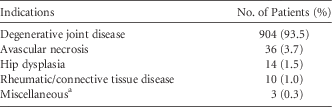
A total of 967 patients underwent BHR during the study period. The mean age of the cohort was 55±9 years; 647 patients (67%) were males and 465 (48%) were African Americans. Among these patients, 32 (3.3%) were obese (BMI >30 kg/m2), 10 (1%) had rheumatoid arthritis or other connective tissue diseases, and 77 (8%) had a history of tobacco smoking. The common indications for BHR are listed in Table 1. All patients received preoperative antimicrobial prophylaxis: 779 patients (80.6%) received 1 dose of vancomycin, 177 patients (18.3%) received cefazolin, and 11 patients (1.1%) received clindamycin.
Common Clinical Indications for Birmingham Hip Resurfacing

a Miscellaneous conditions included Perthes disease, femoral head fracture, and internal derangement of the hip (1 patient each).
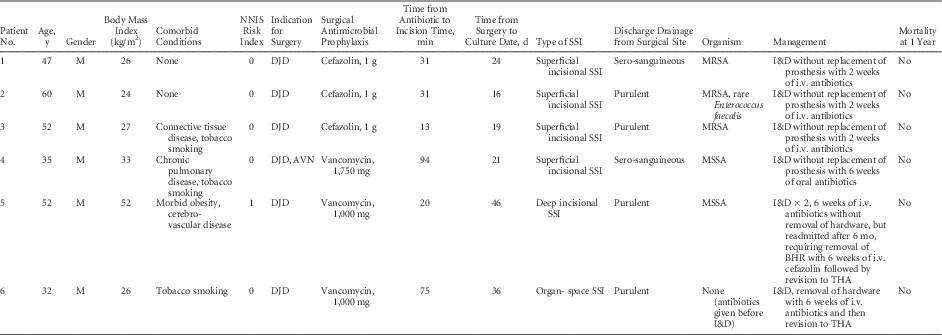
During the 12-month period following BHR, SSIs were identified in 6 patients (SSI rate, 0.62 per 100 procedures). Mean duration from surgery to SSI diagnosis was 25 days (interquartile range [IQR], 20–55 days). The epidemiology and clinical characteristics of each case are discussed in Table 2. Symptoms of SSI included pain, which was reported in all 6 patients, and fever, which was reported in 2 patients. In addition, 4 patients (67%) had purulent discharge from the surgical site.
Infectious Complication after 1 Year of Birmingham Hip Resurfacing

NOTE. NNIS, National Nosocomial Infection Surveillance; SSI, surgical site infection; DJD, degenerative joint disease; MRSA, methicillin-resistant Staphylococcus aureus; I&D, incision and drainage; i.v., intravenous; AVN, avascular necrosis; MSSA, methicillin-susceptible S. aureus; BHR, Birmingham hip resurfacing; THA, total hip arthroplasty.
Among the SSIs, 4 (67%) were monomicrobial and 1 (16%) was culture-negative. The most common pathogen in our study was Staphylococcus aureus. A total of 3 patients (50%) who received preoperative prophylaxis with cefazolin were infected with methicillin-resistant S. aureus (MRSA). Of 3 (50%) patients who received vancomycin as preoperative antimicrobial prophylaxis, 2 (33%) developed SSI due to methicillin-sensitive S. aureus (MSSA). All MRSA SSIs were superficial. Furthermore, 1 patient (16%) who received vancomycin had an SSI categorized as an organ-space infection with negative cultures.
A total of 4 patients with superficial SSIs underwent surgical debridement followed by antibiotic treatment. Among them, 1 patient with deep incisional SSI and 1 patient with organ-space SSI ultimately required removal of the Birmingham prosthesis and received 6-week courses of intravenous (i.v.) antibiotics and then underwent revision to THR. At the 1-year follow-up, the THRs showed no further complications in these 2 patients.
DISCUSSION
To our knowledge, this is the first study to evaluate infectious complications following HR. The SSI rate following BHR was <1%. This rate is lower than that reported for SSIs following THR (2.3%–2.5%).Reference Lindeque, Hartman, Noshchenko and Cruse 6 The pooled deep-prosthetic joint infection (PJI) rate from the same study was 0.9% (95% CI, 0.4%–2.2%; P<.001; n=28,883) compared to 0.2% in the current study.Reference Lindeque, Hartman, Noshchenko and Cruse 6 Importantly, the BHR population is typically younger and has fewer comorbid conditions than do other THA populations. In the current study, 68% of SSIs occurred within 30 days following surgery and 100% occurred within 60 days. All SSIs that occurred within 30 days following BHR surgery were superficial. A similar trend has been previously described for SSIs following THR: 60% of SSIs occurred within 30 days, and 81% of THRs occurred within 90 days following surgery.Reference Lindeque, Hartman, Noshchenko and Cruse 6
In cases of SSI due to MRSA, cefazolin prophylaxis was used; in cases of SSI due to MSSA, vancomycin prophylaxis was used. In previous studies, MRSA SSIs were more common among patients undergoing THR who received prophylaxis with cefazolinReference Sewick, Makani, Wu, O’Donnell, Baldwin and Lee 7 than among those who received vancomycin. Patients who received vancomycin alone for prophylaxis were at increased risk for SSI due to MSSA.Reference Finkelstein, Rabino and Mashiah 8 Because vancomycin is more active against MRSA than cefazolin and cefazolin is more active against MSSA than vancomycin, some experts recommend using both vancomycin and cefazolin together as prophylaxis for patients undergoing surgery involving implants, including THR.Reference Deverick, Kelly, Sandra and Berríos-Torres 9
Incision and drainage followed by antimicrobial therapy was adequate for the cure of all superficial SSIs in this study. Parenteral vancomycin was administered to treat 3 MRSA superficial SSIs for 2 weeks; 1 MSSA superficial SSI was treated for 6 weeks with oral clindamycin. An 83% success rate with i.v. antibiotics has been reported for the treatment of MRSA superficial SSI complicating elective primary THR. In cases of deep incisional SSI or organ-space SSI complicating THR, retention of the infected implant has been suggested as a therapeutic approach in the setting of short duration of symptoms prior to presentation and when overlying soft tissues are in good condition and components of THA are stable.Reference Zimmerli, Trampuz and Ochsner 10 In the case of the deep incisional SSI in the current study, although it was diagnosed relatively soon after surgery (46 days), retention of the implant in combination with i.v. antibiotics failed despite multiple debridement attempts. A 2-stage arthroplasty along with conversion of BHR to THR was performed for this case after failure of initial debridement and implant retention; a 2-stage revision is often recommended for cases with organ-space SSI complicating THA and has a high success rate.Reference Zimmerli, Trampuz and Ochsner 10
In conclusion, BHR was associated with low risk of SSI. S. aureus was the most common SSI pathogen. More than half of the cases of SSI were superficial and occurred within 30 days of surgery. Preoperative screening for S. aureus and subsequent decolonization could be helpful strategies to reduce SSI, and combination antimicrobial prophylaxis with vancomycin and cefazolin might be warranted for patients undergoing BHR.
ACKNOWLEDGMENTS
Financial support: No financial support was provided relevant to this article.
Potential conflicts of interest: All authors report no conflicts of interest relevant to this article.