The Dying Gaul, and Those Who Lived
So wrote the Irish American poet John Montague of the great loss of culture under Great Britain's empire, a violent overmapping of identity whose poignant erasure was itself richly preserved in plays, poems, and songs. Nothing of Ireland's past, it seems, was remembered quite so vigorously as its erasure. And because that disappearance has become such a familiar text of loss, in poem, play, and song, I want to evoke that archive of absence for this study of a similar erasure, centuries earlier—not the Irish under English of Brian Friel's Translations, but the Gallic Celts under Rome; not The Dying Gaul whose images of self-slaughter ennobled their extirpation, but those who survived the conquest, the surrendered, widows and children of the slaughtered who grew that grafted tongue, the twice-born who learned to live again as refugees under Roman rule, and adopt foreign ways—to tease out what little remains there are of the theatre's role in that erasure, resistance, and that monumental realignment of identity called “Romanizing.”Footnote 2
Growing that second tongue—that is, becoming another, refashioning one's identity—is a complicated process to chart in the best of case studies, with an abundance of firsthand testimonials; but without them, at such a distance, at such a scale, across such a vast geography that the Roman conquista represented, and with subjects largely beyond the historic record, it is “a game of few pieces.”Footnote 3 And so it is not surprising that one of the persistently curious features of every major study of Romanizing in the western provinces is the general omission of all but the briefest of reflections on the theatre's role in this assimilation, mostly restricted to the architectural descriptions of theatres.Footnote 4 Why they were built when they were built and how they might have functioned in the assimilation of the prior peoples remains underexplored. Still, we are not left entirely without evidence; even the holes can sometimes be legible.
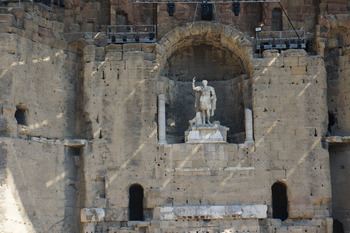
As I am working in the archive of absence, I want to begin with a missing subject, one that once cohabited with a familiar imperial image. It isn't there now—and why it isn't goes to the heart of the historiographical problem I'm tracing—but kneeling next to the emperor on the famous statue in the scaenae frons of the Roman theatre in Orange (Fig. 1) was once the figure of a Gaul, whose submission was displayed ten meters above the stage floor for all who gathered in that theatre to see. That now missing figure was described by Jules Formigé, the first modern archaeologist who excavated the cavea: “Above the cornice … was the dedication of the theatre, surmounted by the colossal statue of Augustus, in a niche, with a captive on bended knee at his feet.”Footnote 5 I think we may assume the captive was a Gaul because the figures from two nearby triumphal arches, the triple arch just north of the theatre at Orange and its companion arch at Carpentras, both also excessively document the defeat of the Gaul. The arches and the emperor's statue remind us that the survivors lived for generations among the trophies of their own defeat, gradually assimilating as Gallo-Romans, channeling a traditional warrior culture into the bureaucracy of rank and support service of a Roman legion that had eradicated their way of life, at best, eliding the rupture, acculturating, perhaps even thriving in a new market, but marked as the defeated, the estranged of their own land.Footnote 6 The survivors of the Gallic Wars, if they ever gathered at the new theatre at Orange, or at any of the other hundred and fifteen Roman theatres in Gallia: Did they watch their own subjugation playing out, and like the Gallic masons who carved the images of their own surrender on the arches, did they participate in staging that narrative? Or is the missing Gaul in the theatre the perfect metaphor of a race whose culture was itself erased?
The replaced emperor, Théâtre Antique, Orange. Photo: The author.

A Nation the Size of Forty Nations
For five centuries, as this superstate called Rome expanded, it consumed and mapped over prior cultures all across the circum-Mediterranean world, from Britain to the Middle East to North Africa—the territorial equivalent of forty or more modern nation-states.Footnote 7 For five centuries, Rome invaded, destroyed, or occupied prior settlements, refounded them as Roman coloniae, and imposed upon the survivors a complex foreign culture (religion, currency, language) that subsumed their lives into the alien administrative structure of Rome, comprehensively overwriting old customs, social orders, and prior identities.
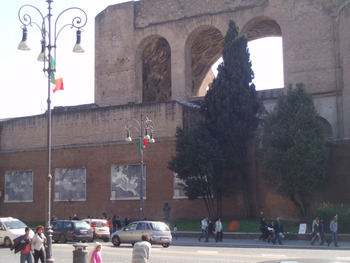
The large story is familiar over many geographies; but consider the pace of that change. In each topography of contact, when the blood was dry and the last resistance quashed, survivors within a single generation would have seen military outposts become permanent settlements, walled garrisons become chartered Roman towns, and it would have been clear that “they” were here to stay. Roman roads and border walls sliced through and broke up old territorial boundaries, indigenous topographies were comprehensively remapped; in some cases the landscape itself was utterly refashioned, swamps drained, ports dug, rivers diverted, massive earthworks thrown up, until the land itself was estranged.Footnote 8 As John Montague wrote: “The whole landscape a manuscript / We had lost the skill to read, …”Footnote 9 As landscape was refashioned, so too were the survivors. Among the accomplishments that Augustus recorded in his Res Gestae is the profoundly understated line that accounts for a massive cultural shift for half of Western Europe: “I brought peace to the Gallic and Spanish provinces.”Footnote 10 This radical realignment of life was largely the work of the first decades of conquest, and to appreciate emotionally the magnitude of this rupture and the great displacement that followed may require a slower, more intent kind of looking than the century-by-century tracking of Rome's cancerous growth as traditionally mapped, like Mussolini's marble and bronze maps (Fig. 2).
Mussolini's marble and bronze maps on the Via dei fori Imperiali charting Rome's expansion. Photo: The author.

If we slow this vast progression, pause the power, and consider the reshaping of a single lifetime, what might we see? Greg Woolf, writing of Romanization in Gallia, imagines a young Gaul growing up on an “iron age farmstead,” “built of posts, wattle and daub,” in a tribal warrior culture with little contact with even basic Roman manufactured goods. If he survived the wars, that Gaul would have seen in one lifetime the construction of the major forts, which became Roman provincial cities; the settlement of troops discharged into citizens; the adoption of a new military culture, language, law, religion, currency, commerce; and all the vast conquista these represented.Footnote 11 Roman template architecture imposed on these frontier sites the whole familiar grid of empire: forum, temples, baths, and then theatres.Footnote 12 But for the pre-Romans, this was all new technology—even the Roman bath is a socially overstructured sphere, what Foucault would call a “learned space”—but unlike Roman baths over native springs, or Roman temples over prior sacred sites, Roman theatres, outside of Magna Graecia, had no prior association.
Although we know very little about performance in the provinces, I suspect the theatre's role in this assimilation was no little one. There are, for example, the remains of 115 purpose-built theatres in Roman Gallia alone, and it remains a curious feature of Romanization that theatres were among the first nonmilitary architecture constructed; most were built early, within the first decade of imposed rule, and the pace of that arrival is worth exploring.
If such a one as Woolf imagines, an Iron Age survivor, first walked the new urban complex as a newly assimilated precontact Other and asked, regarding one of those hundreds of new Augustan theatres built into the new urban centers, “And that building? What goes on in that building?” Such a one might have it described to him in this way—after a pause to assemble complex associations: “Ah … that building was different. That building is where the new edicts are read, where the claques fight it out, where the Jews are sported, where Roman festivals are held, where strangers are tried; that's where games are staged, and the Roman plays—and the playing with Roman plays, with actors in funny boots and distorted masks yelling like demons, or mimes conversant enough with it all to send it up; that's where the emperor's statues are, and his birthday is celebrated; that's where the defeated acknowledge him, where the magistrates throw presents (missilibus) to the populace; it's where the archives are kept, where the frightened gather, where the discontented whisper mutinies, where the wealthy show off, where those who suck at the teats of Rome gets their names inscribed, where the town is ordered by seats; it's where the captives are displayed, and where, if the mood takes you, you find a quick shag: that building is where Romans are made. It's a complicated building, that one.”Footnote 13
This is exactly the moment that the first-century novella writer Dio Chrysostom described, this somewhat terrifying and disorienting moment, when an indigenous stranger—a man from the woods who had “nothing but his long hair and a hut of very strong timbers” (when “hut,” Vitruvius reminds us, connoted primitive)—was discovered by chance and arrested for not paying his taxes to an imperial power of which he was blithely unaware. He was carried to the new Roman outpost and displayed as a criminal before magistrates and a populace who had gathered at a structure he had never seen before: a theatre. He described his horrifying first contact moment:
This is what I saw. It is a great crowd of people shut into the same place and a frightening roar and shouting; I thought they were all fighting with one another. Well, the man brought me before certain magistrates and said with a laugh, “This is the fellow you sent me for. He has nothing but his long hair and a hut of very strong timbers.” The magistrates strode to the theater, and I with them. The theater is a sort of hollow valley, not, however, straight up and down, but half round. It is not a natural formation, but built of stones. You are probably laughing at me for explaining what you know perfectly well.
At first the crowd spent a long time attending to other business. They kept shouting, sometimes amiably and with good temper, when they wished to applaud, but sometimes angrily and in bad temper. Their angry fits were awful. The people they shouted at were terrified; some of them ran around begging mercy and others flung their cloaks off for fear. Once I myself was almost knocked over by the shouting: it was as if a tidal wave or clap of thunder had broken over me.Footnote 14
There, in that noisy, unnatural space, the stranger in deerskin told his rural tale, won the sympathies of the crowd, and accepted the verdict of the Assembly: a gift of a new tunic and cloak, also displayed before the people gathered there in the theatre.Footnote 15 Such experiences must have played out numerous times, in many regions. In the gentle fiction of Dio Chrysostom, citizenship is conferred with the tunic and cloak, made spectacular in that “hollow valley”; but apart from the disorienting culture shock of a sudden intense immersion into Roman urbanity, the stranger is absorbed into empire with relatively minimal discomfort. The wild and unordered body site of the deer hunter is overscribed with Roman dress, remapped; and that remapping occurs as a public act, before spectators in a theatre that consumed its unmarked. The deer hunter may have been released and even rewarded, but he was marked nonetheless, and his landscape was, from that moment on, indelibly altered—indelibly another's.
In other historical accounts, the encounter of the conquered and the theatre is first a terrifying unmapping, a stripping of prior culture, and a violent display of the naked un-Romanized. Josephus recounts just such episodes against the Jews in Roman Judea who resisted the unmarking and remarking of citizenship, and these too occurred in the theatre: “Time and time again ere now the sight has been witnessed of prisoners enduring tortures and death in every form in the theatres, rather than utter a single word against their laws.”Footnote 16 When Josephus writes of another event, in Alexandria, in which thirty-eight members of the Jewish council were marched into the theatre, put upon the stage, forced to participate in an interlude of music, and then flogged before the crowds while captured Jewish women were made to eat pork, we are in the presence of a weaponized theatre of state, aggressively engaged in the recontainment of identity.Footnote 17 Herod, Rome's client king who built the theatres in Judea, may be praised for introducing “large-scale public spectacles and competitions into the Roman East, revolutionizing the recreational habits of the indigenous populations,” is how Zeev Weiss recently put it; but I think it is fair to speak of such harsh stagings of an assimilationist agenda as a weaponization of theatre, in which, through which, spectacles of torture reshape its spectators.Footnote 18
Of the theatre's role in the fashioning of Romans we do not have the text of a single play performed outside of Rome. But how theatre was deployed to Romanize is not without records. Architecturally, a subjugated Gaul is one unignorable image of domination; but we also have descriptions of how the theatre functioned in that alien and frankly weaponized practice of rescripting identities elsewhere in the provinces—particularly for that first conquest generation who made the internal adjustment needed to live under the new order—and such accounts may be of some use. How, for example, the Jew was represented on the comic stage is not known from the surviving plays, but when Herod first built a theatre in Roman Judea, he chose for his site the demolished Synagogue. That overmapping likely had profound consequences in shaping cultural attitudes of race, conquest and assimilation. Were such practices deployed elsewhere, among other dispossessed populations? I think it quite likely that such practices were as routine as Roman template architecture.
So, on the one hand we have hundreds of purpose-built theatres, largely early arrivals in the new grid of empire, which seem to have been deployed in the Romanizing process. But ruins of theatres are scarred texts. Even where reassembled (Sabratha, Orange) they bear their lacunae. They have very broken memories. They can recall a distant Rome, the emperor, sometimes a dedication to those who built it, sometimes a vague relation to Dionysos, with fragments of statues of maenads or satyrs; but they don't seem to remember lives of the performers who worked there, or what exactly was performed in these spaces, or the myriad ways they were used to speak to or across the diverse Roman culturescape. They have, in some sites, archive walls that recall the civic service of distinguished individuals, but not those who gathered in such spaces. Who and how they remembered may be a feature of this Romanization. It was certainly the case in Aphrodisias, with its excessive memory devoted to its most Romanized of citizens, Zoilos.
Gaius Julius Zoilos was one whose name revealed the hybridity of his generation. Originally from the city of Aphrodisias, in Anatolia, he arrived in Rome (somehow, in the buried histories of the vanquished) as a slave to Gaius Julius Caesar, whose name he had been given; and sometime after the assassination he was manumitted by Caesar's heir, Octavian (Augustus), and returned to his home in Anatolia—at the time Roman Caria—with a gift of money, and no little gratitude toward the future Augustus. Zoilos was instrumental in ensuring that his home city of Aphrodisias sided with Octavian against Mark Antony during the civil wars, and for backing the right horse, the town was granted an exemption from all Roman taxes. In the economic boom that followed, Zoilos prospered, became something of the town benefactor—certainly the town's liaison to Rome—and donated back to his city a magnificent theatre. An inscription records the gift in fine letters across the architrave of the proscenion, and a series of nicely preserved images, in frieze, relate his own social journey. In one panel Zoilos is represented at his homecoming, not as a slave, but rather as a “traveler” returning home, in his round, flat, broad-brimmed hat (petasus) and short cloak over a tunic; in a second panel Zoilos is being crowned by Polis (the city), narrating his social ascent; in a third, this “traveler” is now portrayed as a fine Roman orator in a smartly wrapped toga, whom the goddess Timé (Honor) offers a crown and the blessings of a cornucopia.Footnote 19 Assimilation, demonstratively, had its rewards, and Zoilos’ great gift back to the city—a theatre—both accelerated and documented that assimilation. As with Zoilos in Aphrodisias, Cogidumnus in Britain, the client king Juba of Numidia, Herod in Judea, and countless other conduits of Roman culture, Rome's great success lay in brokering aliens into Romans. What memory the theatres still retain seems to be reserved for the already acculturated: stone inscriptions mark official state writing, dedications like those that remember Zoilos. But what of the unacculturated? What of those unarchived below the state record?
From the north of Britain, the fort at Vindolanda, just south of the (later) Hadrian Wall, has produced in its anaerobic soil a marvelous collection of perishable soft material life: shoes and baby's socks, yarn and wigs, saddlebags and gloves, and a cache of written letters that document the day-to-day of unofficial life on the edge of empire. There we find the border business and the banal of border life at the rim of the Roman world: the shopping lists, a birthday party invitation, military orders, speculation for trade, and commiserations between slaves. It is that world that wants recovery. One name appears in a letter that may deliver some insight into this assimilation, and it may very well belong to an actress.
Verecunda: An Actress at the Edge of Empire
Send my greetings to Verecunda. …
—Ascanius, Vindolanda Tablet, 650.Which brings me to a small case study of one actress at the close of the first century at the very edge of empire, of whom a little is known. Her name was Verecunda, adopted or assigned, and that's where the problem begins. How to reconstruct a history of someone whose identity has already been refashioned? She was a mime, in the north of Roman Britain; she was not from there; she partnered with another in the disposable performance trade, a gladiator; and she died, regionally known, at the northernmost frontier, in a military post, without a theatre.
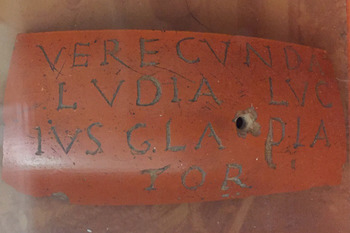
Three things remain of her life. First, her name and profession are found scratched on a small shard of pottery found in Leicester: Verecunda, ludia (actress), and Lucius, gladiator (Fig. 3).Footnote 20 Two names on a clay fragment marking her in an acting profession found in a town with no known theatre is an intriguing place to begin, as it already reminds us that performance was far more extensive than its architectural remains. How did she get there, where did she perform, and what did she perform? The terra-cotta that formed the original bowl was not local; the so-called Samian ware (terra sigillata) pot was fired with Italian clay. Did the couple, like the clay, originate on the Continent, in Gallia or Italy? Did she carry her profession from Rome? Or did they come by a broken shard of imported ceramic ware somewhere else and scratch their names on it? The names were not fired into the clay, but scratched over the surface with some care. Lucius and Verecunda were both in slaved professions, so they were likely foreign, transported to Roman Britain in one or separate traveling companies, camp followers of the troops, maybe. Their names may both be stage names (Verecunda = “Modest”), or hers may be a Roman name, Latinized from the Celtic.Footnote 21 They were clearly both refashioned identities. Somewhere they came together, in a partnership professional and/or romantic. Somewhere they acquired a shard from a bowl, shaped it smooth, and carefully etched their names in an enduring testimonial, carried with them as a broken document of broken identities. At some point, someone bored a hole in it, quite precisely (see Fig. 3), such that the small (3-inch) piece would hang downward, as if it were to be worn. Somehow Verecunda ended up, an actress without a theatre, with Lucius in Ratae (Leicester), where it was not likely he lived to enjoy a comfortable retirement.Footnote 22
Verecunda–Lucius shard, Jewry Wall Museum, Leicester, UK. Photo: The author. Used by permission of the Jewry Wall Museum, Leicester, UK.

More speculation: a second inscriptional reference to Verecunda, also dated to the late first century (ca. 95–100), also in northern England, may confirm that she was not native to Britain. In the Vindolanda tablets (650) a non-Roman soldier, Ascanius, greets Verecunda by name: “Greet Verecunda and Sanctus … Capito, and all my fellow-countrymen and friends.” In Elizabeth Greene's reading of the phrase “omnes cives et amecos,” the sender, Ascanius, “is not of Italian origin, but of some other ethnic group,” with an overscribed Roman name. Moreover, Greene suggests that Ascanius was writing to members of the same mixed community—perhaps one of the cohort of the Batavians or Tungrians that Robin and Anthony Birley documented, living or serving at the fort at Vindolanda—greeting them in the grafted tongue, but acknowledging their old country, with Verecunda being the first among them.Footnote 23 Was she the same Verecunda, attached somehow to the military outpost or part of its entertainment, and did she find a small community of repatriated non-Romans in the north of Roman Britain?Footnote 24 The ongoing excavation of Vindolanda recovers so much of daily life in a military outpost, a life that may have included performance on a military frontier. If this is she, she is there before even the nominal security of Hadrian's Wall (begun in 122 ce), with soldiers who lived in a walled fort and the attendant vicus (trading village of camp followers) that sprang up outside the fort. This was a site that never saw a city, but rather a series of nine erected and demolished forts over two hundred years. This was a temporary military outpost, even by Roman standards. And if she still engaged in performance at such a border zone, there at the ragged edge of empire, what would that performance look like to such a mixed community, from such a mixed community? Even without answers remotely possible, the questions must still be asked, because without asking, we have only the emperor's statues and the inscriptions of those who, like Zoilos, aspired to Romanness. Somehow, what is missing seems bigger than that. Did mimes, like Verecunda, retain something of the old tongue? Did they play in the gaps between assimilation and resistance (“you may greet no one” / “greetings to Verecunda”)? And how might that shape performance? I have written elsewhere of the curses buried in Roman theatres and Roman plays, and I remain deeply intrigued by the leakage of prior lives into present performance by the displaced. I'm intrigued by the metaphor of graffitied names—repurposing ceramic ware as a private memento, claiming identity—and I wonder if a similar strategy of graffiti performance was also at work. Could mimes like Verecunda talk to her own community differently than the state-sponsored festival performative? We call it “signifyin’” elsewhere. Code switching. Letters spoke in Latin, but could performance speak to countrymen? Mimes from Rome were routinely banished to the provinces for doing exactly this, including an edict in 115 that banished all of the mimes from Rome.Footnote 25 They deployed familiar myths to play both within and against power, and were sometimes exiled for it. Did that make the provinces the imperial, radical fringe?
Finally, one last scrap of Verecunda's life. Even farther north, beyond where Hadrian's Wall would be, the Roman army extended its holdings and built a second wall, the turf-on-stone Antonine Wall, and it was here at the high fort of Bar Hill that her gravestone was found. (It is now preserved in the Roman collection of the Hunterian Museum, Glasgow.) When she died we cannot say for certain. (The stone was later repurposed into a house wall, ca. 140 ce.) What we can say is that at the farthest northern border of the empire there died an actress, and a single name on a recycled stone marks the close of a storied life whose story is not known.Footnote 26
In the end, Verecunda—whoever she was—is not much of an archive. But what makes Verecunda fun to think with is her invitation to wonder; she stares out from all the zones of silence, all those holes under the emperors’ feet, and neither speaks nor goes away—the absent present, persistently resisting both memory and erasure. As the old rhyme has it: “Yesterday upon the stair, / I met a man who wasn't there. / He wasn't there again today. / I wish, I wish he'd go away.”Footnote 27 In the old narrative of empire and assimilation, figures like Verecunda are legion; only the faces change. If their stories are preserved at all, it is often at their most inauthentic moments: adopted names, slave names, assigned professions, displaced geographies, working in theatres, performing something to others of the displaced, greetings and not-greetings of restructured identities. What kind of history is that? Do we archive them in a postconquest identity they did not choose? Roman theatres belong to imperial narratives; those who worked in them, or worked without them, have more complicated stories, and are infinitely less visible. But like the missing Gaul that Formigé never restored, once you see the hole next to the emperor, you can never not see it—until the missing Gaul becomes the most present part of the composition.
In the end I ceased the pursuit of Verecunda, whoever she was, because in the end, I found I didn't care for a kind of history that fixes anyone in an identity they never chose. Rome did enough of that.