INTRODUCTION
In English, the expression any is prohibited in simple positive sentences such as (1). By contrast, any is licensed in two linguistic contexts. First, any is licensed in downward entailing linguistic contexts, such as in negative statements, in the antecedent of conditionals, and in the restriction (roughly, the subject NP) of the universal quantifier (e.g., Baker, Reference Baker1970; Giannakidou, Reference Giannakidou1998; Klima, Reference Klima, Fodor and Katz1964; Ladusaw, Reference Ladusaw1980). In these contexts, any is assigned an existential reading, and is referred to as a negative polarity item (NPI). The use of any as an NPI is illustrated in (2).
(1) *John ate any apples.
(2) John did not eat any apples.
The expression any can also be used as a free choice item. Free choice any is licensed in generic or intentional contexts, such as in sentences with imperatives and modals (e.g., may, can, will), as illustrated in (3). Free choice any can either be assigned a universal reading, as in (3a), or an existential reading, as in (3b).
- (3)
a. Any clerk can help you.
b. Press any key.
The distributional and interpretative properties of English any are typical of polarity sensitive items, and various syntactic, semantic, and pragmatic principles have been postulated to account for these properties (e.g., Baker, Reference Baker1970; Carlson, Reference Carlson1980, Reference Carlson, Masek, Hendrick and Miller1981; Chierchia, Reference Chierchia2006; Davison, Reference Davison and van der Auwera1980; Fauconnier, Reference Fauconnier1975; Giannakidou, Reference Giannakidou1998, Reference Giannakidou2001; Horn, Reference Horn2000, Reference Horn, Carlson and Pelletier2005; Kadmon & Landman, Reference Kadmon and Landman1993; Klima, Reference Klima, Fodor and Katz1964; Krifka, Reference Krifka1995; Ladusaw, Reference Ladusaw1980; Vendler, Reference Vendler1967). Previous studies of the acquisition of English any have found that English-speaking children command both the distributional and interpretive properties of any by around age four (O'Leary, Reference O'Leary1994; O'Leary & Crain, Reference O'Leary and Crain1994; Song, Reference Song2003; Thornton, Reference Thornton, Fuller, Han and Parkinson1995). The findings on the acquisition of English any invite us to ask whether the acquisition of polarity sensitive items follows the same developmental path in historically unrelated languages, such as Mandarin Chinese.
Renhe is the Mandarin Chinese equivalent of English any. Like any, Mandarin renhe is prohibited in simple affirmative statements such as (4). Also like English any, renhe can be used as a negative polarity item, as in (5), and as a free choice (FC) item, as in (6). Moreover, when renhe is an NPI, it is assigned an existential reading, like English any, and when renhe is a FC item, it can be assigned both a universal reading, as in (6a), and an existential reading, as in (6b).
(4) *Zhangsan kanjian le renhe ren
Zhangsan see asp any person
‘Zhagnsan saw anyone.’
(5) Zhangsan mei kanjian renhe ren
Zhangsan neg see any person
‘Zhangsan did not see anyone.’
- (6)
a. Zhangsan neng pa shang renhe yi ke shu
Zhangsan can climb up any one cl tree
‘Zhangsan can climb up any one of the trees.’
b. Qing gei wo renhe yi zhang pai
please give me any one cl card
‘Please give me any one of the cards.’
The present study investigated the acquisition of renhe by Mandarin-speaking children. There were two experiments. One examined children's comprehension of FC renhe, and the other examined children's comprehension of NPI renhe. The main finding was that Mandarin-speaking children exhibited adult-like command of renhe in both experiments, in keeping with the observation, based on previous research, that young English-speaking children demonstrate awareness of the linguistic properties of any.
The paper is organized as follows. First we introduce the basic linguistic properties of renhe. Then we provide a literature review on the acquisition of English any. Following the literature review, we report two experimental studies we designed to assess Mandarin-speaking children's comprehension of renhe. Experiment 1 examined children's interpretation of FC renhe in sentences with the modal verb neng ‘can’. Experiment 2 examined children's interpretation of NPI renhe in the scope of the temporal conjunctive zai…zhiqian ‘before’. In the concluding section, we discuss why Mandarin-speaking children, like adults, do not often produce renhe.
Linguistic properties of renhe
Like English any, renhe in Mandarin Chinese is not tolerated in simple affirmative sentences (cf. (4)). Mandarin renhe is licensed in two linguistic contexts. First, as a negative polarity item, renhe is licensed in downward entailing contexts (Ladusaw, Reference Ladusaw1980). Downward entailing contexts license inferences from general terms (e.g., animal) to specific terms (e.g., monkey). To illustrate, negation (e.g., not) is downward entailing. The statement John did not see an animal contains the general term animal, and we can replace this general term with a more specific term monkey, salva veritate. So, if the statement John did not see an animal is true, it follows that the statement John did not see a monkey is also true. Other downward entailing linguistic contexts include the antecedent of conditionals, negative predicates like deny and prevent, the temporal conjunction zai…zhiqian ‘before’, and many other linguistic constructions (see Hsiao, Reference Hsiao2002; Kuo, Reference Kuo2003; Wang & Hsieh, Reference Wang and Hsieh1996). Examples are given in (7).
- (7)
a. Zhangsan mei kanjian renhe ren [Negation]
Zhangsan neg see any person
‘Zhagnsan did not see anyone.’
b. Ruguo you renhe ren qifu ni, qing gaosu wo [Antecedent of conditionals]
if have any person bully you please tell me
‘If anybody bullies you, please let me know.’
c. Ta fandui wo zuo renhe shiqing [Negative predicates]
he prevent me do any thing
‘He prevents me from doing anything.’
d. Xiaolaohu zai renhe xiao dongwu zhiqian pao dao le zhongdian [Before]
Tigger at any little animal before run to asp finish line
‘Tigger ran to the finish line before any of the other little animals.’
As noted earlier, Mandarin renhe can also function as a free choice item. FC renhe is licensed in generic or intentional contexts, such as in sentences with modals and ones with imperatives. FC renhe receives an existential reading in (8), and it receives a universal reading in (9).
(8) Qing xuan renhe yi zhang pai
Please pick any one cl card
‘Please pick any card.’
(9) Women yao dadao renhe yi ge diren
we will beat any one cl enemy
‘We will defeat any enemy!’
The variation between NPI and FC meanings for Mandarin renhe shows that these meanings are evoked by properties of their licensors. In (10a), the licensing operator neng is an ability modal word. Consequently, renhe receives a universal reading. This sentence is false if there is even one big tree that Zhangsan cannot climb. By contrast, renhe is assigned an existential reading in (10b), where it is licensed by the permission modal word neng. The speaker of (10b) is asserting that Zhangsan is permitted to take any one of the apples, but he is not being given permission to take all of them (cf. Vendler, Reference Vendler1967).
- (10)
a. Zhangsan neng pashang renhe da shu
Zhangsan can climb-up any big tree
‘Zhangsan can climb up any big tree.’
b. Zhangsan neng nazou renhe pingguo
Zhangsan can take any apple
‘Zhangsan can take any apple.’
We have chosen to analyze English NPI any and Mandarin NPI renhe as existential quantifiers which are interpreted within the scope of their licensors (cf. Carlson, Reference Carlson1980; Chierchia, Reference Chierchia2006; Ladusaw, Reference Ladusaw1980; Kadmon & Landman Reference Kadmon and Landman1993). An alternative analysis was advanced by Quine (Reference Quine1960: 138–40) (cf. Shimoyama, Reference Shimoyama2011). The alternative is to analyze these expressions as universal quantifiers that obligatorily take scope over their licensors. In our view, there are strong empirical arguments in favor of the existential account. First, the wide-scope universal account generates the incorrect interpretation of sentences like (11) (see Carlson, Reference Carlson1980). On the universal account, example (11) would mean that ‘for every pet, Mary decided not to marry a man who has that pet’. However, if NPI renhe is interpreted as an existential quantifier under negation, then (11) receives the correct meaning, which can be paraphrased as ‘Mary decided not to marry a man who has even a single pet’.
(11) Mali jueding bu jiagei chiyou renhe chongwu de nanren
Mary decide neg marry have any pet De man
‘Mary decided not to marry a man who has any pet.’
We will present just one further argument. The existential interpretation of NPI renhe is rendered explicit when it appears with negation in the antecedent of conditional statements, as illustrated in (12) and (13), which are instructions one frequently hears on airplanes. Both examples have the same meaning, regardless of the word order of renhe and negation (bu). They are instructions to passengers to inform the flight attendant if anything/something was not understood. These sentences are not instructions that are limited to people who failed to understand everything (i.e., EVERY >NOT). As (12) and (13) also indicate, renhe can be replaced by the existential yixie ‘some’ without a change in meaning. Because Mandarin yixie is a positive polarity item, like English some, it is not expected to be interchangeable with a universal quantifier, on the wide-scope universal account, contrary to the facts.
(12) Ruguo ni bu mingbai wo gei ni jieshi guo de
if you neg understand I to you explain asp De
renhe/yixieshiqing, qing gaosu wo
any/some thing please tell me
‘If you do not understand anything/something I have explained to you, please tell me.’
(13) Ruguo you renhe/ yixie wo gei ni jieshi guo dan
If have any/some I to you explain asp but
ni bu mingbai de shiqing, qing gaosu wo
you neg understand De thing, please tell me
‘If there is anything/something I have explained to you that you do not understand, please tell me.’
Domain widening
In a seminal study, Kadmon and Landman (Reference Kadmon and Landman1993) argue that English any extends the domain of quantification that would otherwise be the denotation of the accompanying common noun used as a bare plural. Both NPI any and FC any are argued to invoke the domain widening effect. Let us consider NPI any first using example (14).
- (14)
a. I don't have potatoes.
b. I don't have any potatoes.
Sentence (14a) is true even if I have a few rotten potatoes in my back yard. This is because in a context of utterance, the domain of quantification associated with the common noun (i.e., potatoes) includes typical potatoes (i.e., cooking potatoes), but leaves out atypical potatoes (e.g., rotten potatoes). However, when any is added, as in (14b), the sentence is no longer true if I have a few rotten potatoes. The denotation of potatoes, when combined with any, is extended to include both typical and atypical potatoes. This semantic function of any is known as ‘domain widening’.
A similar domain widening effect is manifested in the use of FC any, as illustrated in (15).
- (15)
a. An owl hunts mice.
b. Any owl hunts mice.
Example (15a) is true even if there are some sick owls which do not hunt mice. These sick owls are legitimate exceptions to the indefinite an owl in (15a). By contrast, the use of any in (15b) extends the set of owls that count, so even sick owls are included as part of the widened domain of quantification in sentence (15b).
Turning to renhe in Mandarin Chinese, renhe exhibits similar domain widening properties, both as an NPI and as a FC. Consider NPI renhe first, as in (16). Like the corresponding English sentences in (14), the use of NPI renhe in (16a) makes all kinds of potatoes relevant in the domain of quantification. So if I have some rotten potatoes, (16a) but not (16b) can be taken as a true description of my situation.
- (16)
a. Wo mei you malingshu
I neg have potato
‘I don't have potatoes.’
b. Wo mei you renhe malingshu
I neg have any potato
‘I don't have any potatoes.’
In a similar vein, FC renhe in (17b) widens the extension of the common noun maotouying ‘owl’, such that even sick owls are relevant to the rule that owls hunt mice. Such domain widening effect is absent in sentences containing plain common nouns such as maotouying, as in (17a).
- (17)
a. Maotouying zhua laoshu
Owl hunt mouse
‘An owl hunts mice.’
b. Renhe maotouying dou zhua laoshu
any owl all hunt mouse
‘Any owl hunts mice.’
Freedom of choice
If I say to you (18) when I offer a basket of apples, you may ask the question in (19).
(18) Pick one apple.
(19) Which one?
By contrast, if I substitute FC any for one in (20), the question Which one? fails to make sense. This is because when I use FC any, this indicates that it doesn't matter which apple is selected. When a speaker uses FC any, the hearer has ‘unrestricted liberty of individual choice’ (Vendler Reference Vendler1967: 132).
(20) Pick any apple.
Another meaning associated with FC any is illustrated in (21) (from Jennings, Reference Jennings1994; cited in Horn, Reference Horn, Carlson and Pelletier2005). In this sentence, the continuation of any after a plain indefinite a bicycle does not give rise to a semantic redundancy; rather any strengthens the freedom of choice.
(21) I am looking for a bicycle, any bicycle that works.
This brings us to the universal reading associated with FC any. If I declare (22), I convey that, no matter which person you select from the domain of quantification, I can beat that person. This gives rise to a universal reading for (22) (Bolinger, Reference Bolinger1960; Giannakidou, Reference Giannakidou2001; Horn, Reference Horn2000, Reference Horn, Carlson and Pelletier2005; Tovena & Jayez, Reference Tovena, Jayez, Corblin, Godard and Marandin1999; Vendler, Reference Vendler1967).
(22) I can beat any one of you.
Turning to Mandarin Chinese, the freedom of choice meaning is attested in sentences containing FC renhe. Like its English counterpart (20), (23) conveys the speaker's intention that the hearer can pick any apple that he fancies. Therefore, it would be redundant for (23) (Pick any apple) to be followed by the question (24b) (Which one?). By contrast, with the plain indefinite yi ge pingguo ‘one-cl-apple’, as in (24a), the freedom of choice meaning is missing, as verified by the fact that it is felicitous to follow (24a) with the question (24b).
(23) Tiao renhe yi ge pingguo
pick any one cl apple
‘Pick any apple.’
- (24)
a. Tiao yi ge pingguo
pick one cl apple
‘Pick one of the apples.’
b. Na yi ge?
which one cl
‘Which one?’
To sum up, renhe in Mandarin Chinese can be used as a negative polarity item and as a free choice item, just like its English counterpart any. Renhe is restricted in distribution; its interpretation is dependent on its licensing operator. Both NPI renhe and FC renhe invoke domain-widening effects. Before we discuss the acquisition of Mandarin renhe, it will be useful to review the findings of previous research on the acquisition of English any.
THE ACQUISITION OF ENGLISH ANY
In the literature, it is reported that English-speaking children exhibit adult-like syntactic and semantic knowledge of NPI any. In an experimental study, O'Leary (Reference O'Leary1994) (see also O'Leary & Crain, Reference O'Leary and Crain1994) reports that four- to five-year-old English-speaking children, like adults, did not produce NPI any in positive contexts; these children only allowed any in negative contexts. In particular, in a Truth Value Judgment task with an elicitation component, eleven children (age range: 4;4–5;4) were presented with two types of target sentence. These sentences, uttered by a puppet, were incorrect descriptions of stories acted out by one of the two experimenters. The first type of target sentence contained the NPI anything and the expected adult-like response was to use a positive polarity item (PPI) such as something; NPIs are not allowed in this situation. An example is given in (25a). By contrast, the other type of target sentence, as illustrated in (25b), contained the PPI some/something. In this case, an adult-like response would be to replace the PPI with an NPI.
- (25)
a. Type 1
Story: Two of the Ninja turtles did not get any toy from Santa, but the third one got a ball from Santa.
Puppet: None of the Ninja Turtles got ANYTHING from Santa.
Adult-like response: No, this one got SOMETHING from Santa.
b. Type 2
Story: None of the three friends had presents for Gonzo.
Puppet: Only one of the friends had some presents for Gonzo.
Adult-like response: No, none of the friends had ANYTHING for Gonzo.
It was found that children never produced NPIs in response to Type 1 sentences in (25a), even though NPIs were produced by the puppet in the immediately preceding discourse. This finding constitutes compelling evidence in support of the claim that English-speaking children are aware of the distributional constraints of the NPIs any/anything. On the other hand, children were found to use PPIs like some or something in their responses to Type 2 sentences in (25b). Apparently, PPIs were initially used to provide the meaning of the corresponding NPIs, though this is not our concern here (see Crain Reference Crain2012; Goro & Akiba Reference Goro, Akiba, Chand, Kelleher, Rodríguez and Schmeiser2004a, Reference Goro, Akiba and Otsu2004b).
In another elicited production study, Song (Reference Song2003) found that English-speaking children are well aware of the distributional constraints of NPI any. This study tested whether children conform to a subject–object asymmetry with regard to the distribution of any. In particular, any is not allowed in subject position, which is syntactically higher than the sentential negation, as shown in (26a). Alternatively, negative pronouns are used in subject position, as in (26b). By contrast, any can occur in object position, i.e., inside the scope of the sentential negation, as shown in (26c). A negative pronoun is also possible in object position, as shown in (26d).
- (26)
a. *Anyone didn't meet John.
b. Nobody met John.
c. John didn't meet anyone.
d. John met nobody.
Taking advantage of the subject–object asymmetry of NPI any, Song (Reference Song2003) tested three- to five-year-old English-speaking children in their use of NPI any in two test conditions (the Subject Condition and the Object Condition). In the Subject Condition, a picture was shown to the child and the investigator, but this picture was hidden from the third person. In this picture, there are two animal characters but neither of them are doing the activity described by the test sentence. In a typical trial, a picture showed two rabbits under a tree and no one is on the tree. The investigator told the child ‘Tell her (the third person) WHO is climbing the tree right now’. Under this condition, children, like adults, were observed to use sentences containing negative pronouns in the targeted subject position, e.g., NOBODY (or NO ONE) is climbing the tree, to respond the experimenter's request. No children produced an any sentence in the Subject Condition. In the Object Condition, the child and one experimenter were presented with a picture showing an animal character doing something other than the activity described by the test sentence. For instance, in a typical trial the child and the investigator were shown a picture of a monkey sitting far away from some toys and a bag. The investigator then said to the child: ‘Tell her (the third person) WHAT the monkey is touching right now.’ Under this condition, younger children (three- to four-year-olds) preferred to use negative pronouns in the targeted object position (The monkey is touching NOTHING), while older children (five-year-olds) tended to used any (The monkey is not touching ANYTHING). The percentage of using any in the Object Condition increased with age (31% of the time in three-year-olds, and 45% of the time in four-year-olds, and 57% of the time in five-year-olds). In short, the experimental findings reported in Song (Reference Song2003) show that English-speaking children observe the subject–object asymmetry in their use of NPI any. This indicates that the distributional constraints of NPI any are already in place in young English-speaking children.
Moreover, English-speaking children distinguished some subtle differences in meaning when any interacts with negation. Using a comprehension methodology, Thornton (Reference Thornton, Fuller, Han and Parkinson1995) presented children with questions like (27).
- (27)
a. Did any of the turtles not buy an apple? (any >not)
b. Didn't any of the turtles buy an apple? (not >any)
In (27a), any takes scope over negation (any >not), so the question asks if there are turtles that did not buy an apple. In (27b), by contrast, negation takes scope over any (not >any), so this question asks if there are or are not turtles that bought apples. Using a Truth Value Judgment task, Thornton tested ten children ranging in age between 3;6 and 4;11. In a scenario, two of the three turtles bought an apple, but the third one did not. In response to (27a), children correctly pointed to the third turtle 93% of the time, saying ‘This one didn't!’ On the other hand, in response to (27b), children correctly pointed to the two turtles that had bought apples 85% of the time, saying ‘These two did!’ In short, Thornton (Reference Thornton, Fuller, Han and Parkinson1995) offers convincing data showing English-speaking children are sensitive to subtle difference in meaning arising from interaction between negation and any (see also Musolino, Reference Musolino1998).
To summarize, English-speaking children have a good command of the syntactic and semantic properties of any by the time they are four years old. Children have been found to be sensitive to the licensing conditions of any, including knowledge about the linguistic contexts in which any can not appear (O'Leary, Reference O'Leary1994; O'Leary & Crain, Reference O'Leary and Crain1994; Song, Reference Song2003). In the absence of negative evidence, children's command of such ‘negative’ linguistic facts has been used by several researchers to argue for an innateness account of the acquisition of negative polarity items (cf. Crain, Reference Crain1991; Crain & Pietroski, Reference Crain and Pietroski2001, Reference Crain and Pietroski2002; Marcus, Reference Marcus1993; Pinker, Reference Pinker1984). If this account is on the right track, we are led to expect children to be sensitive to the licensing properties of the corresponding polarity sensitive items in other languages, including the NPI renhe in Mandarin Chinese.
EXPERIMENTS
The present study investigates Mandarin-speaking children's understanding of the polarity sensitive item renhe. We examined their comprehension of renhe in two linguistic contexts. One was in sentences containing the (ability) modal word neng ‘can’, and the other was in sentences containing the temporal connective zai…zhiqian ‘before’. When renhe appears in sentences with the modal word neng, it is assigned a ‘free choice’ (universal) interpretation by adult Mandarin speakers. On the other hand, when renhe appears in the scope of the downward entailing operator zai…zhiqian, it is assigned an (existential) interpretation, as a negative polarity item. Two experiments were conducted to see whether Mandarin-speaking children assign these different interpretations to the same lexical item renhe in the two linguistic contexts.
EXPERIMENT 1: ACQUISITION OF FREE CHOICE RENHE
METHOD
Experiment 1 investigated Mandarin-speaking children's comprehension of FC renhe in sentences containing the ability modal word neng ‘be able to, can’. The experiment contrasted minimal pairs of sentences with renhe and ones without renhe. A typical minimal pair is illustrated in (28) and (29):
(28) Gongfuxiongmao neng tuidong ren he yige chezi
Kung-Fu-Panda be-able-to push any one cl car
‘Kung-Fu-Panda is able to push any one of the cars.’
(29) Gongfuxiongmao neng tuidong yi ge chezi
Kung-Fu-Panda be-able-to push one cl car
‘Kung-Fu-Panda is able to push one of the cars.’
In (28), renhe appears in combination with the ability modal word neng. Here renhe invokes a ‘free choice’ reading. Suppose there are three cars. No matter which of these three cars is on offer, Kung-Fu-Panda is able to push that car. The sense of free choice attributed to renhe thus gives rise to a universal reading. Let us refer to these sentences as the ‘any-one’ type of sentence. In (29), without renhe, the indefinite common noun yi ge chezi ‘one-CL-car’ appears. Therefore, the sentence simply means that Kung-Fu-Panda is able to push one of the cars. We call this second type the ‘one’ sentences. The only difference between the two types of the sentence is the presence versus the absence of renhe. When renhe is present, the sentences receive a universal reading; when renhe is absent, the sentences receive an existential reading. We exploited this difference in meaning in order to assess Mandarin-speaking children's awareness of the semantic contribution of FC renhe.
Participants
We tested fifty-five Mandarin-speaking children between the ages of 4;5 and 6;3, with a mean age of 5;4. The children were recruited from the kindergarten affiliated to Beijing Language and Culture University (BLCU), Beijing. In addition, twenty Mandarin-speaking adults were tested as the control group. The adults were postgraduate students from BLCU.
Procedures
We used the Truth Value Judgment Task (Crain & Thornton, Reference Crain and Thornton1998). The task involves two experimenters. One experimenter acts out and narrates a story using toys and props, and the other experimenter plays the role of a puppet, who watches the story alongside the child. At some point in each of the stories, the puppet tells the child what he thinks happened in the story. The child's task is to judge whether or not the puppet's description of the story was right or wrong. If the child informs the puppet that he was wrong, then the child is asked to explain what had really happened in the story. When the child judges that the puppet accurately described what had taken place, the child is instructed to reward the puppet by feeding him something he likes to eat, say, a strawberry. Sometimes the puppet doesn't pay close attention, however, and says the wrong thing. In that case, the child is instructed to give the puppet something to remind him to pay closer attention, some food that he doesn't like as much, say a pepper. These procedures make it fun for children to play the game, and they encourage children to attend to the puppet's statements.
The child participants were introduced to the task individually and were tested individually. There was a brief warm-up at the beginning of the test session to ensure that the child could perform the task. In addition, each child was given two practice trials before the formal test session. Each practice trial was divided into two parts. At the end of each part, a simple sentence was produced by the puppet. One sentence was obviously true and was expected to evoke a ‘Yes’ response from the child participant, and the other one was obviously false, and was expected to evoke a negative ‘No’ response from the child participant.
The twenty adult participants were tested on the same stories, but using pictures. The adults were asked to indicate on an answer sheet whether the puppet was right or wrong. As with the child participants, the adult participants were asked to provide a justification if they judged that the puppet had offered an inaccurate description of the story. Practice trials were also given to the adult participants at the beginning of the session.
Test conditions
There were four test conditions, corresponding to the four parts of each story. In the actual testing, the story consisted of two competitions between two animal characters. For the ease of exposition, here we just use one animal character (Kung-Fu-Panda) and one competition (Car-pushing) to illustrate. In the next section, we provide a representative trial that was used in the actual testing sessions.
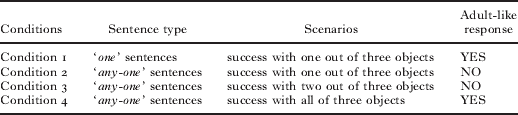
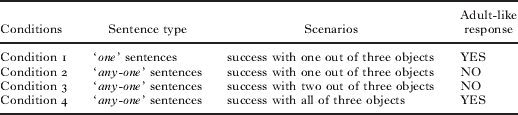
In Condition 1, Kung-Fu-Panda pushed a small car but failed with a medium-sized car and a large car. This scenario is followed by a ‘one’ sentence, Gongfuxiongmao neng tuidong yi ge chezi ‘Kung-Fu-Panda can push one of the cars’. This sentence is a true description of the scenario for adults. Condition 2 used the array of objects as Condition 1, and Kung-Fu-Panda performed the same actions as in Condition 1, but the story was followed by an ‘any-one’ sentence, i.e., Gongfuxiongmao neng tuidong renhe yi ge chezi ‘Kung-Fu-Panda was able to push any one of the cars’. This sentence constitutes an incorrect description of the scenario for adults. In short, Condition 1 and Condition 2 employed the same situations, and the test sentences differed only in the presence or absence of renhe. In combination, these two conditions allow us to assess Mandarin-speaking children's understanding or lack of understanding of the semantic contribution of renhe.
Condition 3 and Condition 4 both used the ‘any-one’ type of sentence, but these conditions differed in the events that were acted out. In Condition 3, Kung-Fu-Panda pushed two cars, but failed to push the third one. In Condition 4, Kung-Fu-Panda successfully pushed all three of the cars. Therefore, if children assigned the universal reading to the targeted ‘any-one’ sentences in these two conditions, they were expected to reject the puppet's statements in Condition 3, but accept the puppet's statements in Condition 4.
The number of ‘Yes’ and ‘No’ responses was counterbalanced, with two ‘Yes’ responses (in Condition 1 and Condition 4) and two ‘No’ responses (in Condition 2 and Condition 3). The four test conditions and the adult-like responses are summarized in Table 1. We adopted a within-subject design, testing all four conditions with each participant.
Four test conditions and expected adult-like responses
Materials
There were three test stories for each participant. These stories exhibited the same overall pattern of events. In particular, each story consisted of two competitions between two animal characters. This allows us to divide the story into four distinct parts, each corresponding to one test condition. To illustrate, in a typical trial, Kung-Fu-Panda and Grasshopper have a car-pushing competition and a fence-jumping competition. In each competition, the two animals each had a chance to try three different objects. The puppet was invited to comment on the animal's performance immediately after each trial.
In the first part of the story, we introduced two animal characters, Kung-Fu-Panda and Grasshopper. Both claim they were the most powerful person in the world. So they decided to have a car-pushing competition. Grasshopper took his turn first, and he only pushed one small car, failing with the other two bigger cars. Then the puppet was invited to comment on Grasshopper's performance. The puppet produced a ‘one’ sentence, as shown in (30). This represents an instance of Condition 1.
(30) Zhameng neng tuidong yi ge chezi
Grasshopper be-able-to push one cl car
‘Grasshopper was able to push one of the cars.’
Expected adult-like response: ‘Yes.’
After the puppet produced the test sentence (30), the child was invited to judge whether the puppet said it right or wrong. This concluded the first part of the story.
Now it is Kung-Fu-Panda's turn. This started the second part of the story. Kung-Fu-Panda tries the three cars, and eventually he pushes the smallest car and the medium-sized car, but fails to push the biggest car. The narration of the story paused at this point, and the puppet produced an ‘any-one’ sentence, as in (31). The child was invited to make a judgment. The second part represents an instance of Condition 3.
(31) Gongfu Xiongmao neng tuidong renhe yi ge chezi
Kung-Fu-Panda be-able-to push any one cl car
‘Kung-Fu-Panda was able to push any one of the cars.’
Expected adult-like response: ‘No, he only pushed two cars.’
Grasshopper fails in the first competition, so he proposes to have a fence-jumping competition. This introduced the third and fourth parts of the story. These parts were conducted in a similar way to the first two parts. In Part 3, Kung-Fu-Panda only jumps over a low fence, failing with the other two higher fences. The puppet produced an ‘any-one’ sentence, as in (32). This represents a scenario for Condition 2. In Part 4, Grasshopper jumps over all the fences without any trouble. The puppet produced an ‘any-one’ sentence, as in (33). This represents a scenario for Condition 4.
(32) Gongfu xiongmao neng tiaoguo renhe yi ge zhalan
Kung-Fu-Panda be-able-to jump-over any one cl fence
‘Kung-Fu-Panda was able to jump over any one of the fences.’
Expected adult-like response: ‘No, he only jumped over one fence.’
(33) Zhameng neng tiaoguo renhe yi ge zhalan
Grasshopper be-able-to jump-over any one cl fence
‘Grasshopper was able to jump over any one of the fences.’
Expected adult-like response: ‘Yes.’
In addition to the four test sentences, there were two filler sentences in each story. One was obviously true (34), and the other was obviously false (35). They were produced before or after a test sentence. For instance, (34) was produced in the third part of the story, followed by the test sentence (32). (35) was produced in the first part of the story, after the test sentence (30). The filler sentences were used to obscure the pattern of study, and to check children's attention.
(34) Gongfu xiongmao zhi tiaoguo le zui ai de zhalan
Kung-Fu-Panda only jump-over asp most low DE fence
‘Kung-Fu-Panda only jumped over the lowest fence.’
(35) Zhameng tuidong le na ge zui da de chezi
Grasshopper push asp that cl most big DE car
‘Grasshopper pushed the biggest car.’
To sum up, three stories were presented in the main session. Each story contained four test sentences, plus two filler sentences. Together, each child received eighteen sentences, including twelve test sentences and six filler sentences. Half of the sentences were expected to receive ‘Yes’ responses and the other half ‘No’ responses. The eighteen sentences were presented in a pseudo-random order. The whole experimental session took about 15–20 minutes, and was audio-recorded.
RESULTS
Fifty-one of the 55 children produced appropriate responses in the practice trials, and hence were included for the data analysis. The other 4 children were excluded from the actual tests either because they experienced difficulty in understanding the task in the practice trials, or they always said ‘Yes’ in the practice trials. We report the findings according to the remaining participants' performance in each test condition. The car-pushing and fence-jumping story is used again to illustrate how the participants responded in the experiment.
In Condition 1, Grasshopper managed to push the smallest car and the puppet produced a ‘one’ sentence i.e., Zhameng neng tuidong yi ge chezi ‘Grasshopper was able to push one of the cars’. In this condition, the child participants accepted the target sentences 100% of the time (153/153 trials), on a par with the adults' total acceptances of the target sentences (100% of the time, 60/60 trials).
In Condition 2, Kung-Fu-Panda jumped over the lowest fence but not the other two fences, and the puppet produced an ‘any-one’ sentence, i.e., Gongfu xiongmao neng tiaoguo renhe yi ge zhalan ‘Kung-Fu-Panda was able to jump over any one of the fences’. In this condition, children rejected the target sentences 83% of the time (127/153 trials). They informed the puppet that Kung-Fu-Panda had only jumped over one fence (the lowest one). The adult participants rejected the test sentences 100% of the time (60/60 trials). A Mann–Whitney test shows no significant difference between the child group and the adult group in this condition (Z = 1·994, p = ·076).
In Condition 3, Kung-Fu-Panda pushed the smallest car and the medium-sized car, but not the biggest car. The puppet produced an ‘any-one’ sentence i.e., Gongfu Xiongmao neng tuidong renhe yi ge chezi ‘Kung-Fu-Panda was able to push any one of the cars’. In this condition, children rejected the ‘any-one’ sentences with an appropriate justification at 82% of the time (125/153 trials). In justifying their rejections of the puppet's statements, these children said that Kung-Fu-Panda only pushed two cars (i.e., the smallest car and the medium-sized car), and he failed to push the largest car. The adult group rejected the ‘any-one’ sentences in this condition 100% of the time (60/60 trials). A Mann–Whitney test shows that the children are no different from the adults in their rejections of the ‘any-one’ sentences in this condition (Z = 2·117, p = ·053).
In Condition 4, Grasshopper jumped over all of the three fences, and the puppet produced an ‘any-one’ sentence, i.e., Zhamen neng tiaoguo renhe yi ge zhalan ‘Grasshopper was able to jump over any one of the fences’. In this condition, children accepted the test sentence 83% of the time (127/153 trials). Adults accepted the test sentences 100% of the time (60/60 trials). A Mann–Whitney test shows no significant difference between the children's and adults' acceptances of the target sentences in this condition (Z = 1·996, p = ·053).
Based on the children's response and their corresponding justifications in the four test conditions, we conclude that Mandarin-speaking children assigned a universal reading to the any-one sentences, in contrast with the existential reading they assigned to the one sentences. The child and adult data are summarized in Table 2.
Summary of the child and adult responses

An examination of the individual child data reveals that the child participants were consistent in their responses across the four test conditions. In particular, 42 out of the 51 children accounted for the majority of the acceptances/rejections of the target sentences listed in Table 2. These children accepted the target sentences in Condition 1 and in Condition 4, but rejected the target sentences in Condition 2 and in Condition 3.
On the other hand, the remaining 9 children exhibited a distinct pattern of response. These children appeared not to understand the lexical meaning of renhe, and they seemed to ignore renhe when they encountered the ‘any-one’ sentences in Condition 2, Condition 3, and Condition 4. More specifically, these 9 children accepted both the ‘one’ sentences in Condition 1, and the ‘any-one’ sentences in Condition 2. On the other hand, these children rejected the ‘any-one’ sentences in Condition 3, and informed the puppet that Kung-Fu-Panda can push two cars, not one. In Condition 4, these children antithetically rejected the ‘any-one’ sentences, on the grounds that Grasshopper jumped over three fences, not one. Taken together, the responses and justifications offered by the 9 children suggested that they did not process renhe. Among the 9 children, only 3 were under five years old; the other 6 children were five years old or above.
To sum up, most of the five-year-old Mandarin-speaking children we tested behaved like adults in their comprehension of FC renhe in the sentences containing the ability modal word neng ‘can’; this finding invites us to conclude that by the time they reach five, Mandarin-speaking children generally understand FC renhe when renhe interacts with some external operator like the ability modal word neng ‘can’.
EXPERIMENT 2: ACQUISITION OF THE NEGATIVE POLARITY ITEM RENHE
METHOD
Experiment 2 investigated Mandarin-speaking children's comprehension of NPI renhe. The linguistic context we chose contains the temporal conjunction zai…zhiqian ‘before’. As discussed earlier, renhe is interpreted as an NPI in this linguistic context. Consider (36).
(36) Xiaoma zai renhe yi ge xiao dongwu zhiqian you dao le
Horse at any one cl little animal before swim to asp
zhongdian
finish line
‘Horse swam to the finish line before any of the other animals.’
In (36), the nominal phrase renhe yi ge xiao dongwu ‘any-one-CL-little-animal’ is embedded in the scope of zai…zhiqian. This sentence states that Horse swam to the finish line before any of the other little animals.
Participants
We interviewed 37 Mandarin-speaking children. The children ranged in age between 4;5 and 6;3, with a mean age of 5;1. They were recruited from the kindergarten affiliated to Beijing Language and Culture University. In addition, we tested 20 Mandarin-speaking adult controls. The adults were postgraduate students who attended BLCU.
Methodology
As in Experiment 1, a variant of the Truth Value Judgment Task was employed in the present experiment (Crain & Thornton, Reference Crain and Thornton1998; Goro & Akiba, Reference Goro, Akiba, Chand, Kelleher, Rodríguez and Schmeiser2004a, Reference Goro, Akiba and Otsu2004b). A difference between this experiment and Experiment 1, however, was that the test sentences in this experiment were presented at the end of the story. The child participants were introduced to the task and tested individually. After a brief warm-up, each child was given one practice trial before the formal test session. On the practice trial, the puppet produced two simple sentences. The temporal connective zai…zhiqian was embedded in one of the sentences, as shown in (37) below. The sentence was a false description of the story, as what really happened is that Donald Duck arrived at the garden before Mickey.
(37) Milaoshu zai Tanglaoya zhiqian dao da le huayuan
Mickey at Donald Duck before arrive at asp garden
‘Mickey arrived at the garden before Donald Duck.’
The other sentence was a true description of the practice trial. These control trials were used to verify that children could answer both ‘Yes’ and ‘No’ correctly and that they had no difficulty understanding zai…zhiqian when it appeared alone. Only the child participants who passed the practice trial could proceed to the main session.
A test story was designed for the formal test session. This story was about a swimming challenge among a group of animals. Crocodile and Frog were the champions of the swimming competitions in the two previous years. This year they would be challenged by eight animals, including Horse, Goose, Sea Dragon, Sea Lion, Whale, Dolphin, Pig, and Penguin. Each of the eight animals had a chance to challenge Crocodile and Frog, so this challenge consisted of eight rounds of competitions, acted out by one experimenter. Big Bird was the judge in this challenge.
Before the competitions started, Big Bird announced a reward system to the challengers: if an animal came in first, beating both Crocodile and Frog, the animal would receive a gold medal. If an animal came in second, beating one of the former champions, either Crocodile or Frog, but not both of them, then the animal would receive a silver medal. If, unfortunately, an animal did not beat either Crocodile or Frog, the animal would receive a dark cross (a symbol of failure in Chinese culture).
In the first round of competition, the challenger was Horse. He swam to the finish line before Frog, but after Crocodile. Since Horse got second place, Big Bird gave Horse a silver medal. The other seven competitions were conducted in a similar way except in one aspect. Starting from the second round of competition, the child participant was invited to help Big Bird present a reward to the animal characters, after he was shown how to do this in the first round of competition. This practice enhanced the child's understanding of the reward system, and encouraged interaction between child and experimenter. In the end, three animals (Sea Dragon, Whale, and Penguin) got a gold medal, three animals (Horse, Sea Lion, and Dolphin) got a silver medal, and two animals (Goose and Pig) got a dark cross.
When the competitions concluded, the eight challengers lined up in a row, with their reward in front of them. This is illustrated in Figure 1.
The last scene of the sample story in Experiment 2.

The reward served as a reminder to the child of the order in which the animals had come (gold medal for the first place, silver medal for the second place, and dark cross for the third place). Next, the puppet, played by another experimenter, talked to the child about what he thought about all of the challengers' performance in the competitions. Starting from the first competition, the puppet considered each animal in turn. He first mentioned the color of the medal in the lead-in sentence and then commented on the challenger's performance by using the renhe target sentence. In particular, when reporting the performance of the three gold medalists, the puppet used the sentence (38), where X represents Sea Dragon, Whale, or Penguin. This constitutes the ‘gold-medal’ condition. Since the animals in question got the first place, (38) is a true description of the competitions in question.
Gold-medal condition
(38) Lead-in sentence
X na le jinpai. Na zai zhe ci bisai zhong,
X get asp gold medal then in this cl competition middle
‘X got a gold medal. So in this competition,’
Test sentence
X zai renhe yi ge xiao dongwu zhiqian you dao
X at any one cl little animal before swim to
le zhongdian
asp finish line
‘X swam to the finish line before any of the other little animals.’
(X = Sea Dragon/Whale/Penguin)
Moreover, when the puppet reported the performance of the three silver medalists, he produced the sentence (39), where X represents Horse, Sea Lion, or Dolphin. This condition is called the ‘silver-medal’ condition. In these three competitions, the animals in question got the second place, so the test sentence in (39) is a false description of the competitions.
Silver-medal condition
(39) Lead-in sentence
X na le yinpai. Na zai zhe ci bisai zhong …
X get asp silver medal then in this cl competition middle
‘X got a silver medal. Then at this competition …’
Test sentence
X zai renhe yi ge xiao dongwu zhiqian you dao le zhongdian
X at any one cl little animal before swim to asp finish line
‘X swam to the finish line before any of the other little animals.’ (X = Horse/Sea Lion/Dolphin)
To recap, three of the renhe test sentences in the gold-medal condition described contexts in which the referent of the subject NP (e.g., Sea Dragon) came first, and three of the renhe test sentences in the silver-medal condition described contexts in which the referent of the subject NP (e.g., Horse) came second. We expected that if children understood NPI renhe in this context, they would judge the renhe sentence to be a true description of the story in the gold-medal condition, but a false description in the silver-medal condition.
The test sentences were interspersed with two filler sentences, which did not contain renhe or zai…zhiqian, as shown in (40) and (41). Both were used by the puppet to describe the dark cross cases. (40) is a true statement and (41) is a false statement. The filler trials were included to provide variety in the task, and to ensure that children remained aware of the task.
Fillers
(40) Xiao'e na le heicha. Na zai zhe ci bisai zhong,
Goose get asp dark-cross then in this cl competition middle
xiao'e you de zui man
Goose swim DE most slow
‘Goose got a dark cross. In this competition, Goose was the slowest one.’
(41) Xiaozhu na le heicha. Na zai zhe ci
Pig get asp dark-cross then in this cl
bisai zhong, xiaozhu you de zui kuai
competition middle Pig swim DE most quick
‘Pig got a dark cross. In this competition, Pig was the fastest one.’
In total, the children responded to eight items in this task (three test sentences in the gold-medal condition, three test sentences in the silver-medal condition and two filler sentences). The test sentences and fillers were administered in a pseudo-random order. As in Experiment 1, if the child informed the puppet that he was wrong, then he was asked to explain ‘what really happened’. The entire testing session, including the warm-up, the practice trial, and the test trials and fillers, lasted about 15 minutes.
The adult controls received the same practice trial and test trials, but not the warm-up. The adults were tested on the same story, using pictures. As we did with the child participants, the adult participants were asked to give a justification if they judged the puppet to be wrong.
RESULTS
Consider first the results from the gold-medal condition. In this condition, the adult controls accepted the renhe sentences 100% of the time (60/60 trials). Children also overwhelmingly accepted the renhe sentences in the gold-medal condition (99% of the time, 110/111 trials). There was no significant difference between the child group and the adult group in their acceptances of the target sentences (Mann–Whitney test, Z = 0·735, p = ·462).
In the silver-medal condition, the adult controls rejected the renhe sentences 100% of the time. Like adults, children rejected the renhe sentences in this condition 92% of the time (102/111 trials). No significant difference was found between the child group and the adult group in their rejections of the target sentences (Mann–Whitney test, Z = 0·239, p = ·811). In justifying their rejections of the puppet's statements, both adults and children indicated that the relevant animal character did not get the first place, or the animal character was in second place. For example, one child said Yinwei xiaoma de le yinpai, you bi ta kuai de ‘Because Horse got a silver medal. Someone was quicker than him’, when he responded to the test sentence Xiaoma zai renhe yige xiao dongwu zhiqian you dao le zhongdian ‘Horse swam to the finish line before any of the other little animals’.
To conclude, Mandarin-speaking children correctly accepted the renhe sentences in the adult-true condition (the gold-medal condition) and rejected the renhe sentences in the adult-false condition (the silver-medal condition). Therefore, this experiment shows that Mandarin-speaking children as young as five years old understood NPI renhe when it is embedded in NPI-licensing contexts like sentences containing the temporal conjunction zai…zhiqian.
CONCLUSION
The present study reported two experiments investigating five-year-old Mandarin-speaking children's comprehension of FC renhe and NPI renhe. In the FC renhe experiment (Experiment 1), FC renhe was tested in sentences containing the ability modal word neng ‘can’. We compared children's comprehension of minimal pair sentences, i.e., sentences with FC renhe and ones without FC renhe. Most of the children we tested were found to be able to differentiate these two types of sentence; they correctly assigned the universal reading to sentences containing FC renhe, in contrast with the existential reading they assigned to sentences containing indefinites (without renhe). In the NPI renhe experiment (Experiment 2), renhe was tested in sentences with the temporal conjunction zai…zhiqian ‘before’. Children correctly assigned the NPI reading to renhe in this context, accepting the renhe sentences in the adult-true condition and rejecting the renhe sentences in the adult-false condition. The finding is then that five-year-old Mandarin-speaking children behaved like adults in their comprehension of NPI renhe and FC renhe.
The findings that Mandarin-speaking children as young as five years old understand FC renhe and NPI renhe are consistent with the innateness account of the acquisition of polarity items (O'Leary, Reference O'Leary1994; O'Leary & Crain, Reference O'Leary and Crain1994). The innateness account contends that the linguistic knowledge of polarity items is part of children's a priori knowledge of Universal Grammar. This account maintains that children master a rich and highly structured system of linguistic knowledge on the basis of minimal input data (cf. Crain, Reference Crain1991; Crain & Pietroski, Reference Crain and Pietroski2001; Crain & Thornton, Reference Crain and Thornton1998). The alternative experience-based account (e.g., Tomasello, Reference Tomasello2000, Reference Tomasello2003) would seem less plausible in the case of the acquisition of the polarity sensitive item renhe. According to the experience-based account, children's linguistic knowledge is largely based on their experience. In the case of renhe, however, there is little, if any, input available to Mandarin-speaking children. Renhe is generally restricted to the formal register of Mandarin Chinese, so it is infrequently used in spoken Mandarin. Attesting to this is a report by Zhang (Reference Zhang2010: 37), who found not a single token of renhe in the Chinese Coco Corpus (a spoken Chinese corpus) (note that Zhang does not mention the corpus size).
We anticipated, therefore, that renhe would be infrequent in child-directed speech. To verify this, we examined three Mandarin Chinese corpora from the CHILDES database, including the Beijing (2) corpus and the Zhou (1) and Zhou (2) corpora (MacWhinney, Reference MacWhinney2000), and the Beijing Early Language Acquisition (BJCELA) corpus built by Thomas Hun-tak Lee and colleagues. All four corpora contain transcripts of conversations between adults and individual children between ages one and six, and these four corpora contain a total of 686,559 adult utterances.Footnote 1 There was not a single adult utterance containing renhe in the entire corpora. Obviously children must encounter at least some instances of renhe, or they would perform at chance on the experiments we reported. However, the absence of renhe in these corpora clearly establishes the fact that renhe is highly infrequent in the input to children, thereby undermining the experience-based account of children's performance.
In view of both the poverty of the stimulus and the early competence of linguistic knowledge of renhe, it seems reasonable to suppose that Mandarin-speaking children's knowledge of polarity item renhe is part of children's innate endowment of linguistic knowledge. This invites us to ask how children acquire the meaning of renhe, despite the paucity of input. Here is a sketch of an answer. Innately, children know that certain words in the speech stream will be associated with the existential quantifier, represented by the symbol ∃ in classical logic. It turns out that one such word is renhe. The question is how the child figures this out. Let us suppose that the child knows the meanings of several of the remaining words that make up the sequences of words the child encounters. These words include Mali ‘Mary’, mei ‘not’, chi ‘eat’, and pingguo ‘apple’, and so on, but they do not include the meaning of renhe. Suppose further, however, that the child encounters a sequence of familiar words, which surround the unfamiliar word renhe. One such experience would be the sequence: Mali mei chi renhe pingguo. We must suppose, further, that the child can tell that, in the present circumstance, the speaker intends to convey the message that Mary did not eat any of the apples. So, the child knows the intended meaning (‘Mary did not eat any of the apples’), and knows that the words surrounding renhe combine to mean that Mary did not eat __ apples. A child in this situation can infer that the semantic contribution of renhe is roughly equivalent to a class of expressions that have the meaning associated with ∃ in classical logic, which include a single, any, one, and the like. Further experience will be required to enable the child to narrow down the meaning of renhe to a more specific meaning, one that is associated with the polarity item, rather than expressions that are close in meaning.
One may ask, further, how children figure out the domain widening effect that existential renhe contributes to sentences, over and above the bare plural alone (i.e., Mary does not eat apples). Following Kadmon and Landman (Reference Kadmon and Landman1993), we would suggest that statements with renhe often follow statements with a bare plural, as a way of extending the set of entities that is usually associated with the bare plural NP. For example, in response to a speaker's assertion Mary does not eat apples, the hearer may inquire whether Mary eats apples in a fruit salad. In response, the speaker may add the existential ‘any’ (renhe) (i.e., Mary does not eat anyapples), so as to exclude apples of any kind, even apples in a fruit salad. Children who experience such dialogues could be expected to glean the ‘domain widening’ nature of polarity sensitive items like renhe.
As a final note in this paper, we wish to highlight a production/comprehension asymmetry observed in Mandarin-speaking children's acquisition of renhe. That is, while Mandarin-speaking children understand renhe, as our experiments have shown, they produce few instances of renhe. The paucity of renhe in child speech is verified by a survey of five child speech corpora, including four Mandarin Chinese corpora from CHILDES (i.e., Beijing 2, Zhou 1, Zhou 2, and Chang), and the BJCELA corpus. There is no child utterance of renhe in these corpora.
We assume that the low frequency of renhe in spoken Chinese is correlated to a typological feature of Mandarin Chinese. In particular, wh-pronouns in Mandarin Chinese function as polarity sensitive items (Cheng, Reference Cheng1991, Reference Cheng1994; Huang, Reference Huang1982; Li, Reference Li1992; Lin, Reference Lin1996, Reference Lin1998). Particularly in spoken Chinese, Mandarin speakers tend to use wh-pronouns to convey meanings that are similar to Chinese renhe or English any. For instance, the basic semantic properties of renhe, including domain widening and freedom of choice, can be conveyed by sentences containing wh-pronouns (Lin, Reference Lin1996: 107–11). This is illustrated in (42) and (43). Consider (42) first. Speaker A asks whether there are some children's books. Speaker B replies with a dou-conditional containing the indefinite wh-pronoun shenme ‘what’, i.e., Women zheli shenme shu dou you ‘No matter what (kind of) book you want, we have it here’. Speaker B's response implies that a wide range of books is available, including those (e.g., adult books) which are previously regarded as irrelevant in speaker A's utterance. This is the domain-widening effect in the sense of Kadmon and Landman (Reference Kadmon and Landman1993), as discussed earlier. The shenme sentence is semantically equivalent to the corresponding renhe sentence Women zheli renhe shu dou you.
(42)
A. Nimen zheli you-mei-you xiaohaizi kan de shu?
you here have-neg-have children read DE book
‘Do you have books for children to read here?’
B. Women zheli shenme ( = renhe) shu dou you
We here what any book all have
‘No matter what (kind of) book you want, we have it here.’
(43)
a. Wo shenme( = renhe) dongxi dou keyi mai gei ni
I what any thing all can buy to you
‘No matter what you want, I can buy it for you.’
b. Buguo ni zhi neng xuen yi-yang
but you only can choose one-kind
‘But you can only choose one.’
Now consider example (43). Example (43a) expresses the idea that I can buy you any one of the things you like, though not necessarily everything you fancy. This freedom of choice reading becomes transparent when (43a) is followed with the continuation (43b) (Lin, Reference Lin1996: 107–08). Again, a similar meaning is conveyed by the corresponding renhe sentence.
Since Mandarin-speaking children can resort to sentences containing wh-pronouns to express meanings similar to sentences containing renhe, they do not need to use renhe in their speech. Indeed, in the five corpora we used to check the production of renhe, children use wh-pronouns, particularly, the wh-pronoun shenme ‘what’, to substitute for the use of renhe, as illustrated in (44)–(48). (44)–(47) show the NPI use of shenme, and (48) shows the FC use of shenme.
(44) Mei you shenme (3;06 from Beijing 2 corpus)
neg have what
‘Nothing exists.’
(45) Shenme ye mei you (ZTX 02;01;12 from Fan, Reference Fan2012)Footnote 2
What also neg have
‘Nothing exists here.’
(46) Wo shenme dou de bu zhao le (ZHZ 02;04;11 from Fan, Reference Fan2012)
I what all get negaspasp
‘I did not get anything.’
(47) Wo neng-bu-neng suibian da yi ge shenme dongxi a (5;5 from Zhou 2 corpus)
I can-neg-can randomly make one cl what thing q
‘Can I just randomly build up anything?’
(48) Ni suibian hua shenme (5;5 from Zhou 2 corpus)
you randomly draw what
‘You can draw anything (you like).’
The data above show that Mandarin-speaking children start using wh-pronouns as polarity sensitive items as young as two years old; a variety of linguistic structures was employed to express both the NPI use and the FC use of wh-pronouns. Moreover, previous studies report that, by the time they reach age four, Mandarin-speaking children use wh-pronouns as polarity items at a nearly adult-like level (Li & Tang, Reference Li and Tang1991).Footnote 3
Considering the abundance of indefinite wh-pronouns in the input, it is reasonable to ask whether Mandarin-speaking children could acquire the linguistic properties of renhe on analogy with wh-pronouns such as shenme. In our view, this is unlikely for several reasons. First, there are linguistic contexts that license wh-pronouns but not renhe, and vice versa (Hsiao, Reference Hsiao2002; Kuo, Reference Kuo2003). Examples are provided in (49) and (50).
(49) Qing an renhe/* shenme jian
please press any what button
‘Press any button.’
(50) Ta haoxiang mai le shenme/* renhe dongxi
he seem buy asp what any thing
‘He seems to have bought something.’
There is a second difference between renhe and wh-pronouns. These expressions sometimes receive different interpretations in the same linguistic contexts. For instance, simple negative sentences with renhe only permit a ‘none’ reading, as in (51a). By contrast, simple negative sentences with the wh-pronoun shenme ‘what’ can receive an ‘insignificance’ reading, in addition to a ‘none’ reading. This is shown in (51b) (Huang, Reference Huang2013).
- (51)
a. Zhangsan mei jian renhe ren
Zhangsan neg meet any person
‘Zhangsan did not meet any person.’ (‘None’ reading)
b. Zhangsan mei jian shenme ren
Zhangsan neg meet what person
i. ‘Zhangsan hardly met any person.’ (‘Insignificance’ reading)
ii. ‘Zhangsan did not meet any person.’ (‘None’ reading)
In short, although there are some overlapping properties between renhe and wh-pronouns, as discussed above, renhe and wh-pronouns differ in both distribution and interpretation. Renhe and wh-pronouns belong to two distinct types of polarity sensitive items in Mandarin Chinese (Hsiao, Reference Hsiao2002; Huang, Reference Huang2013; Kuo, Reference Kuo2003), and should be acquired separately by Mandarin-speaking children.
To conclude, Mandarin-speaking children understand both FC renhe and NPI renhe by the age of five, although they do not often produce renhe. These findings give support to the innateness account of acquisition of polarity items. We attribute the paucity of renhe in child speech to the availability of alternative expressions (wh-pronouns) that convey the intended polarity meanings.