Research areas related to language representation, processing, and production in bilingualFootnote 1 speakers have been investigated with great interest within the last decade. The increasing number of studies on bilingualism as well as the need for an interdisciplinary approach to the study of translation allow for testing a variety of new methodological applications to examine existing models and theories relevant to these fields.
Regarding the study of translation, there are approaches to bilingual competence and performance that are adopted mostly by translation theorists and linguists (e.g., Delisle, Reference Delisle1982; Jakobson, Reference Jakobson and Venuti1959/2000; Nida & Taber, Reference Nida and Taber1969/1982), and cognitive approaches that focus on particular aspects of language use mostly adopted by psycholinguists (e.g., Bloem & La Heij, Reference Bloem and La Heij2003; Krings, Reference Krings, House and Blum-Kulka1986; Tokowicz, Michael, & Kroll, Reference Tokowicz, Michael and Kroll2004).
In this paper, we examine translation from a psycholinguistic perspective to test certain assumptions that could be related to the role bilingual memory plays during translation as proposed by an influential model of language representation, the revised hierarchical model (RHM) of Kroll and Stewart (Reference Kroll and Stewart1994).
We provide a brief review of certain psycholinguistic models that have been proposed to explain how language is represented in bilingual memory. Then, we introduce the latest and most comprehensive one, that is, the RHM, whose assumptions are closely related to the questions raised in this study, namely, whether first language to second language (L1–L2) translation direction involves mainly the implication of semantic memory, whereas L2–L1 translation direction involves lexical memory. We provide evidence in support of RHM and then present evidence challenging this model. Then, we discuss the reasons that motivated our study and give an overview of the experiments we conducted to address these issues.
PSYCHOLINGUISTIC MODELS OF LANGUAGE REPRESENTATION IN BILINGUAL MEMORY
Previous psycholinguistic models that have been proposed to account for bilingual language representation and translation of words between a speaker's two languages were, for example, the word association model (Scarborough, Gerard, & Cortese, 1984), the concept mediation model (Potter, So, Von Eckardt, & Feldman, 1984), and the hierarchical model (Kroll & Curley, Reference Kroll, Curley, Gruneberg, Morris and Sykes1988). Certain assumptions are shared between these models regarding the way concepts and linguistic elements from each language system are represented in the bilingual mind: it is widely agreed that there is a single “storage space” for all the meanings words or pictures convey, but that there are two separate stores for each language lexicon (e.g., Altarriba, Reference Altarriba and Harris1992; Snodgrass, Reference Snodgrass, Kolers and Wrolstad1980; and see Francis, Reference Francis, Kroll and de Groot2005, for a review). Where these models differentiate from each other is in the assumptions on the direction and strength of the links that connect these three memory stores with one another.
According to the early word association model, translation from a bilingual's native L1 to her L2 and vice versa was assumed to be achieved through the lexicon of the L1. Thus, acquiring the meaning of a given word or picture had always to be mediated by the existing knowledge of the L1 lexical entries. Support for this hypothesis has been provided by the study of Scarborough et al. (Reference Scarborough, Gerard and Cortese1984) in which Spanish–English bilinguals performed on a lexical decision task. The authors examined whether recognizing words in one language would affect later recognition of those words’ counterparts in the other language (Experiment 1), and whether recognition of words in one language would be influenced by presentation of words from the other language in the same lexical decision task (Experiment 2). The findings did not yield evidence for facilitation in the former case and for interference in the latter case; thus, it was argued that access to memory seems to be language specific without influence coming from the common conceptual level.
In the concept mediation model, the reverse view was held: L2 lexical store was assumed to have direct access to the conceptual store. In their study, Potter et al. (Reference Potter, So, Von Eckardt and Feldman1984) tested this hypothesis by using a picture-naming and word-naming/translating paradigm with Chinese–English proficient bilinguals (Experiment 1) and with English–French less fluent bilinguals (Experiment 2). The results of both bilingual groups provided support for the concept mediation account for they showed that it took as long to name and translate words from L1 to L2 as to name pictures in the L2. The authors argued that their findings implied that L1–L2 translation is realized with the mediation of the shared conceptual store and not with the help of a direct association between the L1 and the L2 lexical store, and that this pattern of connections in bilingual memory takes place regardless of L2 fluency.
In the hierarchical model the focus of attention was put on proficiency in the L2. Kroll and Curley (1988) questioned the assumption of L2 word conceptualization without L1 mediation, and argued that early learners of an L2 would need to access their L1 to understand the meaning of a L2 word. However, they claimed that as soon as speakers gained fluency in the L2, access to the conceptual store could be achieved without reliance on the L1 lexicon. The authors tested their prediction with English–German bilinguals of advanced and elementary L2 fluency on a translation and picture-naming task, and found supporting results for a shift from word association to concept mediation. Soon after Kroll and colleagues (e.g., Kroll & Sholl, Reference Kroll, Sholl and Harris1992) replicated in their laboratory the finding of the developmental hypothesis that word association progresses to concept mediation depending on the level of proficiency, an effort to incorporate these assumptions was sought in the construction of a more updated model.
The RHM
The RHM of Kroll and Stewart (Reference Kroll and Stewart1994) emphasizes the importance of fluency in the L2 and describes the kind of memory connections that enable bilingual speakers to translate words between their two languages depending on the direction of translation. As with previous models, it consists of three stores (areas): in the first and second stores, lexical information of each language is organized (L1 and L2 lexical stores); in the third store, conceptual or meaning information common to both languages (i.e., conceptual store) is stored. However, RHM further assumes that the strength and use of links between the lexical stores and the conceptual store depend on the direction of translation.
Kroll and Stewart (Reference Kroll and Stewart1994) conducted three experiments on word reading and picture naming with English native speakers (Experiments 1 and 2), and on word reading, picture naming, and word translation of semantically categorized and randomized lists with Dutch–English bilinguals (Experiment 3). The focus of interest was to see whether they would replicate the category interference effect reported by Kroll and Curley (1988) for picture naming, this time using monolingual speakers, and whether this effect would also occur with advanced L2 speakers also performing on a translation task. The results confirmed both research questions. More importantly, they showed that with fluent bilinguals there was category interference only when they named pictures and translated words in the L1–L2 direction and that the latter task took as long to perform as the former. That is, participants needed more time to name a picture in L1 or translate an L1 word into its L2 equivalent when those pictures or words belonged to semantic categories such as clothing, body parts, and so forth, than when not. In contrast, L2–L1 word translation was faster than L1–L2 translation, and did not appear to be influenced by the semantic manipulation of categorized and mixed lists.
Kroll and Stewart (Reference Kroll and Stewart1994) argued that this was evidence for asymmetrical links between the lexical stores and the conceptual store, and assumed that L1–L2 translation followed a route where the form of L1 word led to the retrieval of its meaning from the conceptual store, and then to the translation of that meaning by the retrieval of L2 word form from the L2 lexical store. In contrast, L2–L1 translation was assumed to perform lexically by matching an L2 word to an L1 word from the corresponding lexical store, thus leading to faster translation latencies.
To summarize, what seems to distinguish RHM from other models of language representation in bilingual memory is the hypothesis that when bilinguals translate from their dominant language to a less dominant language the decoding and encoding of information is mediated semantically and conceptually; thus, it should take longer to perform. In the opposite language direction, translation involves a direct association between lexical forms, thus leading to faster responses. That is, information about word meaning is assumed to be used primarily in the L1–L2 translation direction and not in the L2–L1 direction. In addition, fluency in the L2 is also considered to play an important role in the use of the links that connect each store to the other, yet the distinction of connections drawn above seems to hold even for highly fluent L2 speakers.
Evidence in support of RHM
Support for a weak version of these assumptions comes from the study of De Groot, Dannenburg, and Van Hell (1994) on word translation with Dutch–English fluent bilinguals. The findings from the manipulation of variables such as imageability, context availability, definition accuracy, familiarity, word length, word frequency, and cognate status of the translation equivalents showed that semantic variables seemed to play a somewhat greater role in the L1–L2 direction than in the reverse direction. Form variables (cognate vs. noncognate) appeared to affect the implication of lexical memory for noncognates more in the L2–L1 direction than in the L1–L2 direction. However, translating cognates was not found to be asymmetrical.
Further evidence supporting the assumption that L1–L2 connections are more conceptually driven than L2–L1 connections comes from the semantic priming study by Keatley, Spinks, and de Gelder (1994). In three experiments the authors used a cross-language lexical decision task where they manipulated semantic associates and translation equivalents with Chinese–English bilinguals (Experiment 1) and French–Dutch bilinguals (Experiments 2 and 3). Both groups of participants were attested having advanced fluency in the L2. The results yielded asymmetrical priming, whereby more priming occurred in the L1–L2 direction than in the L2–L1 direction, and the authors explained this finding by arguing that L1 representations are more accessible and have stronger connections than L2 representations.
Likewise, in a cross-linguistic study of negative priming with semantically related words and translation equivalents, Fox (Reference Fox1996) investigated the effect of ignored words when presented in bilinguals’ L1 and L2. The prediction was that larger negative priming should occur in the L1–L2 direction because any semantic influence should primarily occur in the direction where semantic memory is assumed to be more implicated than in the reverse direction. Indeed, this was what was found in English–French bilinguals’ performance.
Evidence challenging RHM
There are some studies, however, whose findings do not support the asymmetrical hypothesis of RHM. For instance, La Heij, Hooglander, Kerling and Van Der Velden (Reference La Heij, Hooglander, Kerling and Van Der Velden1996) conducted four Stroop-like experiments to test the RHM's hypothesis for differential implication of semantic and lexical memory in L1–L2 and L2–L1 translation directions, respectively. Dutch–English fluent bilinguals were asked to read and translate words across the two languages and ignore the color in which the word was presented or the picture that followed the word to be translated. The results showed that semantic context had a larger effect on the L2–L1 direction than on the L1–L2 direction, and La Heij et al. (Reference La Heij, Hooglander, Kerling and Van Der Velden1996) argued that this was evidence that the asymmetry reported by Kroll and colleagues was not because of a difference in the underlying processing route (concept mediation vs. word association), but because of the relative ease of concept activation (from L2 to L1) versus word retrieval (from L1 to L2). La Heij et al. (Reference La Heij, Hooglander, Kerling and Van Der Velden1996) also argued that improvement of fluency in the L2 would be expected to decrease the difference in difficulty between concept activation and word retrieval, and that the L1–L2 translation might become as fast as the L2–L1 translation.
In another study, De Groot and Poot (Reference De Groot and Poot1997) manipulated certain word variables (imageability, frequency, and cognate status) in a word translation task on three levels of bilingual fluency. Their results contradicted the RHM hypothesis for asymmetrical connections because they showed a null effect of translation direction on reaction times (RTs) for the group with the highest L2 fluency, and facilitation (faster responses) in the L1–L2 direction for the two groups with the lowest L2 fluency. The authors interpreted their findings by suggesting that word translation was qualitatively the same for all three groups of bilinguals, and that semantic memory was not different in its degree of involvement for the group of proficient L2 speakers.
More recently, Duyck and Brysbaert (Reference Duyck and Brysbaert2004) investigated the nature of the translation process and the role of fluency in the L2 by using a number-word translation task with fluent and less fluent Dutch–French bilinguals. Participants were instructed to name the number word in the format it appeared (Arabic, L1, and L2), or translate it in the other language from the language it appeared (Dutch or French). The logic behind the authors’ experimental manipulation was that because numbers have been found to activate semantic information (e.g., there is faster processing for numbers that represent small magnitude than for numbers that represent large magnitude, and for numbers with close magnitude than for numbers with distant magnitude), semantic effects were expected in the L1–L2 direction. The results Duyck and Brysbaert (Reference Duyck and Brysbaert2004) obtained showed semantic effects of number magnitude for both translation directions and no interaction with L2 proficiency. The authors interpreted their findings as evidence for mapping between number-word forms onto existing semantic information from very early stages of L2 acquisition, and concluded that translation is a process that makes use of the available information from both lexical and semantic routes.
THE PRESENT STUDY
Text translation
Taking into account that few attempts have been made to investigate translation processes via experimental methods at the textual level (e.g., Kiraly, Reference Kiraly, Danks, Shreve, Fountain and McBeath1997; Lörscher, Reference Lörscher1991; Shreve & Diamond, Reference Shreve, Diamond, Danks, Shreve, Fountain and McBeath1997), we sought to examine whether the results obtained with single-word translation tasks would generalize to a more naturalistic task and to something other than single words. For, intuitively, translation processes can be most naturally investigated in tasks that involve text translation, because the actual definition of translation translatio (from Latin) refers to “the transfer of a text from a source-language to an equivalent text in a target-language” (Mpampiniotis, Reference Mpampiniotis1994). Indeed, as Blot, Zárate and Paulus (Reference Blot, Zárate and Paulus2003) argue, the restricted variety of stimuli that have been used so far prevents us from fully evaluating the implications of RHM.
Thus, the main focus in this study was cast on the involvement of conceptual and lexical memory in text translation. Moreover, we attempted to scrutinize the main prediction of RHM, namely, that the translation process for L1–L2 is not the same as that for L2–L1. Specifically, according to RHM, because translating from L1 to L2 is assumed to be semantically mediated, L1–L2 translation should be sensitive to any kind of semantic manipulation (i.e., synonymy in our study), whereas this would not be the case for the L2–L1 direction because translating from L2 to L1 is considered to involve direct mapping between lexical forms in L2 to lexical forms in L1.
Synonymy and recognition
In linguistics, especially in the field of semantics, synonyms are considered those lexical units of any grammatical category that, despite their difference in form (which may extend from a single word to a whole phrase), evoke the same meaning (Motsiou, Reference Motsiou1994). For L2 learners, we assume that synonyms are strongly connected primarily at the conceptual level because they may provide an “umbrella” under which lexical items of similar meaning can be grouped and ease the process of learning (see also Carter & McCarthy, Reference Carter and McCarthy1988). In addition, monolingual (e.g., Scampa, Reference Scampa1986) and bilingual priming studies (e.g., Frenck-Mestre & Prince, Reference Frenck-Mestre and Prince1997) have reported semantic effects from the manipulation of synonyms. Thus, we may argue that because recognition requires meaning determination (Roediger, Reference Roediger1990; Snodgrass, Reference Snodgrass1984), in a recognition task semantic elaboration should be enhanced with the presence of synonyms. Therefore, a recognition task where the variable of synonymy would be manipulated could be an interesting tool to examine the implication of semantic memory in language processing.
OVERVIEW OF THE EXPERIMENTS
Each of the three experiments we conducted (Experiment 1 with Greek–English and English–Greek bilinguals and Experiments 2 and 3 with French–English and English–French bilinguals) consisted of two parts: in the first part, fluent bilinguals carried out orally a text translation task in the L1–L2 and L2–L1 directions. In the second part, the same bilinguals were tested on a word recognition task where they were given a word list and had to recognize the words they remembered having translated in the first part of the experiment. From that list, one-third of the words were actual words from the original passage, one-third was of similar content but had not appeared in the text, and one-third was synonyms of certain words from the original.
Our predictions regarding the translation task were that meaning-based translations would be given in the L1–L2 direction where translation is assumed to be primarily semantically mediated than in the L2–L1 direction where translation is assumed to involve direct lexical mappings. That is, in the L1–L2 direction bilinguals were expected to translate based on the overall meaning (gist) of the text to be translated and not be preoccupied with the exact translation of each single word. Conversely, translations in the L2–L1 direction should be more word based, that is, bilinguals would strive more to translate individual words literally in each sentence and not as much seek help from the overall meaning of the passage.
Regarding the predictions for the word recognition task, we straightforwardly predicted that bilinguals translating in the L1–L2 direction would be more likely to mistakenly “recognize” synonyms of words that had actually appeared in the original text. Because translation in the L1–L2 direction is considered to involve semantic mediation, the meaning of the different words to be translated would be equally activated with their form. In contrast, in the L2–L1 translation, activation of word meanings would be less extensive, and hence, we predicted fewer semantic errors. That is, participants in the L2–L1 direction would be more likely to make fewer false alarms and recognize correctly the words that had actually appeared in the original text, without being confused by synonyms to these words.
EXPERIMENT 1: TEXT TRANSLATION BY ENGLISH AND GREEK BILINGUALS
Method
Participants
These were 30 Greek–English and English–Greek fluent bilinguals. Fifteen of them were English native speakers who lived in Greece for 10 years on average after moving there with their families. Greek was their L2, and they had studied it for about 9 years. Their average age was 25 years (SD = 0.78), and at the time of testing they all worked in the private sector. The other 15 were Greek native speakers who lived and studied in Edinburgh for 6 years on average and had studied English as an L2 for about 10 years. Their average age was 26 years (SD = 0.98).
Participants were recruited through advertisements that clearly stated as a prerequisite proficiency in the bilinguals’ languages. In addition, prior to testing, a language experience questionnaire was administered to ensure that all participants had achieved an advanced level in their L2. The language experience questionnaire consisted of questions of the context of L2 acquisition and use, as well as questions of self-assessment on a 7-point scale on L2 reading and listening comprehension, written, and oral production (see Appendix A). A 7 had to be circled if participants considered the skill as well developed as in their native language (L1) and a 1 if they thought the skill to be totally lacking. Because the present study involved an oral translation task, we report participants’ scores on reading comprehension and oral production, which is our focus here. English bilinguals’ reading comprehension and oral production ratings were M = 5.27 (SD = 0.70) and M = 5.13 (SD = 0.74), and Greek bilinguals’ ratings were M = 5.60 (SD = 0.91) and M = 5.00 (SD = 0.54), respectively, indicating their advanced level in their L2. All participants were paid for participating.
Materials
Part 1: Translation task
A short passage of 110 words in English from the Spadafore Diagnostic Reading Test (SDRT; Spadafore, Reference Spadafore1983) was adapted to the needs of the present experiment (see Appendix B). The SDRT is used as a language comprehension tool to assess language-decoding skills and determine whether there are reading or comprehension problems in ages 6 to adult. It consists, among other subtests, of passages that participants would either hear or read. Participants’ comprehension and reading abilities are assessed with literal and inferential questions based on these passages. The passage that was used in our experiment was selected from the silent reading comprehension section of the SDRT booklet (p. 17). The selection criteria were that the text's topic was of general interest, namely, what everyday life of doctors may be like, and that it did not contain terms anticipated to unnecessarily complicate translation.
Part 2: Word recognition task
A list of 30 words was made. Ten words were actual words taken from the original text. Another 10 were synonyms with words from the original text; a synonym for a target word was identified as the first word given as a synonym for that target in the Collins Compact English Dictionary (1993), and from The Synonym Finder (Urdang & LaRoche, Reference Urdang and LaRoche1979) if there was not a single word available from the first source. Finally, another 10 words that were broadly relevant to the passage but were not present in it were included in the list as distractors (see Appendix C).
Procedure
Participants were tested individually in a quiet room. Each session lasted about 15 min. Prior to performing the text translation task participants were asked to complete the language experience questionnaire. Subsequently, written instructions in English informed them that they had to study a passage for 70 s. After the 70-s time limit had expired, they were asked to orally produce its translation into Greek within a time limit of 7 min. Participants were encouraged to give a complete translation of the original text, that is, translate the whole text and avoid half-finished sentences. Their translations were recorded and transcribed for further analysis and examination for accuracy and errors.
Right after the end of the oral translation task, the experimenter collected the page with the English text and initiated a short discussion for about 4 min. The purpose of this short interval was to divert participants’ attention from the content of the translation task and reduce the likelihood of participants trying to maintain in their short-term memory words from the original text. Then followed the second and final part of the experiment that consisted of presenting participants with a list of 30 words, so that 10 words were actual words from the original text, 10 words were synonymous to some of the words in the original text, and another 10 (distractor) words were of similar textual reference but not present in the text. All 30 words from different categories were in random order. Participants were asked to tick any of the words they remembered having seen in the English text they were given earlier to translate, without being told what proportion of the words would have been in the original text. The recognition task lasted less than a minute.
Design and analysis
Part 1: Translation task
The assessment of bilinguals’ translation accuracy and errors was guided by the particulars of our procedure and population sample. That is, we were interested in examining the translations of fluent bilinguals and not of professional translators. For these reasons, models of translation quality assessment such as the equivalence-based model (House, Reference House1997; Reib, 1971, in Lauscher, Reference Lauscher2000; Van den Broek, 1985) or the functional model (D'Hulst, 1997; Vermeer, 1996), which, in addition, consider features like text typology, text-pragmatic equivalence, or text register (Al-Qinai, Reference Al-Qinai2000) and are suitable for professional translators, were not employed. Instead, our translation assessment was based on standard considerations such as correct grammar, syntax, and semantics that should guide any successful speech act, including translation from one language into another. These considerations are accepted by translation theorists and linguists worldwide (e.g., Munday, Reference Munday2002; Newmark, Reference Newmark1998; Seleskovitch & Lederer, Reference Seleskovitch and Lederer1986). In other words, we checked how well our participants had comprehended the original text and been able to translate its meaning in a grammatically and syntactically well-formed target text.
Thus, for our current purposes, translations’ efficiency was measured according to three textual measures (Georgakopoulou & Goutsos, Reference Georgakopoulou and Goutsos1999; Vinay & Darbelnet, Reference Vinay and Darbelnet1995), which would necessarily implicate semantic and lexical memory: coherence, that is, the extent to which meanings are structured to attribute to each sentence of the translated text a uniform theme, cohesion, that is, how well linguistic elements are combined at surface structure to create grammatically correct sentences, and accuracy (correctness) of translated words. Thus, an example of an error of coherence would be a mistranslation of a sentence, that is, a case in which the speaker would have failed to understand the meaning of the original sentence, thus producing an utterance with a different meaning. An error of cohesion would be the production of an utterance that would violate the grammar rules of the target language (e.g., agreement errors). A lexical mistake, that is, a word mistranslation, would be considered an error of accuracy. Omissions were scored when incomplete sentences were produced. We scored each kind of the above errors that was yielded, by giving it a value of 1, and we conducted analyses on the total amount of scores for each error category.
More importantly, by using the above score measures, we could tap into the involvement of lexical and semantic memory, because the errors yielded would be lexical and semantic in nature. Thus, we would be able to gain some insight of the kind of information employed in each of the two translation directions and whether the findings could be interpreted in light of the RHM.
Results
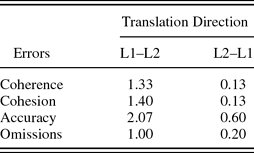
The results of Greek and English bilinguals’ performance on the translation task are presented in Table 1. We conducted four independent sample t tests to compare the performance of L1–L2 and L2–L1 participants with regard to coherence (i.e., errors showing meaning deficit), cohesion (i.e., agreement errors), accuracy (i.e., incorrect translation), and omissions.
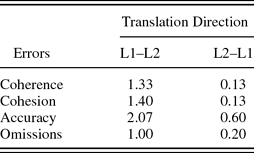
Means of errors committed in the four scoring categories of the translation task
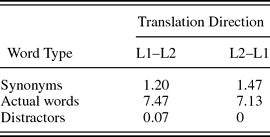
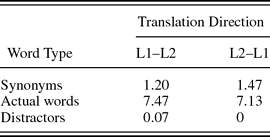
Means of scores yielded for each word type
The difference in errors of coherence between the L1–L2 and L2–L1 direction was significant, whereby more errors were committed in the former than in the latter; M = 1.33 versus M = .13, respectively; t (28) = 6.54, p < .05. The same was true for errors of cohesion; M = 1.40 versus M = .13; t (28) = 3.28, p < .05, as well as for accuracy errors; M = 2.07 versus M = .60; t (28) = 4.47, p < .05. Finally, more omissions were yielded in the L1–L2 direction than in the reverse direction; M = 1.00 versus M = .20; t (28) = 2.35, p < .05.
Part 2: Word recognition task
The results of the recognition task are reported in Table 2. A 3 × 2 mixed analysis of variance (ANOVA) was conducted in which word type was within-subjects factor with three levels (synonyms, actual words, and distractors) and direction of translation was the between-subject factor with two levels (L1–L2 and L2–L1). The results yielded a main effect of word type, F (2, 56) = 319.24, p < .001, but not of translation direction, F (1, 28) = .03, p < 1, nor a significant interaction between the two factors. That is, the performance on word recognition by L1–L2 direction bilinguals was the same as that by L2–L1 direction bilinguals for every word type. Performance in the L1–L2 direction no more influenced recognition of synonyms than performance in the L2–L1 direction (M = 1.20 vs. M = 1.47, respectively), and bilinguals from both directions were able to remember the actual words that had appeared in the original text (M = 7.47 vs. 7.13, respectively). The results of influence of the distractors were similar for both L1–L2 and L2–L1 translation directions (M = .07 vs. M = 0, respectively).
Discussion
Part 1: Translation task
Bilinguals who performed on the L1–L2 translation direction, despite their advanced level of fluency in their L2, were not sufficiently familiarized with L2 knowledge to carry out the translation task with a high level of competence. Thus, certain words were used quite often in wrong context creating problems in the understanding of the translation product, whereas the grammatical function of some linguistic elements was misused overriding grammar rules of the L2. These results are in line with the findings from the study of Kroll and Stewart (Reference Kroll and Stewart1994) that more accurate translations were given and fewer errors were made in the L2–L1 translation direction than in the L1–L2 translation direction. In addition, these findings illustrate the popular belief shared between translation theorists and translators that translating into one's dominant language is easier than translating into an L2 (see Olohan, Reference Olohan2004, for a comprehensive overview on corpus-based studies on translated texts).
The above findings are also relevant to the issue of whether fluent speakers of two languages are also necessarily competent to translate between those languages (Bell, Reference Bell1991). It is reported that this act of speech is present even at very early stages in a bilingual's life (Grosjean, Reference Grosjean1982), and has led to the assumption that translation competence may develop as a function of proficiency in the languages used by a speaker (Lörscher, Reference Lörscher1991) because it is considered an innate skill in all humans (Toury, Reference Toury, House and Blum-Kulka1986a, Reference Toury1986b). In contrast, it is also true that the languages of a bilingual are not always developed to the same extent nor used in the same discourse environment (Grosjean, Reference Grosjean1997; Neubert & Shreve, Reference Neubert and Shreve1992). In addition, the skills required for translating an idea involve many processes that, according to translation theorists, are not necessarily mastered by a speaker who is fluent in two languages (Dancette, Reference Dancette, Danks, Shreve, Fountain and McBeath1997; Shreve, Reference Shreve, Danks, Shreve, Fountain and McBeath1997).
However, we need to note that in this study we were interested in the output of bilingual speakers and not that of professional translators. That is, our assessment of translations was based on how successful the process of information decoding from language A and encoding in language B was. The success of this endeavor was reflected in the production of meaningful utterances that followed the norms of language B.
Bilinguals who performed on the L2–L1 translation direction showed some difficulty in retrieving the L1 translation equivalent. This difficulty can be interpreted in terms of the L2 environment influence on L1 (Weinreich, Reference Weinreich1953). For bilinguals living in an L2 environment the input of L2 was incomparably greater than L1 input. Thus, we may argue that this population of bilinguals would find it increasingly hard to make word for word matching between the lexicons of the two languages, as the strength of lexical links from L2 to L1 would gradually weaken. Consequently, concept mediation would necessarily become stronger in that language direction (L2–L1). In other words, concept mediation may be regarded not only in relation to increased fluency in the L2, but also in relation to temporal loss of fluency in the L1. This account shows how reversible the lexicosemantic organization and the use of language connections in bilingual memory can be.
Part 2: Word recognition task
The findings from the recognition task did not support our initial prediction that bilinguals from the conceptually mediated route would select more synonyms as having appeared in the original text in comparison to the bilinguals from the lexically mediated route. To identify the reasons that may have been responsible for these findings, we considered it possible that the relation between English and Greek was peculiar in some way that reduced the generality of our findings from the translation task to the word recognition task. For instance, there are important structural differences between English and Greek, the latter being a pro-drop language with flexible word order, whereas the former being a subject–verb–object (SVO) language with a fixed word order. These differences might have played a role in how conceptual and lexical memory were implicated in the translation task in comparison to the recognition task. In the following experiment we addressed this concern by replicating Experiment 1 with two languages (English and French) that were linguistically more similar in terms of having the same alphabet, the same SVO structure, and analogous (stricter) word order.
EXPERIMENT 2: TEXT TRANSLATION BY ENGLISH AND FRENCH BILINGUALS
Method
Participants
These were 32 French–English and English–French fluent bilinguals. Half of them were English native speakers studying French as an L2 for about 8 years at degree level at the University of Edinburgh and half were French native speakers, students at the same University, and had studied English as an L2 for about 9 years. English participants’ average age was 21 years (SD = 0.51), and French participants’ average age was 22 years (SD = 0.95).
Prior to testing, bilinguals went through the same language experience questionnaire that we used in Experiment 1, so as to assess whether participants acquired an advanced level in their L2. English bilinguals’ reading comprehension and oral production ratings were M = 5.31 (SD = 0.79) and M = 5.25 (SD = 0.93), and French bilinguals’ corresponding ratings were M = 5.94 (SD = 0.85) and M = 5.06 (SD = 0.93), respectively, indicating participants’ high fluency in the L2. All participants were paid for participating.
Materials, procedure, and design
Materials, procedure, and design were identical to those described in Experiment 1. The only change was in the translation task where the translations produced were into French. English participants were given an English text to translate into French, thus performing an L1–L2 translation, and French participants were given the same English text to translate into French, thus performing an L2–L1 translation.
Results
Part 1: Translation task
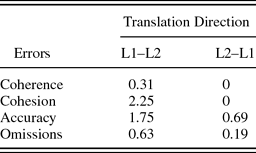
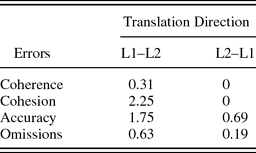
The results of English and French bilinguals’ performance on the translation task are reported in Table 3. We employed the same measures of translation assessment evaluation and corresponding statistical analysis that were employed in Experiment 1. Replicating the findings from Experiment 1, L1–L2 translation direction participants committed more errors than L2–L1 translation direction participants. L1–L2 direction bilinguals made significantly more errors of cohesion and accuracy than L2–L1 bilinguals did; M = 2.25 versus M = 0; t (30) = 5.89, p < .05, and M = 1.75 versus M = 0.69, respectively; t (30) = 2.98, p < .05. The performance of L1–L2 participants was similar to that of L2–L1 participants in the categories of errors of coherence and omissions; M = 0.31 versus M = 0; t (30) = 1.58, p < 1; and M = 0.63 versus M = 0.19, respectively; t (30) = 1.69, p < 1.
Means of errors committed in the four scoring categories of the translation task
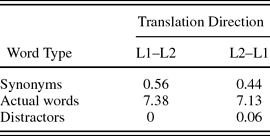
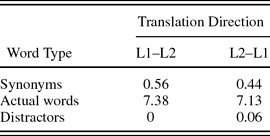
Means of scores yielded for each word type
Part 2: Word recognition task
The results of English and French bilinguals’ performance on the translation task are reported in Table 4. The results of Experiment 2 replicated those of the preceding experiment: we found a main effect for word type, F (2, 60) = 710.60, p < .001, but not for translation direction, F (1, 30) = .27, p < 1, nor an interaction between the two factors. For synonyms, the mean score for the L1–L2 direction was M = 0.56, and for the L2–L1 direction it was M = 0.44. For actual words, in the L1–L2 direction the mean score was M = 7.38, and for the L2–L1 direction it was M = 7.13. Finally, for distractors, the means were M = 0 and M = 0.06, for the L1–L2 direction and for the L2–L1 direction, respectively. These findings showed that bilinguals recognized the same number of synonyms regardless of whether they were translating in the L1–L2 or in the L2–L1 direction, so that it did not appear that the L1–L2 direction was significantly influenced by semantic mediation, as it was expected.
Discussion
Part 1: Translation task
Participants (English) who translated in the L1–L2 direction made significantly more agreement errors in comparison to participants (French) who translated in the L2–L1 direction, a result analogous to what we found in Experiment 1 between English and Greek participants who performed on the corresponding translation directions. This finding was not surprising because a common grammatical feature between French and Greek is the agreement between nouns and adjectives, as well as between pronouns/participles and verbs in gender and number, an aspect of grammatical structure that does not exist in English. Moreover, the combination of morphological constituents in a language is considered to be a conscious process, and in cases where the critical part of a message is the meaning and not the form, as it is assumed for the L1–L2 translation direction by RHM, then morphological errors may occur (Jiang, Reference Jiang2000). This is exactly the type of errors English bilinguals made in Experiment 1 and in Experiment 2.
In contrast, French bilinguals in the L2–L1 direction seemed to provide evidence for more implication of lexical association, for they displayed a tendency to stick to the surface structure of the original text yielding a “word for word” translation (Baker, Reference Baker1997, p. 125). By that we do not mean that bilinguals translated word after word, for a translated unit in some text is considered a sentence (Newmark, Reference Newmark1998); rather, an approach of literal translation was adopted, whereby a highly accurate target text was produced. In other words, although translation is not considered an automatic procedure of tallying one by one grammatical structures and words from the source language with grammatical structures and words from the target language (Mpampiniotis, Reference Mpampiniotis1994); nevertheless, a literal translation rendering would need to employ lexical memory to a considerable degree, which would subsequently lead to high accuracy and “faithfulness” to the original text; this was indeed what we obtained.
Part 2: Word recognition task
As in Experiment 1, the fact that synonyms from the word list were not found to have an influence on L1–L2 bilinguals’ performance in the recognition task led us to the following considerations as to the nature of our manipulation. First, we assumed that perhaps the contextual environment instead of creating retrieval inhibition against certain words that shared similar meanings with other words might be used as a distinctive measure between the latter and words that clearly shared less conceptual features. Although context is considered to help in the understanding of the meaning of a passage to be translated by calling upon information from semantic memory (Laplace, Reference Laplace1994), at the same time it can provide working memory with contextual clues that make certain lexical items more salient than others, and hence, easier to be accurately retrieved. Thus, L1–L2 direction bilinguals’ high accurate word recognition in both Experiment 1 and Experiment 2 might be because of the fact that the lexical nodes of the previously translated L1 words were still enough activated to facilitate word recognition despite the existence of words synonymous to the words from the original text.
Second, we should also take into account the fact that also in this experiment the level of L2 fluency was high for both groups of participants. Thus, if we assume that the implication of lexical and conceptual connections in bilingual memory may gradually become equal in strength when bilinguals reach a high level of fluency in the L2, we could expect advanced bilinguals to use those connections interchangeably. Consequently, the lack of any semantic influence of synonyms and differential results in word recognition in our experiments could result from bilinguals’ proficiency equality in L2. However, the results from the translation task contradict this account. A possible way to make compatible the findings from both tasks while considering the importance of L2 fluency may be to assume that the use of conceptual and lexical memory in language processing by fluent bilinguals depends on the cognitive requirements of the task at hand.
EXPERIMENT 3: TEXT TRANSLATION BY ENGLISH AND FRENCH BILINGUALS
The lack of semantic effects in the L1–L2 direction from the word recognition task we employed in Experiments 1 and 2 led us to consider that it was possible that the passages previously used were so simple (in terms of being short, i.e., 110 words each), that there was no issue of bilinguals failing to recognize which words appeared in the passage. Accordingly, the recognition errors that would have supported the RHM hypothesis were simply too unlikely, regardless of whether the translation direction involved semantic mediation or not. To address this potential confound, in this experiment we used a passage that was three times bigger compared to the text we employed in the previous experiments, while keeping the number of words in the word recognition task constant.
Method
Participants
These were 34 English–French and French–English fluent bilinguals. The participants in this experiment had not taken part in any of the other experiments of this study. Half of them were English native speakers studying French as an L2 for about 8 years at degree level at the University of Edinburgh, and half were French native speakers, also students at University of Edinburgh, who had studied English as an L2 for about 9 years. English bilinguals’ average age was 20 years (SD = 0.94), and French bilinguals’ average age was 23 years (SD = 1.03).
Prior to testing, participants received the language experience questionnaire that was used in the previous two experiments to ensure that they had all acquired an advanced level in their L2. English bilinguals’ reading comprehension and oral production ratings were M = 5.35 (SD = 0.49) and M = 5.06 (SD = 0.66), and French bilinguals’ ratings were M = 6.12 (SD = 0.49) and M = 5.29 (SD = 0.47), respectively, indicating their advanced level in the L2. All participants were paid for participating.
Materials, procedure, and design
We extended the English passage used in Experiments 1 and 2 by three times (330 words). The experimenter increased the length of the text by adding sentences that referred to the same context as the previous sentences and by keeping the same writing style throughout the passage (see Appendix D). Then it was given to three English native speakers who acted as independent judges to check for its grammaticality and uniform character. The 30 lexical item list for the recognition task was accordingly readapted (see Appendix E). The procedure was identical to that employed in Experiment 2: English participants had to translate the English text into French, thus performing in the L1–L2 translation direction, and French participants had to translate the same text into French, thus performing in the L2–L1 translation direction. Design and data analysis were the same as those employed in Experiments 1 and 2.
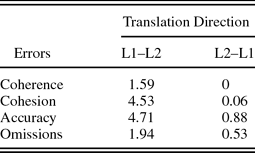
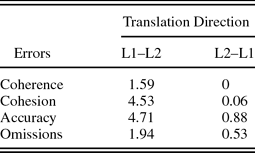
Means of errors committed in the four scoring categories of the translation task
Results
Part 1: Translation task
The results of English and French bilinguals’ performance on the translation task are reported in Table 5. In all four scoring categories, L1–L2 translation direction participants performed significantly worse than L2–L1 translation direction participants. That is, more errors of coherence and cohesion were yielded in the L1–L2 direction than in the reverse direction; M = 1.59 versus M = 0; t (32) = 6.97, p < .05, and M = 4.53 versus M = 0.06, respectively; t (32) = 12.09, p < .05. Finally, more accuracy errors and omissions were yielded in the L1–L2 direction than in the L2–L1 direction; M = 4.71 versus M = 0.88; t (32) = 9.17, p < .05, and M = 1.94 versus M = 0.53, respectively; t (32) = 3.54, p < .05. This pattern of results was similar to that of the preceding experiments indicating the “dominance” of the native language over the L2 during translation even when the latter was performed by advanced bilinguals. In addition, as in Experiments 1 and 2, English participants committed significantly more errors in grammatical agreement.
Part 2: Word recognition task
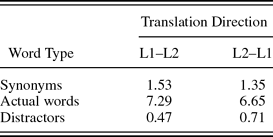
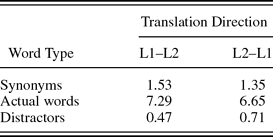
The results of speakers’ performance on the word recognition task are presented in Table 6. The pattern of results was entirely analogous to that observed in the previous experiments. Namely, we found a main effect of word type, F (2, 64) = 250.54, p < .001, but not of translation direction, F (1, 32) = .57, p < 1, nor an interaction between the two factors, so that it did not appear that translation direction led to more false recognitions of the synonymous words. The mean score in the L1–L2 direction for synonyms was M = 1.53 and in the L2–L1 direction was M = 1.35. For actual words the mean score that was yielded in the L1–L2 direction was M = 7.29 and in the L2–L1 direction was M = 6.65. Finally, for distractors the mean score in each translation direction was M = 0.47 and 0.71, respectively.
Means of scores yielded for each word type
GENERAL DISCUSSION
The aim of the present study was to provide a novel experimental way that could test whether the findings regarding the participation of lexical and conceptual memory during word translation could generalize to text translation. We examined an important implication of Kroll and Stewart's (Reference Kroll and Stewart1994) RHM, namely, that lexical and conceptual connections are differentially involved in bilingual word translation. Our experimental procedure was motivated from the intuition that if a translation route involves semantic mediation then the meaning of the corresponding word would be activated over and above any activation that would arise from processing of the corresponding lexical form. In turn, this would mean that those bilinguals who translated in the direction where more participation of semantic memory was assumed; if they were asked to decide which words appeared in the translated text, they would be more likely to be affected by semantic variables related to these words (i.e., synonymy) than bilinguals who translated in the direction where less implication of semantic memory was assumed.
Thus, on the basis of RHM, we made two predictions: one for each of the experimental tasks we employed in our experiments. First, for the text translation task, we predicted that participants who would perform in the L1–L2 translation direction would assign more importance to semantic features of L1 words. That is, bilinguals translating in the L1–L2 direction would base their translation processing on the gist of the source text, and thus produce less literal translations than participants who would perform in the L2–L1 translation direction. Bilinguals who translated in the L2–L1 direction would assign more importance to lexical features of L2 words, thus producing more word for word (i.e., form based) instead of “sense for sense” (i.e., content-based) translations. That is, bilinguals in the L2–L1 direction would be expected to follow an approach where they would replace each individual language chunk from the source language with its closest grammatical and lexical equivalent in the target language.
Second, in the word recognition task, L1–L2 direction participants were expected to mistakenly confuse words that actually appeared in the translated passage with their synonyms. This prediction was forthcoming in two ways. First, the L1–L2 translation route was assumed to be semantically mediated; therefore, the meanings of the words were expected to be activated over and above what would be expected from ordinary processing of their form. Second, the L2–L1 route was assumed to involve direct lexical mappings, so that presumably more emphasis would be given to the lexical form of the words, hence reducing the likelihood that a word would be confused with its synonym.
In all three experiments the predictions for the translation task were confirmed. Bilinguals translating in the L1–L2 direction committed significantly more errors of coherence (i.e., sequence of meanings), an aspect of language that involves the conceptual level. That is, for someone to be able to produce a coherent translation, she has to understand the logical relations among the concepts of a text and the organization of events and situations (Beaugrande & Dressler, Reference Beaugrande and Dressler1994). Consequently, to ensure conceptual connectivity in a translated text (Hatim & Mason, Reference Hatim and Mason1997), conceptual memory is needed to participate to a considerable degree.
As predicted, the findings from bilinguals in the L2–L1 translation direction showed the following patterns that could be related to RHM's assumption of lexical association for this translation direction: bilinguals in the L2–L1 direction in Experiment 1 displayed some difficulty in retrieving the translation corresponding to different words in the passage, even though the target language was participants’ native language. Presumably, this difficulty involved a decrease in the strength of the L2 to L1 lexical link because of the L2 environment influence on the L1. In Experiments 2 and 3, bilinguals in the L2–L1 translation direction produced “faithful” translations to the original, most likely because of a successful matching of L2 lexical items to their L1 counterparts. This direct association between the two lexical stores would favor a highly accurate translation product, and this was indeed what we found.
The results from the word recognition task, however, were not consistent with our predictions related to RHM hypothesis. That is, bilinguals in the L1–L2 direction seemed to be “immune” to our semantic manipulation and were not more likely than bilinguals who performed in the L2–L1 direction to falsely recognize synonyms. We suggest two possible explanations for these results. One explanation could be that the word recognition task was too easy to perform, thus leading to ceiling effects of performance whereby there would not be any false recognition judgments. However, this is doubtful, because even after making the task more difficult in Experiment 3, the results we obtained were very similar to those from Experiments 1 and 2.
Our alternative explanation rests on the intuition that the absence of semantic effects in the word recognition task for the L1–L2 direction does not necessarily entail absence of semantic mediation. Instead, because of participants’ high level of fluency in the L2, it is possible that there would not be much difference in the cognitive process supporting the L1–L2 translation in comparison to the process supporting the L2–L1 translation. In other words, we argue that advanced bilinguals may be able to use lexical and conceptual links connecting L1 and L2 lexical stores with the conceptual store in a selective way depending on the requirements of the task at hand.
One of the studies that corroborate the validity of the controversial results presently reported is that of Dufour and Kroll (Reference Dufour and Kroll1995). These authors tested the relations between lexical and conceptual connections in bilingual memory by using a categorization paradigm on fluent and less fluent English–French bilinguals in both language directions of word representation. The results showed that fluent bilinguals were able to mediate conceptually both language directions, and that less fluent bilinguals did not appear to use the L1 to access concepts for words in the L2. Thus, Dufour and Kroll (Reference Dufour and Kroll1995) argued that semantic mediation is in principle involved in both translation directions, and that the more a bilingual acquires fluency in the L2 the more likely it is for semantic mediation to be involved in the L2–L1 translation.
Moreover, Salamoura and Williams (Reference Salamoura and Williams1999) examined the L2–L1 direction with advanced Greek–English bilinguals on the translation of categorized and mixed word groups to test the RHM prediction that the L2–L1 direction preferentially implicates the use of direct lexical links and does not involve semantic mediation. Contrary to that prediction, translation in the L2–L1 direction was not found to be immune to semantic factors because there was evidence for a facilitatory effect in the categorized condition. Thus, the authors concluded that translation process appears to involve semantic mediation regardless of whether the translation direction is L1–L2 or L2–L1.
Another study that refutes the strong view for asymmetry in translation is the one by Price, Green, and von Studnitz (Reference Price, Green and von Studnitz1999). These authors conducted an functional magnetic resonance imaging study to examine bilinguals’ brain activation during translation and language switching. They found no increase in the activation of the brain area that is believed to be involved in semantic processing in the L1–L2 direction, and supported the possibility that L1–L2 and L2–L1 lexical store connections may take place without the mediation of semantic information. Thus, they argued, it is possible that proficient bilinguals may have the skills to translate from one language to another directly (via direct lexical mappings) without the involvement of semantic memory (see also Jescheniak & Levelt, Reference Jescheniak and Levelt1994).
Thus far it has been argued that flexibility between lexical and conceptual associations in the bilingual mind in hand with high level of proficiency in an L2 may account for the results yielded in the present study. Another factor that might have played a significant part in how language was processed in the experiments we conducted is the nature of the tasks employed. As noted by other researchers (Cook, Reference Cook, de Groot and Kroll1997; de Groot et al., Reference De Groot, Dannenburg and Van Hell1994; Durgunoglu & Roediger, Reference Durgunoglu and Roediger1987), the nature of a task could induce the participants to use a combination of cognitive mechanisms that may not have been employed otherwise. Thus, the fact that bilinguals in the present study had a visual “contact” with the text in the translation task might have facilitated the achievement of high scores for accurate word recognition because word form can easily be retained in memory for longer if a word is presented in written than in any other modality. In addition, other methodological variables present in our experiments such as the little time lag between the translation and the word recognition task could have affected the results in a certain direction.
Moreover, Kroll and de Groot (Reference Kroll, de Groot, de Groot and Kroll1997) have argued that “the translation asymmetry and the corresponding evidence for lexically mediated processing from L2 to L1 may occur only in the absence of context.” This claim is of great importance if one takes into account the fact that thus far the majority of studies that have been done to investigate translation asymmetry were focused on using words and not texts. Thus, the degree of influence of a semantic variable on language processing in the translation of a text may be different from word translation or picture naming. In the same line, Grosjean (Reference Grosjean, Milroy and Muysken1995) has claimed that the use of lexical items in context may create various lexical and semantic representations that depend upon one's textual and contextual knowledge as well as upon one's competence in the linguistic features of the language used. The implications of this latter assumption might also influence speakers’ responses in the word recognition task we used.
Furthermore, we should mention the following considerations regarding the relation between synonymy and text translation and how this might have affected bilinguals’ responses in our study. In translation studies, the text is assumed to play a significant role in the formation of synonymy, because the specific meaning of each lexical item is determined by the textual environment in which it appears (Kendrotis, Reference Kendrotis1996). Thus, a synonym for a word in a specific context may not work as a synonym for the same word put in a different context. Therefore, it could be possible that the semantic links for the synonymous words of the words from the text were not strong enough to revive the semantic relation with the rest of the text because the synonyms were perceived out of context. In other words, their synonymy magnitude might decrease because these words were processed on their own without any contextual clues.
Finally, another important variable that should be taken into account regarding the processing of synonymous words is the fact that a translation equivalent for a word (even for a cognate) may have a wider semantic range than what that word has within its own language (Jiang, Reference Jiang2002; Newmark, Reference Newmark1998). Consequently, one of the two languages of a speaker may afford more activation of synonyms than the other. This account could lead to two different patterns of results: first, if we hypothesize that the language of the word list was bilinguals’ “wider semantic range” language it could lead to inhibition or synonymy disadvantage because there would be many co-activated synonym candidates that would compete with each other and make the recognition task more difficult. Support for this hypothesis comes from the studies conducted by Pecher (Reference Pecher2001) and Hino, Lupker, and Pexman (Reference Hino, Lupker and Pexman2002) in which words with a familiar synonym and words with many synonyms led to slower RTs in a lexical decision task than words with an unfamiliar synonym or words with few synonyms.
Second, if we hypothesize that the language of the word list was bilinguals’ “narrower semantic range” language, we would expect that to lead to facilitation because the synonym for each word we provided in the word list was the first most frequent synonym provided in a dictionary. Thus, bilinguals should proceed to a one to one match and be led to more false alarms. The results we obtained seem to fit with the first prediction; yet more research is needed to test the reliability of this account.
To conclude, it becomes apparent from the arguments presented thus far that the controversial results of certain studies like the present study on bilingual language use may be because of differences between experimental tasks (see Heredia & Brown, Reference Heredia, Brown, Ritchie and Bhatia2004), bilinguals’ level of proficiency in the nonnative language (e.g., de Groot & Hoeks, Reference De Groot and Hoeks1995), and the kind of materials or word type used (e.g., de Groot, Reference De Groot, Frost and Katz1992, Reference De Groot1995; Frenck-Mestre & Prince, Reference Frenck-Mestre and Prince1997). Although our results are not conclusive, we may reconcile the findings from the two experimental tasks we employed, by supporting the idea of a combinatorial and flexible use of conceptual and lexical connections in memory structure of fluent bilinguals, where linguistic information may be encoded and decoded depending on the cognitive requirements of the task at hand.
APPENDIX A LANGUAGE EXPERIENCE QUESTIONNAIRE

APPENDIX B
The selected passage from the SDRT that was used for the translation task in Experiments 1 and 2.
The field of medicine requires an abundance of research. If an illness is to be eliminated, it must first be understood and its cause identified. Doctors realize how important it is to treat people who are suffering from an illness. Certain diseases have no cure so they are not possible to treat. But if enough research is conducted, new cures may be discovered.
Most hospitals devote a certain percentage of their budget for medical research. Commercial companies also spend money on medical research. If they are able to discover a cure or a medicine for a disease, they may make a lot of money. Dedication and hard work are required.
APPENDIX C
The 30 lexical-item list that was used for the recognition task in Experiments 1 and 2 consisting of three word types: actual words from the text, synonymous words with words from the text, and distractors (words of relevant context).
APPENDIX D
The SDRT passage that was used in Experiments 1 and 2 extended by three times for the translation task in Experiment 3.
The field of medicine requires an abundance of research. If an illness is to be eliminated, it must first be understood and its cause identified. Doctors realize how important it is to treat people who are suffering from an illness. Certain diseases have no cure so they are not possible to treat. But if enough research is conducted, new cures may be discovered.
Most hospitals devote a certain percentage of their budget for medical research. Commercial companies also spend money on medical research. If they are able to discover a cure or a medicine for a disease, they may make a lot of money. Dedication and hard work are required.
The profession of a doctor is not an easy one. He often has to spend long hours at the hospital, and when he is at home he can be called for an emergency at any time. So, it is very difficult to keep his personal and work life separate. Consequently, he spends little time with his family, and this is often the cause of arguments with his wife and his children who complain that he spends more time with patients than with his own family.
However, it is also a well-paid activity, and the satisfaction a doctor gets knowing he has helped his patients with their illness is great. These two factors are the main reasons why the profession of a doctor is widely recognized as one of the most successful professions. This can also be seen when you ask a child to tell you what they want to be when they grow up. In many cases, the answer is “a doctor.”
Many TV series have been inspired by this profession as well. Most of them come from America and show what the life of a doctor may be like, when he deals not only with patients but also with other members of staff or with people from the hospital who can influence his personal life and interactions.
APPENDIX E
The 30 lexical-item list that was used for the recognition task in Experiment 3 consisting of three word types: actual words from the text, synonymous words with words from the text, and distractors (words of relevant context).