Introduction
To understand more about the aetiology of suicide and inform potential strategies for prevention, research has focused not only on characteristics of individuals that increase risk of suicide but also on characteristics of the environments in which they live. Neighbourhood characteristics associated with suicide risk include population density, income inequality and markers of social fragmentation and deprivation (Gunnell et al. Reference Gunnell, Peters, Kammerling and Brooks1995; Whitley et al. Reference Whitley, Gunnell, Dorling and Smith1999; Galea et al. Reference Galea, Ahern, Vlahov, Coffin, Fuller, Leon and Tardiff2003; Rehkopf & Buka, Reference Rehkopf and Buka2006). Possible explanations put forward to explain the association between neighbourhood characteristics, such as social fragmentation or deprivation, and suicide risk in ecological studies relate to characteristics of either the individuals living in such areas (compositional effects) or the areas in which they live (contextual effects).
Individual characteristics associated with suicide risk include male sex, living alone, divorce, unemployment, physical illness, substance misuse and psychiatric illness (Yoshimasu et al. Reference Yoshimasu, Kiyohara and Miyashita2008; Li et al. Reference Li, Page, Martin and Taylor2011), and it is difficult to know to what extent these explain, through confounding, the area characteristics associated with suicide in ecological studies.
Statistical methods such as multilevel modelling that allow us to tease out the effects of area independently of the characteristics of individuals living there have only been widely accessible in recent years, and few studies have examined both area and individual influences on suicide risk. Although some of these studies found that associations between suicide and area markers of deprivation, social fragmentation and ethnicity were explained by individual-level characteristics (Agerbo et al. Reference Agerbo, Sterne and Gunnell2007; O'Reilly et al. Reference O'Reilly, Rosato, Connolly and Cardwell2008; Collings et al. Reference Collings, Ivory, Blakely and Atkinson2009), other studies found that area-level associations persisted (Cubbin et al. Reference Cubbin, LeClere and Smith2000; Martikainen et al. Reference Martikainen, Maki and Blomgren2004).
All these studies examined area characteristics measured around the time of suicide and these associations might therefore reflect aggregation into these communities of individuals with mental health or social problems. Neighbourhood characteristics measured a long time before suicide outcomes, such as during childhood, will avoid this problem, and can be informative about long-term contextual effects on suicide risk. Such effects have been described for schizophrenia, for example in relation to urbanicity (Lewis et al. Reference Lewis, David, Andreasson and Allebeck1992; Pedersen & Mortensen, Reference Pedersen and Mortensen2001), and it is possible that where people live when they are growing up also has long-term effects on mood, ability to cope with adversity or other risk factors that ultimately increase suicide risk. However, no studies have examined the association between contextual effects during childhood and subsequent risk of suicide.
Neighbourhood context during childhood could impact on long-term psychological development, personality and mental health (Leventhal & Brooks-Gunn, Reference Leventhal and Brooks-Gunn2003; Xue et al. Reference Xue, Leventhal, Brooks-Gunn and Earls2005; Hart et al. Reference Hart, Atkins and Matsuba2008) through, for example, exposure to local drug use or violence cultures, increased social defeat and reduced social cohesion (McKenzie et al. Reference McKenzie, Whitley and Weich2002; Selten & Cantor-Graae, Reference Selten and Cantor-Graae2005). Such stressors could have a long-term impact on suicide risk mediated through psychological (e.g. negative self-worth or control schema; Goodyer, Reference Goodyer2002; Evans et al. Reference Evans, Heron, Lewis, Araya and Wolke2005) and biological (e.g. epigenetic control of hypothalamic–pituitary–adrenal (HPA) reactivity; Labonte & Turecki, Reference Labonte, Turecki and Dwivedi2012) mechanisms that persist throughout adult life.
There has also been increasing interest in recent years as to how the effects of individual-level risk factors for mental health outcomes vary across different neighbourhood contexts. The most consistent finding has been that risk of schizophrenia associated with ethnic minority status varies according to the proportion of ethnic minority individuals within a neighbourhood (Boydell et al. Reference Boydell, van Os, McKenzie, Allardyce, Goel, McCreadie and Murray2001; Kirkbride et al. Reference Kirkbride, Morgan, Fearon, Dazzan, Murray and Jones2007; Veling et al. Reference Veling, Susser, van Os, Mackenbach, Selten and Hoek2008), and we recently showed that this effect might not be specific to ethnic background but to other characteristics that might mark individuals out as different from others in their surrounding environment, including markers of deprivation and social fragmentation (Zammit et al. Reference Zammit, Lewis, Rasbash, Dalman, Gustafsson and Allebeck2010). These findings resonate with the work of Durkheim and others implicating lack of social cohesion as a risk factor for suicide and other adverse mental health outcomes (Durkheim, Reference Durkheim1951; Kawachi & Kennedy, Reference Kawachi and Kennedy1997; McKenzie et al. Reference McKenzie, Whitley and Weich2002; De Silva et al. Reference De Silva, McKenzie, Harpham and Huttly2005), and we therefore wanted to extend this work to examine whether individual-level risk factors for suicide also varied by neighbourhood context.
We are aware of only three studies that have used multilevel data to examine such cross-level interactions for suicide. One study reported that ethnic minority status was associated with increased suicide risk in areas with small minority populations, but with decreased risk in areas with large minority populations (Neeleman & Wessely, Reference Neeleman and Wessely1999), similar to the findings for schizophrenia. In another study there was no evidence of interaction between individual and area measures of socio-economic status on suicide (Martikainen et al. Reference Martikainen, Maki and Blomgren2004), whereas in the third study evidence for interactions was inconsistent across the subgroups examined (Agerbo et al. Reference Agerbo, Sterne and Gunnell2007). Again, these studies examined the effects of area around the time of suicide. Whether the effect of individual characteristics on suicide risk is moderated by the context in which people grow up has not been previously investigated.
Therefore, the aims of this study were to: (i) estimate the overall relative effects of individual- and higher-level area (school, municipality and county) factors during childhood on suicide, (ii) examine whether area-level characteristics during childhood are associated with risk of suicide, independently of individual characteristics, and (iii) examine whether individual effects on suicide risk vary according to the context in which individuals grow up.
Based on the literature to date, we hypothesized that neighbourhood-level variation would account for only a small proportion of variance in suicide risk (as it does for other mental health outcomes), that growing up in adverse (particularly deprived and socially fragmented) neighbourhoods would increase suicide risk independently of individual-level markers of childhood adversity (although much of the association between neighbourhood characteristics and suicide would be explained by these individual-level characteristics), and that any characteristics that mark individuals out as different from others in their surrounding environment as they grow up would increase suicide risk.
Method
Study population
The study population consists of all individuals born in Sweden in 1972 and 1977 (cohorts selected as school register data were available) and resident there at age 16 years (n = 213 395). Record linkages were performed using unique person identification numbers. Data were linked (up to 31 December 2003) to the National Cause-of-Death Register, the Multi-Generation Register, the Swedish National School Register and the Swedish National Patient Register, and to census records (1980 and 1985; child age 8) and occupation and income registers (1985 and 1990; child age 13) at Statistics Sweden. Of those not having died by suicide prior to the end of follow-up, 1422 individuals had emigrated and 912 had died of other causes. A further 6738 had missing data on school or municipality at age 16 and were also excluded, leaving a sample of 204 323 individuals.
Measures
Suicide
Deaths from suicide and, as is convention, from undetermined causes (Allebeck et al. Reference Allebeck, Allgulander, Henningsohn and Jakobsson1991; Linsley et al. Reference Linsley, Schapira and Kelly2001) according to the Swedish version of ICD-8 (ICD-9 from 1987 to 1996, ICD-10 from 1997) were included within our definition of suicide outcome. ICD codes for suicide were E950–E959 (ICD-8 and ICD-9) and X60–X84 (ICD-10) and codes for deaths of undetermined intent were E980–E989 (ICD-8 and ICD-9) and Y10–Y34 (ICD-10). Of the 204 323 subjects, there were 314 [0.15%, 95% confidence interval (CI) 0.14–0.17] with a suicide outcome (225 definite suicides and 89 deaths of undetermined intent).
Exposures
Data were structured at the following ascending hierarchical levels: individuals (n = 204 323), school year groups at age 16 (n = 2106), schools (n = 1264), municipalities (n = 286) and counties (n = 24). Fixed effects were examined at individual (individual-level), school year group (school-level) and municipality (municipality-level) levels. The median number of individuals in the school year groups was 103 (range 1–260), and in the municipalities 416 (range 71–10 113).
Individual-level variables included sex, family history of suicide (in either biological parent), being foreign born (0, 1 or 2 biological parents born abroad), changing municipalities between age 8 and 16, parental socio-economic position (SEP) at age 8 (unemployed/blue collar/white collar/company owner; highest of rearing parents), parental receipt of welfare benefit at age 13, family income (total of income, welfare benefits and disability pensions for rearing parents) at age 13, single-parent household at age 8, parental education (<9 years/9–10 years/secondary school/higher education; highest of rearing parents), school grade achieved at age 16 [continuous score between 1 (lowest) and 6 (highest)], and having received a diagnosis of any psychotic disorder prior to end of follow-up.
School-level variables were derived by aggregating data from individuals in schools that had at least 10 children registered in a particular year group. School-level variables included foreign-born average (proportion of children with one or both parents born abroad; median 0.15, 90% range 0.03–0.65), social fragmentation average (proportion of children who migrated into Sweden, moved into a different municipality between ages 8 and 16 or were raised in single-parent households; median 0.23, 90% range 0.08–0.46), deprivation average (proportion of children with parents unemployed, receiving welfare benefits or in lowest 10% of income; median 0.15, 90% range 0.05–0.30), low-grade average (proportion of children scoring in lowest 10% of grade score; median 0.10, 90% range 0.02–0.18), and males (proportion of children who were male; median 0.51, range 0.29–1).
Municipality-level data included measures of urbanicity [residence in a city (Stockholm, Gothenburg and Malmo), town (>20 000 inhabitants in 1980) or rural area (⩽20 000 inhabitants) at age 16], population density, and markers of deprivation (derived by summing z scores for mean income, proportion unemployed and proportion on benefits) and social fragmentation (derived by summing z scores for proportion of people migrating in/out of the municipality, voting in municipality elections, married and living in single-person households).
Statistical analysis
Multilevel models were fitted using the MLwiN software (Rasbash et al. Reference Rasbash, Charlton, Browne, Healy and Cameron2009) through the runmlwin (Leckie & Charlton, Reference Leckie and Charlton2011) command in Stata. Null, random-effects models were fitted first, and then individual-, school- and municipality-level covariates were added to the models. Birth year was included in all models. As outcomes were binary, we used multilevel logistic regression. To calculate variance partition coefficients (VPCs) for higher-level random effects in binary response multilevel models, it is common practice to appeal to the latent response formulation of the multilevel logistic model (Goldstein, Reference Goldstein2010), in which case a VPC is calculated in terms of an individual's propensity to die by suicide. In this case the person-level variance is standardized to the logistic variance of π2/3 ≈ 3.29. For example, in a three-level model, where we denote the unexplained variance at level 2 as v 2, and at level 3 as v 3, the proportion of the total unexplained variance at level j is estimated as v j /(v 2 + v 3 + 3.29).
All models were fitted using Markov chain Monte Carlo (MCMC) methods (Browne, Reference Browne2009). Models were run for a burn-in of 10 000 iterations followed by 100 000 monitoring iterations. The mean and standard deviation of each parameter chain give the parameter point estimate and standard error, and the 2.5th and 97.5th quantiles give the 95% interval estimates. Effects for school-level variables are reported for a 10% increase in proportion and those for municipality-level variables are reported for a standard deviation increase. Statistical significance of fixed effect estimates, including cross-level interactions, was tested by deriving z ratios and comparing them with a standard normal distribution.
Missing data for any of the exposure variables or covariates were present in less than 5% of the sample (n with complete case data = 187 316). Sensitivity analyses were conducted by comparing model results to those based on a complete data set, where the missing values were replaced with plausible values derived from the observed data by single random imputation.
Cross-level interactions
We examined interactions between individual-level and school-level characteristics as we hypothesized that school-level measures would most strongly characterize the environment within which the children grew up. To do this, we created the following variables:
-
(a) Individual-level deprivation: summed score of parental unemployment (yes/no), welfare benefits (yes/no) and family income in the lowest 10th percentile (yes/no); score range 0–3.
-
(b) Individual-level social fragmentation: summed score of single-parent family (yes/no), immigrated during childhood (yes/no) and moved into a different municipality between age 8 and 16 (yes/no); score range 0 to 3.
We aimed to examine the following interactions:
-
(a) Individual foreign-born × school-level foreign-born average.
-
(b) Individual social fragmentation × school-level social fragmentation average.
-
(c) Individual deprivation × school-level deprivation average.
-
(d) Individual grade × school-level grade average.
Results
Higher-level variation
The risk of suicide among individuals born in municipalities in the lowest risk quartile was 0.6 per 10 000 (95% CI 0.1–1.7), and 34 per 10 000 (95% CI 29–39) in the highest quartile. However, in both the null and full models only 3% of the estimated proportion of variation in suicide risk was at a higher (non-individual) level (Table 1). The CIs indicate that, even at its upper-most limit, less than 15% of the variance in suicide risk is explained by higher-level variation, and that almost all variation is due to individual-level variation.
Variance partition coefficients (VPCs) a and 95% confidence intervals (CIs) b at each level

a Markov chain Monte Carlo (MCMC) 100 000 iterations.
b 95% CIs are calculated as the 2.5th and 97.5th percentiles of the MCMC chain for each VPC statistic.
c Model including birth year.
d Model including all individual-, school year- and municipality-level variables.
Individual-level characteristics
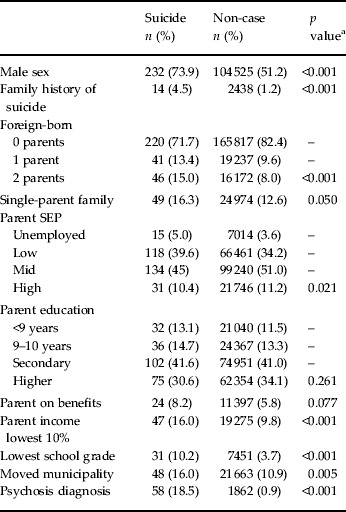
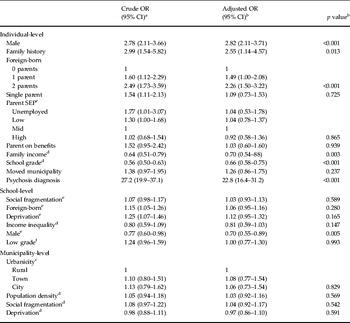
Most individual-level variables, apart from parental education, were associated with risk of suicide (Tables 2 and 3). When adjusted for other individual-level characteristics, having a history of a psychotic disorder was the strongest risk factor for suicide [odds ratio (OR) 22.8, 95% CI 16.4–31.2]. Other individual characteristics associated with increased risk were male sex, having a low school grade, family history of suicide and having foreign-born parents.
Proportion of suicide cases and non-cases exposed to individual-level characteristics

SEP, Socio-economic position.
a For categorical variables the p value is from an omnibus test for variables.
Multilevel model results for association between suicide and individual-, school- and municipality-level variables

OR, Odds ratio; CI, confidence interval; SEP, socio-economic position.
a Including birth year, and variance components at school, municipality and county levels.
b Adjusted for birth year, sex, family history, ethnicity, single-parent status, parental SEP, parental benefits, parental income and moving municipality, and includes variance components at school, municipality and county levels.
c p value is overall p value for categorical variables.
d Per standard deviation
e Per 10% increase.
f Per 10% increase in proportion with grade <10th percentile; in adjusted model also adjusted for individual-level grade.
School grade score and diagnosis of psychosis were not included in the adjusted models as these could potentially mediate associations between other risk factors and suicide. Although having a higher family income at birth was strongly associated (p = 0.003) with reduced risk of suicide in the model adjusting for background characteristics (Table 3), this association was substantially attenuated when further adjusting for grade score, such that there was now only weak evidence for association between family income and suicide (OR 0.80, 95% CI 0.62–1.01, p = 0.065). Adjustment for grade score or diagnosis of psychosis did not change the adjusted estimates for any other individual- or school-level variables in Table 3.
Higher-level characteristics
Most school-level characteristics showed some evidence for association with suicide in the unadjusted analyses (Table 2), albeit school-level social fragmentation and school-level grade average only weakly so, whereas school-level income inequality showed no evidence of association. These associations were eliminated after adjusting for individual-level characteristics, with the exception of the association between the proportion of male pupils in the school and suicide, where the association strengthened markedly, particularly after adjusting for individual gender. This association persisted when we restricted the analysis to schools where the proportion of males fell within 3 standard deviations of the mean (33.6–65.8%, p = 0.001). Individuals in the 10% of schools with the most males (range 57.4–100%) had approximately half the odds of suicide (adjusted OR 0.56, 95% CI 0.34–0.92, p = 0.023) compared to those in the 10% of schools with the least males (range 28.6–45.0%). There was no evidence to support a non-linear effect for the proportion of males at school level (p value for quadratic term = 0.868).
None of the municipality-level characteristics were associated with suicide in the null model or after adjusting for individual-level factors (Table 3). The risk of suicide was similar in cities (0.15%), towns (0.16%) and rural areas (0.14%). There was a similar level of variation in risk of suicide across rural areas [suicide risk range 0–1.2%, interquartile range (IQR) 0.00–0.26%] as there was across areas within cities (range 0–0.54%, IQR 0.06–0.23%).
Study of cross-level interactions
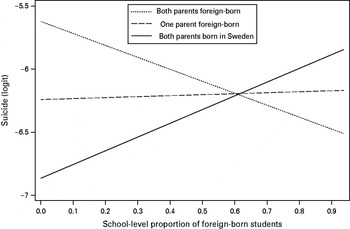
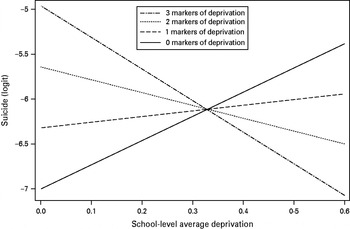
There was weak statistical evidence of cross-level interactions of (a) being foreign-born × school foreign-born average (OR 0.91, 95% CI 0.82–1.00, p = 0.057) and (b) deprivation × school deprivation and risk of suicide (OR 0.81, 95% CI 0.64–1.03, p = 0.087), and interaction estimates were unchanged after adjustment (see online Supplementary Table S1). Both interactions were qualitative in nature; in other words, risk of suicide associated with the presence of the individual-level characteristic changed in an opposite direction compared to individuals without that characteristic as the context changed. For example, foreign-born individuals were at a high risk of suicide if they were part of a school group with very few others who were foreign born, and this risk decreased if their school group consisted of a large proportion of foreign-born individuals (Fig. 1). However, an opposite pattern of risks was observed for individuals whose parents were both born in Sweden. A similar pattern of interactions (Fig. 2) was observed for deprivation. Differences from baseline groups for these interactions were significant primarily within the lower halves of the school-level averages (see online Supplementary Figs S1 and S2), with greater uncertainty around estimates at the higher ends of the school-level averages as these were based on relatively small proportions of the sample.
Cross-level interaction between foreign-born status and school-level foreign-born average. For non-foreign-born individuals, risk of suicide increases as the proportion of foreign-born individuals within the school increases. However, for foreign-born individuals, risk of suicide decreases as the proportion of foreign-born individuals within the school increases.

Cross-level interaction between deprivation score and school-level deprivation average. For individuals with low deprivation, risk of suicide increases as deprivation within the school increases. However, for individuals with high deprivation, risk of suicide decreases as deprivation within the school increases.

There was no evidence of cross-level interactions (a) between social fragmentation and school social fragmentation (p = 0.734) or (b) between grade and school grade average (p = 0.420). As a result of finding an association between school-level male average and suicide we also looked for an interaction between individual sex × school-level male average, although this was not an a priori aim. The reduced risk of suicide associated with an increasing proportion of male pupils in the school was similar for males (OR 0.72, 95% CI 0.54–0.96) and females (OR 0.62, 95% CI 0.38–1.00; interaction p = 0.804).
The patterns of interaction remained very similar when we used different methods of coding individual- and school-level variables (for example using deciles or grouping using different cut-offs), and when we excluded undetermined deaths from our outcome. This suggests that these interactions are robust to variation in the manner in which data were defined, although the statistical evidence for interaction remained relatively weak across these sensitivity analyses. Evidence for interactions in the adjusted models was slightly stronger using the imputed data sample (p = 0.047 for ethnicity and p = 0.032 for deprivation).
Psychotic disorder as a mediator for interactions observed
Estimates of interaction were partly attenuated when we excluded individuals who developed a psychotic disorder, which might have mediated the associations with suicide (foreign-born × school foreign-born average OR 0.94, 95% CI 0.83–1.06; deprivation × school deprivation OR 0.84, 95% CI 0.65–1.08), although the number of suicides in these restricted analyses was reduced (n = 245).
Discussion
Area effects
This is the first cohort study to examine the effect of area characteristics during childhood on suicide risk. We observed very little variation (approximately 3%) in incidence of suicide at higher (non-individual) levels. The relative importance of higher-level and individual-level factors on suicide risk has not been previously reported, but is in keeping with findings for other mental health disorders. For example, although a substantial amount of variation in incidence of depression has been observed at a household level (Chandola et al. Reference Chandola, Bartley, Wiggins and Schofield2003; Thomas et al. Reference Thomas, Weaver, Patterson, Jones, Bell, Playle, Dunstan, Palmer, Lewis and Araya2007), which could reflect shared psychosocial and environmental and, to a lesser extent, genetic influences, the proportion of variance for depression at neighbourhood levels has consistently been reported as being <5% (Duncan et al. Reference Duncan, Jones and Moon1995; Weich et al. Reference Weich, Holt, Twigg, Jones and Lewis2003; Wainwright & Surtees, Reference Wainwright and Surtees2004; Skapinakis et al. Reference Skapinakis, Lewis, Araya, Jones and Williams2005; Fone et al. Reference Fone, Dunstan, Williams, Lloyd and Palmer2007; Thomas et al. Reference Thomas, Weaver, Patterson, Jones, Bell, Playle, Dunstan, Palmer, Lewis and Araya2007), and was approximately 2% for psychosis in a previous study using this dataset (Zammit et al. Reference Zammit, Lewis, Rasbash, Dalman, Gustafsson and Allebeck2010). We were unable to model household-level effects, and these therefore become subsumed within the individual-level estimates of variation in incidence of suicide.
We found no evidence that municipality-level measures during childhood were associated with suicide risk in young adults. However, municipality measures reflect an average across large geographical areas, and a single municipality could encompass within it smaller neighbourhoods with low levels of deprivation or social fragmentation, along with neighbourhoods with high levels of these characteristics. We used school-level data to capture this smaller area variation as these measures potentially encompass both peer-group influences and small neighbourhood characteristics during childhood, given that school attendance was based on catchment areas relating to place of residence.
Several school-level measures were associated with suicide risk. Higher levels of deprivation and of ethnic minorities were both associated with increased risk, although they were attenuated by approximately 50% after adjusting for individual-level characteristics. We also found that suicide risk was higher for individuals who attended schools with a higher proportion of females, and this applied equally to males and females. It is possible that the social environment within schools differs as the relative proportions of male and female pupils change. However, although this seems to be a robust finding within our data, this was not an a priori hypothesis, and might be a chance finding. Future studies examining this hypothesis are needed to resolve this uncertainty.
Although ours is the first study that has examined both compositional and contextual effects during childhood on risk of suicide, other studies have explored these effects measured in adulthood and found little evidence for important contextual effects once compositional effects were accounted for (Agerbo et al. Reference Agerbo, Sterne and Gunnell2007; O'Reilly et al. Reference O'Reilly, Rosato, Connolly and Cardwell2008). For example, in a large Danish nested case-control study, an association between suicide and the proportion of people living alone at a municipality level was attenuated by more than 50% after controlling for individual-level characteristics, whereas associations with municipality-level unemployment and lower income were eliminated completely (Agerbo et al. Reference Agerbo, Sterne and Gunnell2007). Similarly, in a record-linkage study based in Northern Ireland, associations between suicide and area-level measures of deprivation and social fragmentation were eliminated after adjusting for individual and household characteristics (O'Reilly et al. Reference O'Reilly, Rosato, Connolly and Cardwell2008). Although our study suggests that most neighbourhood characteristics during childhood do not have a long-term impact on suicide risk, the association with the proportion of school peers who are female warrants further study.
Individual effects
We observed several individual characteristics that were associated with suicide, as reported consistently in the literature (Yoshimasu et al. Reference Yoshimasu, Kiyohara and Miyashita2008; Li et al. Reference Li, Page, Martin and Taylor2011). Having a diagnosis of a psychotic disorder was very strongly associated with increased suicide risk, conferring a greater than 20-fold risk on suicide; one in five suicides, but less than one in 100 cohort members, had a history of psychosis. Poorer performance academically in school grades at age 16 was also strongly associated with increased suicide risk. The association between lower family income during childhood and risk of suicide was substantially attenuated after adjusting for performance in school examinations, indicating that performance on school grade examinations might mediate the association between family income and suicide.
Cross-level interactions
Although the proportion of variance explained at higher levels within the study was very low, it is still possible for higher-level effects to be important in the context of cross-level interactions. We found some, albeit weak, evidence that the relative risk between individual characteristics and risk of suicide differed according to the context where individuals were raised (school-level characteristics). Having foreign-born parents increased suicide risk for individuals brought up in areas where they were in a relative minority, but protected against suicide in areas where larger proportions of the population had foreign-born parents. We found some evidence of a similar interaction for deprivation, whereby risk of suicide associated with coming from a deprived family changed as the neighbourhood context changed, but in an opposite direction compared to those coming from more affluent families.
A similar interaction between ethnicity and neighbourhood ethnic density at the time of suicide has been reported previously (Neeleman & Wessely, Reference Neeleman and Wessely1999), and our results suggest this may be a long-term effect starting during childhood. Our results also suggest that this effect might not be specific to ethnicity, but to other characteristics that mark individuals out as being different from people living around them. This is consistent with a study showing that associations between several individual characteristics and risk for suicide varied across case-control studies, with a wide range of contextual settings during adulthood (Crawford et al. Reference Crawford, Kuforiji and Ghosh2010).
Similar interactions for psychosis have been described previously within this dataset (Zammit et al. Reference Zammit, Lewis, Rasbash, Dalman, Gustafsson and Allebeck2010). However, the interaction estimates for suicide were only partly attenuated when excluding individuals with a history of a psychotic disorder, suggesting that these interactions might also have effects on suicide that are not mediated through development of psychosis.
Strengths and limitations
One of the strengths of this study is that it is based on a large cohort of individuals, with data on some important exposures measured during childhood and adolescence, many years prior to the outcome of suicide. This is in contrast to almost all other studies of neighbourhood-level exposures to date, and allows us to exclude effects of selection into neighbourhoods as a consequence of mental health or social problems as an explanation for our findings.
However, we did not have data on all potentially important factors that could confound or explain the associations observed. We cannot therefore exclude the possibility that the associations observed in our study are due to residual confounding. Furthermore, area-level measures of deprivation, and particularly social fragmentation, are difficult to measure. Routinely collected administrative data frequently used to measure constructs of social cohesion and fragmentation include data on the proportion of people married, voting, renting privately and living in single-person households, along with levels of residential stability and population turnover (Congdon, Reference Congdon1996). Such data were available at the municipality level whereas our school-level measure was based on the proportion of children immigrating, moving area or brought up in single-parent households. These measures are likely to capture the construct of social fragmentation to some extent, although ideally we would have liked to survey the schools to obtain a more direct measure of social cohesion within the schools or small neighbourhoods the children were raised in, and also more detailed measures of deprivation.
It is also unclear to what extent our individual-level measures of social fragmentation and deprivation reflect disrupted social relationships or economic hardship during childhood. Such direct measures are possible (Kirkbride et al. Reference Kirkbride, Boydell, Ploubidis, Morgan, Dazzan, McKenzie, Murray and Jones2008) but unfortunately are not available in large studies such as ours that rely on administrative data. There are also clearly difficulties in determining what size ‘neighbourhoods’ are or how they should be defined. Ideally, neighbourhoods would be defined such that contextual characteristics within each neighbourhood are homogeneous, but of course in reality research data usually rely on administrative information (e.g. schools or municipalities) to define levels.
However, although misclassification of data may be particularly likely for our higher-level measures, especially those of social fragmentation, it is probably non-differential. Furthermore, suicide and most of the exposures examined were more common in individuals excluded due to missing data, and this, as with non-differential misclassification, may have resulted in estimates being underestimated. Decisions about recording deaths as suicide may have been influenced by neighbourhood effects, but such bias is less likely for neighbourhood measures during childhood. Finally, although this was a large study, the rarity of suicide limited the extent to which contextual effects, and particularly cross-level interactions, could be examined.
Implications
If the cross-level interactions we observed are robustly replicated, they lend support to the belief that contextual effects during childhood can influence suicide risk in young adults. Circumstances whereby individuals fail to fit in with others in their immediate environment during childhood can lead to a decreased sense of connectedness (Durkheim, Reference Durkheim1951) and to increased levels of stress, perhaps through discrimination, hostility or isolation, in keeping with the model of social defeat (Selten & Cantor-Graae, Reference Selten and Cantor-Graae2005). For example, victimization has important effects on psychological adjustment and is one of the most consistently identified risk factors for suicidal ideation and self-harm in early life (Winsper et al. Reference Winsper, Lereya, Zanarini and Wolke2012). Furthermore, mechanisms linking repeated stressors with long-term biological changes associated with development of psychosis have been described (Laruelle, Reference Laruelle2000; Kapur, Reference Kapur2003), and it is possible that these or other such effects also influence suicidal behaviour.
If these qualitative interactions are replicated in other studies, they have potentially important implications for understanding more about social policy. Integration of individuals within communities is clearly important to minimize risks associated with social isolation (Durkheim, Reference Durkheim1951), and because segregation at local levels may undermine social cohesion in society as a whole (Kawachi & Kennedy, Reference Kawachi and Kennedy1997). Our findings suggest that attending a school or growing up in a neighbourhood where at least some others are of a similar ethnic and sociodemographic background can potentially buffer suicide risk in vulnerable individuals.
Supplementary material
For supplementary material accompanying this paper visit http://dx.doi.org/10.1017/S0033291713000743.
Acknowledgements
We thank J.-E. Gustafsson for allowing us data access, and S. Lofving and H. Dal for their help with data preparation. G. Lewis and D. Gunnell are National Institute for Health Research (NIHR) Senior Investigators.
We thank the Swedish Research Council for Working Life and Social Research for their funding. This body had no further role in the collection, analysis or interpretation of data, the writing of this manuscript, or in the decision to submit this manuscript for publication.
Declaration of Interest
None.