Early or convenience voting—understood in this context to be relaxed administrative rules and procedures by which citizens can cast a ballot at a time and place other than the precinct on Election Day—is a popular candidate for election reformers. Typically, reformers argue that maximization of turnout is a primary goal, and reducing barriers between voters and the polls is an important method for achieving higher turnout. Arguments in favor of voting by mail, early in-person voting, and relaxed absentee requirements share this characteristic. While there are good theoretical reasons, drawn primarily from the rational choice tradition, to believe that early voting reforms should increase turnout, the empirical literature has found decidedly mixed results. While one prominent study suggests that voting by mail is associated with a 10% increase in turnout, other studies find smaller—but still statistically significant—increases in turnout associated with other convenience voting methods.
In this paper, we review terminology (“what is early voting?”) and illustrate the breadth and popularity of these reforms; briefly review prior research on early voting, focusing on the political arguments being made in favor of reform and the social scientific findings of the impact of reform on turnout; and finally, add convenience voting reforms to an established model of turnout (Tolbert and Smith 2005; Tolbert, Grummel, and Smith 2001) in order to estimate their impact across the widest possible set of jurisdictions and over a 24-year period. In brief, our research indicates that only one early voting reform—voting by mail—has a positive impact on turnout. Most other reforms have a negligible, and at times negative, impact on turnout. These findings correspond with much of the literature, which shows that campaigns (primarily mobilization efforts) and individual political predispositions are the primary determinants of turnout. Institutional reforms have, at best, a small effect, and are unlikely to solve the challenge of low voter participation in the United States.
An Introduction to Early Voting
What is Early Voting?
For the purposes of this paper, early voting is a blanket term used to describe any system where voters can cast their ballot before the official Election Day. This covers a bewildering array of different electoral systems in the United States and, increasingly, abroad. Primarily, we will use the term to mean in-person early voting, no-excuse absentee balloting, and vote by mail (see Table 1 for a summary).
Early Voting Systems

Some states allow early in-person (EIP) voting, whereby voters can cast early ballots just as they would do on Election Day, most commonly at the local elections office, but increasingly at satellite locations such as community centers, churches, or even grocery stores. The important distinction between EIP and other early voting systems is the requirement that individuals show up in person to cast a ballot. If we believe that getting to the polls imposes a significant barrier to participation, then in-person systems only partially relieve this burden; in addition, the convenience factor varies between systems, depending upon where voters can cast ballots (the elections office vs. the grocery store, for example).
No-excuse absentee voting allows voters to request an absentee ballot without providing any excuse, such as travel or hospitalization; in some states, notably California, a voter can also request “permanent” absentee status, essentially becoming a vote-by-mail voter. Thus, we do not discuss absentee balloting as we have traditionally understood it: casting your ballot before Election Day because you are infirm, out of the country (in the military or living overseas), away at college, or otherwise unable to make it to the polls. This form of absentee balloting has historically been quite restrictive, and the proportion of ballots cast via this method very low. No-excuse absentee balloting, in contrast, has skyrocketed in many states and localities.
Finally, vote-by-mail (VBM) is a system in which all voters receive and cast their ballots via regular mail. It has been used by Oregon for all elections since 1998 (the first election conducted in this manner was a 1996 special election); the United Kingdom uses VBM for local elections; VBM has been used in some local elections in California, and two counties in the state are VBM counties. Under VBM in Oregon, the voter receives a voter's guide approximately three weeks before Election Day, followed by the ballot, generally mailed 18 days before the election. The voter may return the ballot any time after it is received, usually 15 days or closer to Election Day. Voters may also return their ballots in person on Election Day, thereby rendering many “VBM” voters de facto Election-Day voters.
Where are the Reforms Occurring and are Voters Responding?
The first voting reforms aimed at increasing voter convenience took place in the 1980s, when familiar forms of exclusive voting (absentee and EIP) were opened to the wider electorate. Rather than being simply the “safety-net” for voters who were sick, elderly, disabled, college students, or travelers, as it was originally intended and developed, early voting became a method aimed at easing the burden of going to the polls on Election Day. Now, instead of requiring absentee voters to provide a “reasonable excuse” for requesting a non-precinct ballot in advance of the election, states would allow anyone to do so. Similarly, many states allowed voters to cast a ballot at the county clerk's or elections office before Election Day if they were going to be out of town or needed assistance; in the 1980s, Texas began allowing anyone to cast a ballot this way.
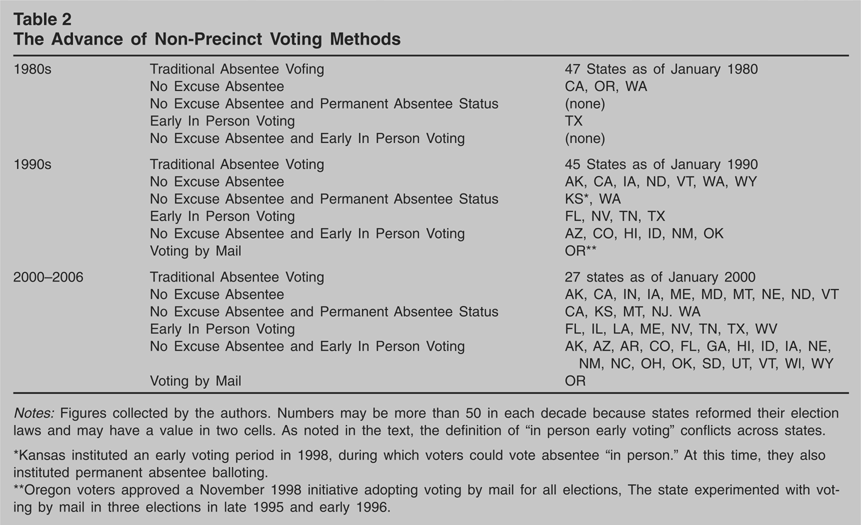
As shown in Table 2, by the late 1990s, 20 states had at least one type of convenience voting on the books, and some had two: Kansas and Washington allowed voters to apply for “permanent absentee” status, which operates exactly like VBM (ballots are automatically sent to voters for each election); six states allowed both no-excuse absentee voting and EIP (or absentee) voting. In 1995, Oregon had its first election under the VBM system, and has conducted all subsequent elections in the same way since 1999.
The Advance of Non-Precinct Voting Methods

The 2000 presidential election's myriad scandals and debacles (mainly technological and clerical in nature) gave birth to a national movement toward overhauling the electoral system. In the wake of the election, many states expanded their election systems to include convenience options—some states even adopted additional early voting options (e.g., Florida, which added no-excuse absentee voting to EIP). The Help America Vote Act (HAVA, 2002) also spurred the growth of early voting. The administrative and technological benefits of early voting systems became particularly important in the period following 2000: a test-run of new voting machines, relief of Election-Day crowds, lower staffing costs, and extra hands-on training opportunities for poll workers appeal to voters and election officials alike.
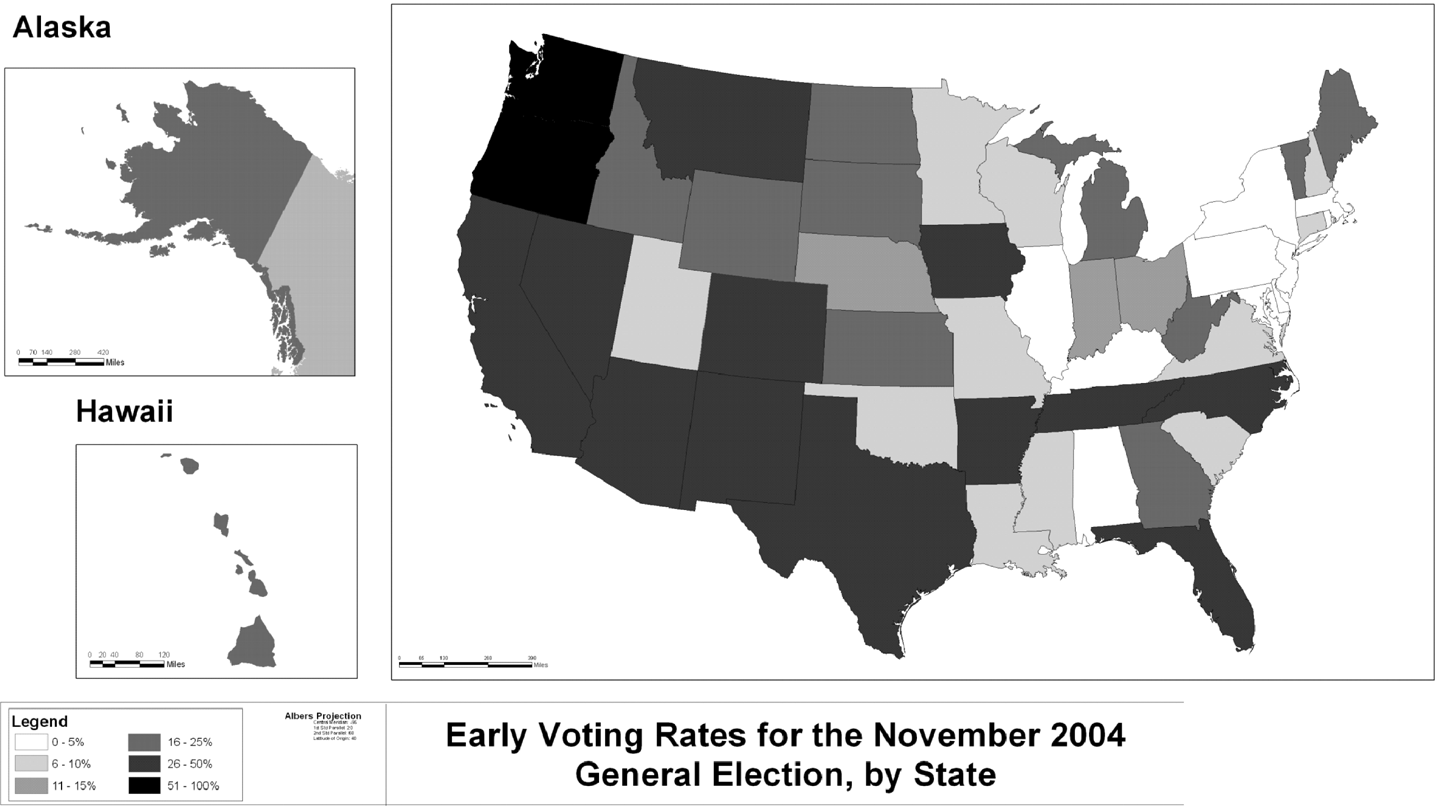
Generally, the non-precinct voting reforms administered over the last 25 years have taken place outside the Northeast. The West Coast and Southwest, in particular, began instituting postal methods early (VBM, no-excuse absentee), and Texas has become the most prominent EIP state, with eight other states following Texas's lead. This trend is quite clear in the rates of early voting in the 2004 general election (see Figure 1).

2004 Early Voting Rates
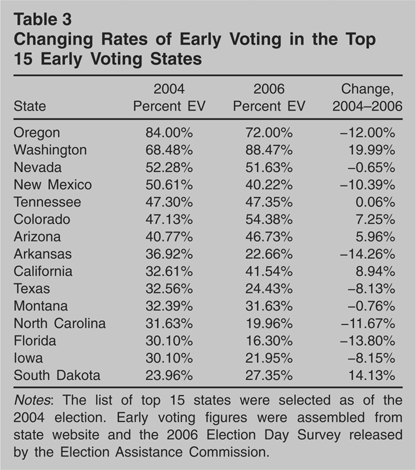
While not uniformly the case, high numbers of early voters primarily appear in states with a high percentage of rural population and in those that are geographically large. The 15 states with the highest early voting rates in 2004 all fit these descriptions (see Table 3). This fits a pattern found in other analyses of individual early voting rates—individual voters who face long commutes or who live in rural areas were more likely to cast their ballot early (Gronke 2004).1
As an aside, at the time of this writing, two months after the 2006 elections, we are unable to obtain early voting statistics for more than half of the top 15 states. Many states report to us that they are compiling this information for the Election Assistance Commission's 2006 Election-Day survey, scheduled to be completed by March 2007.
Changing Rates of Early Voting in the Top 15 Early Voting States

It also appears that those states that adopted non-precinct voting systems early on also have the highest current rates of early voters. Eleven of the “Top 15” early voting states in 2004 had instituted some type of liberalized early voting by the 1990s. Only eight of the remaining 25 had liberalized by that point (compare Tables 2 and 3). What is overwhelmingly apparent from Figure 1 and Table 3 is the rapid increase in early voting once states adopt these reforms. A significant proportion of voters clearly prefer voting at locations other than the precinct place, and on days other than Election Day. In some states, this proportion peaks at 30–40% of the electorate, but in other states there seems no upper bound. For example, 85% of Washington voters cast their ballots absentee in 2006, and Washington State is likely to move to fully VBM by the 2008 election.
Convenience Voting Reforms and Turnout: The State of the Literature
Election officials are strong advocates of early voting reforms. Oregon Secretary of State Bill Bradbury argues that voting by mail increases turnout and results in more citizens having a stake in their government; results in more thoughtful voting, enhancing the democratic process; offers greater procedural integrity; and finally, saves taxpayer dollars. Similar arguments have been made in favor of EIP and relaxed absentee voting. The two primary national organizations that deal with election administration, the National Conference of State Legislatures (NCSL) and the National Association of Secretaries of State (NASS), both issued reports after the 2000 elections, and again after the passage of HAVA that urge states to consider reforms that would allow early voting (NCSL 2001; NASS 2003; 2001; Bradbury 2001). Many reformers hope that early voting may help reengage Americans in the electoral process (ACE Project 2004; Nagourney 2002; Magleby 1987).
The empirical evidence to date supports election officials in their claims of procedural integrity. EIP, absentee balloting, and VBM all do result in a more accurate count (Alvarez and Hall 2003; Hanmer and Traugott 2004; Traugott 2003). The verdict on cost-savings is less clear. Oregon estimates that it saved nearly 17% of the costs of holding elections by adopting VBM, while EIP and liberalized absentee balloting do not clearly result in a cost saving (reported in Hansen 2001). However, improved procedural integrity and flat or slightly positive cost savings have led to widespread recommendations in favor of all varieties of early voting (particularly in response to HAVA requirements). Simultaneously, the use of postal voting is expanding worldwide (Hall 2003; Wintour and Carter 2002; Institute for Democracy and Electoral Assistance, “Postal Voting and Voting on the Internet”). There seems little question, then, that “Election Day in the United States is rapidly turning into an anachronism: waiting in line to cast our ballots will become the quaint notion of a bygone era” (Gronke 2004). Early voting and extended election periods are here to stay.
The empirical evidence on turnout is also positive, but less so. Early voting should increase turnout, theoretically, by easing the resource demands of voting, primarily by eliminating the need to go to the polling booth or by providing more convenient times to vote (McDonald and Popkin 2001; Rosenstone and Hansen 1993; Texiera 1992; Wolfinger and Rosenstone 1980). The empirical evidence supports this expectation. Liberalized absentee balloting leads to a small but significant growth in turnout (Oliver 1996; Dubin and Kalsow 1996). EIP also stimulates participation, again only slightly (Neeley and Richardson 2001; Stein 1998; Stein and Garcia-Monet 1997). Finally, VBM increases turnout (Berinsky, Burns, and Traugott 2001; Karp and Banducci 2000), perhaps by as much as 10% (Southwell and Burchett 2000a).2
Magleby (1987) estimates a 19% increase using VBM, based on a study of local elections in California, Oregon, and Washington. This figure is dramatically higher than that obtained in other studies. However, all studies find a pattern of increasing turnout effects in lower profile contest, so it may be that this figure is accurate.
Citizen support of early voting has been high as well. We know, for example, that Oregonians love VBM. They report a very high level of satisfaction with the system and claim that it makes them more likely to vote (Southwell 2004; 1998; 1996). In Texas, roughly one-third to one-quarter of ballots are cast early. In California in 1978, 4.41% of votes were absentee; by 2006, 40% cast absentee ballots. In Washington State, more than 85% of ballots were absentee in 2006, rising to 100% in some counties (essentially stealth VBM). Nationwide, the CalTech/MIT Voting Technology Project (2001) reported that non-precinct voting rates exceed 15% in more than 12 states in 2000, and the Early Voting Information Center estimated an early voting rate of 21% in 2004 and 2006.
The performance of electoral reforms on changing who votes, however, is decidedly mixed. Berinsky (2004, 1) writes: “[w]hat has not been widely recognized is that this wave of reforms has exacerbated the socioeconomic biases of the electorate.” Berinsky's claim is sustained in compositional studies of all three systems: EIP (Stein 1998), liberalized absentee balloting (Patterson and Caldeira 1985; Oliver 1996) and VBM (Karp and Banducci 2000; Berinsky, Burns, and Traugott 2001; Southwell and Burchett 2000b).
These systems are more commonly taken advantage of by politically active segments of the population. VBM increases turnout more by retaining likely voters in less-intense campaigns (e.g., midterm and local elections) than by recruiting new voters into the system (Berinsky, Burns, and Traugott 2001; Southwell and Burchett 2000b; Southwell 1998). The two studies of absentee balloting indicate that rates of absentee voting vary positively with levels of partisan mobilization: candidates harvest absentee voters in localities where party organizations are strong, and Republican candidates are more likely to harvest absentee voters (Patterson and Caldeira 1985; Oliver 1996). Stein's (1998) study of EIP in Harris County, Texas, showed that that there were significantly larger numbers of Democrats and strong partisans among the “early voters” than among the Election-Day voters.
These past studies, while helpful, are hampered by limitations in research design and methodology that limit their applicability to the past decade of reforms. Most importantly for our purposes here, many of these studies are ancient history from the perspective of early voting. Karp and Banducci (2000) and Southwell and Burchett's (2000b) studies considered only the first three VBM contests. Magleby's (1987) pioneering work looked just at municipal elections in three Western states in the early 1980s. Stein's (1998) study of EIP voting is based on a single election (1994) in a state where rates of early voting have increased dramatically in the past decade, and his results are contradicted by a more recent study (Neeley and Richardson 2001). Neeley and Richardson's study is itself based in just one county in 1996, and relies on self-reports of turnout. Finally, the two studies of absentee balloting (Patterson and Caldeira 1985; Oliver 1996) rely on absentee ballot rates that are less than half what they are today.
Early Voting and Turnout, 1980–2004
In this final section, we evaluate the impact of early voting reforms on turnout over a 24-year period. We wanted to see if we found effects of a similar magnitude across a wide variety of electoral and campaign contexts, over time, and across different kinds of voting reforms. We drew upon an established model of turnout from Tolbert and Smith (Tolbert, Grummel, and Smith 2001; Tolbert and Smith 2005). In these papers, the authors argue that ballot initiatives, far from making the election too complicated and thereby discouraging turnout, do the opposite: they increase turnout, primarily by increasing the salience of the election.
Here, we are less interested in replicating their findings for the effects of initiatives as we are in seeing whether early voting reforms similarly increase turnout—not by educating the electorate, but by lowering at least one barrier to ballot access. We are fortunate to be able to use this dataset because it contains a rich set of other correlates of turnout, including region, election type, institutional provisions, and demographic characteristics of the state (racial diversity and per capita income).3
We do not describe or justify the inclusion of these variables here. Interested readers should go to Tolbert and Smith (2005) for this information. We thank Tolbert, Grummel, and Smith for allowing us access to their data.
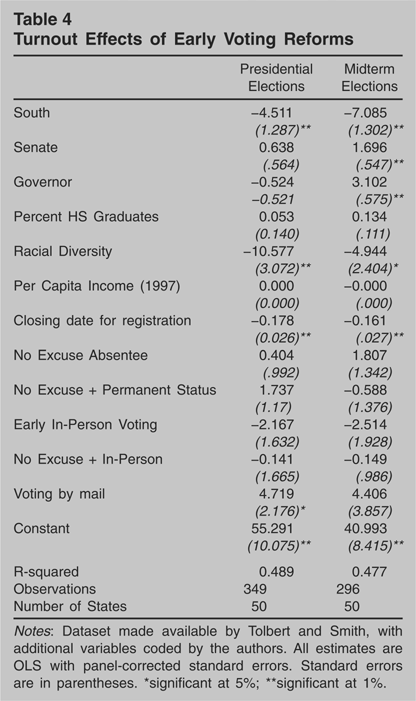
Our replication and extension results are presented in Table 4. We report on a model of turnout in presidential years (column 1) and midterm years (column 2). We will focus our discussion here on the impact of voting reforms on turnout.4
These results match in broad brush strokes the results reported by Tolbert and Smith (2005), although we are using one additional election cycle in the data. We were able to replicate Tolbert and Smith's result sexactly when limiting ourselves to 1980–2002 and using their turnout model.
Turnout Effects of Early Voting Reforms

We find little evidence that early voting reforms increase turnout, except for VBM in Oregon, and then only in presidential elections. As shown in Table 4, column 1, VBM is associated with a 4.7% increase in turnout in presidential years, ceteris paribus. This is less than half of the increase reported by Southwell and Burchett (2000a).5
Southwell and Burchett only examined turnout in the first three VBM elections, two of which were special elections to replace Senator Robert Packwood, who retired under a cloud of ethics charges. The third was a presidential preference primary. Each of these elections showed higher than normal turnout.
In midterm elections, none of the reforms has a statistically significant impact on turnout, although the size of the coefficient on VBM changes only slightly. All of the other coefficients remain well below conventional statistical significance levels and the size of the estimated effect is either quite small or shifts from model to model.
We want to highlight, however, the relatively large, negative, and stable coefficient associated with EIP voting in both models, albeit in both cases with large standard errors.6
The p-value on the EIP voting coefficient is .184 in the presidential year model and .192 in the midterm model.
As shown in Table 2, Florida, Illinois, Louisiana, and Maine added EIP voting after the 2004 election.
Conclusions
Our goals in this paper were threefold. First, we described the lay of the land with respect to early voting reforms, defining the institutional changes, illustrating their geographic dispersion, and reporting the growing number of early voters. Early voting reforms are rapidly expanding nationwide, and will likely be available in virtually every state in 2008. The number of early voters continues to increase rapidly in each election, and in some states shows no signs of abating. It is no longer a question of whether early voting is a smart reform; the question now is what sort of early voting to allow and how to adjust to its impact.
Second, we reviewed the extant political science literature with respect to early voting. Previous scholarly work found a positive impact of early voting reforms on turnout, varying from small (3%) in the case of absentee balloting, to over 10% in the case of VBM. We pointed out, however, that many of these studies looked at a relatively limited historical period, when relaxed balloting requirements were only starting to be introduced and were a novelty.
Finally, we estimated a comprehensive model of early voting and turnout from 1980–2004. We built upon an extant model of turnout, adding to it a series of variables representing early voting innovations. In this analysis, we did find a positive impact of early voting reforms on turnout, but only in the one state that first initiated VBM in 1995 and fully adopted it after 1998, and in that case, only in presidential years. The boost in turnout is smaller than reported in previous work but still significant.
We are not particularly surprised at these modest results. These findings support much of the literature that has found, at best, a modest impact of voting reforms on turnout. Our results are also consistent with theoretical presentations of the paradox of turnout. John Aldrich (1993), in his summary of the rational choice literature on turnout, describes voting as a decision made at the margin, and thus responsive to relatively small changes in costs or benefits. We view early voting as a minor change in the costs of voting, making it more convenient to be sure, but paling in significance to such effects as feelings of citizen empowerment, interest in and concern about the election, and political mobilization by parties, candidates, and other political organizations (Stein, Owens, and Leighley 2003; Rosenstone and Hansen 1993).
In conclusion, we remain skeptical of those who advocate in favor of early voting reforms primarily on the basis of increased turnout. Both these results, and prior work in political science, simply do not support these claims. There may be good reasons to adopt early voting—more accurate ballot counting, reduced administrative costs and headaches, and increased voter satisfaction—but boosting turnout is not one of them.