


%20--%3e%3c!DOCTYPE%20svg%20PUBLIC%20'-//W3C//DTD%20SVG%201.0//EN'%20'http://www.w3.org/TR/2001/REC-SVG-20010904/DTD/svg10.dtd'%3e%3csvg%20version='1.0'%20id='Layer_1'%20xmlns='http://www.w3.org/2000/svg'%20xmlns:xlink='http://www.w3.org/1999/xlink'%20x='0px'%20y='0px'%20width='64px'%20height='64px'%20viewBox='5.5%20-3.5%2064%2064'%20enable-background='new%205.5%20-3.5%2064%2064'%20xml:space='preserve'%3e%3cg%3e%3ccircle%20fill='%23FFFFFF'%20fill-opacity='0'%20cx='37.785'%20cy='28.501'%20r='28.836'/%3e%3cpath%20fill='%23595959'%20d='M37.441-3.5c8.951,0,16.572,3.125,22.857,9.372c3.008,3.009,5.295,6.448,6.857,10.314%20c1.561,3.867,2.344,7.971,2.344,12.314c0,4.381-0.773,8.486-2.314,12.313c-1.543,3.828-3.82,7.21-6.828,10.143%20c-3.123,3.085-6.666,5.448-10.629,7.086c-3.961,1.638-8.057,2.457-12.285,2.457s-8.276-0.808-12.143-2.429%20c-3.866-1.618-7.333-3.961-10.4-7.027c-3.067-3.066-5.4-6.524-7-10.372S5.5,32.767,5.5,28.5c0-4.229,0.809-8.295,2.428-12.2%20c1.619-3.905,3.972-7.4,7.057-10.486C21.08-0.394,28.565-3.5,37.441-3.5z%20M37.557,2.272c-7.314,0-13.467,2.553-18.458,7.657%20c-2.515,2.553-4.448,5.419-5.8,8.6c-1.354,3.181-2.029,6.505-2.029,9.972c0,3.429,0.675,6.734,2.029,9.913%20c1.353,3.183,3.285,6.021,5.8,8.516c2.514,2.496,5.351,4.399,8.515,5.715c3.161,1.314,6.476,1.971,9.943,1.971%20c3.428,0,6.75-0.665,9.973-1.999c3.219-1.335,6.121-3.257,8.713-5.771c4.99-4.876,7.484-10.99,7.484-18.344%20c0-3.543-0.648-6.895-1.943-10.057c-1.293-3.162-3.18-5.98-5.654-8.458C50.984,4.844,44.795,2.272,37.557,2.272z%20M37.156,23.187%20l-4.287,2.229c-0.458-0.951-1.019-1.619-1.685-2c-0.667-0.38-1.286-0.571-1.858-0.571c-2.856,0-4.286,1.885-4.286,5.657%20c0,1.714,0.362,3.084,1.085,4.113c0.724,1.029,1.791,1.544,3.201,1.544c1.867,0,3.181-0.915,3.944-2.743l3.942,2%20c-0.838,1.563-2,2.791-3.486,3.686c-1.484,0.896-3.123,1.343-4.914,1.343c-2.857,0-5.163-0.875-6.915-2.629%20c-1.752-1.752-2.628-4.19-2.628-7.313c0-3.048,0.886-5.466,2.657-7.257c1.771-1.79,4.009-2.686,6.715-2.686%20C32.604,18.558,35.441,20.101,37.156,23.187z%20M55.613,23.187l-4.229,2.229c-0.457-0.951-1.02-1.619-1.686-2%20c-0.668-0.38-1.307-0.571-1.914-0.571c-2.857,0-4.287,1.885-4.287,5.657c0,1.714,0.363,3.084,1.086,4.113%20c0.723,1.029,1.789,1.544,3.201,1.544c1.865,0,3.18-0.915,3.941-2.743l4,2c-0.875,1.563-2.057,2.791-3.541,3.686%20c-1.486,0.896-3.105,1.343-4.857,1.343c-2.896,0-5.209-0.875-6.941-2.629c-1.736-1.752-2.602-4.19-2.602-7.313%20c0-3.048,0.885-5.466,2.658-7.257c1.77-1.79,4.008-2.686,6.713-2.686C51.117,18.558,53.938,20.101,55.613,23.187z'/%3e%3c/g%3e%3c/svg%3e)
%20--%3e%3c!DOCTYPE%20svg%20PUBLIC%20'-//W3C//DTD%20SVG%201.0//EN'%20'http://www.w3.org/TR/2001/REC-SVG-20010904/DTD/svg10.dtd'%3e%3csvg%20version='1.0'%20id='Layer_1'%20xmlns='http://www.w3.org/2000/svg'%20xmlns:xlink='http://www.w3.org/1999/xlink'%20x='0px'%20y='0px'%20width='64px'%20height='64px'%20viewBox='5.5%20-3.5%2064%2064'%20enable-background='new%205.5%20-3.5%2064%2064'%20xml:space='preserve'%3e%3cg%3e%3ccircle%20fill='%23FFFFFF'%20fill-opacity='0'%20cx='37.637'%20cy='28.806'%20r='28.276'/%3e%3cg%3e%3cpath%20fill='%23595959'%20d='M37.443-3.5c8.988,0,16.57,3.085,22.742,9.257C66.393,11.967,69.5,19.548,69.5,28.5c0,8.991-3.049,16.476-9.145,22.456%20C53.879,57.319,46.242,60.5,37.443,60.5c-8.649,0-16.153-3.144-22.514-9.43C8.644,44.784,5.5,37.262,5.5,28.5%20c0-8.761,3.144-16.342,9.429-22.742C21.101-0.415,28.604-3.5,37.443-3.5z%20M37.557,2.272c-7.276,0-13.428,2.553-18.457,7.657%20c-5.22,5.334-7.829,11.525-7.829,18.572c0,7.086,2.59,13.22,7.77,18.398c5.181,5.182,11.352,7.771,18.514,7.771%20c7.123,0,13.334-2.607,18.629-7.828c5.029-4.838,7.543-10.952,7.543-18.343c0-7.276-2.553-13.465-7.656-18.571%20C50.967,4.824,44.795,2.272,37.557,2.272z%20M46.129,20.557v13.085h-3.656v15.542h-9.944V33.643h-3.656V20.557%20c0-0.572,0.2-1.057,0.599-1.457c0.401-0.399,0.887-0.6,1.457-0.6h13.144c0.533,0,1.01,0.2,1.428,0.6%20C45.918,19.5,46.129,19.986,46.129,20.557z%20M33.042,12.329c0-3.008,1.485-4.514,4.458-4.514s4.457,1.504,4.457,4.514%20c0,2.971-1.486,4.457-4.457,4.457S33.042,15.3,33.042,12.329z'/%3e%3c/g%3e%3c/g%3e%3c/svg%3e)
%20--%3e%3c!DOCTYPE%20svg%20PUBLIC%20'-//W3C//DTD%20SVG%201.0//EN'%20'http://www.w3.org/TR/2001/REC-SVG-20010904/DTD/svg10.dtd'%3e%3csvg%20version='1.0'%20id='Layer_1'%20xmlns='http://www.w3.org/2000/svg'%20xmlns:xlink='http://www.w3.org/1999/xlink'%20x='0px'%20y='0px'%20width='64px'%20height='64px'%20viewBox='5.5%20-3.5%2064%2064'%20enable-background='new%205.5%20-3.5%2064%2064'%20xml:space='preserve'%3e%3cg%3e%3ccircle%20fill='%23FFFFFF'%20fill-opacity='0'%20cx='36.924'%20cy='28.403'%20r='28.895'/%3e%3cpath%20fill='%23595959'%20d='M37.442-3.5c8.99,0,16.571,3.085,22.743,9.256C66.393,11.928,69.5,19.509,69.5,28.5c0,8.992-3.048,16.476-9.145,22.458%20C53.88,57.32,46.241,60.5,37.442,60.5c-8.686,0-16.19-3.162-22.513-9.485C8.644,44.728,5.5,37.225,5.5,28.5%20c0-8.762,3.144-16.343,9.429-22.743C21.1-0.414,28.604-3.5,37.442-3.5z%20M12.7,19.872c-0.952,2.628-1.429,5.505-1.429,8.629%20c0,7.086,2.59,13.22,7.77,18.4c5.219,5.144,11.391,7.715,18.514,7.715c7.201,0,13.409-2.608,18.63-7.829%20c1.867-1.79,3.332-3.657,4.398-5.602l-12.056-5.371c-0.421,2.02-1.439,3.667-3.057,4.942c-1.622,1.276-3.535,2.011-5.744,2.2%20v4.915h-3.714v-4.915c-3.543-0.036-6.782-1.312-9.714-3.827l4.4-4.457c2.094,1.942,4.476,2.913,7.143,2.913%20c1.104,0,2.048-0.246,2.83-0.743c0.78-0.494,1.172-1.312,1.172-2.457c0-0.801-0.287-1.448-0.858-1.943l-3.085-1.315l-3.771-1.715%20l-5.086-2.229L12.7,19.872z%20M37.557,2.214c-7.276,0-13.428,2.571-18.457,7.714c-1.258,1.258-2.439,2.686-3.543,4.287L27.786,19.7%20c0.533-1.676,1.542-3.019,3.029-4.028c1.484-1.009,3.218-1.571,5.2-1.686V9.071h3.715v4.915c2.934,0.153,5.6,1.143,8,2.971%20l-4.172,4.286c-1.793-1.257-3.619-1.885-5.486-1.885c-0.991,0-1.876,0.191-2.656,0.571c-0.781,0.381-1.172,1.029-1.172,1.943%20c0,0.267,0.095,0.533,0.285,0.8l4.057,1.83l2.8,1.257l5.144,2.285l16.397,7.314c0.535-2.248,0.801-4.533,0.801-6.857%20c0-7.353-2.552-13.543-7.656-18.573C51.005,4.785,44.831,2.214,37.557,2.214z'/%3e%3c/g%3e%3c/svg%3e)
%20--%3e%3c!DOCTYPE%20svg%20PUBLIC%20'-//W3C//DTD%20SVG%201.1//EN'%20'http://www.w3.org/Graphics/SVG/1.1/DTD/svg11.dtd'%3e%3csvg%20version='1.1'%20id='Layer_1'%20xmlns='http://www.w3.org/2000/svg'%20xmlns:xlink='http://www.w3.org/1999/xlink'%20x='0px'%20y='0px'%20width='64.000977px'%20height='64px'%20viewBox='0%200%2064.000977%2064'%20enable-background='new%200%200%2064.000977%2064'%20xml:space='preserve'%3e%3cg%3e%3ccircle%20fill='%23FFFFFF'%20fill-opacity='0'%20cx='32.064453'%20cy='31.788086'%20r='29.012695'/%3e%3cg%3e%3cpath%20fill='%23595959'%20d='M31.943848,0C40.896484,0,48.476562,3.105469,54.6875,9.314453C60.894531,15.486328,64.000977,23.045898,64.000977,32%20s-3.048828,16.457031-9.145508,22.513672C48.417969,60.837891,40.779297,64,31.942871,64%20c-8.648926,0-16.152832-3.142578-22.513672-9.429688C3.144043,48.286133,0,40.761719,0,32.000977%20c0-8.723633,3.144043-16.285156,9.429199-22.68457C15.640137,3.105469,23.14502,0,31.943848,0z%20M32.060547,5.771484%20c-7.275391,0-13.429688,2.570312-18.458496,7.714844C8.381836,18.783203,5.772949,24.954102,5.772949,32%20c0,7.125,2.589844,13.256836,7.77002,18.400391c5.181152,5.181641,11.352051,7.770508,18.515625,7.770508%20c7.123047,0,13.332031-2.608398,18.626953-7.828125C55.713867,45.466797,58.228516,39.353516,58.228516,32%20c0-7.3125-2.553711-13.484375-7.65625-18.513672C45.504883,8.341797,39.333984,5.771484,32.060547,5.771484z%20M44.117188,24.456055%20v5.485352H20.859863v-5.485352H44.117188z%20M44.117188,34.743164v5.481445H20.859863v-5.481445H44.117188z'/%3e%3c/g%3e%3c/g%3e%3c/svg%3e)
Introduction
Antimicrobial resistance (AMR) is undermining the modern healthcare system by making infections more difficult to treat and prevent, leading to significant morbidity, mortality, and economic impact. 1 The main driver of AMR is antibiotic use. The vast majority of antibiotics are prescribed in the community and up to 50% of these prescriptions are unnecessary. Reference Schwartz, Langford and Daneman2,Reference Silverman, Povitz and Sontrop3 As such, AMR can be mitigated through more judicious antimicrobial use, for which interdisciplinary efforts are needed from clinicians, public health professionals, and policy makers.
Given the high volume of outpatient antibiotic prescribing, antimicrobial stewardship (AMS) in the community is vital to promote appropriate prescribing and mitigate the effects of AMR. Most community AMS efforts have focused on physician prescribers; however, community pharmacists interact directly and frequently with members of the public on matters relating to medication use. Reference Valliant, Burbage, Pathak and Urick4 Their engagement could expand the footprint and influence of stewardship. Although initial efforts to introduce AMS to community pharmacies have been studied, including collaborative practice agreements, point of care testing, and academic detailing, these approaches are not widely implemented, suggesting a need to identify and resolve barriers to their implementation. Reference Bishop, Yacoob, Knobloch and Safdar5
Understanding the determinants to community pharmacist involvement in AMS is essential. Context-based data from pharmacists, the public, physicians, and pharmacy corporations are needed to devise feasible, impactful, and sustainable interventions to minimize the burden of AMR. We sought to identify change strategies to address the barriers and facilitators to implementation of antibiotic stewardship in community pharmacy settings.
Methods
Study design
This was a qualitative study that employed semi-structured interviews with community pharmacists, physicians, nurse practitioners, and members of the public. The study was guided by the Consolidated Framework for Implementation Research (CFIR) Reference Damschroder, Reardon, Widerquist and Lowery6 and Theoretical Domains Framework (TDF) Reference Michie7 to support theory-informed antibiotic stewardship implementation strategies in the specific context of community pharmacies. Reference Moore and Khan8 More detail on recruitment is provided in a previous publication. Reference Langford, Vigneswaran and Daneman9
Participant recruitment
Participants were recruited through a REDCap survey Reference Harris, Taylor, Thielke, Payne, Gonzalez and Conde10 that was distributed through the University of Toronto. Community pharmacists, physicians, and nurse practitioners, practicing and/or residing in Canada were eligible for participation. Convenience sampling was used and several partnerships were leveraged to ensure wide dissemination across a number of groups (eg, members of Ontario Pharmacists Association, Patients for Patient Safety Canada, Ontario College of Family Physicians). The survey included questions about demographic information, perception, and experiences with AMS, and an invitation for interested respondents to participate in a follow-up interview.. Information about the interview was provided to all survey participants who expressed an interest in participation. Interviewees gave informed consent, and each was offered a $150 CAD cheque in recognition of their time and insights.
Data collection
Semi-structured interviews were conducted virtually using a video communication platform (Zoom) from February 25th to April 3rd, 2025. Interviews followed an interview guide that was informed by findings from author panel input, a systematic review, Reference Vigneswaran, Langford and Brown11 TDF and CFIR. The guide covered topics including current AMS practices, perceived barriers, and potential enablers. Interviews were conducted by SV, a Master of Public Health Student with experience in sociobehavioural sciences and qualitative research, alongside either BL or MS (pharmacists with practice in infectious diseases, AMS, and public health), and were audio-recorded using the built-in function on Zoom. The interviews lasted between 30 and 60 minutes and were transcribed verbatim and de-identified for data analysis.
Data analysis
Interview transcripts were analyzed using a hybrid deductive-inductive thematic analysis approach. The Consolidated Framework for Implementation Research (CFIR 2.0) and the TDF served as a deductive coding template to classify implementation determinants. Within these predetermined domains, inductive thematic analysis was employed to identify emerging sub-themes directly from the participant narratives.
Interview transcripts were analyzed using a deductive thematic analysis approach. Key themes were identified and mapped to the appropriate CFIR and TDF domains. All transcripts were imported into NVivo and independently coded by two members of the research team (SV, BL, and MS). To ensure reliability and consistency in the coding process, the research team (SV, BL, and MS) conducted weekly discussions to review discrepancies, refine the coding framework, achieve consensus, and monitor for thematic saturation. Through this iterative process, an inter-coder reliability rate of approximately 90% or higher was established.
Ethics
Informed consent was obtained from survey respondents before participation. The study was approved by the University of Toronto Research Ethics Board (application ID 47105).
Results
Characteristics of participants
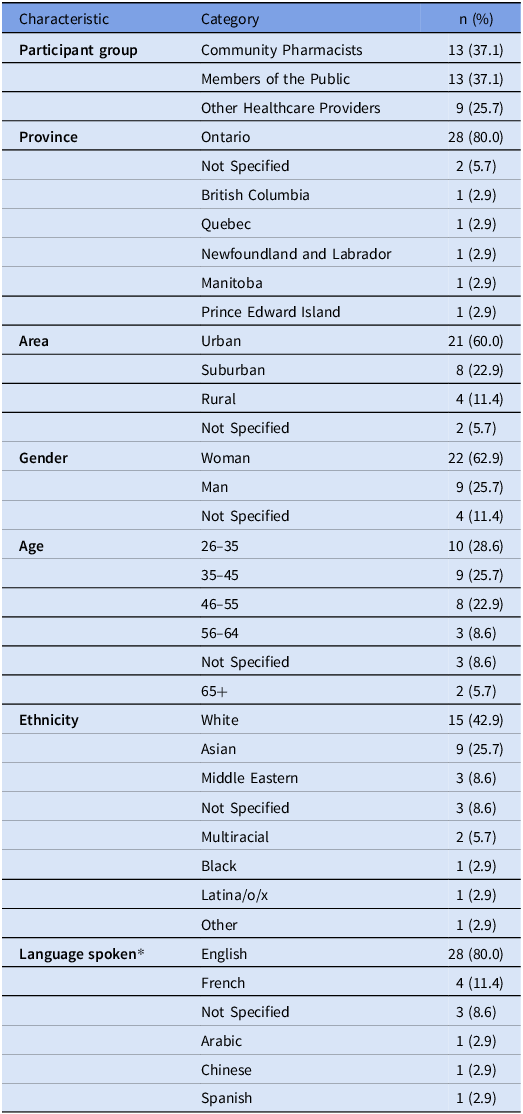
Sixty-five participants expressed their interest in participating in the interview with 32 confirming the follow-up interview invitation. An additional 3 participants were recruited through snowball sampling. Of the 35 interviews conducted, 13 were with community pharmacists, 13 with members of the public, and 9 were other healthcare providers. Of the 9 healthcare providers, 7 were physicians and 2 were nurse practitioners. Most were from urban settings in Ontario (Table 1, Supplementary Table 1).
Participant characteristics

Table 1. Long description
A table with 7 characteristics and 35 categories, detailing participant demographics. Characteristics include Participant group, Province, Area, Gender, Age, Ethnicity, and Language spoken. Each row lists categories and their respective counts and percentages. For example, Participant group has categories Community Pharmacists, Members of the Public, and Other Healthcare Providers with counts 13, 13, and 9 respectively. Province includes Ontario with 28 participants and other provinces with fewer participants. Gender is divided into Woman, Man, and Not Specified with counts 22, 9, and 4 respectively. Age groups range from 26-35 to 65+ with varying counts. Ethnicity includes White, Asian, Middle Eastern, and others. Language spoken is predominantly English with 28 participants.
*participants can identify more than one language spoken.
Determinants of antibiotic stewardship implementation in community pharmacy
Key themes and sub-themes identified along with their corresponding CFIR and/or TDF domain are included in Table 2.
Themes of barriers and facilitators to antimicrobial stewardship implementation in community pharmacy

Table 2. Long description
The table has four columns: Themes and subthemes, Representative quotes, CFIR/TDF Domains, and EDH. It contains 25 rows detailing various themes and subthemes identified in a study on antimicrobial stewardship. Each row includes representative quotes, corresponding CFIR (Consolidated Framework for Implementation Research) and/or TDF (Theoretical Domains Framework) domains, and EDH (Enabling Digital Health) where applicable. The table captures patient expectations, pharmacist education, access to clinical information, limited access to patient history, communication infrastructure, information sharing, interpersonal roles, and prescriber-pharmacist power dynamics.
Patient expectations and public perception
Community pharmacists, physicians, and nurse practitioners described how patient expectations, specifically the perceived need for antibiotics, influenced both prescribing and dispensing patterns. Pharmacists often cited that patients equated antibiotics with effective treatments especially for viral conditions. This attitude has resulted in pressure to fulfill these expectations even when it conflicts with clinical judgement and stewardship principles. Lack of public awareness was consistently presented as a persistent challenge to AMS efforts within the community setting. Several participants, including members of the public, also emphasized the need for broader public health initiatives centered on education to shift patient and public perceptions in support of proper antibiotic use and the importance of AMS.
Access to clinical information
A recurring theme amongst the community pharmacists interviewed was the lack of, or incomplete, access to critical clinical information, including the indication for the prescription, diagnostic test results, and patient history. Many community pharmacists emphasized that the poor integration between primary care and pharmacy prevented them from making informed assessment of antibiotic appropriateness. Several pharmacists expressed their concerns with solely relying on self-reported patient information to determine appropriateness of antibiotic prescriptions, hindering their efforts in AMS. Participants emphasized the need for improved access to electronic health records as a key facilitator to community pharmacist involvement in AMS.
Communication infrastructure and practices
Community pharmacists and prescribers highlighted significant challenges when communicating regarding antibiotic prescriptions. Several participants highlighted the impersonal, outdated, and inefficient communication practices in particular fax systems and delayed responses to phone calls which are major barriers to timely collaboration. The lack of communication between health professions made it difficult for pharmacists to clarify indications, discuss alternative treatment options, and share concerns regarding inappropriate antibiotic prescribing. As a result, this barrier was viewed as a missed opportunity for coordinated AMS delivery. Several participants advocated for the implementation of a secure messaging and communication system that can be integrated into current systems to better support interprofessional collaboration.
Interprofessional roles and relationships
Several participants discussed the complex dynamics, specifically the perceived hierarchy, that exists between community pharmacists and physicians. Pharmacists expressed hesitancy in questioning or challenging prescriptions due to concerns of being seen as overstepping professional boundaries and the risk of straining existing relationships with prescribers. This interprofessional dynamic and power imbalance often presented barriers to community pharmacists’ engagement in AMS services. However, participants emphasized the need for mutual respect and recognized the importance of the pharmacist’s expertise in medication management as a critical skill for AMS practice. Strengthening interprofessional trust and presence of clear definitions for AMS-related roles were viewed as critical to advancing collaborative AMS efforts.
Beliefs about community pharmacist capabilities
Participants expressed varying opinions regarding the capability of pharmacists to engage in AMS. Although most community pharmacists displayed confidence regarding their skills in AMS and readiness for an expanded scope of practice (eg, pharmacist prescribing for minor ailments provides an opportunity to directly integrate AMS principles into their work), some noted that lack of training opportunities and institutional support limited their involvement. Some healthcare providers and members of the public felt that pharmacist’s scope should be limited to dispensing. Enhancing public understanding of the pharmacist’s clinical competencies and providing the necessary support and training for AMS were seen as key facilitators to empower pharmacists to take a larger role in community-based stewardship.
Discussion
This qualitative study offers insights into the barriers and facilitators to AMS by community pharmacists in Canada. Our findings highlight the complexities of implementing AMS in this context, where practice is fragmented. Pharmacists have incomplete access to comprehensive patient records and must navigate interprofessional relationships to influence prescribing. Through the inclusion of key stakeholders (community pharmacists, physicians, nurse practitioners, and the public), this study identifies potential actions to support and sustain AMS interventions in real-world settings.
From our analysis, several themes were identified. Although the public, physicians, nurse practitioners, and pharmacists recognized the important role pharmacists play as medication experts to support antibiotic stewardship, the extent of the envisioned role varied substantially across interviewees. Although physicians often questioned the safety of an expanded pharmacists’ scope due to lack of training in diagnosing diseases (which is foundational to determine the infection being treated and assess appropriateness of antimicrobial therapy), pharmacists tended to value opportunities from the expanded scope which increases autonomy and directly supports provision of AMS. Additionally, the absence of a shared universal electronic medical record and variation in pharmacist’s scope of practice between provinces are critical factors that shape the feasibility and readiness for AMS in the community pharmacy setting. Participants emphasized the need for more integrated interprofessional collaboration and communication, access to clinical information, and improved public understanding of AMR, as critical factors to the success of AMS in community pharmacies. These findings are consistent with research in other jurisdictions that highlight interprofessional fragmentation and limited information exchange between general practitioners and pharmacists as a key barrier limiting the fulfillment of pharmacists’ full scope of practice. Reference Saha, Barton, Promite and Mazza12–Reference Zerbinato, Cunningham and Tonna14 Our study confirms previous findings while using the TDF and CFIR as frameworks to identify potential solutions.
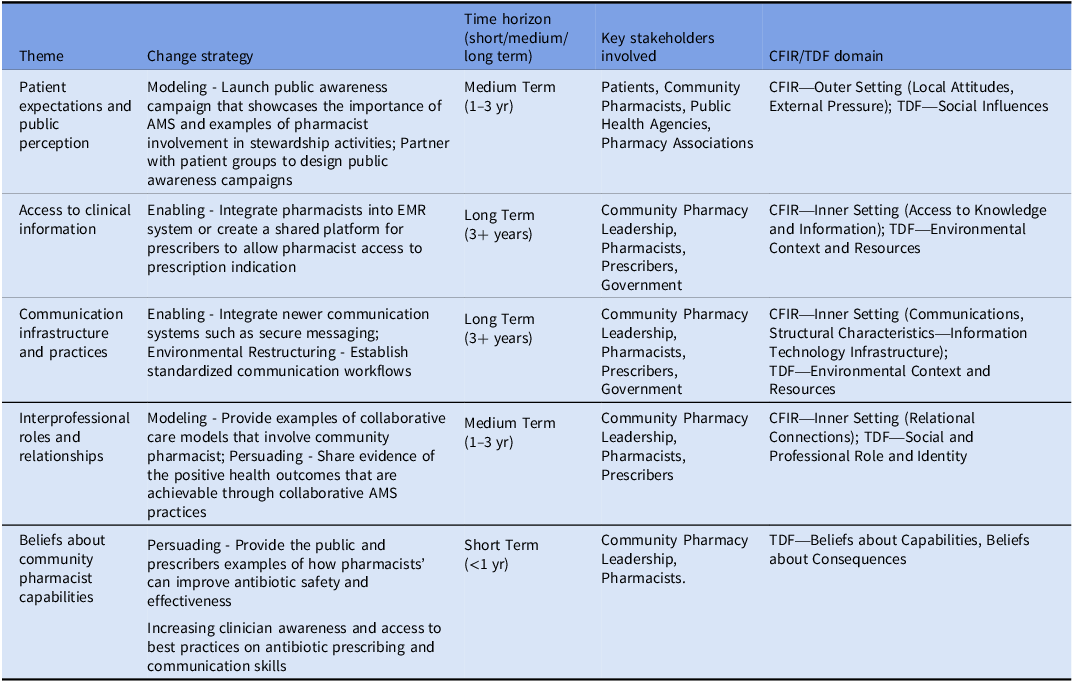
There are several implications for policy and practice. Sustainable and effective AMS within community pharmacy will require system-level facilitators such as improved access to health records, reimbursement framework for AMS services, and interprofessional training opportunities. Potential change strategies identified by our review include (1) launching public awareness campaigns to showcase the importance of AMS and examples of pharmacist involvement in stewardship activities, (2) utilizing secure messaging to facilitate pharmacist and prescriber collaboration, (3) sharing examples of collaborative care models that involve community pharmacists in AMS, and (4) encouraging the inclusion of indication for use on all antibiotic prescriptions (Table 3).
Potential strategies to support antibiotic stewardship in community pharmacy

Table 3. Long description
A table detailing strategies for antibiotic stewardship in community pharmacy. The table has five rows and five columns. Column headers are Theme, Change strategy, Time horizon (short/medium/long term), Key stakeholders involved, and CFIR/TDF domain. Row 1: Theme, Patient expectations and public perception; Change strategy, Modeling - Launch public awareness campaign that showcases the importance of AMS and examples of pharmacist involvement in stewardship activities; Partner with patient groups to design public awareness campaigns; Time horizon, Medium Term (1-3 yr); Key stakeholders involved, Patients, Community Pharmacists, Public Health Agencies, Pharmacy Associations; CFIR/TDF domain, CFIR—Outer Setting (Local Attitudes, External Pressure); TDF—Social Influences. Row 2: Theme, Access to clinical information; Change strategy, Enabling - Integrate pharmacists into EMR system or create a shared platform for prescribers to allow pharmacist access to prescription indication; Time horizon, Long Term (3+ years); Key stakeholders involved, Community Pharmacy Leadership, Pharmacists, Prescribers, Government; CFIR/TDF domain, CFIR—Inner Setting (Access to Knowledge and Information); TDF—Environmental Context and Resources. Row 3: Theme, Communication infrastructure and practices; Change strategy, Enabling - Integrate newer communication systems such as secure messaging; Environmental Restructuring - Establish standardized communication workflows; Time horizon, Long Term (3+ years); Key stakeholders involved, Community Pharmacy Leadership, Pharmacists, Prescribers, Government; CFIR/TDF domain, CFIR—Inner Setting (Communications, Structural Characteristics—Information Technology Infrastructure); TDF—Environmental Context and Resources. Row 4: Theme, Interprofessional roles and relationships; Change strategy, Modeling - Provide examples of collaborative care models that involve community pharmacist; Persuading - Share evidence of the positive health outcomes that are achievable through collaborative AMS practices; Time horizon, Medium Term (1-3 yr); Key stakeholders involved, Community Pharmacy Leadership, Pharmacists, Prescribers; CFIR/TDF domain, CFIR—Inner Setting (Relational Connections); TDF—Social and Professional Role and Identity. Row 5: Theme, Beliefs about community pharmacist capabilities; Change strategy, Persuading - Provide the public and prescribers examples of how pharmacists’ can improve antibiotic safety and effectiveness Increasing clinician awareness and access to best practices on antibiotic prescribing and communication skills; Time horizon, Short Term (<1 yr); Key stakeholders involved, Community Pharmacy Leadership, Pharmacists; CFIR/TDF domain, TDF—Beliefs about Capabilities, Beliefs about Consequences.
CFIR, consolidated framework for implementation research.
TDF, theoretical domains framework.
Strengths and limitations
Strengths of this qualitative study include the incorporation of diverse stakeholder perspectives, the use of implementation science frameworks to guide analysis and identify change strategies, and its focus on the Canadian context, which helps address current gaps in literature and supports the development of relevant interventions that support AMS in community pharmacy. However, several limitations of this study need to be noted. Most study participants reside and practice in Ontario (the most populated province in Canada) which may limit the generalizability to other provinces or territories with different healthcare infrastructure. Although the inclusion of members of the public added valuable perspectives and experiences surrounding patient–pharmacist relationships and expectations for antibiotics, these individuals may not be representative of the general population. The study may be subject to selection bias, as clinicians with a particular interest in AMS may have been more likely to participate, potentially resulting in an overestimation of the acceptability of stewardship interventions. Similarly, participating members of the public were often engaged in health-related advocacy and caregiving, and their healthcare experiences may not be reflective of marginalized, underrepresented, and less health-literate individuals and communities. Lastly, the presence of at least one pharmacist during the interview may have introduced bias especially during interviews with community pharmacists and prescribers. This risk of bias was mitigated by having the non-pharmacist interviewer as the lead facilitator during each interview to maintain positionality.
Conclusion
Perceived barriers and facilitators to AMS in community pharmacy settings vary across the public, prescribers, and pharmacists. However, consistent challenges identified included the siloed system of disciplines, lack of direct pharmacist–prescriber communication, and limited access to patient records. Leveraging the role of pharmacists as medication experts, several potential change str
ategies were identified including public awareness campaigns, secure messaging to facilitate pharmacist and prescriber collaboration, showcasing successful examples of community pharmacy AMS and encouraging the inclusion of indications for use on all antibiotic prescriptions.
Supplementary material
The supplementary material for this article can be found at https://doi.org/10.1017/ash.2026.10891.
Financial support
This work was funded by the New Initiative and Innovation Award—Network for Improving Health Systems from the University of Toronto, Leslie Dan Faculty of Pharmacy and the Dalla Lana School of Public Health.
Competing interests
None.
Artificial intelligence
ChatGPT (GPT-5) was used to support improvement in language and development of the visual abstract. The authors reviewed and edited the content as needed and take full responsibility for the final content of the manuscript.



 Open access

