The publication of the Club of Rome's study The Limits to Growth Footnote 1 in 1972 and the first OECD Guidelines for Multinational Enterprises in 1976 initiated a discussion on the human, ecological, and social footprint of businesses and their role in tackling these challenges. Since then, there has been a steady rise in the expectation for companies to operate as responsible citizens from a broad range of stakeholders. The way corporate governance, compliance, and business ethics are addressed is influenced by increasing performance demands, growing public scrutiny, and new levels of accountability derived from the development of international standards and guidelines on corporate responsibility and the respect of human rights.Footnote 2
The Corporate Responsibility Timeline.

At the same time, companies have come to realise the opportunities that a sustainable and responsible business strategy can offer. It creates value for the company and its shareholders but also for society, namely by creating job opportunities, generating income for local communities, sustaining livelihoods, and fostering local development, as well as by promoting best practices in the areas of human rights, labour, the environment, and anti-corruption.Footnote 3
However, sustainable business cannot thrive where poverty, corruption, and inequality reign, and where human rights are not respected and supported.Footnote 4 Especially when operating in situations of conflict and violence, companies of all sizes should, beyond their primary duty to cause no harm to human rights, have an interest in and contribute to promoting peace and stability.
Many business leaders around the world recognise that respect for human rights is becoming an essential element of good risk management, enabling enterprises to navigate non-technical, non-financial risk in line with international norms, to secure the social license to operate, to enter new markets, and to avoid unnecessary litigation costs or legal liability. Many, therefore, endeavour to protect and respect human rights in their activities. However, there is still a long way to go until the private sector has fully embraced the opportunities to contribute to the development of more peaceful and sustainable societies.
This article provides an overview of existing guidance on the responsibility to respect human rights and its practical consequences for enterprises. It emphasises the importance of ongoing stakeholder engagement in successfully fulfilling the corporate responsibility to respect human rights with best practice examples of stakeholder engagement. The relevance of exercising stakeholder dialogues in conflict or high-risk contexts is also addressed. Finally, recent stakeholder campaigns on business and human rights are highlighted. The article concludes with recommendations on how best to integrate stakeholder engagement into a company's human rights strategy.
Corporate responsibility to respect human rights and its implications for companies
Whereas many multinational enterprises (MNEs) and small and medium-sized enterprises (SMEs) now see a long-term business case for respecting human rights,Footnote 5 it remains one of the most challenging areas of corporate citizenship.Footnote 6 As companies try to fulfil the legal, business, and moral obligations to address human rights within their operations and value chains, they are faced with major challenges. How to adopt a systemic management approach to human rights? How to avoid complicity in human rights abuses? Where to draw the boundaries of responsibility for human rights?
Guidance on the corporate responsibility to respect human rights
With a view on laying the foundations of a system for better managing business and human rights challenges, the Special Representative of the Secretary-General proposed in 2008 a conceptual policy framework known as the Protect, Respect and Remedy Framework. It chartered the state duty to protect against human rights abuses by third parties, including business; the corporate responsibility to respect human rights; and the need for greater access to effective remedy.Footnote 7
The Protect, Respect and Remedy Framework heightened the discussion around corporate responsibility and human rights, and generated momentum in 2011 for the endorsement of the Guiding Principles on Business and Human Rights.Footnote 8 The Guiding Principles clarify the meaning of the corporate responsibility to respect human rights and provide a global standard for preventing and addressing the risk of adverse impacts on human rights linked to business activity. Together with the United Nations (UN) Global Compact Ten Principles,Footnote 9 the Guiding Principles constitute the core framework for business and human rights, and have mainstreamed the corporate responsibility to uphold and respect internationally proclaimed human rights.
Key stakeholder groups have welcomed these standards. Numerous international organisations have drawn on the Guiding Principles in adapting their own business and human rights policies and standards.Footnote 10 Governments such as those of Australia, Canada, and the United Kingdom, as well as the European Union,Footnote 11 have applied the Guiding Principles in their public policies, and it can be expected that others will also start encouraging or requiring corporate human rights disclosure. Several major global corporations have realigned their due diligence processes based on the Guiding Principles and, while these are not legally binding, stakeholder expectations and pressure on enterprises to respect human rights show a trend of increase.Footnote 12 Investors and advocacy organisations have progressively demanded that companies demonstrate and ensure respect for human rights through the measures outlined in the Guiding Principles.
Practical consequences of the corporate responsibility to respect human rights
The responsibility to respect human rights refers to universal human rights principles, understood as those enshrined in the International Bill of Human RightsFootnote 13 and the core conventions of the International Labour Organization (ILO).Footnote 14 These principles present companies with a set of international norms against which to benchmark their own performance and remain accountable for their actions.Footnote 15 Depending on the circumstances, enterprises may need to consider additional standards, such as those of international humanitarian law, when operating in situations of armed conflict.
For companies, in practical terms, respecting human rights means, at a minimum, not infringing on the rights of others, and causing no harm – a responsibility that is a baseline expectation for all companies in all situations.Footnote 16 It is not a passive responsibility but requires action from companies. The Guiding Principles provide concrete and practical recommendations for companies on how to meet their responsibility to respect human rights, namely through determining their sphere of influence,Footnote 17 expressing their commitment to a human rights policy,Footnote 18 developing a human rights management framework,Footnote 19 and exercising due diligence.Footnote 20
The corporate responsibility to respect human rights requires an ongoing and dynamic process (adapted to a company's operating context, sector, and size) that allows for enterprises to become aware of, prevent, and address adverse human rights impacts linked to their business activities and relationships (such as those with suppliers, customers, business partners, and other entities in the value chain).Footnote 21 Companies are asked to identify and assess their actual and potential human rights impact, while integrating and acting upon their findings. They also have to monitor and track the effectiveness of responses so that they can communicate and report on their human rights impact. Finally, a framework for remediation must be established.
At each and every step of this process, it is essential to take stakeholder views into consideration and to engage with them at the local, national, and international levels. Human rights due diligence is a process that helps enterprises address their responsibilities towards the individuals and communities they impact, but also their responsibilities towards shareholders, investors, or business partners, being in the company's best interest. In order to manage human rights effectively, meaningful engagement and dialogue with concerned stakeholders based on transparency and accountability is needed.
Stakeholder engagement – key to the respect for human rights
Engaging stakeholders at every step of a human rights management framework is key in meeting the responsibility to respect human rights. It is not a one-off affair; rather, it is a learning process involving long-term commitments.Footnote 22
Stakeholder engagement – key concepts
Stakeholder engagement relates to mapping and being responsive to the needs of groups affected by, or dependent on, business activity and outcomes while accommodating and balancing their distinct interests. Typically, groups of stakeholders include employees (internal stakeholders); shareholders, investors, customers, business partners, suppliers, and regulators (known as ‘external market stakeholders’); and civil society, community members, international organisations, and non-governmental organisations (‘external non-market stakeholders’).
Companies increasingly recognise the business and reputational risks that come from poor stakeholder relations and the opportunities offered by constructive ones. Actively developing and sustaining good stakeholder relations is a prerequisite for improved risk management and better results on the ground.Footnote 23 It allows companies to better anticipate and act upon the rapidly changing societal expectations within their operating context, as they understand and respect the communities in which they operate. At the same time, it allows them to adopt conflict-sensitive business practices as well as to establish consensus-building processes and trust between business and society in order to gain and maintain a social license to operate. However, for many enterprises finding the right approach to stakeholder engagement and tapping the wider benefits it offers to their business is still uncharted territory.Footnote 24
Realising the opportunities that stakeholder engagement offers requires systematic and proactive stakeholder engagement processes as an integral part of a company's strategy. To implement good stakeholder engagement, some essential steps have to be followed. First of all, stakeholders affected by and dependent on business activities should be identified and prioritised, while their needs and concerns should be assessed and accounted for. Based on stakeholder analysis and needs assessment, a stakeholder engagement strategy should be defined, including engagement objectives and measurable targets as well as activities to be pursued. Implementation of the strategy and effectiveness monitoring should be done in consultation or collaboration with stakeholders. Last but not least, it is essential to report back to stakeholders on the company's performance and achievements.
These steps to establishing good stakeholder relations are all the more relevant in the realm of meeting the corporate responsibility to respect human rights and in successfully implementing the Guiding Principles.
Stakeholder engagement in the context of business and human rights
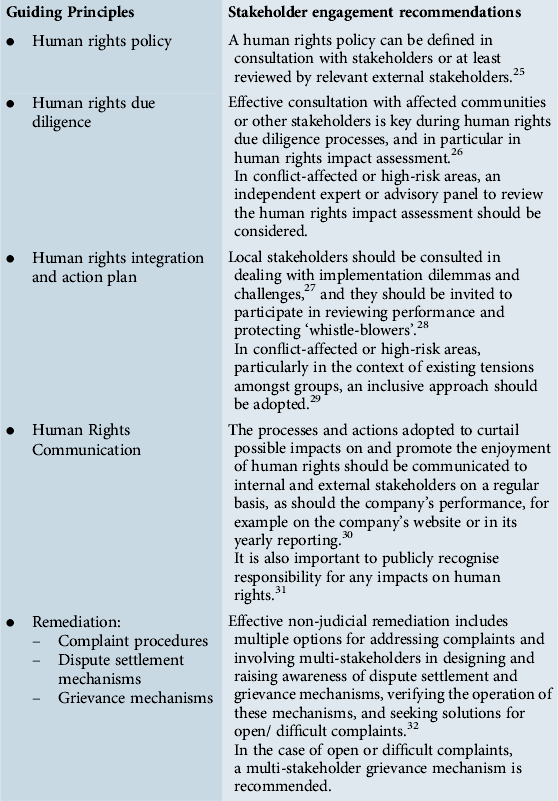
In the context of the corporate responsibility to respect human rights, stakeholder engagement should be a standard element of daily business, as it helps businesses to spot potential human rights impacts, opportunities, or challenges early in the process and at each step of developing and implementing a human rights framework in line with what is suggested in the Guiding Principles and explained in the following table.
Recommendations for stakeholder engagement based on the Guiding Principles.
From the moment a company maps its sphere of influence (its scope of opportunities to support the enjoyment of human rights and make the greatest positive impact),Footnote 33 outlines a human rights policy, and starts employing due diligence, proactive stakeholder engagement processes (such as needs assessment, partnerships, and multi-stakeholder forums) assume strategic significance.Footnote 34 When making use of these processes, a company can choose from a variety of activities: it can inform, communicate, consult, negotiate, involve, collaborate, or empower stakeholders. How far or how deep these activities go depends on the enterprise's level of commitment to engaging with stakeholders.
In this view, stakeholder engagement is exercised so as to build relationships across a company and with external groups, which can directly or indirectly contribute to expanding the recognition of human rights values within the company's sphere of influence.Footnote 35 The purpose is to raise awareness of the human rights risks and opportunities the company faces, and to establish platforms for constructive dialogue and consensus-building processes to the advantage of all involved, the company's own workforce included. These relationships have to be based on transparency and accountability, so that trust among the concerned stakeholders is fostered.
In order to identify relevant external stakeholders and involve them in human rights management processes, it is essential to determine: who in the value chain might be positively or negatively affected by a company's business activities? Who was involved in the past when concerns needed to be addressed? Who can help the enterprise address specific impacts and who can affect its ability to meet its responsibilities? Who will be disadvantaged if excluded from the engagement?
Identifying stakeholder representatives (ensuring that all parties are well represented) and consulting with them can be an efficient way to understand their needs and concerns, to disseminate information to large numbers of stakeholders and to identify common solutions. Moreover, early engagement provides a valuable opportunity to influence public perception and set a positive tone with stakeholders from the outset.Footnote 36 In addition, it can serve as capital during challenging times, contributing to the prevention of conflicts and enhancing the stability and security of business operations.
It is therefore important, when engaging with stakeholders, to agree on the adequate level of information disclosure in ways that are meaningful, comprehensive, and accessible, not only communicating the company's achievements in relation to fulfilling the responsibility to respect human rights, but also being open to addressing challenging issues.Footnote 37 Enterprises should, thus, involve directly affected stakeholders in monitoring the impacts of business operations, and involve external monitors where they can enhance transparency and credibility.Footnote 38
For controversial and complex issues, enterprises should initially consult with stakeholders – consulting inclusively, documenting the process, and following up on results, including reporting back to stakeholders. At a later stage, companies should establish accessible and responsive means for stakeholders to raise concerns and grievances about business activities and enter into good-faith negotiations that satisfy the interests of all parties, especially through operating non-judicial independent remediation mechanisms (such as complaint procedures and dispute settlement and multi-stakeholder grievance mechanisms). These mechanisms should be legitimate, accessible, predictable, rights-compatible, equitable, transparent, and based on dialogue and engagement.Footnote 39
Company-level remediation mechanisms may, for example, enable enterprises to address grievances at an early stage and before these escalate into legal suits or reputation-damaging public campaigns. Furthermore, by tracking complaints, companies can identify systemic problems and adapt practices to counter or mitigate adverse impacts on human rights as well as to prevent future controversies or disputes.Footnote 40 As such, remediation is complementary to any corporate due diligence framework.
Multi-stakeholderism
In particular, multi-stakeholder fora, where the different parties concerned actively participate in looking at controversial issues and finding consensual solutions to those issues, are extremely useful tools for businesses to successfully fulfil their corporate responsibility to respect human rights. This form of stakeholder engagement offers a way forward to prevent, mitigate, and redress conflicts and to spot opportunities for everyone involved or even set industry standards, as is so often the case with international multi-stakeholder initiatives such as the Global Reporting Initiative.Footnote 41
At the local level, multi-stakeholder mechanisms are instrumental to convening with and listening to local stakeholders, thereby identifying their needs and concerns. They are excellent fora for soliciting substantive input from community members and addressing local issues, ultimately contributing to avoiding confrontation with local communities. Options available are community advisory panels, which bring local stakeholders together on a regular basis to discuss issues related to a company's activities. In the case of an open or difficult complaint, local remediation should preferentially be pursued through multi-stakeholder grievance mechanisms, where groups of stakeholders are given the chance to bring forth and resolve grievances.
Enterprises should also consider forming strategic partnerships and collaborating with selected stakeholders to address and overcome human rights challenges. Such collaborative efforts can take the form of public–private partnerships, networks and alliances (with other companies, business partners or suppliers, universities, or research institutions), or partnerships with civil society actors (such as non-governmental organisations).
The benefits enterprises and other stakeholders may reap from engaging in multi-stakeholderism are well illustrated by the success story of the Fair Labor Association (FLA)'s Global Forum for Sustainable Supply Chains.Footnote 42 The Global Forum provides a safe, non-judgemental space (without room for ‘naming and shaming’) where stakeholders can feel comfortable discussing contentious issues and sharing controversial views with industry partners, local and international NGOs, trade unions, leading experts, and people involved in the extended network of the supply chain.Footnote 43
According to Auret van Heerden,Footnote 44 the independent, integrated, and holistic approach of the Global Forum has generated and fostered connections for improved interaction between the different stakeholders. It has positively enabled these trusted stakeholders to discuss challenges in an open manner, to reach agreement on possible solutions and, most importantly, to share ownership and accountability for the results achieved.
However, exercising stakeholder engagement does not come without challenges, inherent to the nature of mapping, accommodating, and balancing different groups of interests. Enterprises are, more often than not, confronted with difficulties when deciding which contributions from stakeholders to take up; communicating and justifying to stakeholders why some suggestions are followed and others are not; tackling grievances; and properly following up on controversial issues raised. One key component in achieving good stakeholder engagement is to be open, transparent, and accountable for actions taken. This will also help to avoid stakeholder fatigue in the long run.
Operating in conflict-affected countries or high-risk areas and engaging stakeholders
When operating in conflict-affected countries or high-risk areas, companies are often confronted with severe operational, legal, and reputational risks.Footnote 45 Widespread violence, political instability, governance failure or even repression, social tension, poverty, and the collapse of civil infrastructure pose threats to employees and to the security of business operations, while poorly enforced legislation, institutional weakness, levels of corruption, human rights abuses, and violations of domestic or international law are powerful obstacles to developing responsible corporate activities.
The lack of a predictable political and economic framework and the risk of violence and conflict present a minefield of complex management issues,Footnote 46 as they impact production and supply lines, increase operating costs, delay business activities, and may have adverse effects on a company's reputation. Additionally, the likelihood that business activities might harm human rights in difficult operating settings is much higher than in stable environments. Indeed, ‘the combination of foreign investment and high-risk countries has proved explosive: violent protests and fierce opposition locally, condemnation and campaigns internationally’.Footnote 47
In order to assess the overall conflict vulnerability, either prior to investing in a specific country or periodically, particularly in instances where political instability and violence escalate suddenly, enterprises may consider consulting one of the following tools, depending on the issues at stake or the circumstances they may face: the Failed States Index,Footnote 48 the Human Rights Risk Atlas,Footnote 49 the Basel Anti-Money Laundering (AML) Index 2012,Footnote 50 The Swisspeace Business Conflict Check,Footnote 51 and the OECD Risk Awareness Tool for Multinational Enterprises in Weak Governance Zones.Footnote 52
When facing high risks of conflict, companies may take one of two options: either to divest and leave the country, or to manage conflict risks effectively and try to contribute to a more stable environment. Enterprises wishing to stay and operate in conflict-affected and high-risk areas face difficult challenges. Some of the questions they need to answer for themselves include which steps to take in order to ensure that operations respect human rights, especially in contexts where others (notably states) do not fulfil their obligations; whether, in these circumstances, they have additional responsibilities and, if so, what these might entail;Footnote 53 and how to avoid inter- and intra-community tensions and increasing the likelihood of violence directed against them.
The complexity of conflict situations requires common frameworks, common reference points for companies on what constitutes responsible business practices in these volatile environments, and awareness of context factors. In addition to the Guiding Principles and the UN Global Compact Ten Principles, further specific guidance is available. A short overview of such guidance tools is provided below.
Guidance on operating in conflict-affected countries and high-risk areas
The UN Global Compact, in collaboration with the Principles for Responsible Investment, has developed the Guidance on Responsible Business in Conflict-affected and High-risk Areas.Footnote 54 The Guidance aims at assisting companies in implementing responsible business practices in conflict-affected and high-risk areas consistent with the UN Global Compact Ten Principles, and seeks to provide a common reference point for constructive dialogue between companies and investors on what constitutes responsible business practices in difficult operating environments. The Guidance categorises responsible business practices in relation to four areas – core business, government relations, local stakeholder engagement, and strategic social investment – and highlights opportunities and challenges for each area.
The Voluntary Principles on Security and Human RightsFootnote 55 provide guidance to companies in the extractive and energy sectors in relation to ‘maintaining the safety and security of their operations within an operating framework that ensures respect for human rights and fundamental freedoms’.Footnote 56 They can also be used by any company engaging with public and private security in high-risk areas. The OECD's Due Diligence Guidance for Responsible Supply Chains of Minerals from Conflict-affected and High-risk Areas,Footnote 57 on the other hand, provides management recommendations for global responsible supply chains of minerals, so that companies respect human rights and avoid contributing to conflict through their sourcing decisions and practices, including their choice of suppliers.Footnote 58
In 2011, the Institute for Human Rights and Business launched a report entitled From Red to Green Flags: The Corporate Responsibility to Respect Human Rights in High-risk Countries.Footnote 59 This report explores the specific human rights dilemmas and challenges facing companies operating in weak governance zones or dysfunctional states. It also provides detailed guidance for business leaders on meeting their human rights responsibilities, in particular in exercising enhanced due diligence based on the ‘3Rs’ of understanding risk, building relationships, and providing remedy.Footnote 60
Stakeholder engagement in conflict-affected countries and high-risk areas
For enterprises, the inherent risks of operating in unstable regions are not simply externalities, but are ‘factors that can be proactively managed in various ways’.Footnote 61 To that end, companies develop strategies that allow them to minimise and manage these risks, among which stakeholder engagement plays a major role.Footnote 62
In violence- and conflict-stricken contexts, stakeholder engagement is a particularly relevant element in the risk management strategy, as engagement with local communities provides an invaluable source of intelligence about the local context. Working directly with the local population paves the way to understanding local concerns, needs, and tensions.Footnote 63 Moreover, stakeholder engagement can help develop good relations at the local level and make companies a relevant and integrated element in the local context, serving as capital for the security and stability of business operations. Proactive community consultation may serve as a means to bring conflicting groups together rather than exacerbate existing tensions and divisions. It can also ‘help companies to gain political support among local communities for business activities (to gain and maintain a social license to operate)’.Footnote 64
When building relationships with local communities in conflict-affected or high-risk areas with a view to respecting human rights, it is essential to design stakeholder engagement processes that are inclusive (of all impacted groups, particularly in the context of existing tensions amongst groups), fair in terms of benefits for the groups, open (based on regular and transparent communication) and focused on winning trust.Footnote 65 Local stakeholders should be consulted in dealing with implementation dilemmas and challenges, and they should be invited to participate in reviewing performance and protecting ‘whistle-blowers’.Footnote 66 The key is to approach communities as partners in preventing and managing conflict, rather than viewing them as a risk factor.Footnote 67
In situations of violence or high risk, the level of expectation around corporate due diligence is significantly higher. Consequently, multi-stakeholder initiatives are of great importance to help establish where the thresholds of business responsibility for human rights might lie, as they provide a forum wherein governments, business, civil society, and local communities can discuss what should reasonably be expected from enterprises in such operating contexts.Footnote 68
One opportunity to engage with stakeholders in conflict-affected countries is to participate in an existing UN Global Compact local network,Footnote 69 or to contribute to setting up such a network in a specific country. The UN Global Compact networks provide a platform for identifying and collaborating with like-minded organisations. Together, companies and other organisations can contribute, within their sphere of influence, to improving the conditions of a country and acting as a force for economic and social progress in an area. For example, in Sudan, a number of international companies, together with Sudanese representatives, launched a forum to set up a business-led local network of the UN Global Compact in the country.Footnote 70
In addition to their core business activities and stakeholder engagement strategies, enterprises may try to shape their operating environments by focusing on social investment and community development initiatives. The primary responsibility for peace, security, and development rests with states, but the private sector can make a meaningful contribution to peace and stability in conflict-affected and high-risk areas.Footnote 71 Companies should ideally maximise the benefits that flow directly from their core functions, such as job creation and broader economic development, while in turn receiving the benefits of increased support in the local communities in which they operate, a more positive public image, and the satisfaction of doing something good.Footnote 72
Responsible social investment is crucial and at the same time challenging in conflict-stricken countries. On the one hand, it is important to deliver long-lasting programmes that benefit local and regional communities as well as the company. On the other hand, a company has the responsibility to do it well and needs to carefully select the beneficiaries in order to avoid further fuelling inter-community conflicts. It is helpful to adopt a regional approach for social investment programmes rather than having only the population in the immediate vicinity of corporate sites benefit from the company's presence. In view of this, social projects should be implemented in partnership with local or international non-governmental organisations and local institutions. Furthermore, a company should ensure that social projects are identified in consultation with affected communities and are strategically aligned with core business activities and impact mitigation responsibilities, such as respecting human rights.
There are often competing human rights-based arguments regarding the presence of enterprises in conflict-affected or high-risk areas, between the moral responsibility a company has in a specific country just by being there and the economic development and benefits that it brings to the local populations and the country in general. The balance between different human rights priorities is a hard one to strike and is unequivocally linked to a company's operating context, sector, and size.
Stakeholders' campaigns on business and human rights
The frustration of selected stakeholders in relation to existent guidance on business and human rights (partly due to the fact that the majority of the above-mentioned standards, guidelines, and initiatives are legally non-binding in character),Footnote 73 together with increased stakeholder expectations for companies to operate as corporate citizens, has led to stakeholder campaigns of many sorts, which will be addressed now.
Campaigns directed at the public image of enterprises
A famous case involving Nike, in 2001, showed consumers' power as active stakeholders. Deriving from a widely forwarded email thread known as the ‘Nike Sweatshop Emails’, which stated that Nike had relocated its production process in Asia and South America, and that workers in these firms were forced to work for long hours and paid low wages, there was a spontaneous, far-reaching temporary consumer boycott as a response. By engaging consumers or other stakeholders proactively, Nike would have had an opportunity to notice their concerns and take measures to avoid the campaigns.
The Sudan Divestment Campaign is another example that reveals how investors can play an influential role in determining companies' business decisions with respect to controversial issues. In 2005, the US government approved the Sudan Accountability and Divestment Act, which authorises and encourages state and local divestment from Sudan, prohibits federal contracts with problematic companies that operate in Sudan's oil, power, mineral, and military sectors, and provides legal protections to asset managers who choose to divest from Sudan.Footnote 74 As a result of the burgeoning pressure exhorted by the Sudan Divestment Campaign, US pension fund investment in foreign companies active in Sudan was largely withdrawn; this placed an additional financial burden on these companies, which were already in the spotlight. In order to respond to the Sudan Divestment Campaign, many international companies engaged in dialogue with the Sudan Divestment Task Force. By taking substantial action, such as significant humanitarian efforts in conjunction with respected partners to the benefit of one or more marginalised populations, they were able to avoid blacklisting.
Campaigns for corporate justice
From launching campaigns with the purpose of drawing attention to corporate behaviour, which invariably tarnish enterprises' reputation at the international level, non-governmental organisations and civil society at large have shifted their focus also to shaping legislation and setting industry standards, in a global trend calling for corporate justice. There has been an upswing in liability risks as stakeholder expectations for corporate compliance have increased and the web of liability has expanded.
In Europe, this is the case with the European Coalition for Corporate Justice (ECCJ),Footnote 75 which promotes holding European companies operating in Europe and abroad legally accountable for failures to comply with the corporate responsibility to respect human rights. In May 2012 the ECCJ launched recommendations for the implementation of the Guiding Principles,Footnote 76 urging the European Union and its Member States to:
• effectively assist companies in meeting their responsibility to respect human rights, by identifying appropriate ways of enforcing due diligence via regulatory measures;
• ensure policy coherence at both EU and Member State level … ;
• take effective measures to lift existing obstacles to justice and to ensure effective remedies for victims of corporate-related violations … .Footnote 77
In line with the ECCJ, the Corporate Justice Campaign,Footnote 78 supported by some 50 organisations, was launched in Switzerland in early November 2011. The campaign is calling on the Swiss Federal Council and Parliament to ensure that corporations headquartered in Switzerland are compelled to take precautionary measures (duty of care) with respect to their activities and those of their subsidiaries, subcontractors, and suppliers, in order to prevent human rights violations in Switzerland and abroad, and that victims of human rights abuses committed by companies headquartered in Switzerland, but also by their subsidiaries, subcontractors, and suppliers, are given the opportunity to institute legal proceedings and seek redress in Switzerland. This campaign gathered significant public support,Footnote 79 and its petition was submitted to the Swiss Parliament in June 2012. It is scheduled to be discussed in one of the Parliament's commissions in 2013.
Bringing cases to justice
At present, there is no established international criminal mechanism for addressing human rights abuses perpetrated by companies. It remains unclear whether, and under which circumstances, corporate actors (including company directors, if relevant) can be prosecuted for violations of international human rights law or international humanitarian law, namely before the International Criminal Court. Hence, cases of corporate human rights abuses are generally subject to civil accountability within domestic jurisdictions. Civil liability is of an intrinsically national nature, but recent developments are introducing changes in domestic and international legal procedures.
The Alien Tort Claims Act
Two recent cases brought before American Courts, Kiobel v. Royal Dutch Petroleum Footnote 80 and Doe v. Chiquita,Footnote 81 hold great potential to influence American and international law on the issue of corporate accountability for human rights violations. The cases were brought to court in the United States under the Alien Tort Claims Act, and at stake was the question of whether foreign corporations doing business in the United States can be held liable in the United States for gross human rights violations committed elsewhere (so called extra-territorial accountability).
This legislation is unique to the United States, but legal precedents in the United States have widened the definition of complicity in human rights violations and reverberated around the world, potentially exposing companies to legal sanction.Footnote 82 There are now a small but growing number of claims being brought in different jurisdictions invoking domestic law of civil remedies against businesses' perpetration of gross human rights abuses, domestically and in third countries. These developments are creating a network of avenues to accountability.
The Kiobel case has come to illustrate how costly poor stakeholder management can become for enterprises. The lawsuit was the end result and a direct consequence of a steady process of deterioration in trust between a company, Shell, and local stakeholders, the Ogoni community, stemming from the company's failure to acknowledge the stakeholders' grievances.Footnote 83 The downward spiral of leaving stakeholder grievances unattended and refusing to engage in dialogue escalated into conflict, total loss of the company's social license to operate in the Ogoni territory, exposure to reputation-damaging global advocacy campaigns, and ultimately a lengthy court case.Footnote 84
Europe
In Europe, two recent cases may potentially set legal precedents to expand the scope of national law to regulate against overseas human rights harm committed by transnational corporations (extra-territorial accountability). In one of the cases, charges were filed against Nestlé and members of its senior management in Switzerland for the death of a trade union leader in Colombia.Footnote 85 In another case, Shell is due to face charges in court in the Netherlands for polluting Nigerian villages.Footnote 86
The European Commission's 2011 communication on corporate social responsibilityFootnote 87 calls on all European businesses to meet their responsibility to respect human rights, as set out in the Guiding Principles. The renewed strategy for corporate social responsibility recommends that European Member States establish a mix of voluntary and binding regulations that implement the corporate duty to respect human rights, and invites them to present or update their own plans for the promotion of corporate social responsibility by 2012.
As noted in the Protect, Respect and Remedy Framework: ‘There is increasing encouragement at the international level, including from the treaty bodies, for home States to take regulatory action to prevent abuse by their companies overseas.’Footnote 88 In light of these campaigns and litigation cases, the importance of stakeholder engagement is increasing. Dialogue at all levels will be necessary to define a mix of voluntary and regulatory requirements to respect human rights. Options include encouragement of multi-stakeholder grievance mechanisms at the local level to solve local issues while at the same time ensuring that affected stakeholders have appropriate remedies. Concurrently, sustainability advisory boards should be formed at the board level or board members should, at least, have the required competences to encourage companies to address these issues proactively.
Concluding remarks and recommendations
Business should be part of the solution to create a more sustainable and just future. Stakeholder expectations often extend to the belief that enterprises can and should make a positive contribution to the enjoyment of human rights where they are in a position to do so. In order to tap into the potential that a sustainable and responsible business strategy offers and to realise the power of shared value, many business leaders have come to recognise that respect for human rights is an essential element of good risk management, including avoiding potential reputational risks or even costly court litigation.
Companies are now aware that what they do in remote or even closed-up areas is scrutinised internationally and has repercussions on their reputation and value. Bad reputation in one location may, hence, undermine the ability to do business elsewhere. Enterprises cannot compensate for human rights harm by ‘performing good deeds elsewhere’.Footnote 89
The Guiding Principles and the UN Global Compact Ten Principles represent the core framework for steering the corporate responsibility to respect human rights, as they provide recommendations to implement a human rights policy, to apply human rights due diligence, and to provide for remedies. Accordingly, companies should seek to carry out gap analyses against these frameworks, setting the responsibility to respect human rights, either by direct reference to the above-mentioned guidance or indirectly by reference to other additional standards, in line with the core framework (for instance, the OECD Guidelines for Multinational Enterprises, the Principles of Responsible Investment or the ISO 26000), so as to limit the uneven playing field with regard to human rights.
To implement a successful human rights management framework, it is essential to take inclusive and participatory stakeholder engagement into consideration at every step of the process as well as at the local, national, and international levels. Ongoing stakeholder engagement is a key success factor in meeting the responsibility to respect human rights, especially when operating in conflict-affected countries and high-risk areas.
Engaging with stakeholders should be done from the outset of a business operation. It should certainly not wait until ‘mechanisms fail to address abuses’. Identifying, convening with, and listening to local stakeholders is instrumental to promoting peace and stability in conflict-affected or high-risk areas, and can help to prevent the potential escalation of controversies and conflicts into lengthy court litigation. It should be in everyone's interest to identify adequate solutions in multi-stakeholder processes and to use court litigation only as a last resort to settle disputes and conflicts.
To conclude, John Morrison rightfully argues that ‘multi-stakeholderism is not just about community consultation for a new business plan or operation. It is not … making a philanthropic gesture to the local community. Indeed, true multi-stakeholderism involves governments, business and civil society coming together as equal but distinct actors from the start’.Footnote 90 Stakeholders should actively and meaningfully participate in governance and accountability measures, from the beginning to the end; only then can real trust develop and sustainable solutions be found.Footnote 91