


Introduction
Group cognitive behaviour therapy (G-CBT) for heterogeneous acute psychiatric inpatients (HAPIs) using a standalone session format is currently attracting increased interest (Clarke and Wilson, Reference Clarke and Wilson2009; Radcliffe, Hajek, Carson and Manor, Reference Radcliffe, Hajek, Carson and Manor2010). Standalone session studies published so far have shown promising results (Fell and Sams, 2004; Veltro et al., Reference Veltro, Falloon, Vendetelli, Oricchio, Scinto, Gigantesco and Morosini2006; Durrant, Clarke, Tolland and Wilson, Reference Durrant, Clarke, Tolland and Wilson2007; Tickle, Regan and Moss-Morris, Reference Tickle, Regan and Moss-Morris2009), although all except one study (Veltro et al., Reference Veltro, Falloon, Vendetelli, Oricchio, Scinto, Gigantesco and Morosini2006) involved fairly small numbers of patients. These studies have focused on a diverse range of therapeutic targets such as anxiety, substance misuse, and assertiveness; and have included a range of cognitive behavioural methods, such as psychoeducation, identifying and challenging thinking distortions, and coping skills training. Three studies used a design involving patient satisfaction ratings after the G-CBT, with two reporting favourable patient satisfaction (Fell and Sams, 2004; Veltro et al., Reference Veltro, Falloon, Vendetelli, Oricchio, Scinto, Gigantesco and Morosini2006 and one study reporting only mixed patient satisfaction (Tickle et al., Reference Tickle, Regan and Moss-Morris2009). One study attempted the use of standardized clinical outcome measures before and after G-CBT, but had difficulty collecting follow-up data, although the study did find improvements in patient's self-efficacy and locus of control in relation to their mental health problems (Durrant, Clarke, Tolland and Wilson, Reference Durrant, Clarke, Tolland and Wilson2007). Another study compared G-CBT to an historical comparison group and was able to show a reduction in patient re-admissions (Veltro et al., Reference Veltro, Falloon, Vendetelli, Oricchio, Scinto, Gigantesco and Morosini2006). Importantly, all such previous studies have used a pre-set therapeutic-target syllabus chosen by the therapist. Yet asking HAPIs themselves to choose the therapeutic target might improve engagement, acceptability, clinical relevance, personal responsibility for therapeutic progress, collaboration and so clinical effectiveness. It would also be interesting to find out what problems patients themselves might choose to work on, and previous studies have not identified what demographic or diagnostic factors might predict re-attendance to standalone G-CBT. However, the format is dependent on HAPIs being able to agree on a group therapeutic target and the therapist being able to deliver CBT without prior notice of what problem will be chosen, so the format might be too demanding for patient and therapist. Previous studies in which the therapist chose the therapeutic target have usually embedded the standalone session G-CBT in a multi-session rolling programme, but given the brevity of acute inpatient stays, the rarely used format of a sole-standalone treatment merits further investigation. The present pilot study therefore used a large patient sample to test the feasibility, acceptability and patient-rated effectiveness of G-CBT in which patients chose any therapeutic target that was relevant to the broad CBT evidence base, within a sole-standalone session treatment format.
Method
Please see the Extended Report for more details of the method.
Participants
The group was open to all patients from two 25-bed acute inpatient wards, except those patients who staff thought would be disruptive or who could not learn due to organic illness. Socio-demographic and ICD-10 diagnostic information of patients who attended was obtained from participants’ records. The inpatient stay duration is typically 4 weeks.
Therapist
The group was run by one therapist who was a qualified clinical psychologist with 6 years clinical experience, including a post-graduate diploma in CBT with Distinction (Oxford University) and accreditation as a cognitive therapist for two and a half years (BABCP) at the commencement of the first group.
Procedure
The group meeting lasted 50 minutes. Standard Group CBT structure was used (e.g. Bieling, McCabe and Anthony, Reference Bieling, McCabe and Anthony2006, pp. 88–103). The patients in each session were briefly socialized into CBT structure and methods; patients then chose one (or occasionally two) problems for the group to target. The group therapist used mainly Socratic questioning, combined with brief didactic psycho-education and occasional management intervention. Patients were allowed to disclose their own therapeutic material but only in sufficient depth for the purpose of learning problem-relevant CBT skills. The focus was mainly on the here and now. The specific treatment methods consisted of mainstream evidence-based CBT from successful treatment trials (Roth and Pilling, Reference Roth and Pilling2007), supplemented by key treatment manuals for each problem adapted for a group format (e.g. Bieling et al., Reference Bieling, McCabe and Anthony2006) and an inpatient setting (Clarke and Wilson, Reference Clarke and Wilson2009).
Assessment methods
Goals for the sole standalone G-CBT session were designed to be realistic and modest (Radcliffe et al., Reference Radcliffe, Hajek, Carson and Manor2010, p. 136). The G-CBT was evaluated in terms of patient attendances (number who attended and re-attended) and patient feedback. Patient feedback was requested at the end of each group, from groups 10–31. Patients were asked to fill in a brief Likert scale questionnaire (disagree strongly = 1–1.9, disagree slightly 2–2.9, unsure = 3–3.9, agree slightly = 4–4.9, agree strongly = 5) to the following four statements: “I have found the group useful”; “I have learned something in the group that I can use to reduce my distress”; “I have enjoyed attending the group”; “I would come to the group again”. To increase validity patient feedback was anonymous.
Results
Further details of the procedure, sample and patient feedback are available in the Extended Report.
Psychological problems patients chose to target with sole-standalone session G-CBT
The main psychological problems chosen by the patients were: general stress management (once), anger management (once), empowerment and hopefulness (once), emotional management (twice), depression (four times), coping with stressful stigma and racism (once), improving sleep (once), coping with frustration (once), reducing self-harm (three times), overcoming procrastination (once), reducing acute arousal (once), communicating effectively with other people who respond negatively (once), healthy versus unhealthy coping (once), improving self-esteem (once), reducing worry and rumination (once), obsessive-compulsive disorder (once), coping with aggressive people (once), coping with family problems (twice), dealing with childhood abuse (once), overcoming trauma (once), coping with ward stressors (once), overcoming guilt (once), and coping with loneliness (once).
Missing data
Twelve patients from the first group did not have their names recorded on the day and could not be traced thereafter (missing data n = 12/137 = 8.8%). A further 14 patients’ (totalling n = 26) age and gender could not be traced (26/137 = 19%), three had no ethnicity recorded (totalling n = 29/137 = 21.2%), and one patient also had no ICD-10 diagnosis (totalling n = 30/137 = 21.9%). Feedback questionnaires were handed out from groups 10–31 (22 groups) and there are no data from 74 out of 200 (37%) patients who attended groups 11–31, mainly due to some patients having to leave for ward appointments and so not being given a questionnaire.
Participants' attendance
One hundred and thirty-seven patients attended a total of 291 times (missing attendance data 12/291 = 4.1%) across 31 groups. The mean number of patients per group was 9.4 (i.e. 291/31, SD = 3.3, mode = 8, range = 1–20), the mean number of attendances per patient was 2.1 (i.e. 291/137, SD = 2.1, median = 1.9, mode = 1.0, range 1–17), and 43% (54/125, n = 12 missing) of patients re-attended.
Participants' demographic characteristics
Fifty-seven out of 111 (51.4%) of patients were male. The overall mean age (n = 111) was 39.7 (SD = 14.1), for males the mean was 37.9 (SD = 13.8) and for females the age mean was 41.4 (SD = 14.3). The ethnic breakdown (n = 108) was 58 White (54%), 19 Black (18%), 12 Indian (11%), 11 Asian (10%), 8 Other (7%).
Participants' diagnoses
The ICD-10 diagnostic breakdown (n = 107, across 138 diagnoses (some patients had more than one diagnosis) was 61% (n = 65) psychosis; 10% (n = 11) bipolar with no psychotic symptoms; 11% (n = 12) severe depression with no psychotic symptoms; 1.9% (n = 2) mania with no psychotic symptoms; 22% (n = 23) substance abuse; 17% (n = 18) personality disorder; 3% (n = 3) organic disorder; 3% (n = 3) anxiety; and 1% (n = 1) feigning mental illness.
Participant re-attendance
Participants who attended only once (57%, 71/125) were compared with participants who attended more than once (43%, 54/125) on age, gender, ethnicity and diagnosis. Being female predicted a significantly higher likelihood of re-attending than not being female (attended only once: males = 31.5% (n = 35), females = 20.7% (n = 23) versus attended more than once: males = 19.8% (n = 22), females 27.9% (n = 31), X = 3.9, df = 1, Pearson chi-square p = .04). Participants diagnosed with bipolar disorder without psychotic symptoms were also significantly more likely to re-attend than participants who did not have this diagnosis (attended only once: no bipolar = 50.5% (n = 56), bipolar 1.8% (n = 2), versus attended more than once: no bipolar = 39.6% (n = 44), bipolar = 9 (8.1%), Fisher's exact test p = .02). Ethnicity and the other diagnostic categories were not associated with re-attendance (organic disorder, anxiety, and feigning mental illness had sample sizes too small to be validly tested). There was a significant moderate correlation between finding the group useful and wanting to attend again (n = 126, Pearson r = .52, p < .01), and a low significant correlation between learning something useful to reduce distress and wanting to attend again (n = 126, Pearson r = .33, p < .01), but the strongest significant predictor of wanting to re-attend was finding the group enjoyable (n = 126, Pearson r = .60, p < .01).
Participant feedback
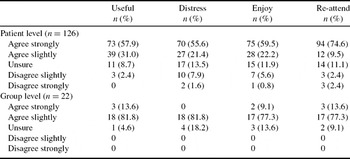
Participants rated the group along the four feedback dimensions. All four mean scores were in the slightly-to-strongly agree range: “I have found the group useful” (M = 4.4, SD = .75); “I have learned something in the group that I can use to reduce my distress” (M = 4.2, SD = 1.1); “I have enjoyed attending the group” (M = 4.3, SD = .04); “I would come to the group again” (M = 4.5, SD = .95). Participant feedback proportions are presented in Table 1. It can be seen that three-quarters or more of the patients agreed with the four feedback dimensions. At a group level of analysis it can be seen that over three-quarters of the groups (at least 17/22) had a mean group session score that agreed with all four of the feedback dimensions.
Patient feedback dimension scores: numbers and proportions of individual patients, and groups scores, at different feedback levels (n = 126 across 22 Groups; 74/200 (37%) missing data

Discussion
The present pilot study sought to test if a format involving a sole-standalone G-CBT session for HAPIs, which permitted patients to choose their own therapeutic targets, would be feasible, acceptable and effective. One hundred and thirty-seven patients attended a total of 291 times across 31 groups, and 22 groups across 200 patients were targeted for feedback.
Running the group was certainly feasible, as evidenced by the large number of patients who attended across the 31 groups. Patients were able to agree on one (or occasionally two) topics to address each session. Based on the breadth of topics patients chose and the range of patient diagnoses included, this format for G-CBT might be used by a therapist with a broad CBT experience and perhaps at least 2 years post-qualification experience. Patients’ chosen topics (e.g. improving sleep, reducing procrastination, managing ward stressors, dealing with stigma, overcoming child abuse) did not completely overlap with those chosen for them by therapists in the previous standalone studies of HAPIs (Tickle et al., Reference Tickle, Regan and Moss-Morris2009; Durrant et al., Reference Durrant, Clarke, Tolland and Wilson2007; Veltro et al., Reference Veltro, Falloon, Vendetelli, Oricchio, Scinto, Gigantesco and Morosini2006; Fell and Sams, 2004), suggesting that the therapeutic targets were more clinically tailored in the current study format. One limitation of the present study is that we can not relate feedback to demographic or diagnostic characteristics. However, almost three-quarters of patients indicated that they strongly wished to re-attend and nearly half actually did re-attend; patients with a diagnosis of bipolar disorder and females were particularly likely to re-attend. Ethnic group made no difference to re-attendance, suggesting broad cultural acceptability. Eighty percent of patients indicated that they enjoyed the group. Despite the sole standalone session format, the group appeared to be effective as almost 90% of patients indicated that they found the group useful, and over three-quarters indicated that they had learned something they could use to reduce their distress. Patient-rated effectiveness results from this pilot study, which involved patients’ therapeutic target choices, are therefore comparable to formats involving therapists’ pre-prepared therapeutic target syllabuses (Veltro et al., Reference Veltro, Falloon, Vendetelli, Oricchio, Scinto, Gigantesco and Morosini2006; Fell and Sams, 2004) and might produce better outcomes, as the study by Tickle et al. (Reference Tickle, Regan and Moss-Morris2009) found more mixed patient satisfaction results than the present study. Given that patient satisfaction measures do not in themselves prove that the patients actually go on to successfully use the CBT skills, future research testing the effectiveness of the G-CBT format as used in the present study might now use more standardized measures, with clinical outcomes such as symptoms or distress, and objective clinical outcomes such as number of days before any next re-admission. Another improvement to the present study and other previous ones (e.g. Fell and Sams, 2004; Tickle et al., Reference Tickle, Regan and Moss-Morris2009) would be to have someone other than the group therapist collect patient outcomes, as this could influence patient satisfaction scores (as discussed by Fell and Sams, 2004, pp. 6–7). There are no randomized controlled/comparison trials of stand-alone G-CBT for HAPIs, for example comparing G-CBT to a support group, which would be a more stringent test of efficacy and would help to ascertain whether the CBT had an effect beyond non-specific therapeutic factors. In conclusion, the results from the present large sample pilot study support the feasibility and acceptability of wider deployment of G-CBT for HAPIs using the format of a sole-standalone session in which patients choose the group therapeutic target.
Acknowledgements
Thanks are due to the patients, clinical staff and management staff of Eastlake and Fernley wards at Northwick Park Hospital, Harrow.




Comments
No Comments have been published for this article.