Introduction
Consumers are becoming increasingly interested in the methods involved in food production, as evidenced by the exponential growth of eco-labels such as organic, fair trade and non-genetically modified organism (GMO) verified in recent decadesReference Howard and Allen 1 , Reference Oberholtzer, Dimitri and Jaenicke 2 . The market for ‘natural’ foods is even larger than organic, with US$37 billion in sales in 2011 3 . Although definitions of natural are relatively vague, they tend to focus on processing inputs rather than agricultural practices. The natural supermarket chain Whole Foods, for example, has an influential list of substances that are prohibited for products they carry, but it contains only one that refers to the agricultural stage of production (foie gras), with most of the 77 others detailing synthetic processing aids 4 . The US Food and Drug Administration, furthermore has no definition of ‘natural,’ but ‘has not objected to the use of the term if the food does not contain added color, artificial flavors, or synthetic substances’ 5 .
Little is known, however, about the agricultural/farming practices consumers may consider natural, other than those already embodied in organic or non-GMO certifications. Bridging this information gap is quite important, because if consumers demonstrate a willingness to support such practices—such as by paying price premiums for the resulting products—it could help improve the economic viability of farm operations. Organic labels on fresh produce, for example, garner retail price premiums of approximately 15–60% when compared with otherwise similar itemsReference Lin, Smith and Huang 6 . In addition, consumer support for other agricultural practices viewed as natural could encourage more farmers to adopt them, which would in turn have the potential to increase the sustainability of food systems.
The techniques used by fruit producers to mitigate bird damage to fruit crops—such as tree fruits and berries—are prime examples of agricultural methods that have the potential to influence the sales (positively or negatively) of food crops, but consumer perceptions of these methods have not been investigatedReference Lindell, Schwiff and Howard 7 . Fruit-eating birds cause significant damage to a variety of fruits, and substantial monetary impactsReference Curtis, Merwin, Pritts and Peterson 8 – Reference Tracey and Saunders 10 . Anderson et al.Reference Anderson, Lindell, Moxcey, Siemer, Linz, Curtis, Carroll, Burrows, Boulanger, Steensma and Shwiff 11 estimated that the Michigan blueberry industry suffers US$14 million in annual losses, and the Washington state sweet cherry industry US$32 million in annual losses, due to bird damage. Although some species causing fruit damage are invasive species, such as the European starling (Sturnus vulgaris), many others are native birds, such as American robins (Turdus migratorius) and cedar waxwings (Bombycilla cedrorum)Reference Lindell, Eaton, Lizotte and Rothwell 12 .
Few management techniques consistently deter pest birds from fruit. Acoustic scare devices such as cannons and wailers vary in effectivenessReference Cook, Rushton, Allan and Baxter 13 , Reference Summers 14 and cannon noise is often annoying to neighbors. One previously available chemical repellent (Mesurol®) is no longer allowed on fruit crops. Visual deterrents such as reflecting ribbons are not consistently effectiveReference Belant and Ickes 15 . Netting can protect grapes from birds but is perceived as too costly by many producers and is impractical for tree fruits such as cherries. A theme that emerges from the literature is the lack of consistency in results; various techniques sometimes work in some situationsReference Lindell, Schwiff and Howard 7 , but birds habituate to deterrent devices quickly and are highly mobile, making the development of successful management strategies challengingReference Bomford and O'Brien 16 .
Consumers are likely to be interested in some aspects of bird management, as birds are more popular with nature enthusiasts than other crop pests, such as insectsReference Sergio, Newton, Marchesi and Pedrini 17 , and 21% of the US population reports participating in bird watching activitiesReference Carver 18 . Two bird management strategies currently in use and under study, falconry and installation of nest boxes to lure predators of pest birds to fruit crops, are potentially attractive to consumers because they employ natural predators of birds. Previous work indicates that attracting insect-eating and predatory bird species may enhance pest management in fruit cropsReference Jedlicka, Greenberg and Letourneau 19 , Reference Kross, Tylianakis and Nelson 20 , so there is precedence for this idea. Many birds of prey are territorial and some, such as American kestrels (Falco spaverius), require cavities in old or dead trees for nestingReference Smallwood and Collopy 21 , which have become less common with greater human management of wooded areas. Thus, predatory bird numbers are unlikely to reach levels necessary for pest bird reduction without human manipulations such as increasing cavity abundance (installing nest boxes) or introducing predatory birds (falconry).
Identifying which bird management methods are favored by consumers may encourage growers to adopt those methodsReference Lindell, Schwiff and Howard 7 . This adoption could lead to the further development of niche markets, with the possibility of price premiums for crops grown utilizing consumer-preferred bird management methods. Such outcomes could help to reverse declining populations of beneficial predators, such as American kestrelsReference Paz, Jareno, Arroyo, Vinuela, Arroyo, Mougeot, Lugue-Larena and Fargallo 22 , in addition to providing economic benefits for growers.
Methods
Focus groups
To better understand consumer perceptions of eight bird management methods most commonly employed by fruit growers, and to help us design a national survey of fruit consumers, we conducted a series of focus groups during October and November of 2012 in the Lansing, Michigan metropolitan area. Focus groups offer a number of advantages over other qualitative methods: (1) they can be a useful technique to help researchers gather a large amount of information about a variety of topics in a relatively short timeReference Morgan and Krueger 23 , Reference Patton 24 , (2) they allow individuals to express and explain their subjective experiences and (3) they provide a forum for participants to interact and respond to the statements and opinions of other participants. A disadvantage of focus groups is that because they take place in a group setting, they risk being dominated by more outspoken and opinionated participants, unless conducted by a skilled facilitator. Because focus groups are qualitative they tend to provide greater insight into issues, therefore quantitative methods may be needed to complement them for generalizabilityReference Morgan 25 .
Much of the literature indicates that conducting three to five focus groups will lead to a point of saturation with regard to new information, and is therefore an appropriate number for rigorous qualitative studiesReference Morgan and Krueger 23 , Reference Guest, Bunce and Johnson 26 . Following this guideline, we conducted four focus groups, with a total of 33 participants. Because little new information was provided during the fourth focus group, additional focus groups were deemed unnecessary. In order to ensure diverse representation, we recruited fruit consumers in person from a natural foods co-op, an independent grocery store, a farmers’ market, and a local university campus, with each focus group consisting of participants from one location. Passers-by were asked if they were interested in sharing their opinion at a later date, for which they would receive US$40 as an incentive. We collected contact information in order to send a reminder, and signed up slightly more participants than desired in anticipation of some no-shows. A homogenous sampling technique such as this often leads to focus groups that consist of participants possessing similar backgrounds. This can promote richer and more dynamic interactions between participants, which can lead to higher quality dataReference Morgan and Krueger 23 , Reference Patton 24 . If groups are too diverse in terms of status, power or other characteristics, for example, participants will tend to censor their ideas.
At the beginning of each focus group, participants were asked to fill out a brief written survey in order to obtain basic demographic information. Since focus group research is intended to gather qualitative data that would be difficult to obtain through a survey format, a fully representative population was neither expected nor achieved. Approximately 58% of participants were female. This imbalance was anticipated due to the fact that women make approximately two-thirds of grocery purchases in the USA 27 . A majority of participants self-identified as non-Hispanic white (76%) and possessed at least an undergraduate degree (67%). Although the focus groups were a non-random sample, the ethnicities of participants did not differ substantially from national averages reported in the US Census. A higher percentage of participants possessed graduate degrees (36%) than the national average (10.6%), however.
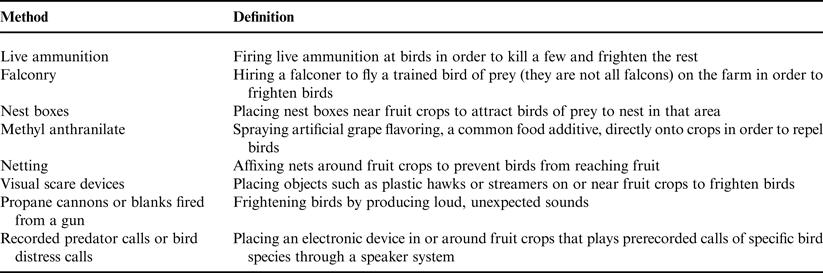
Each focus group interview took 1.5–2 h. We first informed participants that there were no right or wrong answers and we just wanted to know what they think. We then provided participants with a brief explanation of the eight management methods, described as neutrally as possible, and based on conversations with experts in the field. These descriptions were presented to the participants (see Table 1) in a different, randomized order for each group. Nearly all focus group participants indicated little awareness of the issue of bird damage to fruit crops, or potential methods for controlling this damage. We asked participants to discuss their thoughts regarding each method, with follow-up questions to probe why they liked or disliked a method—these probes did not place an emphasis on any specific management practice, nor did we ask about the level of ‘naturalness.’ Audio recordings were then transcribed and analyzed with NVivo software version 10 (QSR International, Doncaster, Australia). The coding identified positive and negative emotions expressed for each technique, as well as reoccurring themes, ideas, words and unanticipated outcomes. The first two authors independently coded the transcripts and then resolved any differences.
Definitions of bird management methods.

National survey
In order to further understand consumer preferences for fruits produced with various bird management methods, we designed a national, web-based survey, using Qualtrics (Provo, UT), an online survey-building tool. The survey was administered from May 15–17 2013 to a panel of US consumers that had previously opted-in to take surveys conducted by Qualtrics, and consisted of two sections. The first section utilized a choice modeling format to estimate willingness to pay for selected bird management methods, and is described in more detail in a previous publicationReference Oh, Herrnstadt and Howard 28 . The second section included demographic questions, as well as additional questions designed to aid in our understanding of consumer perceptions of various bird management methods. The survey questions were pretested with 25 people (primarily graduate students) in order to increase validity, reliability and question clarityReference Dillman, Smyth and Christian 29 . Following pretests, 1000 consumers, a sample size that is typically sufficient to achieve a margin of error of 3%, were selected by Qualtrics and completed the entire survey (i.e., there were no questions with missing data). Because this survey made use of an opt-in panel, rather than a probability sample, determining a traditional measure of nonresponse bias (e.g., response rate) was not possibleReference Schoenherr, Ellram and Tate 30 . Although online surveys are biased toward those with better access to technologyReference Dillman, Smyth and Christian 29 , quotas were used to ensure that the demographics of gender, ethnicity and income closely matched national averages. In addition, IP addresses of respondents were recorded to ensure that they did not complete the survey more than once. We analyzed the data using SPSS version 22 (SPSS, Inc., Chicago, IL).
Results and Discussion
Focus groups
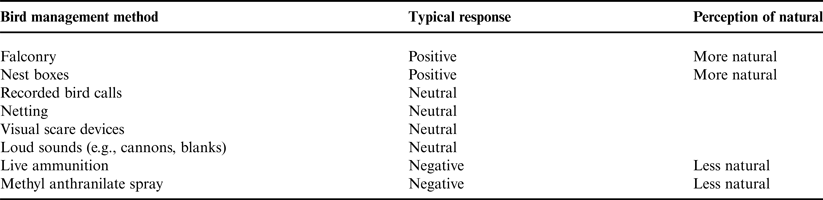
Responses of focus group participants to the eight bird management practices were categorized as shown in Table 2. Falconry and nest boxes were typically viewed very positively, while live ammunition and methyl anthranilate spray were typically viewed negatively. Four other bird management methods were viewed neither positively nor negatively, and did not generate much discussion among focus group participants. Analysis of the transcripts suggested an underlying theme of perceived naturalness, as falconry and nest boxes were viewed as more natural, and live ammunition and methyl anthranilate spray were viewed as less natural. Netting and visual or auditory scare devices, on the other hand, were not typically described as more or less natural. Naturalness was not the only explanation for these responses to bird management methods however, as potential health impacts were also noted frequently for the two that were viewed negatively.
Responses of focus group participants.

Attracting birds of prey through the placement of nest boxes near fruit crops was one of the most well received bird management methods. Focus group participants appreciated the fact that nest boxes invite interaction between predator and prey while promoting a ‘balanced’ and ‘natural’ approach to managing unwanted birds. One participant, for example, stated:
This is taking advantage of the natural system of predators and prey, and I think it's a good thing.
It's more natural. It's letting nature do what it's supposed to do—the birds preying on the birds that are eating the fruit. Like she said, it balances it out. It's more natural—not forced.
The welfare of the birds being deterred was a concern raised by respondents. However, most of their explanations focused on the possibility that endangered species straying into the area could be harmed by the birds of prey.
Similar concerns were raised for falconry, but this bird management method was also viewed very positively by most participants. Another parallel was that many participants explained their preference for falconry as directly related to their perception that it is more natural than other bird management methods:
Seems like a sensible option because it ties into what naturally occurs.
I think [falconry] is the best one, because this is a natural ecosystem right here.
Negative views toward some bird management practices were associated with perceptions of being less natural. While discussing the use of methyl anthranilate to keep birds away from fruit crops, one participant asked if the chemical was naturally found in grapes, or if it was an artificial flavoring agent. After being told that it was the latter, the participant expressed a decidedly negative opinion towards its use, as well as the use of any artificially occurring chemicals in food:
I think that chemicals in food—their days are numbered, and it's not a good alternative.
One participant remarked that using methyl anthranilate on fruit crops ‘seems weird’ while others displayed stronger negative reactions, such as the individual who stated:
I'm not in favor of more food additives in any area. I wouldn't do it. If I knew they used it, I wouldn't buy the fruit.
In two of the four focus groups, participants recalled scientific findings connecting negative health effects with food additives once deemed to be safe by the mainstream scientific community. When the moderator raised the possibility that fruit treated with methyl anthranilate might wash off prior to being sold, participants remained wary, and questioned whether rinsing would actually make a difference.
Focus group participants also reacted negatively when asked for their opinions regarding the use of live ammunition as a bird management method. Interestingly, participants described the impacts of live ammunition with very similar terms when compared with the much more positively received methods of nest boxes and falconry (i.e., the deaths of a few birds and scaring the rest). The higher degree of human involvement with live ammunition may have contributed to this difference. A number of participants mentioned that a farmer using firearms would increase the risk of the accidental shooting of humans, or result in inhumane deaths of the birds. Some also expressed concern that farmers may be using lead shot, which could end up in the soil near the fruit crops, thus affecting the environment and causing human health issues.
Though a majority of commenters exhibited negative reactions towards the use of live ammunition, some expressed ambivalence towards the technique. Several individuals recognized the issues of safety and animal welfare discussed above, but also spoke of empathy towards the farmer, suggesting that it could be one of the more inexpensive options discussed. Others said that, although the use of live ammunition might deter them slightly, overall quality and price would figure more heavily into their fruit purchasing decisions.
Half of the bird management methods elicited predominantly neutral reactions from focus group members. For the most part, participants did not focus heavily on the naturalness of these methods, choosing instead to discuss issues such as cost and feasibility. Individuals demonstrated far less strength of emotion (positive or negative) in their reactions towards these bird management methods. Discussions also tended to be shorter and less specific, even though the same number of probes (e.g., ‘why?’ or ‘tell me more about that’) were used to try to elicit more detail. For example, while discussing the use of recorded predator calls and bird distress calls, one participant simply stated ‘Yeah, I'm ok with it,’ and another, ‘It seems alright.’ Participants voiced similarly neutral reactions such as ‘Generally, I think it's fine’ when asked their opinions about netting. For loud sounds, most participants stated that the amount of noise produced by cannons and shotguns would be appropriate in rural areas, but less acceptable in more highly populated areas where neighbors could be disturbed.
The focus group results helped inform the survey design in several ways. Analysis of transcripts suggested a number of issues related to managing fruit-eating birds that were potentially important to consumers, which were quantified in a national sample. Due to space limitations, the willingness to pay questions focused on the subset of bird management practices that were viewed most positively and negatively in the focus groups, and we hypothesized that consumers would be willing to pay small price premiums for falconry and nest boxes. In addition, we designed the national survey questions using words that were common among focus group participants to help make it more understandable.
National survey
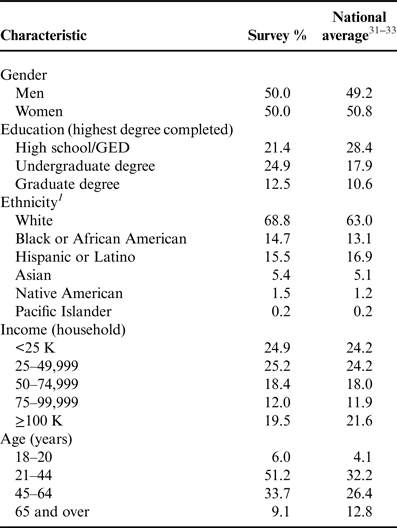
The demographics of the survey respondents are presented in Table 3. Compared with national averages, respondents were very similar for the variables of gender and household income. They were, however, slightly younger, had higher educational attainment, and were more likely to report ‘white’ as their primary ethnicity.
Survey respondents' demographics (n = 1000) compared with US national averages.

1 Respondents could select Hispanic or Latino, and up to one additional category.
Analysis of the survey data provided information of potential use to growers, extension educators and others with interests in improving fruit production. We asked respondents about their level of agreement with five attributes of practices to control bird damage that were frequently discussed in the focus groups. These were measured on a five point Likert scale, to quantify their level of importance (see Table 4). The statement ‘Does not harm my health’ received the highest level of agreement, with 77% of respondents selecting ‘extremely important' and 11.1% selecting ‘somewhat important.’ This was not surprising, as a number of studies have reported human health to be of greater importance than treatment of animals or environmental issues when making food choicesReference Harper and Makatouni 34 – Reference Fox and Ward 36 .
Percentage of survey respondents’ agreement with ‘When considering practices used to control bird damage, how important are the following?’.

Four other statements—‘Is effective for the farmer,’ ‘Uses natural (non-human) processes,’ ‘Does not harm birds,’ and ‘Does not increase the price of fruit’—were all selected as ‘extremely important’ by approximately 40% of respondents. The use of natural processes was therefore of less importance than personal health impacts for many survey respondents. It was comparable with the other attributes, however, including the price of fruit, which suggests some segments of fruit buyers would be interested in more information about this aspect of production. Demographic variables were tested in logistic regression models for the odds of selecting ‘extremely important’ for each of these questions, but each of the models explained less than 5% of the variance, and are therefore not presented here.
The survey also allowed us to estimate consumers’ willingness to pay for apples and grapes grown using certain bird management methods. In confirmation of our hypotheses, respondents indicated they would be willing to pay an average of 22–32% more for fruit grown using falconry and nest boxes, respectively, as bird management methods when compared with fruit grown using live ammunitionReference Oh, Herrnstadt and Howard 28 . One weakness of the survey was that it involved hypothetical choices, which did not require respondents to spend their own money. A number of studies have found that price estimates may be inflated in such conditionsReference Bishop and Heberlein 37 – Reference Vermeir and Verbeke 39 . The willingness to pay estimates should therefore be interpreted with caution, as it is very likely that these amounts would be lower in actual market situations. Strengths of the survey included respondent demographics that closely matched national averages for gender, income and ethnicity, as well as a relatively large sample to help reduce the margin of error. In addition, this is among the first studies to explore interest in falconry and nest boxes from the perspective of potential fruit buyers.
Conclusion
Consumers are playing an increasing role in shaping upstream segments of the food system, including the adoption of practices to manage agricultural pests. Not every agricultural practice is likely to be of interest to consumers, however. Four of the eight bird management methods discussed in focus groups evoked little concern. Methods viewed as having higher or lower degrees of naturalness, in contrast, were of greater interest, with the majority of participants expressing a desire to support or avoid them, respectively. Although communicating the use of less natural or neutral agricultural practices would be expected to provide little benefit for growers, adopting more natural practices and highlighting their use to the public could potentially improve farm economic viability. This is particularly true for practices that are effective in achieving production goals, relative to the financial and labor costs incurred. Although researchers are just beginning to calculate this information, nest boxes show promise because they are relatively inexpensive (approximately US$20 per box in materials, or US$60 for a manufactured box) and easy to maintain. Falconry, however, can cost approximately US$700 a dayReference Pierson 40 in the weeks before harvest: it may be best suited for larger operations with very high value crops (blueberries, sweet cherries and wine grapes).
Growers adopting falconry or nest boxes might benefit from making first-party claims to communicate this information to the public. The majority of consumers we surveyed expressed a willingness to pay more for fruits that embodied these methods. Even if this interest fails to translate into significant price premiums in actual market situations, the high level of interest suggests that it could lead to market niches, and sales advantages versus fruits that do not embody these methods. Other agricultural practices that could potentially be viewed as natural, such as establishing wildlife buffers, might also attract interest from consumers, and merit further research.
Personal health concerns evoked the most positive and negative emotions in the focus groups and were most likely to be rated as extremely important by survey respondents. Our research suggests that agricultural practices considered more natural by large segments of consumers may not have the same market potential as more established ecolabels, such as organic and non-GMO. Although organic standards were established by idealistic growers concerned about the health of the soil, for example, their perceived positive human health impacts played a greater role in rapidly increasing their availability and salesReference Szasz 41 , Reference Obach 42 . Nevertheless, a better understanding of consumer interests in aspects of food production that relate to their ethical concerns—irrespective of health outcomes—has the potential to improve economic outcomes for growers. Those who are willing to adopt practices perceived as more natural and communicate their use to the public could also help move the food system in a more transparent and potentially more sustainable direction.
Acknowledgements
Funding was provided by the Specialty Crop Research Initiative of the National Institute of Food and Agriculture. We thank the focus group participants and survey respondents for contributing to this research.