I. INTRODUCTION
Organic chemical reactions often use sulfuric acid or p-toluenesulfonic acid as homogeneous acid catalysts on industrial scale. These catalysts are inexpensive and active but highly corrosive, energy-consuming, less recyclable, and environmentally pollutive. The development of heterogeneous catalysts for a variety of applications in hydrolysis of crystalline cellulose,Reference Wu, Fu, Yin, Xu, Liu, Lu and Mao1, Reference Jiang, Li, Cao and Mu2 biodiesel synthesis,Reference Wilson and Lee3–Reference Fang, Zhang, Li, Wu and Wu5 and acid-catalyzed reactionsReference Liu, Li, Zhang, Hua, Yang, Hu, Yue and Gao6–Reference Hara9 is receiving significant attention, for they are emerging as substitutes for liquid acids from green chemistry point of view. In comparison with liquid acids, heterogeneous catalysts as solid acids are favored in terms of easy separation, purification, recyclability, and reusability. Indeed, many researches have been devoted to investigate environmentally benign and recyclable solid acid catalysts for organic reactions. Sulfonated (SO3H-bearing) carbon materials, whose composition consists of porous carbon and sulfonic acid group, have been reported as a type of carbon-based strong solid acid catalysts. Two factors that would affect the reaction rate are specific surface area, which supplies a field for the reaction, and density of acid site, which acts as the effective component. These sulfonated (SO3H-bearing) carbon catalysts exhibit high specific surface area, controllable pores,Reference Hou, Zhang, Gu, Liu and Guo10, Reference Peng, Philippaerts, Ke, Van Noyen, De Clippel, Van Tendeloo, Jacobs and Sels11 excellent adsorption capabilityReference Sharifi, Wark, Freude and Haase12–Reference Liu, Sun, Zhu, Meng, Qi and Xiao14 compared with conventional protonated Nafion and Amberlyst,Reference Nakajima, Tomita, Hara, Hayashi, Domen and Kondo15–Reference Okuhara17 and they also show higher densities of effective acid sites compared with inorganic oxide solid acids.Reference Harmer, Farneth and Sun18
However, in typical sulfonation with sulfuric acid, which is the commonly used sulfonation agent, the porous structures of carbon materials are destroyed by the harsh sulfonation conditions, where high sulfuric acid concentration, long sulfonation time, and high temperature are required.Reference Kitano, Arai, Kodama, Kousaka, Nakajima, Hayashi and Hara19, Reference Yu, Jin, Li, Peng and Wang20 To overcome these limitations, Feng et al.Reference Wang, Liu, Waje, Chen, Yan, Bozhilov and Feng21 functionalized porous carbon by covalent attachment of sulfonic acid-containing aryl radicals, which was produced through homogeneous reduction of diazonium salt by hypophosphorous acid. This method is far from practical for diazonium salt, which is explosive at high temperature, and must be prepared below the temperature of 5 °C. However, it indicates that the reaction condition can be mild and will introduce little change to the surface structure of porous carbon material.
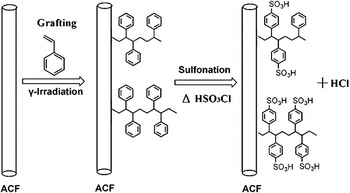
In this study, the inert activated carbon fiber (ACF) was first activated by introducing styrene (St) onto its surface by grafting copolymerization. Subsequently, the modified ACF was then sulfonated with chlorosulfonic acid, which displayed higher reactivity over conventional sulfuric acid, enabling the sulfonation being achieved at a lower temperature for a shorter time. Therefore, the intrinsic porous structure of ACF would be well preserved during the mild sulfonation reaction. The benzene ring supplied by the polystyrene on the surface of ACF would act as an active site for –SO3H anchoring. The chlorosulfonic acid reacted with the benzene ring to introduce a –SO3H onto ACF. Factors that affect the acid density of sulfonated activated carbon fiber (SACF) were further studied. The performance of catalyst was evaluated by comparison with other typical solid acid catalysts.
II. EXPERIMENTAL
A. Materials and reagents
ACF was obtained by carbonization and activation of viscose fiber. Styrene, chlorosulfonic acid, dichloromethane, 1,2-dichloroethane, NaHCO3, HCl, ethanol, and acetic acid were purchased from Guangzhou Reagent Company, Guangzhou, China.
B. Catalyst preparation
ACF cleaned with acetone was sealed in a conical flask with mixed solution of dichloromethane and styrene. Then, the conical flask was exposed in γ-rays from a 60Co source with an irradiation dose of 0.837 kGy/h for 48 h to graft St onto ACF.Reference Ma, Yang, Chen and Zhang22 The grafting copolymer product (ACF-St) was then extracted with toluene for 24 h to remove residual styrene monomers and polystyrene homopolymers.
One gram of ACF-St was immersed in 50 mL mixed solution of chlorosulfonic acid and 1,2-dichloroethane with different concentrations of chlorosulfonic acid (wt%) (from 2% to 100%) in a flask, then heated at a preset temperature (from 50 to 90 °C) for different time (from 30 to 120 min). The treated fibers were then washed with deionized water to remove excess acid till the effluent water was neutral and dried at 100 °C in vacuum. The obtained product was labeled as SACF.
Figure 1 shows the preparation procedure of the radiation grafting of St onto ACF and the introduction of the –SO3H groups. After styrene monomer reacted with the free radical one by one, and a branched chain of polystyrene was grafted onto the surface of ACF, the ACF-St was functionalized with –SO3H group.Reference Zhang, Zhu, Wang, Meng and Liu23, Reference Zhao and Huang24
Preparation Scheme of SACF.

C. Characterization
The thermogravimetric (TG) behavior of fibers was analyzed using a Netzsch TG-209 analyzer (NETZSCH-Gerätebau GmbH, Selb, Germany). The samples were heated from room temperature to 600 °C at a rate of 20 °C/min in a nitrogen flow.
Pore structure parameters of ACFs, including Brauner–Emmett–Teller (BET) specific surface area and Barrett–Joyner–Halenda pore size distribution, were determined according to the nitrogen adsorption–desorption isotherms measured at 77 K at the range of relative pressure from 10−6to 1 using an automatic gas adsorption instrument (ASAP2010; Micromeritics Corp., Norcross, GA). All samples were outgassed at 100 °C for 8 h before the measurement.
Surface morphology of fibers was obtained with thermal field emission environmental scanning electron microscopy (SEM; Quanta 400F; FEI, Eindhoven, Netherlands). All samples were sputter-coated with Au.
Infrared spectra were obtained with a Fourier transfer infrared spectroscopy (FTIR) analyzer (Nicolet/Nexus 670, Madison, WI) equipped with a continuum microscope and attenuated total reflection (ATR) objective. FTIR-ATR measurements were carried out at a range of 4000–700 cm−1.
D. Catalytic performances
The acid-catalyzed esterification of acetic acid and ethanol was used to evaluate the catalytic activity of the catalysts. In brief, the reaction was carried out in a mixture of ethanol (1.0 mol) and acetic acid (0.1 mol) at 70 °C. The same amount of protonated Nafion (0.2 g) was used as reference to compare the catalytic efficiency of the esterification. During the reactions, the liquid phase was monitored by gas chromatography (Agilent 6820, Palo Alto, CA) using a DB-WAX capillary column and a thermal conductivity detector (TCD).
III. RESULT AND DISCUSSION
A. Morphology of SACF
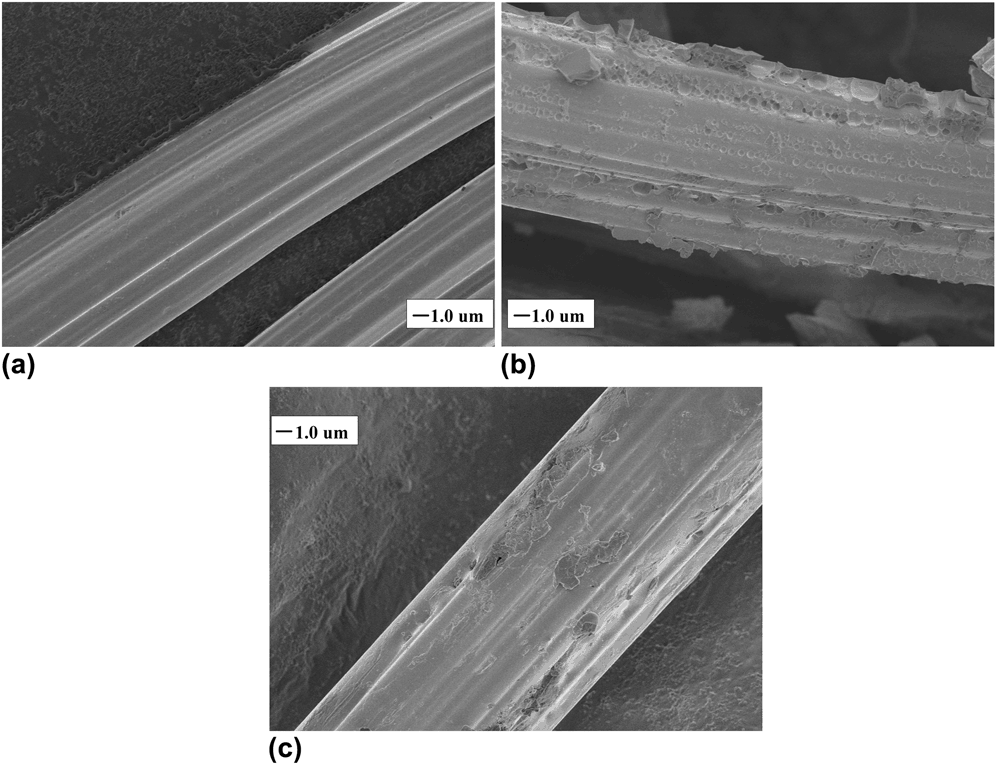
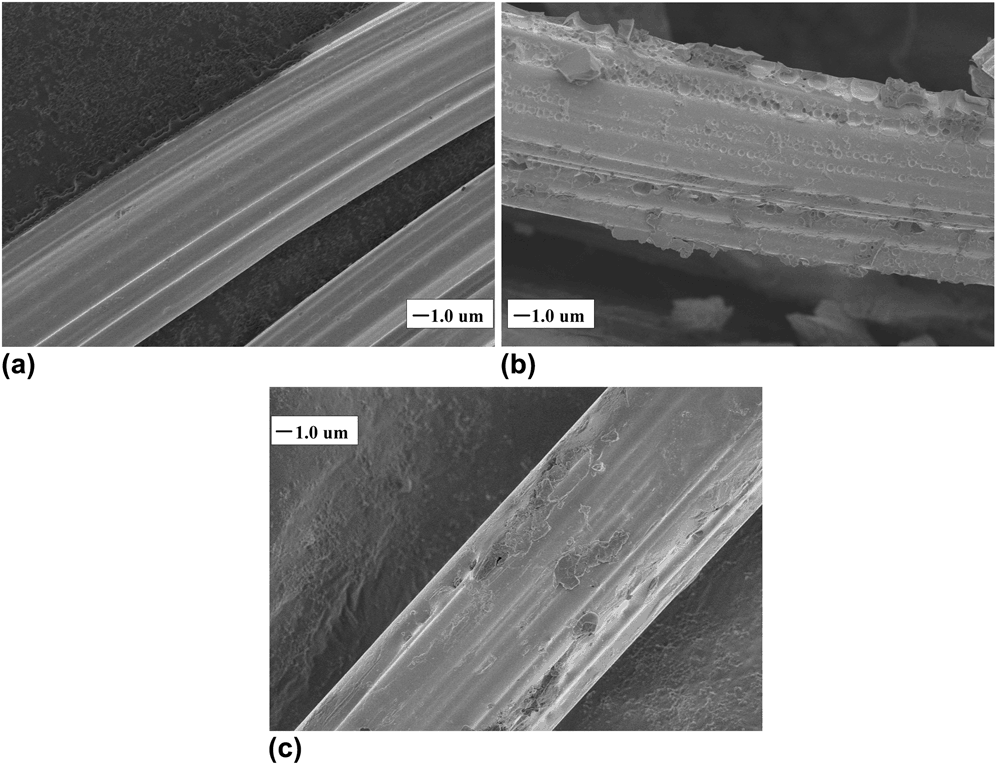
The SEM morphology of fibers with magnification of 3000x was shown in Fig. 2. Comparison between Figs. 2(a) and 2(b) indicates that surface of ACF after grafting St had changed significantly from smooth to coarse. It could be seen that the surface of ACF-St was covered by a thin layer of polystyrene homopolymers, indicating the successful modification of ACF. The diameter of the ACF measured from the SEM was about 7.5 μm, while that of the ACF-St was nearly 10 μm, which showed that a layer of copolymer was wrapping on the surface of the ACF. The diameter of the SACF was 9.5 μm [Fig. 2(c)]; some stacks of copolymer might shed from the surface. However, little obvious change of morphology and diameter of SACF after sulfonation was observed, which should be attributed to the mild reaction conditions of sulfonation.
SEM images of (a) ACF, (b) ACF-St, and (c) SACF.
B. Chemical structure of SACF
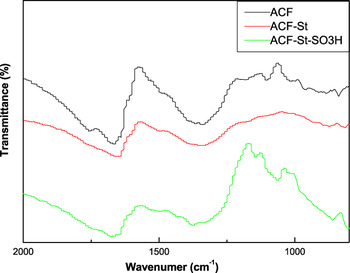
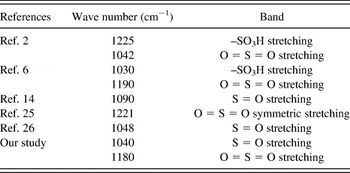
FTIR spectra were used to evaluate the chemical structure of the fibers (Fig. 3). During the process of γ-irradiation-induced grafting, the characteristic of adsorption peak would be the benzene ring used from styrene. However, the original ACF also contained a large number of benzene ring, so that C = C stretching vibrations at 1500 to 1600 cm−1 in benzene ring could be detected for both ACF and ACF-St.Reference Liu, Li, Zhang, Hua, Yang, Hu, Yue and Gao6, Reference Peng, Philippaerts, Ke, Van Noyen, De Clippel, Van Tendeloo, Jacobs and Sels11 Even some functional group for the ACF attributed by the peak at wave number of about 1200 cm−1 (possibly C–O group) disappeared during the γ-irradiation. For the sulfonation modification process, –SO3H group was imported in the catalyst. For the –SO3H groups, most studies considered the vibration bands at about 1100 and 1300 cm−1 as its characteristic band (Table I). The vibration bands at 1040 and 1180 cm−1 corresponded to S = O stretching and O = S = O stretching indicate the presence of SO3H groups.
FTIR spectra of ACF, ACF-St, and SACF.

Characteristic bands of –SO3H groups in FTIR in different references.

C. Thermal stability
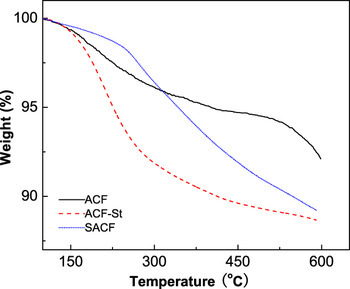
The thermal stabilities of the fibers were investigated by thermogravimetric analysis (TGA) (Fig. 4). Original ACF showed excellent thermal stability as it only lost its weight of 6% at 600 °C. The TG curves showed that both ACF-St and SACF were subjected to higher weight loss compared with original ACF. As ACF was thermally stable at high temperature, weight loss of modified ACF at high temperature could be explained as the degradation of branched polymers grafted on ACF.Reference Zhang, Zhang, Chen, Yuan and Li27–Reference Jung, Kim and Choi29 In the light of this statement, the styrene grafting degree of ACF-St was about 12%, calculated from the weight loss curve. According to the styrene grafting degree of ACF-St, the grafting degree of –SO3H group could be calculated based on the hypothesis that each styrene was entirely sulfonated. Therefore, we could get a grafting degree result of 19.4% for SACF, while the grafting degree calculated from TGA was 11%. The difference based on two methods might be due to the decomposition of the grafted styrene during the sulfonation process and incomplete degradation of the grafts. Meanwhile, the main weight loss peak of ACF-St curve emerged at 150–300 °C, while that of SACF curve was at over 300 °C. This phenomenon also proved that the unstable contents were corroded during the sulfonation process, so the SACF was more stable.
TG analysis of ACF, ACF-St, and SACF.

D. Pore structure
The pore parameters were analyzed and listed in Table II. The statistics showed that the grafting styrene affected the specific surface area of ACF, especially the micropores on ACF. The considerable decrease in S micro from ACF to ACF-St was explained as some micropores were blocked by the grafted styrene, while S meso (specific surface area of mesopores) remained the same. Decrease in S BET and V total were both attributed to the blocked micropores as that in S micro. On the other hand, S micro and V micro did not show obvious decrease from ACF-St to SACF, indicating that sulfonation reaction barely affects the micropores. Mesopores were etched in the sulfonation reaction, which led to the decrease of S BET. According to the analysis of pore structure, we could see that the specific surface area of the modified ACF was not observably reduced; its pore structure was inherited during the preparation process.
Pore structure parameters of the three materials.

Catalytic activities of various catalysts for the esterification of acetic acid.

a TOF means turnover frequency.
E. Effect of reaction conditions on the acid density of SACF
Acid density of SACF was evaluated by titration of sulfonic group with NaHCO3via the method of Bohm titration. Effects of sulfonation temperature, reaction time, concentration of chlorosulfonic acid, and styrene monomer on acid density of SACF were investigated.
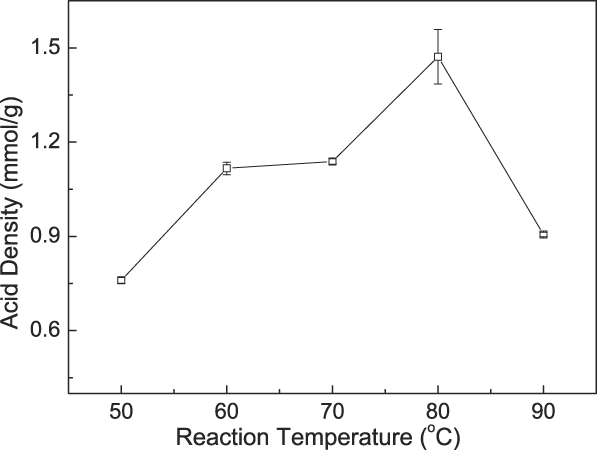
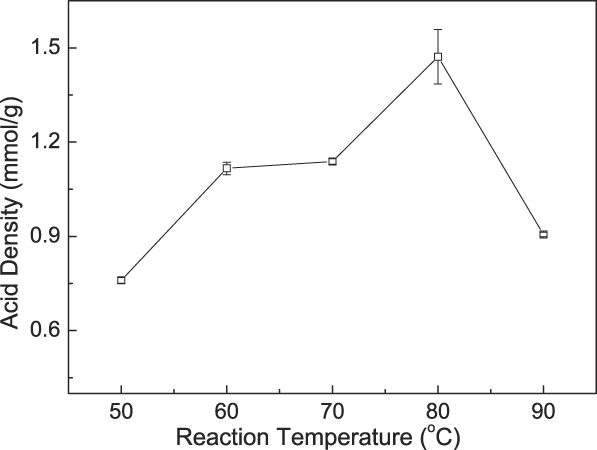
Higher reaction temperature could increase the degree of sulfonation (Fig. 5). As temperature increases, the acid density of SACF increases. Especially, when the reaction temperature is over 60 °C, the acid density will increase significantly; this means that the sulfonation reaction occurs mainly at over 60 °C. However, when the temperature is over 80 °C, the acid density will fall down slightly due to side reaction and degradation of styrene from ACF. Thus, the optimal reaction temperature should be set at around 80 °C.
Effect of reaction temperature on the acid density of SACF (reaction time: 1.5 h; mass percentage of chlorosulfonic acid: 20%; mass percentage of styrene: 10%).
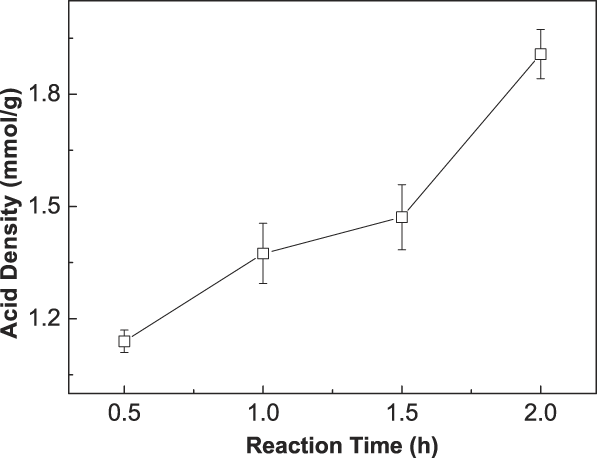
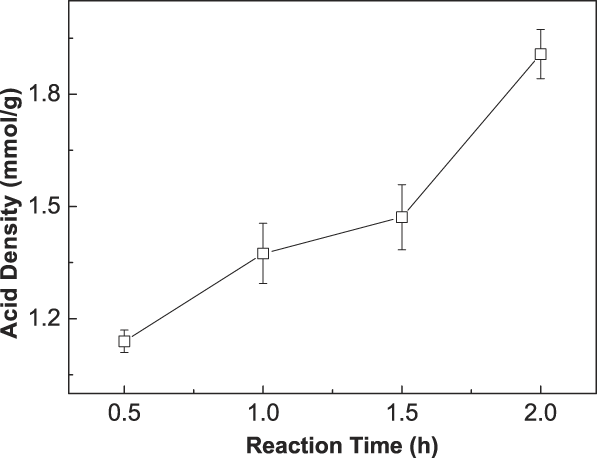
Long reaction time would increase the acid density, but its impact was not as obvious as reaction temperature (Fig. 6). Even the reaction time was as short as 0.5 h, a SACF with acid density of 1.1 mmol/g could be obtained. When the reaction took place for 1.5 h, the acid density reached 1.47 mmol/g, which was close to that in the Ref. Reference Kitano, Arai, Kodama, Kousaka, Nakajima, Hayashi and Hara19. Moreover, it is worth mentioning that 1.5 h for sulfonation reaction is a rather short reaction time compared with that ever published on other references.Reference Kitano, Arai, Kodama, Kousaka, Nakajima, Hayashi and Hara19, Reference Yu, Jin, Li, Peng and Wang20
Effect of reaction time on the acid density of SACF (reaction temperature: 80 °C; mass percentage of chlorosulfonic acid: 20%; mass percentage of styrene: 10%).
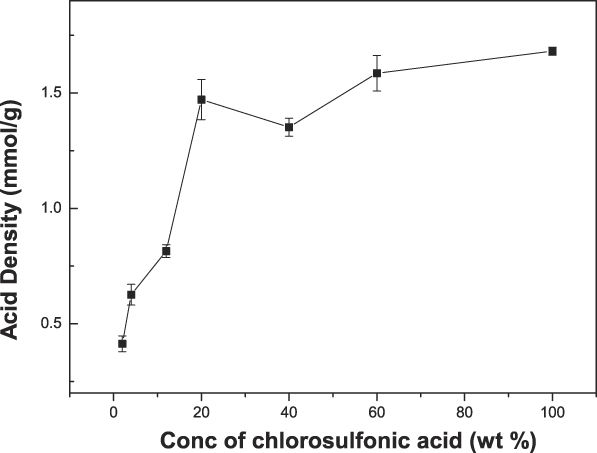
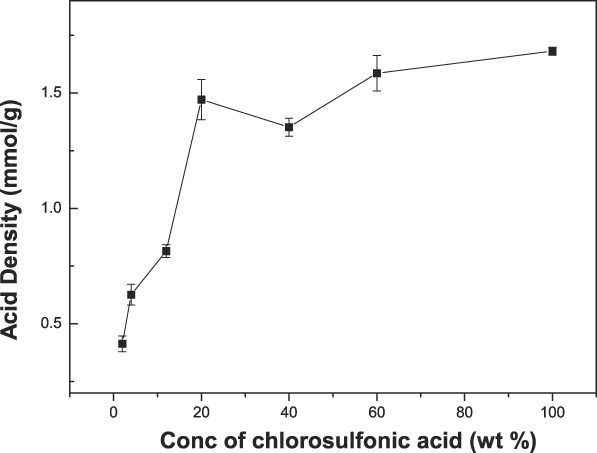
Different concentration of chlorosulfonic acid was studied to find out the proper concentration of chlorosulfonic acid in the preparation of SACF (Fig. 7). Chlorosulfonic acid acted as the sulfonation agent and played an important role on acid density. Acid density increased with concentration of chlorosulfonic acid. At the concentration of 20%, the acid density met its peak and did not rise at higher concentration, which implied that the chlorosulfonic acid was excess at above of 20% concentration.
Effect of chlorosulfonic acid concentration on the acid density of SACF (reaction temperature: 80 °C; reaction time: 1.5 h; mass percentage of styrene: 10%).
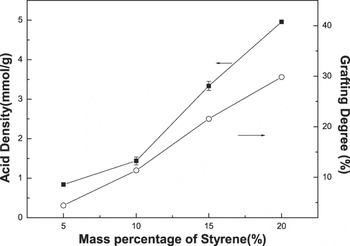
As shown in Fig. 8, when the grafting degree of styrene increased, the acid density also increased. Benzene ring was the dominant reactive sites for the sulfonation functionalization, so it was easy to conclude that the higher the grafting degree was, the greater the acid density would be. But the high grafting degree would decrease the specific surface area of the ACF, thus reducing the catalytic performance. Therefore, both the effects of the acid density and pore structure should be considered to reach a balance during the preparation process.
Effect of mass percentage of styrene on the acid density of SACF (reaction temperature: 80 °C; reaction time: 1.5 h; mass percentage of chlorosulfonic acid: 20%).

Based on the above results, it is concluded that the optimal sulfonation conditions for the preparation of SACF should be at 80 °C for 1.5 h in the 20% mass percentage of chlorosulfonic acid solution using ACF precursor.
F. Catalytic performance
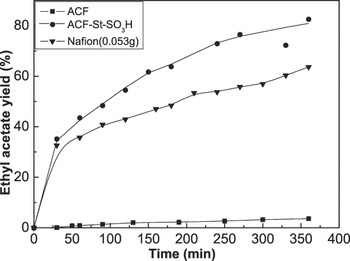
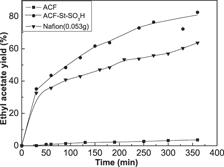
The acid catalytic performance of the SACF was examined with the esterification of acetic acid and ethanol at 343 K. Same amount of protonated Nafion with acid capacity of 5.5 mmol/g was selected for comparison. Figure 9 and Table III show time profiles of acetic acid conversion on the catalysts. It was confirmed that ACF exhibited low catalytic activity as the conversion of acetic acid was only 3.2% after reacting for 6 h in the absence of sulfonic group. SACF required about 300 min to obtain a yield of ethyl acetate over 75%. When the same equivalent H+of protonated Nafion was used as catalyst in the reaction, the ethyl acetate formation rate was much lower under the identical conditions. The hydrophobic property and higher specific surface area of carbon base substrate were believed to contribute to the SACF’s superior performance on catalytic reaction.
Comparison of catalytic activity for different catalysts.

IV. CONCLUSIONS
An ACF-based solid acid catalyst SACF with an acid density of 1.47 mmol/g was prepared by γ-irradiation-induced grafting styrene followed by sulfonation. The SACF showed evident advantages over other typical catalyst in its catalytic activities for the esterification of acetic acid and ethanol. The turnover frequency for ethyl acetate using SACF as catalyst was 0.780 min−1about five times higher than protonated Nafion as catalyst.
ACKNOWLEDGMENTS
The authors gratefully acknowledge the financial support provided by the Guangdong Science and Technology Project (Grant No. 2009A010600003), Specialized Research Fund for the Doctoral Program of Higher Education (Grant No. 200805580007).