



INTRODUCTION
With the current rise in global temperature, numerous studies have focused on greenhouse gas (GHG) emissions (Levy et al. Reference Levy, Mobbs, Jones, Milne, Campbell and Sutton2007; Saggar et al. Reference Saggar, Hedley, Giltrap and Lambie2007; Hernandez-Ramirez et al. Reference Hernandez-Ramirez, Brouder, Smith and Van Scoyoc2009). In addition to carbon dioxide (CO2), methane (CH4) and nitrous oxide (N2O) play important roles in global warming. The global warming potentials (GWP) of CH4 and N2O are 25 and 298 times that of CO2 in a time horizon of 100 years, respectively (Bhatia et al. Reference Bhatia, Pathak, Jain, Singh and Singh2005) and their concentrations in the atmosphere are estimated to be increasing at the rates of 1 and 0·2–0·3% per year (Verge et al. Reference Verge, de Kimpe and Desjardins2007), respectively. In addition to industrial emissions, farmland and agricultural production are major sources of GHG emission (Wassmann et al. Reference Wassmann, Neue, Ladha and Aulakh2004; Lokupitiya & Paustian Reference Lokupitiya and Paustian2006; Verma et al. Reference Verma, Tyagi, Yadav and Singh2006; Liu et al. Reference Liu, Zhao, Lu, Wang, Lin and Rao2008; Tan et al. Reference Tan, Liu, Tieszen and Tachie-Obeng2009). Numerous findings have indicated that rice (Oryza sativa L.) paddy fields are a significant source of CH4 and N2O emissions (Tan et al. Reference Tan, Liu, Tieszen and Tachie-Obeng2009; Kallenbach et al. Reference Kallenbach, Rolston and Horwath2010). Thus, the characteristics of CH4 and N2O emissions from paddy fields and the reduction of these emissions has received attention from scientists.
A considerable number of studies have shown that some farm operations can influence CH4 and N2O emissions. For example, cropping system, crop type, water and nitrogen (N) management, organic matter application and tillage can help to regulate CH4 and N2O emissions (Yagi & Minami Reference Yagi and Minami1990; Akiyama & Tsuruta Reference Akiyama and Tsuruta2002; Al-Kaisi & Yin Reference Al-Kaisi and Yin2005). Cropping system can affect the quality and quantity of crop residues returned to the soil, and eventually influence CH4 and N2O emissions (Mosier et al. Reference Mosier, Halvorson, Reule and Liu2006; Sainju et al. Reference Sainju, Jabro and Stevens2008). Tillage and crop residue (straw) retention have a tremendous influence on CH4 and N2O emission through the alteration of soil properties (e.g. porosity, temperature, moisture, etc.) (Al-Kaisi & Yin Reference Al-Kaisi and Yin2005; Yao et al. Reference Yao, Zheng, Xie, Mei, Wang, Butterbach-Bahl, Zhu and Yin2009). In paddy soils, CH4 is produced by archaea bacteria during the anaerobic degradation of organic matter and oxidized by methanotrophic bacteria (Groot et al. Reference Groot, Van Bodegom, Harren and Meijer2003). Incorporation of organic material into the soil can enhance numbers of archaea bacteria and their activity (Yue et al. Reference Yue, Shi, Liang, Wu, Wang and Huang2005), and provide large quantities of active organic substrate for CH4 production (Sethunathan et al. Reference Sethunathan, Kumaraswamy, Rath, Ramakrishnan, Satpathy, Adhya and Rao2000). Soil amendment with organic material, such as crop residue (Ma et al. Reference Ma, Xu, Yagi and Cai2008) and manure incorporation (Wang et al. Reference Wang, Chen, Ma, Sun, Xiong, Huang and Sheng2013), has been estimated to promote CH4 emission in paddy fields. Biogenic N2O production originates from nitrification and denitrification (Chu et al. Reference Chu, Hosen and Yagi2007), which are processes involving soil microorganisms. Some studies have indicated that N fertilization usually stimulates N2O emissions (Mosier et al. Reference Mosier, Halvorson, Reule and Liu2006; Dusenbury et al. Reference Dusenbury, Engel, Miller, Lemke and Wallander2008; Robertson & Vitousek Reference Robertson and Vitousek2009).
Nitrous oxide and CH4 emissions are indirectly affected by soil temperature and redox potential (Parkin & Kaspar Reference Parkin and Kaspar2003; Dusenbury et al. Reference Dusenbury, Engel, Miller, Lemke and Wallander2008; Liebig et al. Reference Liebig, Tanaka and Gross2010). The emission of N2O and CH4 has been shown to depend on the atmospheric N-input rate, soil temperature, water content, and the chemical and physical characteristics of the soil (Vor et al. Reference Vor, Dyckmans, Loftfield, Beese and Flessa2003). Similarly, cropping sequence and crop species can influence soil temperature by affecting shade intensity and evapotranspiration (Curtin et al. Reference Curtin, Wang, Selles, McConkey and Campbell2000; Amos et al. Reference Amos, Arkebauer and Doran2005). Nitrogen fertilization can reduce soil temperature compared with no N fertilization by increasing shade intensity through increased biomass production (Sainju et al. Reference Sainju, Jabro and Stevens2008).
The middle and lower Yangtze River Plain is one of the most vital rice production bases in China. Since the 1980s, traditional fertilizer management practices have been altered considerably (Du et al. Reference Du, Liu, Xiao, Yang and Ren2009; Tang et al. Reference Tang, Xiao, Tang, Wang, Sun, Li and Yang2014). With the continuous increase of mineral fertilizer application rates, manure inputs have been declining dramatically. Meanwhile, returning crop residue to the field is being accepted gradually. There is a growing concern that the increase of mineral fertilizer application rates may be unsustainable due to their promoting soil CH4, N2O emission and decreasing crop yield. The effect of mineral fertilizer alone on CH4 and N2O emissions under a barley–double-cropping rice system is still undocumented. In addition, applications of crop residue and manure are viable options for maintaining crop yield, but it is important to monitor CH4 and N2O emissions and related microbial activities.
Therefore, the objectives of the current research were to quantify CH4 and N2O emissions from a paddy field and rice grain yield with long-term application of crop residue, manure and mineral fertilizer in barley–double-cropping rice systems in Southern China.
MATERIALS AND METHODS
Sites and cropping system
The experiment was established in 1986. It was conducted in Ning Xiang County (28°07′N, 112°18′E; 36 m asl) of Hunan Province, China. Under a continental monsoon climate, the annual mean precipitation is 1553 mm and potential evapotranspiration of 1354 mm. The monthly mean temperature is 17·2 °C. Soil texture in the plough layer (0–20 cm) was silt clay loam with 13·71% sand and 57·73% silt. At the beginning of the study, the surface soil characteristics (0–20 cm) were as follows: soil organic carbon (SOC) 29·4 g/kg, total N 2·0 g/kg, available N 144·1 mg/kg, total phosphorous (P) 0·59 g/kg, available P 12·87 mg/kg, total potassium (K) 20·6 g/kg, and available K 33·0 mg/kg. There were three crops in a year, barley (Hordeum vulgare L.), early rice and late rice. Barley was sown in the middle of November and harvested in early May of the following year. Early rice was then transplanted and harvested in the middle of July. The growing season of late transplanted rice lasted from late July to the end of October.
Experimental design
The experiment had five treatments: control (without fertilizer input, CK), mineral fertilizer only (MF), rice residue plus mineral fertilizer (RF), low manure rate plus mineral fertilizer (M1 + F), and high manure rate plus mineral fertilizer (M2 + F). The design ensured all fertilized treatments received the same N rate (the amount of N in mineral fertilizer plus that from rice residue or manure) of 142·5 kg/ha during the early rice growing season and 157·5 kg/ha during the late rice growing season. All the fertilized treatments received the same amount of phosphorus pentoxide (P2O5), including the amount of P2O5 in mineral fertilizer plus that from rice residue or manure: 54·0 kg/ha during the early rice growing season and 43·2 kg/ha during the late rice growing season. Likewise, all the fertilized treatments received the same amount of potassium oxide (K2O), constituting the amount of K2O in mineral fertilizer plus that from rice residue or manure: 63·0 kg/ha during the early rice growing season and 81·0 kg/ha during the late rice growing season. The mineral fertilizers included urea, ordinary superphosphate and potassium chloride. Details about the fertilizer management are listed in Table 1. Before transplanting rice seedlings, air-dried rice residue was manually spread onto the soil surface and incorporated into the soil at a cultivation depth of c. 20 cm. For early and late cropped rice, 40 and 30%, respectively, of mineral N fertilizer was applied at seeding and the remaining N fertilizer was applied by top dressing (7–10 days after transplanting) during crop growth. All the P and K fertilizers were applied at seeding. There were three replications and each plot size was 66·7 m2 (10 × 6·67 m2). Data for the individual cropping periods investigated in the present study are referred to as 2013 and 2014, respectively.
Nutrient supply* from rice straw, chicken manure and mineral fertilizer under different fertilizer treatments

N, nitrogen; P2O5, phosphorus pentoxide; K2O, potassium oxide; CK, without fertilizer; MF, mineral fertilizer alone; RF, crop residue plus mineral fertilizer; M1 + F, low manure rate plus mineral fertilizer; M2 + F, high manure rate plus mineral fertilizer.
* Input from mineral fertilizer + input from organic fertilizer. The numbers are in kg/ha.
† The N, P and K content of air-dry early rice straw was 6·5, 1·3 and 8·9 g/kg, N, P and K content of air-dry late rice straw was 6·8, 1·5 and 9·1 g/kg, respectively, and N, P and K content of decomposed chicken manure was 17·7, 8·0 and 11·2 g/kg, respectively.
‡ For the RF treatment,the rice straw return rate (air dry) was 2780 and 3600 kg for early and late rice.
§ For the M1 + F treatment, the manure application rate (decomposed) was 2625·0 and 2670·0 kg for early and late rice.
# For the M2 + F treatment, the manure application rate (decomposed) was 5250·0 and 5340·0 kg for early and late rice.
Collection and measurement of methane and nitrous oxide
Methane and N2O emitted from paddy fields were collected using the static chamber technique at 09 : 00–11 : 00 h during the early rice and late rice growing seasons. The chamber (80 × 80 × 120 cm3) was made of 5-mm polyvinyl chloride (PVC) board and a PVC base with a collar. The base had a groove in the collar, into which the sides of the chamber were settled, and inserted into the soil c. 5 cm deep with nine rice plants growing inside the base. The groove was 1 cm below the level of the flooded water, and the sides of the chamber were settled into the groove of the collar with water to prevent leakage and gaseous exchange. The chamber contained a small fan for circulating the air, a thermometer sensor and a triple-vent hole. From the second day after transplanting of early or late rice, gases were sampled weekly. Before sampling, the fan in the chamber was switched on to allow even air mixture before extracting the air with a 50-ml syringe at 0, 10, 20 and 30 min after closing the box. The air samples were transferred into 0·5-litre sealed sample bags by rotating the trinal vent hole.
The quantities of CH4 and N2O emission were measured with a gas chromatograph (Agilent 7890A, Agilent Technologies Co., Ltd., CA, USA) equipped with flame ionization detector (FID) and electron capture detector (ECD). Methane was separated using a 2-m stainless-steel column with an inner diameter of 2 mm, 13XMS column (60/80 mesh), with FID at 200 °C. Nitrous oxide was separated using a 1-m stainless-steel column with an inner diameter 2 mm, Porapak Q (80/100 mesh) and ECD at 330 °C.
Methane and N2O fluxes were calculated with the following equation (Liebig et al. Reference Liebig, Tanaka and Gross2010):
 $$F = \rho h[273/(273 + T)]{\rm d}C/{\rm d}t$$
where F was the CH4 flux (mg/m2/h) or N2O flux (μg/m2/h); T was the air temperature (°C) inside the chamber; ρ was the CH4 or N2O density at standard state (0·714 kg/m3 for CH4 and 1·964 kg/m3 for N2O); h was the headspace height of the chamber (m); and dC/dt was the slope of the curve of gas concentration variation with time.
The total CH4 and N2O emissions were sequentially computed from the emissions between every two adjacent intervals of measurements, based on a non-linear, least-squares method of analysis (Parashar et al. Reference Parashar, Gupta, Rai, Sharma and Singh1993; Singh et al. Reference Singh, Singh, Raghubanshi, Singh and Kashyap1996).
Global warming potential was defined as the cumulative radiation forcing both direct and indirect effects integrated over a period of time from the emission of a unit mass of gas relative to some reference gas. Carbon dioxide was chosen as the reference gas. The GWP conversion parameters of CH4 and N2O (over 100 years) were adopted with 25 and 298 kg CO2-equivalent/ha (IPCC Reference Stocker, Qin, Plattner, Tignor, Allen, Boschung, Nauels, Xia, Bex and Midgley2013).
Investigation of soil properties
Soil redox potential (Eh value) and soil temperature were periodically recorded along with gas collection throughout the early rice and late rice cultivation period. The Eh electrode was installed permanently at 10 cm soil depth and measured in each plot using an Eh meter (PRN-40, Fuji-wara Scientific, Japan). Soil temperature was recorded with a thermometer (PC-9125, AS ONE Co., Tokyo, Japan) installed at 10 cm soil depth. Air temperature and rainfall data were obtained from Ning Xiang Meteorological Observatory of Changsha Meteorological Station, China (2·5 km east of the experimental site). The daily precipitation and mean temperature during the experimental period are shown in Fig. 1. The temporal variations of the soil temperature and soil Eh at 10 cm deep during the experimental period are shown in Figs 2 and 3.
Daily precipitation and mean temperature during the experimental period at the experimental site.

Soil temperature at 10 cm depth in paddy field during early and late cropped rice in (a) 2013 and (b) 2014. MF, mineral fertilizer alone; RF, crop residue + mineral fertilizer; M1 + F, low manure rate + mineral fertilizer; M2 + F, high manure rate + mineral fertilizer; CK, without fertilizer. Bars show s.d.

Soil redox potential (Eh) at 10 cm depth in paddy field during early and late cropped rice in (a) 2013 and (b) 2014. MF, mineral fertilizer alone; RF, crop residue + mineral fertilizer; M1 + F, low manure rate + mineral fertilizer; M2 + F, high manure rate + mineral fertilizer; CK, without fertilizer. Bars show s.d.

Other measurements
Grain yield was determined from a 1 m2 sampling area at harvest and was expressed as rough (unhulled) rice at 14% moisture content. Above-ground straw yield was determined after drying plant material at 80 °C for 2 days.
Statistical analysis
All data were expressed as mean ± s.e.. The data were analysed as a randomized complete block, using the PROC ANOVA procedure of SAS (SAS Institute 2003). Mean values were compared using the least significant difference test, significant at P < 0·05.
RESULTS
Methane emission
For the early rice crop the curve of CH4 flux was low following transplanting but increased quickly until the peak appeared at 24 and 23 days after transplanting in 2013 and 2014, respectively. In both the seasons, there then followed a dramatic decline to a low level (Fig. 4). In the early rice season, the CH4 flux values were significantly different among treatments of the order of M2 + F > M1 + F > RF > MF > CK (P < 0·05) (Fig. 4).
Methane (CH4) fluxes from the soils affected by long-term fertilizer management during early and late cropped rice in (a) 2013 and (b) 2014. MF, mineral fertilizer alone; RF, crop residue + mineral fertilizer; M1 + F, low manure rate + mineral fertilizer; M2 + F, high manure rate + mineral fertilizer; CK, without fertilizer; ERT, early rice transplanting; ERH, early rice harvesting; LRT, late rice transplanting. Methane emission rate is the mean of values measured within each treatment (n = 3). Bars show s.d.

Methane emission in the late rice crop was focused mainly at the tillering stage (growth stage (GS) 21–29; Zadoks et al. Reference Zadoks, Chang and Konzak1974), and the peak value of CH4 flux was observed at 25 and 24 days after transplanting in all treatments in both years. The emission rate then decreased dramatically to a low and stable level, especially from field drainage to harvest. The order of treatments in CH4 emission was the same as for the early rice crop. (Fig. 4).
Nitrous oxide emissions
The peak flux of N2O was emitted when the field was drained. Meanwhile, some N2O was also emitted during the alternating wetting–drying irrigation period. The first peak value of N2O flux appeared at 7 days after transplanting in all treatments in both 2013 and 2014, before decreasing. The order among treatments was MF > M2 + F > M1 + F > RF > CK during the period from transplanting to field drainage, and RF > M2 + F > M1 + F > M F > CK during the alternating wetting–drying irrigation period. The N2O flux in early paddy rice reached the highest peak at 37 and 35 days after transplanting in 2013 and 2014, respectively (Fig. 5).
Nitrous oxide (N2O) fluxes from the soils affected by long-term fertilizer management during early and late cropped rice in (a) 2013 and (b) 2014. MF, mineral fertilizer alone; RF, crop residue + mineral fertilizer; M1 + F, low manure rate + mineral fertilizer; M2 + F, high manure rate + mineral fertilizer; CK, without fertilizer; ERT, early rice transplanting; ERH, early rice harvesting; LRT, late rice transplanting. Nitrous oxide emission rate is the mean of values measured within each treatment (n = 3). Bars show s.d.
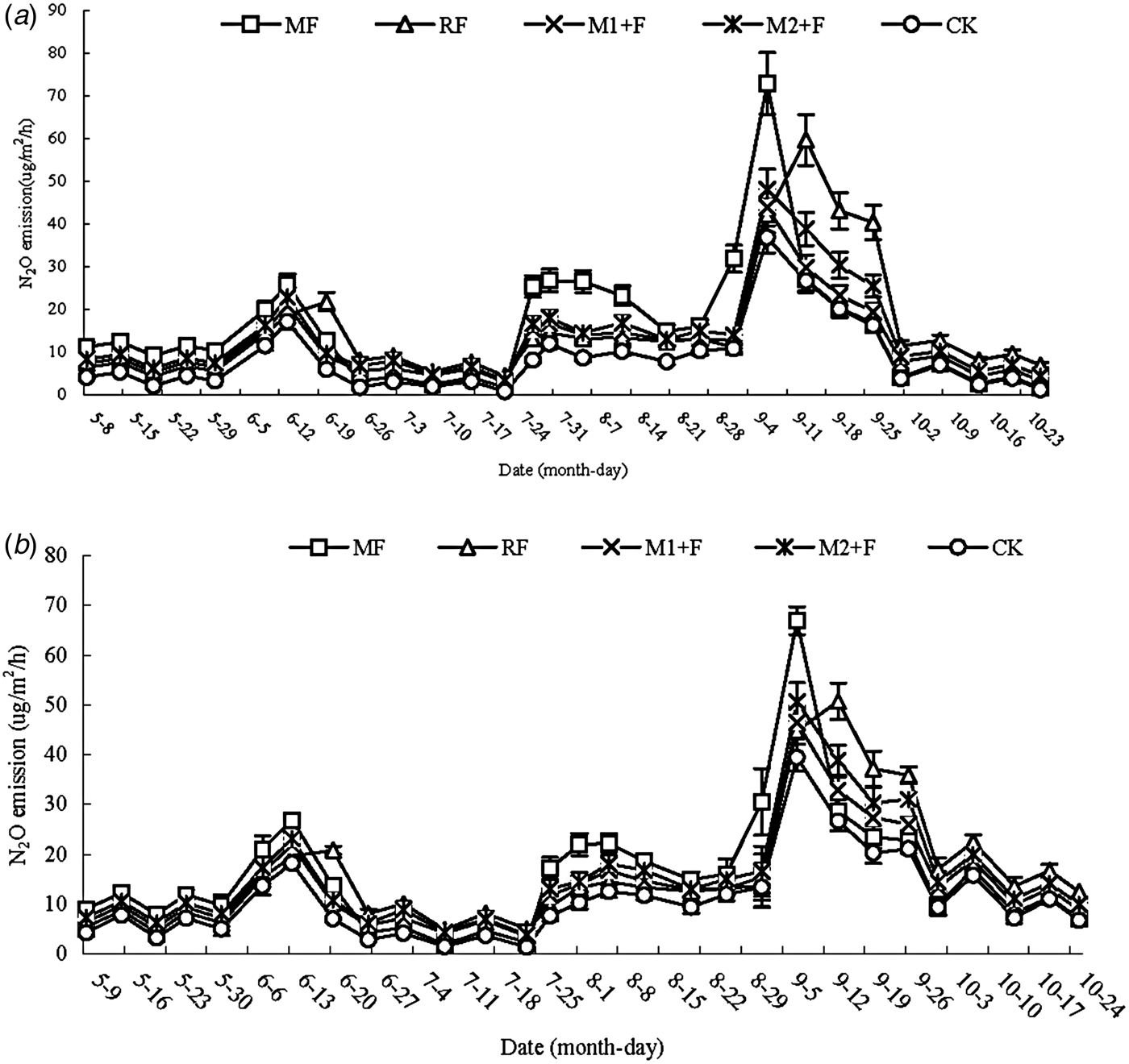
In the late rice crop, N2O emissions increased from field drainage to full heading stage (GS 50–60), and was mainly focused at the booting stage (GS 41–47). The order of N2O emission fluxes among different treatments was MF > M2 + F > M1 + F > RF > CK during the period from transplanting to field drainage, and RF > M2 + F > M1 + F > MF > CK during the alternating wetting–drying irrigation period. In 2013, the average N2O fluxes in the late rice growing season were 20·13, 20·37, 15·44, 17·98 and 11·68 µg/m2/h in MF, RF, M1 + F, M2 + F and CK, respectively. In 2014, the average N2O fluxes in the late rice growing season were 21·05, 21·33, 18·46, 20·50 and 14·68 µg/m2/h in MF, RF, M1 + F, M2 + F and CK, respectively.
Total methane and nitrous oxide emission from paddy fields of early rice and late rice
The cumulative CH4 emission of CK was significantly lower than MF, RF, M1 + F and M2 + F during the early rice crop (P < 0·05), and the sequence of treatments was M2 + F > M1 + F > RF > MF > CK (Table 2). In 2013, the total CH4 emissions from paddy fields covering the whole late rice growth cycle were 3·35, 4·27, 5·86, 8·43 and 2·65 g/m2 in MF, RF, M1 + F, M2 + F and CK, respectively. In 2014, the total CH4 emissions from paddy fields during the whole late rice growth cycle were 3·21, 3·96, 4·88, 6·10 and 2·55 g/m2 in MF, RF, M1 + F, M2 + F and CK, respectively. The sequence of treatments with respect to total CH4 emission was M2 + F > M1 + F > RF > MF > CK (Table 2).
Effects of long-term fertilizer managements on methane (CH4) and nitrous oxide (N2O) emission from rice fields during whole growth period of early and late rice (g/m2)

CK, without fertilizer; MF, mineral fertilizer alone; RF, crop residue plus mineral fertilizer; M1 + F, low manure rate plus mineral fertilizer; M2 + F, high manure rate plus mineral fertilizer.
* Values are presented as mean ± s.e. (n = 3).
Compared with CK, other treatments increased total N2O emissions in the early rice crop with emissions increasing by 0·008 g/m2 (88·89%) in MF, 0·007 g/m2 (77·78%) in RF, 0·005 g/m2 (55·56%) in M1 + F and 0·007 g/m2 (77·78%) in M2 + F in 2013, and by 0·009 g/m2 (81·82%) in MF, 0·009 g/m2 (81·82%) in RF, 0·007 g/m2 (63·64%) in M1 + F and 0·008 g/m2 (72·73%) in M2 + F in 2014 (Table 2). Similar results were observed in the late rice crop in both the seasons. Total N2O emissions increased by 0·053 g/m2 (151·43%) in MF, 0·052 g/m2 (148·57%) in RF, 0·039 g/m2 (111·43%) in M1 + F and 0·047 g/m2 (134·29%) in M2 + F in 2013, and by 0·055 g/m2 (127·91%) in MF, 0·055 g/m2 (127·91%) in RF, 0·047 g/m2 (109·30%) in M1 + F and 0·053 g/m2 (123·26%) in M2 + F in 2014 (Table 2).
Global warming potentials of methane and nitrous oxide
Treatment M2 + F had larger total CH4 emissions than other treatments across the double rice cropping period, while MF and RF had the largest total N2O emissions with quantities of 0·062 and 0·061 g/m2 in 2013, and 0·064 and 0·064 g/m2 in 2014, respectively (Tables 2 and 3).
Double rice grain yield, global warming potentials (GWP) of methane (CH4) and nitrous oxide (N2O) and per yield GWP from rice fields under long-term fertilizer managements

CK, without fertilizer; MF, mineral fertilizer alone; RF, crop residue plus mineral fertilizer; M1 + F, low manure rate plus mineral fertilizer; M2 + F, high manure rate plus mineral fertilizer.
* Values are presented as mean ± s.e. (n = 3).
Global warming potential reflects the relative effect of a GHG, with the GWP of CO2 being defined as 1. In the present study, the GWP of CH4 and N2O from double-cropping paddy fields varied with different fertilizer management, with the trend M2 + F > M1 + F > RF > MF > CK. In 2013, M2 + F had the largest GWP (3320·60 kg CO2-equivalent/ha) of total CH4 and N2O from double-cropping paddy fields, followed by M1 + F (2496·57 kg CO2-equivalent/ha), RF (2124·63 kg CO2-equivalent/ha) and CK (1257·93 kg CO2-equivalent/ha). In 2014, M2 + F again had the largest GWP (2982·57 kg CO2-equivalent/ha), followed by M1 + F (2521·55 kg CO2-equivalent/ha), RF (2289·11 kg CO2-equivalent/ha) and CK (1489·78 kg CO2-equivalent/ha). According to GWP, the contribution of CH4 from double-cropping paddy fields to global warming was greater than that of N2O (Table 3). Double rice grain yield was highest for RF and lowest for CK (Table 3).
DISCUSSION
Methane emission
Methane emission is a complex process including production, oxidation and emission. Chu et al. (Reference Chu, Hosen and Yagi2007) reported that N fertilizer application decreased atmospheric CH4 uptake and resulted in positive emissions from the soil. In the present study, the CH4 flux and total CH4 emissions from paddy fields during the early and late cropped rice were much larger in M2 + F, M1 + F and RF compared with CK, which was similar to the results of Wang et al. (Reference Wang, Chen, Ma, Sun, Xiong, Huang and Sheng2013). The reasons for this may be: (i) microbial activities were improved after returning crop residue/manure to the soil, due to the supplementation of carbon (C) sources and energy for microbial activities to accelerate consumption of soil oxygen and decrease soil redox potential (Eh); (ii) methanogens became active due to the large quantities of C sources, which provided reactive substrates for CH4 emission from paddy fields. Meanwhile, higher CH4 emission in RF, M1 + F and M2 + F during the early and late cropped rice suggests higher root growth due to increased N supply by mineral fertilizer, manure or crop residue, which probably stimulated the activity of methanogens that produce CH4. When N was supplied with mineral fertilizer alone, as in the MF treatment, CH4 emission was probably reduced because of the excessive soil inorganic N level. Reduced root growth due to lower levels of soil inorganic N as a result of the absence of fertilization with organic N probably also reduced methanotroph activity, thereby resulting in lower CH4 emission in MF. Several researchers (Bronson & Mosier Reference Bronson and Mosier1994; Powlson et al. Reference Powlson, Goulding, Willison, Webster and Hutsch1997) have reported that inorganic N fertilization reduced soil CH4 emission compared with organic N fertilization, while others (Amos et al. Reference Amos, Arkebauer and Doran2005; Mosier et al. Reference Mosier, Halvorson, Reule and Liu2006) did not observe the effects of N fertilization on emissions.
Methane production has been shown to increase with increasing temperature (Bergman et al. Reference Bergman, Sevensson and Nilsson1998), while CH4 oxidation is less temperature-dependent than CH4 production (Dunfield et al. Reference Dunfield, Knowles, Dumont and Moore1993). The higher CH4 emissions in all treatments may result from higher CH4 production than the consumption rate under the elevated soil temperature, and could partially explain why CH4 emissions increased in late rice growth season than that of the early rice growth season. In the present study, CH4 emissions increased during the early and late cropped rice when soil Eh decreased, and there are differences in CH4 emissions observed among the different fertilizer management practices. As soil Eh increased during the early and late cropped rice, CH4 emissions decreased.
Hu et al. (Reference Hu, Hatano, Kusa and Sawamoto2002) similarly observed significant CH4 emissions in paddy fields and significantly higher CH4 emissions with N fertilization. In the present study, CH4 fluxes from the control were low in the early and late cropped rice. When N was supplied jointly by manure, crop residue and mineral fertilizer, such as in M2 + F with high manure rate plus mineral fertilizer, M1 + F with low manure rate plus mineral fertilizer and RF with crop residue plus mineral fertilizer, CH4 emissions were probably increased because of the high levels of soil organic N. Therefore, during the early and late cropped rice, the CH4 emission increased gradually with the decomposition of organic matters and growth of rice after transplanting, and reached the peak value at tillering stage in all treatments. However, CH4 emissions in both rice seasons were reduced to a large extent after field drying, because soil aeration was improved during this period, and the activities of methanogens were therefore restricted, and the physiological activity of rice plants decreased, thereby limiting the ability for transportation and emission of CH4. Compared with the RF, M1 + F and M2 + F, it was also observed that MF decreased CH4 emissions from the paddy soil. These results indicated that in paddy soils, where there is high precipitation and high soil temperature, CH4 production may occur.
Nitrous oxide emission
Nitrous oxide is emitted by soils as a result of denitrification in anaerobic soil and nitrification in aerobic soil, with the anaerobic production considered to be more important. In the present study, N2O fluxes from the control were lower than those from the organic–inorganic mixed mineral fertilizer treatments throughout the whole experimental period. The greater N2O flux in MF and RF than in the control during early and late cropped rice, however, probably resulted from increased N substrate availability from both crop residue and mineral fertilizer. Increased N substrate availability due to N fertilization has been known to increase N2O flux due to enhanced nitrification (Drury et al. Reference Drury, Reynolds, Tan, Welacky, Calder and McLaughlin2006; Mosier et al. Reference Mosier, Halvorson, Reule and Liu2006; Dusenbury et al. Reference Dusenbury, Engel, Miller, Lemke and Wallander2008). Increased emissions of N2O from paddy fields by organic–inorganic mixed fertilization management practices have also been reported in other studies (Akiyama et al. Reference Akiyama, Tsuruta and Watanabe2000; Yan et al. Reference Yan, Hosen and Yagi2001; Akiyama & Tsuruta Reference Akiyama and Tsuruta2002; Li et al. Reference Li, Inubushi and Sakamoto2002; Chu et al. Reference Chu, Hosen and Yagi2007). In the present study, organic–inorganic mixed fertilization management practices increased emissions of N2O during the early and late cropped rice. The greater N2O flux in M2 + F and M1 + F was probably due to both the organic and the inorganic mineral fertilization and the flux in early and late cropped rice was probably a result of substantial precipitation and/or increased soil temperature. It has been suggested that the accumulation of manure and crop residue material in the soil during growing of early and late rice enhanced N2O production (Christensen & Christensen Reference Christensen and Christensen1991).
Several researchers have noted increased N2O flux immediately after N fertilization and/or substantial precipitation (Mosier et al. Reference Mosier, Halvorson, Reule and Liu2006; Dusenbury et al. Reference Dusenbury, Engel, Miller, Lemke and Wallander2008; Liebig et al. Reference Liebig, Tanaka and Gross2010). In the present study, greater N2O flux in MF than in M2 + F, M1 + F and RF during the rice growing season may have resulted from increased N contribution from mineral fertilizer, due to its higher N concentration. Greater N2O flux in M2 + F, M1 + F and RF than in the control during the early and late cropped rice may have resulted either from increased N contribution from crop residue due to the higher N concentration in RF and increased organic N mineralization due to manure application during rice growing season in M2 + F and M1 + F. The reasons for greater N2O flux in M2 + F, M1 + F and RF in late rice growth period were also likely to be a result of increased microbial activity and soil temperature. Meanwhile, compared with M1 + F, the greater N2O flux in M2 + F with high manure rate plus mineral fertilizer probably resulted from increased N substrate availability from both high manure and mineral fertilizer. Increased N substrate availability due to N fertilization has been confirmed to increase N2O flux due to enhanced nitrification (Drury et al. Reference Drury, Reynolds, Tan, Welacky, Calder and McLaughlin2006; Mosier et al. Reference Mosier, Halvorson, Reule and Liu2006; Dusenbury et al. Reference Dusenbury, Engel, Miller, Lemke and Wallander2008).
Effects of methane and nitrous oxide flux factors
A considerable number of studies have shown that some soil or environmental factors can influence CH4 and N2O emission. For example, CH4 and N2O production is regulated by vegetation type, soil temperature, soil moisture, root activity and many other factors (Parkin & Kaspar Reference Parkin and Kaspar2003; Wassmann et al. Reference Wassmann, Neue, Ladha and Aulakh2004; Ma et al. Reference Ma, Xu, Yagi and Cai2008; Kallenbach et al. Reference Kallenbach, Rolston and Horwath2010), and soil temperature, soil moisture and soil Eh have been determined to be the most crucial regulators (Kudo et al. Reference Kudo, Noborio, Shimoozono and Kuriharab2014). Yu et al. (Reference Yu, Böhme, Rinklebe, Neue and DeLaune2007) reported that CH4 emission showed an exponential decrease when Eh increased. In the present study, during the early and late cropped rice, the soil Eh rapidly increased simultaneously with rapid CH4 emission decrease. In the present study, crop residues and manure were incorporated into the soil in the RF, M1 + F, M2 + F treatments and their decomposition consumed limited soil-dissolved oxygen. All these factors resulted in decreased Eh and consequently increased CH4 emission under RF, M1 + F and M2 + F.
The soil temperature had a predictive functional relationship with CH4 emission. Khalil et al. (Reference Khalil, Rasmussen, Shearer, Chen, Yao and Yang1998) observed an increase in CH4 emissions from paddy fields with increasing soil temperature and Zhu et al. (Reference Zhu, Liu, Sun and Xu2007) reported a strong correlation between CH4 emission and soil temperature. The current results also found that there was a relationship between CH4 emission and soil temperature, with soil temperature found to be a major factor affecting CH4 emission. In general MF decreased soil temperature, especially during the hotter days, and this may have been partly responsible for lower CH4 emissions when compared with other treatments. Temperature was also the major reason for differences in the CH4 emission pattern between the early and late cropped rice. In the current experimental area, the late rice season was the hottest time of the summer and high temperatures enhanced the decomposition rate of crop residues and manure in the moist environment. During decomposition, a large number of organic compounds are produced and oxygen is consumed, thus decreasing soil Eh and leading to increased CH4 emission. In contrast to the warm temperatures of the late rice season, air temperatures in the early rice season were lower, which resulted in slower crop residue and manure decomposition and therefore little CH4-substrate. Hence, these differences in weather factors (e.g. temperature) resulted in the different characteristics of CH4 between the early and late cropped rice.
The N2O emission was influenced strongly by external factors and many emission peaks occurred during the rice growing season. The emission of N2O was different between the early and late cropped rice, possibly due to the variations in weather. Some studies show that extreme precipitation and drying could increase N2O emission (Zona et al. Reference Zona, Janssens, Verlinden, Broeckx, Cools, Gioli, Zaldei and Ceulemans2011). Hao et al. (Reference Hao, Chang, Carefoot, Janzen and Ellert2001) reported that aeration and water flooding led to ‘outbreaks’ of emissions. In the present study, precipitation in the early rice growing season was much higher than that in the late season. This precipitation difference may explain the fluctuations of N2O emissions between the seasons.
In addition, similar to CH4, N2O emission is also influenced by soil Eh. Weier et al. (Reference Weier, Doran, Power and Walters1993) reported that the rate of N2O emission decreased with increasing soil reducibility. In the present study, crop residues and manure in RF, M1 + F, M2 + F were mainly distributed within the plough layer (0–20 cm) and had a strong redox potential due to decomposition of crop residues and manure. Therefore, compared with the MF, N2O produced from RF, M1 + F, M2 + F soils tended to be further deoxidized to nitrogen gas (N2), which consequently decreased N2O emission. Meanwhile, the greater N2O flux in the late rice growing season than in the season was probably due to increased soil temperature, since increased temperature can stimulate microbial activity and N mineralization (Parkin & Kaspar Reference Parkin and Kaspar2003; Dusenbury et al. Reference Dusenbury, Engel, Miller, Lemke and Wallander2008; Liebig et al. Reference Liebig, Tanaka and Gross2010).
Global warming potentials of methane and nitrous oxide
Global warming potential can be used as an index to estimate the potential effects of different GHGs on the global climate system. Tang et al. (Reference Tang, Xiao, Tang, Wang, Sun, Li and Yang2014) estimated that GWP of double-cropping rice systems increased through the return of straw from winter cover crops. Zhu et al. (Reference Zhu, Yi, Hu, Zeng, Tang, Yang and Xiao2012) reported that the highest GWP was found for incorporation of Chinese milk vetch in a double-cropping rice system, which was 21–325% higher than the other treatments they studied. In the present study, the GWP of CH4, N2O or both had different orders. For a comprehensive consideration, GWP of both CH4 and N2O is an important method to assess the effect of a farming system on climate warming. Therefore, it is necessary to make a combined estimate of global warming effects of CH4 and N2O emitted from each treatment. Thus, GWP and GWP per yield were introduced into the present study for global warming calculations. It was found that the CH4 and N2O GWP for M2 + F and M1 + F were higher than for RF and MF, due to their greater CH4 emissions. Manure and crop residue addition increased early and late rice grain production compared with the control. Therefore, the control without fertilizer may mitigate GHG emissions but may not sustain rice yields. The total of early and late rice production was significantly higher in the M2 + F, M1 + F and RF than in the control, but the GWP per yield of RF was significantly lower than the control, M2 + F and M1 + F. Therefore, application of the crop residue and mineral fertilizer pattern is recommended for double-cropping rice areas in the Middle and Lower reaches of Yangtze River in China, which corresponds to RF as a management option under an intensive cropping system. Further studies are under way to examine whether RF with reduced N fertilization rate might mitigate GHG emissions and sustain crop yields. Other benefits of applying crop rotation rather than mono-cropping include reduced infestation of weeds, diseases and pests. However, for evaluating the GWP of management systems, it would be mandatory to consider the soil C dynamics associated with crop production inputs and machinery use.
CONCLUSIONS
Greenhouse gas emissions from large paddy fields and excessive fertilizer application can contribute significantly to global warming. Managing fertilizer application is one of the feasible ways of limiting GHG emissions from paddy areas. Low fertilizer application results in low-energy consumption, which can contribute to the reduction of GHG and lessen global warming. The current results show that mineral fertilizer application stimulates N2O emission during the early and late cropped rice. Meanwhile, the results indicate that with the same N application rate, different organic–inorganic mixed fertilizer application, such as RF, M1 + F and M2 + F, caused substantial CH4 emissions during the early and late cropped rice compared with those from the conventional MF treatment. However, it significantly increased rice grain yields in both RF, M1 + F and M2 + F production systems. The GWP of both CH4 and N2O resulted in a significantly lower yield-scaled GWP compared with the control treatments. The increased use of organic inputs greatly affected CH4 and N2O emission; however, the inputs were necessary for maintaining soil fertility and are a crucial source of nutrient input for small-scale farmers in paddy fields who cannot rely solely on mineral fertilizer. The combined use of organic inputs and mineral fertilizer is therefore suggested as a potential for intensifying rice production in paddy soil under intensive cropping systems. Nevertheless, future research is necessity to provide a complete insight into the effects of recently developed practices on soil C dynamics.
This study was supported by the National Natural Science Foundation of China (Grant numbers 31201178 and 31571591) and technology innovation platform project of Hunan Province.



