Implications
The present work summarizes research related to the definition of nutrient recommendations for feeds used in the intensive production of rabbit's meat.
Introduction
Rabbits are bred all over the world for different purposes. However, its main use as an agricultural species is for intensive meat production, with most of the farms located in the European Mediterranean area. Rabbits present several advantages to provide meat, such as a rapid growth rate, a short reproductive cycle, high prolificacy, adaptability to farm conditions and ability to thrive on high fibrous ingredients. Moreover, rabbit meat offers excellent nutritive and dietetic properties, such as a high protein content, low cholesterolaemic effect and low sodium level (Hernández and Dalle Zotte, Reference Hernández and Dalle Zotte2010). However, consumption is mostly restricted at present to the production areas, with its acceptance being limited due to cultural, traditional and religious reasons.
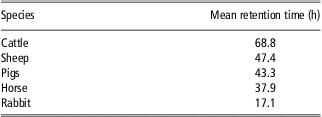
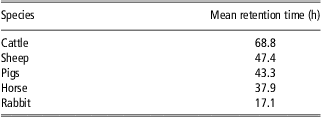
The digestive system of the rabbits is similar to other herbivorous monogastric species, so that digestibility of non-cell wall constituents at the small intestine is also comparable. Otherwise, rabbits are characterized by a high relative capacity of the caecum (Portsmouth, Reference Portsmouth1977), where most of the microbial digestion occurs. Furthermore, rabbits have a specific mechanism of particle segregation at the ileocaecal–colonic junction (Björnhag, Reference Björnhag1972). This system favours the entry into the fermentative area of water-soluble substances and fine particles (<0.3 mm diameter), whereas coarse particles continue their progression to form hard faeces. The easily digestive materials entering the caecum are only retained for a short period of time (∼10 h; Gidenne et al., Reference Gidenne, Carabaño, Garcia and De Blas2010a), as caecal contents are emptied every morning to produce soft faeces. Consequently, the rate of passage of digesta in rabbits is faster than that in other herbivorous species (such as ruminants or horses) and even pigs (Warner, Reference Warner1981; see Table 1). As a result, rabbits achieve a high voluntary feed intake (∼four times higher than a 250 kg steer, and twice as much as a 40 kg growing pig on a live weight basis; Santomá et al., Reference Santomá, De Blas, Carabaño and Fraga1989). This high intake capability allows rabbits fed with high fibrous diets to meet their high nutritive requirements per unit of BW.
Mean retention time of digesta in the gut of different animal species (adapted from Warner, Reference Warner1981)
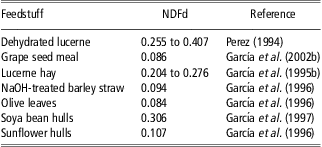
Because the caecal mean retention time is relatively short in rabbits, values of NDF digestibility are generally lower than those observed in other herbivorous species and also pigs (see Table 2). For the same reason, soluble fibre, which is fermented quickly, represents a high proportion of the total cell wall constituents digested (De Blas et al., Reference De Blas, García and Carabaño1999). In fact, most of the fibrolytic activity in rabbits corresponds to pectinases, whereas cellulolytic activity is very scarce (Marounek et al., Reference Marounek, Vovk and Skrivanova1995). Other variables such as hemicelluloses and ADL concentrations on NDF and the proportion of acid detergent cutin on ADL may be partially responsible for the variations in NDF digestibility (Escalona et al., Reference Escalona, Rocha, García, Carabaño and de Blas1999). Dietary particle size is also a relevant factor of fibre digestion efficiency, as it is significantly related to caecal retention time (García et al., Reference García, Carabaño and De Blas1999).
NDFd of several feedstuffs in rabbits
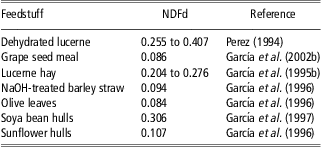
NDFd = neutral detergent fibre digestibility.
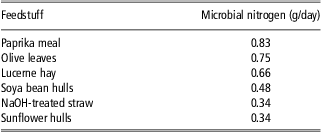
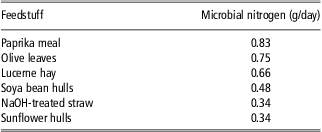
The digestive system of the rabbits permits the re-utilization of part of the end products of caecal fermentation (including microorganisms) through the daily ingestion of soft faeces. Caecotrophy allows increasing CP digestibility (especially in diets containing a high proportion of NDF-insoluble protein) and reducing manure nitrogen excretion. Soft faeces provide on average 0.15 and 0.22, respectively, of the total protein intake in growing rabbits and lactating does (Carabaño et al., Reference Carabaño, Piquer, Menoyo and Badiola2010), with a high concentration of microbial protein (from 0.30 to 0.60) as well as essential amino acids (Nicodemus et al., Reference Nicodemus, Mateos, De Blas, Carabaño and Fraga1999b; García et al., Reference García, De Blas and Carabaño2004). The amount of nutrients recycled depends on factors affecting the efficiency of fibre digestion in the caecum (García et al., Reference García, De Blas, Carabaño and Garcia1995a and Reference García, Carabaño, Perez Alba and De Blas2000; see Table 3). The stepwise regression equation obtained was
 $$ {\rm{MN}}\, = \,0.60\, + \,1.21{\rm{FP}}\, + \,3.52{\rm{UA}}\,{\rm{ - }}\,1.20{\rm{ADL}}\,/\,{\rm{NDF}} $$
where MN is the microbial nitrogen (g/day); FP the proportion of fine particles (<0.3 mm); UA the proportion of uronic acids; and ADL/NDF the degree of lignification of NDF.
Effect of source of fibre on the recycling of microbial nitrogen through caecotropy (calculated from García et al., Reference García, De Blas, Carabaño and Garcia1995a and Reference García, Carabaño, Perez Alba and De Blas2000)
Microbial activity is also responsible for the presence of conjugated linoleic acid in the soft faeces and thus in rabbit's meat, although in smaller amounts than in ruminant species (Gómez-Conde et al., Reference Gómez-Conde, Menoyo, Chamorro, López-Bote, García-Rebollar and De Blas2006). The use of soft faeces has also been proposed for the in vivo estimation of caecal flora composition, including pathogen proliferation (Romero et al., Reference Romero, Nicodemus, García-Ruiz, Ibáñez and de Blas2009b).
Role of fibre in rabbit digestion
Fibrous raw materials are the main constituents of commercial rabbit feeds. Both physical and chemical characteristics of fibre have implications for feed intake, gut health, feed efficiency and performance. Thus, the definition of the optimum dietary levels of fibre has been a major aim of research on rabbit nutrition.
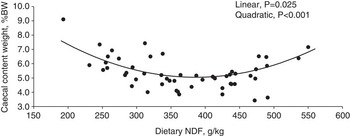
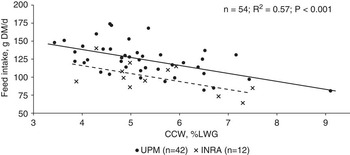
Rabbit does and fattening rabbits are able to maintain a high dry matter (DM) intake in a range of dietary NDF concentrations (De Blas et al., Reference De Blas, Santomá, Carabaño and Fraga1986; Méndez et al., Reference Méndez, De Blas and Fraga1986; Partridge et al., Reference Partridge, Garthwaite and Findlay1989; de Blas et al., Reference De Blas, Taboada, Mateos, Nicodemus and Méndez1995; Gidenne et al., Reference Gidenne, Jehl, Lapanouse and Segura2004). However, a minimal lignified, large-sized (>0.3 mm) fibre content is needed to ensure a fast rate of passage of digesta (Figure 1) and thus to maximize voluntary feed intake (Figure 2). The results presented in Figure 1 indicate that a concentration of dietary fibre of ∼390 g NDF/kg DM is required to minimize digesta accumulation in the caecum (expressed as the proportion of caecal content weight (CCW) on live BW, %CCW). The stepwise regression equation obtained was
 $$ { {\rm{CCW}}\, = \,19.1\;( \pm 2.0)\, - \,0.070\;( \pm 0.011)\;{\rm{NDF}}\, + \,0.000089 \cr \quad ( \pm 0.000015) \ {\rm{ND}}{{{\rm{F}}}^2} \, - \,0.031 \;( \pm 0.0091)\;{\rm{ADL}}\,/\,{\rm{NDF}}; \cr & \quad n\, = \,52;\;{{R}^2} \, = \,0.49;\;P\, \less \,0.001 $$
the additional negative effect of the degree of lignification of NDF (ADL/NDF, %) indicates the influence of the source of fibre. An increase in the proportion of fine particles (<0.3 mm) and a decrease in the proportion of large particles (>1.25 mm) also increase caecal retention time and decrease DM intake (Gidenne, Reference Gidenne1993; García et al., Reference García, Carabaño and De Blas1999).
Influence of dietary NDF content on the weight of caecal contents (García et al., Reference García, Gidenne, Falcao and De Blas2002a).

Effect of weight of caecal contents on dry matter intake at two experimental sites: UPM and INRA (García et al., Reference García, Gidenne, Falcao and De Blas2002a). CCW = caecal content weight; LWG = live weight gain.

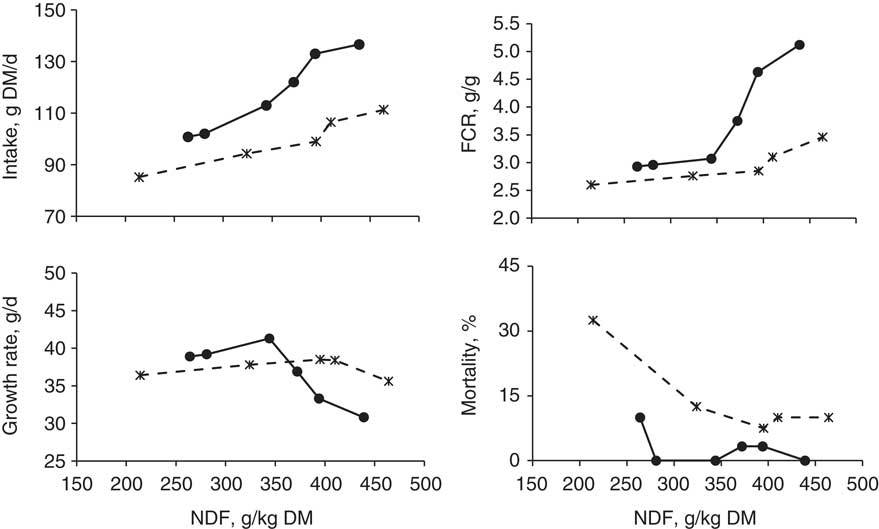
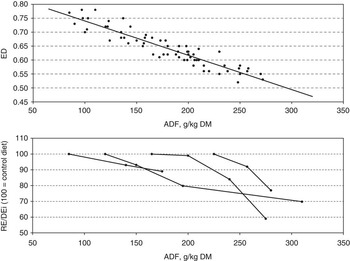
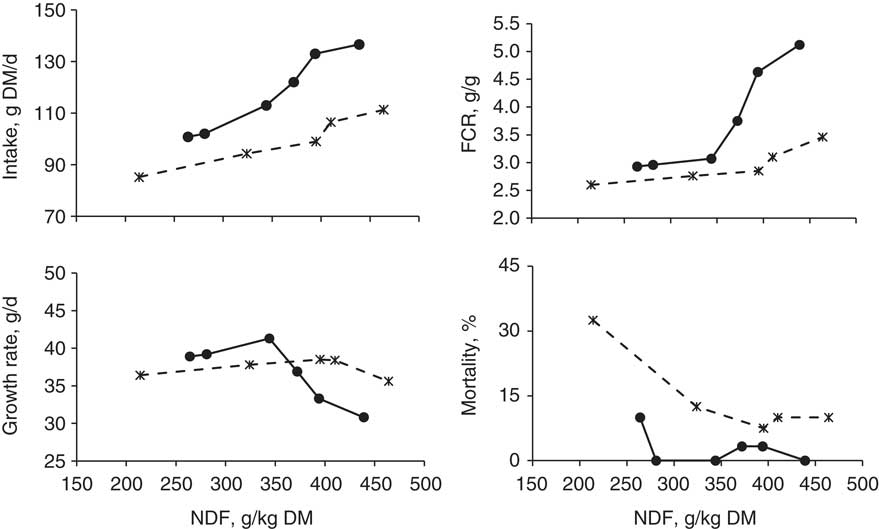
Accordingly, low fibrous levels lead to a decrease in feed intake and thus in growth performance, whereas fattening mortality increases (see Figure 3). Otherwise, rabbits fed high fibrous diets decrease their digestible energy (DE) intake, weight gain and feed efficiency, as the higher feed consumption observed in these diets does not compensate for the sharp decrease in energy digestibility and energy fermentation losses (see Figure 4). A long-term study conducted with highly productive rabbit does fed five fibre levels in iso-DE diets showed that values of reproductive performance, milk production and feed efficiency were maximal for diets containing ∼360 g NDF/kg DM (de Blas et al., Reference De Blas, Taboada, Mateos, Nicodemus and Méndez1995).
Effect of dietary NDF content on growth performance and feed conversion rate (FCR, g/g) of fattening rabbits in two independent studies ( $$$$
, de Blas et al., Reference De Blas, Santomá, Carabaño and Fraga1986;
 $$$$
, Gidenne et al., Reference Gidenne, Jehl, Lapanouse and Segura2004).
Influence of dietary ADF content on energy digestibility (ED, De Blas et al., Reference De Blas, Wiseman, Fraga and Villamide1992) and efficiency of digestible energy for energy retention in growth (RE/DEi; De Blas et al., Reference De Blas, Fraga and Rodríguez1985; Ortiz et al., Reference Ortiz, De Blas and Sanz1989; García et al., Reference García, Gálvez and De Blas1992, Reference García, Gálvez and De Blas1993).

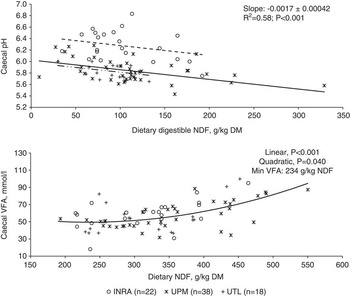
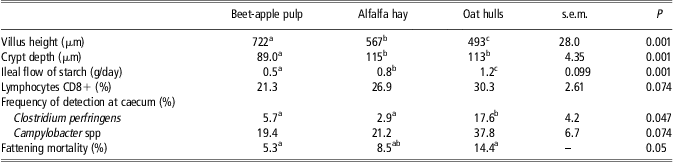
Dietary fibre is widely considered as the major nutritional factor to prevent digestive pathologies. The reasons for this are still unclear. Low fibrous diets imply a decrease in substrates available for the fibrolytic flora and a decrease in intestinal peristalsis, which might alter the equilibrium among the microbial species. In this way, a reduction of dietary NDF from 300 to 250 g/kg decreased microbiota diversity at the caecum (Nicodemus et al., Reference Nicodemus, Pérez-Alba, Carabaño, De Blas, Badiola, Pérez de Rozas and García2004). Increasing levels of fibre in the diet also lead to a decrease in caecal pH and to an increase in volatile fatty acid concentration (see Figure 5). These changes were greater when highly digestible sources of fibre were used and may explain the role of fibre in controlling pathogen growth (Gidenne et al., Reference Gidenne, Kerdiles, Jehl, Arveux, Briens, Eckenfelder, Fortune, Montessuy, Muraz and Stephan2001b; Gidenne and Licois, Reference Gidenne and Licois2005; Gómez-Conde et al., Reference Gómez-Conde, García, Chamorro, Eiras, Rebollar, Pérez de Rozas, Badiola, de Blas and Carabaño2007 and Reference Gómez-Conde, Pérez de Rozas, Badiola, Pérez-Alba, De Blas, Carabaño and García2009). In addition, the partial substitution of insoluble with soluble fibre might minimize the deterioration of intestinal villi caused by highly lignified fibre, and then increase immune response and digestion efficiency, especially in young rabbits (Mourao et al., Reference Mourao, Pinheiro, Alves, Guedes, Pinto, Saavedra, Spring and Kocher2006; Alvarez et al., Reference Alvarez, Marguenda, García-Rebollar, Carabaño, De Blas, Corujo and García-Ruiz2007; Gómez-Conde et al., Reference Gómez-Conde, García, Chamorro, Eiras, Rebollar, Pérez de Rozas, Badiola, de Blas and Carabaño2007; Table 4).
Effect of dietary NDF content on caecal pH and caecal volatile fatty acid concentration in studies carried out at different laboratories (García et al., Reference García, Gidenne, Falcao and De Blas2002a).

Effect of fibre source in diets containing 300 g/kg NDF on the integrity and activity of intestinal barrier, detection frequency of several potential harmful bacteria at caecum and fattening mortality (Gómez-Conde et al., Reference Gómez-Conde, García, Chamorro, Eiras, Rebollar, Pérez de Rozas, Badiola, de Blas and Carabaño2007)
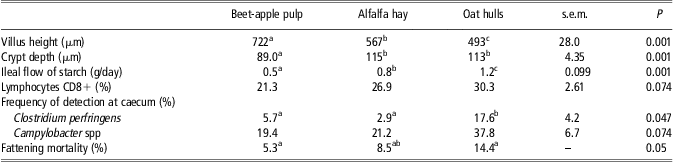
a,b,cValues in a row not sharing a common letter differ at P < 0.05.
Fibre also has a diluting effect on dietary starch content, and avoids an excessive ileal flow of starch that might promote pathogen growth. Starch digestibility is generally very high (>0.97) in rabbits (Blas and Gidenne, Reference Blas and Gidenne2010). However, in young rabbits (less than 5 weeks old), when pancreatic activity is not fully established, ileal starch flow can be significant (Gidenne et al., Reference Gidenne, Segura and Lapanouse2005). Starch digestibility also decreases in highly lignified diets (Motta et al., Reference Motta, Fraga and Carabaño1996; Gómez-Conde et al., Reference Gómez-Conde, García, Chamorro, Eiras, Rebollar, Pérez de Rozas, Badiola, de Blas and Carabaño2007; see Table 4) or when non-cereal sources (as peas) are used (Gutiérrez et al., Reference Gutiérrez, Espinosa, García, Carabaño and De Blas2002b). In the same way, the addition of amylases to the diet has proven to be effective in the reduction of fattening mortality in several studies (Gutiérrez et al., Reference Gutiérrez, Espinosa, García, Carabaño and De Blas2002b; Cachaldora et al., Reference Cachaldora, Nicodemus, García, Carabaño and De Blas2004).
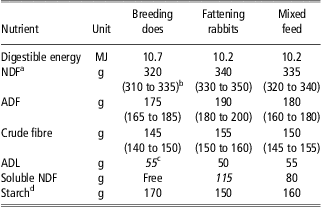
Recommendations for dietary total fibre levels expressed as NDF, ADF or crude fibre are shown in Table 5 for the three types of feeds more commonly used in practice. Energy values have been estimated for each average level of fibre and for moderate (45 g/kg) total ether extract content according to De Blas et al. (Reference De Blas, Wiseman, Fraga and Villamide1992). Optimal type of fibre has been considered by proposing minimal levels of soluble NDF and large-sized particles. The protective influence of the lignin fraction has also been recognized, because of its favourable effect on digestive disorders observed in several studies (Perez et al., Reference Perez, Gidenne, Lebas, Caudron, Arveux, Boudillon, Duperray and Messager1994; Nicodemus et al., Reference Nicodemus, Carabaño, García, Méndez and De Blas1999a; Gidenne et al., Reference Gidenne, Arveux and Madec2001a).
Nutrient requirements of intensively reared rabbits as concentration/kg corrected to a dry matter content 900 g/kg (De Blas and Mateos, Reference De Blas and Mateos2010)
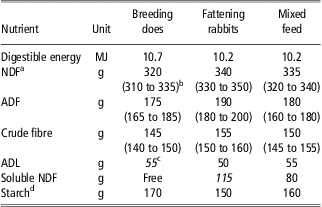
aProportion of long fibre particles (>0.3 mm) should be higher than 0.22 (breeding does) and 0.205 (fattening rabbits).
bValues in parentheses indicate range of minimal and maximal values recommended.
cValues in italics are provisional estimates.
dValues for starch are indicative.
Effects of fat addition
Inclusion of fats in commercial feeds for rabbits is usually restricted to less than 30 to 35 g/kg because of its negative influence on pellet and meat quality. However, fat is well digested by rabbits (Maertens et al., Reference Maertens, Huyghebaert and De Groote1986; Santomá et al., Reference Santomá, De Blas, Carabaño and Fraga1987) and allows increasing the dietary energy concentration and the feed conversion rate in typically high fibrous fattening diets (Partridge et al., Reference Partridge, Findlay and Fordyce1986).
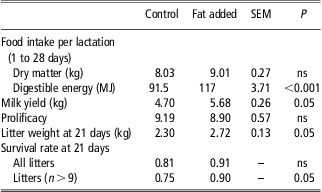
Furthermore, several long-term studies have shown that a supplementation with ∼30 g/kg of fat in isofibrous diets of highly productive does increased DE intake, milk production and rate of young rabbits’ survival, especially in high prolific animals (see Table 6). The effects were more evident in multiparous rabbit does. Instead, neither body reserves nor fertility or prolificacy are affected by fat addition according to the review of Fernández-Carmona et al. (Reference Fernández-Carmona, Pascual and Cervera2000). Recent work (Maertens et al., Reference Maertens, Aerts and De Brabander2005) has also shown that dietary inclusion of linolenic acid might further decrease young rabbits’ mortality and improve reproductive efficiency.
Effect of fat addition (35 g/kg pork lard) in lactating rabbit diets on intake and performance (Fraga et al., Reference Fraga, Lorente, Carabaño and de Blas1989)
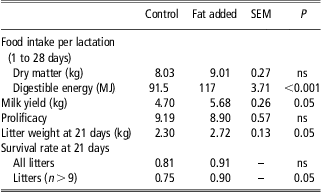
According to the previous information, a minimal addition of 20 to 30 g/kg of fat is frequently recommended in diets for breeding does, whereas inclusion of fat in fattening feeds depends on its cost per unit of energy.
Recommendations for dietary nitrogen balance
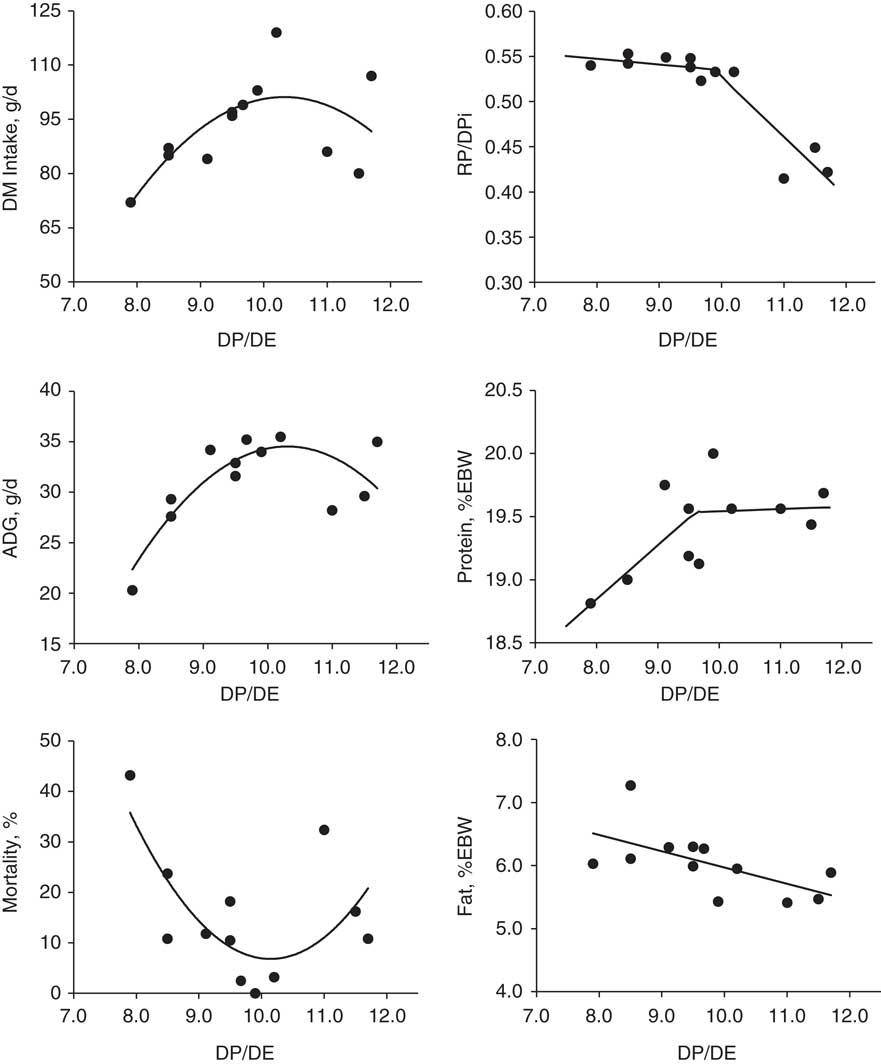
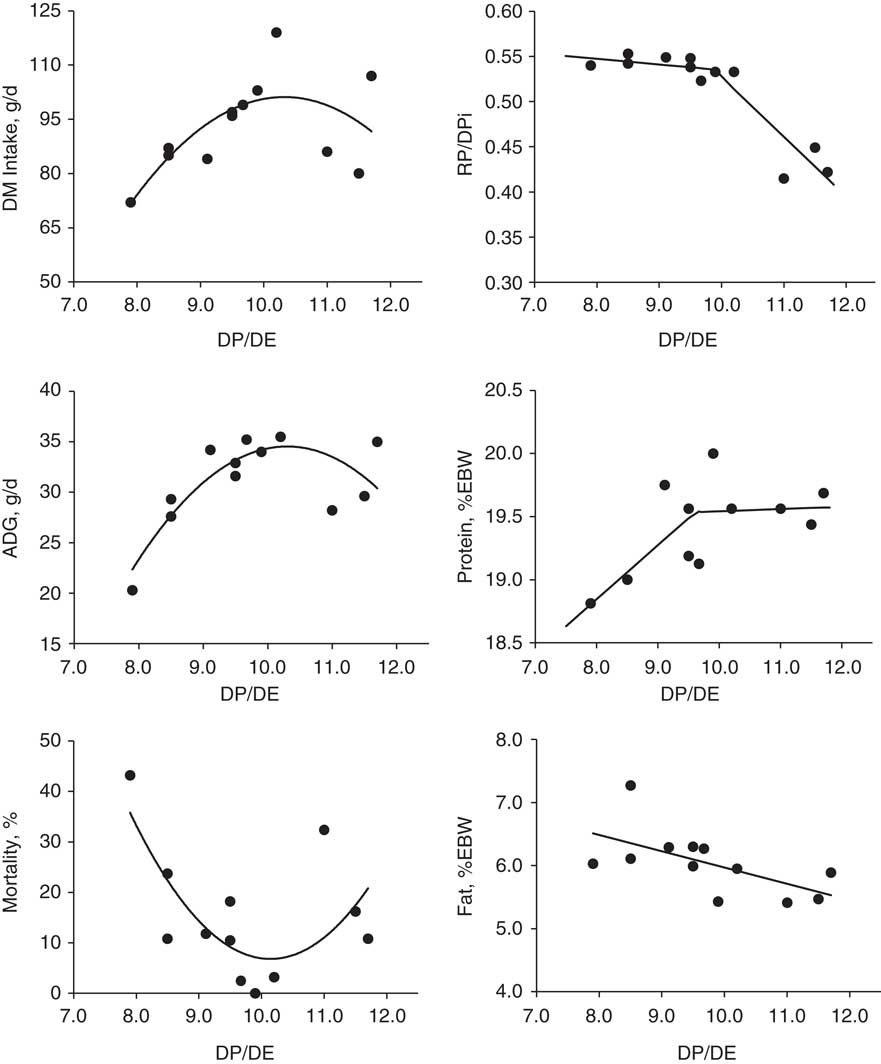
Protein and amino acid requirements for rabbits have been determined in several dose–response studies, where both the high growth and milk production potential per unit of live BW and the recycling of nutrients through caecotrophy have been considered. Figure 6 shows the effect of 12 diets that combined factorially three levels of ADF (from 90 to 180 g/kg DM) and four of CP (from 130 to 200 g/kg DM) on the performance of fattening rabbits. Results indicate that a ratio of ∼10 g of digestible protein/MJ DE is optimal to achieve maximal feed intake, daily weight gain, protein retention and protein efficiency and to minimize fattening mortality. Optimal dietary protein concentrations are higher for lactating does (12 g digestible protein (DP)/MJ DE) than for fattening rabbits, as reviewed by Xiccato (Reference Xiccato1996).
Influence of the dietary digestible protein (DP) to digestible energy (DE) ratio on DM intake, average daily gain (ADG, g) and mortality in the fattening period (De Blas et al., Reference De Blas, Pérez, Fraga, Rodríguez and Gálvez1981), the fat and protein content in the empty BW (%; Fraga et al., Reference Fraga, de Blas, Pérez, Rodríguez, Pérez and Gálvez1983) and the efficiency of retention of DP intake (RP/DPi; De Blas et al., Reference De Blas, Fraga and Rodríguez1985).
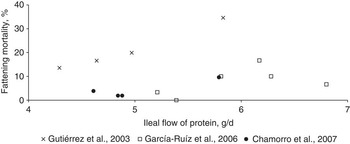
A low amount of protein reaching the caecum has been related to a decrease in the proliferation of total anaerobic bacteria (García-Palomares et al., Reference García-Palomares, Carabaño, García-Rebollar, De Blas, Corujo and García-Ruiz2006), Clostridium spiroforme (Haffar et al., Reference Haffar, Laval and Guillou1988), Escherichia coli (Cortez et al., Reference Cortez, Brandebruger, Greuel and Sundrum1992) and Clostridium perfringens (Chamorro et al., Reference Chamorro, Gómez-Conde, Pérez de Rozas, Badiola, Carabaño and De Blas2007) and to lower incidences of intestinal disorders and fattening mortality according to the works shown in Figure 7. Ileal protein flow in these studies was decreased by lowering the dietary protein content, using high digestible sources or supplementing feed with proteolytic enzymes. Otherwise, endogenous nitrogen is another relevant substrate for microbial growth in rabbits (García et al., Reference García, De Blas and Carabaño2004), but its role in pathogen proliferation and digestive pathology is still unclear.
Effect of the apparent ileal flow of protein at the post-weaning period on the fattening mortality according to several experiments.

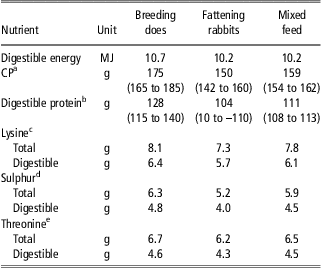
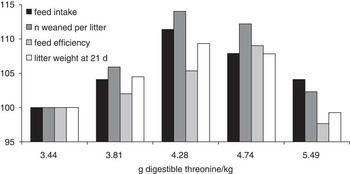
Practical recommendations for dietary CP and DP levels, calculated for standard DE values, are shown in Table 7. Optimal contents of crude and faecal digestible essential amino acids have been derived from studies reviewed by De Blas and Mateos (Reference De Blas and Mateos2010); an example of one of them is presented in Figure 8.
Protein and amino acid requirements of intensively reared rabbits as concentration/kg corrected to a dry matter content of 900g/kg (De Blas and Mateos, Reference De Blas and Mateos2010)
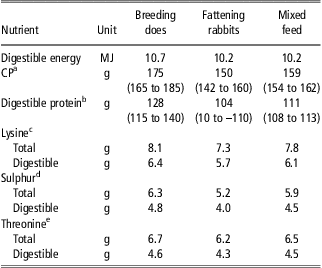
aValues in parentheses indicate range of minimal and maximal values recommended.
bDigestibility of CP and essential amino acids is expressed as faecal apparent digestibility
cTotal amino acid requirements have been calculated for a contribution of synthetic amino acids of 0.15.
dMethionine should provide a minimum of 35% of the total total sulphur amino acid requirements.
eMaximal levels of 50 and 72 g/kg of digestible and total threonine, respectively, are recommended for breeding does.
Effect of dietary apparent faecal digestible threonine concentration (g/kg DM) on productive traits of lactating does (Base 100 = diet containing 3.44 g digestible threonine/kg; De Blas et al., Reference De Blas, Taboada, Nicodemus, Campos, Piquer and Méndez1998).

The full implementation of an accurate system of evaluation of ileal digestibility of amino acids (García et al., Reference García, De Blas and Carabaño2005) would permit an increase in nitrogen digestion efficiency and a further decrease in dietary protein content. Reducing dietary protein concentration to minimal levels also allows decreasing nitrogen excretion through manure (Maertens et al., Reference Maertens, Luzi and De Groote1997; Xiccato, Reference Xiccato2006).
Mineral and vitamin requirements
When compared with other domestic species, rabbit meat is relatively poor in sodium but rich in potassium and phosphorous. Otherwise, rabbits present some particularities such as the high content of minerals in milk (Mateos et al., Reference Mateos, Rebollar and De Blas2010). Highly prolific rabbit does producing high amounts of milk can show a deficit of calcium at late gestation or early lactation, with symptoms similar to those of milk fever in dairy cows. An excessive calcium intake is excreted in the urine, forming a characteristic precipitate, and might damage the kidney structure.
Furthermore, rabbits are able to partially digest phytic acid at the caecum and recycle phosphoric acid through soft faeces (Marounek et al., Reference Marounek, Duskova and Skrivanova2003). Accordingly, the digestibility of phytic acid is higher in rabbits than in other monogastric species (Gutiérrez et al., Reference Gutiérrez, García, Carabaño, Mateos and De Blas2000). Most B-vitamins, together with vitamin C and vitamin K, are also synthesized by the gut flora and recycled by caecotrophy (Carabaño et al., Reference Carabaño, Piquer, Menoyo and Badiola2010), although dietary supplements might be needed to meet the requirements. Other minerals such as chloride, sodium and potassium are present in soft faeces in higher concentrations than in hard faeces (Hörnicke and Björnhag, Reference Hörnicke and Björnhag1980).
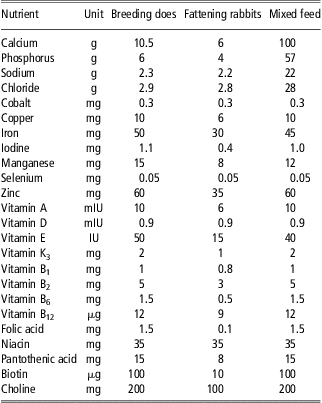
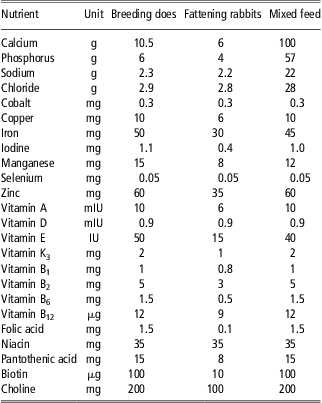
There is a lack of research on optimal mineral and vitamin levels for rabbits’ diet formulation. The standards proposed in Table 8 are mostly based on practical levels used by the industry.
Mineral and vitamin acid requirements of intensively reared rabbits as concentration/kg corrected to a dry matter content of 900 g/kg (De Blas and Mateos, Reference De Blas and Mateos2010)
Feeding management
Weaning is a critical phase for the development of digestive disorders in rabbits, as in other domestic species. Early weaning (at 25 days of age) allows increasing reproductive efficiency in intensively reared rabbits (Méndez et al., Reference Méndez, De Blas and Fraga1986; Nicodemus et al., Reference Nicodemus, Gutiérrez, García, Carabaño and De Blas2002). However, several works suggest a positive influence of a delay of weaning age (up to 35 days of age) to prevent fattening mortality (Lebas, Reference Lebas1993; Feugier et al., Reference Feugier, Smit, Fortun-Lamothe and Gidenne2006; Romero et al., Reference Romero, Nicodemus, García-Rebollar, García-Ruiz, Ibáñez and de Blas2009a). This effect might be explained by an insufficient development at early ages of the digestive enzymatic capability (Corring et al., Reference Corring, Lebas and Cortout1972; Dojana et al., Reference Dojana, Costache and Dinischiotu1998; Scapinello et al., Reference Scapinello, Gidenne and Fortun-Lamothe1999; Gutiérrez et al., Reference Gutiérrez, Espinosa, García, Carabaño and De Blas2002a), which would lead to an increasing flow of nutrients towards the hindgut and to an alteration in the equilibrium of the gut flora. In this context, late weaning seems to exert a protective effect on the proliferation of E. coli O103 (Gallois et al., Reference Gallois, Gidenne, Tasca, Caubet, Coudert, Milon and Boullier2007) and C. perfringens (Romero et al., Reference Romero, Nicodemus, García-Rebollar, García-Ruiz, Ibáñez and de Blas2009a). Consequently, in the more typical reproductive rhythm used in commercial practice, rabbit does are mated 11 days after parturition and weaned at 35 days to achieve a 42-day length of the reproductive cycle.
Otherwise, a feeding restriction during 2 weeks after weaning has decreased fattening mortality and improved the feed conversion rate in field experiments (Gidenne et al., Reference Gidenne, Combes, Feugier, Jehl, Arveux, Boisot, Briens, Corrent, Fortune, Montessuy and Verdelhan2009a and Reference Gidenne, Murr, Travel, Corrent, Foubert, Bebin, Mevel, Rebours and Renouf2009b). These results might be explained by a decrease in caecal pH and a higher caecal concentration of volatile fatty acids (Gidenne and Feugier, Reference Gidenne and Feugier2009), which, together with the reduction of the nutrient flow to the hindgut, might contribute towards reducing pathogen proliferation in the digestive contents of the restricted animals.