Introduction
This article reports on my work at Leeds Conservatoire (United Kingdom) with Masters-level music students studying composition, performance and production on the MA Music programme (previously MMus Creative Musician). The following presents some arguments in favour of a student-centred learning and teaching approach for higher music education (HME), including consideration of some practical methodologies, which I have found useful in my own conservatoire teaching practice. I also undertake theoretical modelling designed to strengthen student-centred pedagogies and enable application of these ideas at a curriculum design level. I teach MA Music students in individual and group settings, but it is on strategies of particular relevance to the latter which the current research is focussed.
In the first half, I outline the context for student-centred HME, briefly examining some creative, interpersonal and institutional challenges to which such pedagogies may offer solutions. As part of this, I draw together existing research into “self-efficacy” for learners (e.g., Miksza, Reference MIKSZA2011) and distributive agency in classroom settings (e.g., Bayley, Reference BAYLEY2016; Hood & Kraehe, Reference HOOD and KRAEHE2017), to offer a model of motivation accounting for both individual and group learning environments. In the second half, I discuss two approaches to student-centred delivery which I use in my own pedagogical practice. Firstly, I explore Critical Response Process (CRP) as a structure for peer-to-peer critique, supporting discussion with analysis of questionnaire responses from students participating in my CRP class at Leeds Conservatoire. Secondly, I consider some practice as research (PaR) methodologies as a foundation for research-based student-centred learning and teaching. Finally, I propose a student-centred curriculum design framework for HME, cross-mapping different learning activities, knowledge paradigms and forms of motivation based on the previous discussion. Throughout, I aim to demonstrate how student-centred pedagogy can enable students to build motivation and engagement with their programme of study.
Context
Institutional and pedagogical background
MA Music is a 1-year programme delivered at Leeds Conservatoire, devised with my colleague Professor Andrew West. The course is open genre and open discipline, offering flexible provision in performance, production and composition (including songwriting). We adopt a correspondingly multi-modal pedagogy, combining discipline-specific individual specialist tuition with multidisciplinary group teaching strategies bringing together all students within a single class. This means group teaching must cater to a diversity of musical backgrounds, skill levels and learning goals; in any one group, there may be classical violinists, pop songwriters, electronic music producers and musical theatre vocalists. The intention is that students will benefit both from the narrow focus of specialised study and the more lateral outlook afforded within mixed disciplinary settings. Consequently, I have been able to rethink where my value as a “teacher” lies: in some cases, I can fulfil the conventional role of a practitioner with greater experience and knowledge than my students; at other times, my students may be working outside of my immediate specialism or may have very different stylistic goals to my own. In the latter context, I must think critically about ways in which I can enable students to enhance their practice; my role thus moves variously between teacher, facilitator, coach and even “co-producer” with the student (Clark, Reference CLARK2018, p. 89). My job is to help students design a methodology to solve a particular developmental problem by scaffolding (Land et al., Reference LAND, HANNAFIN, OLIVER, Land and Jonassen2012) learning collaboratively with them, and in many cases, also with their peer group.
In the United Kingdom, the Teaching Excellence Framework, Postgraduate Taught Experience Survey and National Student Survey (NSS) all ask students to rate their programmes of study, and most institutions also undertake internal quality assurance. Focus on quality courses is a good thing for students and educators alike; however, the questionnaire design for surveys like the NSS implies a binary provider–consumer relationship between students and their teachers. In reality, higher education students and teachers can learn from one other, each can take charge of the learning process at different times, and they share a responsibility towards setting and reaching goals. This shared responsibility is very important in the case of HME where the research or development goals may be highly personalised and difficult to quantify. In an attempt to provide a meaningful pedagogical response to the requirements of monitoring and, at least within the United Kingdom to the increasing numbers of graduates leaving higher education, educators are turning to a range of terms to focus their practice, account for student voice and differentiate their approach. These terms, which are often used interchangeably, include: active learning; content-focussed teaching; student-centred teaching; student-centred learning environments; inquiry-based learning; case-based learning; learning-focussed teaching; student-activated teaching; problem-based learning and project-based learning (Nerland, Reference NERLAND2018).
Of the bewildering range of terms available to describe student-focussed models for learning and teaching, I find “student-centred” to be most useful. This is because “centred” implies a reciprocity between teacher and student, meaning both must place themselves in the position of a learner, albeit a more-experienced (teacher) and less-experienced (student) one. This terminology also encapsulates other useful pedagogies, such as research-based learning. Research-based learning is mirrored in the real-world requirements of being a professional musician, where practitioners must be able to develop knowledge independently to deliver a convincing musical product or experience. However, the term “research-based” does not necessarily imply that the questions being asked are relevant to the student’s own ambitions and value perspectives (either in supporting or challenging them). Thinking about learning and teaching as student-centred helps to ensure that such research problems are formulated, or scaffolded (Land et al., Reference LAND, HANNAFIN, OLIVER, Land and Jonassen2012), with reference to this individual context. These approaches can be conceived of as simultaneously instrumental and transformative in their benefits (Clark, Reference CLARK2018), i.e., leading both to more knowledge and to more proactive critical engagement with how that knowledge is gained.
Building student motivation
Student-centred pedagogies are derived from a constructivist model of learning (Nerland, Reference NERLAND2018) in which students are understood to form their own view of their discipline. Student motivation is located dualistically, formed through both intrinsic and extrinsic forms of motivation (Ibid). These motivational dimensions are based on validation from the teacher (extrinsic) and the student’s developing sense of “self-efficacy” derived from an internalised understanding of their personal motivations for study (intrinsic). Perception of self-efficacy – the ability of individuals to effect change in their lives – has been positively linked to the amount of time students spend on practising and developing, and is perhaps one of the most important prerequisites for the successful acquisition of new knowledge (Miksza, Reference MIKSZA2011; Ritchie, Reference RITCHIE, Miller, Sharp and Strong2012). Self-efficacy involves developing a technical knowledge of what one is practising and an emotional–psychological understanding of why it is important (James, Reference JAMES, Carnell and Fung2017). Cultivating this in students implies not only that HME courses should enable a deepening of professional (or contextual) disciplinary knowledge but that they should help students to identify ways in which this knowledge could be applicable for their own development. The resultant sense of self-efficacy will help graduates to sustain enthusiasm and drive in response to the rapidly changing nature of work within different creative industries. Even for those going on to work professionally in areas other than music, it is desirable that they retain their passion for the subject.
One problem with such an individualistic conceptualisation of student-centred pedagogies is that it could lead to an atomised student experience, predicating discourse on self-“other” binaries. A more nuanced approach needs to attend additionally to the ways in which these individual subjectivities are interdependent with and inter-reliant on one another. These issues might be especially vexed for those students who embody comparatively marginalised identities on account of their racial, gender, sexual orientation or other characteristics. Where agency is performed individualistically the ways in which this is defined relative to wider social, political and material forces will remain underexplored. This risks replicating normatively White, male, cisgender, heterosexual ways of being in pursuit of individual autonomy, thereby erasing the self (-efficacy) of students whose identities and bodies are shaped differently (Bayley, Reference BAYLEY2018). One way in which responsive student-centred pedagogies might be able to overcome this is by directing learning intra-personally, so as to engage students as they interact (and intra-act) in group settings. This encourages students to “listen to those who have been marginalised and learn from them, and realise that the dominant view is not the only way to approach the world” (Clark, Reference CLARK2018, p. 95). Intra-action thus leads to what could be termed intratrinsic motivation based on the mutually impactful dynamic between individuals within a class.
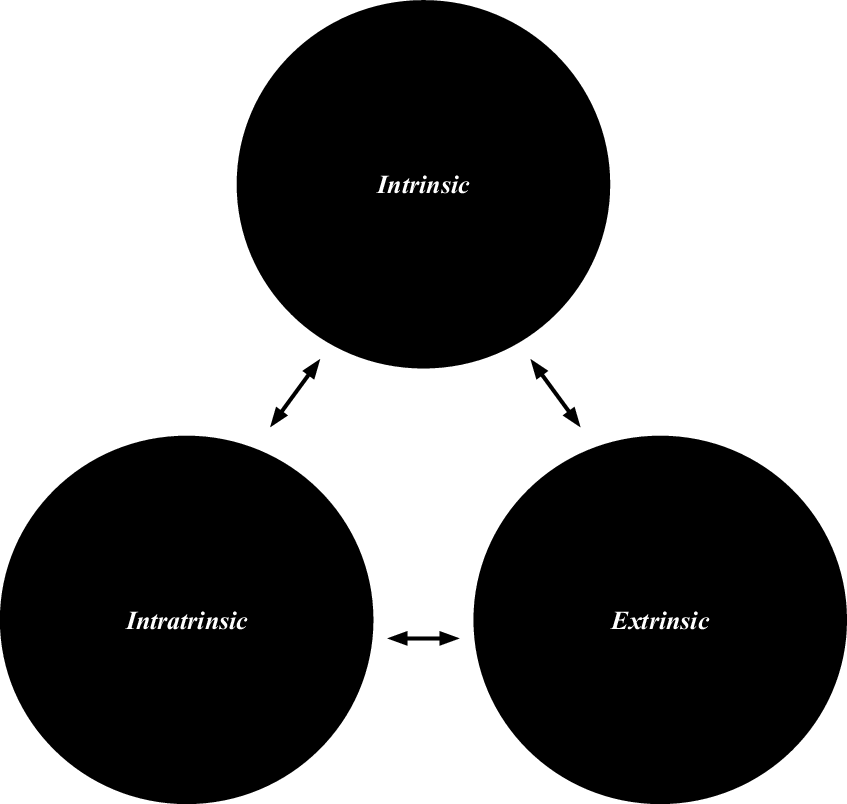
This could enable student-centred pedagogy to move beyond dualistic formulations, in order to focus on the “distributive agency” (Bennett, Reference BENNETT2010) of student–teacher groups (Hood & Kraehe, Reference HOOD and KRAEHE2017) through which efficacy and motivation are collectively (per-) formed. This would align student-centred pedagogy somewhat with a posthumanist understanding of agency as something which “happens because material bodies are always dependent on one another” (Hood & Kraehe, Reference HOOD and KRAEHE2017, p. 34), i.e., not divided into autonomous selves, but inter-reliant. In the case of group critique, students may feel how their sense of self is performed by the class and how their internalised motivations for study have a corresponding collectivity. As Clark observes, non-hierarchical partnership-based pedagogies demonstrate to students and teachers that “knowledge is socially constructed and that truth is sometimes hard to pin down” (Clark, Reference CLARK2018, p. 87). This makes teaching a causally non-linear process in which it is difficult to trace the precise origin of student motivation to any single actor; instead, efficacy is distributively performed. The teacher also performs their pedagogical knowledge through the class, meaning that the “student group” might conceivably comprise only a teacher and an individual student. Following Bayley’s recommendation that pedagogies should seek “performativity” rather than “performance” (i.e., emergence and movement rather than the acting out of fixed representations) (Bayley, Reference BAYLEY2016), one might go so far as to propose pedagogy as student-centring rather than merely student-centred, since the centres to which teachers and students must attend are in a constant state of flux and intra-action. Figure 1, below, illustrates this through a three-dimensional model of motivation, incorporating intrinsic, extrinsic and intratrinsic forms.
Three-Dimensional Model of Motivation.

Under the right circumstances then, validation can be a synthesis of teacher, student and peer group perspectives: teachers must carefully scrutinise students’ work and make clear their own background and value perspectives; students must act as independent thinkers by forming and investigating their own questions and peer-to-peer forms of learning must be developed for students to engage with and distributively shape one another’s development. In each case, validation comes not from positive comments about a student’s work but from making clear that their development is significant both to their peers and their teachers, and that they are capable of effecting and participating in positive change themselves. Once a student realises that their development is valued by others based on the work they have produced and will produce, it follows that they themselves recognise value in their practice even when they are not yet producing their best work. Students need not be high-level practitioners for this to be the case; part of recognising their own value perspectives lies in them developing an understanding of why they would like to further develop their practice. In a student-centred approach, learning comes as a result of a student’s teachers and peers recognising and engaging with these motivations.
Student-centred teaching in practice
Critical response process
One tool I have found especially useful in undertaking student-centred learning and teaching is CRP, a pedagogy designed by Lerman and Borstel to allow for the giving and receiving of useful feedback (Lerman & Borstel, Reference LERMAN and BORSTEL2003). I have used CRP with groups of students from very different musical backgrounds taking it in turns to present work to one another. CRP meets the definition given above of student-centred learning because it establishes a dialogue which variously engages the student, teacher and peer group. The process enables peers to comment on creative work in a way that does not damage relationships between members of the group or give rise to unduly positive (or negative) feedback. This is generally guided by a facilitator who helps ensure that participants do not stray from the structure and occasionally must play the role of referee if feedback is not constructive. CRP takes the form of a four-step process, beginning with the presentation of a piece of work in progress by a “presenter,” followed by “statements of meaning” given by a group of “responders” commenting on their experience. Facilitators initiate these statements by posing an opening question, such as “What was stimulating, surprising, evocative, memorable, touching, meaningful for you?” (Ibid, p. 19). These statements are followed by questions from the presenter to the responders, then by a series of neutral (or open) questions from responders designed to uncover more about the presenter’s motivations and creative approach, and finally a series of “permissioned opinions” (Ibid) from responders based on the presenter’s answers to the neutral questions posed. Intriguingly, because responders must first state the topic of their opinion the presenter can decline to hear these opinions if the stated topic does not appear relevant. This is intended to empower the presenter and thereby support them in the vulnerable task of showing their work.
CRP has been used in fields such as contemporary dance for some time but is less commonly practiced in music or music education. This may in part be due to a perceived conflict between music as a skill-based craft and music as a wider artistic practice. On the one hand, playing a violin to a high standard requires intensive physical training and the (often linear and graded) acquisition of a range of technical skills; on the other hand, knowing what to express and how to express oneself musically through these skills requires an artistic experience that needs to be developed through more reflective, less goal-directed study. In this sense, CRP acts as a mirror through which practitioners are able to see the gaps between their personal image of themselves and their work and its reception with others. Certainly, some of these gaps may require bridging through the undertaking of technical training, though where the need for this has been identified through a CRP session, the student will be able to understand the artistic need that drives this.
One of the principal tools of CRP is “neutral questioning,” meaning that questions are posed in such a way as to avoid revealing (or imposing) the opinion of the questioner. For example, instead of asking, “Why did you include the long guitar solo in the middle of the composition?” the responder asks something like, “How does the guitar solo extend or develop the drama?”. The former question suggests that the responder has the opinion that the guitar solo is too long, whilst the latter question indicates that the responder believes it is worth discussing the guitar solo but does not reveal exactly in what sense. This challenges the presenter to consider the wider context of the material in their composition and to reflect on how it might be used best. The presenter is asked not to attempt to read into the questions for embedded opinions but to assume the responder wants to learn more about how the presenter can develop their work. Conversely, the responder asking the question will be able to determine if their opinion on the guitar solo will be of relevance. For example, if the presenter answers by saying that the guitar solo is part of a guide track that will be replaced then the responder knows the presenter does not need to hear an opinion about it in its current form. In a mixed group of musicians with differing experiences and skillsets another benefit of using CRP is that, even when the precise technical demands of the practice may lie outside the knowledge base of those responding, the group as a whole are able to use the practice of neutral questioning to find ways of encouraging the presenter to find their own solutions.
CRP is effective at delivering on the triple goals of intrinsic, extrinsic and intratrinsic motivation described above. Firstly, it is beneficial in helping students to develop intrinsic motivation flowing from the control invested in them by the process. They do not need to practice scales simply because their teacher (or some other source of authority) tells them it is necessary; they do so because their peers have helped them understand what might be possible creatively if they develop these skills. Furthermore, in the forming of neutral questions and selection of permissioned opinions, they have been obligated to think critically about how well their current skill level allows them to communicate their intentions and on what areas they should be focussing for further development. Secondly, CRP provides extrinsic motivation for presenters by creating an expectation that responders will engage in helping them to find workable approaches rather than simply validating their work through praise (which in any case might be given disingenuously). The process asks responders to suspend their competitive instinct for a short time and to invest themselves in helping the presenter get a better perspective on their practice. Responders should aim to help the presenter “to do their best work, not something only as good as your last work” (Lerman & Borstel, Reference LERMAN and BORSTEL2003, p. 14). When the student’s peers take time to truly consider how they might develop as a practitioner, this external support provides additional motivation for further study and practice.
Thirdly, as a structure, CRP affords considerable opportunities for intratrinsic motivation to develop. Establishing a clear process acknowledges that the collective knowledge, skills and resources brought together in a given class can work together beyond the sum of their parts. CRP acts to constrain certain behaviours (e.g., competition) and enable others (e.g., cooperation) in pursuit of more creative, receptive and collaborative intra-actions. Without a defined structure, feedback sessions can be diffuse and unproductive; without clearly defined roles, it is difficult for students to know what is expected of them and harder for them to articulate their obligations towards one another. This means that professional rivalries can easily creep in with responders feeling pressured to give responses that reveal their own accomplishment or experience. CRP thereby potentiates the kind of non-linear, intrapersonal learning discussed above, enabling presenters and responders to responsively modify their understanding of one another’s work (and one another). In this sense, the process presupposes that learning will occur amongst all members of a group and that pedagogical agency is similarly distributed. Of course, teachers can invoke their institutional or professional authority to redirect the session focus, though such a move effectively constitutes a suspension of the process and, where a strong sense of distributive classroom agency is engendered, such a unilateral move might even be rejected by the students.
Student questionnaire on CRP
As part of the research for this article, I asked students taking part in a 4-week series of CRP sessions, led by my colleagues and me at Leeds Conservatoire, to comment on their experiences via an anonymous questionnaire (see Appendix 1). Respondents positively rated the effect that the sessions had on their self-efficacy and as a tool for developing a constructively critical group study environment. Responses to “Q1. What have you found most useful about the work in progress sessions on the course?” particularly highlight the agentially distributive nature of the CRP process. For example: “[…] collective opinions of the group, especially clashing opinions”; “[…] learning about other peoples [sic] methodologies and influences”; and “[…] the process of coming up with questions for the presenters makes me consider my own approaches to making music.” These responses illustrate intratrinsic forms of motivation enacted intrapersonally through the distributive agency of the CRP class; this enables responders to enrich their own disciplinary understanding whilst engaging the presenter in expressing their own perspective. These pedagogical benefits would not be possible without the combined and often “clashing” perspectives and capabilities of the whole group, including the teacher.
Responses to “Q2. How helpful did you find the Critical Response Process we used in sessions?” suggest that students view CRP was a useful structure to guide feedback sessions and drive personal development. For example: “[…] Insightful. Allowed us to be open and honest in a really positive way”; “Very helpful for personal development”; “Helpful as it structures the session”; “[…] it results in far more useful feedback than an unstructured feedback session would” and “[…] it makes you think in a different way.” However, on being asked “Q3. How well do you feel you understand the Critical Response Process?” students commented on the challenge of accurately following the four stages and of forming neutral questions, e.g., “The only area I struggled with is creating a question for this process”; and “I sometimes forget the stages but it is so useful!” These responses reveal the facilitative role which the teacher must play to make CRP effective; whilst the teacher may contribute subject-level expertise they must also be an expert at applying critical methodologies to uncover different ways of thinking and doing. Responses to “Q4. What would you like to see more of during work in progress sessions?” perhaps indicate scope in our MA Music curriculum for more and longer CPR sessions, e.g., “More of these sessions with everyone.” Other responses also relate to specific practical constraints on, for example, room size and availability which are likely peculiar to each institution, e.g., “[I would like] live performances, instead of backing track and mp3.”
Responses to “Q5. How have you acted on feedback received during work in progress sessions?” and “Q6. Is there anything else you would like to add?” indicate a broadly positive view of CRP as a motivational and developmental framework. For example: “It’s been really helpful, inspirational. It’s made me think and feel more supported within the course amongst my peers”; and “[…] it was helpful to play my music to people who don’t normally listen to that kind of music.” Overall, students commented that CRP was an effective pedagogical tool: “The process is the best way I’ve ever given on record feedback”; and “I think the Critical Response Process works really well.” This positive report is echoed in similar reviews of work in progress sharing at other institutions (e.g., Harris, Reference HARRIS, Haddon and Burnard2016). Of course, CRP is not a panacea, and a small number of responses suggest resistance to the non-hierarchical student-teacher relationships implied, e.g., “I felt that the feedback was good but I was hoping for some extra in depth feedback from the lecturers if possible”. This may relate to historical expectations about master–pupil relationships within a conservatoire setting based on a unidirectional understanding of knowledge transmission from teacher to student. Whilst we do not mandate MA Music teachers at Leeds Conservatoire to use CRP for individual tuition, this student comment perhaps indicates further scope for individual and group sessions to be more closely and transparently integrated so that student–teacher relationships can be consistently and robustly modelled throughout the student experience. In fact, one student suggested this directly in their response commenting, “I just think we should do it [CRP] throughout the whole course”.
Practice as research
As is clear from the example of CRP, student-centred pedagogies challenge students to generate knowledge about their subject under the guidance of their teachers and peer group, making them highly compatible with research-based learning and teaching approaches. Given the inherently multi-modal design of HME (at least within the United Kingdom), which almost invariably blends written or spoken forms of critique with expressive musical practice, there are rich opportunities for such student-centred research to take place. Being based at a conservatoire I am required to coach practitioners in preparation for employment within the creative industries (i.e., professional or non-professional music making in a variety of contexts), so I am especially interested in research models that foreground creative practice as a means of generating knowledge. Musicology or theoretical literature are certainly valuable but students studying practical music degree courses should not be expected to undertake two parallel programmes, one practical the other theoretical, or encouraged to replace their own practical understanding with that of other theoretical commentators. Instead, it is important to promote an equivalence of value between theoretical (largely written) and creative (e.g., musical) outputs and to encourage students to think of their practical and written work as centred on the same artistic and technical concerns. Students can think of themselves as practitioner-researchers exploring musical challenges through written work and testing the claims of theoretical literature through real-world musical practice (on interfaces between theory and real-world practice, see Morley & Jamil, Reference MORLEY and JAMIL2021).
Nelson’s “Dynamic Model for Practice as Research” (Nelson, Reference NELSON2006; 2013) provides a multi-mode model to guide artistic practice-based research projects. Nelson favours the term “practice as research” (PaR) because it implies a synonymity between practice and research, rather than relying on other forms of commentary to validate the knowledge generated through creative work. He also proposes that arts researchers accompany their creative work with a written commentary to further elaborate on the knowledge gained (Nelson, Reference NELSON2013). This is in line with the Research Excellence Framework guidelines 2021 (United Kingdom), which ask participating institutions to provide a short abstract to accompany any submissions in which “the research process, the research insights, and the time and manner of dissemination” are not evident in the output itself (Anon, 2019, p. 102). Nelson’s model highlights three areas of activity which any research project is likely to move between: creative practice, critical reflection and contextual study. Nelson shows how these activities map onto different knowledge paradigms: know-how (practice), know-what (critique) and know-that (context). He proposes that the three areas can all lead into one another so that a research project might begin with a contextual, critical or practice-based form of activity (Nelson, Reference NELSON2013, p. 37). In this respect, Nelson’s model flows naturally from real creative process, which may be initiated in response to practical experience, critical reflection or wider context.
The “Iterative Cyclic Web” (Smith & Dean, Reference SMITH and DEAN2009) is another example of a practice-based model with relevance to research-based pedagogy. The model identifies three domains of activity and associated outputs: “academic research” leading to “critical accounts [and] theorisations”; “research-led practice” leading to “theories and techniques” and “practice-led research” leading to artworks or documentation thereof (Ibid, p. 20). This offers a PaR framework parallel to Nelson’s model, focussed perhaps more directly on enabling practitioner-researchers to plot intended outputs. Whilst such a framework could have benefits for students planning suitable formats for their institutional assessments, I find Nelson’s model to have broader applicability as a pedagogical model due to its clear focus on ways of knowing rather than types of output. In a student-centred pedagogy based on individual, interpersonal and intrapersonal forms of activity, movement between different knowledge paradigms is paramount, with outputs acting predominantly as evidence of learning undertaken rather than a transmission of new knowledge in the academic sense. Indeed, PaR projects may begin without a conventionally formulated problem, instead progressing from “an enthusiasm of practice” (Haseman, Reference HASEMAN2006, p. 3), capturing something of the pedagogical “performativity” (Bayley, Reference BAYLEY2016) discussed above.
Considered as a form of student-centred learning, this kind of research-based study means that the teacher may not always be an expert in the field of enquiry (Clark, Reference CLARK2018). As with CRP, they must be experts in applying critical methodologies to their practice and to the practice of other practitioners. The role of the educator is to guide students as an equal partner through “a shared process that is inherently unpredictable in its outcomes” (Healey et al., Reference HEALEY, FLINT and HARRINGTON2014). Such an enquiry-led approach resonates with existing initiatives such as the Research=Teaching (R=T) initiative at UCL, which aims to identify ways in which staff and students can work in partnership to achieve mutual learning and development (Tong et al., Reference TONG, STANDEN and SOTIRIOU2018). For students, “what is produced and learned may not be new knowledge per se; but it is new to [them] and, perhaps more significantly, transforms their understanding of knowledge and research” (Healey et al., Reference HEALEY, FLINT and HARRINGTON2014, p. 43). This constitutes a “leading through” to knowledge (Nelson, Reference NELSON2006, p. 107), which drives intrinsic motivation by investing students with power, builds extrinsic motivation by challenging teachers to move towards the values and goals to which their student aspire and potentiates intratrinisc motivation by emphasising the distributive agency of the teacher–student group.
A student-centred framework for HME course design
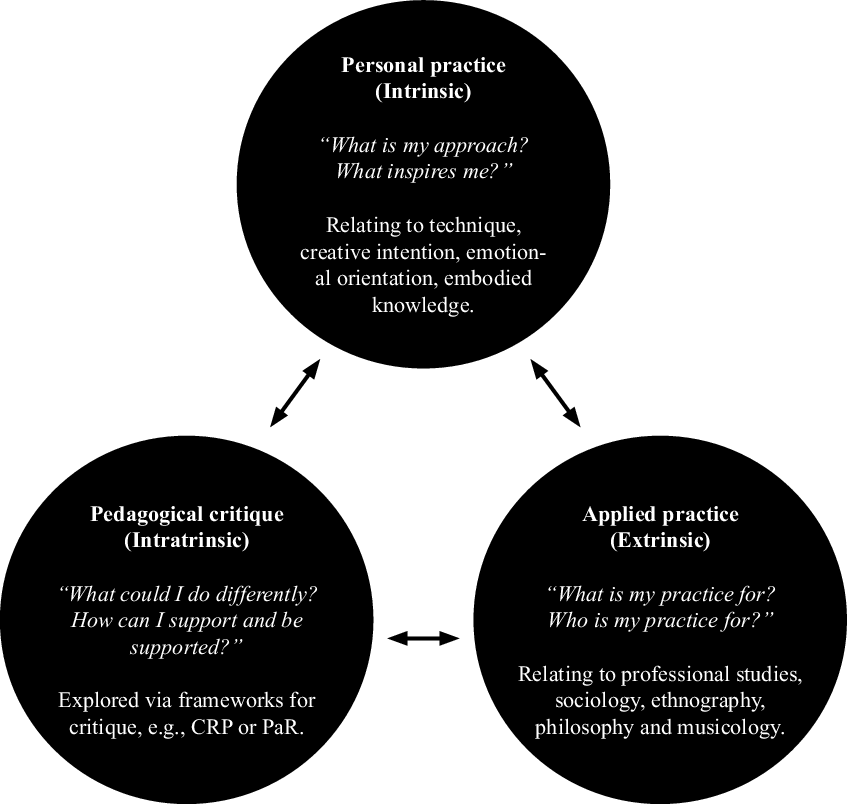
It is possible to adapt Nelson’s model to outline three overlapping areas of student practice: personal practice (know-how), pedagogical critique (know-what) and applied practice (know-that). Onto these can be mapped the three motivational dimensions outlined above (see Figure 1): intrinsic motivation maps to personal practice, intratrinsic motivation to pedagogical critique and extrinsic motivation to applied practice. Figure 2 below brings these areas together to provide a framework for student-centred HME course design. The framework outlines the relevant epistemological, motivational and practical considerations for each area, including two questions based on the themes raised in the contextual background and questionnaire responses above, which are designed to initiate reflection on development opportunities. Whilst the motivational dimensions are centred on different areas of practice, the significance of each is stressed not merely in isolation but in harmony with the other two areas. By mapping individual dimensions of motivation to separate areas I do not mean to imply that, for example, intrinsic motivation will not play a role in pedagogical critique. Instead, I aim to show how without personal practice intrinsic motivation will lack an experiential foundation, without appropriate pedagogical critique intratrinsic motivation will not grow, and without contextual knowledge of the relative positions of the student and teacher within creative and educational industries extrinsic motivation will lack potency. By “applied practice,” I mean the application of musical skills and knowledge to professional music making and academia (e.g., composition, performance, research, etc.), as well as the use of transferrable skills outside of music (e.g., team building, leadership skills, etc.). This connects with the definition from Morley and Jamil of real-world education as a means through which students apply their skills and knowledge to employment contexts (Morley & Jamil, Reference MORLEY and JAMIL2021); I choose to use “applied” instead to underline that, in a practice-based subject such as music, personal and pedagogical contexts outside of established workplaces can also have real-world significance.
Three Contexts for HME Course Design.

The framework I have proposed has parallels with Bolton and Delderfield’s (Reference BOLTON and DELDERFIELD2018) principles of reflective practice. They identify three forms of knowledge on which students and educators might focus: the “public area of knowledge,” which includes public policy and wider practice as expressed through professional or academic publications; the “personal area of knowledge,” which is private and idiosyncratic, and includes material (creative) practice; and the “shared area of knowledge,” which refers to the shared knowledge developed and embodied by the peer group of which the student and teacher are a part (Ibid, p. 52). Bolton and Delderfield argue that teachers should remain aware of these knowledge paradigms as different contexts in which students might pursue knowledge development. My model differs subtly from theirs in dividing material practice between all three areas: personal practice carried out in private, which is intended to develop technical or creative proficiency; pedagogically informed or peer-to-peer focussed practice, shaping work with input from teachers and fellow students and applied practice in a variety of professional and academic contexts.
Students are thus invited to bring their embodied, idiosyncratic understanding of their practice into contact with a pedagogical critique provided by the teacher and their peers. Students also contextualise their approach within applied contexts and seek referential points for their work in broader theoretical and philosophical debate, which may involve sharing their personal practice publicly outside of the institution. These areas of study can be moved through iteratively and in any order, depending on the student’s personal awareness and previous experience, and the orientations and capabilities of the group of which they are a part. Most importantly, students should be able to understand personal practice, pedagogical critique and applied practice as being equally valid “pathways through which musical creativities flow” (Blain, Reference BLAIN, Haddon and Burnard2016, p. 80), though each context affords different kinds of knowledge. This multi-directionality is a challenge to conventional research paradigms and by extension the associated pedagogies flowing from them, which typically place greater emphasis on objectivity and unidirectional knowledge transmission from teacher to student, or what Bayley refers to as a “download” and “banking” approach to learning and teaching (Bayley, Reference BAYLEY2016, p. 49).
Conclusions
This article has engaged with the concept of student-centred learning and teaching, seeking to reposition such pedagogies within parallel discussions on self-efficacy (Miksza, Reference MIKSZA2011; Ritchie, Reference RITCHIE, Miller, Sharp and Strong2012) and distributive classroom agency (Bayley, Reference BAYLEY2016; Hood & Kraehe Reference HOOD and KRAEHE2017; Bayley, Reference BAYLEY2018), in order to offer a three-dimensional model of motivation, centring on intrinsic, extrinsic and intratrinsic forms. In support of this thesis, I have outlined my experience of using CRP and PaR methodologies as pedagogical tools, exploring how these can be applied in conservatoire settings to potentiate motivational development and group cohesion. Based on the three-dimensional model of motivation and practice-led review of student-centred pedagogies, I have proposed a curriculum design model for HME pedagogy bringing together a range of different learning and artistic practice contexts of relevance to HME students.
A student-centred curriculum is dynamic and transparent, allowing students to see themselves framed through the practical and contextual work undertaken. Students are not required to absorb a single, pre-determined canon of knowledge but must be driven by their “enthusiasm of practice” (Haseman, Reference HASEMAN2006, p. 3) and the abilities of their teacher and peer group to submit these positions to a rigorous pedagogical critique. At the same time, all practitioners, whether students or more experienced musicians, must remain aware of the relevance of their skills within different applied contexts, be these professional or non-professional. It is for the student and teacher, together with the student’s peer group, to interrogate these expectations and to outline strategies through which appropriate skills can be developed. When a student has played a direct role in identifying a skills deficit themselves, instructive teaching towards this will be more readily received and more deeply understood than if the student is simply told what they need to know. Personal Construct Theory practitioners in psychology refer to the way in which “our identities are constructed rather than simply discovered,” arguing that people define themselves through “stories” that we act out in our daily lives (Fransella, Reference FRANESELLA2005, p. 237). The responsibility of educators is to enable students to challenge, redefine and augment these stories, and to contrast and interleave them with competing and parallel narratives about how to be a musician. Student-centred forms of learning and teaching distribute responsibility for learning between student, teacher and peer group, encouraging intra-active dialogue through which students are able to practice and construct their personal stories. Along the way, both students and teachers are able to learn more about the way they and others relate to their discipline.
Appendices
Appendix 1. Responses to Questionnaire on Critical Response Process
Questionnaire Design
The questionnaire was presented to a group of students participating in a 4-week series of work in progress sessions using the Critical Response Process, which I facilitated during autumn/winter 2018. Prior to the series, I gave a workshop on Critical Response Process for the group, explaining what it is and how to use it. My work in progress group was drawn from approximately half the overall class enrolled on the MMus Creative Musician 2018–19 (the course title has since changed to MA Music). Respondents from my group were asked to reflect on their experience of Critical Response Process, in support of research being undertaken for this article.
Questionnaire Form
This questionnaire asks you about your experience of Critical Response Process work in progress sessions during trimester 1 (academic year 2018–19). The results will be used to inform a forthcoming research publication exploring European approaches to pedagogy. You may answer as many, or as few of the questions below as you wish. Your answers will remain anonymous.
-
Q.1: What have you found most useful about the work in progress sessions on the course?
-
Q.2: How helpful did you find the Critical Response Process we used in sessions?
-
Q.3: How well do you feel you understand the Critical Response Process?
-
Q.4: What would you like to see more of during work in progress sessions?
-
Q.5: How have you acted on feedback received during work in progress sessions?
-
Q.6: Is there anything else you would like to add?
Please confirm you give permission for your responses to be published as part of a research project on European pedagogies. Yes/No
Summary of Responses
Eight work in progress session participants responded (of a possible thirteen). The table below summarises the written responses given for each question. Responses are given verbatim, including any spelling or punctuation irregularities.