Childhood conduct problems, including aggression, rule-breaking, and violence, predict risk for persistent antisocial behavior, substance abuse, and crime across the lifespan (Rivenbark et al., Reference Rivenbark, Odgers, Caspi, Harrington, Hogan, Houts and Moffitt2018). Clinically-significant conduct problems, including oppositional defiant disorder (e.g. irritability, anger, and defiance) and conduct disorder (e.g. violating rights of others or age-appropriate norms or rules) are common, with prevalence estimates ranging from 3% to 12% (Nock, Kazdin, Hiripi, & Kessler, Reference Nock, Kazdin, Hiripi and Kessler2007). The financial implications of conduct problems are significant owing to greater uptake of educational, health, juvenile justice, and psychosocial services (Rivenbark et al., Reference Rivenbark, Odgers, Caspi, Harrington, Hogan, Houts and Moffitt2018). However, there is heterogeneity in the course, prognosis, and treatment needs of children with conduct problems. The presence of callous-unemotional (CU) behaviors identifies a distinct subgroup of children with conduct problems who show low empathy and guilt, reduced emotional sensitivity, and apathy towards rules (Frick, Ray, Thornton, & Kahn, Reference Frick, Ray, Thornton and Kahn2014). Across development, CU behaviors predict severe and stable conduct problems (Frick et al., Reference Frick, Ray, Thornton and Kahn2014; Waller & Hyde, Reference Waller and Hyde2017, Reference Waller and Hyde2018). Etiological research beginning in early childhood (ages 2–5) has begun to explore precursors to CU behaviors, which is significant because it is when the developmental foundations for key markers of CU behaviors, including empathy and conscience, are laid (Kochanska, Reference Kochanska1997), and when severe trajectories of conduct problems have their origins (Campbell, Shaw, & Gilliom, Reference Campbell, Shaw and Gilliom2000; Rivenbark et al., Reference Rivenbark, Odgers, Caspi, Harrington, Hogan, Houts and Moffitt2018). Research focused on developmental precursors to CU behaviors can improve our ability to identify children at risk for persistent conduct problems and can elucidate novel targets for preventative interventions and treatments (Dadds, English, Wimalaweera, Schollar-Root, & Hawes, Reference Dadds, English, Wimalaweera, Schollar-Root and Hawes2019).
Low fearful arousal and deficits in social affiliation are two theorized developmental precursors to CU behaviors (Waller & Wagner, Reference Waller and Wagner2019). First, fearful arousal is the tendency to show reactive and highly threat-sensitive fear in response to potential danger, harm, or uncertainty in the environment (i.e. freezing, trembling, and facial expressions of fear; Mobbs, Reference Mobbs2018). Reduced fearful arousal is thought to contribute to the development of CU behaviors because the processes that would normally inhibit behavior in response to cues of punishment or threat (Frick & Morris, Reference Frick and Morris2004; Patrick, Fowles, & Krueger, Reference Patrick, Fowles and Krueger2009) or that would motivate adaptive and rule-compliant behavior (Fowles & Kochanska, Reference Fowles and Kochanska2000; Kochanska, Reference Kochanska1997) may be less efficient or absent. Reduced perception of and sensitivity to cues of others' fear is also thought to undermine empathic, caring, or helping responses, which could further contribute to the development of CU behaviors (Blair, Reference Blair2013; Marsh, Reference Marsh2017; Marsh, Reference Marsh2019). In support of these theoretical positions, longitudinal evidence has begun to link observations of child fearlessness assessed between 18 months and 3 years old with the emergence of CU behaviors in early childhood (Goffin, Boldt, Kim, & Kochanska, Reference Goffin, Boldt, Kim and Kochanska2018; Waller et al., Reference Waller, Trentacosta, Shaw, Neiderhiser, Ganiban, Reiss and Hyde2016; Waller, Shaw, & Hyde, Reference Waller, Shaw and Hyde2017). Preschool children with high levels of CU behaviors also exhibited fear recognition deficits, including less attentional orientating to distress cues (Kimonis et al., Reference Kimonis, Fanti, Anastassiou-Hadjicharalambous, Mertan, Goulter and Katsimicha2016; White et al., Reference White, Briggs-Gowan, Voss, Petitclerc, McCarthy, Blair and Wakschlag2016).
Second, social affiliation is the intrinsic motivation for close social relationships, evidenced through social touch, smiles, vocalizations, gestures, and body postures (Depue & Morrone-Strupinsky, Reference Depue and Morrone-Strupinsky2005). Low social affiliation is thought to underpin risky pathways to CU behaviors by undermining the processes through which empathy, cooperation, and conscience are typically socialized (Kochanska, Reference Kochanska2002; Viding & McCrory, Reference Viding and McCrory2019; Waller & Hyde, Reference Waller and Hyde2018). In support of this notion, observations of low social affiliation, which have included measurement of eye-contact, mutual gaze, and affection, assessed between 18 months and 4 years, have been linked to CU behaviors (Bedford, Pickles, Sharp, Wright, & Hill, Reference Bedford, Pickles, Sharp, Wright and Hill2015; Waller et al., Reference Waller, Trentacosta, Shaw, Neiderhiser, Ganiban, Reiss and Hyde2016). In sum, there is emerging evidence linking variability in two dimensions of temperament, reduced fear sensitivity and low social affiliation, to the development of CU behaviors.
In addition to the child characteristics of fearlessness and low social affiliation, multiple empirical studies from the preschool implicate parenting practices in the development of CU behaviors. For example, beginning at ages 2 and 3 years, lower levels of parental warmth (Pasalich, Dadds, Hawes, & Brennan, Reference Pasalich, Dadds, Hawes and Brennan2011; Waller et al., Reference Waller, Gardner, Viding, Shaw, Dishion, Wilson and Hyde2014; Waller et al., Reference Waller, Shaw, Neiderhiser, Ganiban, Natsuaki, Reiss and Hyde2017) and higher levels of parental harshness (Mills-Koonce, Willoughby, Garrett-Peters, Wagner, & Vernon-Feagans, Reference Mills-Koonce, Willoughby, Garrett-Peters, Wagner and Vernon-Feagans2016; Waller et al., Reference Waller, Gardner, Hyde, Shaw, Dishion and Wilson2012) have been shown to predict increases in CU behaviors across the preschool period. While these studies explored the direct effects of parenting on CU behaviors, the impact of parenting can also depend upon children's own predispositions (Kochanska, Reference Kochanska1997; Kochanska, Kim, Boldt, & Yoon, Reference Kochanska, Kim, Boldt and Yoon2013). For example, the impact of harsh parenting on risk for CU behaviors might be exacerbated for children with low fearful arousal. More specifically, the experience of overly harsh parenting could further desensitize the child to threat cues (Patrick et al., Reference Patrick, Fowles and Krueger2009; Waller & Hyde, Reference Waller and Hyde2018). Alternatively, low levels of parental warmth could stymy the development of empathy and cooperation for children who already have low socioaffiliative motivation (Waller et al., Reference Waller, Trentacosta, Shaw, Neiderhiser, Ganiban, Reiss and Hyde2016; Waller & Hyde, Reference Waller and Hyde2018). That is, among children with a tendency for low social affiliation, an absence of rewarding affiliative interactions with a parent (i.e. warm and affectionate parental inputs), may mean that a child has even fewer opportunities to mimic, practice, or develop affiliative behavior, increasing risk for CU behaviors.
To date, however, existing research offers somewhat contrasting findings regarding the interplay between parenting and child characteristics centered on fearful arousal or social affiliation in the development of CU behaviors. For example, in one study, harsh parenting exacerbated the effects of fearlessness at age 2 on CU behaviors at age 13, controlling for parental warmth (Barker, Oliver, Viding, Salekin, & Maughan, Reference Barker, Oliver, Viding, Salekin and Maughan2011), whereas in a second study, positive parenting in early childhood exacerbated the effects of fearlessness at age 2 on CU behaviors at age 4, controlling for parental harshness (Waller, Shaw, & Hyde, Reference Waller, Shaw and Hyde2017). In another study, observed parental positive reinforcement during a clean-up task mitigated the effects of observed child fearlessness on later CU behaviors, but parental harshness was not assessed (Waller et al., Reference Waller, Trentacosta, Shaw, Neiderhiser, Ganiban, Reiss and Hyde2016). The results of these prior studies offer an inconsistent picture of how parenting practices might interact with specific child characteristics (i.e. fearlessness and low social affiliation) in relation to risk for CU behaviors. A key limitation of these prior studies is that parental warmth and harshness have not been consistently included in the same statistical model when predicting CU behaviors. Moreover, no studies have tested the potential for specificity in potential interactions between parental warmth and child social affiliation and between parental harshness and child fearlessness taking into account the co-occurrence of these different parenting practices and child characteristics.
In addition, the majority of prior studies examining fearlessness and CU behaviors have focused on very brief assessments of children's responses to non-social stimuli (i.e. single trials lasting a few minutes), including scary or novel toys (Barker et al., Reference Barker, Oliver, Viding, Salekin and Maughan2011; Waller et al., Reference Waller, Trentacosta, Shaw, Neiderhiser, Ganiban, Reiss and Hyde2016) or noises (Waller, Shaw, & Hyde, Reference Waller, Shaw and Hyde2017). Assessment of fearlessness in the context of real-world social cues (i.e. ‘social fearlessness’) could provide a stronger test of models that propose that CU behaviors develop, in part, when children are unresponsive following parental, teacher, or other adult efforts to manage their behavior via contingency-based learning. Likewise, social affiliation occurs across a broad range of social interactions and contexts, all of which are likely informative about children's motivation for, initiation, and maintenance of social closeness. However, prior studies exploring deficits in social affiliation and CU behaviors have focused only on brief and single tasks centered on the parent–child relationship (Dadds et al., Reference Dadds, Allen, Oliver, Faulkner, Legge, Moul and Scott2012; Waller et al., Reference Waller, Trentacosta, Shaw, Neiderhiser, Ganiban, Reiss and Hyde2016). To address these gaps in the literature, the current study generated ecologically-valid assessments of both fearlessness and social affiliation closer to ‘real world’ experiences using an observational assessment period that lasted 2–3 h with 11 different behavioral situations assessing fear to novelty (e.g. new or scary things), social fear (e.g. stranger tasks), or social engagement with adults.
In the current study, we simultaneously examined the direct effects of both observed fearlessness and social affiliation on later CU behaviors. We hypothesized that observed fearlessness and low social affiliation at age 3 would be independently related to higher CU behaviors at age 5, accounting for earlier CU behaviors and other covariates. Second, we examined whether parental harshness and warmth moderated the effects of fearlessness and low social affiliation on later CU behaviors. We hypothesized specificity in these interactions such that the effect of fearlessness on later CU behaviors would be exacerbated by high levels of parenting harshness, and that the effects of low social affiliation on later CU behaviors would be exacerbated in the context of low parental warmth (Waller & Hyde, Reference Waller and Hyde2018). Finally, to establish specificity to CU behaviors rather than other early markers of childhood conduct problems, we tested models with oppositional-defiant behaviors at age 5 as the outcome, controlling for co-occurring CU behaviors. We hypothesized that there would be no significant effects of fearlessness and low social affiliation at age 3 on later oppositional-defiant behaviors. That is, we hypothesized specificity in the effect of early fearlessness and low social affiliation on later CU behaviors, but not oppositional-defiant behaviors.
Method
Participants
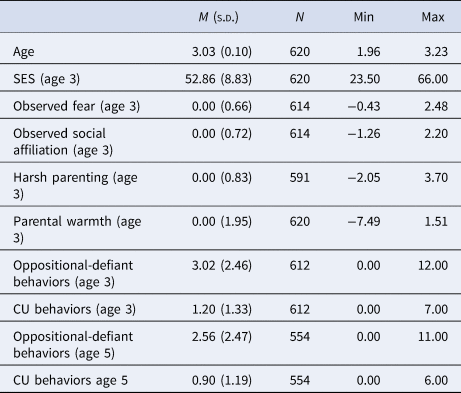
Participants were from the Boston University Twin Project and were recruited from birth records supplied by the Massachusetts Registry of Vital Records. Twins were selected preferentially for higher birth weight and gestational age. No twins with birth weights below 1750 g or with gestational ages less than 34 weeks were included in the study. Twins were also excluded if they had a known developmental disorder (e.g. chromosomal abnormalities) that might affect task performance. Six hundred and twenty twins (310 pairs; 50.6% female) participated in the age 3 assessment. Five hundred and fifty four (277 twin pairs) were reassessed at age 5. Race and ethnicity were generally representative of the Massachusetts population (89.4% European-American; 7% Hispanic/Latino/a). Socioeconomic status according to the Hollingshead Four Factor Index (Hollingshead, 1975) ranged from low-to-upper middle class (M = 52.86, s.d. = 8.83).
Procedure
Participants completed a laboratory visit of 2–3 h within ~1 month of their third and fifth birthdays. Informed consent was obtained from primary caregivers. Both twins were assessed separately across 11 behavioral situations, including the NIH Toolbox Cognitive Battery-Preschool Edition, Bracken School Readiness Assessment, and nine tasks from the Laboratory Temperament Assessment Battery-Preschool Version (Lab-TAB; Goldsmith, Reilly, Lemery, Longley, & Prescott, Reference Goldsmith, Reilly, Lemery, Longley and Prescott1999), including the Pop-up snake, Arc of toys, and Bead sort, which were administered by trained Research Assistants (see Supplemental Methods for detailed descriptions). All tasks were video recorded for later behavioral coding by a team of 20 coders who were randomly assigned to code videos (although the same coder never coded both twins within a twin pair). All coders were trained to a reliability of >0.80. Twenty percent of videos were coded by two different coders to calculate inter-rater reliability for each domain (see Supplemental Methods for more details).
Measures
Oppositional defiant and CU behaviors
Measures of oppositional-defiant and CU behaviors at ages 3 and 5 were derived from parent reports on the Achenbach System of Empirically Based Assessment, Preschool Forms (Achenbach & Rescorla, Reference Achenbach and Rescorla2000). The ASEBA includes a DSM-referenced scale for oppositional-defiant behaviors comprised of six items (e.g. ‘defiant,’ ‘disobedient,’ and ‘angry moods’). Five items from the ASEBA (e.g. ‘no guilt after misbehavior,’ ‘punishment does not change behavior,’ and ‘unresponsive to affection’) were used to measure CU behaviors (for reviews of this approach, see Waller & Hyde, Reference Waller and Hyde2017; Waller & Hyde, Reference Waller and Hyde2018). Internal consistency was high for measures of oppositional-defiant behaviors (age 3, α = 0.82; age 5 α = 0.83) but low for the measure of CU behaviors (age 3, α = 0.55; age 5, α = 0.59), although largely consistent with prior studies that have used these five items (Waller & Hyde, Reference Waller and Hyde2018; Waller, Shaw, & Hyde, Reference Waller, Shaw and Hyde2017).
Observed social affiliation
Children's social affiliation was operationalized as attempting to talk to, play with, and/or elicit a response from experimenters (e.g. smiling, vocalizations, or gesturing to get tester's attention) or responding to or elaborating upon questions asked (e.g. child tells a story instead of a short answer) across 11 behavioral episodes. Coders rated children's social affiliation during each laboratory episode on a 5 point scale. To receive a ‘5’ rating, multiple counts of social affiliation needed to be present during the task, whereas a ‘1’ rating indicated that the child did not try to engage others or respond to questions. Scores from across all 11 tasks were averaged for an overall social affiliation score (α, age 3 = 0.85). Inter-rater reliability based on independent coding of 20% of the videos was good (ICC = 0.85).
Observed fear
Fear was assessed by rating the frequency and intensity of children's fearful behaviors across each of the 11 behavioral episodes. For each behavioral episode, children were rated on a scale of 1–5, with ‘5’ being highly fearful and ‘1’ being low in fear. To receive a rating of ‘1’, the child showed no freezing, caution, or hesitation in responding to the experimenter or tasks. In contrast, to receive a rating of ‘5’, the child showed a range of behavioral indices of fear, including crying and refusing to participate in the task and/or crying while completing the task, standing frozen in the room without participating in any tasks, needing the parent in the room, or needing to be physically next to the parent. Scores from each task were averaged together to form an overall fear score (α = 0.90). Inter-rater reliability based on independent coding of 20% of the videos was excellent (ICC = 0.90).
Parenting (age 3)
Parent reports of parenting were based on published measures used in the Twins Early Development Study at similar ages (Knafo & Plomin, Reference Knafo and Plomin2006). Harsh parenting was assessed via two items focused on displays of negative discipline (Knafo & Plomin, Reference Knafo and Plomin2006), which had been adapted from a widely-used semi-structured interview assessing parent practices (Deater-Deckard, Reference Deater-Deckard2000). Parents rated items on a 5-point scale ranging from 1 (rarely or never do this) to 5 (usually do this) to indicate how frequently they ‘spanked or slapped’ their child or ‘yelled at’ their child. The reliability of the scale was low (α = 0.53), likely influenced by only including two items, which could render the alpha interpretation somewhat meaningless (Eisinga, Te Grotenhuis, & Pelzer, Reference Eisinga, Te Grotenhuis and Pelzer2013). However, these items have previously been shown to form a separate factor from the other discipline items in the scale and our goal was to capture displays of negative and harsh discipline as indexed by these two items (Knafo & Plomin, Reference Knafo and Plomin2006). Parental warmth was assessed via nine items from the positive subscale of the Parent Feelings Questionnaire (Deater-Deckard, Reference Deater-Deckard1996) that tapped displays of positive and warm parenting (e.g. ‘I enjoy hugging or cuddling this child’ and ‘I am usually affectionate with this child’), which loaded together to form parental warmth factor (range, β = 0.54–0.91, p < 0.001). Items were rated on a 5-point scale ranging from 1 (definitely untrue) to 5 (definitely true) and the scale showed adequate-to-good reliability (α = 0.71).
Analytic plan
Although a twin sample was used, the focus of the analyses was phenotypic (i.e. not genetically-informed). We estimated path models regressing children's oppositional-defiant and CU behaviors at age 5 onto fear, social affiliation, parental harshness, and parental warmth at age 3. Covariates were sex, child age, socioeconomic status, and either and concurrent CU behaviors or oppositional-defiant behavior as relevant. All participants with complete or partial data were included in the analyses using Full-Information Maximum Likelihood (Enders & Bandalos, Reference Enders and Bandalos2001), which effectively deals with missing data and provides less biased parameter estimates than other techniques (Enders & Bandalos, Reference Enders and Bandalos2001). Of note, the 66 participants (33 twin pairs) lost to follow-up did not differ significantly on any of the predictors at age 3. All analyses were conducted in Mplus 7.4 (Muthén & Muthén, Reference Muthén and Muthén2019). Corrections to the standard errors in each predictive model to account for non-independence of observations due to the nested structure of the data (i.e. twins are nested in families) were addressed using the TYPE = COMPLEX and CLUSTER commands in Mplus (Asparouhov & Muthen, Reference Asparouhov and Muthén2006).
Results
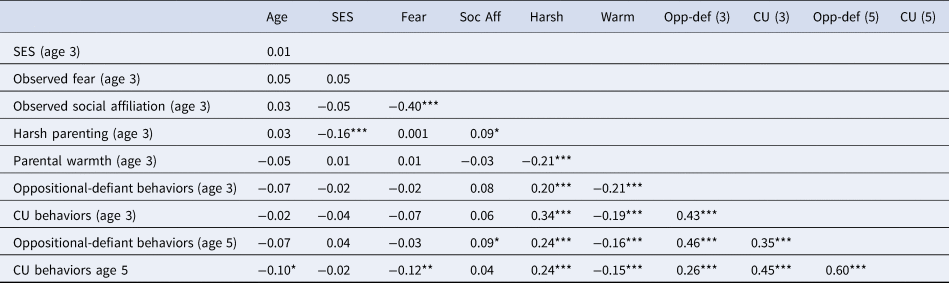
Descriptive statistics are presented in Table 1 and bivariate correlations in Table 2. Higher parental harshness was correlated with lower warmth at age 3 (r = −0.21, p < 0.001) and CU behaviors and oppositional-defiant behaviors were moderately correlated both within and across age (range, r = 0.26–0.60, p < 0.001). Moreover, fearlessness was correlated with lower social affiliation (r = −0.40, p < 0.001). These bivariate associations reinforced the strategy of exploring main and interactive effects within multivariate models capable of identifying specificity in the relationships between measures of interest while accounting for overlapping variance based on method or problem behavior severity.
Descriptive statistics for continuous study variables

Bivariate correlations between continuous study variables

Note. There were no significance differences between boys and girls on any study variables with the exceptions that boys were reported to experience lower parental warmth than girls (t = −2.03, p < 0.05) and boys had higher CU behaviors at age 3 (t = −3.02, p < 0.01). Sex was included as a covariate in all subsequent analyses. There were no significant differences in scores on any study variables based on race (European American v. Other) or ethnicity (Hispanic v. non-Hispanic), although this was largely homogenous sample on the basis of race/ethnic groups. Race and ethnicity were not included in analyses presented subsequently, although their inclusion did not change the findings (results available on request).
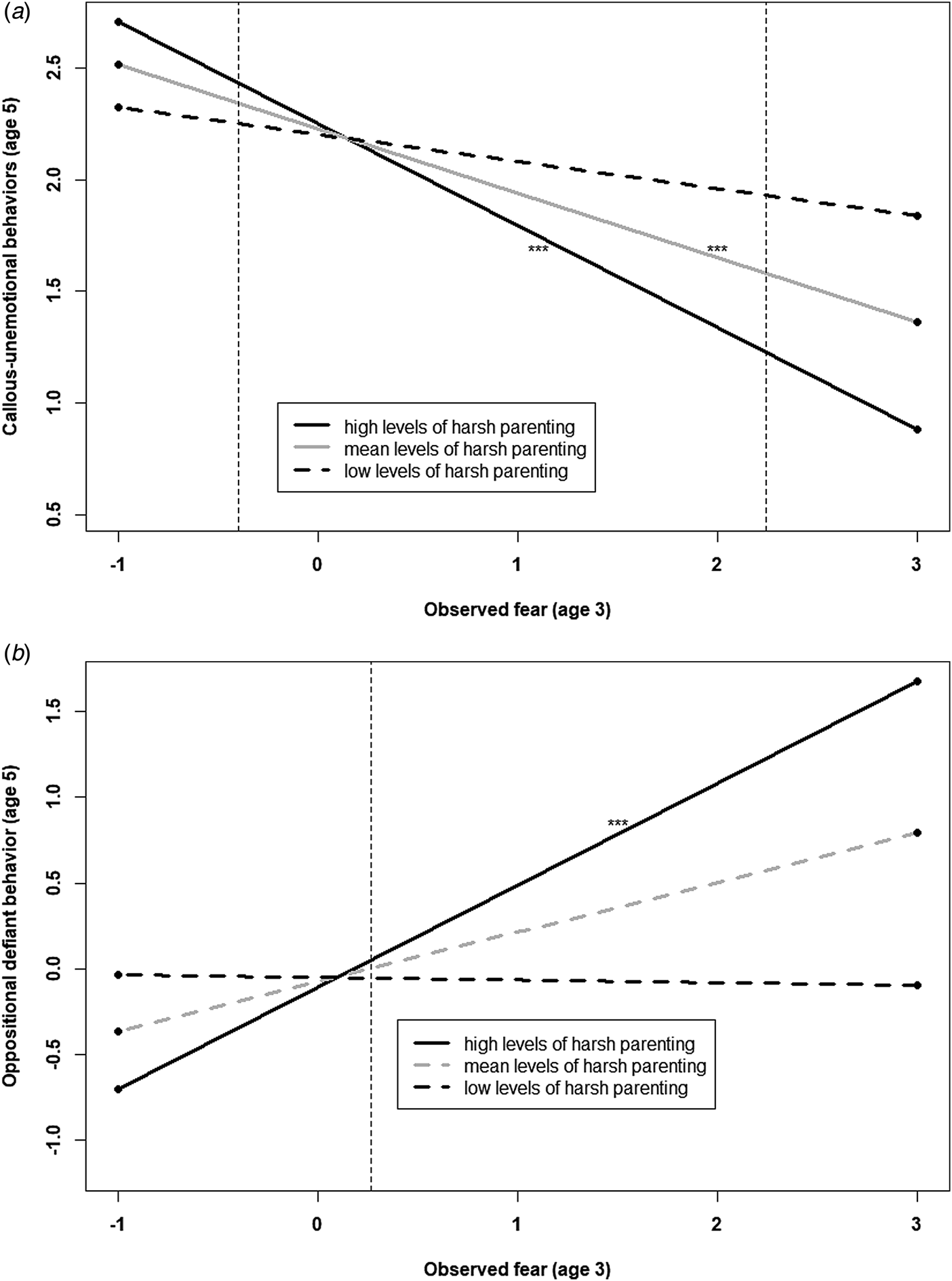
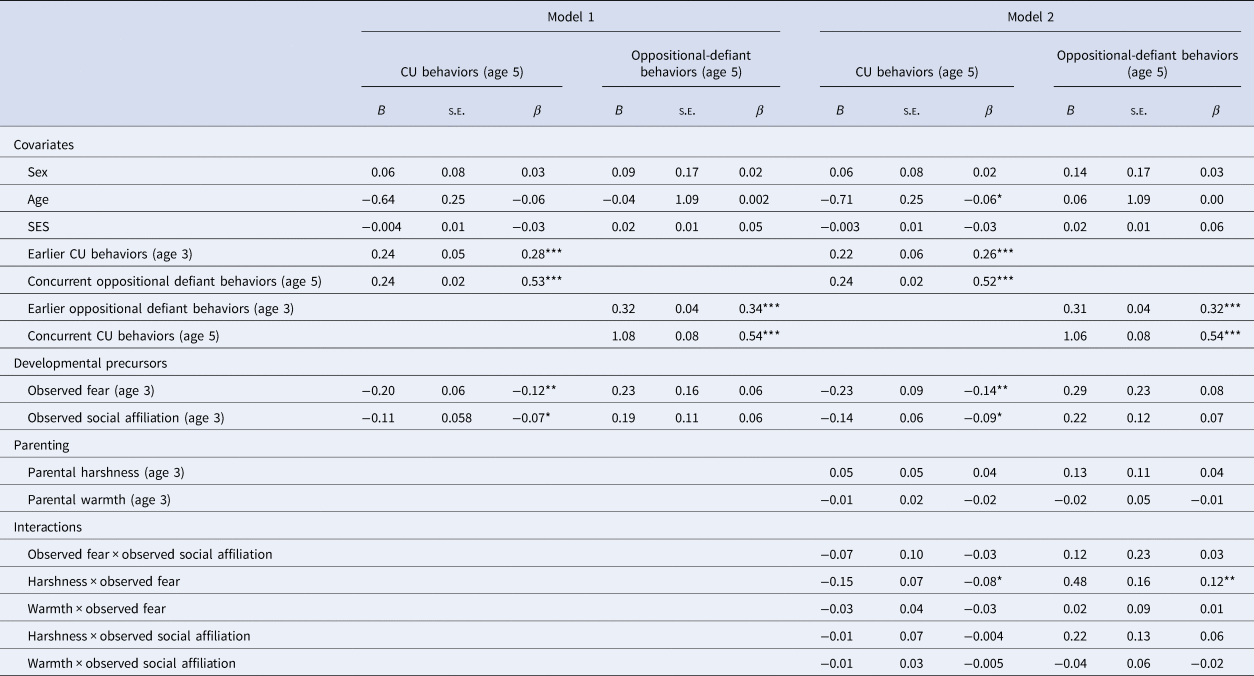
First, we examined a multivariate model testing main effects of observed fear and social affiliation and parental harshness and warmth at age 3 on CU behaviors at age 5, controlling for co-occurring oppositional-defiant behaviors, earlier CU behaviors, sex, SES, and age (Table 3). Consistent with hypotheses, lower fear (β = −0.12, p < 0.01) and lower social affiliation (β = −0.07, p < 0.05) at age 3 were related to higher CU behaviors at age 5. Second, we tested whether these main effects were qualified by interactions with parental harshness and warmth (Table 3). In line with hypotheses, there was a significant interaction between fear and harsh parenting at age 3, but not fear and parental warmth, in the prediction of CU behaviors at age 5 (β = −0.08, p < 0.05). Probing this interaction revealed that low fear was significantly related to higher CU behaviors when children experienced high (B = −0.31, s.e. = 0.07, p < 0.001) or mean (B = −0.20, s.e. = 0.06, p < 0.001), but not low levels (B = −0.09, s.e. = 0.07, p = 0.24) of harsh parenting (Fig. 1). Regions of significance indicated that the association held for children scoring below the mean for observed fear or for children scoring more than approximately two standard deviations above the mean. There was no significant interaction between social affiliation and either harsh parenting or parental warmth.
Differential effects of the interaction between harsh parenting and observed fear at age 3 on later CU behaviors v. oppositional-defiant behaviors at age 5.
Note. ***p < 0.001. Values for observed fear represent centered values. (a) Observed fear was significantly related to CU behaviors when children experienced high (B = −0.31, s.e. = 0.07, p < 0.001) or mean (B = −0.20, s.e. = 0.06, p < 0.001), but not low levels of harsh parenting (B = −0.09, s.e. = 0.07, p = .24). Regions of significance (dotted line) indicate that at levels of observed fear below −0.40 (n = 239), high and mean levels of harsh parenting are related to higher CU behaviors, but at levels of fear above 2.24 (n = 9), high and mean levels of harsh parenting predicted lower CU behaviors. (b) Observed fear was significantly related to oppositional-defiant behaviors when children experienced high levels of parental harshness (B = 0.41, s.e. = 0.17, p < 0.05), but not mean (B = 0.20, s.e. = 0.17, p = 0.16) or low (B = −0.01, s.e. = 0.16, p = 0.95) levels of parental harshness. Regions of significance (dotted line) indicate the effects of harsh parenting on later oppositional-defiant behaviors applied only for observed fear scores above 0.27 (n = 140).

Multiple regression analyses showing differential main and interactive effects of low fear, low social affiliation, harsh parenting, and low parental warmth at age 3 on later CU behaviors v. oppositional defiant behaviors at age 5

We modeled pathways from all covariates (age, sex, and SES) to all other predictors in the models.
***p < 0.001, **p < 0.01, *p < 0.05.
Finally, to establish specificity of effects for CU behaviors, we examined a model testing main and interactive effects of observed fear and social affiliation and parental harshness and warmth at age 3 on oppositional-defiant behaviors at age 5, controlling for co-occurring CU behaviors, earlier oppositional-defiant behaviors, sex, SES, and age. Consistent with our specificity hypotheses, there were no main effects of fear and low social affiliation on later oppositional-defiant behaviors (Table 3). However, we found a significant interaction between parental harshness and observed fear (β = 0.12, p < 0.05). In this case higher fearful arousal was associated with increases in oppositional-defiant behaviors from ages 3 to 5 among children who experienced high levels of parental harshness (B = 0.41, s.e. = 0.17, p < 0.05), but not children who experienced mean (B = 0.20, s.e. = 0.17, p = 0.16) or low (B = −0.01, s.e. = 0.16, p = 0.95) levels of parental harshness (Fig. 1). There were no other significant main effects of social affiliation or main or interactive effects of parental harshness or warmth.
Discussion
The current study establishes fearlessness and deficits in social affiliation as important precursors of CU behaviors in early childhood. We found that observed fearlessness and low social affiliation directly predicted increases in CU behaviors, but not oppositional-defiant behaviors, from ages 3–5. Additionally, harsh parenting moderated the link between fearlessness and CU behaviors such that fearless children who experienced harsher parenting exhibited the highest levels of CU behaviors. This study is the first to demonstrate specificity in the longitudinal relationship between observed fearlessness and low social affiliation and later CU behaviors, thus advancing research on the etiological underpinnings of CU behaviors (Waller & Wagner, Reference Waller and Wagner2019). We also provide further insight into the specific types of caregiving environments in which risk for CU behaviors may be exacerbated, an important step toward informing the development of mechanistically-targeted and individualized treatment strategies.
There is a growing consensus that fearlessness is a developmental precursor that impacts the development of CU behaviors in early childhood (Waller et al., Reference Waller, Trentacosta, Shaw, Neiderhiser, Ganiban, Reiss and Hyde2016; Waller & Hyde, Reference Waller and Hyde2018). Impairments in fearful arousal are thought to undermine the typical inhibitory functions of environmental cues that provoke behavior change, caution, or sensitivity to others, thus increasing risk for CU behaviors (Blair, Reference Blair2013; Frick et al., Reference Frick, Ray, Thornton and Kahn2014; Marsh, Reference Marsh2017; Patrick et al., Reference Patrick, Fowles and Krueger2009). The specificity in early fearlessness effects on CU behaviors, but not oppositional-defiant behaviors, is consistent with evidence that CU behaviors demarcate a qualitatively distinct subgroup of children at risk of conduct problems characterized by punishment insensitivity, low guilt, and uncaring about rules. The current findings support this view and the findings of prior studies of fearlessness and CU behaviors in the early childhood period (Barker et al., Reference Barker, Oliver, Viding, Salekin and Maughan2011; Waller, Shaw, & Hyde, Reference Waller, Shaw and Hyde2017). The findings make a novel contribution to the literature by employing a generalizable observational measure across a significantly longer assessment period than prior studies, which included multiple changing social and nonsocial situations, thus mapping more closely onto the typical socialization situations when parents, teachers, and other adults interact with children.
We also explored the role of harsh and warm parenting, which have previously been implicated in the development of CU behaviors (Mills-Koonce et al., Reference Mills-Koonce, Willoughby, Garrett-Peters, Wagner and Vernon-Feagans2016; Trentacosta et al., Reference Trentacosta, Waller, Neiderhiser, Shaw, Natsuaki, Ganiban and Hyde2019; Waller et al., Reference Waller, Gardner, Hyde, Shaw, Dishion and Wilson2012). Consistent with prior reports (Barker et al., Reference Barker, Oliver, Viding, Salekin and Maughan2011), the main effect of observed fear on later CU behaviors was partly contingent on harsh parenting, but not parental warmth. Children who showed low fear and experienced harsh parenting had significantly higher CU behaviors, whereas children with high fear who experienced harsh parenting had significantly lower CU behaviors. Interestingly, we found the opposite pattern of findings for oppositional-defiant behaviors, even in the absence of a main effect of fear. Specifically, higher levels of fear and experiencing more parental harshness predicted increases in oppositional-defiant behaviors from 3–5 years old. These findings replicate and extend classic developmental work showing that parental discipline promotes conscience development in relatively fearful toddlers, but not fearless toddlers (Kochanska, Reference Kochanska1997). We extend these findings by establishing that the combination of child fearlessness and parental harshness is detrimental to socialization because of its impact on emergent CU behaviors. More specifically, the experience of harsh parenting may desensitize already fearless children to cues of threat or negative reinforcement from the environment. On the flip side, harsh parenting may exacerbate risk for oppositionality, negative reactivity, and emotion dysregulation, specifically among highly fearful children.
The current findings also contribute to a growing body of evidence that points to deficits in socioaffiliative motivation as being an important, and specific, precursor to CU behaviors (Waller & Wagner, Reference Waller and Wagner2019). We found that fewer observed instances of social affiliation (e.g. based on coders rating the presence of vocalizations, gestures, and smiles) specifically predicted increases in CU behaviors, but not oppositional-defiant behaviors. Socioaffiliative motivation in early childhood lays the foundation for healthy attachment relationships, social bonding, and relationship formation across the lifespan (Depue & Morrone-Strupinsky, Reference Depue and Morrone-Strupinsky2005). In particular, caregiver-child affiliative interactions help to scaffold children's internalization of empathic, cooperative, and prosocial behaviors (Depue & Morrone-Strupinsky, Reference Depue and Morrone-Strupinsky2005), all of which are processes that appear to have gone awry among children with CU behaviors. In contrast to hypotheses however, these effects were not moderated by parental warmth. It may be that the measure of parental warmth used in the current study failed to characterize the sensitive and contingent responding implicated in the development of socioaffiliative processes or that these processes may have occurred earlier in development prior to our first assessment at age 3. Nevertheless, our findings provide a foundation upon which future research using narrower measurement approaches to assess parental nurturance, attachment, or warmth could elucidate interactions between infants and their caregivers that impact risk for later CU behaviors.
Of note, while regression model results indicated that low social affiliation at age 3 predicted increases in CU behaviors, social affiliation and CU behaviors were not correlated concurrently or longitudinally within bivariate models. At the same time, more social affiliation at age 3 was concurrently related to lower observed fear at age 3 and longitudinally related to higher oppositional-defiant behaviors at age 5. The possibility that the predictive link between low social affiliation and later CU behaviors arose as a statistical artifact should therefore not be overlooked. However, we suggest instead that the overlapping variance between social affiliation, low fear, and oppositional-defiant behavior is akin to a more general exuberance or boldness phenotype (Nigg, Goldsmith, & Sachek, Reference Nigg, Goldsmith and Sachek2004; Stifter, Putnam, & Jahromi, Reference Stifter, Putnam and Jahromi2008), and that our finding represents the association between CU behaviors and low socioaffiliative motivation and engagement that emerges once variance in this broader construct, or once variance in interactions with parenting, are parsed within multivariate models.
Although our study had strengths, including a prospective longitudinal design, observational measures, and stringent multivariate models, we note some limitations. First, the five-item CU behaviors measure we used had low internal consistency. However, the internal consistency estimates are consistent with those previously reported by studies using the same five items, and the construct and predictive validity of this brief measure has now been widely-established (for reviews, see Waller & Hyde, Reference Waller and Hyde2017; Waller & Hyde, Reference Waller and Hyde2018). Second, although this was a twin study, covariances between CU behaviors and observed fearlessness and social affiliation were too low to meaningfully decompose into genetic and environmental influences contributing to these associations. Future twin studies with larger sample sizes are warranted to explore potential genetic v. environmental influences on fearful arousal and socioaffiliative motivation. In particular, while heritability estimates for CU behaviors range from 40% to 79% (Viding & McCrory, Reference Viding and McCrory2012), such estimates tell us little about what may be inherited. Accordingly, studying individual differences in low fear sensitivity and socioaffiliative motivation may represent narrower psychobiological targets of study to explain inherited variability in a CU-like phenotype (cf., Viding & McCrory, Reference Viding and McCrory2019; Waller & Wagner, Reference Waller and Wagner2019). Third, the sample was composed of majority of European-American and middle-class families drawn from the community; thus findings may not generalize to diverse samples, those drawn from lower SES backgrounds, or clinic-referred children. Finally, we focused on the age period of 3 to 5 years old but studies with multiple follow-up assessments are needed to examine how fearlessness and low social affiliation contribute to within- or between-person stability in CU behaviors across development and beyond the preschool years.
In sum, we provide evidence of two important developmental precursors to CU behaviors: fearlessness and low social affiliation. Divergent pathways from children's fearlessness to CU behaviors v. fearful arousal to oppositional-defiant behaviors were exacerbated in the context of harsh parenting. This work provides further evidence that parenting and child temperament synergistically and differentially interact to increase risk for different subtypes of childhood conduct problems. The findings speak to the need for preventative interventions aimed at reducing risk for CU behaviors that begin in the toddler years and that emphasize the reward to be gained from social affiliation with others, including treatment modules that explicitly promote opportunities for social affiliation (cf., Dadds et al., Reference Dadds, English, Wimalaweera, Schollar-Root and Hawes2019; Kimonis et al., Reference Kimonis, Fleming, Briggs, Brouwer-French, Frick, Hawes and Dadds2019). At the same time, treatment modules are needed that build on the fundamentals of many effective parent training programs, which teach parents to minimize the use of harsh discipline. Our results suggest that parents may need specific scaffolding and training modules to help promote rule-compliant, non-aggressive, and cooperative child behaviors, with strategies contingent on whether the child is relatively more fearful or fearless.
Supplementary material
The supplementary material for this article can be found at https://doi.org/10.1017/S003329171900374X.
Acknowledgements
The Boston University Twin Project (BUTP) is supported by grants from the National Institute of Mental Health (MH062375) and the National Institute of Child Health and Human Development (HD068435) to Dr Saudino. Ms. Flom is supported by F31MH114590.