The “Purpose Problem”
In his influential 1954 study, Johannes Munck proposed that one of Paul's self-perceived purposes as a missionary was to hasten the parousia of Christ by bringing in the “full number of the nations” (Rom 11:25).Footnote 1 Outside of this theory there have been few attempts to investigate what Paul understood his mission to be.Footnote 2 Perhaps this is because it is notoriously difficult to study an author's intentions. Or, more probably, since the difficulty of interpreting authorial intentions has not deterred Munck or other Pauline critics, perhaps this is because some texts in the Pauline corpus seem to offer a very clear answer to the problem. These passages play a central role in scholarship on the “purpose problem.”Footnote 3 One of them is Gal 1:16, wherein Paul reveals that he became an apostle in order to preach about Jesus τοῖϛ ἔθνεσιν (to the nations). This statement seems straightforward enough.Footnote 4 Another text is 1 Cor 9:19–22, wherein Paul admits that his missionary tactics serve his (apparent) overall goal of “winning” (κερδήσω) individuals. These verses, and a few others like them, have been sufficient for L. J. Lietaert Peerbolte and John Knox to conclude that the apostle understood his task to be primarily one of preaching. Lietaert Peerbolte offers an abridged version of his position when he states, “for Paul the character of his work can be summarised as ‘preaching the gospel.’”Footnote 5
But what place does this view leave for Paul's work as a founder of congregations?Footnote 6 And what does this theory make of the apostle's efforts to maintain congregations in person, through emissaries, and by instructional epistles? Scholars have not fully appreciated the place of the ekklēsia in Paul's mission. However, Pauline critics have also never compiled an inventory of the apostle's “statements of action,” that is, passages wherein Paul claims to carry out activities. By collecting and categorizing these texts, this article approaches the purpose problem in a holistic manner rather than focusing on individual verses that may not reflect the complexity of Paul's perceived missionary objectives. The data from Paul's statements of action make untenable the presumption that Paul's work as a community-builder was secondary; this material suggests that the establishment and maintenance of congregations occupied a central place in Paul's perception of his missionary purpose.
The position taken in this article is that Paul's preaching activity and his work with his congregations shared a dialectical relationship. While most critics emphasize Paul's preaching task and understate his work as a community-builder, illuminating the aforementioned dialectic will lead to an interpretation of Paul's missionary goals that accounts for both of his major apostolic tasks. Before this dialectic is discussed, it will first be suggested that Paul in fact understood his mission to have a two-fold purpose: preaching the gospel and building congregations. The data from the inventory and categorization of Paul's statements of action support this position. Rudolf Bultmann's interpretation of the “eschatological occurrence” provides a helpful framework into which this material will then be placed.Footnote 7 The attractiveness of Bultmann's model is that it associates Paul's preaching activity with his efforts to establish and maintain congregations while also recognizing the eschatological significance of Paul's missionary activities. Bultmann stops short of commenting on Paul's perceived purpose as a missionary, but the data from the inventory of action statements allow for an extension of Bultmann's model and a fresh perspective on the apostle's missionary goals.
The Purpose of Paul's Mission in Recent Literature
Recent scholarship on Paul's mission affords minimal attention to the apostle's purpose as a missionary.Footnote 8 Nonetheless, there is plenty of material that helps to lay the groundwork for the discussion of the purpose problem. Scholars have approached the problem indirectly via analyses of certain key Pauline passages—for example, Rom 11:12,Footnote 9 11:26,Footnote 10 and 15:14–33Footnote 11—as well as within comparative studies that posit an association between Paul's work and that of a philosophical preacherFootnote 12 or a prophet.Footnote 13 In addition, the problem has also been tackled in studies on the origins of Judean missionary activity.Footnote 14 Since the present study aims to interpret the purpose problem directly, it will depart in focus, to a certain degree, from the works reviewed below. This particular body of scholarship was selected because it has guided the direction of the debate and because it represents the various approaches to, and positions taken on, the purpose problem. However, the breadth of the debate is too large to cover in its entirety.
Martin Goodman (1994)
Martin Goodman's Mission and Conversion initiated a shift in the way that scholars conceptualized first-century missionary activity. Before Goodman's study, Adolf von Harnack's theoretical framework enjoyed significant currency. Harnack's monumental study proposed that JewishFootnote 15 missionary movements existed before the first century C.E. and that the Christian movement adopted both Jewish methods of proselytizing and the Jewish goal of gaining proselytes from among the Gentiles.Footnote 16
Goodman, as is well known, proposed an alternative view, which has since enjoyed near-consensus support.Footnote 17 He suggested that Christianity was the only movement that could be categorized as a missionary religion before the second century. By implication, Judaism was not a missionary religion before the development of the Christian movement and therefore can not inform scholars of the kind of missionary pursuits in which the first Christians engaged.Footnote 18 Goodman distinguished between four kinds of mission: informational, educational, apologetic, and proselytizing.Footnote 19 He suggested that the fourth kind is the one that Harnack implied in the debate over Jewish missionary activities in antiquity. Goodman, however, saw this view as problematic, because the central features of a proselytizing mission are absent from sources on Jewish missionary activity. He characterized proselytizing missionaries as those who wanted individuals to depart from their social group and join a new group that was based on their new views.Footnote 20 Goodman argued that the early Christian movement was the only religion to set out on a universal program to proselytize,Footnote 21 a point that the present study will revisit below.
Both Goodman's definition of a proselytizing mission and his perspective on the missionary landscape in the first century have been influential.Footnote 22 It is my contention that Goodman's study should lead Pauline critics beyond parallels between Paul and Hebrew Bible (HB) prophets or philosophical preachers since Paul's proselytizing mission held a different objective from these other forms of mission. However, my view here is not shared by several Pauline critics including Lietaert Peerbolte, who has recently agreed with Goodman's perspective of first century mission but has also related Paul's understanding of his mission to those of the HB prophets.Footnote 23 Goodman's study, of course, leaves room for an overlap between Paul's perceived goals and those of the HB prophets.
Johannes Munck (1959)
In Paul and the Salvation of Mankind, Munck proposed an influential reading of Paul's missionary objectives. Citing Mark 13:10 and Matt 24:14, among other passages, Munck posited that already in the first century there existed the belief that preaching the gospel to all nations was the prerequisite for Christ's parousia to occur. Footnote 24 He extended this observation by suggesting that this belief is also apparent within Rom 10–11. It is within these chapters of Romans, according to Munck, that Paul reveals the significance of preaching the gospel and expresses the notion that Israel had been hardened until the “fullness of the nations” was brought to faith in Christ, as well as the idea that only after the Gentiles were included would all Israel be saved.Footnote 25
Munck proceeded to argue that Paul believed Christ's return to depend on his own mission to the Gentiles. Since this is a lofty task for a single individual, he postulated that Paul must have regarded his congregations in major cities to represent the entire nation in which they were located. Paul, having evangelized the nations in this way, believed that he would precipitate Christ's return and the eschatological events that he referred to in Rom 10–11.Footnote 26
John Knox (1964)
Knox focused his study on the meaning of Paul's claim to have completed the proclamation of Christ from Jerusalem as far around as Illyricum (Rom 15:19).Footnote 27 He called it a “very obvious and familiar point” that preaching the gospel was Paul's primary concern.Footnote 28
Knox, like many others, agreed with Munck's description of the eschatological component to Paul's mission. He disagreed with Munck on two points, though. First, he found no evidence outside of Romans to indicate that Paul conceived of the Gentile mission as hastening Christ's second coming. Thus, Munck's thesis that Paul understood his own mission to hold this kind of eschatological significance prior to his composition of Romans did not persuade Knox.Footnote 29 Second, Knox did not believe that Paul thought Christ's return hinged solely on Paul's preaching to the nations.Footnote 30 He suggested that, according to Paul, the eschaton would be delayed until the gospel was proclaimed to all the nations but that he viewed himself as only one of several missionaries working to accomplish this goal.Footnote 31 These are two important revisions of Munck's thesis. The result is that Knox's Paul conducts a mission with far less at stake than Munck's Paul.
Like critics after him, Knox proposed that Paul's purpose lay primarily in evangelizing activity, while his work with his congregations was a secondary task with little connection to his overall sense of apostolic purpose. The following quotation is representative of this view:
Much of his time and energy, as he tells us, during this period [i.e., from his calling until the composition of Romans] were taken up with what he calls “the care of all the churches”—that is, with the nurturing and regulating of Christian communities which he or his associates had already established. It is clear that this pastoral and administrative work irked him and that he wanted to be free of it. One can readily sense his relief when he writes Rom 15: at last he can take up again the work he was really called to do!Footnote 32
The notion that Paul's preaching activity was more important to him than his work constructing and maintaining communities is currently the majority view, and it can be traced back at least a few generations.Footnote 33 Sensitivity to Paul's statements of action, however, will reveal that this is an erroneous conclusion.
Terence L. Donaldson (1993, 1997, 2006)
Donaldson has published several studies that treat the problem of Paul's self-perceived missionary purpose. His work is particularly effective at situating Paul's activities and ideas into the context of Judean thought patterns.
In a 1993 article, Donaldson attempted to illuminate the logic behind Paul's formula that Israel's rejection equaled the Gentiles' gain (Rom 11:12). He observed that Paul portrays both the Gentile mission and Israel's stumbling (Rom 11:25–27) as temporary states: Whereas the Gentile mission will occupy only the limited time marked by Israel's “hardening,” the “hardening,” in turn, will last only until the “fullness of the nations has come.”Footnote 34 After this period of time, Israel's situation will be reversed. Thus, for Donaldson, the logic at play in this scheme is not “the spatial logic of displacement” but rather, “the temporal logic of delay.” In this way, “Israel's failure to respond to the gospel makes possible the ‘riches for the Gentiles' by opening up not some space but some time.”Footnote 35 Donaldson proceeded by attempting to locate Paul properly within variegated Jewish opinions on Gentile inclusion in Israel's covenant with God. He argued that it is best to understand Paul not as a universalist (i.e., a tolerant Jew who recognized “righteous Gentiles”) associated with the eschatological pilgrimage tradition, nor as part of a rigid tradition represented by Jub. 15:26 that deems all individuals not circumcised eight days after birth to be excluded from the covenant. Rather Paul is, for Donaldson, a covenantal nomist, who expected the “exclusion and judgment” of non-Jews at the eschaton but was also open to the inclusion of proselytes before that time.Footnote 36
In Paul and the Gentiles, Donaldson tackles further the purpose problem with his discussion of the convictions behind Paul's “missionary self-consciousness.”Footnote 37 A central text for his thesis is Gal 5:11, where Paul reveals to the Galatians that he no longer “preaches circumcision.” Donaldson understands this statement to indicate that Paul previously preached circumcision and that Paul was therefore concerned for Gentile inclusion in salvation even before his Damascus experience. He posits a parallel between Paul's pre-Damascus preaching and Eleazar's instructions in Josephus's story of Izates.Footnote 38 Donaldson concludes that Paul acted with “advocacy” and “strong encouragement” while proselytizing even before his calling. Of course, his calling changed his understanding of boundary markers; his experience on the road to Damascus convinced him that faith in the gospel of Christ, rather than adherence to the Torah, defined membership in God's covenant.Footnote 39
Donaldson suggests further that Paul perceived his apostolic mission to be modeled after the duty of the Servant in the LXX version of Isa 49:1–6 (Gal 1:15); the Servant's task among the Gentiles provided a useful model for Paul's mission to the Gentiles:
[T]he Servant is somehow identified with Israel (49:3), is given the task to be a light to the nations (v. 6), and at the same time will “bring Jacob/Israel back to” the Lord (v. 5). Indeed, the parallels are much closer in the case of the Servant than in that of the prophets in general; despite Jer 1:5, prophets were oriented toward Israel much more than to the nations…he found in the Servant-missionary of Isaiah a model for the mission to the Gentiles within which he had been given a primary role.Footnote 40
Both the Servant-missionary and the Eleazar text are helpful for situating Paul's understanding of his mission within the context of Judean thought.
In a recent article, Donaldson has questioned whether Paul had a conscious missionary strategy throughout his ministry. His reason for doubting the systematic nature of Paul's work is his observation that any grand vision that Paul might have held would have been partially derailed by “stubborn realia on the ground.”Footnote 41 Since this article's aim is to engage directly with the purpose problem, Donaldson's reconstruction of Paul's vision is presently the more important of the two components (i.e., vision and reality). On Paul's grand plan, he writes:
Called by God and entrusted with the gospel “to the uncircumcised,” Paul was thereby commissioned to complete the Servant's task of announcing salvation to all the nations to the ends of the earth, an enterprise which, when completed, would usher in Christ's parousia and the consummation of salvation.Footnote 42
This vision is the culmination of Paul's conviction that he played an important role in the Gentiles' inclusion in the covenant—that is, the Servant model from Isaiah—and of his belief that his own work could play a role in the timing of Christ's parousia.
Since many scholars have grappled with how to interpret Paul's claim in Rom 15:19 to have completed his missionary tasks from Illyricum to JerusalemFootnote 43—an important verse for studies on the purpose problem—it is worthwhile to review Donaldson's unique interpretation of it. His reading of this verse departs from previous interpretations in that he does not believe that our data on Paul's missionary deeds can support this claim. First, there is little evidence to suggest that Paul intended his congregations to function as centers of further missionary activity, which would have thereby helped Paul to complete his work.Footnote 44 Second, his statement cannot be explained by the common two-stage interpretation that Paul's congregations represented the larger province of which they were a part, and that Paul only established assemblies where no one had preached the gospel.Footnote 45 This is because there were regions in the east where Paul still could have preached but did not, such as Troas (2 Cor 2:12–13) and perhaps Thrace, Moesia, and Illyricum.Footnote 46 Thus, Donaldson cautions against equating Paul's grand missionary vision with his actual activities.
L. J. Lietaert Peerbolte (2003)
Rom 15:15–16 is a central passage for Lietaert Peerbolte's interpretation of Paul's missionary goals. In v. 16, Paul states that he is a “minister of Christ Jesus to the Gentiles in the priestly service of the gospel of God, so that the offering of the Gentiles may be acceptable, sanctified by the Holy Spirit.”Footnote 47 Lietaert Peerbolte argues that this description of his missionary task is modelled after Isa 66:20 where it was expected that the members of Israel who were dispersed among the Gentiles would be gathered and offered to God.Footnote 48 He also locates an element of apocalyptic expectation in Paul, which he parallels to Pss. Sol. 17, a text that attests to the idea that Gentiles would be converted in the eschatological age.Footnote 49 But rather than initiating the gathering of the Jews from among the Gentiles, Paul acted as the servant who brings the Gentiles themselves in the form of an offering.Footnote 50 Lietaert Peerbolte's summary of Paul's missionary purpose as follows:
Throughout his ministry Paul considered the proclamation of the gospel, the Christ event, to be his prime task. He was called and urged by God to proclaim Christ. As a result of Paul's proclamation of the gospel, new communities developed consisting of Jews and pagans alike.…Paul's view of these new communities was that they formed the beginning of the “new creation” that God was about to establish…. these communities of those who confessed Christ as the Lord would contribute to the further spread of the gospel.Footnote 51
As can be seen from this text, Lietaert Peerbolte is hesitant to credit Paul for his role in establishing congregations.Footnote 52 Moreover, when he does afford the apostle credit as their founder, Lietaert Peerbolte concludes that “the communities [Paul] founded were not the ultimate goal of his ministry, but a means to a further spread of the gospel.”Footnote 53
Eckhard Schnabel (2004)
Schnabel's massive two-volume book, Early Christian Mission, contributes substantially to scholarship on Paul's missionary work. In his section “Paul's Self-understanding as a Missionary,” Schnabel addresses the topic of Paul's own perception of his missionary goals.Footnote 54 His method is to identify and analyze selected passages that contain interpretive clues regarding Paul's conception of his mission.Footnote 55 Schnabel summarizes his understanding of Paul's objectives as follows:
The oral proclamation of the gospel was not an end in itself. Paul was not content simply to confront Jews and Gentiles with the gospel: he wants to “save” people (1 Thess 2:16; 1 Cor 9:19–22; 10:33), he wants to lead them to obedience of faith (Rom 1:5; 15:18), he wants to help people move from listening and hearing to understanding and obeying (Rom 10:14–21), and he wants to establish and consolidate churches.Footnote 56
Schnabel contends that all of Paul's missionary activities follow one rule: “that people are won for faith in Jesus Christ.”Footnote 57 He is careful to note that Paul's tasks were diverse and many, but it is Schnabel's contention that Paul performed them in order to win people over to faith in Christ, which was Paul's central purpose. Because Schnabel's solution is broad, it does not illuminate the mechanics of Paul's missionary activities. It is unclear if the apostle was simply attempting to win individuals or if his missionary activities were more structured than this. Schnabel's solution is a good starting-point, but further inquiry is required.
Summary of Previous Research
This cursory review of literature has attempted to outline the various approaches to the purpose problem and the theories posited to answer it. Donaldson and Lietaert Peerbolte have suggested that Paul modeled his mission after the Servant-missionary in Isaiah (Donaldson) and the HB prophets (Lietaert Peerbolte). While Goodman's study allows room for partial overlap between Paul's mission and those of early Judean figures, it also identifies problems in making close parallels between early Jesus-movement and early Judean-missionary phenomena.
Munck, followed to a certain degree by Knox and Donaldson, has suggested that Paul regarded his mission as a necessary precursor to the parousia. This has proven to be an influential theory, but as Knox has observed, it is supported almost exclusively by one text: Rom 10–11.
Knox asserted that it is a “very obvious and familiar point” that preaching the gospel was Paul's primary concern.Footnote 58 In fact, Knox goes so far as to say that the work of establishing and maintaining communities “irked” Paul. The view that community building was a secondary concern for Paul has found recent support from Lietaert Peerbolte.Footnote 59 Schnabel, correctly in my mind, includes Paul's work among his congregations a part of his mission; however, he does not sufficiently support this thesis. This task still remains. In the section below, it will first be demonstrated that Paul's work among his congregations comprised a major component of his mission. Many of the apostle's statements of action belong to the category of either establishing or maintaining assemblies of believers.Footnote 60 Second, this study will explore the dialectic between Paul's preaching activity and his work as a congregation-builder and will suggest that this dialectic is a hermeneutical key to illuminating Paul's self-perceived sense of missionary purpose.
Paul's Statements of Action
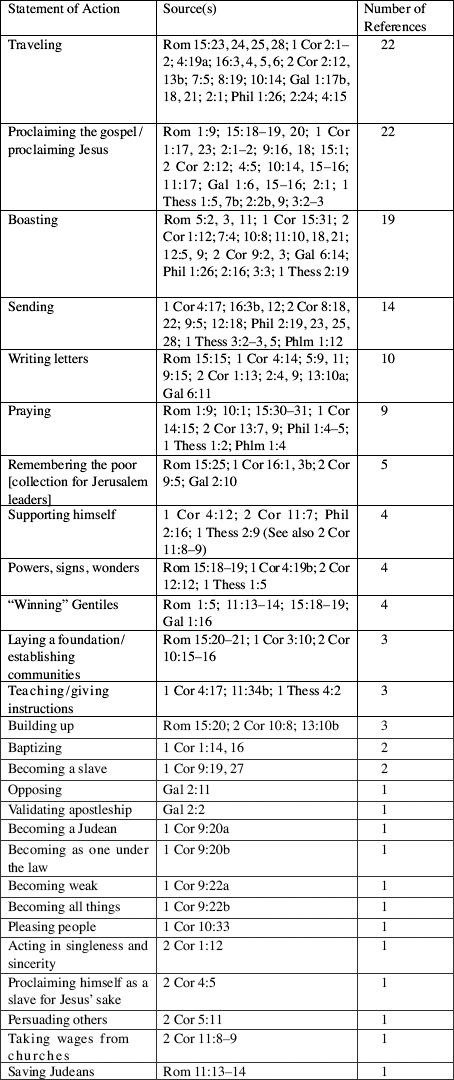
The phrase “statements of action” refers to passages where Paul claims to have performed an action in the past, claims to be carrying one out in the present, or states that he intends to perform one in the future. Both discursive actions, such as preaching, teaching, and praying, and non-discursive actions, such as traveling and sending letters, are included in the inventory. Sensitivity to these statements in their entirety demonstrates the extent to which Paul emphasized each particular task and the scope of his activities as a missionary. For present purposes, this study will highlight how the inventory reveals the centrality of Paul's work as a community-builder and nurturer.
In order to be counted as a statement of action, a text must meet two criteria. First, it must demonstrate a certain degree of specificity. This requirement disqualifies vague accounts of activities—though some statements of action are necessarily vaguer than others. An example of a text that does not meet this requirement is 1 Thess 2:7b, where Paul reminds the Thessalonian believers that he was “gentle” among them. This is admittedly a statement where Paul claims to be doing something (i.e., being gentle), but it betrays little about a specific task, and thus I have not included it as a statement of action.Footnote 61
The second criterion is that Paul must actually claim to have performed the action or be planning to perform it. This standard disqualifies statements about non-action—that is, actions that Paul says he did not do. For example, in 2 Cor 1:23b, he tells the Corinthians that he “did not come again to Corinth.” He often recounts his travels—and they will figure prominently in the inventory of action statements—but 2 Cor 1:23b does not belong among the action statements.Footnote 62
Paul also occasionally writes about an activity that he intended or wanted to do but did not do. In 1 Thess 2:18, he recounts a time when he wanted to visit Thessalonica but encountered obstacles. A similar situation is found in 2 Cor 1:15–22, in which Paul indicates an unfulfilled desire to visit Corinth. Rather than statements of action, these are admissions of inaction. Negative actions, such as in 2 Cor 1:23b, are such by choice, and failed actions, such as in 1 Thess 2:18 and 2 Cor 1:15–22, are such by circumstance.Footnote 63 Neither dataset is included in the inventory and subsequent interpretation of action statements.
Descriptions of actions in which Paul played a passive role are not statements of action, either—for example, texts where Paul recounts being persecuted (e.g., 1 Thess 3:3b; 2 Cor 4:7–9; 6:4–10). Likewise, when Paul expresses a desire to carry out an activity in the future but does not commit to it (e.g., Phil 1:27–28a), these passages also do not meet the criteria.
One final comment should be made while on the topic of criteria. The apostle certainly did not write about every activity that he performed. However, despite the paucity of the letters on some of Paul's actions, the apostle records enough of his own activities for scholars to gain insight on which of those he prioritized.
Inventorying Paul's Action Statements
This article's approach to the purpose problem finds theoretical support from the work of practice critics.Footnote 64 Theodore R. Schatzki, a prominent contemporary practice theorist, describes “the practice approach” as a method of interpretation that “develop[s] an account of practices, either the field of practices or some subdomain thereof (e.g., science), or…treat[s] the field of practices as the place to study the nature and transformation of their subject matter.”Footnote 65 This article attempts to do both.Footnote 66 A significant claim made by many practice theorists is that the mind is, to a certain extent, constituted within practices.Footnote 67 The belief that the mind is therefore accessible through an interpretation of practices, while not shared by all practice theorists, is central to my approach; I posit that Paul's conception of his mission is partially accessible through an analysis of what he reported that he did and planned to do during the time in which he carried out his mission.Footnote 68 This principle follows from Schatzki's contention that practices represent “the source and carrier of meaning, language, and normativity”Footnote 69—an idea that both practice theorists and thinkers who belong to various other traditions of thought share.Footnote 70 A preference for the terrain of activities and the contention that an analysis of them can lead to insights with regard to questions of intentionality link this study's approach with the practice tradition, despite significant differences in this work from sociological and philosophical practice approaches.Footnote 71
Having outlined the criteria that dictate which passages are action statements and having situated this study's approach to the purpose problem within work falling under the rubric of practice theory, it is now time to present Paul's statements of action. The following entries represent the actions that Paul claimed to perform.
Paul's Statements of Action
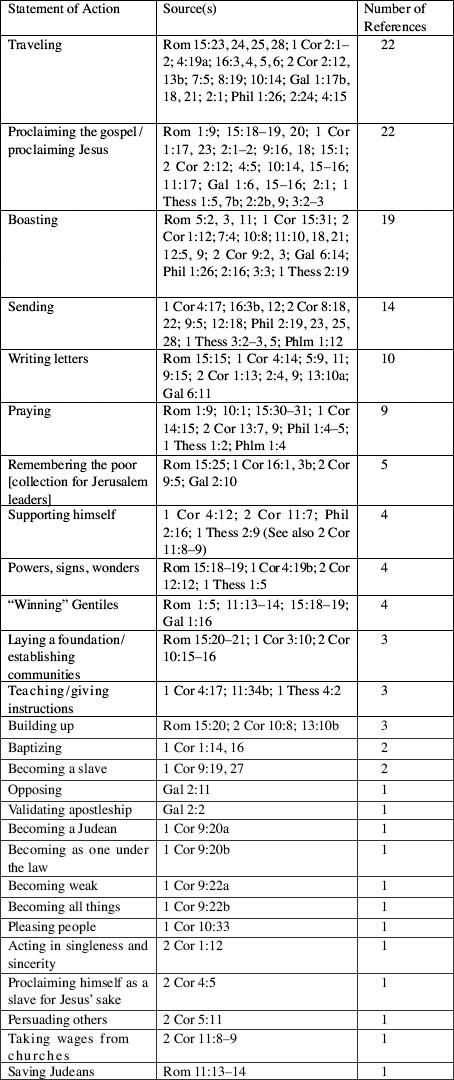
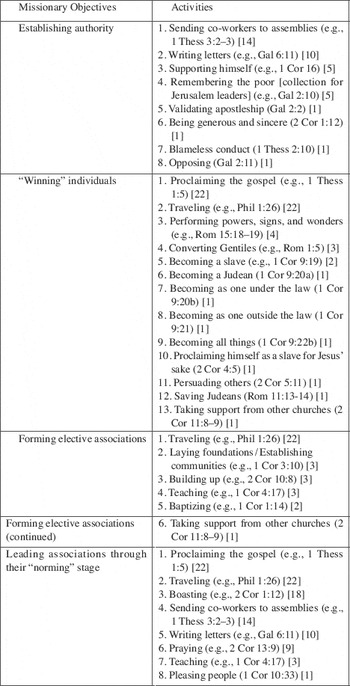
There is not enough space in this article to analyze every action statement. What is of particular relevance is the relative number of action statements that represent activities performed in the interest of establishing and maintaining Paul's congregations. In order to illustrate this phenomenon, a second chart is presented below. The second chart classifies each action statement under one or sometimes more categories. The categories themselves are intended to reflect Paul's missionary objectives. They serve a descriptive function and are meant to represent best Paul's statements of action, even though Paul never categorized his actions in such a manner. Minor revisions to the categories could be proposed, but the only element of their hermeneutical value that is of interest here is their attestation to Paul's work establishing and nurturing congregations of believers.
Classification of Paul's Action Statements: Paul's Missionary Objectives

A few comments are required at this point in order to explain the categories. The first grouping, “Establishing authority,” refers to John Schütz's definition of authority. Schütz argues that authority is a context for communication where the directives of the person in authority are recognized by others as “right.”Footnote 72 It is thus an “interpretation of power.”Footnote 73 The statements of action under this first category represent some of Paul's attempts to establish authority. This, in fact, is not a very controversial proposition; Wayne Meeks has convincingly shown that Paul performed many of these tasks for this very reason.Footnote 74 For example, he has demonstrated that Paul's responses to the conflicts in Corinth were responses to conflicts that were “not only between persons but also between different kinds of authority.”Footnote 75 The persons were those who claimed—or were bestowed with—authority.Footnote 76 These individuals claimed authority from different sources, including wealth, rhetorical skills, and spiritual gifts. Interestingly, Meeks cites Paul's personal visits, his act of sending emissaries, and his letter writing as responses to these conflicts.Footnote 77 With regard to letter writing specifically, he elaborates: “The letters themselves are instruments used intentionally to exert authority; they therefore exhibit the strategies of influence that Paul and his co-workers thought would be effective.”Footnote 78
Other tasks listed under the first category include “acting in singleness and sincerity,” “validating his apostleship,” “opposing,”Footnote 79 “blameless conduct,” and “supporting himself.” With regard to “supporting himself,” Paul's claim in 2 Cor 11:8–9 to have taken support from other churches while working in Corinth represents, apparently, his policy while in Greece but not elsewhere.Footnote 80 Barrett posits that Paul kept himself from being under the Corinthians' financial obligation for the sake of the success of his preaching. Since authority is necessary for successful preaching—at least by Schütz's definition of authority— this action statement belongs in the first category. Along with this action, “blameless conduct” and “acting in singleness and sincerity” are also forms of behavior that Paul performed in order to further ensure that others considered his preaching to be authoritative. These actions are therefore placed into the first category.
Pauline scholars have been right to look past Paul's personal objective of establishing authority in order to reach the apostle's understanding of the importance of his mission. This category unites a series of tasks that go along with the territory of claiming apostleship, but there is no indication that Paul sought to establish authority simply for the sake of obtaining it. It was rather a precursor for “winning” individuals (which in turn was a precursor for the formation of associations of believers).
The second category, “‘winning’ individuals,” is what is commonly understood to be Paul's intention behind “preaching” and “proclaiming the gospel.” I have chosen to title this category this way because Paul himself uses the word (κερδαίνω) to describe the kinds of activities that are placed under this category and because it is less problematic than comparative terms, such as “converting.” The statements of action placed under this category seem to require little elaboration. Some exceptions are the “becoming” statements. But Paul himself claims that the purpose behind these activities was to “win” individuals (1 Cor 9:19–22). “Taking support from other churches” deserves some attention as well. My reason for classifying this activity under category two is Paul's explanation for performing it: “in order to serve you [the Corinthians]” (2 Cor 11:8). This seems to mean that Paul took support from others in order to work towards “winning” the Corinthians.
Categories three and four hold primary significance for my interpretation of Paul's missionary purpose, since they are specific to the apostle's work establishing and preserving congregations of believers. Their titles thus call for elaboration.
“Forming Elective Associations,” the third category, borrows terminology from sociological theory on small group formation,Footnote 81 which Bruce J. Malina has constructively applied to group formation in the Jesus movement. “Forming” is the first of a five-stage sociological model of small group evolution, according to Bruce W. Tuckman's model.Footnote 82 Malina describes this stage as the time when the group is “put together.”Footnote 83 Since Paul was responsible for “putting together” small groups,Footnote 84 I follow Malina and other sociologists by using the term “forming” to describe Paul's task of establishing congregations. I also have appropriated the term “elective associations” from Malina's study.Footnote 85 Malina uses the term “elective” over “voluntary” in order to distinguish between ancient Mediterranean notions of volunteering and modern conceptions of the notion, noting that the modern notion of volunteerism is anachronistic and thus not applicable.Footnote 86
The fourth category, “Leading associations through their ‘norming' stage,” borrows terminology from studies by Tuckman, Richard L. Moreland, and John M. Levine on the stages of small group development. Norming is the third of five stages of development, according to Tuckman's model. The first is forming, which has already been discussed. The second is “storming,” which does not involve Paul directly. Malina describes this stage as follows:
Group members arguing with each other and heaping criticism on the leader…group members become more assertive and each tries to change the group to satisfy personal needs. Resentment and hostilities erupt among group members with differing needs.”Footnote 87
Generally, Paul comes back onto the local scene—by means of a letter, an emissary, or a personal visit—in order to resolve these conflicts. As such, he ushers in the “norming” stage, which is characterized by attempts to reach resolutions on earlier problems and by setting out clearer directives for group conduct.Footnote 88
The placement of certain action statements in categories three and four deserves some attention as well. Some of these choices are obvious. For example, there should be little argument over the placement of “laying foundations/establishing communities” and “building up” under the category of “Forming elective associations.” Likewise, most critics would probably grant that “sending co-workers to assemblies,” “writing letters,” and “teaching” belong under “Leading associations through their ‘norming' stage”—even if Paul performed these tasks for other reasons, too. It is fairly obvious that Paul traveled in order to preach, establish congregations, and maintain congregations. However, some of the other placements require explanation.
“Preaching” is classified, without much controversy, under category two, but it is also a category four action. Certain “preaching” action statements illustrate the rationale behind this decision. Paul describes the purpose of proclaiming the gospel as saving (σῴζω) people (1 Cor 9:22–23; 15:1–2). What is significant is that he understands that the preaching task was not necessarily fulfilled after an initial visit to a city. Rather, he proclaims portions of his gospel even while writing letters, as 1 Cor 15:1–10 demonstrates; Paul preached his gospel not only as a means of “winning” individuals but also as a means of resolving uncertainties. For this reason, the preaching task fits under the fourth category.
Paul's teaching is classified under both the third and fourth categories. Like Paul's preaching, his teaching was offered throughout the course of his relationships with his congregations. One of Paul's teaching action statements indicates that he taught in every place that he went—during the forming stage and in the norming stage of his communities as well (1 Cor 4:17). In Thessalonica, the believers were unsure about the state of those who had already died and what impact this might have on eschatological events. Thus, Paul did not complete his instructional duties by the end of his initial visit (see 1 Thess 4:13–5:11); they were carried out while he was working to lead the Thessalonian association through its norming stage as well. For these reasons, categories three and four are appropriate fits for Paul's teaching activity.
Paul's prayers are classified under the fourth category even though not all nine concern associations in their norming stage. Nonetheless, several of them do (1 Thess 1:2; Phil 1:4–5; 2 Cor 13:7), which is the reason for this activity's placement within the fourth category. For the same reason, Paul's boasting belongs under the fourth category; the apostle's boasting is often, but not exclusively, meant to set an example for the proper way to boast.Footnote 89
Paul's Statements of Action: Observations
By my count and by the criteria set out above, the inventory of action statements is a complete list. A cursory scan through the list is sufficient for noticing the number of tasks that Paul claimed to perform related to congregation-formation and congregation-maintenance.Footnote 90 Many of the action statements fall under the second category, “Winning individuals.” This is the missionary objective that critics most often mention when they tackle the question of Paul's missionary purpose, a focus that led scholars to understate the centrality of Paul's work establishing and maintaining congregations of believers. But two of the four categories of action statements relate to Paul's work among his communities: “forming elective associations” and “leading associations through their ‘norming' stage.” In light of these data, these two activities must be counted as missionary objectives, as well.Footnote 91 The next logical step in this inquiry is to ask why Paul would have endeavored to fulfill these three particular objectives. An examination of the dialectic between Paul's preaching activity and his work among his communities, I argue, will reveal the answer.
An Old Theory and a New Proposal
Rudolf Bultmann's Theology of the New Testament is better known for its exegetical prowess and its portrayal of the Jesus movement's early development than for its interpretation of Paul's missionary purpose. Nonetheless, Bultmann's analysis of Paul's missionary objectives provides an avenue by which they can be understood in light of the data retrieved from his statements of action.
According to Bultmann, Paul understood the “salvation-occurrence” (i.e., Christ's death and resurrection) to have set in motion the “eschatological occurrence” (i.e., the first disciples' faith, apostolic preaching of the word, the Church, the sacraments, life as a Christ-believer, etc.), which in turn ended the old age. The eschatological occurrence had already begun by the time that Paul had his experience on the road to Damascus. Christ's return would complete and confirm this process (see 1 Thess 4:16; 1 Cor 15:23, 51–56).Footnote 92
For Bultmann, Paul regarded the preaching of the gospel as the means by which the resurrection became an experiential fact of human history.Footnote 93 Since the preaching of the word is centered around the proclamation of “Jesus as the crucified and risen Lord,” the preaching itself makes the crucifixion and resurrection of Jesus not just a past event but also a present reality (2 Cor 6:2).Footnote 94 Bultmann then draws a connection between preaching and assemblies of believers. He notes that the term ekklēsia can sometimes denote the “total Church”—meaning the translocal assembly of all who believe—and at other times mean a single congregation.Footnote 95 He does not specify when the term is used one way and when it is used the other. But he argues that for Paul the preaching activity functions to gather individuals into the “ecclesia, Church, and congregation.”Footnote 96 Certain passages cited by Bultmann in support of this model refer to the universal church as an institution that sets members apart from non-believers. For example, Bultmann notes that in 1 Cor 12:27, Paul expresses the eschatological nature of the universal church when he refers to it as the “body of Christ.” In other passages, Paul speaks to the Corinthians about their identity as affiliates of the church and its hierarchical structure.Footnote 97 Bultmann then argues that, for Paul, being “in Christ” means—in part—membership in a congregation.Footnote 98
Bultmann does not argue that Paul regarded the establishment and maintenance of congregations as primary purposes of his mission, but he does not attempt to answer the question of missionary purpose, either. What he demonstrates is that Paul's acts of preaching the gospel and his work establishing congregations are related in the sense that preaching calls individuals into congregations “in Christ” and that these events are part of the eschatological occurrence. He also suggests, by citing passages from Paul where ekklēsia denotes individual congregations of believers, that being “in Christ” means, in part, membership in an assembly.
Bultmann's discussion of Paul's missionary tasks can be compared to Schnabel's analysis of certain views held by the Jerusalem apostles in Acts. Schnabel comments on the rationale in the early Church behind believers banding together as follows:
The missionary work of the apostles is grounded in the conviction that salvation can be found only in Jesus.…The salvation that Peter refers to [in Acts 4:12] is to salvation “from this corrupt generation” (Acts 2:40). Salvation therefore implies separation from the unbelieving and disobedient people and affiliation with the true people of God of the last days, with the community of people who believe in Jesus as God's Messiah and who have received the Spirit of prophecy promised by God through Joel, the Spirit who conveys new life corresponding with this new loyalty.Footnote 99
Schnabel understands Luke's Peter to hold the view that only believers will be saved and that the only access to salvation is through Christ. As a result, believers must separate themselves from non-believers. Paul seems to share this perspective. In 1 Thess 4:11, the apostle instructs the Thessalonians to live quietly (ϕιλοτιμεῖσθαι ἡσυχάζειν) and to mind their own affairs (πράσσειν τὰ ἴδια). In 1 Cor 5:1–2, he suggests that the man in Corinth who has committed an act of sexual immorality “of a kind that is not found even among Gentiles” should be cast out from the congregation. He repeats this instruction a few verses later with respect to anyone who has committed any immoral act: “But now I am writing to you not to associate (συναναμίγνυσθαι) with anyone who bears the name of brother who is sexually immoral or greedy, or is an idolater, reviler, drunkard, or robber. Do not even eat with such a one” (1 Cor 5:11). Paul believed that Christ-followers should live to a certain degree apart from others. The fact that a major component of his missionary tasks was devoted to the establishment and maintenance of congregations of believers is consistent with his conviction. Moreover, if we grant Goodman his definition of a proselytizing mission and his identification of the Jesus movement as taking part in one—which many critics do—then we should recall that proselytizing missionaries wanted individuals to depart from their social group and join a new group that was based on their new views.Footnote 100 This is what Paul wanted Christ-believers to do, as well.
Conclusions
According to Schnabel, the underlying aim for all of Paul's missionary activities was that people be saved. I have suggested that Paul regarded membership in a congregation as important—though perhaps not necessary—for one's salvation, since it was a means by which Christ-believers could be distinguished from others, an ideal that the apostle valued (1 Thess 4:11; 1 Cor 5:1–2; 5:11). Bultmann's interpretation of the dialectic between preaching and founding communities leads to the recognition that an eschatological purpose was driving Paul's mission. The apostle regarded the establishment and consolidation of congregations as tasks that followed naturally from successful preaching and believed that these objectives required fulfillment before the parousia. For Paul, salvation comes to those “in Christ,” and those “in Christ” should identify themselves as different from others by virtue of their membership in a congregation of Christ-believers. The apostle understood the purpose of his mission as preparing individuals for the eschaton—which meant getting individuals to believe in Christ and getting them involved in local Christ-believing communities before the parousia.