Introduction
Transcatheter stent implantation into growing vessels is an essential minimally invasive treatment option in infants and small children with CHD and corresponding vascular stenotic lesions.[Reference Stanfill, Nykanen, Osorio, Whalen, Burke and Zahn1–Reference van Kalsbeek, Krings, Molenschot and Breur5] After stent implantation in small children, serial stent re-expansion is frequently necessary to keep pace with somatic growth [Reference Stanfill, Nykanen, Osorio, Whalen, Burke and Zahn1,Reference Quandt, Ramchandani and Bhole3,Reference van Kalsbeek, Krings, Molenschot and Breur5] . Concerns exist regarding the creation of fixed obstructions secondary to the stent if expansion to larger diameters over time is not possible. Until now, there are no endovascular stents designed for or approved for use in infants, nor is there a stent capable of being implanted at infant vessel diameters and achieving adult size while maintaining structural integrity. Most tested low-profile coronary or peripheral stents have limited finite maximum expansion diameters. Depending on the design of the stent, further over-dilations using ultra-high-pressure angioplasty balloons will result either in extreme stent shortening or intentional stent fracture with the potential loss of radial strength [Reference Morray, McElhinney, Marshall and Porras6,Reference Sathanandam, Haddad, Subramanian, Wright, Philip and Waller7] . Therefore, stent therapy in growing infants remains problematic, making surgical explantation or complex re-stenting procedures necessary during further growth [Reference McMahon, El-Said, Grifka, Fraley, Nihill and Mullins8,Reference Boe, Zampi, Schumacher, Yu and Armstrong9] . Despite various design limitations, Cook Formula and Bard Valeo peripheral stents are the most commonly used stents for this off-label approach with reasonably acceptable results [Reference Stanfill, Nykanen, Osorio, Whalen, Burke and Zahn1–Reference van Kalsbeek, Krings, Molenschot and Breur5]. Both of these stents are no longer easy to have on the European market, and it is crucial to find alternatives. BeSmooth stents (Bentley InnoMed, Germany) are low-profile, pre-mounted, balloon-expandable, bare-metal, open-cell-designed peripheral stents. These stents have been also used infrequently in the off-label treatment of small patients with native or recurrent aortic coarctation and native or post-surgical branch pulmonary arteries stenosis. Long-term outcomes of these stents as well as safety and performance during re-dilatation have not been reported in the literature. Herein, we evaluate the ex vivo feasibility of post-dilating BeSmooth peripheral stents into adult vessel size diameters. We also describe the mechanical behaviour of BeSmooth stents during multiple-stage sequential re-dilations and stent-in-stent re-dilation approach.
Methods
Setting and setup
The ex vivo benchside testing of BeSmooth peripheral stent systems was carried out in the digital biplane catheterisation laboratory (Artis zee system, Siemens, Germany) of our institution. According to the local guidelines, there was no need for the permission of the institutional review board because no patient data were used. The tests were done in a sterile environment and in the absence of any member or representative of the manufacturing companies. Balloon inflation was done with a Monarch® inflation device (20 cc/ml barrel – 30 atm/bar) (Merit Medical Systems, Inc., USA), and digital inflation pressure was noted at each balloon inflation. Nominal expansion and post-dilatations of the stents were recorded with continuous biplane cine-fluoroscopy. Balloons were completely deflated after achieving the inflation pressure. Biplane X-ray single-frame shots were acquired after each stent dilation for fluoroscopic stent measurements. Calibration was performed before each measurement. Direct stent measurements were also done meticulously using a 6-Inch/15 cm Vinyl plastic ruler (GRI, China).
BeSmooth peripheral stent systems
The BeSmooth peripheral stent systems are over-the-wire (0.035-Inch), pre-mounted, balloon-expandable, bare-metal stents. The stents are indicated for the treatment of de novo or re-stenotic, atherosclerotic lesions in protected peripheral arteries offering high radial force, flexibility, and low profile. BeSmooth stents are made of Cobalt-Chromium (L605) with an open-cell design. The stent exists in three versions (SV, MV, and LV) that differ slightly by the width of the strut (0.135, 0.145, and 0.165 mm, respectively), while the thickness of the strut is 0.145 mm for the three versions. Each stent version is recommended to be inflated according to the nominal diameter of the balloon upon which the stent is pre-mounted. The expanded stent-graft diameters are 5.0 and 6.0 mm for the SV, 7.0 and 8.0 mm for the MV, and 9.0 and 10.0 mm for the LV model. Each stent version is available in five nominal lengths, starting from 18 mm and moving up to 57 or 58 mm (18, 23, 27–28, 38, or 57–58 mm). The nominal and rated burst pressures of the semi-compliant balloon carriers are 10 and 13 bars for stents with a diameter of 5–6 mm, and 8 and 12 bars for stents with a diameter of 7–10 mm, respectively. All sizes are compatible with 6-Fr introducer sheaths. The catheter shaft size is 5-Fr with a 75 cm /120 cm length.
Benchmark testing rationale, protocol, and measurements
The rationale of the study protocol was to test three different scenarios of redo interventions on BeSmooth peripheral stents implanted at vessel diameters of small patients. The three scenarios are sequential upsizing post-dilation without re-stenting (test 1), post-dilation until plateau/breakpoint followed by re-stenting (test 2), and finally, straightforward re-stenting (test 3). The MV and LV versions of the stent are almost similar. Both of these stent versions are suitable for treating vessels with diameters ranging from ≥ 6 to 10 mm. The assignment of each stent to each scenario was random.
Over a 0.035-inch/260 cm stiff wire, three sterile samples of BeSmooth peripheral stents with nominal diameters of 7, 8, and 10 mm were initially expanded by inflating their balloon carriers to nominal pressure and then to 13 atm. Test 1: BeSmooth stent Ø7 × 23 mm was sequentially post-dilated using Ø12 × 40 mm and Ø14 × 40 mm Armada 35 (Abbott Vascular, USA) and then Ø16 × 40 mm Atlas® Gold (Bard Peripheral Vascular, Inc., USA) non-compliant ultra-high-pressure angioplasty balloon catheters. Test 2: BeSmooth stent Ø10 × 57 mm was post-dilated using an Ø14 × 40 mm Armada 35 (Abbott Vascular, USA) angioplasty balloon catheter. Subsequently, BeSmooth stent Ø10 × 57 mm was re-dilated with a 48 mm-long bare-metal Optimus® XXL stent (AndraTec, Germany) hand-mounted over another Ø14 × 40 mm Armada 35 angioplasty balloon in an attempt to expand the BeSmooth stent Ø10 × 57 mm to a minimum diameter of 14 mm (stent-in-stent). Test 3: BeSmooth stent Ø8 × 57 mm was post-dilated directly with a 48 mm-long bare-metal Optimus® XXL stent (AndraTec, Germany) hand-mounted over a Ø16 × 40 mm Altosa-XL (AndraTec, Germany) angioplasty balloon in an attempt to expand the BeSmooth stent Ø8 × 57 mm to a diameter of 16 mm (stent-in-stent).
Direct and anteroposterior fluoroscopic relevant measurements of the diameter and length of the inflated stents were performed at each step. Balloon rupture was recorded and described. We classified balloon rupture into pinhole tears and complete or partial, radial, or horizontal tear lines.
We paid attention to audible stent cracks. The stents were closely inspected in direct view and on X-ray acquisitions to count the struts fracture and evaluate the stent distortion and fracturing patterns. We classified stent fractures as complete longitudinal fractures if there was clear evidence of disruption of each of the struts along the stent’s entire length and partial longitudinal fractures if the struts were disrupted along a portion of the stent. Circumferential stent fractures are fractured connections between stent rings with the rings themselves remaining circumferentially intact along the length of the stent.
Results
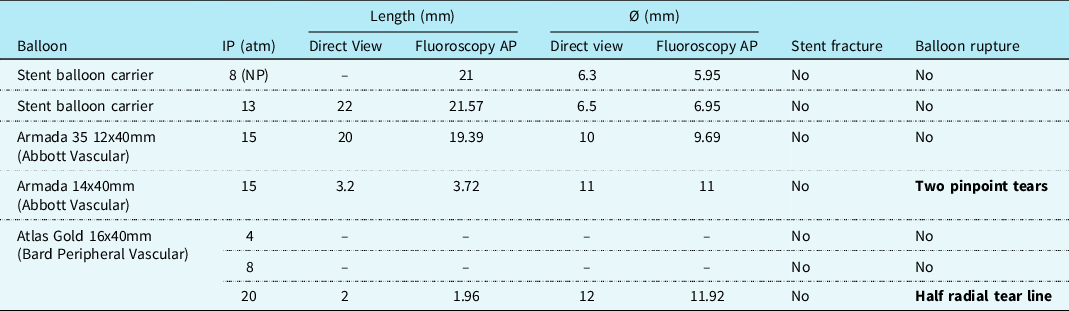
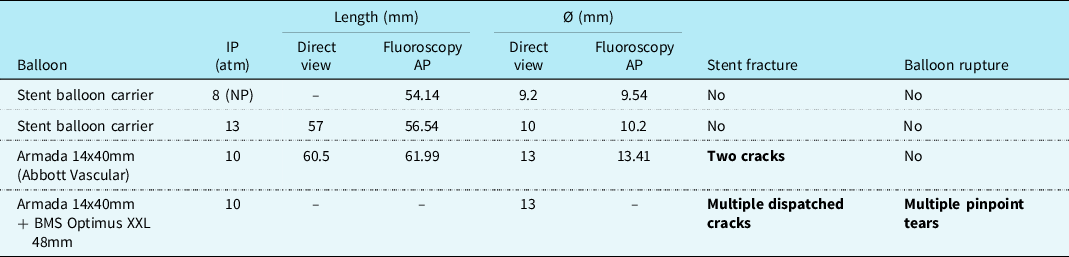
The results of the benchside tests of the BeSmooth peripheral stents with nominal diameters of 7, 10, and 8 mm are outlined in Tables 1, 2 and –3, respectively.
Benchside test results with BeSmooth stent Ø7 × 23 mm

AP = anteroposterior; atm = atmospheres; IP = inflation pressure; NP = nominal pressure; Ø = diameter.
Benchside test results with BeSmooth stent Ø10 × 57 mm

AP = anteroposterior; atm = atmospheres; IP = inflation pressure; BMS = bare-metal stent; NP = nominal pressure; Ø = diameter.
Benchside test results with BeSmooth stent Ø8 × 57 mm

AP = anteroposterior; atm = atmospheres; BMS = bare-metal stent; IP = inflation pressure; NP = nominal pressure; Ø = diameter.
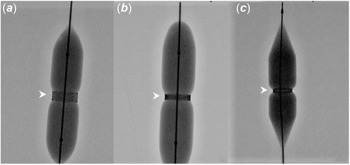
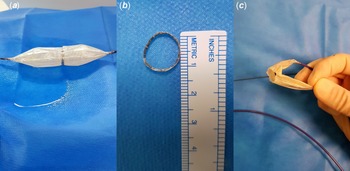
Test 1: The BeSmooth stent Ø7 × 23 mm can be post-dilated to 10 mm diameter with a little shortening. Upsizing the stent to 11 mm with an Armada 35 balloon Ø14 mm led to the stent shrinking to 3.2 mm (Table 1, Fig 1). It was impossible to post-dilate the BeSmooth Ø7 × 23 mm beyond a diameter of 12 mm because the Atlas Gold Ø16 mm balloon exploded at an inflation pressure of 20 atm. At last, BeSmooth Ø7 × 23 mm shortened to 2 mm (Fig 2a) forming a 12 mm-large solid ring circle with overlapping struts (Fig 2b). There was a half-circular radial tear line within the Atlas Gold balloon (Fig 2c). We did not hear any stent cracks or visually identified struts fracture on direct or X-ray inspections. Manual inspection of the ring circle revealed an inward sharper protrusion of the overlapped struts.
Anteroposterior X-ray acquisitions shots of sequential upsizing high-pressure balloon inflation of the BeSmooth stent Ø7 × 23 mm ( a , b , c ). Note the stent shortening and the fixed stent diameter.

BeSmooth Ø7 × 23 mm shortening to 2 mm and forming a 12 mm-large solid ring circle with overlapping struts after sequential balloon inflation ending up with an Atlas Gold balloon Ø16 mm ( a , b ). Half-circular radial tear line of the woven mesh Atlas balloon with loss of pressure ( c ).

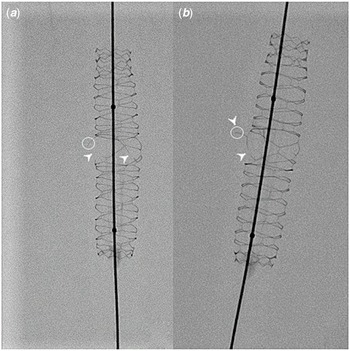
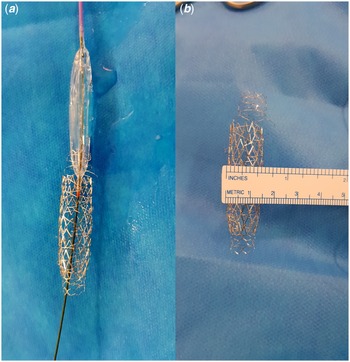
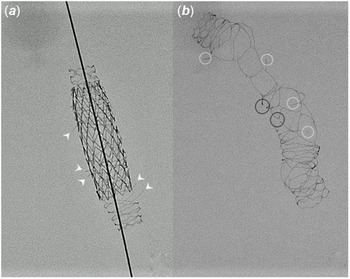
Test 2: BeSmooth Ø10 × 23 mm was expanded with progressive pressure inflation of the Armada 35 balloon Ø14 mm. We stopped the inflation at a pressure of 10 atm when we heard two stent cracks (Fig 3). The BeSmooth Ø10 × 23 mm reached a diameter of 13 mm without shortening and the balloon did not rupture. A bare-metal 48 mm-long Optimus XXL stent mounted on an Armada 35 balloon Ø14 mm was re-expanded inside the BeSmooth Ø10 × 23 mm stent. The inflation was stopped at a pressure of 10 atm because BeSmooth Ø10 × 23 mm was severely fractured at a diameter of 13 mm, and the balloon was ruptured at multiple points with subsequent loss of inflation pressure (Fig 4a and b). We noticed complete circumferential straightening of the stent zigs just before the stent fractured. The stent was distorted completely when re-inspected carefully with the separation of the stent rings at the point of longitudinal fracture with radial fracture lines and protrusion of the fractured ends within the stent circles (Fig 5a and b).
Anteroposterior ( a ) and lateral ( b ) X-ray acquisitions shots of the BeSmooth Ø10 × 23 mm after progressive expansion with an Armada 35 balloon Ø14 mm. Note the two longitudinal fracture lines within the stent occurring in two opposing cells within the most stretched middle section of the stent at a diameter of 13 mm (white pointed arrows). This pattern of fractures induced an outward orientation of the stent struts in different directions (white circles).

Severely fractured BeSmooth Ø10 × 23 mm at a diameter of 13 mm when re-expanded with bare-metal 48 mm-long Optimus XXL stent mounted on an Armada 35 balloon Ø14 mm ( a , b ). Note the multiple holes within the ruptured Armada balloon and subsequent loss of inflation pressure ( a ).

Anteroposterior X-ray acquisitions shots of the BeSmooth Ø10 × 23 mm after inflation of 48 mm-long Optimus XXL stent and balloon rupture. Note the multiple and dispatched strut fractures with inward and outward orientations (white pointed arrows) ( a ). Same BeSmooth Ø10 × 23 mm re-inspected after carefully taking out Optimus stent. Note the total stent distortion with radial (connection between cells) (black circles) and longitudinal (within the cell line) (white circles) fracture lines ( b ).

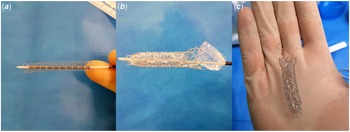
Test 3: Bare-metal 48 mm-long Optimus XXL stent was mounted on an AltoSa-XL angioplasty balloon Ø16 mm and was expanded progressively inside the BeSmooth Ø8 × 57 mm until the balloon exploded at an inflation pressure of 10 atm. We heard three stent cracks and identified three fractures of the stent struts (Fig 6a). There was a full circular radial tear line within the AltoSa-XL balloon, and the withdrawal of the balloon distal part was critical (Fig 6b). The stent, however, did not shorten visually.
Three strut fractures of the BeSmooth Ø8 × 57 mm when expanded with a bare-metal 48 mm-long Optimus XXL stent mounted on an AltoSa-XL balloon Ø16 mm ( a ). Note the full circular radial tear line within the balloon that was cut in half with subsequent loss of inflation pressure ( b ).

Discussion
BeSmooth peripheral stents have been used infrequently in the off-label stent treatment of small patients with various congenital heart lesions. This report is the first to describe the mechanical behaviour of BeSmooth stents when over-dilated to reach adult-size diameters in three different scenarios. In our benchmark test conditions, we showed that excessive stent shortening with overlapping struts, balloon rupture with loss of inflation pressure, or uncontrolled stent fracture patterns at small balloon diameters limit safe and effective post-dilation of BeSmooth stents beyond 13 mm.
Stent implantation remains a controversial strategy in patients below 15 kg due to relatively large sheath sizes and the inability to accommodate adult vessel sizes after somatic growth. Initially, the Palmaz stents and later on the Cook Formula and Bard Valeo stents were the most commonly used in this approach because these stents are conformable and easy to deliver, even in small children.[Reference Stanfill, Nykanen, Osorio, Whalen, Burke and Zahn1–Reference Morray, McElhinney, Marshall and Porras6,Reference Ing, Khan, Kobayashi, Hagler and Forbes10] However, these stents have limited radial strength to prevent vessel recoil, have limited expansion diameters after re-dilations, and lack the potential for controlled stent strut breakage.[Reference Kudumula, Noonan, Taliotis and Duke2,Reference Quandt, Ramchandani and Bhole3,Reference Agnoletti, Marini, Ou, Vandrell, Boudjemline and Bonnet11] Both Formula and Valeo stents are pre-mounted open-cell stents. However, the Valeo stent has a triple helical architecture and the open cells are larger than the ones in the Formula stent with a “two diamonds” cell design. For that reason, the maximally achievable diameter of the Valeo stents has been reported to be higher than the one achieved by the Formula stents.[Reference Travelli, Sullivan, Takao and Ing4,Reference Krasemann, Kruit, van der Mark, Zeggelaar, Dalinghaus and van Beynum12] The BeSmooth open-cell stents also have a triple helical architecture, yet uncontrolled stent shrinking or struts fracture within the cells occurred at lower expansion diameters. We observed that the stent reached its plateau/breakpoint at an inner diameter of 11–12 mm. We observed that no further dilatation was able to occur once the diamond-shaped open cells were elongated into a circular shape because the metal itself is non-stretchable. Expanding the stent above 11–12 mm has led either to the cracking of the stent struts at various points without length shortening or to excessive stent shrinking, and overlapping struts, yet without stent fracture.
Other groups have reported intentional uncontrolled stent breakage of commonly available stents [Reference Morray, McElhinney, Marshall and Porras6,Reference Sathanandam, Haddad, Subramanian, Wright, Philip and Waller7] . In the process of stent post-dilation, the stress applied to the stent can exceed the ultimate tensile stress limit of the metal and result in an overload stent fracture allowing for further expansion of the vessel lumen. Intentional fracture of the stent using non-compliant ultra-high-pressure balloons has been promoted in a previous study. The authors showed that it can be accomplished across many different stent types with relatively low adverse event rates.[Reference Morray, McElhinney, Marshall and Porras6] However, caution must be taken because this intentional stent breakage can result in protrusion into adjacent vessels,[Reference Quandt, Ramchandani and Bhole3] an unstable portion of the fractured stent with the need for re-stenting, distal stent fragment embolisation, and even a vascular tear or disruption after stent fracture requiring covered stent placement.[Reference Morray, McElhinney, Marshall and Porras6] We observed in our benchmark tests that most balloon ruptures were explosive and all balloon ruptures led to the loss of inflation pressure. Most ruptures had a radial tear line pattern even within the higher profile Atlas Gold woven mesh balloon. This may lead to the “parachuting” of the distal balloon parts, which then may make re-sheathing and retrieval of the balloon within the distorted stent risky and perhaps impossible.[Reference Krasemann, Kruit, van der Mark, Zeggelaar, Dalinghaus and van Beynum12] High-pressure-induced balloon rupture during dilation can also result in vessel rupture causing haemoptysis or even hemothorax.[Reference Morray, McElhinney, Marshall and Porras6]
In comparison, it has been shown that a Cook Formula stent can reach a maximum diameter of 16 or 18 mm. After that, a “stent-in-stent” breaking procedure can be performed with a covered stent inside and an Atlas balloon of 18 or 20 mm.[Reference van Kalsbeek, Krings, Molenschot and Breur5] The authors showed that a controlled longitudinal fracturing with little foreshortening and preservation of the circular shape can be achieved in vitro with an Atlas balloon not more than 2–4 mm larger than the Formula stent. Although in vivo stent breaking has not been indicated in the series of patients with recurrent aortic coarctation, van Kalsbeek et al. report that it has been performed successfully in their centre in two patients with left pulmonary artery stenting without going into details.[Reference van Kalsbeek, Krings, Molenschot and Breur5] This was not the case with the BeSmooth stents because the maximum achievable diameter without breaking the stent was 12–13 mm at the expense of an excessive and uncontrolled stent shortening. The stent-in-stent re-dilation approach did not have any impact on safely reaching larger stent inner diameters due to balloon rupture with loss of inflation pressure or uncontrolled stent fracture patterns at small balloon diameters.
The direct use of a single large-diameter balloon and or a balloon longer than the stent tends to promote foreshortening of the stent during overexpansion. When the balloon is longer than the stent, the balloon can continue dilating at both distal and proximal non-covered extremities even when the stent has reached the maximal plateau diameter. The dog-boning phenomenon of the balloon will compress the extremities of the stent toward each other while the centre of the stent is expanding to its full diameter.[Reference Peters, Ewert and Berger13,Reference Wong, Backer, Keenan, Dincer and Cho14] This will lead to excessive shortening and struts overlapping. On the other side, it may be discussed that fractures can be more easily achieved using less oversized balloons with higher inflation pressures rather than larger diameter balloons with lower pressures. However, in ideal clinical practice, stent re-dilation is achieved with gradual upsizing of the balloons keeping the balloon-to-waist ratio within the target ratio as low as possible.[Reference Danon, Gray and Crystal15,Reference Fujimoto, Fujii and Hata16] It is unlikely that a balloon much bigger than the nominal stent diameter is immediately used, as the index vessel diameter in most cases will be slightly larger than the nominal stent diameter.
Alternative and novel therapies
For the aforementioned reasons, there was a development, in the past decade, of bioresorbable scaffolds or breakable paediatric-specific stents to offer a lower profile and wider potential diameters.[Reference Grohmann, Sigler, Siepe and Stiller17,Reference Ewert, Peters, Nagdyman, Miera, Kühne and Berger18] Unfortunately, these stents showed significant limitations and so far have not proved to be a good alternative.[Reference Haddad, Adel Hassan, Al Soufi and Kasem19] Newer potential therapies are being evaluated for this unmet need in infants. A novel approach to this problem is using the newly developed BeGrow™ stent system by Bentley InnoMed with predetermined breakage points to allow for expansion to larger diameters. The BeGrow™ stent is an L605 cobalt-chromium, a pre-mounted, balloon-expandable stent, compatible with a 4-Fr sheath and 0.014-inch guidewire, thereby allowing implantation in small vessels. The two first-in-man pulmonary artery stent implantations in a newborn with single-ventricle circulation and a toddler with biventricular circulation were reported as part of the ongoing licencing trial. It has been shown that the unique stent design allows post-dilation steps up to a diameter of 11.5 mm while maintaining radial force and uniform expansion with only minimal foreshortening. When exceeding a diameter of 11.5 mm, it has been only speculated that the spiral arrangement of the predetermined breaking points allows the stent to break in a controlled manner and maintain a residual radial force.[Reference Quandt, Knirsch and Michel-Behnke20] Longer in vivo follow-up will be needed to see how this stent performs clinically once breakage is achieved. Another novel approach to this problem is the new cobalt-chromium balloon-expandable Renata Minima stent with a unique cell design to allow for a wide range of stent diameters from 4 to 22 mm.[Reference Zahn, Abbott, Tailor, Sathanandam and Armer21] The stent comes pre-crimped onto a Minima delivery system balloon with an outer diameter comparable to a 4-Fr sheath and can be delivered directly over a 0.014 or 0.018-inch guidewire or via a 6-Fr sheath. This new stent was implanted in 22 different target vessels of six piglets. The animal study showed high implant success, predictable re-dilatability to adult diameters and favourable histopathology.[Reference Zahn, Abbott, Tailor, Sathanandam and Armer21] Importantly, both bioresorbable and breakable strategies are designed to sacrifice future stent structural integrity to keep pace with growth. On the other side, the Minima stent is designed to provide lifelong vessel support. Further studies will be needed to determine if these differences are clinically relevant.
Limitations and strengths
Benchside tests of medical devices may not always predict clinical performance. We performed these tests ex vivo without supporting vessel walls. The mechanical properties of the stents alone will be the same, but these stents may behave differently in vivo. The in vivo duration of stent implantation may play a role in the susceptibility of the stent to fracture with balloon angioplasty. Fatigue longitudinal fractures resulting from chronic, cyclic loads applied over time can occur. Follow-up in vivo re-dilations may be undertaken on in situ fractured stents and the expansion patterns may be different. The use of a balloon shorter than or equal to the stent length may have offered differing results during Test 1. Ideally, we would have tested similar stents and repeated the measurements. However, we were limited to three samples of BeSmooth peripheral stents, which limits the statistical power and ability to generalise these findings. However, all reported tests were performed using the same testing equipment, in the same laboratory, and by the same personnel. Data were also collected meticulously during the same session to reduce any potential variation in test conditions. We believe that this study is noteworthy given that the data is novel. Our distinctive observations of this stent type during overdilation will offer practical information for end-users of this stent type.
Conclusion
In our benchmark setting and conditions, excessive stent shortening with overlapping struts, balloon rupture with loss of inflation pressure, or uncontrolled stent fracture patterns at small balloon diameters limit post-dilation of BeSmooth peripheral stents above a diameter of 13 mm. The sequential multiple-stage upsizing method of re-dilation and the straightforward or stepwise stent-in-stent re-dilation approaches did not have any impact on safely reaching larger stent inner diameters. These stents are not ideal candidates for off-label stent interventions in small children if re-expansion to adult vessel size is expected during follow-up. Efforts should be made to implant low-profile stents with adult diameter potential in children who will not require further cardiac surgery.
Acknowledgements
None.
Author Contributions
RH and SMM performed the benchside tests. RH collected data, performed direct and fluoroscopic measurements, designed illustrative material, and took the lead in writing and revising the entire manuscript. All authors discussed the results, have read and approved the final version of the manuscript.
Financial Support
This research received no specific grant from any funding agency, commercial, or not-for-profit sectors.
Conflicts of Interest
None.