In recent years, scholars of the Borgia-group codices have begun to consider the possibility that these magnificent pre-Hispanic works may actually record certain “real-time” historical events. This hypothesis, however, has been difficult to assess for a number of reasons. First, there is the issue of what these almanacs actually record; that is, whether or not they are meant to convey contemporary events, historical occurrences, or whether they are intended as prognostications. Second, there is the issue of how to date almanacs referring to the indigenous ritual calendar system, which records time based on a repeating set of 20 day signs and 13 sequential numbers. For example, the day 1 Crocodile is followed by 2 Wind, 3 House, and so on, and after the thirteenth coefficient on the day 13 Reed, the count of 13 numbers begins again on 1 Jaguar, the beginning of another trecena. This system of 20 day signs and 13 numbers results in a 260–day calendar known as the tonalpohualli, which was primarily associated with ritualistic and religious matters and was used in the naming of people and events (Boone Reference Boone2007:17). Mesoamericans also had a 365-day solar cycle (xihuitl) that consisted of 18 “months” of 20 days (veintenas), with a remainder of five days at the cycle's end, known as the Nemontemi or “nameless days”; together they form the solar calendar (xiuhpohualli) (Boone Reference Boone2007:14, 17). These two separate calendars were integrated together to form a longer cycle of 52 years, known as the xiuhmopilli with 52 different year-bearer dates, forming what might be considered the Mesoamerican “century.” The Borgia-group codices are particularly important for the study of Mesoamerican cosmology not only because of their pre-Columbian origin, but because they are largely religious in nature and are therefore, as a result of the Spanish effort to stamp out “idolatry,” exceedingly rare documents for Mesoamerican scholars (Byland Reference Byland, Díaz and Rodgers1993:xiv). In contrast to the Maya Calendar Round, the central Mexican 52-year cycle was recorded by using the tonalpohualli calendar in conjunction with a count of 365-days marked by year-bearers drawn from the tonalpohualli day signs, without any reference to veintena glyphs—indeed such glyphs are virtually unknown in pre-Conquest Aztec calendar notations. Because the central Mexican year was composed of a complete 260-day cycle, plus 105 days of the following tonalpohualli cycle, in many years there was a second or later occurrence of a specific tonalpohualli date. Any given year sign, designated by a trapeze and ray design in the Codex Borgia, could represent that year in any 52-year cycle. Nonetheless, using archaeological and cultural data, it is often possible to pinpoint the placement of these dates.
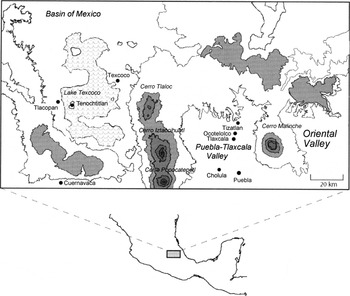
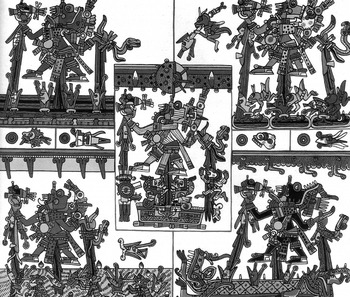
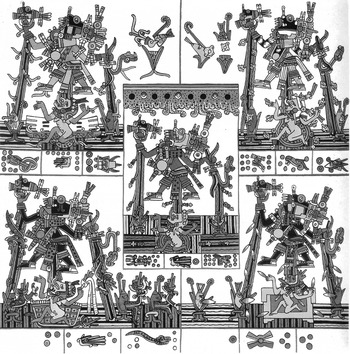
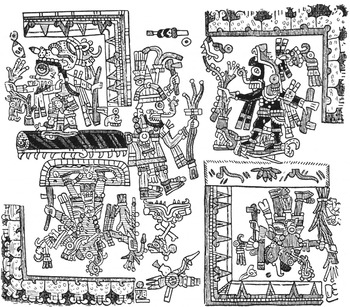
Most recently, astronomical data have been used to help determine the historical placement of xiuhmopilli dates in the Codex Borgia, known to be from central Mexico (Figure 1). In his groundbreaking 1999 article, Anthony Aveni uses five related pages from the Codex Borgia (25, 27–28, 53–54) to demonstrate that real-time events may be represented by the dates, especially the initial date in the year 1 Reed on both Borgia 27 and 28, which is linked to Venus transitioning from the evening to morning sky (Figures 2 and 3). Borgia pages 27 and 28 record both day and year signs for each of the picture's quadrants, and Aveni (Reference Aveni1999) suggests it is possible to establish the equivalent dates in the Julian calendar (Figures 2 and 3). In her 2006 monograph, Christine Hernández (Reference Hernández2006:9–10, Table 2) similarly takes up the possibility of real-time dates in the Codex Borgia. Although Hernández accepts Aveni's Julian date of 26 March, 1467 (April 4, 1467, Gregorian) for the first date on Borgia 27 (1 Reed-1 Crocodile on the lower right), which coordinates with the date of the last visibility of the Evening Star (Bricker Reference Bricker2001:S39), she suggests, contrary to Aveni, that the rest of the dates on page 27 are not of astronomical significance. She proposes instead that they all cluster in March–April and refer to the same seasonal period relating to the upcoming planting season. Thus she focuses on dates in March that span 1467–1519 (Hernández 2004:Table 11.2), rather than testing the multiple sets of dates spanning 1311–1519 that were studied by Aveni (Reference Aveni1999:Table 2). In analyzing the dates arrayed around the four corners of page 27, Hernández focuses on dates in the second half of the fifteenth century, whereas Aveni investigated multiple xiuhmopilli sequences. She places the last scene on the lower left of Borgia 27 (1 Rabbit-1 Vulture) on 16 March, 1506 in the Julian calendar rather than 17 March, 1428 (Aveni Reference Aveni1999:Table 2; Hernández Reference Hernández2006:Table 2). Although Aveni (personal communication 2006) has subsequently revised his table so that it is in accord with the layout proposed by Hernández, his approach remains different because he focuses on real-time astronomical events that were presumably observed or calculated to occur on these dates, while Hernández identifies the dates and associated imagery as future predictions, although she seems to refer to a “real-time” Venus event corresponding to the last appearance of the Evening Star on 16 March, 1467 (Hernández 2004:Table 11.2, 2006:9, 12, Table 2). Hernández (Reference Hernández2006:12) revises Eduard Seler's (1963) interpretation by suggesting that the imagery refers to the year represented by the xiuhmopilli date, rather than the entire set of year-bearer dates with related day signs. Seler had argued, for example, that 1 Reed referred to all 13 years that have Reed year-bearers.
Central Mexico. Map by Sarah Woolley.

Codex Borgia 27 (Byland Reference Byland, Díaz and Rodgers1993; courtesy of Bruce Byland).

Codex Borgia 28 (Byland Reference Byland, Díaz and Rodgers1993; courtesy of Bruce Byland).

Following Aveni's lead, we see the events represented are indeed actual natural history records rather than prognostications for future events, and these events are presumed to be in the last century before the conquest. In our opinion, however, the later occurrence of the tonalpohualli day sign 1 Crocodile for 1467 on Borgia 27 represents equally interesting astronomical events, namely the last visibility of the Morning Star and the full moon on the day before the winter solstice (December 21, 1467, Gregorian; 12 December, 1467, Julian) (Milbrath Reference Milbrath2012). The second occurrence of the tonalpohualli dates for the years represented on page 27 results in dates in the Gregorian calendar sequenced as follows: December 20, 1467 for 1 Reed-1 Crocodile; December 16, 1480 for 1 Flint-1 Death; December 13, 1493 for 1 House-1 Monkey; and, December 11, 1506 for 1 Rabbit-1 Vulture. We hypothesize that given the representation of mature maize and rainfall patterns, the imagery on Borgia 27 refers to records of observations about the completed agricultural season, and the imagery in the four scenes refers to the conditions of the planting season that had just come to a close (Figure 2). This placement seems preferable to selecting the first occurrence of the tonalpohualli dates, which all fall well before the onset of the rains, and thus present an illogical situation because the scenes would represent "predictions" for the coming planting season, as Hernández (Reference Hernández2006) seems to imply, but also incorporates accurate "real-time" astronomical events that involve direct observation, such as the last visibility of the Evening Star. It is possible that both sets of xiuhmopilli dates are important, for they would span the entire agricultural cycle, from the period when the fields are prepared for planting, to the time of harvest. There is evidence of a fixed agricultural cycle of 260 days among Maya communities today, and a 260-day agricultural cycle is used by the Quiche Maya for high altitude maize, which is harvested around the winter solstice (Milbrath Reference Milbrath1999:13–15). This presents a possible overlap with the Codex Borgia, which may show a high altitude maize crop (Milbrath Reference Milbrath2012).
Our interpretation of the xiuhmopilli dates is based on the assumption shared by both Aveni and Hernández that the Codex Borgia uses the Aztec calendar to encode calendrical information into the almanac. Given the probable origins of the Codex Borgia, however, this may be a hasty assumption. Cholula in the Puebla-Tlaxcala Valley (Figure 1), Tehuacan Viejo in southern Puebla, and the Mixteca of Oaxaca have all been proposed as the origin point of the codex and other screenfolds of the Borgia group (Boone Reference Boone2007:213–230), but the striking similarities between images in the Borgia and murals at Ocotelolco and Tizatlan make it likely that the Codex Borgia is from the area around Tlaxcala or the Puebla-Tlaxcala Valley (Milbrath Reference Milbrath, Ruggles and Urton2007). An especially close comparison is seen in the Octelolco altar, which illustrates a scene very much like the imagery on Codex Borgia 32 (Boone Reference Boone2007:Figure 132). These images share details such as a central vessel resembling the Aztec cuauhxicalli, with a skeletal face flanked by two serpents with clawed front feet, each bearing a deity face in its jaws. The unusual rectangular frame of knives surrounding the scene is identical in both images. Given that the Codex Borgia likely originated very near the northeastern limit of Mixtec cultural influence (Pohl Reference Pohl, Vail and Aveni2004), it seems logical to consider the possibility that the dates recorded in the almanac refer not to the Aztec calendar, as has been presumed, but to the calendar used by the Mixtecs. This article seeks to test whether Mixtec or Aztec dates are used in the xiuhmopilli dates in the Codex Borgia, building on the works of Aveni and Hernández by using empirical data to place year-bearer dates in Borgia-group codices and associated images (in this case the Borgia itself as well as the Codex Vaticanus B) in the European calendar (Figures 2, 3 and 4).
METHODOLOGY
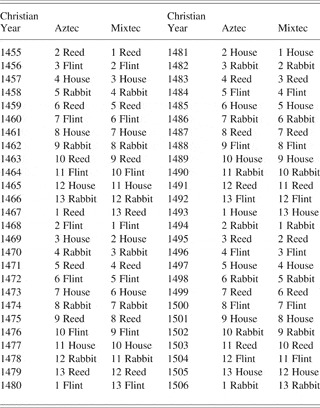
Unlike Aveni and Hernández, who both utilize known Venus events to place the Borgia agricultural almanacs in real-time, this article will utilize tree-ring analysis to attempt to place drought depictions in the Codex Borgia and the Codex Vaticanus B in relation to datable drought events in Mexico. In so doing, this study will convert both the Aztec and Mixtec year-bearer dates into their Gregorian equivalents (see Table 1), and then analyze them in relation to available data pertaining to droughts and estimated maize yields in central Mexico. It is hoped that this approach will help to determine which of these two calendar systems was used in the Borgia-group codices. This study is not intended to be definitive; rather, the purpose of this study is to explore whether Mixtec calendrics played a role in these almanacs. Admittedly, there are a number of problems with this approach. First, the true nature of the Borgia agricultural almanacs is not well understood. Despite convincing arguments to the contrary by Aveni and Hernández, the possibility must be raised that these works are abstract or prescriptive in nature, and that they do not pertain to real-time events as we would understand them.
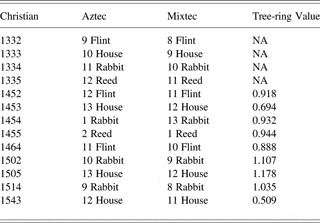
Aztec and Mixtec year comparisons 1455–1506.

Elizabeth Boone (Reference Boone2007:145–147) links the four rain gods represented with xiuhmopilli dates on Borgia 27 and Vaticanus B 69 with a Zapotec account of the 260-day calendar quartered into 65-day periods associated with different cocijos, the Zapotec rain gods (Figures 2 and 4). She notes that the day signs on page 27 (1 Crocodile, 1 Death, 1 House, and 1 Vulture) form 65-day periods ruled by different rain gods, like the Oaxacan account. Furthermore, a Mixtec account from Oaxaca recorded by Francisco de Burgoa associates the year-bearers of the four quarters of the xiuhmopilli with different prognostications, with eastern (Reed) and western (House) years being generally favorable for people and crops, whereas northern (Flint) years are variable, and southern (Rabbit) years are too hot and dry, leading to famine, pestilence, and warfare. A similar account is documented by Durán (1971:392–393) in central Mexico, who records that Reed years were ones of abundant rain and maize, but he notes a different outcome for House years, because these were either too rainy or misty. Flint years were ones of cold and ice, which were barren and associated with famine. Rabbit years were variable, and the fortunes of maize could go either way. Another interesting related account from central Mexico is found in the Historia Mexicana por sus pinturas (Boone Reference Boone2007:146; Garibay Reference Garibay1979:26), which describes four sources of water in Tlaloc's “house,” each with a different effect on the crops. The water source for good rains nourishes crops, whereas the bad rains are damaging because they produce mildew, rain sheets or hail, or insufficient rains. Although these are not specified as to year-bearers or quarters of the calendar, they can be related. For example, a House year (west) which is too rainy and misty might be expected to have a bad rain that produces mildew.
Codex Vaticanus B 69 (after Seler Reference Seler1963:Figure 586).

Comparing the Oaxacan and central Mexican accounts for prognostications of maize shows some consistency in terms of Reed years being favorable, but not so with the Rabbit years. Whereas Durán says that Rabbit years are variable, other central Mexican sources are in accord with the Mixtec source that says Rabbit years are uniformly bad. The bad reputation of 1 Rabbit years may be based on the 1 Rabbit famine of 1454, “one of the most widely reported social calamities in Aztec history” (Therrell et al. Reference Therrell, Stahle and Soto2004:1267). These accounts suggest that the different quarters of the calendar are linked with different rainfall patterns in terms of prognostications, but they might also reflect some long term observations of natural cycles involving climate and agriculture. Certainly, there is also evidence from the historical chronicles to suggest that they are based on actual observations. The historical annals of the Aztecs, compiled in the Colonial period, are full of records documenting droughts, floods, and other natural history events (Quiñones Keber Reference Quiñones Keber1995). Thus it seems reasonable to test whether the droughts recorded on Borgia 27 and Vaticanus B 69 depict actual events, reflecting the intersection of meteorological events, agricultural cycles, and cultural history.
DROUGHT EVIDENCE
There are a number of ways to reconstruct historical droughts. In the case of central Mexico, the most obvious and available method is through the extant colonial accounts. These, of course, are subjective and cannot be taken by themselves as fact. Additionally, scholars have attempted to use lake sediment records to determine periods of historical drought in central Mexico, although this method has proven somewhat imprecise for the area here under study (Metcalfe and Davies Reference Metcalfe and Davies2007). A third, more reliable method is through the analysis of tree-ring data. During times of drought, trees cannot grow at their normal rate, and thus the rings will not be spaced as far apart as during optimal growing conditions. When tree-ring data are cross-referenced with other information, it yields a tremendous potential for pinpointing droughts to their specific years. Since the number of rings a tree has will tell you how old the tree is, all one needs to do is count out the rings and measure the anomalous years (with very low growth rates), to determine the time and severity of a given drought, cross-referencing the rings with well established sequences of overlapping records of tree-ring growth. Two recent studies have attempted to do exactly this. In their 2004 study, Matthew Therrell and colleagues (2004:1265) correlate their research on tree-ring data with known droughts from Aztec historical annals. In so doing, they arrive at a total of 13 noteworthy droughts for the period 1332–1543, with droughts actually spanning multiple years in two cases (1332–1335, 1452–1455) (see Table 2). Their research positively correlates their tree-ring data with known historical droughts for central Mexico, thus lending credence to the use of tree-ring data in determining historical droughts (Therrell et al. Reference Therrell, Stahle and Soto2004:1270). Although the droughts documented in the tree-ring data from 1332–1335, based on the Casas Grandes sequence, have now been proved to be inaccurate (David Stahle, personal communication 2009), reliable data come from Puebla, in the tree-rings from Cuauhtemoc la Fraga, providing a sequence running from 1474 through the early Colonial period. In their subsequent research, Therrell et al. (Reference Therrell, Stahle, Diaz, Oviedo and Cleaveland2006a, Reference Therrell, Stahle, Diaz, Oviedo and Cleaveland2006b) explore the relationship between tree-ring data and famine by estimating the maize yields for highland central Mexico based on the growth of an ancient stand of trees in Puebla. They established the pattern of estimated maize yields by studying the relationship of modern tree-ring records to known maize yields over a 22-year period. Until very recently, maize agriculture was a very precarious undertaking in central Mexico, having only a very small window during which the rainy season must begin for a crop harvest to achieve optimal yields. This is largely due to the high elevation of central Mexico (generally more than 1,800 m asl) which leads to an early frost, and because under-watered maize is generally unable to survive the annual mini-drought, called the canícula, which usually extends from the middle of summer until late July (Therrell et al. 2006:493–494). For our purposes, this study is particularly useful because the tree-data the authors are utilizing come from the Puebla area, which is the second most southerly habitat in Mexico where Douglas Fir trees grow in abundance, and the location near the Puebla-Tlaxcala Valley, the probable origin point for the Codex Borgia. Using combined maize yield estimates for the states of Puebla, Tlaxcala, and Veracruz, Therrell and colleagues (2006:495, Figure 1) find that the tree-ring and historical data generally agree, when they compared their “reconstruction to historical records of crop failure and famine in order to cross-validate the tree-ring and historical records.” Their research (Therrell et al. Reference Therrell, Stahle, Diaz, Oviedo and Cleaveland2006a:501) strongly suggests a positive relationship between tree-ring data, maize harvest, and social crisis. The proposition here is to test whether these dates for droughts can be applied to the Codex Borgia agricultural almanacs, and whether the data related to climate help to confirm either the Aztec or Mixtec dating systems for the dates recorded.
Chronology of 13 drought events from Aztec historical sources, with droughts in 1452, 1464, 1505, 1543 documented in Chimalpahin (Reference Chimalpahin1998), and the remainder from a variety of other sources (Therrell et al. Reference Therrell, Stahle and Soto2004:1265). Comparable dates are given in both Aztec and Mixtec calendars, and tree-ring values from 1452 on. A tree-ring value of 1.0 represents average tree growth conditions, and by inference, average soil moisture conditions and presumably near average rainfall amounts. Earlier tree-ring values are from Durango, and those after 1473 are from Cuauhtemoc, Puebla; accurate data for Mexican tree-rings are not available (NA) prior to 1452 (David Stahle, personal communication 2009).

CONVERSION OF AZTEC AND MIXTEC DATES
Scholars have long known that the Aztecs and Mixtecs used related calendars, but the year-bearers are somewhat different. In a significant study of the Mixtec calendar, Wigberto Jiménez Moreno (Reference Jiménez Moreno, Moreno and Higuera1940) argued that scholars had not given adequate attention to the fact that a particular year date in the Aztec calendar corresponds to the same tonalpohualli day sign in the Mixtec calendar, but with a different coefficient; that is to say, a year date in the European Calendar that is 2 Reed in the Aztec system will be 1 Reed in the Mixtec system (Jiménez Moreno Reference Jiménez Moreno, Moreno and Higuera1940:70). Although the single numerical difference between the two signs seems inconsequential, it in fact can be quite significant due to the nature of the Mesoamerican calendar. In terms of the four possible year-bearer signs (Reed, Rabbit, House, Flint), 2 Reed and 1 Reed would be placed twelve years apart, since the days would have to cycle through all thirteen coefficients. Jiménez Moreno charts the years 1507–1591 and gives both the Aztec and Mixtec equivalents for each Christian year. Recent studies suggest that the Codex Borgia was created in the middle-to-late fifteenth century, and certainly no later than 1519 (Cassidy Reference Cassidy2004:191; Milbrath Reference Milbrath, Ruggles and Urton2007), so we have extrapolated Jiménez Moreno's dates back to the beginning of the previous century, as seen in Table 1. What Jiménez Moreno (Reference Jiménez Moreno, Moreno and Higuera1940) reveals in his calculations is that any year-bearer sign in the Aztec calendar will correlate with the same sign in the Mixtec calendar but be one numeral coefficient greater. For example, the Mixtec year date 1 Rabbit would correspond to the Aztec date 2 Rabbit. Similarly, the Mixtec year date 13 House would correspond to the Aztec date 1 House, because the year dates are drawn from year-bearer signs that mark a different ending point in the annual cycle. Looking at Table 1, one can easily correlate any Aztec year-bearer date with its Mixtec and Christian equivalent.
Borgia 27
Page 27 of the Codex Borgia appears as parts of a two-page set dealing with rainfall and maize production (Figure 2). Borgia 27 clearly has iconographic references to some form of drought phenomenon. The page itself is divided into four quarters, each with an associated xiuhmopilli date directly beneath the rain god image and another compartment in the center with a rain god but no dates. Each of these segments represents one of the four cardinal directions (east, north, south, west), with the middle pictorial representing the “center” direction (Hernández Reference Hernández2006:6). Each quadrant contains a depiction of Tlaloc, the Postclassic period central Mexican rain god, his head upturned to the sky and rain streaming from his hands and between his legs. Each picture also includes a skyband. For the lower right and upper left of page 27, this skyband is characterized by cloudy skies and scrolls that could symbolize rain clouds or sheets of rain. Both pictures seem to represent a healthy and robust maize harvest, but the scene on the upper left seems to show crops inundated with too much water pooling around the crops. Each representation of the earth is significantly different, ranging from a bountiful earth crocodile in the lower right to a parched earth with rodents on the lower left. The parched earth is associated with a skyband that is a sun-drenched yellow with red solar rays pointing downward towards the ground. A similar sky is shown in the upper right, but here the crops are attacked by a different form of pest, and there is some evidence of rainfall in the pool of water in the center of the band. These iconographic differences will be discussed in detail, but in both cases the agricultural outlook does not appear good.
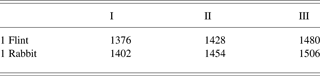
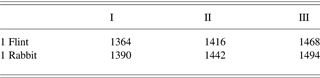
For the two depictions that show pests attacking maize and a sunny sky that might represent drought, the given dates are the year 1 Flint, day 1 Death (upper right) and the year 1 Rabbit, day 1 Vulture (lower left). Year signs, it should be noted, are formed by combining the 260-day calendar with the 365-day solar count, which results in a xiuhmopilli sequence of 52 years that will be named for the day signs Reed, Flint, House, or Rabbit, each combined with a sequence of 13 numbers. These four signs, called the “year-bearers,” are the last day of the annual cycle, positioned just before the five-day period, the Nemontemi or “unlucky and worthless days,” according to Alfonso Caso (Reference Caso, Ekholm and Bernal1971:Tables 2–4). Using a table for the xiuhmopilli sequence developed by Caso (Reference Caso, Ekholm and Bernal1971:Table 5), and focusing on dates in the fifteenth and early sixteenth centuries, the year 1 Flint yields the following possible years in the Aztec calendar: 1428, 1480, and 1532. These three years represent different xiuhmopilli cycles spaced 52 years apart. The year sign 1 Rabbit corresponds to 1402, 1454, and 1506. If the Reed and Rabbit year-bearers are derived from the Mixtec calendar, however, they would yield very different results. The year 1 Flint in the Mixtec calendar, equivalent to the year 2 Flint in the Aztec calendar, correlates with 1416, 1468, and 1520 (Caso Reference Caso1951). The year-bearer 1 Rabbit in the Mixtec calendar would similarly correspond to the year 2 Rabbit, equivalent to 1442, 1494, and 1546.
Vaticanus B 69
The Codex Vaticanus B, also of the Borgia group, has more stylistic elements consistent with Mixtec art than do the other codices of the Borgia group (Boone Reference Boone2007:228). Eduard Seler (Reference Seler1963:I:258–260) notes that page 69 of the Vaticanus B bears a great deal of resemblance to Borgia 27 (Figures 2 and 4). The scene similarly features five representations of Tlaloc the rain god, positioned in four quadrants and in the center as well. Although less obvious than the Borgia, these depictions do have a climate-related theme, featuring two skybands with solar rays (drought?) and two with volutes that seem to represent rain and clouds. The two potential drought images in this case are located in the lower right and upper left, but they are associated with the same dates seen on Borgia 27, and the agricultural pests may be the same, as discussed below. Each Tlaloc figure clutches an axe in one hand and a tan-colored vegetal symbol represented with white circles at one end and roots at the other end. In the two scenes with rain clouds, Seler (Reference Seler1963:I:260) notes that maize ears are not represented but he says that Tlaloc holds “un sartal de piedras preciosas, cózcatl, la misma idea se expresa con suficiente claridad” (a string of precious stones, cozcatl, expressing the same idea with sufficient clarity). Given the color of the plants, it is likely that the maize is represented. Since the scenes are much smaller, owing to the small size of the page (12.4 × 14.7 cm), the artist chose to show the symbol of an individual maize plant, rather than the field of maize seen in the much larger image on Borgia 27 (25.8 × 26 cm). Like the Borgia, Vaticanus B 69 provides xiuhmopilli dates with a day and year sign for each quadrant, noting the years of 1 Rabbit and 1 Flint for the two possible drought images. The equivalent dates in both the Aztec and Mixtec calendars are the same ones as noted for Borgia 27. We will return to Vaticanus B, once we have analyzed the drought events on Borgia 27.
DROUGHT ANALYSIS FOR BORGIA 27
According to research by Therrell and colleagues (2004:1267), 13 major droughts can be documented for the late pre-Hispanic period in central Mexico, with 1454 being the most severe for the period here under consideration. As previously noted, the authors report that this drought, called the “Famine of One Rabbit,” was considered to be a major social disruption in Aztec history. The years of reported drought from 1332–1543, their Aztec and Mixtec equivalents, and the associated tree-ring values for nine of these droughts are listed in Table 2. We have excluded the tree-ring values in their table for the years 1332–1335, because the earlier records based on Casas Grandes samples are now considered invalid (David Stahle, personal communication 2009).
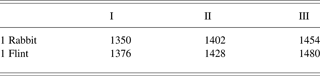
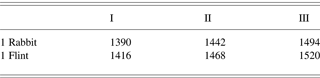
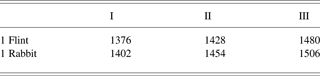
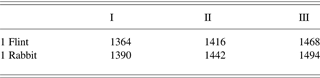
Because we are investigating a pre-Columbian codex, and our hypothesis is that it records actual events rather than prognostications, dates that come after the fall of Tenochtitlan in 1521 are not considered here. Although dates that fall towards the middle of the fifteenth century are the most likely candidates, those that fall earlier cannot be entirely disregarded. Thus, this study will consider them as possible real-time dates, but we acknowledge that relevant tree-ring data are not yet available prior to 1452. Tables 3 and 4 present 1 Flint and 1 Rabbit dates, the ones that seem most likely to be associated with drought on Borgia 27, and give their equivalents in both the Aztec and Mixtec systems grouped in columns that relate the closest dates in the two systems.
Possible years in the western calendar corresponding to Flint and Rabbit years on Borgia 27, using the Aztec calendar.
Possible years in the western calendar corresponding to Flint and Rabbit years on Borgia 27, using the Mixtec calendar.
Correlations for the Aztec Years
For the earliest set of dates, Column I in the Aztec system, neither of the dates correlates to any droughts documented in Aztec historical records. In Column II, however, the drought image on Borgia 27 corresponds perfectly with the known “Famine of One Rabbit” in 1454 (Table 3), an event well documented in Aztec sources, as discussed above. Codex Telleriano-Remensis 32r records a slightly different scenario for this year, noting that there was so much snow that people died of hunger, but Eloise Quiñones Keber (Reference Quiñones Keber1995:217) points out that other sources, such as Durán, specifically mention drought in this year. In the next 1 Rabbit year (1506), Codex Telleriano-Remensis 41v shows a plague of rats, and one commentator notes that the rats devoured the seeds at night (Quiñones Keber Reference Quiñones Keber1995:228–229). Since that source also notes that there was a famine in the previous year (13 House), presumably the rats had no stored maize to feed on so they resorted to digging up freshly planted seeds. On Borgia 27, the scene shows rodents attacking the maize (Figure 2). It should be noted, however, that the Aztecs had long associated the year 1 Rabbit with famine (Therrell et al. Reference Therrell, Stahle and Soto2004:1269). Thus, it would also make sense for the year 1 Rabbit to be linked with drought even if the Borgia almanac was not designed to reflect real-time events.
The Aztec Column II, 1 Flint date of 1428 does not match up well with any of the 13 drought events documented in the study of Aztec historical records (Tables 2 and 3). There are no droughts in proximity to that date, and the 1454, 1455, 1464 droughts documented by Therrell and colleagues would seem to be too early to be linked with the next recurrence of 1 Flint in 1480. No records of droughts in either 1428 or 1480 appear in major ethnohistorical sources, such as Durán and the Codex Telleriano-Remensis.
Turning to the imagery associated with 1 Flint depiction in the upper right of Borgia 27, we note that it may not represent a drought (Figure 2). The reason we have cause to suspect this is that there is a puddle of water represented in the center of a scene of winged pests carrying off the maize, very likely representing locusts. Interestingly, locusts in Mexico (Schistocerca piceifrons) are documented to reproduce in the presence of significant moisture at the beginning of the rainy season (Centre for Overseas Pest Research 1982:302–305). Grasshoppers can transform into locusts under the right conditions, and swarming behavior begins when rain is sufficient to breed but later insufficient to nurture crops that provide the food supply.
Research by César Caviedes (Reference Caviedes2001:252) indicates that during years of El Niño climate patterns, locust outbursts related to drought have been noted in tropical areas of Africa and South America. But, during La Niña years, there is also some evidence of locust plagues in Yucatan (Bricker and Hill Reference Bricker and Hill2009:232). In these years, surface temperatures in the Pacific Ocean tend to be cooler than normal, while the opposite is true for the Atlantic. Warmer surface temperatures result in increased tropical moisture for the Yucatan and other areas bordering the Atlantic, and this increased rainfall seems to correlate with the presence of locusts in the area. In his study of the relationship between El Niño and La Niña climate patterns and history, Caviedes (Reference Caviedes2001) notes similar behavioral patterns for African desert locusts. Brief periods of heavy rain can profoundly affect the social habits and physiological characteristics of these insects, which not only become more active during these short rainy spells, but also take advantage of the dampness to reproduce. As subsequent generations emerge, vegetation becomes increasingly scarce and, in time, this dearth of nourishment can trigger their swarming behavior. During times of favorable air flows from east to west, these locust swarms are actually capable of making the 2,600 mile journey across the Atlantic from the coasts of Mauritania and Senegal, arriving in the Antilles in as little as five days (Caviedes Reference Caviedes2001:159–161). Swarming across the Atlantic, however, is a very rare occurrence (John Capinera, personal communication 2009).
The destructive presence of locusts appears during or following wet years, but long-term drought would be as lethal for locusts as it would be for maize. Thus, 1 Flint may be depicting an event after a heavy rainfall, which has allowed for the locusts to mature and take advantage of the healthy maize. It is notable that, at the bottom of the 1 Flint scene, at least one of the maize stalks appears to be emerging from a pool of water. And, this evidence of rainfall coordinates with the fact that 1 Flint years are not drought years in the Aztec historical records, nor in the correlating years in the Mixtec calendar (Table 2).
The term "locust" is often used for grasshoppers in their swarming phase. Unlike grasshoppers and many related species, the locust that usually plagues Mexico, Schistocerca piceifrons, actually goes through two generations in a single year. The female will begin to lay her eggs during the onset of the spring rains, generally in April, and her offspring will spend the following months feeding on weeds and vegetation. After reaching reproductive maturity, this new generation will begin to lay its eggs around October, and the subsequent generation will continue the cycle the following April (Centre for Overseas Pest Research 1982:303). Under normal conditions, one would therefore expect that if these locusts are going to swarm, they would begin invading Mexican maize fields in the late summer when the crop is mature. Eggs are generally deposited in the fields during these swarms in October, and hatch the following spring to feed on the immature crops. If, however, the vegetation begins to die back, as would happen during a drought, these locusts could become gregarious and travel long distances in search of suitable vegetation, possibly feeding in areas unaffected by drought. Indeed, it is possible that a drought in Yucatan could lead the swarm to fly west to central Mexico (John Capinera, personal communication 2009). Online reports of recent locust plagues in Yucatan include ones in 2004, 2006, and 2009, the latter two taking place in November and January, respectively, at the end of the growing season.
From the life cycle and habits of S. piceifrons, we might expect to have locusts breeding during the onset of the rainy season (May), and if there followed a period of drought that covered the latter part of the agricultural cycle, as seems to be represented by the sun-drenched skyband on Borgia 27 (1 Flint quadrant), then swarming behavior would begin. Given the proposed date for the 1 Flint date on Borgia 27 (December 1480), the swarming probably began in November through December, a time of year that locust plagues have been recorded in modern Mexico.
For the purposes of this study, the implication of our analysis is that both Columns II and III in Table 3 represent dates that could reflect actual events, since the 1 Rabbit years (which are more clearly a drought) align with known droughts, while the 1 Flint years do not. A drought would not be expected if 1 Flint represents a wet year with locusts, as seems to be the case. In support of this, we note that study of the ethnohistorical sources for the Valley of Mexico by Anton Kovar (Reference Kovar, Sanders, Kovar, Charlton and Diehl1970:33–35) who cites ethnohistorical records in the Relaciones de Chalco and Noble y Lebrija documenting plagues of locusts and grasshoppers in the years 1488 and 1491 (9 Flint and 12 Reed, respectively), years that are not documented as drought years (Table 2).
Based on the data published in the National Oceanic and Atmospheric Administration (NOAA) website (Therrell et al. Reference Therrell, Stahle, Diaz, Oviedo and Cleaveland2006b) and data on Early Wood (EW) and Late Wood (LW) growth in tree-rings supplied by David Stahle (personal communication 2009), we can discuss both maize yields and climate records for Puebla (Cuauhtemoc la Fraga). For the tree-ring data, the number 1 designates an average growth measurement. The reconstructed maize yield data are a statistical construction based upon tree-ring measurements, and in this set 0 designates an average yield. Thus, any estimated yield above this level represents a favorable maize harvest, while those below represent a below-average yield.
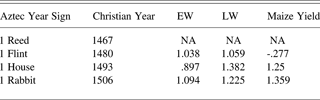
The scenario depicted in the 1 Flint quadrant of Borgia 27 seems to confirm a wet period followed by a dry one for the year 1480. Consulting the tables in Therrell et al. (Reference Therrell, Stahle, Diaz, Oviedo and Cleaveland2006b), we find that in 1479, the year before the 1 Flint date, the maize yield reflects a very dry year, with a well-below-average maize yield of −0.937. The raw data provided by David Stahle show corresponding tree-ring measures with below-average Early Wood (EW) for growth for 1479, and Late Wood (LW) growth for that year, 0.970 and 0.943 respectively. The spring-summer growing season (92% from May to October) is correlated with Late Wood chronology, the principal measure used in determining the maize yields for each year in the highlands of central Mexico (Therrell et al. 2006:496–498). We also include the Early Wood data to study the overall pattern of rainfall in given years. To take this analysis back another year, we find that 1478 was even drier, with an estimated maize yield of only −1.58, and Early Wood and Late Wood figures of 1.06 and 0.648, indicating that a drought began in the early summer. For the 1 Flint year of 1480, the estimated maize yield is −0.277, while the Early Wood and Late Wood figures are 1.038 and 1.059. Thus, 1480 was relatively wet compared to the two previous years, making for the precise conditions under which we would expect to find locusts. Unfortunately for the people of central Mexico, their maize fields recovering from two years of drought provided precisely the type of nourishment needed by these swarming insects.
Correlations for the Mixtec Years
Columns I, II, and III in Table 4 are all possible sets of years if 1 Flint and 1 Rabbit on Borgia 27 are interpreted as dates in the Mixtec calendar. Starting with the years in Column I, 1364 and 1390, we find no real correlations with known droughts recorded in Aztec sources. Taking the second column of Mixtec dates, 1416 and 1442, we find no solid correlation. For Column III, the years 1468 could correspond with the drought of 1464 in Table 2, but we have no indication that this drought lingered for years. The 1494 date in Column II date is an unlikely correlation, as it falls eight years before the drought of 1502. Thus, we do not find a solid correlation between the images on Borgia 27 and real-time droughts if the dates are taken to be ones recorded in the Mixtec calendar. On the other hand, we do find interesting correlations for the Aztec calendar. If our analysis of the 1 Flint and 1 Rabbit quadrants of Borgia 27 is correct, it would seem that this information supports the use of the Aztec calendar, as the calendar used in recent studies of “real-time” events in the codex.
BORGIA 28
A scene very similar to Borgia 27 and Vaticanus B 69 appears on Borgia 28, but here the sequence of year-bearers runs from 1 Reed to 5 Reed, indicating a five-year period (Figure 3). Even though the first year sign is effaced, it probably is 1 Reed, given the dates that follow in sequence (2 Flint, 3 House, 4 Rabbit, 5 Reed). The dates 2 Flint, 3 House, and 5 Reed and associated tonalpohualli dates are all well preserved in the codex, confirming the year sequence proposed. Bruce Byland (Reference Byland, Díaz and Rodgers1993:xxii) noted that in the restoration painted for the Dover edition, the artists Gisele Díaz and Alan Rodgers (1993) did not reconstruct certain day signs because the page was too badly damaged. Their reconstruction of Borgia 28 used in our Figure 3 shows only the number 1 but not the year sign Reed, and it represents the day sign Movement with only three red dots, the number that also seems to be apparent in the facsimile edition (Anders et al. Reference Anders, Jansen and García1993). Nonetheless, both Hernández and Aveni reconstruct the day sign as 5 Movement. Hernández (Reference Hernández2006:28, Note 21, Tables 7, 8) correlates the dates on Borgia 28 with 1467–1471, beginning with the reconstructed date of year 1 Reed, day 5 Movement in the lower right, corresponding to 21 May, 1467 (May 30, Gregorian), whereas Aveni's (1999:S10–S11, Table 3) study of astronomical events places that date on February 5, 1468, representing the second occurrence of the date in the year 1 Reed (presuming the year ended in February as it did in some versions of the Aztec system) (Nicholson Reference Nicholson, Ekholm and Bernal1971:Table 4). There are actually two associated day signs with each year, and the first is clearly the day Movement, but Aveni considers the second day sign too effaced to be reconstructed. Hernández (Reference Hernández2006:Table 2), however, reconstructs the date as 1 Reed-9 Deer (20 June, 1467), based on the patterning of other pairs of day signs on the page.
Tlaloc is shown in all five compartments on page 28, each with a set of three day signs, the first in each set is clearly a year-bearer marked by the trapeze-and-ray sign in the examples that remain well preserved (Figure 3). Aveni (Reference Aveni1999:S15, Tables 3 and 4) looked for corresponding astronomical events for the year-bearers and tonapohualli dates, and found the second occurrence of 1 Reed-5 Movement on February 5, 1468 relates the first visibility of Venus the Evening Star, and a number of additional dates on page 28 coordinate with important astronomical events. Hernández (Reference Hernández2006:1, 19, Tables 7 and 8) suggests an alternate model and links all the dates to their first occurrence in the year, showing that the day sign sets associated with individual years cluster at the beginning of the rainy season in May through June. Even though Hernández does not support the association with Venus events suggested by Aveni, she sees a number of connections with the eclipse season and partial lunar eclipses for the dates in the central compartment associated with the 5 Reed year. We think it is likely that she is correct in focusing on the seasonal recurrence of rainfall events in May through June “when the first ears of corn are beginning to ripen and the rains are coming on a more regular basis” (Hernández Reference Hernández2006:20). Nonetheless, we must bear in mind that both occurrences of the date may be significant, especially in the case of the initial xiuhmopilli date of 1 Reed-5 Motion. This date may measure the interval between the onset of the rains and an important Venus event, the first appearance of the Evening Star on the second occurrence of this date in the year 1 Reed.
Hernández's (2006:Figure 3) diagrams of rainfall in the Puebla-Tlaxcala area, based on the Worldclimate website (www.worldclimate.com, accessed on May 9, 2002), show rainfall peaks in June, preceded by a period of increased rain in May (averaging between 60 and 170 mm in three locations in Puebla). The onset of rain in the state of Puebla differs in different areas, beginning the earliest in Tehuacan, where up to 50 mm are recorded at the beginning of March, to the city of Puebla itself and Chietla, Puebla, where rain is negligible until April, going from under 20 mm at the beginning of the month to 60 or 70 mm at the beginning of May.
The fortunes of maize are represented by different forms of rainfall on Borgia 28, with rain marked by knives associated with the 1 Reed year, referring to damaging rains that cut open the maize ears (Figure 3). Hernández (Reference Hernández2006:20) suggests that these are flint knives representing lightning. The water goddess below wears the mask of the wind god, Ehecatl, so it is possible that a combination of wind and heavy rain are shown, which clearly is damaging the crops. The following year, 2 Flint, shows maize being attacked by something that Hernández (Reference Hernández2006:20) describes as red-spotted stones representing hail, frost, or fungus. She notes that the 3 House years are associated with rain that bears flames, indicating drought, and she sees the 4 Rabbit year as a representation of strong winds, with the final year, 5 Reed, being the only favorable year, represented by rain with flowers. We note that it is possible that the Ehecatl figures in the year 4 Rabbit are worm-like creatures representing some actual form of pest carried by winds. One such pest that often attacks maize is a species of caterpillar, the fall armyworm or Spodoptera frugiperda (Lepidoptra: Noctuidae) (John Capinera, personal communication 2009). We will return to consider the climate records and estimated maize yields in relation to a possible drought event in the year 3 House and the ideal maize crop represented in the year 5 Reed.
Unfortunately, tree-ring data for the years most likely represented on Borgia 28 (1467–1471) are as of yet unavailable. Rather than proceeding here without the appropriate information, we will instead test to see whether the 1 Reed quadrant of Borgia 28 could represent the beginning of the next xiuhmopilli, following the one depicted on Borgia 27. If this is the case, Borgia 28 would follow the years 1519–1523 in the Aztec calendar, or 1507–1511 in the Mixtec system. Obviously, the Aztec dates here pose a serious problem, since they coincide with the Spanish conquest of central Mexico. Nevertheless, we will proceed here in order establish a comparison between the Aztec and Mixtec sets of dates. If we accept that Borgia 28 shows a later set of Aztec dates, the imagery suggests that the period spanning 1519–1523 was one of relative dampness. Unlike Borgia 27, there are no clear depictions of drought or dryness on Borgia 28, with the possible exception of 3 House. Locusts and rats are also absent from this page, although the lower left quadrant does appear to show some kind of worm-like pest emerging from the maize. According to John Capinera (personal communication 2009), the worm-like creatures on the lower left of Borgia 28 probably represent the fall armyworm. Larvae typically are a brownish color with elevated spots that are dark and bear spines, and they feed on maize kernels by burrowing through the husk on the side of the ear (Capinera Reference Capinera2001:403–407). Both the coloration and burrowing behavior seem to be shown on Borgia 28 by the "worms" boring through the husk. They bear the face of Ehecatl, the wind god, perhaps because the fall armyworm is distributed by windblown eggs. The eggs mature into armyworm caterpillars, and then pupate in cocoons, emerging as moths with a wingspan of 32–40 mm (Capinera Reference Capinera2001:406–407). The round symbols on the Ehecatl worms represent stars, possibly evoking the spotted markings on the armyworm caterpillars while also alluding to the nocturnal nature of the moths they represent. In their larval state they can affect young maize by burrowing in at the growth point of the plant, but higher densities are seen later in the season when they attack mature maize. In northern areas of the United States they do not appear until August and may have only a single generation, but further south multiple generations are reported and they are abundant from April to December (Capinera Reference Capinera2001:405). Highland Mexico, with the danger of frosts and snow, would seem to follow the pattern of the northern climates, but Yucatan would be expected to be more like the southern areas of the United States, where they would be expected to have long seasons with multiple generations. Much like locusts, they can deplete an entire area's food supply in a short period before moving on, as an “army,” to the next food source. Interestingly, armyworms are known to reproduce and feed during periods of dampness, so we would expect them to thrive during wet years, which could include years with a wet spring or early rainfall (John Capinera, personal communication 2009).
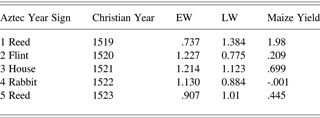
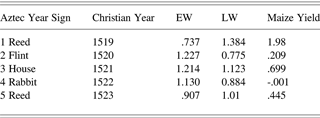
Looking at the span from 1519–1523, the data for 1522 (4 Rabbit) indicate that this was a fairly average year, with the reconstructed maize yield of -.001, and Early Wood and Late Wood measurements of 1.130 and 0.884, respectively (Table 5). This year would be the least damp year represented by the images on Borgia 28, which would make 4 Rabbit the least likely year for an armyworm infestation in the Aztec calendar dates spanning a five-year period from 1519–1523. Given the uncertainty surrounding the weather-related imagery on the page, the worms depicted in the 4 Rabbit year probably offer the best chance for establishing real-time dates for Borgia 28. We must await further climate data to see whether Borgia 28 can be correlated with 1470, the previous xiuhmopilli placement of 4 Rabbit, and to analyze the climate patterns for that year in relation to fall armyworms. An earlier placement of this page seems likely given the dearth of images relating to Spanish influences, and other evidence dating the Codex Borgia prior to conquest.
Early Wood, Late Wood, and Estimated Maize Yield data for xiuhmopilli dates 1519–1523. Zero represents an average maize yield, as in the 4 Rabbit year. All other years are above average. Average tree-ring values are set at 1.0, so the years 2 Knife and 4 Rabbit are somewhat below average for Late Wood but above average for Early Wood (Source: unpublished tables provided by David Stahle 2009).
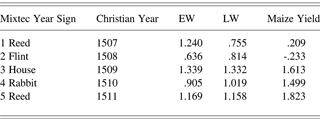
Testing the Mixtec dates, however, we do find pre-Conquest dates that have correlating climate records for the years 1 Reed to 5 Reed (1507–1511). From the available data for Puebla, it appears that the 1 Reed year of 1507 saw a fairly good harvest, with an above-average reconstructed maize yield of 0.209, and Early Wood and Late Wood measurements of 1.240 and 0.755 (Table 6). The 2 Flint year of 1508, however, did not see such good fortunes, with a maize yield of only -0.233 and Early Wood and Late Wood measurements of 0.636 and 0.814. The following year, however, offered much better prospects, as did both 1510 and 1511, the 4 Rabbit and 5 Reed years. Thus, if we were to accept the Mixtec calendar for Borgia 28, there would be only one year (2 Knife, 1508) with a below average maize yield, while the rest would be mostly substantially above average. From the depictions on Borgia 28, however, it appears that at least four of the five images represent poor crops, although the causes of these failures remain open to interpretation: hail, fungus, frost, worms, or drought. Although the bountiful image for 5 Reed (1511 in the Mixtec system) in the center is supported by the available data (1.823 reconstructed yield, 1.169 EW, 1.158 LW), the two previous years (1509, 1510) offer a very similar outlook. In the 4 Rabbit year (1510), we find that although the data suggest that this was a good year for maize (1.499 reconstructed yield, 0.905 EW, 1.019 LW), 1509 and 1510 have similarly high yields. Further, according to the tree-ring records, 1510 was slightly damper in the Late Wood growing season when the maize matures. The conditions in 4 Rabbit (1510) could be optimal for an outbreak of fall armyworm, which would most likely occur in the late summer during a period of relatively high rainfall.
Early Wood, Late Wood, and Estimated Maize Yield data for xiuhmopilli dates 1507–1511. Zero represents an average maize yield, as in the 4 Rabbit year. All other years are above average. Average tree-ring values are set at 1.0 (Source: unpublished tables provided by David Stahle 2009).
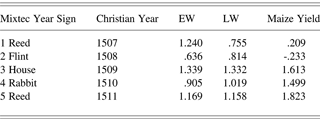
Using the Aztec systems of dates, it is difficult to determine whether the five-year cycle shown on Borgia 27 began in 1467 or 1519, because the climate data are inadequate prior to 1474. And, if we do take the dates to be a later occurrence of the Aztec dates 1 Reed to 5 Reed (1519–1523), and compare them with what would be the comparable dates in the Mixtec system (1507–1511), there is no substantial difference because both sets of dates belong to a sequence of years that are relatively wet. This indicates that these two set of dates cannot be used as evidence for whether the Aztec or Mixtec system works better in terms of real climate records.
DROUGHT ANALYSIS FOR VATICANUS B 69
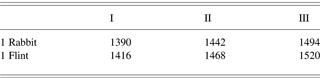
The dates in Tables 7 and 8 for the Codex Vaticanus B extend the year-bearer set back another xiuhmopilli period in the Aztec and Mixtec systems (Figure 4). They are rearranged to take into account the fact that the sequence appears to begin with the year 1 Rabbit at the lower right of the page. Vaticanus B pages 1–48 are read from left to right, as indicated by the tonalpohualli count beginning on the bottom of page 1, representing a different reading order from the right to left reading order of the tonalpohualli starting on the bottom of Borgia 1, but the reading order changes on Vaticanus B when the manuscript flips to its verso side, and pages 49–95 are read from right to left. The eastern direction and the day sign Crocodile that often begins a calendar cycle is positioned variably, sometimes on the lower left corner of the page (as on pages 95–96) or on the lower right (as on pages 49 and 77), and sometimes in the upper right (as on pages 69 and 73). On page 69, the eastern direction is in the upper right, based on the 1 Reed-1 Crocodile date, and the subsequent years rotate in a counterclockwise direction, as on Borgia 27–28. It is not clear where the cycle “begins,” but in order to test a scenario that is different than the one seen on Borgia 27, we begin the sequence with the 1 Rabbit date at the lower right, followed then by 1 Reed, 1 Flint, and 1 House.
Possible droughts in Aztec years for the Vaticanus B, page 69.
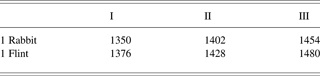
Possible droughts in Mixtec years for the Vaticanus B, page 69.
Correlations for the Aztec Years
For the Codex Vaticanus B Plate 69, we find that Aztec dates in Columns I, II, and III in Table 7 are within the possible range for this study. In the case of Column I, there is no correlation with ethnohistorically-documented droughts recorded in Table 2. In Column II, we find this to be true as well. For Column III, we find that the 1 Rabbit date corresponds perfectly with the drought of 1454, whereas the 1 Flint date of 1480 does not match up to any known droughts. Much like the Borgia, the two images associated with the 1 Rabbit and 1 Flint dates are quite different (Figure 4). The 1 Rabbit image, like the one in the Borgia, is clearly a drought. There is a small grey rodent with a long tail (possibly a rat or field mouse) eating the maize stalk and the ground is represented with an arid brown color. In contrast, the year 1 Flint is not apparently a drought image, for the rain god Tlaloc seems to be standing in a blue puddle on the back of an earth monster, indicating standing water that probably relates to prior rainfall, as in the comparable image in the Codex Borgia 27. An insect attached to a maize stalk in Tlaloc's right hand seems to be a locust. Although the artwork here is not as detailed as in the Borgia, the basic elements of the pest seem to be the same: two antennae on the top of the head, a downward-curving tail, an eye beneath the antennae, and legs in bent position beneath the body, indicating a locust is probably represented. Again, like the Borgia, the climatic conditions portrayed do not seem to be a drought, but a period of dryness after a deluge, during which there could be locusts in a year 1 Flint.
Correlations for the Mixtec Years
As the study by Therrell et al. (Reference Therrell, Stahle, Diaz, Oviedo and Cleaveland2006b:500) clearly shows, a drought can continue to affect maize yields for as long as a decade, so drought events in proximity to the recorded year should also be considered. Further, as Bricker and Hill (Reference Bricker and Hill2009:251) have noted, the second year of a multiyear famine is often much worse than the first. For Column I, there are no historically documented droughts that correspond to the dates 1390 and 1416 in the Mixtec system, and the 10-year interval between the 1 Rabbit date of 1442 in Column II and the drought of 1452 seems too long to be linked in any case (Tables 2 and 8). The 1 Flint date in 1468 follows shortly after the drought of 1464, but this was apparently an isolated event, rather than a multiyear drought (Therrell et al. Reference Therrell, Stahle and Soto2004:Table 1). Because data prior to 1474 are not yet available for Puebla, the earlier tree-ring records in Table 2 are from Durango, and based on these data a mild drought is indicated by tree-ring records for the year 1464. In Column III of Table 8, the Mixtec 1 Rabbit year of 1494, falling between the droughts of 1464 and 1502 recorded in Table 2, seems too far removed to be related. But here, we can apply data from the Puebla tree-ring records and the estimated maize yields. The year 1494 was a bumper crop according to the estimated maize yields of 1.407 (Therrell et al. Reference Therrell, Stahle, Diaz, Oviedo and Cleaveland2006b). Thus any correlation with drought in the Mixtec year 1 Rabbit is very unlikely. The Mixtec 1 Flint year (1520) in Column III seems too far removed from known drought events to be considered a match, and as noted previously, the year 1 Flint need not be linked with a year of complete drought, if it is in accord with the cycle of climate (wet followed by dry) in which locusts are likely to develop. The Early Wood measurements in 1520 of 1.227 indicate good growth early in the season, and the Late Wood at 0.775 is somewhat below average even though the maize yield based on Late Wood is somewhat above average (0.209) (Therrell et al. Reference Therrell, Stahle, Diaz, Oviedo and Cleaveland2006b). Based on the tree-ring data, 1520 could have been rainy through June but then followed by a dry period later in the growing season. This could correlate with the climate conditions represented on Vaticanus B with an outbreak of locusts (Figure 4), but the clear lack of correlation between the wet conditions in 1494 and in the comparable Mixtec 1 Rabbit year makes it seem unlikely that the Mixtec system of dating was used for the climate-related imagery on page 69 of Vaticanus B.
DELUGE AND THE FATE OF CROPS
Up to this point we have focused on links between rainfall patterns and agricultural pests, but we now turn to an image of an apparent deluge in the year 1 House, seen on both Borgia 27 and Vaticanus B 69. Having demonstrated that the Aztec year-bearer system more closely corresponds to the patterning of events on Borgia 27, we can turn to study rainfall patterns in the year 1 House for corroborating evidence. Heavy rains could be devastating because they could literally drown the crops. For example, in 1517 the lake in the Valley of Mexico rose suddenly without any mention of rain, resulting in a flood (Kovar Reference Kovar, Sanders, Kovar, Charlton and Diehl1970:36). In the next year Kovar (Reference Kovar, Sanders, Kovar, Charlton and Diehl1970:36) notes that the Historia Mexicana por sus Pinturas reported a famine in Tlaxcala in the year 1518. Perhaps the flooding in the Valley of Mexico was caused by heavy rains in more distant mountains, rains that could have affected Tlaxcala, and resulted in a failed harvest in 1517, and a lack of stored maize in the following year meant there was a famine.
Table 9 provides the years in the European calendar, Early Wood data, Late Wood data, and reconstructed maize yields for the xiuhmopilli cycle beginning in 1467. For that year there are no available data. Because the sequence for Cuauhtemoc la Fragua, Puebla begins in 1474, we are only able to provide data for the years 1480, 1493, and 1506 in Table 9. The Early Wood and Late Wood measurements are taken from an area of Puebla that is close to the region under consideration. Early Wood data are useful for determining precipitation for winter and early spring months, while the Late Wood data indicate rainfall during the late spring and early summer (David Stahle, personal communication 2009). For example, 1506 is a famine year according to ethnohistorical sources, but both the Early Wood and Late Wood indicate above average rainfall, and the modelers have estimated high maize yields for this year. The modeling for maize yields based on Late Wood growth is not always a direct correlation, and David Stahle (personal communication 2009) considers the maize yield estimates for Cuauhtemoc to be more reliable than the raw data of tree-ring records. Furthermore, comparing the tree-ring width (with a mean of 1.0) and the maize yield values (with a mean of 0) as we have done in Table 9 may not be a valid approach because figures around the mean in one data set may not result in figures around the mean in the second set. Only when you have an extreme will the correlation be clear, thus when there is extremely low growth in Late Wood, maize yield estimates are certain to be low.
Borgia 27 dates and Early Wood, Late Wood, and Estimated Maize Yield data. From Cuauhtemoc, Puebla. Average maize yield is 0, average EW and LW growth is 1. (Sources: Therrell et al. Reference Therrell, Stahle and Soto2004, Reference Therrell, Stahle, Diaz, Oviedo and Cleaveland2006b; David Stahle, personal communication 2009).
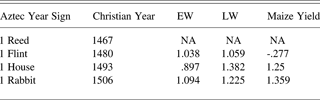
Both Vaticanus B 69 and Borgia 27 seem to show an overabundance of rain in a 1 House year. Borgia 27 shows the maize inundated by water in that year and Vaticanus B shows a cloudy sky and Tlaloc walking through water in the scene on the lower left. As can be seen in Table 8, the Aztec 1 House year of 1493 was a wet year, with both the Late Wood and reconstructed maize yield data well above average. The depiction in the upper left of Borgia 27 clearly supports this evidence. In contrast, the data for 1480 (1 Flint) are most perplexing because there is above average growth in Early and Late Wood, but the estimated maize yields are well below average. The inconsistency may be because the estimates for this early period are based on only a small number of trees. Perhaps the recent studies being conducted by David Stahle and colleagues (Reference Stahle, Diaz, Burneete, Paredes, Heim, Fye, Soto, Therrell, Cleaveland and Stahle2011:Figure 2) on tree-ring values for Bald Cypress stands near Tula will help to resolve this apparent contradiction. Their graph showing droughts over a period from a.d. 880–1550 show some segments of the record in sufficient detail to study individual years, but unfortunately the year 1480 is not in one of the detailed segments.
For the 13 reported droughts years, Therrell et al. (Reference Therrell, Stahle and Soto2004:Figure 3) noted significantly above normal growth four years prior to the Aztec drought years, which they say is reminiscent of the El Niño oscillation (Maasch Reference Maasch, Sandweiss and Quilter2008). The tables published by Therrell et al. (Reference Therrell, Stahle, Diaz, Oviedo and Cleaveland2006b) show a wet period expressed by high maize yields just prior to 1500, followed by an abrupt drop in tree-ring width indicating the seasonal rains became less abundant (-0.679 estimated yield for 1500). Given the good overlap between 1506 (1 Rabbit) and evidence of famine in the ethnohistorical accounts of a plague of rats in that year recorded in the Codex Telleriano-Remensis (Kovar Reference Kovar, Sanders, Kovar, Charlton and Diehl1970:35; Quiñones Keber Reference Quiñones Keber1995:229), as well as a drought in 1505 as suggested by paleoclimate studies based on extrapolation of data from Douglas Fir trees in Durango (Therrell et al. Reference Therrell, Stahle and Soto2004:Figure 8), the Aztec system of dates for the year-bearers seems to be confirmed.
The evidence presented here suggests that the sequence of events in “real time” corresponds to the xiuhmopilli cycle beginning on Borgia 27, in 1 Reed in 1467 on the day 1 Crocodile. This could be 26 March, 1467 (April 4, 1467, Gregorian), the date proposed by a number of scholars (Aveni Reference Aveni1999; Bricker Reference Bricker2001, Hernández Reference Hernández2006), or 11 December, 1467 (December 20, 1467, Gregorian), the second occurrence of the 1 Crocodile date (Milbrath Reference Milbrath2012). Exploring the associated tonalpohualli day signs listed on Borgia 27, we find the second occurrence of 1 Crocodile in the year 1 Reed presents a better candidate because the records of climate and the fate of the crops (locusts, rats) would reflect the fate of the mature crop, corresponding well with the completed agricultural cycle. If these dates record the second occurrence in the year, the Gregorian dates would be as previously noted: December 20, 1467 for 1 Reed-1 Crocodile; December 16, 1480 for 1 Flint-1 Death; December 13, 1493 for 1 House-1 Monkey; and December 11, 1506 for 1 Rabbit-1 Vulture. The 1 House date in 1493 would correspond to Late Wood measures for tree-ring growth when rainfall was especially abundant. The data for 1506 (1 Rabbit), a drought year according to ethnohistorical sources, remain anomalous because of the high maize yield estimates. Another complication is that because the Aztec year actually ended in February (Milbrath Reference Milbrath2012; Nicholson Reference Nicholson, Ekholm and Bernal1971:Table 4), Early Wood data that we link to 1506, actually refer in part to the year 13 House. Looking at the maize yield for 1505 may actually be more relevant, and here we find a much lower maize yield (0.336), but still above the mean of zero (Therrell 2006b).
CONCLUDING REMARKS
In this study, we used the year-bearer signs from two sets of drought-themed almanacs from two separate Borgia-group codices. We converted these year-bearers into real-time dates using the European calendar according to both the Aztec and Mixtec calendar systems. These dates were then matched up against 13 droughts that occurred during the late pre-Hispanic period. Then, using tree-ring and reconstructed maize yield data, we considered the occurrence of “wet years” in these almanacs, including the possibility that the presence of locusts in these depictions indicates a year in which heavy rains early in the growing season were followed by a period of dryness, rather than a drought as has been assumed. This study was undertaken with the hope of finding a strong correlation between one of the two calendars and known historical droughts in central Mexico. According to our findings, the use of the Aztec calendar system seems to be most probable for the Codex Borgia. It seems likely that these almanacs do record real-time agricultural events, although we must proceed here with due caution. Nevertheless, this conclusion is well supported by cross-references with climatological data, ethnohistorical accounts, and extant Aztec codices. Real-time events are also confirmed in other records, such as the unique 18-page narrative on Borgia 29–46 that shows an historical record of a total solar eclipse in 1496 on Borgia 40 (Milbrath Reference Milbrath, Ruggles and Urton2007).
The strongest correlation found in this study was for the 52-year xiuhmopilli cycle spanning the Aztec years equivalent to 1467–1506. Unfortunately, there are as of yet no maize-yield estimates available for years before 1474. There is, however, plenty of evidence to substantiate this conclusion. First, we must consider the second year date given on Borgia 27, 1 Flint, which corresponds to the Christian year 1480. In this quadrant, we see Tlaloc, a yellow skyband, and what appears to be a plague of locusts destroying a healthy crop of maize. At least one of the maize stalks appears to be growing up from a puddle of water. The depiction in Vaticanus B69 shares many of these elements, including the skyband, the locust, and a puddle of blue water on top of the earth monster. As previously discussed, the presence of the locusts in these depictions suggests a period of relative wetness followed by a dry period, and this situation is confirmed by the available data.
In the 1 House quadrant of Borgia 27, which we place in 1493, the artist clearly intended to depict a scene of wetness and healthy maize. Apparently the rainfall was not sufficient to damage the crops. The available tree-ring and maize-yield data confirm that this was the case, with a reconstructed maize yield of 1.25, well above average, and Late Wood figures of 1.382 that are also above average. This data help confirm our placement of this quadrant within the xiuhmopilli cycle beginning in 1467 in 1 Reed.
The final quadrant of Borgia 27, which we place in 1506 (1 Rabbit), is the most clear depiction of drought in the almanac. The ground here appears to be completely dry, and the small, seemingly underdeveloped maize is being consumed by what appears to be a plague of rats or field mice. This plague is also depicted for the same year in the Codex Telleriano-Remensis 41v, which notes that 1 Rabbit was a year of famine, and Quiñones Keber (Reference Quiñones Keber1995:228–229) notes that the sequence from 1505–1506 represents a repeat of the famine seen 52 years earlier in 1453–1454, giving some ethnohistorical credence to the placement of the 1 Rabbit quadrant in that year. The climate data for the years 1505–1506 in Puebla, however, does not indicate a drought for this year. According to David Stahle (personal communication 2009), we must remember that the records for Cuauhtemoc de la Fragua, Puebla involve as many as 90 trees for the 1550s, but going back through time, the number of trees sampled is much less, so that for the beginning of the estimated maize yield sequence in 1474 there are as few as two trees, which can lead to less reliable results for these early records. Therrell and colleagues (2004), however, found the evidence for a drought in the 1 Rabbit years sufficiently compelling to include that year in a list of droughts, although they placed it in 1505 rather than 1506 (Table 2). Their findings, coupled with the account of rats in the Codex Telleriano-Remensis, do suggest that this is the correct placement for this date.
Our research therefore seems to confirm the use of the Aztec calendar system in the Codex Borgia. By no means, of course, is this study intended to be definitive; rather, our intention has been to test the Aztec and Mixtec systems in this almanac, as well as to provide an additional means by which to test for real-time events in the Codex Borgia. It is significant that our research reveals the same year date sequence in real-time events suggested by a number of scholars. Although these weather-related almanacs reveal only one facet of an immensely complex document, it is hoped that this study has gone one step towards decoding this section of the Borgia. Of course, ancient Mesoamericans conceptualized time differently than we do, and it is likely that this almanac was created to reflect elements of the past, present, and future. At least part of this document, however, seems to reflect an historical account of natural phenomena related to production and harvest of maize, a staple crop central to Mesoamerican systems of belief that in many ways played the determining part in the struggle for life and death in central Mexico.
RESUMEN
En la última década, varios estudiosos prominentes de mesoamérica han intentado utilizar los datos astronómicos para colocar las imágenes en la página 27 del Códice Borgia, en "tiempo real". Este método ha dado algunos resultados interesantes, pero todos estos autores basen sus estudios en la suposición de que el Códice Borgia fue elaborado de acuerdo con el calendario azteca. Tomando en cuenta el origen probable del Códice Borgia en la zona limítrofe de las zonas culturales mixteca y nahua oriental, se debe comprobar esta suposición. Este artículo compara imagines que muestran fenómenos meteorológicos que tienen fechas distintas en las páginas 27–28 del Códice Borgia con los datos científicos de la zona de Puebla, como medidas del crecimiento anual de árboles y estimaciones de la cantidad de maíz producido. Al hacerlo, hemos probado nuestra hipótesis de que estas páginas representan registros históricos relacionados con el clima y variaciones en la abundancia del maíz. Mediante pruebas de fechas asociadas con los patrones climáticos específicos, utilizando tanto los sistemas azteca y mixteca del portador del año, también investigamos qué sistema de fechas funcionara mejor con los datos del clima y si las imágenes agrícolas en el Borgia 27–28 anotan algún tipo de observación directa. Nuestra investigación para este documento parece confirmar lo que muchos estudiosos han supuesto: que la información del calendario en el Códice Borgia fue codificado con el calendario azteca. Los portadores del año anotados en Borgia 27 se extienden desde el año 1467 hasta 1506 (1 Caña a 1 Conejo), y todas las fechas parecen agruparse en diciembre, cuando el maíz estaba totalmente maduro. Mediante el análisis de las representaciones de los fenómenos meteorológicos relacionados con la producción de maíz en Borgia 27 y un almanaque en paralelo en la página 69 del Códice Vaticanus B, ofrecemos un análisis nuevo de este documento muy conocido, específicamente argumentando que una gran sequía se muestra en el año 1 Conejo, mientras que el año 1 Pedernal está vinculado con un período de sequía después de las fuertes lluvias, una condición a veces articuladas con los enjambres de langostas como los que están pintados en Borgia 27. Borgia 28 muestra una imagen más detallada de un período de cinco años, que probablemente se extienda desde 1467 hasta 1472, mostrando las diferentes formas de daño a los cultivos debido al clima, insectos, moho u hongos, las heladas y el granizo.
ACKNOWLEDGMENTS
We would like to thank Victoria Bricker, Liwy Gazioso Sierra, Jeffrey R. Parsons, and Vernon Scarborough for reading and commenting on this paper. We also thank David Stahle and John Capinera for essential information used in our analysis.