Much research suggests that increased second language (L2) input at home may not support L2 acquisition for child L2 learners, whereas increased L2 input through schooling is crucial (Dijkstra, Kuiken, Jorna, & Klinkenberg, Reference Dijkstra, Kuiken, Jorna and Klinkenberg2016; Govindarajan & Paradis, Reference Govindarajan and Paradis2019; Páez, Tabors, & López, Reference Páez, Tabors and López2007; Paradis, Rusk, Sorenson Duncan, & Govindarajan, Reference Paradis, Rusk, Sorenson Duncan and Govindarajan2017). At first glance, this finding may seem surprising, given that increased input has been clearly linked to emerging language abilities in other contexts. For example, in bilingual children, increased first language (L1) input is related to stronger abilities in the L1, heritage language (Hammer et al., Reference Hammer, Komaroff, Rodriguez, Lopez, Scarpino and Goldstein2012; Pham & Tipton, Reference Pham and Tipton2018; Place & Hoff, Reference Place and Hoff2016; Sorenson Duncan & Paradis, Reference Sorenson Duncan and Paradis2020). In monolingual children, a wide range of studies have shown that increased linguistic input at home is associated with gains in language ability (Ambridge & Lieven, Reference Ambridge and Lieven2011; Hoff, Reference Hoff2006). However, a fundamental difference exists between these contexts and that of L2 acquisition in childhood. In the latter case, the proficiency of the speakers varies greatly and linguistic input from less proficient speakers (e.g., L2-speaking parents) may not provide sufficiently rich input to support L2 acquisition, especially into the elementary school years (Chondrogianni & Marinis, Reference Chondrogianni and Marinis2011; Hammer, Scarpino, & Davison, Reference Hammer, Scarpino, Davison, Neuman and Dickinson2011; Paradis, Reference Paradis2011; Place & Hoff, Reference Place and Hoff2016; Sorenson Duncan & Paradis, Reference Sorenson Duncan and Paradis2020). Importantly, most studies examining L2 input at home have aggregated input across family members. Emerging evidence suggests that a more nuanced approach to investigating the relations between linguistic input at home and emerging L2 abilities is needed (Paradis & Grüter, Reference Paradis, Grüter, Grüter and Paradis2014). For example, L2 input from siblings – as opposed to parents – may be particularly relevant for understanding individual differences in children's L2 acquisition, at least for Spanish–English children in the preschool and early elementary school years in the United States (Bridges & Hoff, Reference Bridges and Hoff2014; Rojas et al., Reference Rojas, Iglesias, Bunta, Goldstein, Goldenberg and Reese2016). The present study builds on this research by investigating the separate roles of maternal input, sibling input, and school exposure in predicting lexical, morphological, and narrative skills in young child L2 learners from diverse cultural–linguistic backgrounds in Canada.
Concurrent L2 input at home
Much research to date has focused on aggregate measures of home language input, across family members. Several studies have demonstrated that increased relative L2 input at home is associated with increased L2 abilities (Blom, Reference Blom2010; Gathercole, Kennedy, & Thomas, Reference Gathercole, Kennedy and Thomas2016; Jia & Aaronson, Reference Jia and Aaronson2003; Jia & Fuse, Reference Jia and Fuse2007; Prevoo et al., Reference Prevoo, Malda, Mesman, Emmen, Yeniad, Van Ijzendoorn and Linting2014; Unsworth, Reference Unsworth2013). Yet, many other studies have reported null results for the relation between relative L2 use at home and school-aged children's emerging L2 skills (Chondrogianni & Marinis, Reference Chondrogianni and Marinis2011; Golberg, Paradis, & Crago, Reference Golberg, Paradis and Crago2008; Govindarajan & Paradis, Reference Govindarajan and Paradis2019; Páez et al., Reference Páez, Tabors and López2007; Paradis, Reference Paradis2011; Paradis et al., Reference Paradis, Rusk, Sorenson Duncan and Govindarajan2017; Pham & Tipton, Reference Pham and Tipton2018). These aggregate measures are robust and reliable measures of home language input (Paradis, Reference Paradis2017), but they do not allow us to evaluate the extent to which input from individual family members differentially impacts L2 acquisition. Accordingly, this study contrasts the influence of the relative quantity of L2 input from mothers – who are L2 learners – with older siblings who, although they are also L2 learners, are receiving their education in the L2.
L2 Input from mothers: quantitative and qualitative factors
From the conflicting findings noted above, it remains unclear if increased relative L2 input from mothers is beneficial for migrant children's L2 acquisition, because few studies have isolated the impact of quantity of maternal L2 input from that of input from other family members. Rojas et al., (Reference Rojas, Iglesias, Bunta, Goldstein, Goldenberg and Reese2016) isolated parental input from sibling and peer input and did not find a significant effect for parental input. In contrast, Sorenson Duncan and Paradis (Reference Sorenson Duncan and Paradis2020) specifically investigated the relations between the amount of L2 input children received from their mothers and their emerging L2 abilities, and found a significant effect of maternal input. They found that five-year-old, L2-learning children from diverse first language L1 backgrounds who heard more L2 (English) input from their L2-speaking mothers used a greater number of word types when telling a story in the L2, but fewer complex sentences. From this limited research, it remains unclear as to the circumstances under which increased maternal L2 input will be beneficial, have negligible impact, or hinder children's emerging L2 abilities. One possibility is that qualitative characteristics of maternal input (such as L2 fluency), more so than input quantity, influence children's emerging L2 abilities.
Adult L2 learners, like the majority of mothers in first generation migrant families, are known to vary greatly in their L2 fluency (Ellis, Reference Ellis, Davies and Elder2004), and this variation has been suggested as a determinant of children's L2 abilities (Chondrogianni & Marinis, Reference Chondrogianni and Marinis2011; Golberg et al., Reference Golberg, Paradis and Crago2008; Hammer et al., Reference Hammer, Scarpino, Davison, Neuman and Dickinson2011; Sorenson Duncan & Paradis, Reference Sorenson Duncan and Paradis2020). For example, adult L2 speakers are known to omit grammatical morphemes (e.g., Hawkins & Liszka, Reference Hawkins and Liszka2003); as a consequence, parents with limited fluency in English may not be providing their children with sufficient exemplars of these morphemes to support morphosyntactic development (Chondrogianni & Marinis, Reference Chondrogianni and Marinis2011, Paradis, Reference Paradis2011; Paradis et al., Reference Paradis, Rusk, Sorenson Duncan and Govindarajan2017). Sorenson Duncan and Paradis (Reference Sorenson Duncan and Paradis2020) reported that five-year-old children whose mothers had higher levels of L2 fluency used more complex sentences on an L2 narrative task compared to children whose mothers had lower L2 fluency. Similarly, results from studies conducted with Spanish–English bilinguals in the United States have demonstrated that increases in English input support children's emerging abilities when that input is provided by a native English speaker (Hoff, Rumiche, Burridge, Ribot, & Welsh, Reference Hoff, Rumiche, Burridge, Ribot and Welsh2014; Place & Hoff, Reference Place and Hoff2016). Accordingly, we hypothesize that L2 fluency may underlie the seemingly conflicting findings across studies that have estimated maternal L2 input via quantitative measures. For example, Prevoo et al. (Reference Prevoo, Malda, Mesman, Emmen, Yeniad, Van Ijzendoorn and Linting2014) reported on the bilingual development of Turkish–Dutch bilingual children in the Netherlands and found that increased maternal Dutch input was associated with increased Dutch vocabulary scores. Importantly, all of the mothers in their sample had obtained at least some of their education in the Netherlands, suggesting that they were likely proficient speakers of Dutch. In contrast, Pham and Tipton (Reference Pham and Tipton2018) reported on the development of Vietnamese–English bilinguals in the United States and found that increased English input at home was not related to these children's emerging English vocabularies. Importantly, all of the mothers in this study were born outside of the United States, and two-thirds of the sample reported having limited English proficiency. In sum, there is emerging evidence that maternal L2 fluency may be a more important source of individual differences in children's emerging L2 abilities than quantity of maternal L2 input. In order to disentangle these, relative quantity of maternal input in the L2 and maternal L2 fluency are examined as separate factors in the present study.
L2 input from older siblings
Siblings are an integral part of children's daily lives. Emerging evidence suggests that older siblings, in the context of migrant families, have privileged status as language models for younger siblings. Specifically, interactions with siblings have been reported as an important factor in language learning for both monolingual and bilingual children (e.g., Bridges & Hoff, Reference Bridges and Hoff2014; Hoff-Ginsberg, Reference Hoff-Ginsberg1998; Hoff-Ginsberg & Krueger, Reference Hoff-Ginsberg and Krueger1991; Hoff, Welsh, Place, & Ribot, Reference Hoff, Welsh, Place, Ribot, Grüter and Paradis2014; Rojas et al., Reference Rojas, Iglesias, Bunta, Goldstein, Goldenberg and Reese2016; Wong-Fillmore, Reference Wong-Fillmore1991). Bridges and Hoff (Reference Bridges and Hoff2014) found that older siblings spoke more in English to their toddler brothers and sisters than the parents in Spanish–English bilingual households. In this study, toddlers with older siblings had more advanced English development than those who did not. Rojas et al. (Reference Rojas, Iglesias, Bunta, Goldstein, Goldenberg and Reese2016) reported on the bilingual acquisition of Spanish–English-speaking children in kindergarten. They found that English input from older siblings and peers, but not from parents, was significantly related to mean length of utterance and lexical diversity on an English narrative task. In comparing the impact of different interlocutors, Rojas et al. created aggregate measures for parents as well as for siblings and peers, thus making it difficult to disentangle the specific role of input from older siblings in children's emerging L2 abilities. While this emerging body of evidence points to a specific and important role of L2 input from siblings, further research is necessary to fully understand the extent to which input from older siblings supports L2 acquisition. In particular, it is unclear to what extent siblings’ input contributes uniquely beyond the rich L2 input that is abundant from both peers and teachers at school.
Cumulative exposure to the L2 at school
It is well established that L2 input at school has a profound effect on migrant children's emerging L2 abilities (e.g., Armon-Lotem, Walters, & Gagarina, Reference Armon-Lotem, Walters and Gagarina2011; Blom, Paradis, & Sorenson Duncan, Reference Blom, Paradis and Sorenson Duncan2012; Jia & Fuse, Reference Jia and Fuse2007; Paradis, Reference Paradis2011; Unsworth, Reference Unsworth2013). In fact, as noted above, several studies have illustrated that input at school, but not home, supports migrant children's L2 acquisition (e.g., Chondrogianni & Marinis, Reference Chondrogianni and Marinis2011; Dijkstra et al., Reference Dijkstra, Kuiken, Jorna and Klinkenberg2016; Gámez, Reference Gámez2015; Golberg et al., Reference Golberg, Paradis and Crago2008; Paradis, Reference Paradis2011). For example, in their longitudinal study, Golberg et al. (Reference Golberg, Paradis and Crago2008) found that school-aged children's growth in their L2-English productive and receptive vocabularies was tightly related to increases in their exposure to English in school over a two-year period. However, concomitant increased English-language use at home, aggregated across all family members, was not associated with growth in children's English vocabularies over the same time period. It is important to note that not all studies have reported this special status for L2 input at school in children's emerging L2 abilities. Hammer et al. (Reference Hammer, Komaroff, Rodriguez, Lopez, Scarpino and Goldstein2012) reported significant relations between Spanish–English bilingual children's emerging English vocabularies and both input at home from parents and input received at preschool. Their results suggest a role for both home and school input in children's L2 development. Taken together with the above-mentioned studies, it is clear that school input is an important factor in children's emerging L2 abilities; however, it remains unclear to what extent, and in what circumstances, school input will take precedence over home input in supporting children's L2 acquisition.
Effect of input across linguistic subdomains
To date, the vast majority of studies focus on the relations between L2 input and a single measure of children's emerging L2 abilities (Dijkstra et al., Reference Dijkstra, Kuiken, Jorna and Klinkenberg2016; Golberg et al., Reference Golberg, Paradis and Crago2008; Paradis, Arppe, & Tulpar, Reference Paradis, Arppe and Tulpar2016; Pham & Tipton, Reference Pham and Tipton2018; Prevoo et al., Reference Prevoo, Malda, Mesman, Emmen, Yeniad, Van Ijzendoorn and Linting2014; Roesch & Chondroginanni, Reference Roesch and Chondrogianni2016; Scheele, Leseman, & Mayo, Reference Scheele, Leseman and Mayo2010; Unsworth, Reference Unsworth2013). These studies have consistently demonstrated profound relations between L2 input and L2 acquisition and provide a strong foundation for advancing our understanding of children's emerging L2 abilities. Nevertheless, the question remains as to the extent to which the findings from these studies reflect the pattern of acquisition across multiple linguistic subdomains. Emerging evidence suggests that L2 input may differentially impact L2 acquisition across subdomains, at least in terms of magnitude (Chondrogianni & Marinis, Reference Chondrogianni and Marinis2011; Hammer et al., Reference Hammer, Komaroff, Rodriguez, Lopez, Scarpino and Goldstein2012; Sorenson Duncan & Paradis, Reference Sorenson Duncan and Paradis2020). For example, Hammer et al. (Reference Hammer, Komaroff, Rodriguez, Lopez, Scarpino and Goldstein2012) found that Spanish–English children's use of English with their mothers was associated with better story recall scores but not vocabulary scores. Sorenson Duncan and Paradis (Reference Sorenson Duncan and Paradis2020) reported that five-year-old, L2-learning children who heard more relative L2 (English) input from their L2-speaking mothers used fewer complex sentences in a narrative task, but a greater number of word types. As such, questions remain as to what extent and under what circumstances L2 input from different sources will differentially impact acquisition across linguistic subdomains in the same group of L2 children.
The current study
In considering the relations between home language environment factors and children's emerging L2 abilities, this study examines several sources of L2 input: concurrent quantity of L2 input from mothers, concurrent quantity of L2 input from older siblings, maternal L2 fluency and cumulative L2 exposure at school. In so doing, this study examines the relative importance of each of these sources of input in children's L2 acquisition with a view to isolate the unique contribution of sibling input. Specifically, this study asks: (a) Does relative quantity of L2 input from the mother and older siblings differentially impact children's L2 acquisition across linguistic subdomains (narrative macrostructure, morphosyntax, and vocabulary)? (b) Does maternal L2 fluency impact children's L2 acquisition across these linguistic subdomains? (c) To what extent is cumulative L2 exposure at school related to children's emerging L2 abilities across linguistic subdomains? (d) What is the relative importance of each of these sources of L2 input for children's L2 acquisition across linguistic subdomains?
In evaluating the contribution of each of these sources of L2 input on children's emerging L2 abilities, it is important to consider child-internal variables, i.e., attributes of the individual child. Specifically, this study included control variables for age, non-verbal reasoning, and phonological short-term memory. These variables were included in this study because previous research has suggested that such child-internal factors may account for more variance than input variables in children's emerging L2 vocabulary and morphosyntactic abilities (Paradis, Reference Paradis2011; Paradis et al., Reference Paradis, Rusk, Sorenson Duncan and Govindarajan2017; Pham & Tipton, Reference Pham and Tipton2018), and consequently, accounting for this variance is necessary before estimating the influence of various sources of linguistic input.
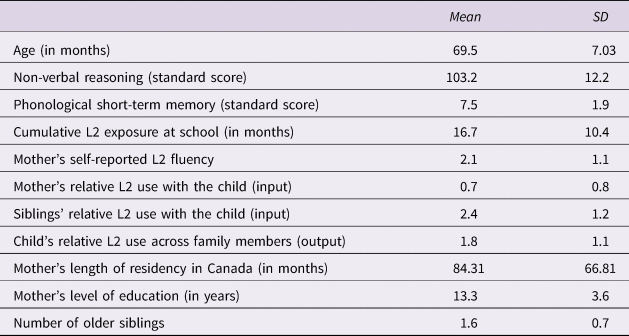
The comparison above between the results of Prevoo et al. (Reference Prevoo, Malda, Mesman, Emmen, Yeniad, Van Ijzendoorn and Linting2014) and Pham and Tipton (Reference Pham and Tipton2018) regarding maternal education, residency in the host country, and maternal L2 fluency, indicate that contextualizing maternal input factors can be highly relevant. In the present study, we specifically note the maternal education levels and the length of residence in Canada of these mothers. We focus on these variables because past studies have noted these as sources of individual differences in both the amount of L2 input mothers provide to their children and in mothers’ L2 fluency (Driessen, van der Slik, & de Bot, Reference Driessen, van der Slik and de Bot2002; Golberg et al., Reference Golberg, Paradis and Crago2008; Hammer et al., Reference Hammer, Komaroff, Rodriguez, Lopez, Scarpino and Goldstein2012; Sorenson Duncan & Paradis, Reference Sorenson Duncan and Paradis2020). For example, Sorenson Duncan and Paradis (Reference Sorenson Duncan and Paradis2020) reported that mothers who received higher levels of education prior to migration were less likely to speak in the L2 (English) with their children. They also reported that higher maternal education levels were also associated with increased maternal L2 fluency. In terms of length of residency, Driessen et al. (Reference Driessen, van der Slik and de Bot2002) reported on the L2-Dutch acquisition of a diverse group of children in the Netherlands and found that mothers who had lived in the Netherlands longer had a higher level of Dutch fluency. Accordingly, we include maternal L2 education and maternal length of residency as part of our participant characteristics (Table 1) and correlation matrix showing the relations between participant characteristics and language input variables (Table 3).
Participant Information

Notes. The scale for relative L2 input is based on a five-point scale where 0 = no English input and 4 = only English input. Similarly, the scale maternal L2-fluency is based on five-point scale where 0 = no English fluency and 4 = highly fluent. Standard scores are based on monolingual norms.
Methods
Participants
Participants were 113 typically developing children from diverse L1 backgrounds, who were learning English as a L2 (L1s = Arabic [27], Cantonese [15], Gujarati [3], Hindi [4], Mandarin [10], Pashto [1], Punjabi [7], Spanish [15], and Urdu [31]). Children had a mean age of 5;10 and had been in school for, on average, 16.7 months. All children had parents who were foreign-born and L2-speakers of English. Forty-nine of the children were also foreign-born; the remaining 64 children were born in Canada but did not receive consistent and significant exposure to English until they began preschool or school. All children had at least one older sibling who attended school in English (mean = 1.6 older siblings, sd = 0.7, range = 1–4). The older siblings in this study had a mean age of 12;3 (sd = 34.8 months): 18 of these siblings were less than 7;0, 83 were between the ages of 7;0 and 10;11, and 72 of the siblings were at least 11;0. Sixty-two siblings were born in Canada, and an additional 31 siblings moved to Canada before their fifth birthday, suggesting that 93 (52%) of the siblings had attended all of their schooling in Canada. Further participant details are provided in Table 1.
It is worth noting that this sample of children contains an overlapping but not identical sample to several previous studies (e.g., Paradis, Reference Paradis2011; Sorenson Duncan & Paradis, Reference Sorenson Duncan and Paradis2020). Previous work did not consider the older siblings as a source of linguistic input and included a limited number of linguistic abilities. As such, this study further advances our understanding of home language input in children's L2 acquisition across linguistic subdomains.
Procedures
Alberta language and environment questionnaire
The Alberta Language and Environment Questionnaire (ALEQ: Paradis, Reference Paradisn.d.; Paradis, Reference Paradis2011) was used to gather detailed demographic information, including information about mother's length of residency in Canada, maternal fluency, relative quantity of maternal L2 input, number and ages of siblings, the relative quantity of L2 input from siblings, the relative quantity of L2 output from the child, and cumulative exposure to the L2 in school. It is administered as an oral interview between the parent and the researcher, often with the assistance of an interpreter / cultural broker. Maternal L2 fluency was scored on a five-point scale (0–4), ranging from no English fluency (0) to highly fluent (4). In this interview protocol, maternal L2 fluency ratings measure general L2 proficiency and comfort level in communicating in the L2. The full protocol and further details about this estimate of fluency can be found through the CHESL website (https://www.ualberta.ca/linguistics/cheslcentre/questionnaires#ALEQ). Relative quantity of L2 input from both the mother and the siblings was also scored on a five-point scale (0–4), ranging from no-English/all-L1 (0) to all-English/no-L1 (4). It is important to note that the relative language input from older siblings was averaged across older siblings for each child. This was done because not all children had the same number of older siblings. For example, only two children had four older siblings. If a variable had been created for Sibling 1, Sibling 2, Sibling 3, and Sibling 4, every child who did not have four older siblings would have had no score to enter for Sibling 4. This is problematic because missing data leads to exclusion from the regression analysis. Averaging across siblings thus allowed a score to be entered for every child. In providing the description of this sample of siblings, we estimated the siblings’ age of arrival in Canada by subtracting their current age from the mother's length of residency in Canada.
Columbia Mental Maturity Scale
Non-verbal reasoning ability was estimated using the Columbia Mental Maturity Scale (CMMS; Burgemeister, Hollander Blum, & Lorge, Reference Burgemeister, Hollander Blum and Lorge1972). On this task, children are shown a series of large cards, one at a time. Each card contains a set of three to five pictures and children are asked to identify the picture that does not belong in the set. Standard scores are based on monolingual norms, with a mean of 100 and standard deviation of 15.
Comprehensive Test of Phonological Processing
The nonword repetition subtask of the Comprehensive Test of Phonological Processing was used to estimate phonological short-term memory (CTOPP; Wagner, Torgesen, & Rashotte, Reference Wagner, Torgesen and Rashotte1999). This subtask includes a list of nonwords, words that are pronounceable based on the phonotactics of English but are not actual words. The nonwords increase in length as the task progresses. The nonword stimuli were played for children from a CD and children were asked to repeat each nonword right after hearing it. Standard scores are based on monolingual norms, with a mean of 10 and a standard deviation of 3. It is important to acknowledge that children's phonological short-term memory abilities may appear somewhat depressed when assessed through their L2 (Masoura & Gathercole, Reference Masoura and Gathercole1999; Sorenson Duncan & Paradis, Reference Sorenson Duncan and Paradis2016). This should not pose a problem for the present analysis as all children are L2 learners and the individual differences in phonological short-term memory, not the absolute score, are of interest.
Edmonton Narrative Norms Instrument
The Edmonton Narrative Norms Instrument (ENNI) is a story-generation activity that involves six stories of varying complexity, evolving from two to four characters (Schneider, Dubé, & Hayward, Reference Schneider, Dubé and Hayward2005). It was used to sample children's ability to convey story information coherently and consistently in their L2, that is, macrostructure abilities. Microstructure abilities, e.g., morphosyntax and vocabulary, were also estimated using this task. For all measures, the children's performance was tallied according to the scoring protocols provided with this standardized measure of narrative development. Standard scores for all measures on the ENNI are based on monolingual norms with a mean of 10 and a standard deviation of 3. Stories were video-recorded and later transcribed and analyzed by a native speaker of English. A second researcher transcribed a subset of the data to verify the reliability of these transcripts. The transcription reliability was 91% (word-by-word).
For macrostructure, transcripts were analyzed for story grammar units and the referring expressions that were used for character introductions. Story grammar scores were counted for one of the four-character stories (A3) and represent the number of included plot details. Referring expression scores were tabulated across the six stories (A1–A3; B1–B3) and reflect the extent to which appropriate referring expressions were used to introduce new characters and objects that are central to the stories. Children received three points for each character and object that was introduced with a referring expression that contained an indefinite article (an airplane), two points for introductions that involved a definite article (the airplane), and one point for pronominal introductions (it). The raw score for referring expression was the sum of all points awarded across the six stories. For microstructure, children's productive morphosyntactic L2 abilities were estimated via mean length of utterance (MLU), and their productive L2 vocabularies were estimated via the number of different word types that they produced in completing this task. Notably, following the ENNI scoring protocols, word types were scored at the lemma-level; that is, inflectional variants were not counted as separate word types.
Peabody Picture Vocabulary Test
The Peabody Picture Vocabulary Task (PPVT) was used to estimate children's receptive vocabulary size (PPVT-IIIR; Dunn & Dunn, Reference Dunn and Dunn1997). On this standardized task, children select an image from an array of four pictures that best matches the word spoken by the experimenter. Children's raw score is the number of correct choices before reaching ceiling. Standard scores are based on monolingual norms, with a mean of 100 and standard deviation of 15.
Test of Early Grammatical Impairment
The Test of Early Grammatical Impairment (TEGI) was used to further estimate children's morphosyntactic L2 abilities (Rice & Wexler, Reference Rice and Wexler2001). Specifically, we administered the ‘screener’ from this task which examines children's ability to accurately produce third person singular ([-s], a teacher teaches) and regular and irregular past tense ([-ed] he raked / he dug). On this standardized task, the screener score is the mean proportion correct score across these two tasks. Unlike the other tasks in this battery, this task is criterion-referenced. As such, instead of obtaining a standard score, children are either scored as performing at or above age-expectations for same age monolingual children or as below this level of expectation.
Results
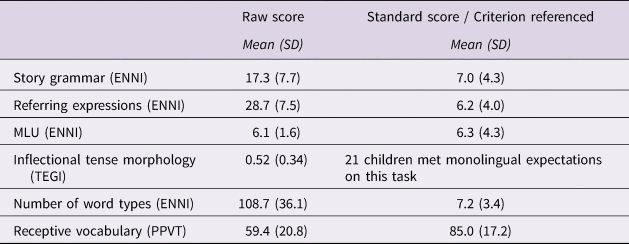
Table 2 provides a summary of children's performance on the range of linguistic subdomains included in this study. This summary includes both raw and standard scores. It is important to note that these standard scores are based on monolingual norms / criterion-referenced and consequently they are not indicative of developmental language delay but rather the extent to which these typically developing L2-learning children are approaching the language abilities exemplified by their same-age monolingual peers (cf. Paradis, Schneider, & Sorenson Duncan, Reference Paradis, Schneider and Sorenson Duncan2013). Standard scores / criterion referenced are thus provided here to offer insights into the level of emerging L2-abilities for this sample of children. Raw scores were used as the outcome variables in the regression modelling.
Descriptive statistics for language measures

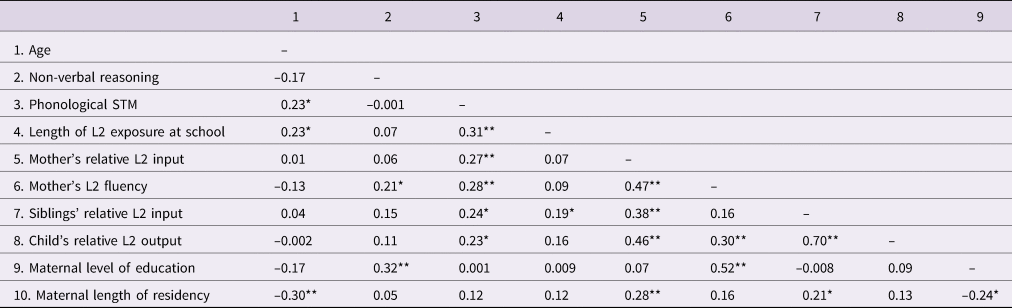
Table 3 presents a Pearson correlation matrix of bivariate correlations between the estimates of participant characteristics, input, and environment variables. The majority of variables were not significantly correlated with each other. Only one strong correlation was noted; this was between the relative L2 input that children receive from their older siblings and children's relative L2 output. For the correlations in Table 3, children's relative L2 output was the average of their output with all family members. When considering their output to older siblings specifically, the correlation rises to very strong (r(111) = .84, p < .001). Accordingly, to avoid issues with collinearity, children's output was not included in the regression models. The remaining correlations were all weak to moderate; consequently, there was no further concern of collinearity.
Pearson correlations between participant characteristics, input, and environment variables

Notes. STM = short-term memory; * p ⩽ .05, ** p ⩽ .01.
The relations between input from older siblings and mothers on children's emerging L2 abilities
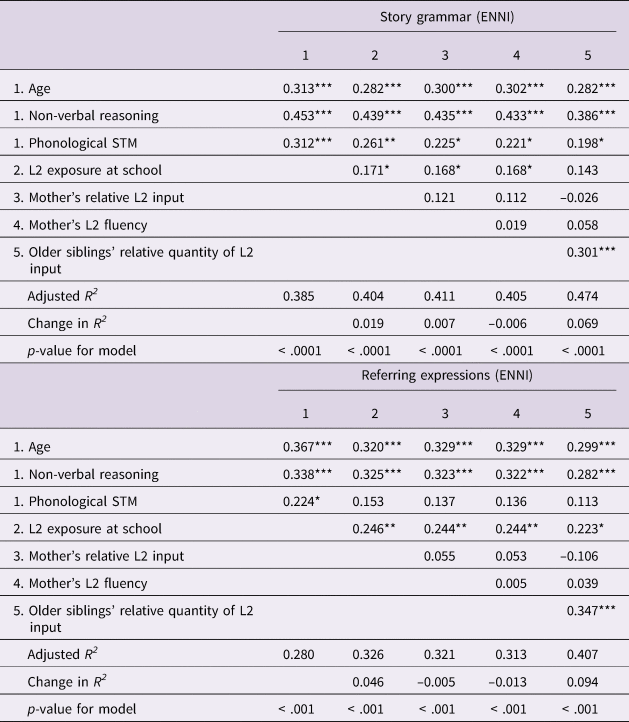
Hierarchical linear regression modelling was used to estimate the influence of a range of input factors on children's emerging L2 abilities. Modelling was done with the raw score for each linguistic subdomain as the outcome variable (i.e., ENNI: story grammar, referring expressions, MLU, word types; TEGI: inflectional morphology screener raw score; and PPVT-IIIR: receptive vocabulary raw score). Regression analyses were conducted using the base package of R version 3.5.2 (R Foundation for Statistical Computing, 2018). Standardized betas were calculated using the lm.beta package (Behrendt, Reference Behrendt2015). In step 1, the control variables for child-internal factors were entered. In this study, these were: age, non-verbal reasoning, and phonological short-term memory. Children's exposure to English at school was entered into the models in step 2. In step 3, maternal relative quantity of L2 input was added. Maternal L2 fluency was then added in step 4. In step 5, the relative quantity of L2 input from older siblings was entered as a predictor. The results for each linguistic subdomain are summarized in Tables 4–7.
Hierarchical linear regression results showing the influence of input from school and home on children's L2 narrative macrostructure abilities

Notes. STM = short-term memory; values are standardized β values; * p ⩽ .05; ** p ⩽ .01; *** p ⩽ .001, The p-values provided for the model are based on a comparison with the null hypothesis.
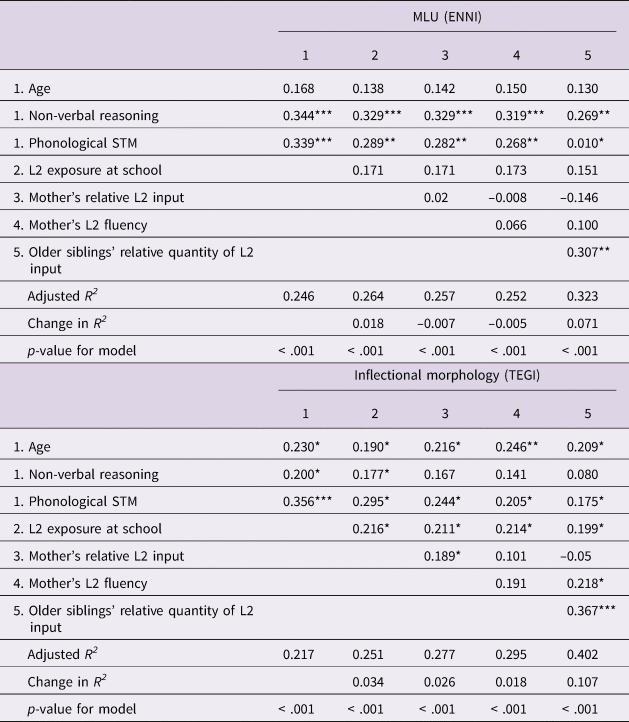
Hierarchical linear regression results showing the influence of input from school and home on children's emerging L2 morphosyntactic abilities

Notes. STM = short-term memory; values are standardized β values; * p ⩽ .05; ** p ⩽ .01; *** p ⩽ .001, The p-values provided for the model are based on a comparison with the null hypothesis.
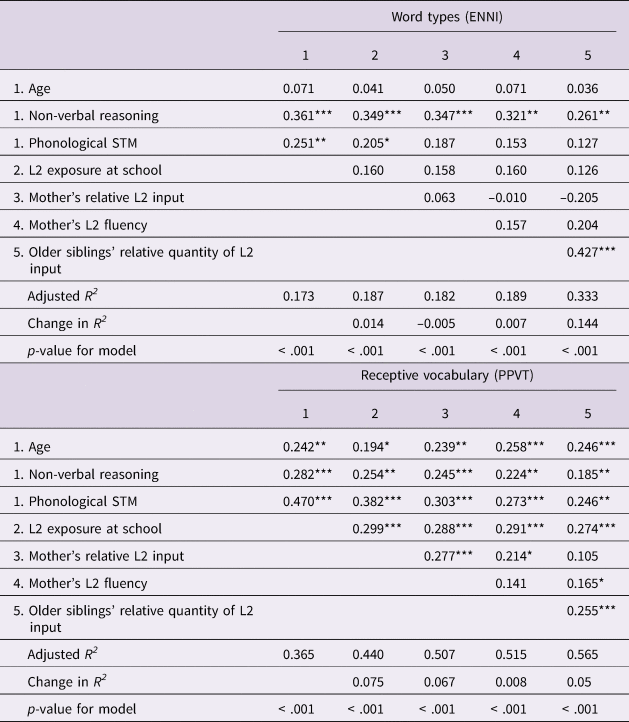
Hierarchical linear regression results showing the influence of input from school and home on children's emerging L2 lexical abilities

Notes. STM = short-term memory; values are standardized β values; * p ⩽ .05; ** p ⩽ .01; *** p ⩽ .001, The p-values provided for the model are based on a comparison with the null hypothesis.
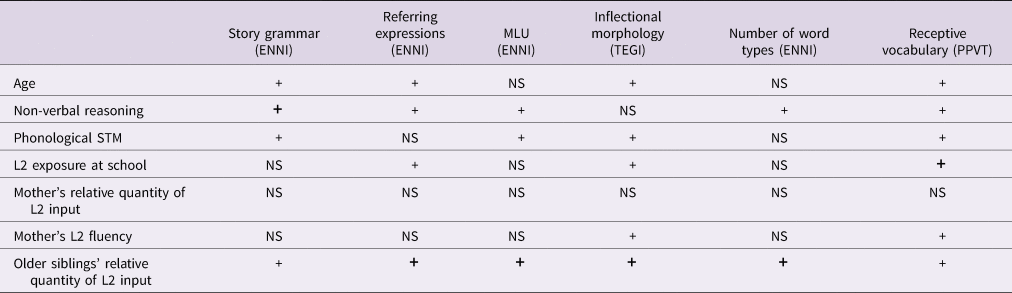
Summary of regression results from the final step of the regression models

Notes. STM = short-term memory; + denotes a significant and positive relations; NS indicates a non-significant effect; the larger, bolded symbol indicates the largest standardized beta for the model.
Story grammar
Story grammar ability was estimated using the ENNI. The results of the regression analyses are presented in Table 4. The child-internal variables accounted for a combined 39% of the variance in children's story grammar scores. The sources of input considered in this study accounted for an additional 9% of the variance, due largely to the influence of the relative L2 input that children heard from their older siblings (at 7%). The amount of exposure to English (L2) at school was not significant in the final step of the model. Maternal fluency and mother's relative quantity of L2 input were also not significant predictors. In fact, the addition of the maternal input variables did not explain any additional unique variance. In sum, children who heard more relative L2 input from their older siblings produced stories that included more relevant plot details.
Referring expressions
Children's ability to appropriately introduce characters was estimated using the ENNI. The results of the regression analyses are presented in Table 4. The child-internal controls accounted for 28% of the variance in children's character introductions. The input variables considered in this study accounted for an additional 13% of variance in children's scores, with relative quantity of L2 input from older siblings accounting for a unique 9%. Exposure to English (L2) at school appears to account for the remaining 4% of the variance, as maternal fluency and mother's relative quantity of L2 input were not significant predictors of this score and accounted for no additional variance in steps 3 and 4. Notably, in the final step of the regression model, the standardized β value was higher for the relative quantity of L2 input that children received from their older siblings compared to the cumulative L2 exposure they had received through school. In sum, children who had been in school longer and heard more relative L2 input from their older siblings used more appropriate referring expressions to introduce the characters.
MLU
MLU was calculated across the six stories included in the ENNI. The results of the regression analyses are presented in Table 5. The child-internal control variables accounted for 25% of the variance in children's MLU. The input variables accounted for an additional 7% of the variance. Notably, cumulative amount of English (L2) exposure at school, maternal L2 fluency, and mother's relative quantity of L2 input were not significant predictors of MLU and had a negligible impact on the amount of explained variance. As such, the additional variance explained by the input factors can be attributed to the relative quantity of L2 input children receive from their older siblings. In sum, children who heard more relative L2 input from their older siblings produced longer utterances on this narrative task.
Inflectional tense morphology
Children's inflectional morphology abilities were sampled with the TEGI, an elicitation task. The results of the regression analyses are presented in Table 5. The child-internal variables accounted for 22% of the variance in children's performance on this task. Exposure to English (L2) at school, mother's L2 fluency, and relative quantity of L2 input from older siblings were significant and positive predictors of children's accurate use of inflectional morphology. These variables accounted for an additional 19% of the variance in children's scores. The relative quantity of L2 input that children received from their older siblings accounted for 11% of this variance. Notably, in the final step of the regression model, the standardized β value was higher for the relative quantity of L2 input that children received from their older siblings compared to the cumulative L2 exposure they had received through school. Mother's relative quantity of L2 input was not a significant predictor of scores on this task. In sum, children who had been in school longer, had mothers with higher L2 fluency, and heard more relative English from their older siblings produced more verbs with the appropriate tense inflection.
Number of different word types
Across the six stories on the ENNI, the number of word types produced by the child was tabulated. The results from the hierarchical linear regression analyses are presented in Table 6. The first step, which included child-internal variables, accounted for 17% of the variance in this estimate of children's productive vocabularies. The input variables accounted for an additional 16% of the variance in children's use of different word types. Relative quantity of L2 input from older siblings accounted for 14% of this unique variance. Notably, the β-value for the relative quantity of L2 input from older siblings was also the greatest of all variables tested here. In sum, children who heard more relative L2 input from their older siblings used more word types when telling an L2 (English) story.
Receptive vocabulary
Vocabulary development was further estimated using a receptive task, the PPVT-IIIR. The child-internal variables accounted for 37% of the variance in children's receptive vocabularies. The input variables accounted for an additional 20% of variance in children's performance on this measure. The hierarchical regression modelling suggested that each of the input variables contributed to explaining some of this additional unique variance; however, the relative quantity of L2 input that children received from their mothers was not significant through to the final step. Relative quantity of L2 input from older siblings accounted for 5% of variance. Notably, the β-value was slightly higher in the final step for cumulative exposure to L2 at school compared to the relative L2 input from older siblings. In sum, children who had been in school longer, had mothers with higher L2 fluency, and heard more relative L2 (English) from their older siblings understood correctly more words on this measure.
Summary of results
This summary of results is based on the fifth and final step of the regression models. After controls for child-internal variables (age, non-verbal reasoning, and phonological short-term memory), relative quantity of L2 input from older siblings was positively and significantly related to children's performance on all of the language measures included in this study. In fact, input from older siblings had the highest standardized beta of all predictor variables for four out of the six linguistic subdomains included in this study. Cumulative exposure to English (L2) at school was positively and significantly related to children's performance on half of the English language measures in this study, specifically the measures of referring expressions, inflectional morphology, and receptive vocabulary. Maternal L2 fluency was significantly related to two out of six of the language measures, specifically the measures of inflectional morphology and receptive vocabulary. In contrast, for the relative L2 quantity children heard from their mothers, there were null results across all measures. These results are summarized in Table 7.
Discussion
This study detailed the relations between varied sources of L2 input on children's emerging L2 abilities across linguistic subdomains. After controlling for the child-internal variables of age, non-verbal reasoning, and phonological short-term memory, we found the relative quantity of L2 input from older siblings was positively and significantly related to children's performance on a variety of L2 (English) measures. In fact, individual differences in the amount of L2 input from older siblings had the strongest relation to children's L2 scores across four out of the six linguistic subdomains examined here. That is, children who heard more relative L2 from their older siblings included more story elements on the narrative task, more frequently used the appropriate referring expression to introduce characters, had longer MLUs, and used more different word types. Hearing more relative L2 input from older siblings was also associated with greater accuracy at producing inflectional morphology on an elicitation task and higher receptive vocabulary scores. We also found that maternal L2 fluency and cumulative L2 exposure at school were positively and significantly related to inflectional morphology and receptive vocabulary scores. Increased relative quantity of L2 input from mothers was not associated with increases in L2 abilities.
L2 input at home and emerging L2 abilities: the special status of input from older siblings
In this study, we specifically investigated the extent to which input from older siblings has special status in supporting children's emerging L2 abilities. To do this, we contrasted input from siblings with maternal input. Accordingly, we first discuss the role of L2 input from mothers before detailing the role of L2 input from siblings. Increased relative L2 input from mothers was not associated with children's performance on the L2 (English) measures that were included in this study. Our null results align with several previous studies that have used aggregate measures of L2 input at home (e.g., Chondrogianni & Marinis, Reference Chondrogianni and Marinis2011; Golberg et al., Reference Golberg, Paradis and Crago2008; Páez et al., Reference Páez, Tabors and López2007; Paradis, Reference Paradis2011; Pham & Tipton, Reference Pham and Tipton2018; Rojas et al., Reference Rojas, Iglesias, Bunta, Goldstein, Goldenberg and Reese2016). These results, however, differ from Sorenson Duncan and Paradis (Reference Sorenson Duncan and Paradis2020), who reported that increased relative L2 input from mothers was related to increased productive vocabularies but decreased complex sentence use. In interpreting this difference, it is worth noting that only two-thirds of the children in Sorenson Duncan and Paradis had older siblings, whereas in the present study all children had older siblings. Thus, the composition of home language input across the families in these two studies may have differed in meaningful ways, and in our view possibly lead to the differential findings across the studies. This speculation is in line with findings from Bridges and Hoff (Reference Bridges and Hoff2014), who found that mothers’ relative use of English and Spanish with their toddlers differed among families who had school-aged children compared to those without older siblings, suggesting that the presence of older siblings can alter the composition of home language input. We feel that another relevant difference between these studies is related to children's age and school exposure. The children in the present study were slightly older and had been in school longer than those in Sorenson Duncan and Paradis (Reference Sorenson Duncan and Paradis2020). We speculate that, as children advance through school, their emerging L2 abilities are more heavily influenced by input from other children, such as older siblings, as opposed to parents. Indeed, we are not the first to posit this developmental shift in the way input influences L2 acquisition (e.g., Golberg et al., Reference Golberg, Paradis and Crago2008; Paradis, Reference Paradis2011; Rojas et al., Reference Rojas, Iglesias, Bunta, Goldstein, Goldenberg and Reese2016). It is, thus, important that future research consider under what circumstances increased quantity of input from mothers will influence children's emerging L2 abilities. In our view, the current state of research suggests that increased quantity of L2 input from mothers, in and of itself, is insufficient to support children's emerging L2 abilities. This finding has profound practical implications for the advice that researchers, educators, and clinicians give to parents. Specifically, these results highlight that it may do little good to encourage L2-speaking parents to speak more regularly in the L2 with their children and, as previous research has suggested, increasing L2 input is likely to have detrimental effects on the child's continued L1 development (Bohman, Bedore, Peña, Mendez-Perez, & Gillam, Reference Bohman, Bedore, Peña, Mendez-Perez and Gillam2010; Gathercole et al., Reference Gathercole, Kennedy and Thomas2016; Prevoo et al., Reference Prevoo, Malda, Mesman, Emmen, Yeniad, Van Ijzendoorn and Linting2014).
In seeking to understand the limited influence of the amount of L2 input mothers provide, we also considered qualitative aspects of the mothers’ speech, which we estimated via maternal L2 fluency. We found a significant role of mothers’ L2 fluency in children's L2 inflectional morphology and vocabulary scores. This finding aligns with previous findings and speculations that mothers with higher levels of L2 fluency are more likely to use rich vocabulary and less likely to omit grammatical morphemes (Chondrogianni & Marinis, Reference Chondrogianni and Marinis2011; Golberg et al., Reference Golberg, Paradis and Crago2008; Hammer et al., Reference Hammer, Komaroff, Rodriguez, Lopez, Scarpino and Goldstein2012; Paradis, Reference Paradis2011; Sorenson Duncan & Paradis, 2020). Taken together, these studies suggest that maternal L2 fluency is an important factor in the emerging L2 abilities of both preschool and young elementary-aged children, even when the relative quantity of L2 input from the mother is not. Future research which directly assesses the L2 input that mothers of varying fluency provide is necessary to disentangle the exact nature of the relations between maternal L2 fluency and emerging L2 abilities across linguistic subdomains (cf. Place & Hoff, Reference Place and Hoff2016).
It is relevant to ask what factors potentially influence maternal L2 fluency, and in turn, children's L2 acquisition. All mothers in this study were foreign-born and were L2 learners of English, but they varied both in their length of residency in Canada and in their education levels (see Table 1). In terms of length of residency, correlations in Table 3 indicate a weak association between longer maternal residency and using more of the L2 with children. However, our analyses showed greater use of the L2 was not supportive of children's L2 acquisition. Maternal L2 fluency was not associated with length of residency. This finding aligns with research into adult L2 learners’ acquisition, which has shown that general measures of length of residency may not be related to L2 fluency; instead, more specific factors such as increased interaction with native speakers appear to be important (Derwing, Munro, & Thomson, Reference Derwing, Munro and Thomson2008). In terms of maternal education, the correlations in Table 3 indicate that mothers with higher levels of education were more likely to have higher fluency in English. We found that maternal L2 fluency was positively associated with children's emerging L2 abilities. The correlation between maternal education and maternal L2 fluency suggests that some component of our L2 fluency measure could be the language style that more highly educated mothers – whether bilingual or monolingual – use (Hoff, Reference Hoff2006). Notably, this component could be separate from the gains in L2 pronunciation, vocabulary, and morphosyntax that higher levels of education provide (Stevens, Reference Stevens1999). To evaluate whether education explained separate variance from L2 fluency, we conducted post-hoc analyses where maternal education was added to the final step of the regression models for the two measures where maternal L2 fluency was found to be significant. In both cases, above and beyond the influence of maternal education, maternal L2 fluency still had a significant and positive relation to children's L2 inflectional morphology and L2 receptive vocabulary scores (p = .02, .006, respectively). Thus, we conclude that the impact of maternal L2 fluency on children's L2 acquisition in our study is not simply the impact of the general education levels of these mothers.
Turning to the L2 input children received from their older siblings, we found that this input measure was consistently and significantly related to children's L2 abilities across all six linguistic subdomains. In fact, the relative quantity of L2 input that children received from their older siblings had the strongest relation to their emerging L2 abilities of all variables, including child-internal controls, for four out of six of the linguistic subdomains considered in this study. These results add to an emerging body of literature that suggests that older siblings, who attend school in the L2, can be effective and important language models for L2-learning children from migrant backgrounds (e.g., Bridges & Hoff, Reference Bridges and Hoff2014; Rojas et al., Reference Rojas, Iglesias, Bunta, Goldstein, Goldenberg and Reese2016; Wong-Fillmore, Reference Wong-Fillmore1991). These findings extend the previous work by demonstrating that this relation between input from older siblings and children's emerging L2 abilities continues even after children enter school and across a wide range of linguistic subdomains. One implication of these results is that, if one was to encourage L2 use within the home, L2-based conversations with older siblings may be particularly relevant. In our view, however, encouraging L2 use among any family members should be done only after also giving careful consideration to the consequences such increased L2 input may have on children's continued L1 maintenance (Wong-Fillmore, Reference Wong-Fillmore1991).
The stark contrast in the impact of the quantity of L2 input children received from their mothers versus older siblings points to the importance of separately examining the L2 input from different family members in studies of children's L2 acquisition. In many previous studies, input from siblings was aggregated with other family members (e.g., Chondrogianni & Marinis, Reference Chondrogianni and Marinis2011; Golberg et al., Reference Golberg, Paradis and Crago2008; Paradis, Reference Paradis2011), and our results support the contention that aggregating sources of L2 input can mask the important role of some interlocutors in children's L2 acquisition, i.e., siblings. In interpreting the differential impact of relative L2 input from mothers compared to older siblings, we propose that L2 fluency may be an underlying factor. That is, although the L2 abilities of older siblings were not directly assessed in this study, we believe that, through their experiences of being educated in the L2, older siblings could have been better equipped than mothers to provide their younger siblings with enriched L2 input. Therefore, increases in L2 input from siblings – but not mothers – were associated with stronger L2 skills in these children. Certainly, this explanation aligns with previous interpretations of null results across aggregated home language measures (Chondrogianni & Marinis, Reference Chondrogianni and Marinis2011; Golberg et al., Reference Golberg, Paradis and Crago2008; Paradis, Reference Paradis2011) and with our results for a specific role for maternal L2 fluency. Future research which explicitly measures the L2 fluency of older siblings is necessary to empirically evaluate this proposal.
There are alternative explanations beyond L2 fluency which may underlie our pattern of results and should also be considered. It could be that the type of interactions that younger children tend to have with their older siblings also provides a context for exemplifying the rich linguistic exemplars children need. For example, perhaps children are more likely to engage in imaginative play with older siblings compared to mothers. Indeed, a crucial role for interactive language input has been suggested in previous studies (e.g., Sorenson Duncan & Paradis Reference Sorenson Duncan and Paradis2019; Williams & Thomas, Reference Williams and Thomas2017). Accordingly, future research which considers the type of interaction, the L2 proficiency, and potential age-related differences in how siblings interact is needed to detail the way in which input from siblings influences L2 acquisition. Another factor which could have influenced our results is that siblings tended to use more English than did mothers (see Table 1). As such, it is possible that a threshold of input is required to support language learning (Pearson, Fernandez, Lewedeg, & Oller, Reference Pearson, Fernandez, Lewedeg and Oller1997); in this study it is conceivable that the relative quantity of L2 input from older siblings fell above this threshold, while the relative quantity of L2 input from mothers fell below. A final consideration is that the relative L2 input from older siblings was highly correlated with children's own relative L2 output when speaking with their older siblings. As such, we cannot rule out the possibility that increased relative L2 output by children contributed to the strength of the association that we observed between relative L2 input from siblings and children's emerging L2 abilities (e.g., Hammer et al., Reference Hammer, Komaroff, Rodriguez, Lopez, Scarpino and Goldstein2012; Paradis, Reference Paradis2011).
L2 Input from older siblings compared to L2 input at school
Previous research has demonstrated that children who have received more cumulative L2 exposure through school have more advanced L2 abilities (Armon-Lotem et al., Reference Armon-Lotem, Walters and Gagarina2011; Blom et al., Reference Blom, Paradis and Sorenson Duncan2012; Jia & Fuse, Reference Jia and Fuse2007; Paradis, Reference Paradis2011; Unsworth, Reference Unsworth2013). Not surprisingly, a significant relation was found in this study as well, with cumulative quantity of L2 exposure being significantly related to L2 story grammar, inflectional morphology, and receptive vocabulary scores. However, once the concurrent relative quantity of L2 input from older siblings was added to the models, the magnitude of the effect was reduced, and in the case of story grammar the significance of the effect did not carry through to the final model. This highlights the importance of the relations between the relative quantity of L2 input from older siblings and emerging L2 abilities. This point is further emphasized by the larger standardized βs and increased explained variance for the input from older siblings compared to those for cumulative exposure to the L2 at school (Tables 4–7). Specifically, for the majority of L2 outcome measures, the L2 input children receive from their older siblings accounts for as much, or more, of the unique variance as that of cumulative exposure to English at school. In drawing this comparison, it is important to note that input from siblings is a concurrent measure of input, while L2 exposure at school is a cumulative measure. Concurrent measures of language input may be more strongly related to children's bilingual abilities than their age of first exposure (Bedore et al., Reference Bedore, Peña, Summers, Boerger, Resendiz, Greene and Gillam2012, Ruiz-Felter, Cooperson, Bedore, & Peña, Reference Ruiz-Felter, Cooperson, Bedore and Peña2016). Notably, in the specific context of these studies, age of first exposure to the L2 appears to provide a similar estimate of amount of exposure as our measure of cumulative exposure at school. As we do not have a concurrent measure of school input, we avoid drawing direct conclusions about the relative importance of L2 input from older siblings compared to input at school. Certainly, substantial previous research has demonstrated a crucial role for the input children receive at school and their emerging L2 abilities (Armon-Lotem et al., Reference Armon-Lotem, Walters and Gagarina2011; Blom et al., Reference Blom, Paradis and Sorenson Duncan2012; Jia & Fuse, Reference Jia and Fuse2007; Paradis, Reference Paradis2011; Unsworth, Reference Unsworth2013). Instead, we use this comparison to illustrate that, for migrant children, the impact of L2 input from older siblings on their L2 acquisition is substantial.
L2 input and L2 acquisition across subdomains
We now turn to the extent to which L2 input may impact children's acquisition differentially across subdomains. After controlling for child-internal variables, the input variables considered in this study (i.e., cumulative exposure to the L2 at school, the relative quantity of L2 input from mothers and older siblings, and maternal L2 fluency) explained a combined 8% of the unique variance in story grammar scores, 19% of the unique variance in inflectional morphology, and 20% of the variance in receptive vocabulary. Thus, although the effect of L2 input is robust across measures, L2 input, as we have measured it, may play a larger role in some linguistic subdomains than others. One possible explanation for these profile effects is that L2-learning children tend to show more advanced L2 abilities in language-general areas – which are those that can be more readily shared between languages, like story grammar – than they do in L2 specific areas, like morphosyntax and vocabulary (Oller, Pearson, & Cobo-Lewis, Reference Oller, Pearson and Cobo-Lewis2007; Paradis & Kirova, Reference Paradis and Kirova2014). In our study, sources of L2 input explained more than double the unique variance in L2 inflectional morphology and L2 vocabulary scores than in L2 story grammar. These were also the variables on which maternal L2 fluency and cumulative L2 exposure at school had a positive effect. Similarly, Hammer et al. (Reference Hammer, Komaroff, Rodriguez, Lopez, Scarpino and Goldstein2012) found an influence of maternal L2 fluency on vocabulary scores, but not story-retell. Thus, it seems plausible that L2 input may be particularly relevant for more language-specific, as opposed to language-general, abilities.
When considering language-specific abilities, an emerging question is whether similar magnitudes of relations are expected across language-specific abilities. In particular, the specific nature of L2 input in this context could plausibly lead to differences. For example, on the one hand, vocabulary is a skill where L2 learners are known to make steady gains (e.g., Huckin & Coady, Reference Huckin and Coady1999). On the other hand, morphosyntax is often an area of marked difficulty for adult L2 learners (e.g., Hawkins & Liszka, Reference Hawkins and Liszka2003; Hinkel, Reference Hinkel2003; O'Brien, Segalowitz, Collentine, & Freed, Reference O'Brien, Segalowitz, Collentine and Freed2006). As a result, it has been suggested that L2 input from L2 speakers may not contain sufficient exemplars to support children's learning of morphosyntax (e.g., Chondrogianni & Marinis, Reference Chondrogianni and Marinis2011; Paradis, Reference Paradis2011; Sorenson Duncan & Paradis, Reference Sorenson Duncan and Paradis2020). Accordingly, a stronger relation between L2 input at home and vocabulary is expected than between L2 input at home and morphosyntax. Indeed, this is the pattern of results that Chondrogianni and Marinis (Reference Chondrogianni and Marinis2011) reported. They found that L2 input was more closely tied to vocabulary compared to inflectional morphology. This contrasts with the results of our study where we found comparable effects of input across these two subdomains. It is important to evaluate why our pattern of results deviates from previous emerging evidence on this topic. In this study, we measured input differently than in past studies and we think this difference is important for understanding our results. As is common, Chondrogianni and Marinis employed an aggregate home language measure and did not include a measure specifically for sibling input. Thus, their results may be more closely tied to L2 input from parents. In contrast, the results from the current study specifically include the input from older siblings, who we believe are more likely to provide exemplars of L2 morphosyntactic structures to support acquisition and thus their input may ‘boost’ the effect of L2 input at home in the domain of morphosyntax, resulting in a comparable overall effect of home input across these two subdomains. Our results support this interpretation, as can be seen by contrasting the results in Tables 5 and 6, paying specific attention to the results for the TEGI and PPVT as these measures most closely parallel the measures used by Chondrogianni and Marinis. In our study, adding the L2 input from older siblings in the final step of the model results in double the change in R2 for morphosyntax compared to the observed change for vocabulary, leading to overall similar changes in R2 for the input variables as a whole. Accordingly, we believe that the differences between these studies highlight the importance of considering multiple sources of L2 input when evaluating the relations between input and emerging L2 abilities across linguistic subdomains.
Conclusion
This study illustrates that, in addition to the influence of cumulative quantity of L2 input at school, concurrent L2 input at home from older siblings supports children's L2 lexical, morphosyntactic, and narrative abilities. In our view, the results of this study highlight that L2 input from older siblings is instrumental in supporting the emerging L2 abilities of their younger siblings. This finding has important methodological consequences: it serves to caution against aggregate measures of home language input across speakers who use the L2 to varying degrees and with varying levels of proficiency.
Acknowledgements
We would like to thank the parents and children who participated in this research, and the Edmonton Public School Board who assisted in recruiting families. Special thanks go to the Multicultural Health Brokers Cooperative for their assistance in recruitment and in providing interpretation services. Finally, we would like to express our appreciation to the agencies who provided financial support for this research. Funding was provided to Tamara Sorenson Duncan from the Vanier Canada Graduate Scholarship (770-2010-0038) and the Killam Foundation (Isaac Walton Killam Doctoral Scholarship at the University of Alberta, Edmonton, AB and IWK Research Fellowship at the IWK Health Centre, Halifax, NS: #22266), as well as a Donald Hill Fellowship at Dalhousie University. Funding was provided to Johanne Paradis from the Alberta Heritage Foundation for Medical Research (Population Health Investigator Award #200800174), the Alberta Centre for Child, Family and Community Research (#090415INV-Paradis), the Canadian Language and Literacy Research Network (Investigator Initiated Research Award #27061500), and Early Child Development Support Services, Edmonton (Innovative Research Grant – 2008).