I
The Ottoman economy was based on the agricultural sector until the dissolution of the Empire following World War I. Agriculture accounted for more than half of its national income, employed more than 80 per cent of the population and represented the major source of fiscal revenues (Quataert Reference Quataert, İnalcık and Quataert1994, p. 849). So as to modernize the economic structure of the Empire and reduce the development gap vis-à-vis Western countries, the Ottoman government as early as the second quarter of the nineteenth century launched a programme of reforms (Tanzimât), drawing inspiration from European institutional models. In exchange for the promise of their political and financial support to maintain the territorial integrity of the Empire, the European powers obtained assurance, with the Tanzimât, that the Ottoman institutions would become more suited to interacting with the Western economies, opening up to free trade and foreign investment.
Of the reforms in the agrarian sector, the Land Code (1858) recognised landed property rights to peasants who had hitherto cultivated the state lands as tenant farmers, thereby incentivising new investments in agriculture at least in some areas of the Empire such as Palestine.Footnote 1 Such investments were further stimulated by commercialisation of the agricultural sector under the influence of growing foreign demand coupled with an increase in domestic demand sustained by a growth in population due to natural causes, immigration flows and the expansion of the chief port cities (Quataert Reference Quataert, İnalcık and Quataert1994, pp. 848–9).
Indeed, the growth in production and agricultural exports has been assessed as the main factor behind the positive, albeit small, average annual increase of 0.7 per cent in GDP per capita between 1870 and 1913 (compared with an average rate of 1.5 per cent across countries in Western Europe and the US) (Pamuk Reference Pamuk, Çetin and Yilmaz2010, p. 16); the economic growth model of the late Ottoman Empire has recently been described as ‘agricultural export-led growth’ (Pamuk Reference Pamuk, Lains and Pinilla2008, p. 387).
The increase in agricultural production, whose annual gross volume more than doubled between 1860 and World War I, has been ascribed to the size of the area under cultivation, in areas with low population density, chiefly owing to the effect of granting property rights under the Land Code. The increase in exports, however, has been attributed to the Empire's integration within the world economy of Western capitalism as an importer of industrial goods and exporter of agricultural products and raw materials (Pamuk Reference Pamuk1987, p. 83; 2008, pp. 376–8, 387). The Lebanon, Syria and Palestine, linked to international trade through their ports on the eastern coast of the Mediterranean, were the Ottoman regions which recorded the highest growth rates in per capita income and agricultural exports (Pamuk Reference Pamuk2006, p. 814). In particular, from the 1850s onwards the agriculture sector in Palestine exported substantial surpluses to neighbouring regions and, to a growing extent, to Europe (Schölch Reference Schölch1993, pp. 283–92).
This article aims to examine financial intermediation channels which supported the development of the agricultural sector in late Ottoman Palestine. Studies in Ottoman financial history have mainly focused on the formal credit market and on the role of local banks, wholly or partly financed with Western capital, particularly the Imperial Ottoman Bank (Clay Reference Clay2000, Reference Clay and Cottrell2008; Eldem Reference Eldem1999, Reference Eldem2005). Such studies have identified the main activities of the above banks in supporting European investment in the Empire and financing the state, flanked in this operation by the European financial markets that managed capital flows associated with the purchase of Ottoman bonds. These banks were long considered the Western arm of financial imperialism (Blaisdell Reference Blaisdell1966). However, the expansion of their branches throughout the imperial provinces, particularly those of the Imperial Ottoman Bank in Palestine from the late 1910s, took place as a response not so much to funding requests by European operators, but rather to the demand for funds by provincial notables for the financing of trade in agricultural products. That said, the activity of these provincial branches, although at the service of local economic needs, did not significantly contribute to the agricultural growth of late Ottoman Palestine, appearing to be the effect rather than the cause of such growth (Clay Reference Clay1994, pp. 608–9). Indeed, this growth began in the 1850s and accelerated from the late 1890s, on emergence from the phase of international depression of agricultural prices, prior to the opening of the provincial banks. Their expansion, therefore, was merely the response to new profit opportunities maturing thanks to a higher growth rate of the Ottoman economy.
In this article we show it was the traditional informal market of credit run by local notables which financially supported the development of the smallholder-based farm sector in the Palestinian district of Haifa.Footnote 2 The main research question is: what led to the success of the informal rural credit market as compared with the formal credit market? To date, the study of the role of the informal rural credit market in the growth of the agricultural sector of the late Ottoman Empire has been unduly neglected in studies of Ottoman financial history. Rogan (Reference Rogan and Philipp1992) was one of the first to draw attention to such a lacuna. Paving the way towards a better understanding of the functioning of such markets was the work by Doumani (Reference Doumani1995), shedding light on the link between local financial intermediaries and the organisation of agricultural production in the Palestinian area. This article follows the same research strand, examining a novel historical source: the acts of the Public Notary of Haifa between 1890 and 1915.Footnote 3 In this study, the Public Notary is a privileged source for two reasons: first, due to the central location of the geographical area in question, given that the agricultural products from northern Palestinian territories destined for export were channelled precisely into the port of Haifa, whose importance in interregional commercial relations and in those between the Middle East and Europe grew with the arrival of the Heijaz railway (Schölch Reference Schölch and Owen1982, p. 55); secondly, because it is paradigmatic for the importance of modernising legal institutions in a developing financial system. Indeed, the Public Notary worked at one of the institutions created under the reforms, namely the civil tribunal, destined to replace the religious sharia court for all disputes that did not concern religious or family status matters and to implement the new law codes enacted with the reforms. The civil tribunal had its offices in the provincial district capitals and the Haifa tribunal started operations in 1870 (Yazbak Reference Yazbak1998, p. 65). The main function of the Public Notary was to allow the transition from a private form of certification to public contracts. In contracts of a financial matter, this had the effect of reducing the enforcement costs incurred by the creditor to execute the contract and make it respected by the debtor, thereby reducing the cost of credit.
The analysis of Public Notary acts shows the active involvement of notables in informal markets for agricultural credit in the district of Haifa, while intermediation on the part of the formal credit sector appears only later, with target customers being not peasants, but only the class of notables. Despite applying interest rates lower than those applied by the notables, the banks were unable to establish themselves as direct intermediaries for smallholders insofar as they were penalised by a problem of information asymmetries: they knew too little about the creditworthiness of their potential customers. By contrast, the local notables, offering greater asset guarantees, managed to gain access to bank credit so as, in turn, to be able to grant loans to smallholders. In their relationship with the latter, the notables enjoyed an information advantage over the banks stemming from the establishment of interlinked credit market transactions, among which rural credit acted as a magnet. This network, in the notarial acts, is reflected in the stipulation of credit contracts, namely bay' wafā, salam and muzara‘ah, expressions of the interconnection of the credit market with other markets which concerned, respectively, real-estate transactions, trading in agricultural commodities and tax farming for collecting the tithe. The phenomenon of interconnected markets, in which the same lenders and borrowers interacted, allowed the creditor to lower information and monitoring costs and acquire more easily the commodity used as security for the loan in that it was the same commodity exchanged on other markets connected to the credit market (like agricultural commodities or real estate such as land, houses and warehouses). In a legal context of progressive privatisation of land in the hands of the peasants, encouraged under the Land Code, and of increasing commercialisation of the agricultural sector, stipulation of these contracts no longer concealed money-lending mechanisms involving dispossession of the smallholders' real estate or their harvest. Rather, it became the instrument used by local notables, competing amongst themselves, to carry through new entrepreneurial strategies with a view both to investing in peasants' landholdings, where they generally collected the tithe, and to managing a sales network for agricultural products on a local and international scale.
Given that the increases in agricultural production and exports represented the chief factor behind the per-capita GDP increase towards the end of the Ottoman Empire, it may be advanced that informal rural credit markets represented an efficient financial institution to support such growth in late Ottoman Palestine.Footnote 4
II
The 1858 Land Code allowed the transition from a system with uncertainty of land tenure to one in which such a right was certified by a cadastral title and held exclusively by the individual who cultivated the state lands (Karpat Reference Karpat, Polk and Chambers1968, pp. 85–8; Cuno Reference Cuno1980, pp. 245-75). Representing a legislative bulwark in defence of the rights of the small landholding peasants, the Code allowed a reduction in the power of provincial notables.Footnote 5 They had been granted the right to collect the tithe over the state lands and, in the course of time, had arrogated a sort of ownership over the lands within their fiscal units. Concomitant fiscal reforms contributed to diminish the power of the notables who acted as local tax farmers (multazim), reducing to two (renewable) years the term of tax farming which, far from being temporary, had become a life-time and even hereditary entitlement. Further, the short duration of tax-farming contracts was congenial to the government, which sought to update their conditions according to performance in the agricultural sector (Çizakça Reference Çizakça and Cottrell2008).
The reforms of the Land Code and the tax system contributed to change the relations of production and the patterns of land ownership, at least in Palestine, inasmuch as they induced the notables to abandon the idea of wealth and power based on territorial expansion at the expense of the peasants.
Prior to the reforms, acting as multazim the notables used to enhance their economic and political power through the creation of large estates by following two different strategies. With the first, they expropriated the land of insolvent farmers, often taking advantage of their imprecise boundaries. With the second, they simply interpreted the granting of their own fiscal unit in terms gradually closer to those of land ownership.
By contrast, following the reforms and in conjunction with the growing demand for agricultural products on domestic and foreign markets, the Palestinian notables found it preferable to increase their income by taking advantage of the tax-farming system combined with a funding strategy for farmers. Indeed, the rapid commercialisation of agriculture encouraged farmers, rising through the Code to the status of ‘de facto landowners’, to extend the cultivable area and to turn to the multazim themselves to obtain loans for investments in fixed and circulating capital. Due to the increase in productivity of the farmers' lands, the multazim would collect a higher share of agricultural products as a tithe and as return on loans. Finally, the multazim themselves organised and managed the sales network of farm products (mainly wheat and other cereals) on local and international markets (Schilcher Reference Schilcher, Keyder and Tabak1991).
The notables' waiver of territorial expansion also stemmed from the protection granted to farmers under the Land Code against the risk of having their lands expropriated owing to insolvency. The debtor had the right to maintain at least a house and arable land sufficient to support the family (Ongley Reference Ongley1892, p. 218).
In the end, a landholding pattern, based on small land ownership as an engine for commercialisation, became established alongside the new entrepreneurial strategies of the notables that were centred on their activity of financial intermediation in the informal rural credit markets (Gerber Reference Gerber1985, ch.8).
Concomitant with the strengthening of the informal agricultural credit markets was a proliferation of banks – mostly with European capital – during the 1850s, due to increasing economic integration between the Ottoman Empire and Europe, the growing financial needs of the Ottoman State and financial modernisation triggered by the Ottoman Commercial Code of 1850 (which legitimised interest on loans, albeit limited to a rate not exceeding 12 per cent on commercial and financial credit) (Kuran Reference Kuran2005). The development of a formal credit market was indirectly encouraged by the 1858 Land Code which, strengthening the legal protection of private land property rights, finally provided banking intermediation with the possibility of using the mortgage on land as a hedge against the risk of insolvency by the borrower, whilst reducing the creditor's costs of enforcement.
At the onset, the new banks, mushrooming in the capital and in major cities, aimed to provide loans to the Ottoman government and financial services to European entrepreneurs. Later, they opened branches in the provinces attracted by the profit opportunities emerging in the agricultural sector. However, these banks, including the Imperial Ottoman Bank, failed to become direct intermediaries for smallholder farmers despite applying interest rates lower than those charged on the traditional informal credit markets under the control of the local notables (who, however, usually applied even higher-than-legal interest rates). They accepted deposits, discounted bills of exchange and financed businesses, but their funding remained confined to the class of urban entrepreneurs which comprised local notables who maintained strong ties with the rural hinterland (Kuran Reference Kuran2011, pp. 162–3; Clay Reference Clay1994).
III
If the banks were unable to displace the notables, this was due to existing informational asymmetries. The banks lacked adequate knowledge of the peasants' riskiness and were unable to effectively monitor the use of the loans for productive purposes. The possibility of screening safe borrowers through the requirement of land as collateral did not solve the problem because of the high transaction costs associated with seizing the pledged asset. This resulted in the resistance of banks to lend to small landowners.
A failure was also experienced by the Agricultural Bank, although it had been established by the government in 1888, with the precise aim of encouraging investment in agriculture by farmers through loans with a subsidised interest rate of about 6 per cent per year and with the requirement of the land as collateral (Quataert Reference Quataert1975, p. 214).Footnote 6 The farmers refrained from applying for a secured loan from the Bank and continued to prefer loans from the notables, albeit at a higher interest rate, because the latter could not require any collateral and, in the event of insolvency, were precluded by the Ottoman Land Code from totally dispossessing the debtor's real estate – which did not apply when the loan was granted by the Bank (Issawi Reference Issawi1988, pp. 76–7, 410–12).
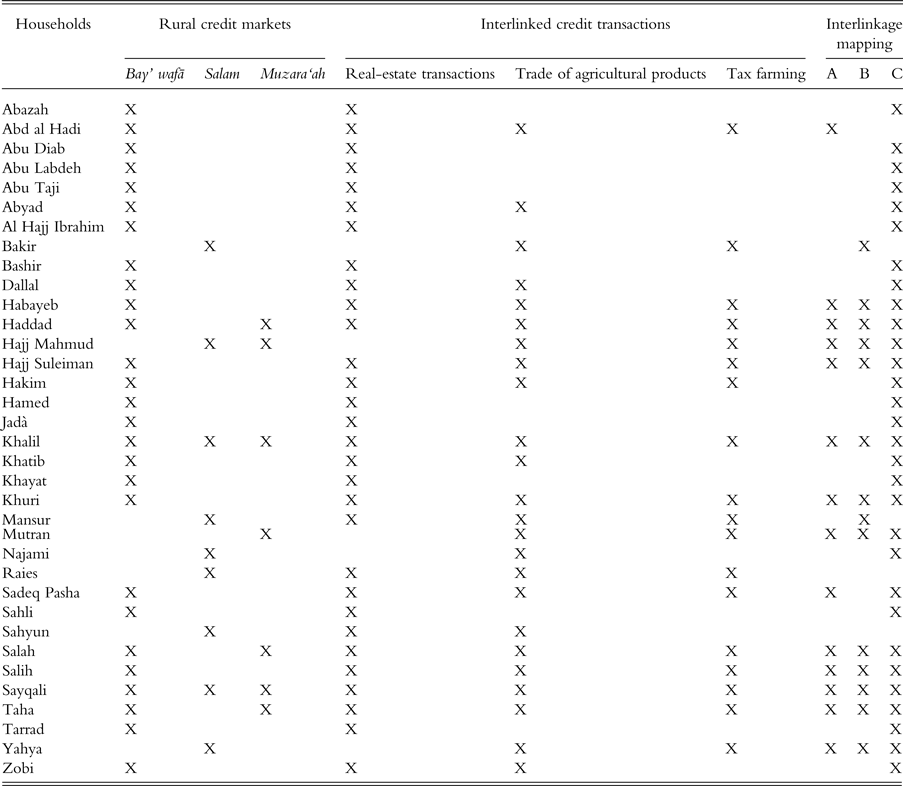
Unlike the banks, local creditors possessed an informational and monitoring advantage that came, in the first place, from the long-lasting relationships binding them to the debtors – the latter being the farmers living in the villages where the creditors and their families possessed property and originally came from. This phenomenon concerned 80 per cent of the families of creditors in the notarial acts. Secondly, the informational advantage was further strengthened by the lender through the phenomenon called ‘interlinked credit market transactions’, a term used for credit relations favoured by the complementarity between lender and borrower in professional and productive relationships (Ray Reference Ray1998, pp. 541, 561–72; Hoff, Braverman and Stiglitz Reference Hoff, Braverman and Stiglitz1993, pp. 33–52). The credit market was thus linked to specific transactions in other markets in which the same lenders and borrowers operated. Bay' wafā, salam and muzara‘ah contracts, typical of the informal rural credit market in Haifa, are indeed emblematic of the interconnection of the credit with other markets which concerned, respectively real-estate transactions, trading in agricultural commodities and tax farming. The notarial acts highlight the proclivity of some of the most prominent local notables to bring together, under a single entrepreneurial figure, the many roles played in the three different markets connected to that of credit.Footnote 7 Indeed, 66 per cent of the notables mentioned in the acts were involved in more than one of the sectors indicated for the interlinked credit transactions (Table A2).
The creation of an interlinkage not only allowed creditors to save on the costs related to information regarding the borrower or the monitoring of a loan, but also enabled them to seize the collateral more easily should the debtor fail to repay his loan. This collateral was often the object of the transaction itself in the other markets that tied lender and borrower into an exchange relationship.
In the district of Haifa, for example, as shown by the notarial acts we examined, in many cases the object of transaction in the related markets comprised cereal products. The interlinkage based on these products emerged when the credit relationship was juxtaposed to a fiscal relationship in which the creditor acted as tax farmer (multazim), and therefore collector of tithes in kind, in a village in which the smallholders lived to whom he had granted a loan, or when the creditor was, at the same time, a trader and then the buyer of agricultural goods produced by the peasant borrower. In other cases, instead of agricultural products, the subject of the transaction could be houses, stores and lands if the interconnected market was real estate and if, by contract, the creditor could dispose of such property so as to guarantee the repayment of the debt as long as the latter remained outstanding.
The phenomenon of interconnected markets guaranteed the creditor not only against the risk of involuntary default by the debtor, due to low-cost monitoring of information and the ease in acquiring collateral, but also against the strategic risk, since the debtor's behaviour, in addition to the definitive termination of the finance relationship, might have caused the further breakdown of the relationship that bound him to the creditor in the market for interconnected goods.
The informational advantage enjoyed by local notables linked to geographical and/or professional proximity to the borrower also helped create a clear segmentation of the informal rural credit market in which the creditor had a clientele receiving repeated loans. Such a segmentation of the rural credit informal market could eventually grant a local monopoly to a notable. In effect, in the period preceding the reforms and the increased commercialisation of the agricultural sector, the establishment of markets connected to informal credit was mainly used by notables to impose their local monopoly, allowing them to keep up the price of credit. Thus, in the case of insolvency, given the legal uncertainty concerning property rights, the notables could easily claim against the debtor's assets which were the subject of transaction on collateral markets, or maintain the peasants in a state of constant indebtedness so as to ensure favourable terms for acquiring their agricultural products (Aytekin Reference Aytekin2008).
Following the reforms and in the phase of growing demand for agricultural products, when the need for adequate investments in the agricultural sector became pressing, the monopolistic position of the local notables started to waver because of an emerging scenario of ‘monopolistic competition’, in which each notable tried to gain the largest possible share of the surplus produced by peasants' smallholdings protected under the Land Code (Nadan Reference Nadan2005). This would take place through the creation of a network of markets interconnected to that of rural credit that allowed notables/creditors: (1) to lower the interest rates by reducing the cost of information and monitoring, attracting a larger clientele of farmers who could be provided with capital to invest in the agricultural sector; (2) to capture the effects of the ensuing increases of rural productivity in credit-related sectors which were particularly sensitive to the increasing commercialisation of agricultural products.
The payment of taxes and debts to the same group of notables could have increased the risk of the peasants being easily caught up in a spiral of debt. To avert this risk there was, however, the possibility for the peasants to renegotiate more easily the terms of repayment, taking advantage of the competition among notables in light of the capture of the agricultural surplus.
Competition among notables became even fiercer when banks began to open provincial branches in response to the growing financial needs of the commercial and agricultural sectors. If the banks failed to attract a local clientele made up of small landowners, this was because of the informational disadvantage they suffered. However, these banks were successful in financial intermediation with the local notables. Indeed, from the end of the 1910s, the notables began to turn to banks for capital they would use to finance the farmers and the long-distance trade of agricultural products.Footnote 8 In doing so, they took advantage of arbitrage opportunities stemming from the differences between the interest rates on the loans offered to farmers and those offered by the banks – the former being higher. Such an opportunity increased the number of credit transactions of local intermediaries, providing access to credit for all those who possessed a level of assets deemed sufficiently safe by the banks.
Recourse to formal credit by a larger number of local intermediaries contributed to undermine the monopolistic positions hitherto held by a small number of notables. While lowering the cost of credit, this also stimulated the development of a wider network of interconnected markets. Indeed, in order to maintain their competitiveness, it was necessary for creditors to lower their interest rates, but to do so they had to simultaneously lower the cost of information and monitoring. The lowering of such costs was related to the involvement of debtors in the interconnected markets. The more the risk of default was reduced thanks to the spread of interlinked markets, the more the interest rate could go down – to the benefit of the local economy.
It is impossible to ascertain the interest rates on individual loans through notarial acts. From other studies, however, it seems that in the area and in the timespan examined, they oscillated between 20 and 30 per cent (Issawi Reference Issawi1988, p. 76; Rogan Reference Rogan and Philipp1992, pp. 243–4). What the notarial acts show is an increasing use by local notables of banks, particularly the Imperial Ottoman Bank (in the acts 40 per cent of the notables/creditors had a bank loan), and their progressive involvement in increasingly interconnected credit markets.Footnote 9 This phenomenon came to affect the traditional segmentation of the informal rural credit market to the extent that it encouraged competition and combated those collusive practices that damaged farmers.
IV
The bay' wafā contract was a sale with redemption through which the seller/debtor maintained the right to repurchase the property sold, refunding the buyer/creditor the agreed price plus interest (Santillana Reference Santillana1938, pp. 158–62). The contract originally helped skirt the Islamic prohibition of usury. A debtor who sold his real estate with redemption rights granted the buyer/creditor the right to rent out the property (usually to the same debtor) until the debt had been paid off. The rent charged by the buyer/creditor actually represented the interest on the capital paid for the purchase of the property, the value of which usually was 20 per cent higher than the capital borrowed (Rogan Reference Rogan and Philipp1992, p. 243).Footnote 10
Avoiding the Islamic ban on usury is a need that also emerges in the salam contracts. With these, the notables offered the peasants a loan securing, in exchange, part of the agricultural products, in the form of a technical advance purchase before harvest and at prices lower than the market's. The share of ‘hidden’ interest in the advance purchase was a compensation for the risk that the merchant took on by buying a good that did not yet exist (Santillana Reference Santillana1938, pp. 168–77, 394).Footnote 11
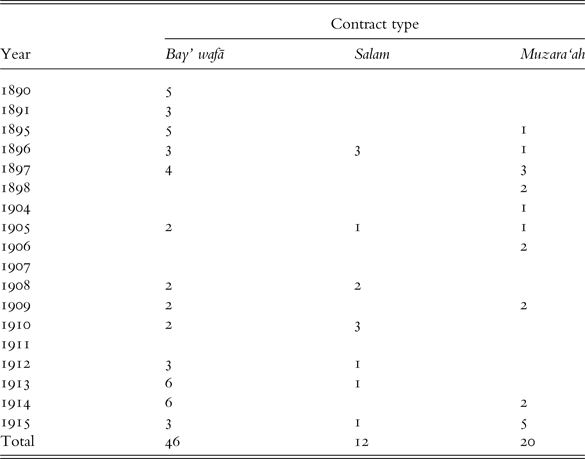
The notarial acts point to an evolution, between 1890 and 1915, in the use of bay' wafā and salam contracts. When the first notarial registers were drawn up, between 1890 and 1896, Palestine was in the midst of a depression of international agricultural prices, which increased the risk of loans to farmers. The negative economic trend allowed the resurfacing of relationships, between farmers/borrowers and notables/lenders, similar to those in place before the upsurge of commercialisation in agriculture and the enactment of the 1858 Land Code, when in the Palestinian context one could speak of a ‘fluid inventory of the land’ (Kark and Gerber Reference Kark and Gerber1984, p. 373). At that time, the bay' wafā and salam contracts gave creditors a strong position against the farmers and easy hoarding of their assets in the case of insolvency. During the years of depression of agricultural prices, a similar mechanism of land confiscation due to debt and following the stipulation of bay' wafā and salam contracts actually existed, though the notarial acts do not allow such a claim to be quantitatively assessed.Footnote 12
What clearly emerges, in the timespan ranging from 1890 to 1915, is a negative correlation between the number of legal disputes over real-estate matters and the number of transactions in the real-estate market. In the 1890s, in the midst of the international depression of farm prices, the number of real-estate disputes was particularly high. The latter were mostly related to cases of usurpation of ownership rights or confiscation of property as a result of debt, or non-compliance with contract clauses. In those years, the pattern of disputes reflected the general climate of economic uncertainty which negatively affected the volume of real-estate transactions and increased credit risk. From 1896, however, with the exit from economic depression, the number of legal disputes decreased significantly. This was coupled with a proliferation of new contracts (sales, rents) on the real-estate market, which indicated a climate of greater confidence and higher expectations on investment returns (Ecchia Reference Ecchia2008, graph 3, p. 301). In the district of Haifa, the rise of prices of agricultural products was therefore accompanied by the development of the real-estate market. At the same time, the expansion of the real-estate market in the years following the crisis was, in turn, positively related to the gradual expansion of the banking sector, confirming that the end of the depression of farm prices, in a legal context of clearer establishment of land property rights, positively affected the expansion of the credit market. In 1914 as many as 18 branches of the Imperial Ottoman Bank, the Credit Lyonnais, the Deutsche-Palästina Bank and the Anglo-Palestine Company operated in Palestine, and all of them (with the exception of the Credit Lyonnais) owned offices in Haifa (Gilbar Reference Gilbar and Kushner1986, p. 206).
Further, after 1896–7, bay' wafā and salam contracts are used differently from those reported in the recessionary period. First, in bay' wafā contracts it began to be specified that the purpose of the loan was to be investment in agriculture; secondly, the stipulation of contracts was no longer made only between peasants and notables, but also among the notables themselves. The latter began to use their property, especially houses and lands purchased during the boom in the real-estate sector, as security on loans from the banks. The aim was to start other businesses, such as storage and trade in agricultural products, but also to finance those farmers who lived within their fiscal unit.Footnote 13 Of the total contracts, bay' wafā account for 59 per cent (Table A1) and mostly (70 per cent) concern lands; houses account for 35 per cent, shops 11 per cent, and warehouses 7 per cent.Footnote 14 Creditor notables who stipulated bay' wafā contracts accounted for 77 per cent of the total (Table A2).
The bay' wafā contract lessened the risk taken on by the creditor insofar as it authorised the confiscation of the seized asset, though not allowing the creditor to seize other property of the debtor should the sale of the land at auction not suffice to cover the unpaid debt (while the banks were authorised to do so). The contract limited the number of loan applicants to those who possessed property to offer as security but allowed, at the same time, the cost of credit to be lowered in proportion to the reduction in risk. Thus, thanks to the synergies created between a legal context which guaranteed respect for property rights and the new cycle of economic expansion focused chiefly on the real-estate sector and the commercialisation of the agriculture, bay' wafā contracts became used as instruments to support medium- to long-term credit in agriculture and create an effective network of markets connected with those of credit, in the sector of real-estate transactions.
After 1896 even the salam contracts took on a new function, one corresponding to the interests not only of the notables, but also those of the farmers. These contracts were used by the notables in order to acquire agricultural products for local markets as well as for export. Competing with each other, the notables were no longer trying, through salam contracts, to keep the farmers in a state of debt in order to acquire their product on the most favourable terms. On the contrary, they were now trying to gain control over interconnected markets in the sale of agricultural products. Such contracts, moreover, were more accessible to the farmers than bay' wafā contracts because, unlike the latter, they required no mortgage on property.
Thanks to their flexibility, salam contracts began to be used by anyone with savings, so much so that in the notarial acts farmers providing loans in the form of salam contracts can also be found.Footnote 15 Furthermore, the notarial acts show that salam contracts began to be signed between the notables themselves in order to connect the local sales network of agricultural products, run mainly by Muslim notables, with international markets, largely controlled by Christians (Doumani Reference Doumani1995, ch. 4).Footnote 16 During the recovery of agricultural prices, salam contracts connected the credit market with the trade of agricultural products and acquired the function of short-term credit to chiefly finance the farmer's working capital.
Of all contracts, salam accounted for 15 per cent (Table A1), chiefly concerned with oil, wheat, fruit, vegetables, oil seeds (sesame) and legumes (broad beans).Footnote 17 Creditor notables who stipulated salam contracts in the acts amounted to 26 per cent of the total (Table A2).
V
Between 1895 and 1915, a new type of credit agreement also appears in the notarial acts: the contract of muzara‘ah. This form of contract connected the credit market with tax farming, as the notable/lender was also the multazim (collector). The muzara‘ah represented an evolution of the traditional rural co-partnership contract by which each member gave his share in terms of means of production, gaining a profit proportional to the share invested. The most common type of muzara‘ah was that corresponding to the sharecropping contracts in which one of the parties gave the plot of land, the seeds and working animals, and the other the labour (Santillana, Reference Santillana1938, pp. 303–9; Firestone Reference Firestone1975, pp. 154–5). From the notarial acts it emerges, however, that even the muzara‘ah underwent changes. The most widespread type of muzara‘ah became a different kind of contract according to which a notable, usually the local multazim, offered a loan to a group of peasants, residents of the same village who owned their own land. In the contract all the individual borrowers were named, and each received a specified sum in accordance with the amount of land held. The loan was intended to improve the productivity of the land of individual farmers – who invested the loan in the purchase of seeds, livestock, tools and agricultural machinery – and was returned individually or collectively, in the event of bankruptcy of an individual farmer, after two years: if one of the borrowers defaulted, the others were to make up his payment (Firestone Reference Firestone1975, pp. 154–5).
In exchange, the multazim obtained from the farmers a certain percentage, usually 11.5 per cent, of the harvest of wheat and other cereals, in addition to the tithe. Often, to encourage farmers to accept the contract, the multazim took on the burden of paying property tax introduced by the reforms, amounting to four-thousandths of the value of all land and buildings. Moreover, these contracts were accompanied by a clause under which, should the farmers decide to use the loan not only for investments in village lands but also to cultivate new land further away (in an attempt to reduce the risks of bad harvest, but also with a view to making property claims over hitherto uncultivated lands), a share of the harvest from such land would also be paid to the multazim.Footnote 18
The muzara‘ah contract was an agreement between the multazim and the farmers aiming, for both parties, to improve the trade-off between maximising profit and risk containment (particularly high in the case of investment in agriculture). As regards containment of the contractors' risks, the collection of the agricultural tax as a percentage of output, instead of a fixed share of inputs, would allow the farmer to share the risks with the tax collector (Coşgel and Miceli Reference Coşgel and Miceli2005). However, the latter could still diversify his own share of the risk by acquiring the right of tax farming in a number of villages – a widespread practice, as shown by the notarial acts (10 out of 35 families of notables assumed the role of multazim over more than one village, up to a maximum of 19 villages).Footnote 19 The collector also compensated for taking on part of the risk through the lowering of transaction costs both to measure the harvest and to monitor the farmer's work. In the first instance, his local roots enabled him more easily to determine his share of the harvest as tithe; in the second, it was the farmers themselves who underwent mutual monitoring (‘small-scale peer monitoring’) out of a collective responsibility to pay their tithe and loan. When the loan was offered on a collective basis the costs of failure were shared by the group. Debtors making up the group were well aware that, in case of default, none would be able to get a new loan. This led them to select their own members carefully to avoid joining forces with individuals who could become insolvent and hence undermine the creditworthiness of the group as a whole (Ray Reference Ray1998, pp. 579–80).
Closely related to the need to minimise the group's risk exposure was also the system of distribution of plots among the peasants of the same village. This somewhat resembled the English system of open fields, where each family had several parcels of land dispersed within the territory and contiguous to those of other families in order to reduce the uncertainties for each farmer as regards their yield. Collective responsibility might be interpreted, in this case, as a kind of informal and private insurance in the event of crop shocks (McCloskey Reference McCloskey1976, pp. 124–70).
If practices of mutual insurance could raise problems of free riding and moral hazard, linked to the difficulty of measuring the contribution of each farmer, to avoid such problems, there was not only the group's self-selecting mechanism described above. The system of land allocation itself, typical of Arab villages, had the advantage of lowering monitoring costs, usually requiring collective performance at ploughing or harvest. Joint liability and the specific distribution of the land were a guarantee for both the multazim, who was reassured about the return on capital, as well as for the peasants, who increased their credibility. Finally, the reduction in the unit incidence of the default risk would reduce the cost of credit, thereby lowering interest rates.
The notarial acts also show that 40 per cent of landowners acted as multazim in the villages where their lands were situated and, where this function was associated with the muzara‘ah contract, the trend reached 100 per cent of cases (Table A2). Some scholars (Yazbak Reference Yazbak1998, pp. 71–3, 113, 140–1) consider landownership of some notables in the villages where they acted as multazim as the effect of tax collection and of the granting of loans to farmers who were likely to lose their land due to insolvency. In point of fact, an alternative hypothesis can be set forth. It seems plausible that such landownership was not the consequence but rather the cause of the notables' decision to take on the role of multazim and stipulate credit contracts with farmers in the villages where their lands were located, as occurred, according to what is registered in the acts, in 40 per cent of cases (Table A2). The original motivation is to be found precisely in the opportunity for notables to exert much greater control over farmers, with many of whom their families had age-old relationships, as well as over rural production. Indeed, the informational advantages enjoyed by notables/multazim were a disincentive to the malpractice, common among farmers, to hide part of the crop and, conversely, an incentive to the stipulation of muzara‘ah contracts with those farmers. Moreover, as the multazim was on his own land, the notable could keep for himself the whole harvest, without giving the tithe to a third party; this represented an advantage especially when the multazim invested in his own land. Of all the contracts examined, those of muzara‘ah represent 26 per cent and notables are involved in 20 per cent. The families whose members act as multazim are all involved in the trade of agricultural products, a sector which involves, in general terms, 69 per cent of notables/creditors (Table A2). In essence, it seems clear that the muzara‘ah represented an important means used by notables/multazim to access the agricultural surplus to be placed on the markets and to transform themselves from mere tithe collectors into active entrepreneurs.
VI
In conclusion, the map of the villages in the district of Haifa mentioned in our sources was juxtaposed to a dense and complex network of interconnected markets controlled by several notables competing with one another, most of them (51 per cent) united by their acting as multazim (Table A2). This network of markets interconnected with that of agrarian credit represented the means by which informal rural credit markets became established as a more efficient institution than that of formal markets in financing development of the agricultural sector. The peasants' demand for capital was met by the local notables who, in turn, were supplied by the provincial banks. In their activity as financial intermediaries, the notables benefited from a reduction of credit risk through the implementation of new business strategies designed to develop a network of markets connected with that of rural credit. The creation of interconnected markets reduced, for the creditor, the information asymmetries and, at the same time, ensured, in a context of ‘monopolistic competition’, that he acquired the agricultural surplus from the small landholders. In such a way, the notables' profit opportunities expanded to a number of fields closely related to that of financing farmers: taxation, thanks to their role as tithe collectors; trade, for the sale of agricultural products on regional and international markets; real estate, in connection with transactions of immovables, the value of which was increasing in proportion to the growth of agricultural commercialisation.
The evolution of three of the most common financial contracts in the agricultural sector of Ottoman Palestine, i.e. salam, muzara‘ah and bay' wafā contracts – representative of the interconnection of the rural credit markets with the markets, respectively, of agricultural products, of tax farming and of real-estate transactions – testifies to the parallel evolution not only of the notables from mere collectors and moneylenders into real entrepreneurs, but also of peasants from tenant farmers to small landowners.
Indeed, the rural credit markets with their interlinkages allowed the emergence of a middle peasantry class increasingly aware of the income opportunities and upward social mobility offered by growing commercialisation of agricultural products and by the new role of landholders. Easier access to credit was one of the crucial factors thanks to which it is indeed possible to track an improvement in the socioeconomic status of some farmers whose names occur more frequently. Farmers belonging to a rising middle class are involved in the sale and lease of land, the granting of salam loans to other farmers (following the same ways adopted by the notables), the institutions of partnerships whose financial resources were invested in the cultivation of land, the purchase of equipment or the storage and transport of agricultural products to local markets. Furthermore, some farmers began to take on themselves the role of multazim (Doumani Reference Doumani1995, pp. 132–3).Footnote 20
The economic literature has shown that there is a positive correlation between growth, legal reforms and dissemination of markets interconnected to the informal rural credit market in developing countries (Greenwald and Stiglitz Reference Greenwald and Stiglitz1986). In the case of late Ottoman Palestine, greater security in the matter of land property rights and growing demand for agricultural products favoured the interconnections in the three types of contracts considered as an efficient tool for the growth of investments in agriculture and the exports of agricultural products, contributing to form the framework around which the growth model of the Palestinian rural sector was structured at the end of the Empire. This growth was also reflected in the increase in tax revenues from the rural sector, especially of the tithe (Shaw Reference Shaw1975; Pamuk Reference Pamuk1987, p. 238). This appeared even more important as taxes on agriculture were the main revenue item which the government relied on to offset the hefty deficit which, since the mid nineteenth century, had exposed the Empire to continual financial dependence on European nations.
APPENDIX
Contracts per year

Notables' entrepreneurial activities: rural credit markets and interlinkages