

Introduction
The Linearbandkeramik culture (LBK), which emerged in the Danube Basin around 5500 BC and was responsible for the spread of a sedentary lifestyle in central and western Europe, gave rise to various entities that developed during the first part of the Middle Neolithic. In western Europe, this applies, among other things, to the Hinkelstein–Grossgartach–Rössen sequence.
The funerary practices of each of these four related cultures have long been described as relatively homogeneous (e.g. Lichardus-Itten Reference Lichardus-Itten1980; Pavúk Reference Pavúk1972), suggesting that they formed a broadly unified cultural sphere. The LBK has been associated with oval pit-graves, usually gathered in cemeteries, containing a single individual deposited flexed on their left side, with their head oriented eastward (see contributions in Bickle & Whittle Reference Bickle and Whittle2013; Hofmann Reference Hofmann, Devlin and Graham2015, 109; Jeunesse Reference Jeunesse1997a; Waldvogel Reference Waldvogel2025a). As for the Hinkelstein, the Grossgartach, and the Rössen cultures, which share several characteristics, the deceased is placed in a pit-grave, usually laid on their back with their lower limbs in extension and their head westward (Childe Reference Childe1929; Lichardus et al. Reference Lichardus, Lichardus-Itten, Bailloud and Cauvin1985; Lichardus-Itten Reference Lichardus-Itten1980). However, the increasing amount of funerary data accumulated over recent decades has begun to challenge this apparent homogeneity of practices (e.g. Bickle & Whittle Reference Bickle and Whittle2013; Hofmann & Bickle Reference Hofmann, Bickle, Roberts and Vander Linden2011; Modderman Reference Modderman1988; Pechtl & Hofmann Reference Pechtl, Hofmann and Müller-Scheeßel2013; Waldvogel Reference Waldvogel2021; Reference Waldvogel2022; Reference Waldvogel, Kerouanton, Maitay, Praud and Soler2024; Reference Waldvogel2025a). Research devoted to the western LBK, for instance, has revealed significant variability in body orientation and position, as well as in the types of artefacts deposited with the dead (Arbogast Reference Arbogast1983; Jeunesse Reference Jeunesse1995a; Reference Jeunesse, Constantin, Mordant and Simonin1997a; Waldvogel Reference Waldvogel2025a). Such observations raise broader questions regarding the extent to which funerary practices can be strictly associated with an archaeological culture defined through ceramic styles.
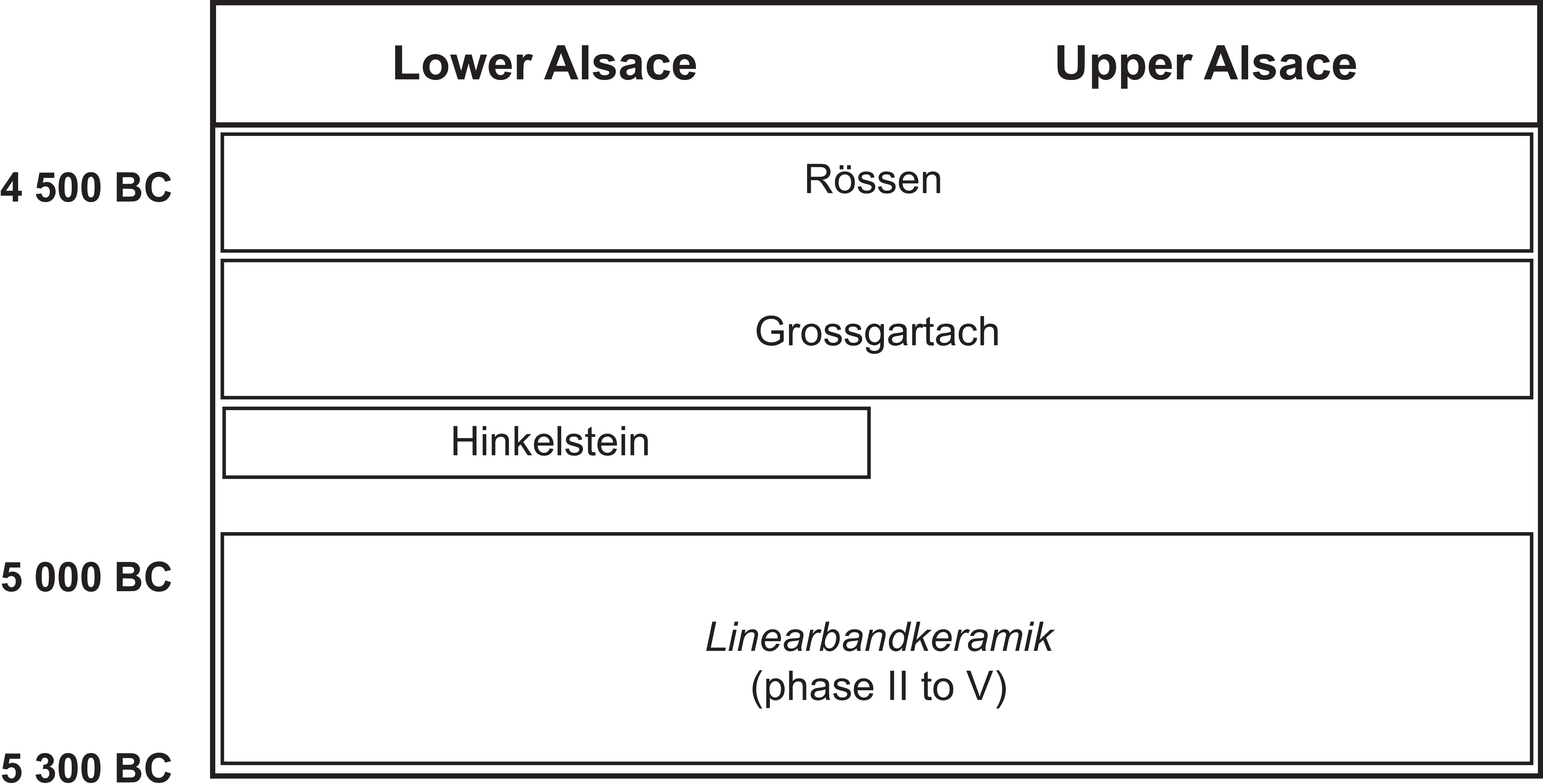
The Alsace Plain, located in eastern France, offers a particularly suitable context in which to address this issue. Bordered by the Vosges Mountains to the west and by the River Rhine to the east, it was occupied by LBK communities between 5300 BC and 4950 BC, corresponding to phases II to V of Walter Meier-Arendt’s (Reference Meier-Arendt1966) chronological subdivisionFootnote 1 . These first Neolithic communities were subsequently followed by a succession of related cultures during the first half of the regional Middle Neolithic, around 4800 to 4460 BC (Figure 1) (Denaire Reference Denaire2009; Denaire et al. Reference Denaire, Lefranc, Wahl, Ramsey, Dunbar, Goslar, Bayliss, Beavan, Bickle and Whittle2017; Jeunesse et al. Reference Jeunesse, Lefranc and Denaire2004). The Hinkelstein (HST), originating in the Worms region, is thought to have reached Lower Alsace in 4910–4725 BC, that is to say between 40 and 175 years (68% probability) after the end of the LBK in the area (Denaire et al. Reference Denaire, Lefranc, Wahl, Ramsey, Dunbar, Goslar, Bayliss, Beavan, Bickle and Whittle2017, 1136). However, several discoveries suggest that the beginning of the Hinkelstein around Worms was contemporaneous with the end of the LBK in Alsace (Denaire et al. Reference Denaire, Lefranc, Wahl, Ramsey, Dunbar, Goslar, Bayliss, Beavan, Bickle and Whittle2017, 1136–7; Jeunesse Reference Jeunesse1999; Reference Jeunesse2006, 13; Jeunesse & Strien Reference Jeunesse, Strien and Zeeb-Lanz2009; Spatz Reference Spatz2001). In the latter zone, the Hinkelstein was followed by the GrossgartachFootnote 2 (GG) and the Rössen (RO). Since the 1990s, three funerary ‘facies’ defined by recurring combinations of funerary gestures have been identified in the Alsace Plain and adjacent zones, suggesting a more complex social reality than that implied by the chrono-cultural divisions established for these four cultures on the basis of ceramic styles (Jeunesse Reference Jeunesse1995a; Reference Allard, Dubouloz, Hachem and Jeunesse1997a; Reference Jeunesse, Constantin, Mordant and Simonin1997b).
Chronology of the Early Neolithic and the first part of the Middle Neolithic in the Alsace Plain (Illustration: L. Waldvogel).

Figure 1 Long description
The Linearbandkeramik is followed by a short hiatus. After this, the Hinkelstein culture is found in Lower Alsace only. Both regions then have the sequence from Grossgartach to Roessen.
The substantial increase in the funerary corpus now makes it possible to reassess this model from a broader geographical perspective, incorporating evidence from neighbouring areas associated with the same archaeological cultures. Building on previous studies (Jeunesse Reference Jeunesse1995a; Reference Jeunesse1997a; Reference Jeunesse, Constantin, Mordant and Simonin1997b), this paper refines the analytical framework through the distinction between funerary ‘facies’ and ‘sub-facies’, allowing funerary variability to be examined at multiple spatial scales and its possible social significance to be explored. More specifically, it sets out to consider whether recurring regional patterns of body treatment, grave layout, and associated artefacts may hint at the existence of distinct social segments rooted in particular territories, which may have materialised forms of belonging through specific funerary gestures, while simultaneously participating in a broader Danubian sphere.
Methodology
Identifying funerary human remains
The first step in this research was to create a list of sites that yielded human remains dated to the Early Neolithic (LBK) and the first half of the Middle Neolithic (HST, GG, RO) in the Alsace Plain. This survey was based on available publications up to 2021 (articles, assessment or excavation reports, monographs). Each find was re-examined to confirm its cultural attribution. A review of the literature confirmed that not all the deceased were deposited with artefacts. Thus, to minimise the risk of error, undated human remains located outside any funerary context (e.g. settlements or undetermined contexts) were excluded from the outset. Out of the 61 sites collected, this process led to the exclusion of seven (Waldvogel Reference Waldvogel2025a). Additionally, individuals found in bicultural cemeteries (i.e. sites used by two succeeding cultures: HST/GG or GG/RO) and lacking artefacts that could confirm their cultural attribution were also excluded. Finally, the small number of cremation deposits (six for the LBK, three for GG) led to their exclusion from the study, which instead focuses on the variability of inhumation burials.
The second step was to assess the funerary nature of the human deposits retained, based on the archaeological definitions of the concept of ‘grave’ (sépulture; Boulestin & Courtaud Reference Boulestin, Courtaud, Knüsel and Schotsmans2022; Boulestin & Duday Reference Boulestin, Duday, Mordant and Depierre2005; Lerclerc & Tarrête Reference Leclerc, Tarrête and Leroi-Gourhan1988). This type of structure is defined as a final deposition site, where one or more deceased were placed with the intention of carrying out a funerary act, which reflects a ‘positive intentionality’ toward the deceased (Gallay Reference Gallay, Duday and Masset1987, 28) and presupposes the holding of funerals. In our discipline, identifying a grave relies on the convergence of several ‘positive’ criteria (Boulestin Reference Boulestin, Baray and Boulestin2010, 23–4; Boulestin & Courtaud Reference Boulestin, Courtaud, Knüsel and Schotsmans2022, 60–2), such as the funerary context, the presence of artefacts intentionally associated with the deceased, the careful positioning of the body, or the repetition of the same practices within a given corpus.
This approach made it possible to classify human remains located in settlements or undetermined contexts as funerary when their characteristics aligned with practices observed in contemporary cemeteries. On the other hand, human deposits showing notable differences from the practices observed in cemeteries, classified as ‘other types of human remains’, were excluded from the analysis because of the uncertainty surrounding their interpretation, as they may have resulted from funerary, non-funerary, or post-funerary behaviours (Waldvogel Reference Waldvogel2025a; Reference Waldvogel2025b).
Funerary practices and geographic variability
To better understand the sources of funerary variability, and explore how recurring traits concentrated in given geographic areas may be interpreted, this study draws on insights from social anthropology. The latter has shown that funerary rites result from a group’s effort to address the disruption caused by the loss of one of its members. They therefore support the deceased, both physically and symbolically, in their transition to a new state (Baudry Reference Baudry2005; Hertz Reference Hertz1905/Reference Hertz1906; Lemonnier Reference Lemonnier2008; Thomas Reference Thomas1975; Reference Thomas1985; Van Gennep Reference Van Gennep1909) through a complex set of codified actions imbued with symbolic meaning, whose proper execution guarantees the effectiveness of the ritual. In this way, funerary rites form a system that contributes to the reproduction of shared prescriptive norms (Hertz Reference Hertz1905/Reference Hertz1906; Thomas Reference Thomas1975; Yannic Reference Yannic2010) and the maintenance of social bonds (Baudry Reference Baudry2005; Reference Baudry and Yannic2010; Durkheim Reference Durkheim1960 [Reference Durkheim1912]), so that ‘death is […] not merely the end of an individual existence, but a collective dimension’ (Baudry Reference Baudry2001, 29–30). This also implies that funerary norms within a group are rarely homogeneous, as different categories of individuals may be subject to distinct norms. This phenomenon has been widely documented in ethnographic studies, which show that such variability may depend on factors such as the deceased’s social status, age at death, gender, or the circumstances of death (e.g. Hertz Reference Hertz1905/Reference Hertz1906). Individuals who die a bad death (malemort) may be deprived of funerals (e.g. Anstett & Schmitt Reference Anstett and Schmitt2023; Frazer Reference Frazer1934; Héritier Reference Héritier1996, 109; Hertz Reference Hertz1905/Reference Hertz1906; Schmitt et al. Reference Schmitt, Anstett, Baroiller, Bérard, Boulestin, Lattard, Ménard and Rigeade2025; Thomas Reference Thomas1975; van Wing Reference van Wing1938, 38), although in some cases they can be reintegrated into the community through ceremonies of reparation that transform them into a bon mort (e.g. Geirnaert-Martin Reference Geirnaert-Martin1992).
In prehistoric archaeology, however, studying the funerary sphere is particularly challenging. First, only behaviours that leave material traces can be observed, thereby providing access only to part of the population and its social dynamics (Bocquentin et al. Reference Bocquentin, Chambon, Le Goff, Leclerc, Pariat, Pereira, Thevenet and Valentin2010; Lemonnier Reference Lemonnier2008). Second, the data reflect descriptive rather than prescriptive norms (Boulestin Reference Boulestin, Lauwers and Zemour2016). In other words, the observation of regularities in the archaeological record (descriptive norms) does not necessarily reflect the rules imposed on the group (prescriptive norms), and equating the two involves a methodological leap, as some behaviours may result, for instance, from non-normative habits (Boulestin Reference Boulestin, Lauwers and Zemour2016). Within this framework, archaeological analysis can only rely on the identification of observable regularities in the treatment of the dead (i.e. funerary practices), which do not provide access to the belief system underlying them (i.e. rites; Boulestin & Duday Reference Boulestin, Duday, Mordant and Depierre2005). Our understanding of the funerary sphere is therefore largely based on indirect material traces (i.e. body position and orientation, grave layout, objects deposited with the dead; Boulestin & Duday Reference Boulestin, Duday, Mordant and Depierre2005). In this context, the repeated occurrence of similar patterns of variability within a given geographical area, without any correlation with biological data such as age or sex, may suggest the existence of social units rooted in particular territories (e.g. clans, lineages) and expressing their distinctiveness through several aspects of life, including funerary practices.
Among the material traces that can be analysed, the objects found in graves are particularly complex to assess. Their study first requires determining whether they relate to the dead (i.e. personal objects; objects reflecting a specific collective identity, such as gender, age, or position within the social hierarchy), formed part of the funerary rites, or resulted from commemorative practices (Bailly & Plisson Reference Bailly and Plisson2008). Given the difficulties inherent in making such distinctions for prehistoric contexts, small objects recovered from the grave fill (e.g. scattered pottery sherds) were excluded from my analyses, since they may represent either intrusions or the material outcome of ritual activities (e.g. communal meals followed by the deliberate breaking of ceramic vessels). Consequently, the analyses focused primarily on artefacts recovered in direct association with the deceasedFootnote 3 . These artefacts, whether complete or fragmented, may be linked either to the deceased themselves or to defined funerary rites. Although, as emphasised by the functionalist approach, the study of material culture in prehistoric societies allows us to understand only its structure (i.e. its form) and broad categories of functioning (i.e. its mode of action; Sigaut Reference Sigaut and Perlès1991), the presence of these items alongside the dead nonetheless suggests that they held meaning for the living. Thus, the identification of recurrent patterns adopted by a part of the population within a geographically restricted area should lead us to consider the hypothesis of social segments rooted in a given territory and expressing their identity through distinct funerary gestures, for instance by selecting specific artefacts considered meaningful to them. Such a configuration was, for example, observed during ethnoarchaeological fieldwork among ‘traditional’ societies in western SumbaFootnote 4 (Indonesia). Although this region shares a common material culture, social structure, and religion, our informants reported that certain ethnic groups (i.e. territorial groups; Taylor Reference Taylor, Bonte and Izard2011, 242–4) used specific rituals (e.g. breaking vessels on the grave during funerals), whereas others did not.
Building on these ethnological insights, and to address the question of regional variability, I refined the analytical construct of funerary facies (previously called ‘traditions’; Jeunesse Reference Jeunesse1995a; Reference Jeunesse1997a; Reference Jeunesse, Constantin, Mordant and Simonin1997b) and introduced the complementary concept sub-facies. These concepts are designed to identify recurring and distinctive funerary gestures adopted by parts of the population within a circumscribed region, without any correlation with the age at death or biological sex of the deceased. Both concepts are applied independently of chrono-cultural divisions to identify behavioural regularities operating at a different scale from the distribution of ceramic styles (generally used to define archaeological ‘cultures’). In this perspective, facies and sub-facies may be interpreted as potential indicators of distinct social segments, whose shared gestures materialise specific forms of social belonging. Their identification relies on the recognition of recurring particular traits within defined areas, namely body orientation and position, types of goods, and pit layout.
Results
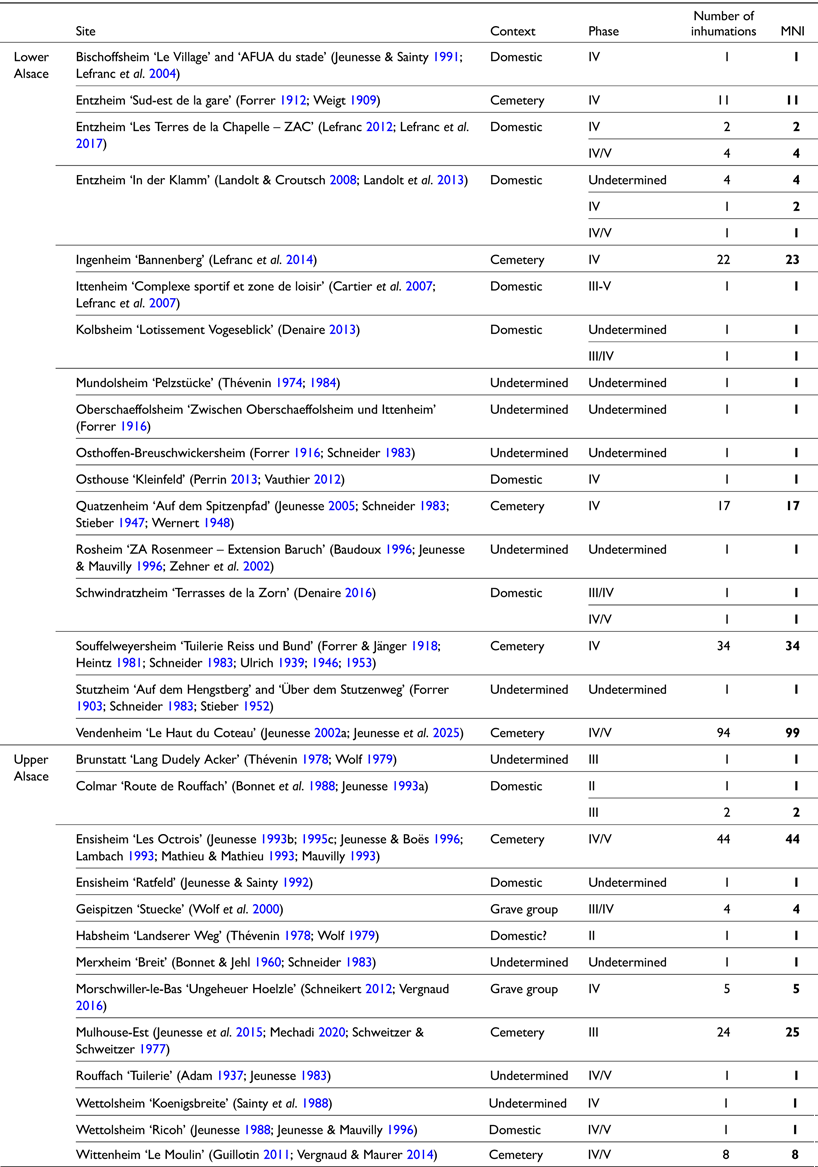
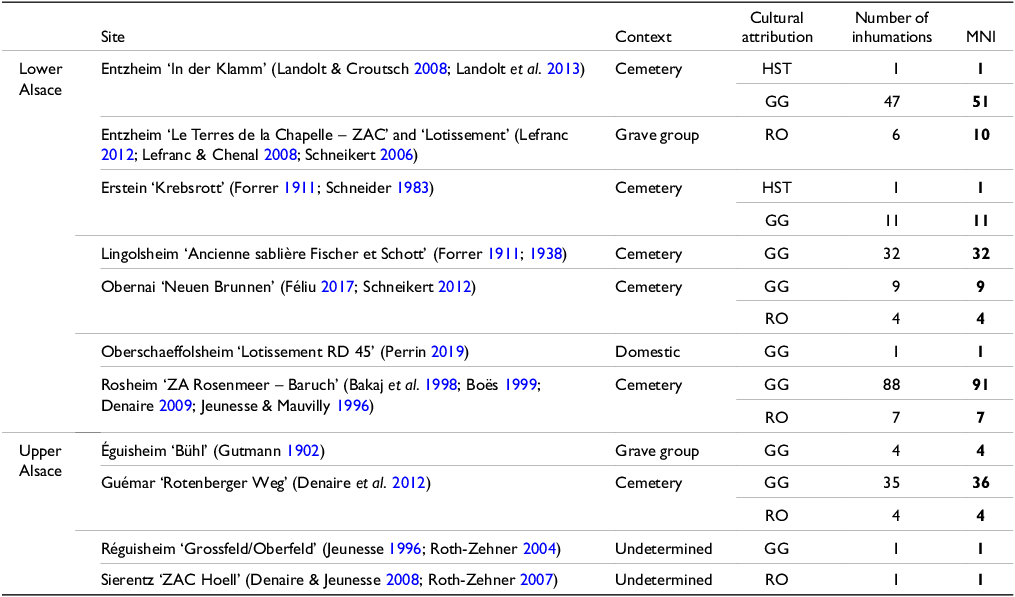
The analysis of the corpus from the Alsace Plain for the different archaeological cultures (Tables 1 & 2) has led to the identification of:
-
• Linearbandkeramik: 297 inhumations (Minimum Number of Individuals/MNI: 305) from 30 sites;
-
• Hinkelstein: two inhumations (MNI: 2) from two sites;
-
• Grossgartach: 228 inhumations (MNI: 236) from nine sites;
-
• Rössen: 22 inhumations (MNI: 26) from five sites
Inhumation burials in the Alsace Plain attributed to the Linearbandkeramik culture

Table 1 Long description
The table presents data on archaeological sites in Lower and Upper Alsace, focusing on context, cultural attribution, number of inhumations, and MNI. It is divided into two main sections: Lower Alsace and Upper Alsace. The table has 30 rows, each representing a different site. The CONTEXT column indicates whether the site is associated with a domestic setting, cemetery, or grave group. The PHASE column specifies the phase of the Linearbandkeramik culture, with phases ranging from III to IV/V and some sites having undetermined phases. The NUMBER OF INHUMATIONS column provides the count of inhumations at each site, while the MNI column lists the Minimum Number of Individuals. Notable sites include Bischoffsheim with 1 inhumation, Entzheim with multiple entries totaling 17 inhumations, and Vendenheim with 94 inhumations. The table provides a comprehensive overview of the distribution and context of inhumation burials across different sites in the Alsace Plain.
Inhumation burials in the Alsace Plain attributed to the Hinkelstein, the Grossgartach, and the Rössen cultures

Table 2 Long description
The table presents data on archaeological sites in Lower and Upper Alsace, focusing on context, cultural attribution, number of inhumations, and MNI. It is divided into two main sections: Lower Alsace and Upper Alsace. The table has 11 rows, each representing a different site. The columns include Site, Context, Cultural Attribution, Number of Inhumations, and MNI. The table captures the archaeological findings and their cultural attributions, providing a comprehensive overview of the burial sites and their characteristics.
The Linearbandkeramik (c. 5300–4950 BC)
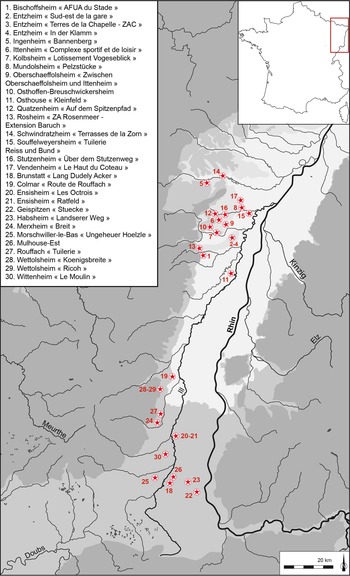
The study of LBK inhumations (Figure 2) shows marked differences between Lower and Upper Alsace in several parameters. This phenomenon is clearly visible from phase IV onwards, a period for which the funerary record is relatively balanced between Lower and Upper Alsace. Within each region, a coherent set of gestures can be observed across all types of contexts (i.e. cemeteries, settlements, undetermined contexts) and does not appear to be related to the age at death and biological sex of the deceased, except for certain types of objects associated with the dead.
Location of the inhumation burials used in this study and attributed to the Linearbandkeramik culture (Illustration: L. Waldvogel; base map: A. Denaire).

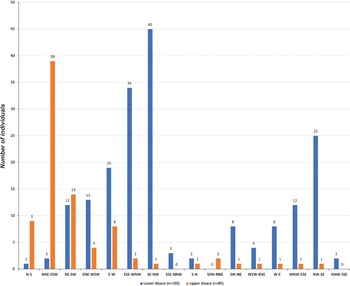
The orientation of the bodies shows distinct trends. In Lower Alsace, 31% of the individuals for whom this parameter is known have their heads to the west (‘antipodic’), contrary to the LBK practice of placing the head to the east. In contrast, in Upper Alsace, 92% of the individuals with known orientation are buried with their heads to the east, in line with the practice identified in the Danube Basin (Figure 3).
Orientation of the deceased in the Linearbandkeramik culture in Lower and Upper Alsace. The first cardinal direction denotes the position of the head (Illustration: L. Waldvogel).

Figure 3 Long description
A bar graph comparing the orientation of the deceased in the Linearbandkeramik culture in Lower and Upper Alsace. The horizontal axis lists different orientations. The vertical axis represents the number of individuals, ranging from 0 to 50. The graph features two data series: one for Lower Alsace (blue bars) and one for Upper Alsace (orange bars). Notable trends include a high number of individuals oriented with head to the east or south-east in Lower Alsace and a second, lower peak of inhumations with head to the north-west. In Upper Alsace the majority of individuals are buried with head to the north (39 individuals). Other orientations show varying numbers of individuals, with some orientations having no recorded individuals.
The data also highlight a broader range of body positions for the deceased in Lower Alsace during phases IV/V (Waldvogel Reference Waldvogel2025a) and confirm the frequency in this region of a position previously unknown in the Alsace Plain and beyond: lying on the back with the lower limbs extended (Jeunesse Reference Jeunesse1995a; Reference Jeunesse1997a). The particularity of Lower Alsace is also already visible in the ‘traditional’ LBK position (flexed on the side), with an average recorded knee flexion from 18° to 170°. A closer examination reveals two distinct trends: marked flexion (100–170°), and more moderate flexion (18–70°). In contrast, in Upper Alsace, average flexion never drops below 90° (Figure 4). This phenomenon cannot be attributed to the presence of a wooden container affecting body position, since most cases for which the decomposition environment has been assessed indicate that the pit was filled shortly after deposition of the body directly in the ground. Likewise, the hypothesis of a direct relationship between a supine position and the use of a wooden container (Thevenet Reference Thevenet2012; 2013) cannot be generalised, as several individuals displaying this position have decomposed in a filled environment.
Average knee flexion of individuals buried in a lateral flexed position (Illustration: L. Waldvogel).

Figure 4 Long description
Angles are much more varied in Lower Alsace, while they consistently fall between 90 and 180 degrees in Upper Alsace.
Current data also indicate that, although the grave pits are generally oval, certain structural features are documented only in Upper Alsace. At the Mulhouse-Est cemetery (phase III), burial 5/2014 shows an arrangement referred to as a ‘banquette’ system, which is ‘an elevation of the pit above the bottom, where the skeleton lies’ (Allard et al. Reference Allard, Dubouloz, Hachem and Jeunesse1997, 34; translation by the author). Located to the east of the space containing the deceased’s bones, it stands 30 cm high, with a maximum length of 1.95 m and a width of 0.50 m. This burial is further distinguished by a post-decompositional intervention, as a large portion of the skeletal remains was removed after the flesh had decayed, while the remaining bones were crushed (Jeunesse et al. Reference Jeunesse, Affolter, Barrand-Emam, Chenal, Denaire, Mauvilly, Arbogast and Lefranc2015). Additional arrangements were reported for burial 1 at the same site by Roger and Joël Schweitzer (Reference Schweitzer and Schweitzer1977), who noted the presence of ‘postholes’, later reclassified as ‘stakeholes’ due to their small size (Jeunesse et al. Reference Jeunesse, Affolter, Barrand-Emam, Chenal, Denaire, Mauvilly, Arbogast and Lefranc2015). The authors also reported ‘circular discolorations’ in burials 2, 11, 14, 15, 17, and 20 (Schweitzer & Schweitzer Reference Schweitzer and Schweitzer1977), but their interpretation as stakeholes should be considered with caution.
Although grave goods encompass a wide range of object types, analysing them together with biological parameters (where known) shows that in Upper and Lower Alsace some appear to be linked to the biological sex of the deceased. This is the case for fire-lighting kits (men: 27%; women: 3%), adze blades (men: 40%; women: 1%), flint blades (men: 35%; women: 2%), and flint arrowheads (men: 35%; women: 0%), which are preferentially deposited with men. However, biological sex is not the only factor, as among the 66 individuals identified as male, only 45% were associated with an adze blade, 18% with a flint arrowhead, 14% with a fire-lighting kit, and 14% with a flint blade.
While some types of items are preferentially associated with biological sex, during phases IV/V others display regional patterning that cannot be readily explained by biological data. Thus, in Lower Alsace, colourants mainly occur as raw or partly worked nodules, and in contrast to Upper Alsace food deposits, polishing stones/sharpening tools, bone arrowheads, grinding tools, and awls are attested (Figure 5). Ornaments are rare and their types are also limited: the 12 identified items, composed of a total of 145 elements, shows that 11 were necklaces and one a bracelet. Except for a few contemporary marine shells (Nucella lapillus), the raw materials derive from two species of small terrestrial and river shells (Ena detrita and Margaritifera margaritifera, or Unio), as well as deer teeth or antlers.
Frequency of object types found in inhumation burials in Lower Alsace and Upper Alsace during phases IV/V (illustration: L. Waldvogel).

Figure 5 Long description
A bar graph compares the frequency of various object types found in inhumation burials in Lower Alsace and Upper Alsace during phases IV/V of the LBK. The horizontal axis lists different object types, categorized into body ornaments, chipped stone tools, colorants, polished stone tools, and worked animal bones. The vertical axis represents the frequency percentage. The graph uses two colors: blue for Lower Alsace and orange for Upper Alsace. Notable trends include a higher frequency of colorants in powdered form in Upper Alsace and a higher frequency of axe blades and arrowheads in Lower Alsace. The graph highlights the variability in funerary practices and the types of artifacts deposited with the dead.
In Upper Alsace, colourants are found almost exclusively in powdered form. Ornaments are well attested and display a considerable diversity of types: three bone rings, one bracelet, eight necklaces, two antler toggles (Geweihknebel), three perforated shells (one Spondylus, one marine fossil shell, one terrestrial shell), and two V-Spondylus (i.e. shells with a V-formed incision, generally interpreted as belt buckles). These ornaments also stand out for their large number of components, with 19 objects comprising a total of 600 elements. Most are made from contemporary Atlantic and/or Mediterranean marine shells, while recent discoveries confirm a change in the morphology of small Spondylus shell beads (Jeunesse Reference Jeunesse1995a): beads from phase III have varied shapes (triangular, oblong, discoidal, trapezoidal); during phases IV/V only the discoidal shape persisted, with new beads made from Trivia monacha, Nucella lapillus, Dentalium vulgare, and Columbella rustica suggesting close links with Mesolithic populations (Jeunesse Reference Jeunesse1997a; Reference Jeunesse2002a, 151; Rigaud Reference Rigaud2011). Furthermore, Upper Alsace has yielded the only known examples of bone rings in Alsace (Figure 6). The study of the raw material used for ornaments in the Alsace Plain indicates that, whereas those made from animal bone and terrestrial/river shells are also attested in settlements, those made from marine shells – especially Spondylus – are found almost exclusively in inhumation burials. This pattern suggests that they held a particular significance within the funerary sphere in Upper Alsace.
Burial 6 from Morschwiller-le-Bas ‘Ungeheuer Hoelzle’ contained an individual wearing two bone rings (photograph: ANTEA-Archéologie).

The Hinkelstein (c. 4800–4730 BC)
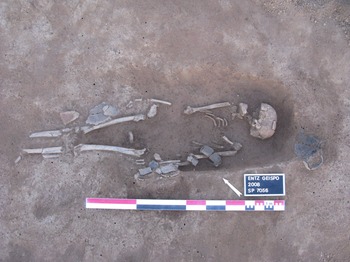
The known Hinkelstein graves in Alsace are limited to two individual inhumations from bicultural cemeteries (HST and GG) located at Erstein ‘Krebsrott’ and Entzheim ‘In der Klamm’ (Lower Alsace) (Figure 7; Table 2). Although this small corpus precludes any meaningful assessment of variability, their characteristics are briefly described here. The individual from tomb II at Erstein ‘Krebsrott’, poorly preserved, was oriented WNW–ESE. The deceased was associated with fragments of a decorated cup with a globular body (near the feet) and fragments of two boar tusks located either in the neck area (Forrer Reference Forrer1911, 196) or on one of the individual’s arms (Schneider Reference Schneider1983). The likely adult female from Entzheim ‘In der Klamm’ (burial 7056) lay on her back with extended limbs and head to the SE, in a pit that fits her body (1.90 × 0.60 m) (Figure 8). The decorated cup and the bowl located to the left of the skull were elevated above the skeleton (Landolt et al. Reference Landolt, Abert, Bolly and Leprovost2013, 362). This observation led to the proposal that these ceramics were either placed on a board used to close the grave or on a banquette. The incompleteness and spatial distribution of the ceramics found at the level of the deceased may be the result of intentional breakage. These include two incomplete cups, whose sherds were scattered around the left forearm, and sherds of a pot found along the right lower limb. The deceased also had a complete and a fragmented sandstone grinding tool placed near the right foot, and wore a fired clay armring with two grooves on the left arm. This last type of object is concentrated in the southern Upper Rhine Plain, where it appeared during the LBK. However, it is mainly found in settlements (Jeunesse Reference Jeunesse1993c; Reference Jeunesse1995b). The specimen from the Hinkelstein grave at Entzheim ‘In der Klamm’ thus represents the oldest and only example of such an ornament in a funerary context in the Alsace Plain.
Location of the inhumation burials used in this study and attributed to the Hinkelstein, the Grossgartach, and the Rössen cultures (Illustration: L. Waldvogel; base map: A. Denaire).

Burial 7056 from Entzheim ‘In der Klamm’, where the position of artefacts suggests the presence of a banquette (photograph: Archéologie Alsace).

The Grossgartach (c. 4730–4600 BC)
The Grossgartach inhumations from the Alsace Plain (Figure 7) show a certain degree of variability. However, given the current state of evidence, the lack of well-preserved cemeteries in Upper Alsace prevents us from assessing whether a regional trend exists.
The analysis of body orientations, known for 75% of the 236 individuals, indicates a tendency to deposit the deceased with their head to the west (94%), although some alternative orientations exist (Figure 9). Regarding body positions, the most common is supine with both the upper and lower limbs extended (61%), which co-exists with nine other less represented configurations (Waldvogel Reference Waldvogel2025a).
Orientation of the deceased attributed to the Grossgartach and the Rössen cultures (Illustration: L. Waldvogel).

This period has yielded the first traces of wooden structures for the Neolithic in the region. While their existence in some inhumation burials had long been hypothesised based on a combination of indirect evidence (e.g. linear delimitations, decomposition in an empty space, flat pit bases; Boës Reference Boës1999; Reference Boës2004; Féliu Reference Féliu2017; Landolt et al. Reference Landolt, Abert, Bolly and Leprovost2013), it has been confirmed by recent discoveries at Bernolsheim-Mommenheim ‘Plateforme départementale d’activités de la région de Brumath’, where residual traces of wood were identified in four burials from cemetery 1 (burials 3004, 3202, 3210, 3238; Leprovost Reference Leprovost2023) (Figure 10). However, it remains challenging to identify the exact nature of these wood traces and to ascertain whether they corresponded to simple planks, a movable container, or a wooden casing directly constructed within the grave (Waldvogel et al. Reference Waldvogel, Perrin, Oberlin, Jonville, Pélissier and Mauduitin press). Their use should also not be generalised or linked to the supine position, as several supine individuals from Rosheim appear to have decomposed in a filled space (Boës Reference Boës1999; Reference Boës2004).
Burial 3238 from Bernolsheim-Mommenheim ‘Plateforme départementale d’activités de la région de Brumath’, where traces of wood were identified (photograph: Archéologie Alsace).

Grave goods include a wide range of object types, of which two seem to be preferentially deposited with men: flint arrowheads (men: 47%; women: 0%) and adze blades (men: 23%; women: 4.5%). Nevertheless, biological sex appears to be only one of the factors influencing the deposition of these types of items, as 47% of male individuals are not associated with them. Contrary to the LBK, the limited corpus currently available for Upper Alsace prevents us from identifying any clear pattern in the deposition of specific artefact types across the Alsace Plain. While variability appears to operate primarily at the site scale, several common tendencies can nevertheless be identified. Certain items attested in LBK graves, such as double adze blades and specific marine shell ornaments (e.g. V-Spondylus, perforated Spondylus shells) disappear during the Grossgartach, and new types emerge, including stone armrings (‘anneaux-disques’), armrings made from boar tusks, and axe blades. The range of materials used to produce adornments is diverse and relies mainly on locally available resources. These include various rocks (Jurassic oolitic limestone, lignite, jet, probably schist and serpentinite), which dominate the assemblages, as well as animal bones (deer teeth, boar tusks, bird bones, fox canines), Atlantic marine shells (Nucella lapillus, Dentalium vulgare), continental molluscs (freshwater mussels of the Unio type), fossil shells (Natica, Tympanotonos), and, more rarely, fired clay. Only a few items indicate long-distance exchange: this is the case for Nucella lapillus and Dentalium vulgare (Atlantic coasts; Jeunesse Reference Jeunesse1997a, 72), fossil Natica and Tympanotonos (Paris Basin; Bonnardin Reference Bonnardin2009, 48), and probably schist (St-Amarin?) and serpentinite from the Alps (Jeunesse Reference Jeunesse1995b, 6). The same types of ornaments are also attested in contemporary settlements. However, stone armrings constitute a notable exception, as they are always fragmented (Jeunesse Reference Jeunesse1995b, 11), so that the only complete specimens known come from graves.
The Rössen (c. 4600–4400 BC)
Rössen inhumations are concentrated in Lower Alsace and their limited number (22 burials) (Figure 7) does not allow for the identification of regional trends in the object types deposited with the dead. The data show that, in this region, the preference for the deposition of the head to the west continues (17 of 19 individuals) (Figure 9), whereas body positions indicate limited variability, with a preference for a supine placement with both upper and lower limbs extended (seven of nine individuals with available information; Waldvogel Reference Waldvogel2025a). The use of wooden containers for certain individuals has also recently been highlighted with the discovery of burial 371 at Hochfelden ‘Route départementale n°421’ (Oberlin Reference Oberlinin press; Waldvogel et al. Reference Waldvogel, Perrin, Oberlin, Jonville, Pélissier and Mauduitin press) (Figure 11).
Burial 371 from Hochfelden ‘Route départementale n°421’, where traces of wood were found (photograph: Archéologie Alsace).

Compared with the preceding periods, grave goods are characterised by a more limited spectrum. This is particularly visible in the reduced diversity of ceramic forms, as well as in the limited range of chipped stone tools (arrowheads, blades) and bone tools (awls). Ornaments also show a reduction in the range of materials employed, which remain largely local: limestone (47%), Dentalium shells (28.5%), mother of pearl (24%), schist (0.5%), and Nucella lapillus (0.25%). Given the limited number of inhumations, no clear pattern in the deposition of specific object types related to biological data or regional distribution can currently be identified. The observed variability therefore appears to operate primarily at the site scale. Moreover, as during the Grossgartach, body ornaments are also attested in Rössen settlements. However, stone armrings are consistently found in a fragmented state (Jeunesse Reference Jeunesse1995b, 11).
Discussion
The study of funerary practices documented in the Alsace Plain during the Early Neolithic (LBK) and the beginning of the Middle Neolithic (HST, GG, RO) reveals a significant diversity in the treatment of the dead. As previously mentioned, such variability observed at the site level may be linked to the fact that individuals within a group could be subject to distinct prescriptive norms due to their belonging to one or several particular social categories (e.g. gender, age at death, social status; e.g. Hertz Reference Hertz1905/Reference Hertz1906). However, the recurrence of specific gestures adopted by part of the population at the local or regional scale, without any apparent correlation with variables accessible through archaeological analysis (e.g. age at death, biological sex), raises additional questions. The available evidence suggests that other factors may also have contributed to this variability. When compared with data from well-preserved cemeteries and settlement graves in other areas occupied by Linearbandkeramik, Hinkelstein, Grossgartach, and Rössen populations (Figure 12), it appears that the observed geographical variability does not constitute an isolated phenomenon. Besides, some of its main patterns often transcend the chrono-cultural divisions defined on the basis of ceramic styles, even though these populations shared a broadly similar material culture. The combined analysis of key parameters (i.e. pit layout, body orientation and position, objects associated with the dead) not only supports the identification of four funerary facies, as previously recognised (Jeunesse Reference Jeunesse2006; Jeunesse et al. Reference Jeunesse, Lefranc and Denaire2004), but also suggests the presence of several sub-facies. The existence of these two categories, which should be understood as statistical tendencies emerging from the available corpus rather than homogeneous entities, likely held social significance, to which I now turn.
Location of the cemeteries included in the comparative corpus, with outline of the distribution of the various cultural groupings. Linearbandkeramik: Aiterhofen-Ödmühle (Nieszery Reference Nieszery1995); Balloy ‘Les Réaudins’ (Mordant Reference Mordant and Jeunesse1997); Bucy-le-Long ‘La Fosselle’ (Hachem et al. Reference Hachem, Allard, Constantin, Farruggia, Guichard and Ilett1998); Berry-au-Bac ‘Le Vieux Tordoir’ (Allard et al. Reference Allard, Dubouloz, Hachem and Jeunesse1997); Bruchstedt (Kahlke Reference Kahlke2004); Cuiry-lès-Chaudardes ‘Les Fontinettes’ (Ilett & Constantin, Reference Ilett, Constantin and Guillaume1993); Écriennes ‘La Folie’ (Bonnabel et al. Reference Bonnabel, Paresys, Thomasausen, Chambon and Leclerc2003); Kleinhadersdorf (Neugebauer-Maresch & Lenneis Reference Neugebauer-Maresch and Lenneis2015); Larzicourt ‘Champ Buchotte’ (Chertier Reference Chertier1980); Menneville ‘Derrière le village’ (Thevenet Reference Thevenet2010); Nitra (Pavùk Reference Pavúk1972); Schwetzingen (Gerling Reference Gerling2012); Sondershausen (Kahlke Reference Kahlke2004); Vedrovice (Podborský Reference Podborský2002). Hinkelstein: Trebur (Spatz Reference Spatz1999); Worms-Rheingewann and Worms-Rheindürckheim (Meier-Arendt Reference Meier-Arendt1975). Grossgartach: Trebur (Spatz Reference Spatz1999); Jechtingen (Dornheim Reference Dornheim, Denaire, Jeunesse and Lefranc2011). Rössen: Rössen (Rötting Reference Rötting and Wegner1983) (Illustration: L. Waldvogel; base map: A. Denaire).

Figure 12 Long description
A map of Europe displaying the locations of cemeteries included in a comparative corpus. The map highlights different cultural groupings with specific markers. Key locations include Aiterhofen-Odmühle, Balloy, Bucy-le-Long, Berry-au-Bac, Bruchstedt, Cuiry-lès-Chaudardes, Écriennes, Kleinhadersdorf, Larzicourt, Menneville, Nitra, Schwetzingen, Sondershausen, Vedrovice, Trebur, Worms-Rheingewann, Worms-Rheindürkheim, Jechtingen, and Rössen. The map uses different symbols to represent sites of the comparison corpus for Linearbandkeramik, Hinkelstein, Grossgartach, and Rössen. The map also includes rivers and other geographic features to provide context for the distribution of these sites.
A regionalisation of funerary practices in the Danubian world
The study of the different kinds of material evidence mobilised to characterise funerary practices, together with the comparison between objects recovered from inhumations and those found in settlements, show that most artefact types identified in graves are also attested in domestic contexts. However, certain ornament types and raw materials constitute an exception, as they are found almost exclusively in burials, suggesting that they might have been selected deliberately for funerary purposes. In addition, several aspects of funerary practices display recurrent regional patterns that cannot be explained by the biological characteristics of the deceased accessible through osteological analysis.
Within the western part of the LBK, this variability can be described through the identification of two funerary faciesFootnote 5 . The first (Facies I) encompasses Upper Alsace and the Paris Basin. In these regions, the deceased are predominantly oriented with their heads between the NE and the SE, and are placed in lateral flexed positions, either on the left or on the right side. Variants of the supine position with flexed lower limbs are also documented. The angle of flexion of the legs is generally high, usually exceeding 90°, which closely corresponds to practices observed in the Danube Basin. Grave goods frequently include ornaments composed of beads made from animal bones or teeth, sometimes combined with other elements such as recent marine shells. Powdered colourants are also attested, although their distribution around the body differs from the pattern observed in the Danube region (Waldvogel Reference Waldvogel2025a).
Despite this shared set of gestures, the available data highlight regional distinctions within this facies (Figure 13). In Upper Alsace and the Vosges region (sub-facies Ia), the banquette within pits is largely absent, and grave goods in phases III–V often include objects such as fire-lighting kits, axe-hammer blades made from deer antler, and polished stone tools. Ceramic vessels are frequently deposited in graves during phase III, but become rarer in phases IV and V. In contrast, the Paris Basin (sub-facies Ib) is characterised by the absence of cemeteries – the deceased are deposited in graves located in settlements (Bickle & Whittle Reference Bickle and Whittle2013, 373; Bocquentin et al. Reference Bocquentin, Chambon, Le Goff, Leclerc, Pariat, Pereira, Thevenet and Valentin2010; Pechtl & Hofmann Reference Pechtl, Hofmann and Müller-Scheeßel2013, 124) – and the frequency of banquettes, which are often associated with ‘niches’ (Bonnabel et al. Reference Bonnabel, Paresys, Thomasausen, Chambon and Leclerc2003; Thevenet Reference Thevenet2010). Ceramic vessels remain frequent in graves during phases IV and V, while Spondylus beads display notable morphological diversity (e.g. Thevenet Reference Thevenet2010, pl. 17, 42, 56, 92), contrary to Upper Alsace at this time. Moreover, several categories of objects present in sub-facies Ia (e.g. fire-lighting kits, antler axe-hammer blades, and polished stone tools) are now rare in inhumations (Jeunesse Reference Jeunesse2006, 8; Plateaux Reference Plateaux and Guillaume1993, 101; Thevenet Reference Thevenet2010). These features, specific to the Paris Basin, persist in the region during the following Villeneuve-Saint-Germain period (Waldvogel Reference Waldvogel2021; Reference Waldvogel2022; Reference Waldvogel2025a; Waldvogel & Jeunesse Reference Waldvogel and Jeunesse2022).
Location of sub-facies Ia (Linearbandkeramik)/Ib (Linearbandkeramik, Villeneuve-Saint-Germain) and sub-facies IIa (Linearbandkeramik)/IIb (Linearbandkeramik) (Illustration: L. Waldvogel; base map: A. Denaire).

Facies II is attested in Lower Alsace and in the Neckar region. According to previous studies, it may also be present in the north-western LBK, although there are problems of poor preservation at its main cemeteries (Jeunesse Reference Jeunesse1995a; Reference Jeunesse, Constantin, Mordant and Simonin1997b). In this facies, colourants are deposited as raw or semi-worked nodules and show no preferential association with the sex or age of the deceased, while ornaments mainly consist of recent terrestrial and river shells (Ena detrita and Margaritifera in Lower Alsace; Zebrina detrita, Pseudunio auricularius, Unio pictorum, and Anodonta cygnea at Schwetzingen in south-west Germany) or fossil shells (Glycymeris at Schwetzingen; Gerling Reference Gerling2012). Another particularity is the frequency of antipodic orientations, with a significant proportion of individuals buried with their heads oriented between the SSW and the WNW (31% at Schwetzingen, 31.5% in Lower Alsace), in clear contrast with the pattern observed in Upper Alsace (7%). Despite these shared features, several elements point to a specific dynamic in Lower Alsace and support dividing Facies II into at least two subgroups separating Lower Alsace (sub-facies IIa) from the Neckar region (sub-facies IIb) (Figure 13). Sub-facies IIa (Lower Alsace) stands out in that flexed individuals show a wide range of average angle of flexion of the lower limbs, from 0° to 170°. Food deposits are also attested, a practice which remains rare in eastern LBK areas but is also documented in the Hinkelstein culture (Spatz Reference Spatz1999), which developed in the Palatinate contemporaneously with the end of the LBK in Alsace (Jeunesse Reference Jeunesse2006, 13; Jeunesse & Strien Reference Jeunesse, Strien and Zeeb-Lanz2009). The appearance, during phase IV, of individuals buried in a supine position with extended lower limbs echoes a similar practice observed in neighbouring Hinkelstein groups. In contrast, sub-facies IIb (Neckar region, south-west Germany) displays a more ‘conservative’ configuration. Flexed positions remain dominant, with angles of knee flexion similar to those observed in the Danube Basin, which never drop below 90°. The supine position with extended limbs is uncommon (1% in Schwetzingen), whereas grave goods are characterised by the presence of bone pins in a few graves and by the rarity of polished stone tools.
The study of funerary practices associated with the Hinkelstein, the Grossgartach, and the western part of the Rössen (first part of the Middle Neolithic) has confirmed the existence of common features that define Facies III (Jeunesse Reference Jeunesse, Constantin, Mordant and Simonin1997b, 545). The latter presents several patterns indicating a persistence of traits from sub-facies Ia. In Facies III, the supine position with extended lower limbs is generally adopted, Spondylus ornaments are rare – and completely disappear during the Grossgartach (Jeunesse Reference Jeunesse and Guilaine2002b, 52) –, colourants are deposited as nodules, and grinding tools are frequent. At the same time, new tendencies appear, such as the increasing use of stone and animal bones for ornaments, and the deposition of axe blades with the dead.
Within this facies, however, several geographic variants that transcend chrono-cultural subdivisions can be distinguished (Figure 14). Sub-facies IIIa is currently documented in the Hinkelstein cemeteries of the Worms region in Germany (Trebur, Worms-Rheingewann, Worms-Rheindürkheim; Meier-Arendt Reference Meier-Arendt1975; Spatz Reference Spatz1999) – the number of Hinkelstein inhumations in Alsace is currently too small to extend observations there. It is characterised by the predominance of an easterly burial orientation – therefore continuing LBK practice – and the presence in graves of imitations of deer teeth made from terrestrial or river shells, bracelets made of deer antler, and beads mainly made of locally available recent or fossil shells. Arrow shaft straighteners and food deposits are frequent, while arrowheads are rare. During the Grossgartach, the same region (Trebur; Spatz Reference Spatz1999) displays slightly different patterns that suggest the existence of a sub-facies IIIb. There are now roughly equal numbers of people buried with their head to the west or east, whereas other elements change: shell imitations of deer teeth are replaced by real ones, and Spondylus ornaments and arrowheads disappear from inhumations. Sub-facies IIIc is represented at least in the Alsace Plain, where it encompasses both the Grossgartach and the Rössen. Inhumations of this area differ from the Grossgartach ones at Trebur due to the high frequency of arrowheads, the presence of limestone imitations of deer teeth, and, more broadly, the frequent use of limestone for ornaments.
Location of sub-facies IIIa (Hinkelstein of the Worms region), IIIb (Grossgartach of the Worms region), and IIIc (Grossgartach and Rössen of the Alsace Plain) (Illustration: L. Waldvogel; base map: A. Denaire).

Finally, several contemporary cultures located further east display specific funerary gestures defined as Facies IV (Jeunesse Reference Jeunesse2006; Jeunesse et al. Reference Jeunesse, Lefranc and Denaire2004). In contrast with Facies III, these groups maintain the lateral flexed position common since the LBK. This is documented in the Stichbandkeramik, the eastern part of the Rössen culture area, parts of the Lengyel, the Samborzec, the Jordanów, and the Gatersleben cultures (Jeunesse Reference Jeunesse2006, 13–19; Jeunesse et al. Reference Jeunesse, Lefranc and Denaire2004, 18; Pavlů & Zápotocká Reference Pavlů and Zápotocká2013; Zápotocká Reference Zápotocká1998), spanning an area from modern-day eastern Germany to Poland. Although their detailed examination lies beyond the scope of this study, the data indicate significant internal variability, also suggesting the existence of several sub-facies (Waldvogel Reference Waldvogel2025a).
Funerary facies as an indicator of social units rooted in specific territories?
The patterns outlined above highlight the recurrence of specific funerary gestures within circumscribed areas. Although observed among only part of the population, these practices show no correlation with biological sex or age at death. They are furthermore associated with geographical variability in the types of ornaments or raw materials used for their manufacture. This phenomenon suggests the existence of regional dynamics shaping funerary practices within the broader Danubian sphere. One possibility is that this reflects the agency of one or several social units (e.g. clans, lineages) associated with particular territories, which expressed their distinctiveness through several specific funerary gestures. Despite a shared material culture and a common set of practices across the Danubian world, some local segments appear to have used the funerary sphere to materialise special forms of belonging. While this can only be suggested for the Hinkelstein, the Grossgartach, and the western part of the Rössen, it appears particularly convincing in the case of the Linearbandkeramik populations of the Alsace Plain, which constitute the core dataset of this study.
In this region, the distinction between Upper and Lower Alsace in the funerary sphere corresponds to differences documented in several other spheres of social life. This is notably visible in house plans and orientations: Upper Alsace is characterised by trapezoidal houses oriented on a W–E axis, whereas Lower Alsace displays the typical rectangular LBK house plan oriented NW–SE (Jeunesse Reference Jeunesse1995a, 10; Lefranc Reference Lefranc2007, 30). Differences are also apparent in subsistence practices. Archaeozoological studies have shown that during phases II–III, pig was the principal species consumed in Lower Alsace (tradition A), whereas goats and sheep predominated in Upper Alsace (tradition B), mirroring patterns documented in the Danube region. During phase IV, however, both areas converged towards tradition A (Arbogast & Jeunesse Reference Arbogast and Jeunesse1996, 398–9; Reference Arbogast, Jeunesse, Colledge, Conolly, Dobney, Manning and Shennan2013, 277). Finally, Upper and Lower Alsace are also distinguished by ceramic styles (Jeunesse Reference Jeunesse1995a; Lefranc Reference Lefranc2007). Taken together, these convergent lines of evidence suggest that the funerary distinction observed here forms part of a broader regional pattern. They support the hypothesis of two territorially structured zones in which differences were expressed through variations across several domains. In this context, the regional variability observed in the Alsace Plain during the LBK – mirroring the same Upper/Lower Alsace division – may indicate the presence of multiple social units embedded in these territories, some of which articulated their differentiation from others through the funerary sphere.
The reproduction of these practices over several generations likely contributed to the persistence of these particular funerary gestures, which may explain why some of them transcend the cultural entities defined through ceramic styles. This phenomenon is particularly apparent in the Paris Basin, where a substantial proportion of the practices established during the final phases of the LBK persisted into the Villeneuve-Saint-Germain (sub-facies Ib). Similarly, several practices that became widespread in Lower Alsace at the end of the LBK (sub-facies IIa) were maintained and became widespread during the Hinkelstein, Grossgartach, and western parts of Rössen. This continuity contributed to the emergence of Facies III, which itself displays a degree of regional differentiation (sub-facies IIIa, b, c). In this context, it is noteworthy that, despite clear differentiation in ceramic styles between the Grossgartach and the Rössen, DNA analyses have revealed biological continuity among individuals attributed to these two cultures buried in the Obernai cemetery (Lower Alsace; Féliu Reference Féliu2017). This suggests that changes in ceramic styles do not necessarily reflect the arrival of genetically distinct populations, but may instead indicate transformations occurring within local groups.
While these patterns may partly result from internal developments, some evidence also points to processes of interaction and borrowing between neighbouring communities. This hypothesis may be considered, for example, in the case of the supine position with extended lower limbs, a practice that is rarely documented across the LBK as a whole but occurs frequently in Lower Alsace (sub-facies IIa). This position is, however, well attested within the Hinkelstein culture of the Worms region, as illustrated by the cemeteries of Worms and Trebur (Meier-Arendt Reference Meier-Arendt1975; Spatz Reference Spatz1999). The possibility of contacts between these two cultures is further supported by the concentration of Hinkelstein evidence in Lower Alsace following the hiatus marking the end of the LBK in the region, as well as by the probable introduction, during phase IV of the LBK, of the pivoting technique in ceramic decoration (Lefranc Reference Lefranc2013, 505). As already noted by Meier-Arendt (Reference Meier-Arendt1975, 77), a key question remains whether these practices were adopted by LBK communities in Lower Alsace from Hinkelstein groups, or whether the transfer occurred in the opposite direction.
In this context, the identification of geographical variability (facies, sub-facies) that is independent of biological sex and age at death within a single archaeological culture – that is to say a construction defined by ceramic styles (Bocquentin et al. Reference Bocquentin, Chambon, Le Goff, Leclerc, Pariat, Pereira, Thevenet and Valentin2010; Roberts & Vander Linden Reference Roberts, Vander Linden, Roberts and Vander Linden2011) – once again challenges the notion of coherent and homogeneous entities corresponding to a single social group or society (Hodder Reference Hodder and Hodder1978a; Reference Hodder and Hodder1978b; Renfrew Reference Renfrew, Rowlands and Friedman1977; Roberts & Vander Linden Reference Roberts, Vander Linden, Roberts and Vander Linden2011). Rather, the sharing of a common material culture does not preclude the existence of groups that distinguish themselves through subtle variations in different aspects of social life. This phenomenon has frequently been documented by ethnological studies. For example, Pascale Bonnemère (Reference Bonnemère1992) has shown that, although the twelve groups forming the Anga of New Guinea share a common material culture and similar social structures, each nevertheless developed distinctive traits. Thus, the Baruya and the Ankave can be distinguished, among other things, by their domestic architecture (Bonnemère Reference Bonnemère1992, 22–3). Likewise, the island of Sumba (Indonesia) shares a common material culture, but harbours two distinct social structures in its eastern and western regions, primarily identified through variations in domestic and funerary architecture (Jeunesse Reference Jeunesse, Kadrow and Müller2019; Wunderlich Reference Wunderlich2019). In western Sumba, where segmented societies are found, variability in funerary rituals is also linked to the presence of several clans belonging to a particular ethnic groupFootnote 6 . These examples suggest that, in prehistoric archaeology, the identification of social units rooted in specific areas is best achieved through the correlation of evidence from multiple domains, including funerary practices, subsistence strategies, and domestic architecture.
Conclusion
Our analysis has demonstrated that funerary practices in the Alsace Plain during the Early Neolithic (Linearbandkeramik) and the first part of the Middle Neolithic (Hinkelstein, Grossgartach, Rössen) often display a high degree of structured variability. By integrating the available corpus with comparative evidence from adjacent regions, this study has identified coherent patterns of geographic variability. The latter, conceptualised as facies and sub-facies, highlight the recurrence of funerary gestures within circumscribed areas. Although their exact social significance remains difficult to determine, their geographical distribution may reflect the existence of distinct social units rooted in particular territories (e.g. clans or lineages), which expressed aspects of their identity through parameters such as body orientation and position, pit layout, and selected artefacts. This observation underlines once more the importance of approaching the usually pottery-based Neolithic cultures not as homogeneous social units, but as composed of complex and heterogeneous groups. Future research combining funerary, domestic, and subsistence data at a wider regional scale will be necessary to better understand the mechanisms underlying the persistence and transformation of this variability.
Acknowledgements
This research builds on part of my doctoral thesis, defended in November 2023 at the University of Strasbourg (France) under the supervision of Professor Christian Jeunesse, whom I would like to thank. My gratitude also goes to Marie Besse, Professor of Prehistory, as well as my reviewers, whose comments greatly improved the first version of this text. I would also like to thank Claudine Abegg and Alexandre Gouverneur for their help with proofreading, as well as Céline Oberlin (Archéologie Alsace) and Bertrand Perrin (ANTEA-Archéologie) for sharing their photographic documentation.




 Open access

