Introduction
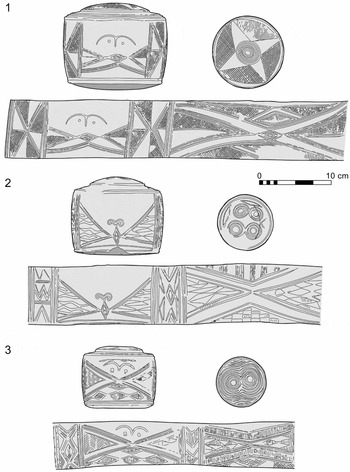
The Folkton Drums are the most remarkable decorated artefacts from Neolithic Britain (Figure 1). Excavated by Reverend William Greenwell between 1866 and 1868 (Greenwell Reference Greenwell1890), the ‘drums’ are three solid cylinders of decorated chalk that accompanied a child burial placed in a barrow (Kinnes & Longworth Reference Kinnes and Longworth1985) at Folkton, North Yorkshire. The precise date of the burial is unknown, but the site is believed to be part of a wider tradition of single inhumation burials, including Liff's Low in Derbyshire and Duggleby Howe in East Yorkshire, dating to the later centuries of the fourth millennium BC (Loveday et al. Reference Loveday, Gibson, Marshall, Bayliss, Bronk Ramsey and van der Plicht2007; Gibson & Bayliss Reference Gibson, Bayliss, Leary, Darvill and Field2010; Loveday & Barclay Reference Loveday, Barclay, Leary, Darvill and Field2010). Stylistically, the motifs on the drums—which include a series of geometric and curvilinear motifs, as well as eyebrow motifs denoting possible faces—have been linked to Late Neolithic Grooved Ware pottery decoration (a class of pottery whose decoration is typically linked to passage tomb art motifs; for example, Bradley Reference Bradley1997: 64–65), as well as other decorated Neolithic artefacts including carved stone balls and mace-heads (Roe Reference Roe, Coles and Simpson1968; Marshall Reference Marshall1977; Longworth Reference Longworth, Cleal and MacSween1999). They also share similarities with motifs found on Neolithic rock art panels from regions such as North Yorkshire and western Scotland and in Irish passage tombs (Cochrane & Jones Reference Cochrane and Jones2012). Longworth (Reference Longworth, Cleal and MacSween1999: 87) notes a resemblance to motifs on Wessex gold work, accessory cups and collared urns. The drums were considered unique until another undecorated ‘drum’ was discovered recently in a pit at Lavant in Sussex. It is currently in Chichester Museum and remains unpublished. The Lavant drum is associated with a pottery sherd identified by one of the authors (Andrew Meirion Jones) as probable Mortlake Ware, not Grooved Ware as proposed by Teather (Reference Teather2010: 208); this suggests a Middle Neolithic, rather than Late Neolithic or Early Bronze Age, date. The Folkton Drums can also be related stylistically to a broader class of decorated chalk artefacts with Grooved Ware associations, such as the chalk plaques from Amesbury and Durrington Walls (Harding Reference Harding1988; Varndell Reference Varndell1999; Teather Reference Teather2010; Parker-Pearson Reference Parker Pearson2012: 228–29).
The Folkton Drums; image by Aaron Watson redrawn from an original by Longworth (Reference Longworth, Cleal and MacSween1999).

Analysis of these decorated chalk artefacts—as part of a wider, Leverhulme-funded project examining Neolithic art in Britain and Ireland—has revealed evidence for the substantial erasure and subsequent reworking of motifs on these objects. The Folkton Drums were recorded, using Reflectance Transformation Imaging (RTI) and photogrammetry, to examine whether episodes of erasure and reworking might be detected. RTI and photogrammetry are advanced digital analogues to traditional photography that aim to provide more scientifically objective visual information. A mathematically enhanced sequence of digital images was used to produce a composite digital visualisation of the object (Cultural Heritage Imaging n.d.). Previous work has already demonstrated that RTI and photogrammetry can significantly contribute to the analysis of artefacts (Earl et al. Reference Earl, Martinez and Malzbender2010; Miles et al. Reference Miles, Pitts, Pagi and Earl2014).
RTI and photogrammetry: their use and potential in archaeology
RTI (Mudge et al. Reference Mudge, Voutaz, Schroer, Lum, Mudge, Ryan and Scopigno2005), and one of its subdivisions, polynomial texture mapping, was developed in 2001 at Hewlett Packard Laboratories (Malzbender et al. Reference Malzbender, Gelb and Wolters2001) and is a non-destructive, affordable and easy-to-perform imaging technique. There are many interesting applications in the field of cultural heritage, based on its ability to acquire and represent the 3D reflectance properties of objects. Compared to traditional texture mapping, polynomial texture maps and reflectance transformation images provide increased definition, including surface colours, self-shadowing, sub-surface scattering and inter-reflections. The technique samples and models the level of reflectance independently for each pixel, enabling the user to manipulate the material properties of objects in the scene (Malzbender et al. Reference Malzbender, Gelb, Wolters and Zuckerman2004).
Close-range photogrammetry, or image-based modelling, is the construction of a 3D model of an object from 2D images; it has been applied in the digital capture of archaeological artefacts and works of art. The most widespread use of this technique, however, has been for monuments, historic buildings and their facades, rather than for portable antiquities, although research has demonstrated that photogrammetry is capable of high-quality data-capture, even at millimetre range (Salonia et al. Reference Salonia, Scolastico, Pozzi, Marcolongo and Messina2009). Photogrammetry has been used for documentation, monitoring of structural problems and authentication studies, as it provides advanced volumetric perception and enhanced material description (Yilmaz et al. Reference Yilmaz, Yakar, Gulec and Dulgerler2007).
Methodology
The Folkton Drums were visualised in polynomial-texture-map and reflectance-transformation-image form using the highlight-based method (Mudge et al. Reference Mudge, Malzbender, Schroer, Lum, Ioannides, Arnold, Niccolucci and Mania2006). A series of raking and oblique light images were captured with a Nikon d800e digital SLR camera following the cultural heritage imaging guidelines (Cultural Heritage Imaging n.d.). The open-source reflectance transformation image builder software, developed by the University of Minho in collaboration with Cultural Heritage Imaging in 2009, was used for processing, as described in the guide to highlight image processing (Cultural Heritage Imaging n.d.). Polynomial-texture-map and reflectance-transformation-image files were viewed via specialised software, the reflectance transformation image viewer (ISTI-CNR/CHI RTIViewer) (Cultural Heritage Imaging n.d.) and the polynomial-texture-map viewer (HP Labs PTM Viewer) (Lyon Reference Lyon2004). The former is compatible with both .ptm and .rti files, while the latter supports only .ptm files. Both software packages enable interactive manipulation of the lighting position and enhancement of the final outcomes through different rendering modes.
Photographic sequences of Folkton drums 2 and 3 were captured from varying angles using a Nikon d3100 digital SLR camera. In order to capture complete datasets for both sides, the objects were turned upside down during the data capture session. Then the images were loaded into commercial software (Agisoft Photoscan) and masks were applied to remove unnecessary background and reflections. The camera positions were computed based on common points on the images. The next step was the computation of a point cloud and the reconstruction of the geometry (mesh) and texture. The resulting 3D models can be viewed immediately or exported to any other 3D software.
Results of the analysis
An analysis placing the new documentation in its broader chronological and archaeological context is still ongoing and will be detailed elsewhere on the completion of the ‘Making a Mark’ project. Here we summarise the results of the RTI and photogrammetric analyses. We retain Longworth's (Reference Longworth, Cleal and MacSween1999) original numbering of the drums (see Figure 1). For all three drums, we recorded new motifs, evidence of erasure and reworking, and evidence for sequences of working. Each drum has four panels of decoration around its circumference: two long horizontal panels divided by two short vertical panels. The drums also have a distinct orientation: a front and back. The front of each drum is distinguished by distinctive ‘eyebrow’ motifs. The top surface of each of the drums is also decorated with raised carved bosses.
New motifs
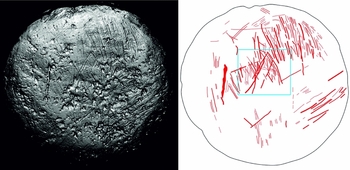
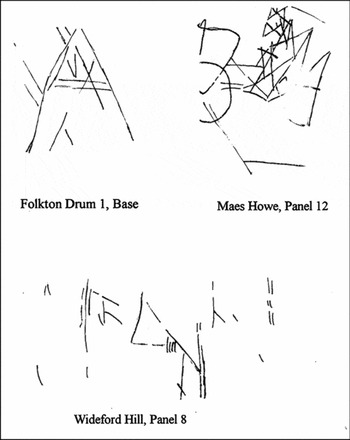
Two sets of new motifs were recorded using RTI analysis. The most complex of these was on the base of drum 1 (Figure 2). A series of parallel, linear, incised tool-marks are evident and can clearly be seen in Figure 2. These are cut by a triangular motif, with a horizontal incised line at its centre, rather like a letter ‘A’. To the right of this motif, and partially overlying it, is a further diagonal line and another incised horizontal mark. Together, these two A-shaped incisions create a motif that closely resembles in form (although not in scale) the scratched decoration found in the Maes Howe and Wideford Hill passage tombs, Orkney (Ashmore Reference Ashmore1986; Bradley et al. Reference Bradley, Phillips, Richards and Webb2001) (Figure 3). Further parallels include the lower face A of the Cronk yn How stone, Isle of Man (Darvill et al. Reference Darvill, O’Connor, Cheetham, Constant, Nunn and Welham2005: fig. 6) and a linear marked stone from Fylingdales Moor, North Yorkshire (Brown & Chappell Reference Brown and Chappell2005: 69, fig. 43). In fact, a parallel is explicitly drawn between the decoration on the side panel of drum 3 and the Fylingdales stone by Brown and Chappell (Reference Brown and Chappell2005: 70, fig. 44). Despite the geographic proximity between Folkton and Fylingdales, the new motifs detected on the base of drum 1 are best paralleled in Orcadian passage tombs.
Base of drum 1 indicating multiple scratched lines and triangular or ‘A’-shaped motifs (highlighted in blue rectangle); viewed under Reflectance Transformation Imaging Specular enhancement.

Comparison between incised motifs on base of drum 1 and incised motifs in Maes Howe and Wideford Hill passage tombs; image (not to scale) drawn by Andrew Meirion Jones; Maes Howe and Wideford Hill motifs redrawn from originals in Bradley et al. Reference Bradley, Phillips, Richards and Webb2001.

On the upper part of the base of drum 1 (as seen in Figure 2) are a further series of fine parallel scratches with another diagonal line cutting across them, along with another area of multiple parallel scratches. All of these groups of multiple parallel incisions closely resemble the haphazard decoration on chalk plaques (for example, akin to those seen on the reverse of the Amesbury chalk plaques; Harding Reference Harding1988).
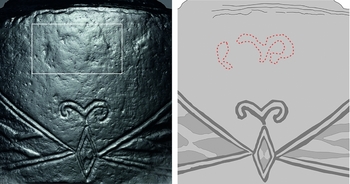
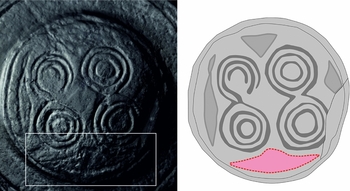
Probably the most spectacular discovery was the evidence for a further ‘eyebrow’ motif on the front of drum 2. This faint motif is situated above the existing spiral motif on drum2, around 0.5cm below the top edge (Figure 4, in the area of the white rectangle). Once identified, using RTI, it is quite clearly visible to the naked eye.Additionally, a small, pecked cross is also evident in the centre of one of the concentric ring motifs on the top of the boss on drum 3, forming a crossed ‘pupil’ in the centre of the ‘eye’ motif. At the centre of the other ring motif is a small, pecked depression. It is difficult to tell if this is part of the design or a residue of the pecking from working or shaping the drum; this particular drum has a very rough, unfinished surface appearance.
Partially erased eyebrow motif on the face of drum 2: the erased motif is at the top of the image directly above the double spiral motif (highlighted in the white rectangle); viewed under Reflectance Transformation Imaging Specular enhancement.

Evidence of erasure and reworking
The faint ‘eyebrow’ motif on the face of drum 2 is clear evidence of reworking and erasure. In fact, a greater area of erasure, in the form of a stippled texture on the top and front of drum 2, is evident from the photogrammetric analysis. It appears that the entire front centre of drum 2 has been reworked at some stage (Figure 4). Drum 2 is damaged around the top front edge and it is clear to see, from texture differences visible using photogrammetry and RTI, that a thin spall or flake of chalk was removed in order to remodel the front motifs; and this damaged one of the triangular motifs on the top boss of the drum. While previous documentation (Longworth Reference Longworth, Cleal and MacSween1999) records evidence for three triangular motifs between the circular motifs on the boss of drum 2, the fourth motif is missing. RTI analysis reveals that a fourth triangular motif once existed, but has been damaged or erased (Figure 5). On the basis of the orientation of the spall or flake that erased both the ‘eyebrow’ and boss motif, it must have been removed by a right-hand blow while the drum was inverted. It seems probable that this is a by-product of the deliberate erasure of the ‘eyebrow’ motifs on the front of drum 2.
Damaged boss with triangular motif on the top of drum 2: the damaged boss is at the bottom of the image (highlighted in pink); viewed under Reflectance Transformation Imaging Specular enhancement.

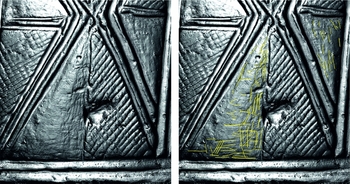
Further evidence of reworking was evident in a faint incision running parallel to the upper line of the lozenge on the face of drum 1. On one side of drum 1, all of the undecorated ‘blank’ spaces reveal evidence of prior working in the form of faint scratches or incisions (Figure 6). Similarly, on the other side panel of drum 1, faint scratches or incisions are also evident in the two lower undecorated ‘blank’ spaces. Again, on the back panel of drum 1, the lowermost part of the panel has spalled and then been carved over.
Reworking and erasure on the bottom blank space of the side panel, drum 1; erased motifs indicated in yellow; viewed under Reflectance Transformation Imaging Specular enhancement.

On drum 2, the side panel with three registers of decoration exhibits evidence of faint scratches on the lowermost part of the panel, while the upper part of the panel appears unfinished, abraded or damaged. There is faint evidence for an earlier motif next to the central motif on this panel.
The back panel of drum 3 has a series of faint vertical lines evident near the top; this is potentially earlier decoration that has been abraded or removed. On the centre right of this panel there are a series of faint scratches below the main vertical incisions. Again, there is evidence of reworking near the base of the back panel in the form of faint scratches.
Evidence for sequences of working
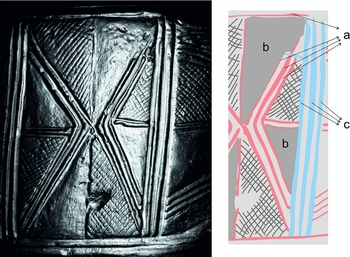
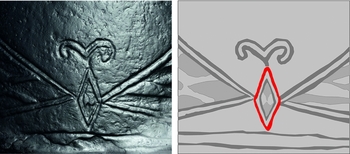
An unexpected result of RTI analysis was clear evidence for motifs of sequences of working. On the upper right-hand area of the side panel of drum 1, a stratigraphic sequence of working is discernible (Figure 7). The process began with an incised outline for the triangular area that was then filled in by crosshatched incisions. The upper part of the initial incised line for the triangular motif was erased by the next stage of working, which appears to have been the erasing of incisions in the ‘blank’ undecorated area. Finally, the double vertical lines that divide the side panel from the remainder of the decorated circumference of the drum were incised. On the front of drum 2 (Figure 8), the vertical lozenge of the central motif clearly cuts the triangular panels that come to a point in the middle of the panel. It is apparent from visual inspection with the naked eye that these two triangular panels do not meet. As the vertical lozenge cuts these triangular motifs, it must have been executed at a later stage. Similarly, on the complex side panel of drum 3 (Figure 9), the lowermost triangular motif is cut by the horizontal incision at the base of the motif.
Again, the vertical incisions that divide or frame both sides of the side panel appear to have been executed after the decoration of the rest of the panel.
The stratigraphy of working evident on the side panel of drum 1, sequence denoted by a, b and c (note all blank spaces exhibit evidence for erasure); the lines delineating the upper blank panel have been partially erased; viewed under Reflectance Transformation Imaging Specular enhancement.

Central motifs, drum 2 exhibiting the intercutting of motifs; viewed under Reflectance Transformation Imaging Specular enhancement.

Complex side panel on drum 3 exhibiting the stratigraphy of working; note the motifs at the base continuing beyond the limits of the basal horizontal incised line (indicated in red).

Discussion
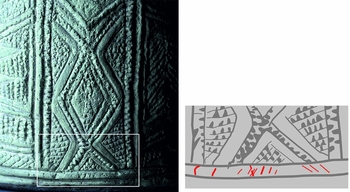
Taken together, the evidence revealed by RTI analysis and photogrammetry suggests considerable evidence for reworking. Previous interpretation of the Folkton Drums has emphasised the improvisatory character of making, viewing and handling the artefacts; the decoration on each drum changes as the viewer manipulates it (Jones Reference Jones2012: 180). It has also been argued that the drums were rapidly manufactured and buried (Jones Reference Jones2012: 180). The results of the RTI and photogrammetry add complexity to this picture.
The new motifs on the base of drum 1 are suggestive of experimentation, with a number of designs intercutting each other. The repetitive incisions that appear on this surface are redolent of the kind of repetitive and intercutting incisions that occur on Late Neolithic chalk plaques and the walls of flint mines (Harding Reference Harding1988; Varndell Reference Varndell1999; Barber et al. Reference Barber, Field and Topping1999; Teather Reference Teather2011).
More interesting is the evidence for erasure, particularly of the ‘eyebrow’ motif on the front of drum 2, and the evidence for other instances of erasing on all three drums. There are a number of ways of reading this evidence. We might interpret this as indicating multi-authorship and curation; we have, however, no clear knowledge of time-depth for these acts of erasure and revision.
If we take the evidence for erasure alongside that for sequences of working, another interpretation presents itself: erasure and revision occurred during the process of working. This is demonstrated quite clearly by the sequences of working on certain areas of the drums; for example, the upper right-hand part of the side panel on drum 1. Here, a design of two triangles seems to have been faintly incised and, with one of these triangular motifs, crosshatched. The adjacent space was then smoothed, erasing part of the initial design. Only then were bolder, deeper incisions made, outlining the triangular motif.
Erasure was a twofold process. It was part of the process of decorating the drums: incisions were made and erased during phases of working. Erasure was also part of secondary phases of revision: motifs, such as the ‘eyebrow’ on drum 2, were remodelled and revised sometime after the drum had been made and circulated.
Erasure and revision are significant as they are important components of the stylistic phases identified in Irish and Orcadian passage tomb art (O’Sullivan Reference O’Sullivan1986, Reference O’Sullivan, L’Helgouach, Le Roux and Lecornce1996; Eogan Reference Eogan1997; Bradley et al. Reference Bradley, Phillips, Richards and Webb2001; Jones Reference Jones, Cummings and Fowler2004; Cochrane Reference Cochrane, Thomas and Jorge2009). Eogan (Reference Eogan1997) identified five phases of art in Irish passage tombs: these begin with finely executed angular incisions, followed by angular picked art, dispersed areas of picking and ribbon art executed in relief. The final stage is close area picking, which is associated with the erasure of earlier motifs by sculptural relief carving (Cochrane Reference Cochrane, Thomas and Jorge2009). These have traditionally been interpreted as distinct stylistic phases, but on the basis of the Folkton Drum evidence we may entertain the possibility that these phases of working and reworking also relate to the improvisatory process of a single phase working of the stone on which the motifs are carved. In a similar sense, Lesley McFadyen (Reference McFadyen and Last2007) and Colin Richards (Reference Richards2013) have argued for the improvisatory and processual character of practices of building in the British Neolithic.
Improvisation and experimentation lie at the heart of the artistic process. In his recent book on contemporary sculpture, Ian Dawson (Reference Dawson2012: 9) observes:
that gestures that later might become iconic are sown from simple intuitive responses, and come from a stance of not knowing; that artists, irrespective of the scale of their work, endeavor to work from a position of unfamiliarity, the act of discovery still the bedrock of the making process.
This echoes Tim Ingold's recent discussion of ‘making’. Taking his cue from the philosophers Gilles Deleuze and Felix Guattari, Ingold argues that we should think from materials (Ingold Reference Ingold2013: 94), discovering as we go. This analytical project has worked in a similar way, recording the sequence of gestures involved in working these chalk artefacts, and uncovering the series of improvisatory decisions made as the chalk was worked and reworked. By thinking of these artefacts not as static finished objects, but as ‘incomplete’ artefacts whose working underwent improvisation, erasure and revision, we have highlighted the importance of thinking about archaeological art less in terms of finished symbols, and more in terms of processes of making.
Conclusion
Recent technological advances make it possible to obtain dense and accurate 3D surface data via photogrammetry and fine surface 2.5D detail via RTI. These powerful, easy and affordable techniques are becoming increasingly common in archaeology and the heritage sector as a means of documentation, analysis and dissemination. When their application is targeted on clear research questions, they can revolutionise archaeological practice and lead to new discoveries (see also Díaz-Guardamino & Wheatley Reference Díaz-Guardamino and Wheatley2013; Miles et al. Reference Miles, Pitts, Pagi and Earl2014). In this case study, RTI and photogrammetry enable virtual analysis of episodes of reworking. The technology is rapidly developing, and further processing of the acquired datasets using algorithmic rendering and new fitting algorithms for RTI may yet reveal hitherto undiscovered evidence.
The case study has demonstrated evidence for reworking in this iconic group of Neolithic artefacts; art in archaeology has been traditionally explored through stylistic analysis, whereas the study of style has been allied to a culture-historical approach aimed at determining the chronology of motifs and traditions (Conkey & Hastorf Reference Conkey and Hastorf1990), and their relationship to identities (Domingo Sanz et al. Reference Domingo Sanz, Fiore, May, Sanz, Fiore and May2009). We have shown that this focus on style may obscure significant information. Instead, an analysis of processes of working and reworking alongside a stylistic analysis yields valuable information concerning craftsmanship, identity and engagement with materials in prehistory.
Acknowledgements
We would like to thank: Gill Varndell and Neil Wilkin at the British Museum for their help in recording the drums; Graeme Earl and the Archaeological Computing Research Group at the University of Southampton for help and encouragement on this project. We are grateful for a Humanities Faculty Small Award from the University of Southampton that paid for travel to the British Museum and gratefully acknowledge the receipt of grant award RPG-2014–193 from the Leverhulme Trust for the project entitled ‘Making a mark: imagery and process in the British and Irish Neolithic’.