In Berlin, on 1 June 1932, at the height of its popularity, the jazz vocal group the Comedian Harmonists recorded ‘Der Onkel Bumba aus Kalumba tanzt nur Rumba’ (‘Uncle Bumba from Kalumba Dances Only Rumba’). The song, which demonstrates the transnational exchange that was central to the jazz age, had begun life in the USA as ‘When Yuba Plays the Rumba on the Tuba’. Composed in 1931 by Herman Hupfeld for the revue Third Little Show, ‘When Yuba Plays’ was Broadway's first entry into the international commercial rumba craze. While Hupfeld's version presents a colonizing narrative of an American who escapes the Depression to conquer Cuba by playing the rumba on his tuba, the German version, with words by the German Jewish lyricist and Berlin theatrical impresario Fritz Rotter, is more ambiguous. Produced at a time of rising Nazi influence towards the end of the Weimar Republic, it detailed the all-consuming effects of a rumba craze on the people of fictional Kalumba, including the lyrical I's eponymous Uncle Bumba. In the town of Kalumba, the citizens, from the mayor to the tiny babies, spend all day and all night dancing rumba rather than attending to matters of state or family (see the lyrics in Appendix 1 below). The story of ‘Der Onkel Bumba’, and especially the performance of it by the Comedian Harmonists, charts the German version of a transnational youth culture in its final throes. It illustrates articulations of hopes and anxieties and of complex and shifting understandings of Self and Other for those identifying with a cosmopolitan imagined community centred on an idea of jazz that included a variety of dance-band music, from commercial jazz and blues to commercial tango and rumba.
Formed in 1927 by the Berliner Harry Frommermann, the Comedian Harmonists made their debut in 1929, at the beginning of the global economic downturn. Frommermann was inspired to create the ensemble by the new sound marketed as jazz that was spreading across Europe. The six members of the Comedian Harmonists, five singers and the pianist Erwin Bootz, started in the mould of the US vocal harmony group the Revellers, but quickly tailored their style to their particular strengths: the strong voice of the bass Robert Biberti, the very high tenor of Ari Leschnikoff and Frommermann's ability to mimic instruments with his voice. The second tenor Erich Collin and the baritone Roman Cycowski rounded out the ensemble. Despite the onset of the economic depression in both Europe and the United States, the band became tremendously popular, encouraging a market for numerous similar jazz vocal groups. The Comedian Harmonists consistently released hit records, made radio and film appearances, and regularly sold out concerts. In January 1932 and November 1933 they became the first popular-music group to play in the prestigious Berlin Philharmonie. The Comedian Harmonists performed in a variety of contexts, from radio, record and film to concerts in prestigious halls, grand theatres and fancy hotels. Their live performances featured them elegantly clad in tuxedos standing around a grand piano, sometimes making humorous faces or miming playing instruments whose sounds they were mimicking with their voices. Along with their peers in the Berlin entertainment world, including the Weintraub Syncopators, Marlene Dietrich and Paul O'Montis, the Comedian Harmonists represented the German manifestation of a larger jazz age transnational youth culture that centred on cosmopolitanism, modernity and the consumption of jazz.Footnote 1 Yet, despite their large presence in the late Weimar entertainment world and a renewed popular interest in them during post-unification Germany, there has been a relative dearth of academic scholarship on them.Footnote 2
Of the few scholarly works that do mention the Comedian Harmonists, Patrick Frölicher's article ‘“Spiel noch einmal für mich, Habanero”’ briefly discusses precisely the song under consideration here, ‘Der Onkel Bumba aus Kalumba tanzt nur Rumba’, and highlights the cultural theoretical issues with which this article engages. As part of looking at the reception of Cuban music in Germany more generally, Frölicher uses ‘Der Onkel Bumba’ and the commercial rumba craze to make an argument about German cultural politics and Self/Other identity articulation in ways that illustrate the challenges of interpreting such transnational works without sufficient attention to specific national and cultural contexts. Frölicher, through an analysis of the song's lyrics, places ‘Der Onkel Bumba’ and other songs of the German rumba craze into a narrative of exoticization, focusing on the process by which a Western Self exoticizes an Other:
The cited song lyrics can be looked upon as paradigmatic of the reception of Cuban music in Germany. Even in this country, Cuba is thought to be, above all, a tropical ‘Paradise’, where one can live ‘grandly’ with ‘only a small bit of money’. The city with the exotic-sounding name ‘Kalumba’ lies ‘somewhere’, in an unspecified location where they would rather dance rumba from morning until evening than occupy themselves with the really important matters of life.
What is suggested here would continue after the war: back then, and to some extent still today, the individual countries of Latin America were generally not differentiated from each other. In many Schlager lyrics the image of an ‘exotic Other’ predominates: a homogeneous group of people who are or were totally different than one's Self […]. Exotic ‘Others’ are excellently suited for defining the boundaries and validating the Self, and naturally for thinking about one's own established identity.Footnote 3
Frölicher's critique of ‘Der Onkel Bumba’ as exoticizing, homogenizing and Othering is contingent upon a model of Self/Other identity articulation rooted in the works of Edward Said, Franz Fanon, Toni Morrison and Michel Foucault, among others, and developed by postcolonial and critical race studies. This model, as summarized by Victoria Sturtevant in her article on the ‘Latin Spitfire’ Lupe Velez, argues that ‘dominant white cultures in Europe and America have defined themselves specifically in relation to a projected, subordinate, and eroticized Other’, and that the Other functions as ‘a mirror and foil, defining through difference the legitimacy of the dominant subjects and playing out fantasies of eroticism, naturalness, spirituality, and violence that are repressed in European and American bourgeois culture’.Footnote 4 What Sturtevant calls ‘defining through difference the legitimacy of the dominant subjects’, a process that elevates the dominating Self at the expense of the dominated Other, is what I call here ‘identifying against’. This particular identify-against lens is often extraordinarily accurate in describing the interactions between dominant and subordinate groups and has facilitated powerful analytical readings by scholars.Footnote 5 It is important to note that identifying against does not necessarily imply rejection of an Other. As Eric Lott and countless other scholars have noted, Self/Other positioning includes exoticizing desire just as much as it includes rejection. But whether the Other is being rejected or desired, what is key in the identifying-against paradigm is that the Other functions as a figure against whom the Self is able to define his or her identity. As Marianna Torgovnick sums up in Gone Primitive: ‘The West's fascination with the primitive has to do with its own crises in identity, with its own need to clearly demarcate subject and object even while flirting with other ways of experiencing the universe.’Footnote 6 Identifying against, no matter how close that contact may seem, is at its core an identification through difference. This holds true even when an identifying-against affinity apparently manifests in ‘identifying as’, such as the case of ‘white Negroism’ discussed by Jeffrey Melnick in A Right to Sing the Blues. Writing about George Gershwin's close association with blackness, Melnick notes:
To pull off the white Negro act Gershwin had to believe, first of all, that he was white. He must have been fairly certain that there would be general agreement that he had a solid claim to whiteness. Essential to the enactment of white Negroism is a shared knowledge of the voluntarism which lies at its core: one does not become ‘just like them’ unless one begins as something else altogether.Footnote 7
Identifying against is a Self/Other stance that can manifest in desire for an Other one sees as fundamentally different, as well as in the cruder forms of hostile rejection. While certainly many songs of the German rumba craze function the way Frölicher suggests for some Germans, it is not appropriate to apply this model broadly to every instance of what seem like Self/Other dynamics without taking into account the specificities of song, location, performer, performance and audience.
A crucial difference that challenges the identify-against Self/Other foundation that Frölicher uses for his reading of the German rumba craze is that the producers and consumers of the different rumba songs have different subject positions and not all of them fit easily within the dominant Self paradigm. In the case of the original ‘When Yuba Plays’, when sung by the New Englander and Yale man Rudy Vallee about a white American tourist musically conquering Cuba (a US protectorate at the time), the identify-against Self/Other reading mostly fits, and Vallee can easily be read as standing in for a dominant Self in an unequal relationship with exoticized and subordinated Cubans.Footnote 8 Applying the same Self/Other identify-against framework to Germany during the rise of National Socialism, the German subject is subsequently read as a hegemonic and undifferentiated German public consuming an exoticized and commodified Other, possibly even facilitating Fascism through the public inaction brought about by the distraction of a suspect mass culture. However, neither the Comedian Harmonists nor Rotter fitted the dominant hegemonic identity of Self in the context of 1932 Germany. In a broader sense, Rotter and the Comedian Harmonists were members of a cosmopolitan youth culture that included bohemians, Jews, homosexuals, New Women and others, and was increasingly marginalized as un-German by conservative, reactionary, anti-modernist foes such as Joseph Goebbels. On a more specific level, Rotter and three members of the Comedian Harmonists were Jewish in an increasingly anti-Semitic Germany. A subject is not always a Self. And many of the producers and listeners of some of these popular tunes were not Selves, but Others. This should prompt new readings of Self/Other relations in the commercial rumba craze and other jazz age popular German songs.
In the rest of this article, I put forward two arguments that reinforce each other. I propose that an Other/Other model is a valuable addition to the models scholars have hitherto so productively utilized when looking at identity and cultural production. Secondly, I argue that reading the song ‘Der Onkel Bumba aus Kalumba tanzt nur Rumba’ through the lens of identifying through rather than only identifying against opens up new insights into the complicated situation for the German Jews and German Gentiles who were part of transnational youth culture at the end of the Weimar Republic. With an eye towards the historical and cultural location of the creators of the song, I trace ‘Der Onkel Bumba’ from New York to Berlin, showing how this whimsical pop song in its varied constructions can be read as an articulation both of the hopes of a transformative jazz utopia and of the limitations of that utopia in the face of Hitler's barbarism. However, before I begin my theoretical and musical exploration, I shall spend a few pages setting up my use of terms such as ‘transnational youth culture’, ‘Asphalt Culture’, ‘jazz’ and ‘rumba’ as a way of defining the historical and cultural location with which my two linked arguments are in conversation.
Terminological tensions: transnational youth culture and the jazz penumbra
Before I begin my alternative reading of ‘Der Onkel Bumba’ grounded in the identifying-through Other/Other model, I must explain a few of the terms that form the basis of this article and how I use them. The first terms I will address are ‘transnational youth culture’ and a term often used to describe that culture in Germany during the Weimar era, ‘Asphalt Culture’ (‘Asphaltkultur’). At the turn of the century, but much accelerated after the First World War, there emerged an urban transnational youth culture that defined itself through the valorization of modernity and cosmopolitanism experienced through mass cultural consumption.Footnote 9 This culture adopted an array of aesthetics to which many different countries contributed, but which was most heavily associated with US mass culture, especially jazz and its associated dances. This transnational youth culture was what Benedict Anderson would describe as an ‘imagined community’. For Anderson it was often the consumption of mass culture (in his example, newspapers) that allowed people to understand themselves as part of a community with people they had never met.Footnote 10 For the members of the imagined community that was the jazz age transnational youth culture, it was the consumption of the same tunes, dancing the same dance steps or wearing the same fashions that bound them into the same imagined subculture. The power of jazz to create an alternative nation is alluded to in the 1922 article ‘Jazz Latitude’, which detailed jazz's international journey and the way that it shaped and was shaped by the people who embraced it from Berlin to Tokyo.Footnote 11
The importance of media in the creation of transnational youth culture means that they take on special significance as a primary analytical source. Because the imagined community is based on shared media products, the community cannot be understood without them. Additionally, an important relationship exists between celebrities and fans – or between representative individuals and the larger community. The Bright Young Things, as the transnational youth culture was called in the UK, were simultaneously a small set of elite jet-setters like the Mitford sisters and Noël Coward, whose activities were reported in newspapers, and also the British youths who engaged in a process of identification with, imitation of and consumption of the products and press around those figures. This sort of imagined community is created through the consumption of the celebrity, who is in turn created through his or her consumption by the imagined community. In this way, the cultural products and producers are a synecdoche for the community; the struggles and values expressed by the celebrity can be read as connected to the struggles and values that members of the subculture imagine they share as a whole.
Chief among the values, or imagined values, this imagined community shared was youthfulness. On which side of the centennial dividing line you were born was an important meme in the interwar period, distinguishing ‘us’ from ‘them’. The 1927 newspaper advertisement Frommermann placed to form the Comedian Harmonists requested that all prospective members be under 25, and although he ended up having to engage a few slightly older singers, the desire for modern youth was there. Annemarie Collin, the sister of the second tenor, noted that her brother, unlike herself or his fellow band members, was born before the turn of the century: ‘Erich was born on 26 August 1899 in Berlin. And we always said he was from the past century. I was born in 1901, so in this century. And I find that one could tell that about him, that he came from another century.’Footnote 12 Giving youth membership to those born after 1900 was an easy delimiter, but it also meant that ‘youths’ could be over 30 years old by the time Hitler came to power. Additionally, many young people, especially those in völkisch German Youth Movement groups like the Wandervögel, had little in common with their urban cosmopolitan cogenerationalists. Nonetheless, a particular construction of youthfulness, full of vitality and the energy of the city as opposed to the moribund lethargy of the old generation or the provincialism of the Wandervögel, was paramount to this transnational jazz-age imagined community. The journalist Katharina Rathaus summed up the rejection of the culture of her elders and her alignment with urbanity and jazz:
The notion of the ‘good old times’ is marked by a fear of the new, and skepticism over the new dances usually goes along with an inability to dance them. And as the ‘new’ is always the slogan of the young, so does the new generation fasten its excited grip on the new dances. It senses that the empty bowls of the old Europe will offer no new nourishment for the blood, that the burned-out temperament of the European centers of culture can convey to the body no unsuspected, electrifying rhythm.Footnote 13
For Rathaus and other members of the transnational youth culture, it was important not just that they were young, but that they would be part of a renewing and progressive cosmopolitan future broken from the chains of the past.
Youthfulness and rejection of the past also carried with them other social and political values for the transnational youth culture. Consuming jazz also came to be associated with an embrace of democracy, sexual freedom and social tolerance. Interviews with German jazz fans and musicians of the Weimar and Nazi periods are full of comments like Carlo Bohländer's insistence that ‘my love for jazz made me completely immune to the racism of the Nazis, who branded jazz as alien and as incompatible with the superior feelings of the Germanic people’.Footnote 14 It was not just racism that was seen as incompatible with being a member of the jazz generation, but also anti-Semitism and sexism. Alfred Polgar summed up this feeling in a 1928 Uhu article which tells of a father reprimanding his son for not giving his trolley seat to a female passenger. The son, after accusing his father of sleeping through the developments of modern society, mounts a feminist response explaining that the younger generation rejects those gallantries as sexism reinforcing notions of female weakness and male dominance. The son proclaims that ‘a man of contemporary thought distinguishes in his behaviour as little between man and woman as, for example, between Christian and Jew’, a powerful statement of how the German jazz generation imagined themselves to be.Footnote 15 Whether these values were more posture than lived is beside the point. What is important is that both supporters and detractors of this transnational youth culture associated these stances with it. The members of the jazz age presented themselves as the new world to come, a world of progress and modernity.Footnote 16
While the transnational youth culture was imagined internationally, it was enacted locally, and could be profoundly affected by the political and cultural politics of the nation concerned. The transnational youth culture had different names in different countries: the Lost Generation in the USA, Bright Young Things in the UK and Zazous in France. Germany lacked such a popularly accepted insider-generated collective noun, and as the phrase ‘transnational cosmopolitan youth culture’ is a bit unwieldy, I will describe the New Women and New Men of Weimar Germany as part of ‘Asphalt Culture’, a term in use at the time, though mostly by detractors. Although the term ‘asphalt’ had been used as a slur by anti-modernists like Werner Sombart as far back as the turn of the century, it is most often attributed to ‘National Socialist propagandists and ideologists like Josef Goebbels and Alfred Rosenberg. To them Asphalt was the negative opposite of Boden in the Blut und Boden cult of the National Socialist ideology. Asphalt to them was synonymous with rootlessness and Jewish cosmopolitanism.’Footnote 17 Democracy, cosmopolitanism and progressivism were decried by those using the term Asphalt Culture as an insult, but they also were the same values embraced by those described as embodying the culture. Owing to this general agreement concerning the constituency and values of Asphalt Culture, even if the judgments of those values were diametrically opposed, I think it appropriate to adopt the term here. While I use Asphalt Culture without negative judgment, the negative associations attached to the term are still important. Asphalt Culture, for the conservative forces gaining ever-increasing power, was a stigmatizing category apparent in personal presentation, musical consumption, choice of pastimes, language usage, those with whom one associated and even where one lived. I use Asphalt Culture to keep visible the particularly virulent anti-urbanism and anti-Semitism that those identified as part of Asphalt Culture had to deal with.
When I use the term Asphalt Culture, I refer specifically to members of the youth-orientated urban cosmopolitan middle class of the 1920s and early 1930s, aligned with modernity and mass cultural consumption. This subculture was made up primarily of those born in the small baby boom that happened in the first decade of the century. Detlev Peukert identified this generation, noting that
the 15- to 25-year-old age-group in 1925 was the product of a particular peak in the birth rate. These young people, born between 1900 and 1910, left school during the Weimar years and entered a labour market that was already stagnant and over-subscribed. For them, the usual conflict with the older generation over their role in society took place under very unfavourable conditions and became particularly embittered.Footnote 18
These members of Asphalt Culture, having been born for the most part after 1900, were generally too young to have fought in the Great War, but old enough to have seen the horrible after-effects of it, resulting in a resistance to nationalism and militaristic masculinities articulated, for example, in the Comedian Harmonists’ song ‘Ich bin kein Hauptmann, bin kein großes Tier’ (‘I Am No Captain, No Great Animal’). None of the Comedian Harmonists fought in the Great War and the two oldest members, Collin and Leschnikoff, both entered military training at the tail end of the war but never served in combat. This particular distance from the valorization of war service was part of the great rift between Asphalt Culture and not only the more militarist and nationalist older generations, but also the upcoming younger ones who would embrace the militant nationalism of the Hitler Youth. Asphalt Culture, this imagined community centred in Berlin, one of the jewels of the modern transnational, rejected the previous manifestations of Germanness and instead aligned itself with a new transnational counterculture based in cosmopolitanism and rooted in American jazz.
Despite the embrace of all things American (a phenomenon labelled ‘Amerikanismus’), participants in Asphalt Culture were not looking for actual American citizenship. Rather – as implied when Rudolph Kayser asked in 1925 ‘Is Americanism not a new orientation to being, grown out of and formed in our European destiny?’ – they looked to embody a virtual American aesthetic as a means of crafting a new Germanness.Footnote 19 Asphalt Culture can thus be understood as having taken advantage of the way that the hegemonic Self conflates different Others into one undifferentiated mass in the process of identifying against them. This process of Othering has been analysed by many scholars, especially in the wake of Said's groundbreaking monograph of 1978, Orientalism. While Said discussed the use of Others located externally, the musicologist Richard Middleton explained this process through the category of ‘Low-Others’, a form of internal Other made up of a wide variety of different stigmatized people. He noted: ‘The various types [of Low-Others] have been to some extent interchangeable, and from the first, the whole range (peasants, primitives, exotics, women, bohemians, lumpen) are liable to be slipped into, connected to, conflated with each other. Yet this in turn only increases the chance that something will not fit – that control will break down.’Footnote 20 Asphalt Culture was similarly a conglomeration of diverse stigmatized groups, including youth, which coalesced into something larger through the very collapsing into one mass on which the Self/Other binary operates. Regardless of the individual stigma categories of each member, Asphalt Culture as a whole fell under what the influential sociologist Erving Goffman categorized as social deviant stigma, defined as
the kind presented by individuals who are seen as declining voluntarily and openly to accept the social place accorded them, and who act irregularly and somewhat rebelliously in connection with our basic institutions – the family, the age-grade system, the stereotyped role division between the sexes, legitimate full-time employment involving maintenance of a single governmentally ratified personal identity, and segregation by class and race. These are the ‘disaffiliates’.Footnote 21
Mirroring Goffman's definition of social disaffiliates, members of Asphalt Culture voluntarily declined and openly rejected the social position accorded them, acting rebelliously in connection with society's institutions. They embraced homosexuals, show people, jazz musicians and minorities, including German Jews. They were seen as rejecting family, militarism, nationalism and productive employment. Yet, their insistence on seeing themselves not as Others but as modern Germans and the way of the future challenged the very definition of the hegemonic Self and resulted in a powerful backlash. It is because of the cultural challenge of this group of social disaffiliates, who came to represent the Weimar Republic itself, that the best term I have to describe them is one coined by their enemies.
The second set of terms I want to discuss are ‘jazz’ and ‘rumba’. One thing on which much scholarship on jazz in the Weimar Republic agrees is that the music consumed as jazz in Germany was not really jazz at all.Footnote 22 Rather, it is described as pseudo-jazz, syncopated dance music, or some other phrase used to distance that music from the modern concept of ‘real’ jazz. Paradigmatically, J. Bradford Robinson defines true jazz very specifically in his foundational article ‘Jazz Reception in Weimar Germany’: ‘By “legitimate jazz” I mean the music now called as such by jazz historians, involving solo or group improvisation, a New Orleans-style instrumental ensemble, a rhythmic basis of triplet swing, and a repertoire of New Orleans “standards” and 1920s popular songs.’Footnote 23 His very restrictive definition is shared by most of those writing on Weimar jazz, yet all of these scholars also admit that although the music under consideration is not ‘true jazz’, it was nonetheless understood to be jazz at the time. Michael J. Budds explains the contradiction most clearly:
the modern construction of jazz history properly privileges African-American performance practices and places special emphasis on the art of solo improvisation. The formulation of this model, as a result, tends to overlook the common application of the term ‘jazz’ in the early decades of the century. For this reason, for example, Paul Whiteman, the leader of a spectacularly popular sweet band – and not Louis Armstrong – could be advertised and lionized in his own time as ‘the King of Jazz’. Likewise, because it is believed that he refined the details of solos prior to performance, the reputation of Frankie Trumbauer, who was emulated by a generation of white and Black jazz saxophonists, has dramatically dimmed. During the infamous Jazz Age following World War I, nevertheless, the word ‘jazz’ was routinely used – in the United States as well as in Europe – to identify animated, bouncy, syncopated, improvisatory dance music performed by ensembles of various sizes that featured the saxophone and a drum set.Footnote 24
The boundaries of what is and is not considered real jazz today are heavily contested, to say the least. However, I am not interested in modern definitions of jazz, but rather in those used by people of the time to understand the music to which they listened.
When I use the term jazz, I am referring to what can be thought of as a ‘jazz penumbra’. The jazz penumbra includes the diverse sorts of music produced and consumed by a wide variety of people internationally which were understood to be jazz at the time regardless of whether people would prefer to exclude them now. I make this distinction not just because it is historically accurate, but also because the narrow definition of jazz erases the importance of music from outside the USA as part of the history of jazz, especially Afro-Cuban music. As Timothy Brennan notes:
Afro-Cuban music […] is not usually included under the rubric ‘jazz’, although there are several scholars who have begun to question that premise […]. At any rate, there is no question that both influenced one another from the start. Afro-Cuban music was also popular globally from at least the beginning of the nineteenth century, and so was arguably as widely disseminated as the work of artists enlisted in the pantheons of North American jazz, even if less studied; and to complicate matters, some of what is called ‘jazz’ by global audiences is Latin, African or Asian. In the 1930s, Fernando Colazzo and the Tres Hermanos Barreto, for example, were as much jazz to French audiences as were Jelly Roll Morton and Louis Armstrong.Footnote 25
For this article, it is especially important to note that in both Europe and the New World during the Jazz Age rumba and jazz were not necessarily understood as completely separate spheres, especially when looking at the international commercial versions of jazz and rumba, like ‘Der Onkel Bumba aus Kalumba tanzt nur Rumba’, that were produced and consumed by people who were neither African American nor Afro-Cuban.Footnote 26
The international rumba craze first began in Europe in 1928, when the Cuban singer Rita Montaner introduced the son pregón ‘El Manisero’ (‘The Peanut Vendor’) to the jazz clubs of Paris. It spread to the United States in May 1930, when Don Azpiazú and his Orchestra released their version of the same tune; by 1931 the dancer Walter Carlos and his wife were causing a sensation demonstrating the rumba at Berlin's Wintergarten. As had happened with the tango, rumba (both the dance and the music) was incorporated into the jazz age. Indeed, for many people in many places, including Germany, Cuban-associated music was jazz, as this passage from Die Musik, in which Wolfgang Weber defines jazz, indicates: ‘Jazz is a sum of cleverly combined ideas, invented on Broadway, in Chicago's subway, or best of all in Cuba by American mulattoes, and perfectly styled by veterans of the dance halls of international hotels.’Footnote 27 Of course, the commercial rumba that was part of the jazz age musical penumbra, including ‘Der Onkel Bumba’, could be quite removed from what many modern scholars think of as ‘real’ rumba, just as Paul Whiteman is far removed from what many modern scholars think of as ‘real’ jazz. Yet, for the members of the transnational youth culture, they were all part of the jazz penumbra, and this is important because rumba then carried the imagined values and associations of jazz crucial to the formation of the imagined jazz-age community, including Asphalt Culture.
Ultimately, it was the political values associated with jazz, more than the policing of musical boundaries, that was most important to both members and detractors of Asphalt Culture. Alfred Baresel, one of the most important Weimar jazz advocates, declared that ‘jazz is no new music, rather a new concept of musicking’, and that concept of musicking was the idea of an ensemble of equals playing without a conductor, in other words, democracy.Footnote 28 Not surprisingly, the strongest articulation by insiders of what jazz meant to members of Asphalt Culture emphasized disaffiliation with German social and political hegemony:
Writing in the Weltbühne in 1921, Hans Siemsen applauded jazz for being ‘so completely undignified. It knocks down every hint of dignity, correct posture, and starched collars. Whoever fears making himself laughable cannot dance it. The German high-school teacher cannot dance it. The Prussian reserve officer cannot dance it.’ Given the ability of jazz dance to promote humanity, kindness, and humor and to destroy ‘stupidity, haughtiness, and dignity’, Siemsen wanted to prescribe it for all public officials. Indeed, had it been introduced earlier, it might have saved Germany from the war: ‘If only the Kaiser had danced jazz – then all of that never would have come to pass!’Footnote 29
Although Theodor Adorno would argue that the democratic values attached to jazz were a fantasy, being a jazz adherent in Weimar Germany carried powerful symbolic value, and that value became more important as the attacks on Weimar democracy intensified. Jazz, including the music of the rumba craze, represented a declaration of allegiance to freedom, democracy, anti-militarism, anti-nationalism and liberation from Old Europe. Declaring allegiance to jazz, even commercial jazz and rumba far removed from Louis Armstrong or the Sexteto Habañero, was one of the markers that made someone part of Asphalt Culture and by extension associated with its values. To use jazz as a means of articulating one's sense of self was to take on a resistant identity that was increasingly stigmatized and Othered. In this context, even the most innocuous songs could take on greater importance as a marker of political and social identity protest.
Self/Other relations and transference of stigma
It is important to ask how one might read differently a cultural text like ‘Der Onkel Bumba’ that is produced and/or consumed by people who rather than representing the Self in opposition to an Other are instead themselves Others. How does one think about Other/Other relations rather than Self/Other relations? Michael Rogin and Melnick have both explored Other/Other relations during the jazz age through American Jewish production of African American jazz. They argue that American Jews, like the American Irish before them, attained whiteness (i.e. Self status) by identifying against African Americans while appropriating African American cultural forms.Footnote 30 Melnick detailed the ways in which American Jews helped turn jazz into a representation of America itself (both in the USA and abroad), whitening and nationalizing what had been a marginalized African American expressive culture. Then, by mastering the now Americanized and whitened jazz, Jewish Americans were able to pass themselves into American citizenship and whiteness. In Rogin's and Melnick's readings of this Other/Other relationship, American Jewish jazz producers and consumers ultimately end up in an identifying-against relationship with African Americans similar to the standard Self/Other identificatory dyad, working within the binary to move themselves from the black Other side to the white Self side. In essence this Other/Other relationship transforms into yet another Self/Other relationship.
This USA-focused discourse is one of the most prominent narrative frameworks used to think about black–white musical relations, especially in the jazz age, and would seem an obvious starting place when looking at German relations to jazz; indeed it is the frame that Frölicher uses. However, because Germany and the USA differed in the ways in which the national Self and Other were constructed and in which jazz signified, the use of jazz would have different identity implications in Weimar Germany from those it had in jazz-age America. Josh Kun offers a different way of viewing American Jewish relationships to music of the jazz penumbra, specifically American Latin music, arguing that American Jews were attracted to Latin music, the music of an Other, not in order to become assimilated into the white Self, but as a way of resisting that assimilation by identifying with a different Other.Footnote 31 For German Jews of the jazz age, songs like ‘Der Onkel Bumba’ could not function as they could for American Jews either as a means of assimilation into the national Self (as Melnick and Rogin argue), or as a means of resisting assimilation (as Kun argues). As Jonathan Wipplinger notes about the difference between American and German use of the figure of the black jazz performer in the Hollywood film The Jazz Singer and the German jazz opera Jonny spielt auf: ‘Hollywood was advertising Jewish assimilation through black association, the Nazis were racializing Jews to smooth the path to their extermination.’Footnote 32 The increasing racialized anti-Semitism that was also being attached to jazz through images like the Nazi use of the Jonny spielt auf poster for their ‘Entartete Musik’ exhibition, the black musician of the original poster given the addition of a Star of David, denied German Jews performing jazz the trajectory of assimilation into whiteness, or in this case ‘Aryanness’; further, a foreign music pledging allegiance to jazz and symbolizing Amerikanismus would not lead to increased German national membership, at least not as the nation was being defined by its rising conservative forces.
That German Jewish embracing of jazz would function differently from American Jewish embracing of jazz comes down to the fact that German Jewish/African American Other/Other relations are vitally different from American Jewish/African American Other/Other relations. The difference is explained by Philip Bohlman's distinction between internal and external Others:
The other without exists at the ‘rim of the world’, and the great distance between that other and the self generated for Europeans in the Age of Discovery a sense of awe and wonder. Encountering and gazing upon the other at a distance, even when enclosed in museums or inscribed as something mysterious in a travel book or a recording of world music today, is necessary as a means of retaining the awe and wonder. The self is thrown into sharper focus and historically redefined with rubrics such as ‘civilization’.
The other within exists within the space also occupied by the self, thereby creating a situation of competition rather than awe. Competition for cultural resources and public attention is immediate, which in turn may lead to a sense of being threatened by the other. Rather than the wonder of distance, the other within generates a nervousness of proximity, even competition.Footnote 33
American Jews and African Americans were both internal Others within the USA. The identify-against process that happened between some American Jews and African Americans arose because the two internal Others were set against each other by hegemony in competition for access to national Selfhood. Jazz-age German Jews and their bohemian cosmopolitan youth culture compatriots, on the other hand, when taking up African (or Latin) American music, were not trying to distance themselves from or dominate a cohabiting internal Other with which they were competing. They were an internal Other referring to, but not having significant interaction with, an external Other. The power dynamics in an internal-Other/internal-Other relationship are different from those in an internal-Other/external-Other relationship, and that should change the way in which texts like ‘Der Onkel Bumba’ are read. So if the specific political and cultural situation at the end of Weimar and the specific configuration of Other/Other relationships made the use of jazz or rumba untenable as a means of solidifying oneself as a member of the national Self, then how else can we view what the Comedian Harmonists and some of those who bought their records were doing?
To answer this question and subsequently generate an alternative reading of a text like ‘Der Onkel Bumba’ to the one Frölicher provided, I need something other than the existing Self/Other identify-against model. The key to this alternative model comes from extensions by Mitchell Morris of Goffman's seminal work Stigma. Goffman distinguishes between different types of stigma, yet he also insists on a similarity of the processes by which stigmatized people come to understand themselves, noting: ‘Persons who have a particular stigma tend to have similar learning experiences regarding their plight, and similar changes in conception of self – a similar “moral career” that is both cause and effect of commitment to a similar sequence of personal adjustments.’Footnote 34 Morris builds upon this passage to explore the connection between the diva and her gay male fan, arguing that because of the compatibility of moral careers, identification can be transferred between stigmatized people. The divas classically (though not exclusively) worshipped in gay male spaces, while almost always marked by the stigma of being women within a patriarchy, also generally have additional stigmata of Otherness: being a member of a racial minority like Tina Turner, having minority religious status like Barbara Streisand, marked by drug use like Judy Garland, of a size considered outside mainstream norms like the Weather Girls, queer like Marlene Dietrich, of the working class like Dolly Parton, having non-traditional gender presentation like Grace Jones, or combinations of these. Morris further defines the diva as
a woman who struggles to overcome ineradicable marks of a stigmatized identity […]. Furthermore, the stigmata of a diva are crucial to her appeal, for they are the points at which the investments of an audience at the margins (almost certainly the most passionate part of the public) can be most easily attached. Stigmata can be translated into one another.Footnote 35
Morris raises the possibility of what I am calling identifying through. The reverent drag queen singing ‘Somewhere over the Rainbow’ is not identifying against Judy Garland, creating a grotesquerie that distances the queen from Garland in order to reinforce his own masculinity; rather, the queen is identifying through Garland. The drag queen uses the cover of someone with a different stigma but related moral career to express something inexpressible in that social context about himself as a stigmatized subject.
As bell hooks explores in her article ‘Eating the Other’, the engagement with the cultural production of racial minorities by those who are not seen as being part of a racial minority can often fall into patterns that are oppressive and reinforce white supremacy, even if those doing the engagement do not intend this. However, it does not always have to be so, and I think it is not coincidental that one of the few instances of non-black engagement with black culture that hooks singles out for praise in that article, John Waters's film Hairspray, deals with a non-black character who is herself stigmatized. As hooks writes:
Hairspray is nearly unique in its attempt to construct a fictive universe where white working class ‘undesirables’ are in solidarity with black people. When Traci says she wants to be black, blackness becomes a metaphor for freedom, an end to boundaries. Blackness is vital not because it represents the ‘primitive’ but because it invites engagement in a revolutionary ethos that dares to challenge and disrupt the status quo […]. Traci shifts her positionality to stand in solidarity with black people. She is concerned about her freedom and sees her liberation linked to black liberation and an effort to end racist domination.Footnote 36
Hooks's reading of Hairspray, while not using the specific language of Goffman, points to the importance of stigma transference in creating solidarity rather than oppression between black and non-black subjects. This ability of stigma to transfer, to speak about an Other either in solidarity with or as a cover for one's own Othered subjectivity, would become a frequent use of the jazz penumbra by German members of cosmopolitan youth culture, but was especially important for German Jews in the increasingly hostile environment of late Weimar and the early Nazi regime. The identifying-through Other/Other strategy of German cosmopolitan youth culture allows works ostensibly about a different Other, through transference of stigma, sometimes to be read as representing those Others performing the work or listening to it instead. This allows ‘Der Onkel Bumba’, rather than only being an example of Germany's exoticization of Cuba in order to reinforce German nationalism, also to be a cover for marginalized people within Germany to express something otherwise unspeakable about their situation, including offering alternative social possibilities or political critique, both of which I argue exist in this song.
Yet, there is a lurking problem. While a stigmatized person may identify through another stigmatized person's representation, not all stigmata are the same. For racial anti-Semites, Jewishness (institutionalized after the Nuremberg Laws), like blackness and Latinness, was not voluntary. Unlike youth identification, it cannot be grown out of, and unlike cosmopolitanism or bohemianism, it cannot be discarded. This is a crucial difference with serious ramifications. In light of that, I finish this article with a brief look at the demise of Berlin's cosmopolitan jazz-age counterculture as indicative of the limits of stigma transference. Finally, I wish to emphasize that I am not arguing that ‘Der Onkel Bumba’ and other songs like it are incapable of being used in exoticizing ways, especially by audience members who enjoy hegemonic identity privilege. However, I want to argue that that is not the only way in which that song can be used, and that looking further opens access to important other voices and possibilities. While Other/Other transference can be performed overtly, one of its strengths as a survival strategy within a hostile environment is that it allows modes of communication that are not overt, that contain plausible deniability, and that can be activated underneath utterances that seem less critical or even supportive of hegemony. That ‘Der Onkel Bumba’ can be dismissed as ‘harmless’ exoticism gives it the power to carry covert critique and comfort.
From Yuba to Bumba
A year before the Comedian Harmonists recorded ‘Der Onkel Bumba aus Kalumba tanzt nur Rumba’, Walter O'Keefe was singing the original ‘When Yuba Plays the Rumba on the Tuba’ on Broadway. Both versions can be analysed as an anxiety-tinged response to the rumba craze invading the respective national borders of the USA and Germany, but the contrasting politics of those countries at the dawn of the 1930s heavily shaped the two versions of the song. In 1931, the year after Azpiazú kicked off the rumba craze in the USA with his version of ‘El Manisero’, the USA answered back with ‘When Yuba Plays’. Discussing the USA's relationship to Cuban music, Louis Pérez notes that ‘[Cuban] music served as both source and setting of the North American meditation on sex and sensuality […]. The music was necessary to the pursuit of romance and seduction.’Footnote 37 The Cuba of ‘When Yuba Plays’ is presented as the leisurely decadent vacation spot that many Americans liked to imagine/construct the country as, where even a funny-looking, dumb, lazy American could become a huge success. The lyrics brag about how Yuba is able to become more popular than ‘El Manisero’, all while drinking rum and romancing women (see Appendix 2). ‘When Yuba Plays’ represents the tourist orientalist fantasy Frölicher attaches to ‘Der Onkel Bumba’, where Cuba remains an external Other that bolsters the American Self and never threatens that Self with competition from within its borders. The American identifies against the Cuban, justifying economic exploitation, cultural appropriation and exoticized fetishistic desire. Yuba takes advantage of everything Cuba has to offer, and is even able to triumph over Cuban musicians on their own turf in the realm of Latin music.
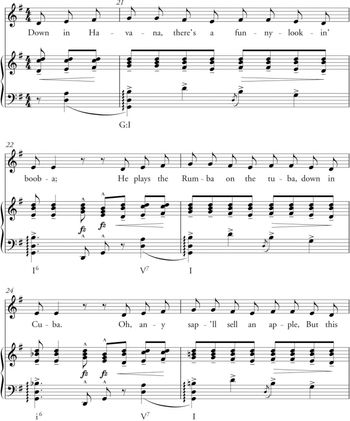
The notated music of ‘When Yuba Plays’, at least in the original sheet-music form, bears few markers of the sound that would come to be associated with commercial rumba.Footnote 38 Because the original sheet music is only a piano score, the sorts of Cuban instruments, such as bongo, clave or tres, which could be present in a more fully orchestrated performance, are unmarked. It has no clear instance of rumba or son rhythms, except for a pattern that shows up in the left hand during the refrain that gestures towards a tresillo rhythm (see Example 1, bars 22 and 24). Rather than the son pregón form of ‘El Manisero’, ‘When Yuba Plays’ has a typical Tin Pan Alley structure of an opening verse and then a repeated AABA refrain. Yet it does also have non-standard musical elements. Its AABA refrain deviates from the standard 32 bars of four eight-bar sections consisting of balanced phrases. The A sections are twelve bars long, rather than eight, and the phrases begin early enough in the preceding bar with three strongly accented notes that the melody rhythm could be heard as having a ‘Latinesque’ flair if the listener were as inexperienced with the new global genre as most international consumers would have been. The verse, which details Yuba's lazy incompetence, is in G minor, and the refrain, which details Yuba's dominance in Cuba, modulates into the parallel G major, a triumphant arrival at the primary structural interest point of the song emphasizing American triumphalism. There are light plays of modal mixture as the song alternates between I–I6–V7–I and I–i6–V7–I, and the fleeting presence of the G minor gives the song exotic colour, yet without seriously challenging the stability of the G major tonic (see Example 1).Footnote 39
‘When Yuba Plays the Rumba on the Tuba’. Refrain, A section.

It is also notable that ‘When Yuba Plays’ tends to eschew pre-dominant chords, consisting primarily of tonic and dominant with some added sixth degrees and some secondary dominants to spice up the song. When the song finally lands on the subdominant, it is at the B section of the refrain amidst syncopations in the piano left hand and a soaring high melody praising Yuba's skills, experience and overall tuba excellence. The B section briefly brings back modal mixture, generating musical tension and contrast before driving back to the A section and the end of the song. Hupfeld uses humorous lyrics, rhythmic drive, light syncopation and touches of modal mixture to construct a song that evokes ‘El Manisero’ and then steamrolls over it both sonically and metaphorically. In the fantasy of ‘When Yuba Plays’, ‘El Manisero’ no longer comes to the USA in the form of, for example, Azpiazú; rather, the USA comes to Cuba and contains and then integrates just enough of it to demonstrate mastery and control without seeming as if it were changed too much by it in return. ‘When Yuba Plays’ uses mockery and identification against Cuban Others to defuse the threat of the increasing popularity and influence of Cuban music and people in the United States while simultaneously working to reframe the musical relationship between the USA and Cuba to one of inherent US superiority and dominance.
When it travelled to Germany, the possible meanings and implications of ‘When Yuba Plays’ changed dramatically. In 1932, shortly after its 1931 première on Broadway and the release of popular American recordings by Vallee and the Revellers, Rotter, a regular collaborator with the Comedian Harmonists, crafted German lyrics, turning slacker Yuba into respectable Uncle Bumba, Cuba into Kalumba and the song into a story not of the triumph of a tourist, but of the rising obsession of a country with the rumba. To read this song as being simply about a hegemonic Self exoticizing and thereby controlling an Other illuminates nothing new. While it certainly could function that way for some groups, if we recognize the diversity of subjects within Germany, including those not granted Self status within hegemony, then a greater diversity of interpretation becomes available. Frölicher asks why ‘the uniquely German singer has an uncle, in other words a relative, in Kalumba’. The only explanation he offers is that ‘rumba-fever was rampant in Germany at the time, as demonstrated alone by the fact that the “Comedian Harmonists” sang in German, in other words, for a German audience’.Footnote 40 I think Frölicher's question can be taken further. If this song is read from the position of internal Others using transference of stigma to speak not about an exotic Other but about themselves, then what new things can this tale of the rumba craze tell us about Germany in 1932 and the members of Asphalt Culture's relationship to it? In making the transfer across the ocean, from a Broadway Tin Pan Alley song to a Berlin Schlager, ‘Der Onkel Bumba’ changed, I argue, from an example of Self/Other colonial domination to an example of Other/Other transference of stigma used as a cover for political commentary on the moment that was the volatile third phase of the Weimar Republic. The German song and its performance history also show a rupture among members of Asphalt Culture regarding how to address that moment: aspirational articulation of utopian countercultural resistance or critical illumination of a rising dystopian menace. My analysis begins with a utopian reading through the Comedian Harmonists’ performance before turning to more dystopic anxieties lurking in the text.
Although the sheet music stayed the same, in the transfer from English to German, Rotter's new German lyrics radically transformed the song. First, and most strikingly, the scene is shifted from Cuba to a mysterious place located ‘somewhere’ named Kalumba. The lyrical I of ‘When Yuba Plays’ is a friend who relates the story of Yuba's triumph in Cuba, where the rumba craze remains safely distanced and contained, though still available to sample, like a taste of rum. Things are different in ‘Der Onkel Bumba’. The eponymous Uncle Bumba, who is from Kalumba rather than a tourist there, is the German lyrical I's family, rather than a friend. In ‘Der Onkel Bumba’ the rumba is not a resource sitting in a protectorate to be harvested; rather, it is a force overtaking a nation. Instead of being the triumphant American tourist going somewhere else for a thrill, Bumba is one of the many Kalumbans who have become possessed by the rising rumba within their homeland. In the Rotter lyrics, Bumba is a bearded, respected scholar and patriarch who abandons propriety as well as his wife and family in favour of dancing rumba all hours of the night. Recall the 1921 Weltbühne quotation about jazz, praising its ability to ‘promote humanity, kindness, and humor and to destroy “stupidity, haughtiness, and dignity”’, pointing out specifically that ‘“The German high-school teacher cannot dance it. The Prussian reserve officer cannot dance it. […] If only the Kaiser had danced jazz – then all of that never would have come to pass!”’Footnote 41 Amplified in the Comedian Harmonists’ performance by the bass Biberti putting on a rustic Bavarian dialect for the word ‘beard’, Uncle Bumba is presented as precisely the starched-collared type to which Asphalt Culture placed themselves in opposition but which they thought jazz might help cure. And in this song, the teacher, the public officials and all of the rest of the anti-cosmopolitans of Kalumba/Germany can and do dance to jazz/rumba. They have all dropped their dignity and haughtiness and have given themselves over to jazz. ‘Der Onkel Bumba’, as the Comedian Harmonists recorded it, details the utopian triumph of jazz over that older generation and the metamorphosis of Kalumban society that Siemsen rhapsodized about in Weltbühne. Kalumba, as a stand-in for Germany, embraced the prescription of jazz as a progressive transformational force.Footnote 42 Additionally, by recording what would then become a huge hit in Germany, the Comedian Harmonists deliver the prescription in reality that they sing about on record. However, a positive reading of ‘Der Onkel Bumba’, much like a positive reading of Germany in 1932, is not so easily done, and so, in order to push the song towards a Siemsen-like utopian signification, the Comedian Harmonists had to make some important changes in performance.
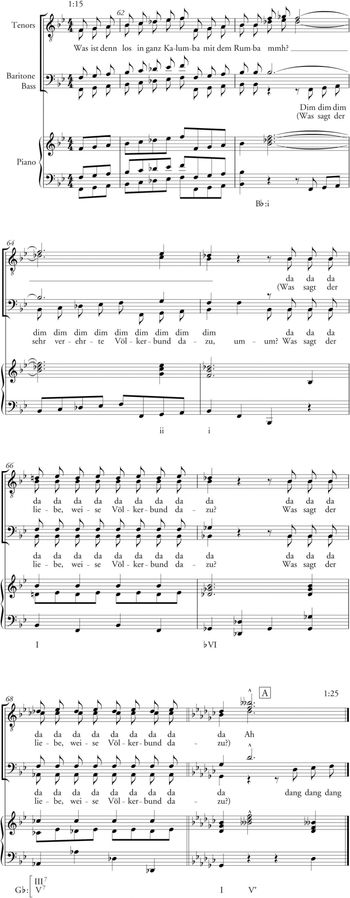
The Comedian Harmonists perform their version of the song at a rapid-fire tempo with more syncopation in the bass vocal line than the sheet music shows, resulting in a more virtuosic and dazzling vocal performance. Their recording is exuberant and joyous, their arrangement injected with humorous filigree. The Comedian Harmonists’ version begins in B♭ minor for the verse and then, mirroring the sheet music's harmonic shift to the parallel major, shifts to B♭ major for the first refrain. Then the Comedian Harmonists make their biggest changes. They insert a five-bar bridge leading into the second refrain, which allows them to modulate into the ♭VI tonal region of G♭ major (see Example 2). In nineteenth-century German art music, especially the works of Schubert, transitory modulation to ♭VI tonal regions often signified a sojourn into a world of dreams.Footnote 43 The Comedian Harmonists were well versed in the works of nineteenth-century art-music composers as a result of their time studying at conservatorires (Leschnikoff, Bootz and Collin) or singing in opera houses or the Großes Schauspielhaus (Leschnikoff, Cycowski and Biberti). Alongside jazz tunes, like those of Duke Ellington (‘Creole Love Call’), the Comedian Harmonists also performed and recorded art-music pieces (sometimes jazzed up) by composers including Schubert, whose Der Lindenbaum, no. 3 of Six moments musicaux, D.780 (released as ‘Moments Musical’), and Heidenröslein were in their repertoire, Rossini (Barber of Seville overture), Johann Strauss II (Perpetuum mobile) and Brahms (Sandmännchen). While the harmonic move connects the song to the German musical tradition in which they were trained, the Comedian Harmonists emphasize the connection of their version of ‘Der Onkel Bumba’ to jazz and the utopian and egalitarian possibilities associated with that genre by transforming the second refrain into a wordless jazz vocal instrumental section marked by intricate interplay between the voices and the mimicking of muted trumpets in swung rhythm. Most significantly, unlike the temporary nature of the majority of nineteenth-century appearances of the ♭VI, the Comedian Harmonists never modulate back out of the ♭VI region to return home. When they enter their new utopian ‘Kalumba’, they stay there and end the song in their new harmonic home. Their jazz instrumental ending offers the possibility not only that there can be solidarity between the various stigmatized identities under the banner of the modern youth, but also that the spirit of Asphalt Culture would be able to transform the whole country in a lasting way. Not only are the Comedian Harmonists giving a glimpse of another, better world in their arrangement of this song, they – a mixed group of young people harmonizing within the jazz penumbra – are also manifesting it as they sing it on stage. For the Comedian Harmonists, the Jewish and Gentile members were unified through the ideology of jazz and their performance of this unity. They also model Asphalt Culture's ideology of egalitarianism by showing a working model of the beauty, harmoniousness and desirability of Jewish and non-Jewish collaborations and relations, both personal and professional. The viability of this ideal is modelled by the virtuosic sonics of their performances as their voices intertwine in complicated syncopated lines and the lead is shared among the members, emphasizing the ease and harmoniousness of the union of Jewish and non-Jewish voices through jazz.
‘Der Onkel Bumba aus Kalumba tanzt nur Rumba’, Comedian Harmonists. Transition between refrains with missing Rotter lyric in parentheses.

This production of a sonic utopia was neither accidental nor apolitical. Their arrangement was purposefully crafted by Frommermann and Bootz; the rapidity and intricacy of their performance took effort and demanding rehearsals; and the use of jazz in Germany was always already an entry into politics, signifying democratic and cosmopolitan values perceived by National Socialists as a direct threat to the imagined community the rising Nazi party wanted to create. The historian Corey Ross argued that one of the Nazi goals was to create an imaginary community more encompassing than and in opposition to the one Asphalt Culture was creating, though he notes: ‘Ironically, the road to Nazi mass culture was paved in large part by the very “asphalt culture” of Hollywood-style films and jazz-inspired hit songs that the movement had so noisily railed against before 1933.’Footnote 44 In 1932, when ‘Der Onkel Bumba’ was released, the struggle for media dominance that Ross describes was under way, but not yet over. While the Comedian Harmonists and their compatriots were enacting and making desirable asphalt values through jazz, the Nazis were moving to counteract them.
In 1930, Dr Wilhelm Frick, a close associate of Adolf Hitler, was appointed Minister of the Interior in Thüringen. Michael Kater explained that Frick
lost no time in promulgating, on 5 April, a formal ordinance against ‘Negro culture, for German folkdom’, because ‘jazz band and drum music, Negro dances, Negro songs, Negro plays’ constituted a ‘glorification of Negrodom and flew in the face of the German sense of culture’. Therefore, until 1 April 1931, when this Nazi government was toppled, it was forbidden to conduct jazz or jazzlike performances in Thuringia in public. This partial success so encouraged right-wingers all over Germany that a veritable flood of spiteful literature issued against jazz music and musicians, in a period when the Nazis were in fact making impressive headway in elections at national and regional levels.Footnote 45
In this context, as attacks against their imagined community and its very real members increased, it became more and more difficult and took more and more effort for the Comedian Harmonists to continue to present the unified front of jazz utopia. Biberti noted that in late 1932, shortly after they had recorded ‘Der Onkel Bumba’, the ensemble started having trouble; for example, radio stations that had engaged them before started refusing to book them for performances.Footnote 46 Their access to the airwaves began to be limited, and with it their ability to shape community. Despite these developments, the group did not want to leave Germany. They were still convinced that the power of jazz music would prevail, that the old ideology would fall before the new, and that there could be a harmonious coexistence for Jews and Gentiles in Asphalt Culture under the banner of jazz, just as there was in the band itself. By continuing to perform ‘Der Onkel Bumba’ and songs like it, the Comedian Harmonists continued to function as a very popular and visible vector for the cosmopolitan imagined community.
Yet, even within their utopian version of ‘Der Onkel Bumba’, there are seeds of doubt and dystopia. Within the added bridge that allowed them to modulate into their utopian resistant space, there are the shadows of a sentiment very different from the hopefulness of jazz triumphant. Susan McClary pointed out that the long-standing associations of the ♭VI modulation with dreams could be either positive or negative: ‘The flat-six modulation creates a sudden, dramatic shift into what is perceived as an alien region: a realm of fantasy, illusion, nostalgia, unreason, or the sublime, depending on the semiotic context.’Footnote 47 The ♭VI into which the Comedian Harmonists draw the listener could be the horror of unreason just as easily as it could be the sublimity of jazz utopia. Through their performance of the song, the Comedian Harmonists tried to make Rotter's ‘Der Onkel Bumba’ represent a Germany far more positive than the one that was around them was becoming. In order to do that, however, they had to erase one very important lyric that Rotter wrote, a lyric that offers a view into Asphalt Cultural anxiety about the Germany of 1932.
While the Comedian Harmonists were relatively insulated from day-to-day anti-Semitism owing to their fame, many of their colleagues, including Rotter, were not. Rotter and his brother, Alfred, were among Berlin's most successful theatre entrepreneurs. By 1927, they owned many of Berlin's greatest theatres, including the Metropol, the Residenz, the Trianon, the Zentral, the Kleine and the Lessing theatres and the Theater des Westens. Their success prompted vicious anti-Semitic backlash, and they dealt with daily attacks against them in the right-wing press. Starting around 1931, the Rotter brothers became primary targets for Nazi invectives. To quote Marline Otte:
Just like other Jewish entertainment businesses, and maybe even more so, they had become a prime target of the National Socialist movement's unprecedented campaign to make significant inroads in Germany's cultural sphere. Shortly before the Nazis seized power, the National Socialist press launched an offensive with the aim of felling a wounded giant. No day could pass without the Rotter brothers and their latest ‘crime’ making headline news. Nazi agents violently discouraged potential visitors to the Rotter theatres, whose owners they increasingly painted as corrupt and low characters. In addition, they physically threatened the two brothers and their families, who rightly began to fear for their lives in the tumultuous final year of the republic.Footnote 48
It was within that politicized environment, amidst increasing Nazi protests and threats to his life, that Rotter wrote the German lyrics to ‘Der Onkel Bumba aus Kalumba tanzt nur Rumba’. Rotter's ironic line that opens verse 2 – ‘Die Politik ist ganz vergessen in Kalumba’ – would have made it difficult for listeners not to connect the song with the political situation of the time. However, the strongest connection between the lyrics of this rumba song and German politics was a line that never made it into the version the Comedian Harmonists recorded. The last line of the refrain written by Rotter after describing the increasing hold the rumba had on the Kalumbans was: ‘Was sagt der sehr verehrte Völkerbund dazu?’ (‘What does the very honourable League of Nations have to say about this?’). This line challenged the Comedian Harmonists’ performance of the rumba as signifying the new modernity triumphing over old ways of thinking and cast it instead as the rising unreason of Nazism overtaking Germany. According to the Comedian Harmonists’ sketches for their arrangement of ‘Der Onkel Bumba’, they should have ended the first refrain with Rotter's line, then amplified the sentiment by repeating it two more times in the five-bar bridge they added to modulate into their ♭VI fantasia. However, when it came time for the Comedian Harmonists to record, the words were cut and replaced with nonsense syllables (see again Example 2).Footnote 49 This cut line represents the core conundrum for members of Asphalt Culture in the uncertainty of 1932, because it is this line that shifts the song from utopia to dystopia and from modelling the possibility of a better future to critiquing an increasingly disturbing present. The ways in which other artists who sang ‘Der Onkel Bumba’ dealt with this line make more apparent the fissures within Asphalt Culture and what would become fissures within the Comedian Harmonists.
Leo Monosson, an extremely popular German Jewish singer of the Weimar era, chose in his 1932 recording to change Rotter's challenging lyric to ‘Was sagt die sehr verehrte Grossmama dazu?’Footnote 50 In Monosson's version, he commits completely to Asphalt youth utopian resistance, emphasizing the critique of the old generation and de-emphasizing that of rising Nazism. He overwrites the plea to the League of Nations with a jab at ‘Grandmother’. The Melody Gents, another jazz vocal group not unlike the Comedian Harmonists and led by the German Jewish pianist and arranger Rudolph Goehr, by contrast, in their 1932 version sang the lyric exactly as written, keeping the dystopic critique more explicit.Footnote 51 If one places values primarily with overt textual references, then the Monosson version of ‘Der Onkel Bumba’ might rank as the least favourable (with its ‘Grossmama’ line), the Melody Gents version as the most (with the explicit ‘League of Nations’ line) and the Comedian Harmonists version somewhere in the middle. Monosson's and the Comedian Harmonists’ versions, by dropping or altering the Rotter line, can be read as attempting to avoid politics and as being less brave than the Rotter original or the Melody Gents’ recording. Rotter was certainly brave to write those lyrics, especially considering the danger and scrutiny he was under. However, viewing only the utterance of the explicit text as political overlooks not only the politicized nature of performing jazz regardless of its lyrical content, but also the way in which performance context colours the line or its absence.
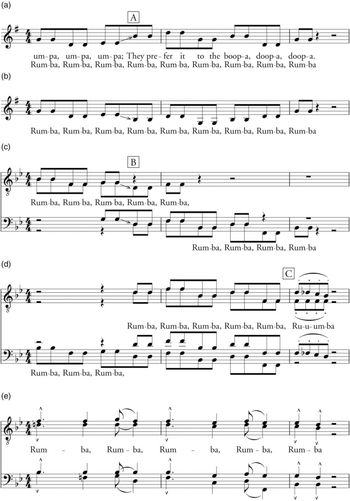
Monosson performed his version with backing by the jazz band Orchester Lajos Barany. Considering that he replaced the ‘League of Nations’ with a ‘Grossmama’, one might imagine that his version would be full of utopian fantasy or political soft-pedalling. Yet in some ways his is the harshest of all three. Monosson follows the general shape of the melody, but sings the song in a clipped, staccato way without the vocal lightness of Vallee, the Melody Gents or the Comedian Harmonists. He sustains notes only in the B section of the refrain and performs the rest of the song in that liminal space between speaking and singing. The song is taken at 160 bpm (faster than the Melody Gents), removing any sense of relaxedness, but slower than the Comedian Harmonists, removing any sense of anticipatory excitement. A heavy accompaniment dominated by low instruments makes the song feel plodding, more like marching than dancing, and the tuba doubling Monosson's voice only adds to the heaviness. When Monosson sings the focal dominant–tonic phrase which ends the A section of the refrain – ‘rumba, rumba, rumba, rumba, rumba, rumba, rumba, rumba, rumba’ (see Example 3a; in English, ‘um-pa, um-pa, um-pa; They prefer it to the boop-a, doop-a, doop-a’) – he changes the original melody, making the first half of the phrase pull downward and the second half push aggressively upward (see Example 3b). Monosson sings it in a rushed fashion and mechanically, often going flat and increasing in volume, making the repeated ‘rumbas’ seem disorientating, a bit menacing and slightly out of control. Monosson finishes the song by practically spitting out the line ‘Was sagt die sehr verehrte Grossmama dazu?’ He sings that line slower and louder, in his darkest timbre, with the full power of the brass behind him, emphasizing each syllable, giving an aggressive performance out of proportion to the lighter lyrics. Monosson does not critique the Nazis textually, but neither does he provide a breezy utopian escape. Instead, he delivers a simmering, confrontational aural challenge of something attached to plausible lyrical deniability.
‘Um-pa’/‘Rumba’ melodic line in (a) the sheet music for ‘When Yuba Plays’ and (beneath) the Melody Gents’ performance of ‘Der Onkel Bumba’; (b) Leo Monosson's version of ‘Der Onkel Bumba’ and (c–e) the Comedian Harmonists’ performance of the same song.

The Melody Gents kept the ‘League of Nations’ lyric and so also kept explicit Rotter's textual critique. In the political context, it was extremely courageous of them to do so. However, they also followed the harmonic and melodic contours of the original sheet music, hewing exactly to the written melody of the ‘rumba’ phrase (see again Example 3a). The original melodic contour, with its leaps up and down, gives the phrase a humorous quality, and keeping that contour adds to the general whimsical quality of their smoother performance, softening the bite of Rotter's critique. Also undercutting the urgency of Rotter's critique is the relaxed tempo at which the Melody Gents take the song – approximately 148 bpm, close to the original sheet music's ‘tiempo de rumba’ of 144 bpm, giving them ample room to create a luxurious sonic space. Despite being the most aggressive lyrically, it is the least aggressive sonically. Unlike the Comedian Harmonists, the Melody Gents remain in the parallel major, offering no alternative aural space (utopian or dystopian) to comment on the present reality, and in contrast to the Monosson version there is very little in the vocal delivery that is challenging or disturbing. The Melody Gents sing Rotter's line, but without any musical or performance choices to support the line as part of a pointed critique. Indeed, the challenging lyric, sung only once, is buried somewhat by suddenly poor diction and the louder entrance of background instruments. The lyrical critique is sung, but the aural performance pulls back from it, giving a different kind of plausible deniability.
The Comedian Harmonists manoeuvre between the Melody Gents’ and Monosson's performances, neither singing the words explicitly nor replacing Rotter's lyric with a line about a Grandmother. They replaced the Rotter line with wordless syllables, exposed within the texture, sung the first time by the strong bass voice of Biberti and then joined by the rest of the ensemble. They did not sing the words, but they still sang the line, and if an audience member had heard the Melody Gents’ version, which was released in March, three months before the Comedian Harmonists’, or had purchased the sheet music, they would know exactly which words Biberti's vocables were replacing. The presence of the Melody Gents’ version in the airwaves of late Weimar, with Rotter's words intact, allowed for the Comedian Harmonists to cut the words without necessarily losing the meaning. In a musical version of identifying through, audiences so inclined could listen to the vocables and still hear Rotter's excised lyrics. This would be the same reception process that occurred when audiences of the cabarettist Claire Waldoff would ‘hear’ the anti-Hermann Göring lyrics widely attributed to Waldoff overlaid onto the original ‘innocent’ lyrics of her signature song, ‘Hermann’.Footnote 52 Replacing Rotter's provocative words with vocables would not necessarily erase the presence of those words in the audience's memory or the critique that Rotter wrote into them, but rather evoke them. This is especially true in view of the ambivalence built into the Comedian Harmonists’ performance.
The Comedian Harmonists’ opening of the song, ‘Mein Onkel Bumba, ohne Sorgen, frisch und froh’, sung in the minor mode at the rapid, staccato 198 bpm clip, comes off anxiously, making it hard to believe that Bumba actually is carefree, fresh and happy. From these opening performance gestures, the Comedian Harmonists continue to include minor musical options that undercut the idyllic nature of what is presented. For example, while the Melody Gents keep the original, jumpy melodic contour for the ‘rumba’ passage, the Comedian Harmonists drag it downward. They retain some upward leaps, but emphasize an overall downward trajectory. In the Comedian Harmonists’ first performance of the ‘rumba’ phrase (see Example 3c) the downward creep occurs by means of a drop at B (replacing the upward leap at A in the sheet music; cf. Example 3a), as well as a downward flow of the ‘rumbas’ through the voices from first tenor to bass. The second time the phrase occurs, they add a downward chromatic descent at the end of the phrase (at C; see Example 3d). The third and last time they sing the ‘rumba’ phrase it pulls relentessly downward (see Example 3e); the upward leaps are gone. While the lightness of their voices and the syncopated rhythmic drive keep these passages from the darkness of Monosson's version, the speed with which they sing ‘rumba’ nine times imbues the line with a mania that could be just as easily anxiety as excitement. These points of anxiety build as the song progresses, until Rotter's lurking dystopia threatens to erupt in the ♭VI refrain.
While the original sheet music has only hints of minor within the major refrain, the Comedian Harmonists highlight and expand the emphasis on the minor in their ♭VI version. In what corresponds to the B section of the refrain, they linger heavily on G♭ minor, darkening the piece and troubling the utopia they set up for themselves. They also regularly disrupt the flow of the wordless space with abrupt forte block chords, often minor, augmented or otherwise jarring, that break into the music disorientatingly off the strong beats (see Example 2, at A). The Comedian Harmonists’ performance of the song generally forces a hopeful tone, just as the group themselves steadfastly maintained the jazz utopian values of Asphalt Culture, despite something disturbing lurking below the surface of the jazz dream. Biberti reported: ‘We did not take the Nazis seriously, like so many. We talked about all that was happening, all of the bullying and insults on the road, but we brushed it off, because we believed that we would be able stay out of these events as a well-known group for whom foreign countries were also open.’Footnote 53 This may explain why the group ultimately chose to excise Rotter's critical lyric despite making expanded space for it in their arrangement. The group had not given up on jazz ideals and the viability of their oppositional imagined community. Of course, the Comedian Harmonists, as a mixed group, may also have been ambivalent about including so overt a critique in an increasingly dangerous environment. However, cutting Rotter's lyric would not erase the Comedian Harmonists’ hypervisibility as a group of mixed Jewish and non-Jewish musicians harmonizing together to the syncopated sounds of cosmopolitan jazz and all the politics that went with that.
The next year, in 1933, Hitler came to power and most of the Comedian Harmonists’ colleagues left the country. Monosson, the Jewish members of the Melody Gents and the Rotter brothers fled Germany as soon as Hitler became chancellor. The Rotters, who had been such regular Nazi targets before the Machtergreifung, did not escape unscathed: Fritz survived in exile, but his brother and sister-in-law were killed after being forced off the road by pursuing Nazi forces during their attempt to flee the country.Footnote 54 When Goebbels announced that all musicians had to register as members of the newly formed Reichsmusikkammer (with the implication that Jews would not be allowed in), even more of Berlin's Jewish entertainment luminaries left. The Comedian Harmonists, however, persevered. They still believed that their staggering popularity and the mixed nature of the band's makeup would make them an exception. It seemed they were not wrong, at least for a while. They applied for membership of the Reichsmusikkammer and waited. As they waited, they continued to perform for 15 months after other Jewish entertainers had been banned, even at one point with special permission from the Reichsmusikkammer itself. They were still performing to packed houses, and members of the band felt it was better to stay and keep performing than to leave. As Biberti explained:
We had had thoughts of a possible emigration since the end of 1933 – from the time we experienced our first difficulties on tour. But despite all the arrogance and bullying of the Nazis, we were still not too nervous even in 1934, because we, like so many at the time, thought two or three months and it's over. But at some point we all realized that the whole thing would take longer.
Of course we had the intention of staying together. In addition we believed, because we brought in foreign currency to Germany, that they would allow us to keep working for a long time. Frommermann, Collin and Cycowski were at that time the only Jewish artists in Germany who were still allowed to work, albeit not in the country itself. This meant that we could go on recording records as freely as before, there were not the tiniest of restrictions. We just believed we'd make it through.Footnote 55
For the moment they would remain united through their shared stigma of bohemian countercultural membership, and by continuing to record jazz as a mixed, cosmopolitan group they helped keep Asphalt Culture alive and continued to offer a resistant version of what Germany could look and sound like.
Despite increasing government condemnation and stigmatization, the Comedian Harmonists remained very popular, even after the Machtergreifung, something Biberti attributed to the political power of the resistant utopian space they created:
I must say that these concerts were oversubscribed in the year 1933. Even in the remotest spot the public knew who we were and could be sure that it wouldn't have to listen to propaganda or Nazi ideas from us. Our song repertory was not suitable to follow all the trends of suddenly demanding inclinations, and our little performances naturally even less so. That was clear to the people. They could sit down and amuse themselves and let two hours pass nicely. Thus it became nearly a protest action to come to our concerts, because we were the only ones in the German music heavens who could afford to abandon the whole national ballyhoo. The people knew that, and felt that with us they were far from all politics, as it were.Footnote 56
Biberti articulated a position where being ‘far from politics’ became a political act of protest against Nazi values. The Comedian Harmonists held on to the idea that ‘Die Politik it ganz vergessen in Kalumba’ could be subversive. This was not lost on the Nazis. Polemics against the band increased, including the charge that the jazz they and others performed was the political weapon of Jews against the German state rather than the expression of a new Germanness. The Comedian Harmonists’ hope of remaining together looked increasingly untenable as tensions began to pull the band apart. As the possibility of remaining together began to look less feasible, so too did the cosmopolitan Asphalt Culture that they had been keeping alive not only for themselves, but also for their audience members. Audience members who had used the Comedian Harmonists and others like them as an articulation of their imagined community now had to listen to official announcements by a Nazi official before each concert warning that the music they were about to hear was condemned by the German state.Footnote 57 ‘Der Onkel Bumba’ became more the story of Rotter's excised words and less the story of the Comedian Harmonists’ ambivalent but hopeful performance of it.
Dissolution: the limits of stigma transference
Asphalt Culture, though partially composed of people with non-voluntary stigmata such as gender and religion, was framed as a combination of a voluntary stigma (bohemianism) and a transitory stigma (youth). With the transition from Weimar Republic to Nazi Germany the values that unified Asphalt Culture began to diminish: people were no longer so young, the Weimar Republic's democracy no longer existed, a retrenchment of conservative gender politics chipped away at the New Women's and New Men's ability to actualize their gender role identities, and bans on jazz music and other ‘degenerate’ media limited the nourishment and maintenance of Asphalt Culture as a large imagined community with national influence. As the unifying stigmata receded, the dividing stigmata, like Jewishness or homosexuality, were pushed more to the forefront by the new regime, fragmenting the culture. Just as the individual celebrities formed and were formed by their imagined community, so too the growing fissures in that community began to manifest themselves within the Comedian Harmonists.
In April 1934, a lawyer was brought in to mediate a conflict that had arisen between the members of the band. The contract that defined the group as a business named all of the members as equal partners. With the Machtergreifung (when the National Socialists came to power), the Comedian Harmonists were banned from appearing in UFA films and lost radio bookings; and in May 1934 they lost permission to perform inside Germany. All this was a devastating blow to their income, and they attributed it to the fact that half the membership was Jewish. The non-Jewish members of the group (Biberti, Bootz and Leschnikoff), represented by Biberti, felt it was unfair that they should all suffer equally a loss caused by the stigma of the Jewish members alone. Biberti argued that the non-Jewish members should be given a larger share of the dwindling income to make up for the losses. The Jewish members (Frommermann, Collin and Cycowski), led by Collin, argued that the two halves were inextricably linked and that everything should be equally shared, as it had always been, good and ill. The arbitrator agreed with Collin.Footnote 58 Stigma was still in the process of being transferred, but it became clear that the non-Jewish members were becoming increasingly uncomfortable with that process. A distancing from the romance of voluntary social deviation and the accompanying critique of hegemonic systems was emerging in the Gentile half of the group as the negative consequence of continued maintenance of Asphalt Culture within the Third Reich became more dire.
In this extended quotation, the baritone Cycowski's recollection of one of the Comedian Harmonists’ last concerts within Germany points towards the end of Asphalt Culture and one of the groups that represented it:
We had one of our last concerts in Stuttgart; we had already been warned of incidents. We sang in the sold-out concert hall, in front of almost a thousand people. And completely up front sat the elite of the SA and the SS […]. At first everything went well. Shortly before the break – we were singing
a shrill whistle sounded from the balcony. We broke off in the middle of the song and Biberti whispered to us: ‘Calm! – Remain calm! Don't get excited!’ – Everywhere the people, some of them very furious, rose and insulted the troublemaker. In front, in the first row, the SA and SS leaders turned around a little unpleasantly and saw how a group of listeners, also in the balcony, pounced on a young man with a whistle in his hand. A young man, stupid and deluded, to whom someone had said: What the Comedian Harmonists do up there is bad for the folk, and so on. The people attacked this guy and from the stage it seemed as if they wanted, in their indignation, to throw him down off the balcony. Luckily that did not happen, because that incident would have certainly been enough to have us arrested for ‘disorderly conduct’.
Ushers led the young man out, the Nazi leaders in the first row turned towards us again, applauded us demonstratively and we sang on:
That Cycowski's recollection of the end of the ensemble revolves around ‘Der Onkel Bumba’ is telling. In that moment, standing before a full house of frustrated fans, antagonistic rowdies and elite Nazi leadership, months before the Jewish members would have to flee the country, the ideal of a modern cosmopolitan Germany united in jazz became impossible. ‘Der Onkel Bumba's’ rumba craze could now only be the dystopia of which Rotter, who had now fled, had warned. The lyric that the Comedian Harmonists had once voluntarily cut because they would conflict with the Germany to which they aspired soon could not be said at all. By the time the Comedian Harmonists might have wanted to put the lyric back, it was too late. However, Rotter's silenced text always remained lurking within the wordless melody of the Comedian Harmonists’ version. While they may not have been able to say the lines any more, the meaning was clear without them. Asking what was wrong with Kalumba as audience members got into a physical altercation with a Nazi thug during the concert of an ensemble who had once all been German but now were a ‘mixed-race’ group performing music proclaimed before each show by a Nazi Party official to be bad for the Volk was more than enough. Additionally, it was not just the cut lyric which signified that the song was tipped towards articulating anxiety in relation to rising Nazism, it was also the genre of the rumba itself. Far from just being an exoticized genre, the rumba as part of the jazz penumbra was always already political. Also, the rumba, separate from jazz, was beginning to be used to carry a more specific signification of rising fascism in some circles, especially those jazz-orientated cabaret circles of which Rotter and the Comedian Harmonists were a part.Footnote 60
Under the Nazi regime, remaining members of Asphalt Culture could still try to identify through the jazz penumbra, but now the consequences of doing so were violence and state-sponsored disenfranchisement. Soon many of those that could opt out of voluntary stigma started doing so. Troublingly, as the incident with the arbitrator initiated by Biberti showed, when these members of Asphalt Culture who could join the majority decided to do so, too often they tried to achieve this by identifying against their Jewish comrades. Other/Other solidarity turned into Self/Other distancing. In 1935, Goebbels passed down an edict stating: ‘There is no place for jazz, jimmy, slow fox, rumba and other negro dances on German radio. They will be replaced by German round dances and line dances.’Footnote 61 In February of that year, the Comedian Harmonists finally received a letter from the Reichsmusikkammer officially banning the group not only from performing on stage together, but also from even rehearsing together. The Nazi regime banned not only Asphalt Culture's music, but also its musicking. The Jewish members of the group tried to convince the non-Jewish members to come with them to Vienna, Paris or America, but Biberti would not leave his ageing mother, his apartment and the successful life he had built in Berlin. The other non-Jewish members followed Biberti's lead, and the Comedian Harmonists dissolved as the three Jewish members were forced to flee Germany alone. The unity of cosmopolitan youth was pulled apart and the harmony that they symbolized as a mixed ensemble was over. Identifying through became identifying against, and the ♭VI went from utopia to horror. Asphalt Culture was functionally dead as a movement that could contest the Nazis’ construction of an imagined national community. The two halves of the sundered Comedian Harmonists reformed into new groups that tried to continue as before. The Jewish exiles reformed as the Comedy Harmonists starting in Vienna before moving to Paris, and the non-Jewish members reformed as part of the Meistersextett in Berlin.
The Comedy Harmonists, while in Paris, found some success in the expatriate/exile community, which consisted not only of expatriate African American jazz musicians, but also of exiles from National Socialist lands, including Germany and German-occupied territories such as Austria and the Sudetenland. In 1935, shortly after arriving in Paris, they recorded the Cuban composer Eliseo Grenet's rousing rumba ‘Espabilate’ with Josephine Baker.Footnote 62 Sung in Spanish, the song is taken at a jaunty clip and bears multiple markers of ‘Latinness’, including prevalent syncopations and constant maraca percussion. For the Comedy Harmonists, the rumba stopped being a way for them to identify through Latinness or jazz with a cosmopolitan Germanness that included Jewishness and valued democracy. Instead, it became a way for them to identify against a new and different stigma they carried, the very Germanness the Nazis denied them. Just as blackface minstrels, in Rogin's view, worked to identify against in order to assimilate, the Comedy Harmonists attempted to use their performances of the rumba/jazz to identify against their Germanness and to become assimilated into non-German Allied culture. It was a strategy that ultimately proved ineffective. It just so happened that while the Comedy Harmonists were passing through the USA on tour, President Roosevelt ordered all passenger boats to stay in port, leaving the group and many others stranded. They tried to continue performing, but as the war heated up, the American public grew cold. Frommermann recalled:
With the horribleness of the war, dislike grew for everything in America that was German. German goods were boycotted, remained lying rusting in the ports’ warehouses, and even we emigrants, who had so far supported the Americans, became more and more unpopular. Naturally we six were forced to sing only in English. And it was a terrible English, with a heavy German accent that would not be suppressed, an accent which, before the war, the public had found particularly charming. Now however, we were sung into the dust by artistically less cultivated groups.Footnote 63
The tradition of identifying against described by Rogin and Said is typically a form of creating a white Western Self, but affirming their whiteness was not the Jewish members of the Comedy Harmonists’ problem. What they needed was to lose their now stigmatized German identity, but no amount of rumba or jazz on the part of the German Jewish exiles could make American audiences accept them as anything other than German.
The Meistersextett tried to continue their career in Berlin, following demands to purge anything too jazzy, too Jewish and too degenerate, including their ‘un-German’ former name, ‘Comedian Harmonists’. They continued to feature music at the edges of the jazz penumbra despite Goebbels's prohibitions, though they toned down elements that would threaten too greatly their insecure Self status.Footnote 64 Whereas the Comedy Harmonists’ 1935 ‘Espabilate’ featured prominent and jangly maracas and a heavily emphasized Latin rhythm in the piano and vocals, the Meistersextett's 1938 recording of the Cuban composer Joseph Calle's ‘Amapola’ tried to walk the line of indicating ‘Latinness’ in order to evoke the old Weimar sound that had made them popular while not making that sound obvious enough to draw the wrath of the Nazis.Footnote 65 Their version of ‘Amapola’ had a maraca, but it was soft, and buried low in the mix. While they had light Latin rhythms in the piano and some vocal syncopation, the overriding vocal style was a smooth bel canto with the supporting voices often singing long notes that obscured the rumba rhythm in the background. The commercial rumba was still there, evoking the use of transference of stigma to create the old Asphalt Culture, but without the solidarity or the actual transference. Old Weimar as rumba was buried under non-threatening sentimentality like a nostalgic echo of a time past, something that hooks identifies as the ‘nostalgic evocation of a “glorious” past’ which is linked to ‘white western conceptions of the dark Other, not to a radical questioning of those representations’.Footnote 66 Since the core Asphalt Culture depended upon cosmopolitanism and a coalition of the stigmatized, the all-‘Aryan’ ensemble – no longer bohemian, no longer young, no longer harmonizing with Jewish Germans – could not achieve that Other/Other transference. Rather than identifying through, their version of ‘Amapola’ reads as identifying against. Singing their smoothed-out version of ‘Amapola’ only reaffirmed their normalized ‘Aryan’ Self against the exotic Latin Other.
Despite the Meistersextett's moves to conform to the new national imaginary, the Nazi government sensed that they were still aligning themselves, however gently, with the spirit of Asphalt Culture and moved to stop them. At the end of 1940, the Oberkommandos der Wehrmacht announced that it would serve the welfare of soldiers to ‘exclude from the troops everything that propagates jazz in their musical life. This also includes whimpering vocal quartets, which differ in no way from the effeminizing singing style of the former Comedian Harmonists…!’Footnote 67 That ban included the Meistersextett. Shortly thereafter, at the beginning of 1941, the group received a letter banning them completely, stating simply: ‘The presentation of your ensemble is not suited to supporting the military thought of the German people.’Footnote 68 They were not German enough – at least as Germanness was constructed by the Nazis. That same year the Comedy Harmonists fell apart because they were too German for US audiences. In their heyday, the Comedian Harmonists, Rotter and other Asphalt Culture performers exemplified a process of identifying through, using stigma transference in order to create identities that were based on empathy and solidarity with fellow-stigmatized rather than antipathy towards, or desire to control, the Other. They used the malleability and diversity of the Other category to redefine the one in which they found themselves as something resistant to the group Othering them. Asphalt Culture tried to turn the tables on the Self to create an imagined community of Others large enough to have formed the basis of a new national Self.
These strategies met with mixed results, succeeding in some moments and failing in others, read one way by those inside Asphalt Culture and another way by those hostile to it. In the end, the Nazis were able to divide, conquer and destroy Weimar Asphalt Culture, yet despite the instability of ‘youth’ as a stigma category and the failure of Asphalt Culture to stop Hitler's rise to power, the use of transference of stigma and the creation of alternative social possibilities through musical performances should not be dismissed out of hand. The space created by Asphalt Culture was threatening enough to the Nazis’ power that they took systematic pains to dismantle it. The example of the transnational youth culture of jazz-age Germany opens up new ways of thinking about identification and cultural production beyond the oppositional Self/Other lens. At the same time, the application of stigma theory to readings of Weimar Asphalt Cultural production shows the limits of stigma transference in the face of structural inequalities. While stigma can transfer for identification purposes, as Goffman points out, not all stigmata are categorized equally by social power structures. Yet for a time, the Comedian Harmonists, Rotter and other performers of cosmopolitan Weimar created an ideological sonic space through mass popular music including commercial jazz rumbas like ‘Der Onkel Bumba aus Kalumba tanzt nur Rumba’ that created the possibility of a community of solidarity in Othered Selves rather than Selfish marginalization of Others.
APPENDIX 1
DER ONKEL BUMBA AUS KALUMBA TANZT NUR RUMBA
Words by Fritz Rotter, music by Herman Hupfeld, 1932
Recorded by the Comedian Harmonists, Berlin, 1 June 1932
English Translation
APPENDIX 2
WHEN YUBA PLAYS THE RUMBA ON THE TUBA
Words and music by Herman Hupfeld, 1931