Introduction
Advance care planning (ACP) has important benefits for patients with cancer and their caregivers. ACP improves alignment of the care a cancer patient receives with that patient's wishes (Brinkman-Stoppelenburg et al., Reference Brinkman-Stoppelenburg, Rietjens and van der Heide2014; Silveira et al., Reference Silveira, Kim and Langa2010), leads to earlier and increased referrals to hospice care (Tenoet al., Reference Teno2007; Wright et al., Reference Wright2008), reduces intensive treatment and hospitalizations at the end of life (EOL) (Brinkman-Stoppelenburg et al., Reference Brinkman-Stoppelenburg, Rietjens and van der Heide2014), increases patient and family quality of life (Detering et al., Reference Detering2010; Silveira et al., Reference Silveira, Kim and Langa2010; Wright et al., Reference Wright2008), and enhances satisfaction with care (Detering et al., Reference Detering2010). Clinical guidelines recommend timely ACP and palliative care as vital components of person-centered cancer care (Ferrell et al., Reference Ferrell2017; Institute of Medicine, 2014; Levy et al., Reference Levy2016; Peppercorn et al., Reference Peppercorn2011), yet most patients with cancer do not have these important conversations (Nelson et al., Reference Nelson2011; Peppercorn et al., Reference Peppercorn2011; Wright et al., Reference Wright2008). More than one-half of cancer patients report that their oncologists do not know their EOL care preferences (Miljkovic et al., Reference Miljkovic2015; Nelson et al., Reference Nelson2011). Despite ongoing efforts to increase ACP, a national longitudinal study found no increase in EOL discussions or use of living wills among those with cancer between 2000 and 2012 (Narang et al., Reference Narang, Wright and Nicholas2015). As the global population continues to grow and age, the number of cancer deaths worldwide is expected to rise significantly to 13.2 million per year by 2030 (Weir et al., Reference Weir2015), intensifying the urgency to find new, effective approaches to increase communication and documentation of patient EOL care preferences.
Effective ACP is a multistep process (Sudore et al., Reference Sudore2008) that occurs through a series of candid conversations between individuals, their family and/or surrogate decision-makers, and their healthcare providers (Brinkman-Stoppelenburg et al., Reference Brinkman-Stoppelenburg, Rietjens and van der Heide2014). Patients are given straightforward, clear information about their prognosis and options for care and treatment (Peppercorn et al., Reference Peppercorn2011) and are invited to consider their preferences for care within the context of their beliefs and values (Schwartz et al., Reference Schwartz2003; Winter, Reference Winter2013), life priorities (Dev et al., Reference Dev2012), and practical concerns (Khan et al., Reference Khan, Gomes and Higginson2014; Patlak et al., Reference Patlak, Balogh and Nass2011).
Prior research has identified multiple patient barriers to ACP conversations. Some barriers, such as lack of access to providers willing to initiate ACP (Agledahl et al., Reference Agledahl2011; Dev et al., Reference Dev2012; Heyland et al., Reference Heyland2013; Keating et al., Reference Keating2010; Nelson et al., Reference Nelson2011; Tulsky et al., Reference Tulsky1998; Wagner et al., Reference Wagner2010) or lack of knowledge that ACP is an option (Tobler et al., Reference Tobler2012) with significant benefits (Levi et al., Reference Levi2010) can be effectively addressed through systems changes that promote or require ACP as a standard part of patient care and education. Other barriers present a different kind of challenge. Evidence shows that many patients experience psychological challenges when participating in ACP conversations (Greutmann et al., Reference Greutmann2013). These include emotional discomfort (i.e., anxiety, sadness, or fear) when thinking about cancer or EOL (Schickedanz et al., Reference Schickedanz2009; Simon et al., Reference Simon2015) and awkwardness when talking about the disease or death with family or providers (Northouse & Northouse, Reference Northouse and Northouse1988) who may not feel comfortable participating in these discussions (Foster et al., Reference Foster2015). These psychological challenges can lead to avoidance of reflection and communication about EOL issues, including ACP. Interventions for patients with advanced cancer that address these psychological barriers are needed to enable patients and caregivers to realize the important benefits that ACP can provide.
Mindfulness is a moment-to-moment intentional awareness that facilitates acceptance of one's lived experience (Davis & Hayes, Reference Davis and Hayes2011; Kabat-Zinn, Reference Kabat-Zinn2003). Mindfulness practices developed through training enable individuals to mobilize regulatory resources when presented with emotional challenges, minimizing negative consequences associated with intense emotional reactions (Tang et al., Reference Tang, Hölzel and Posner2015; Teper et al., Reference Teper, Segal and Inzlicht2013) and maximizing appropriate, contextualized responsiveness. Evidence shows that mindfulness facilitates the regulation of emotion (Corcoran et al., Reference Corcoran2009; Farb et al., Reference Farb2010; Tang et al., Reference Tang, Hölzel and Posner2015) and decreases the emotional reactivity (Cahn & Polich, Reference Cahn and Polich2009) that often inhibits timely communication about EOL and ACP (Generous & Keeley, Reference Generous and Keeley2017; Sorrell, Reference Sorrell2018). Evidence also suggests that mindfulness is inversely correlated with psychological distress (Barnes et al., Reference Barnes2007; Carmody & Baer, Reference Carmody and Bae2008; Coffey & Hartman, Reference Coffey and Hartman2008) and is linked with relationship satisfaction (Gambrel & Keeling, Reference Gambrel and Keeling2010; Jones et al., Reference Jones2011). By cultivating mindfulness and mindful communication skills, patients and their caregivers may develop an adaptive alternative to emotional reactivity and avoidant coping that could facilitate healthy coping and openness to ACP.
The purpose of this study was to explore the effects of a novel mindfulness intervention, Mindfully Optimizing Delivery of End-of-Life (MODEL) Care on the lived experiences and ACP of a cohort of patients with advanced cancer and their caregivers. The intervention combined mindfulness practice, mindful dialog, and information about ACP to cultivate emotional and relational capacities that may enable patients and their caregivers to respond to the experience of living with advanced cancer and to talk about the disease and future care with greater ease.
Methods
Study population
The inclusion criteria for patients in the MODEL Care study were: (1) adults 18 years of age or older; (2) receiving care from a medical oncologist who had agreed to be involved in the study; (3) diagnosed with an incurable and advanced-stage solid malignancy (stage IIIB, IIIC, or IV); and (4) whose death within the next 12 months would not be a surprise for their attending medical oncologist (Moss et al., Reference Moss, Lunney and Culp2010; Robinson et al., Reference Robinson2008). Participants also (5) were willing and able to participate in the MODEL Care mindfulness classes, (6) had a family member or friend eligible and interested in participating in the study, (7) were willing and able to consent, (8) had not completed a Physician Orders for Scope of Treatment (POST) ACP form with their oncologist, and (9) were not receiving hospice care.
Inclusion criteria for caregivers were: (1) adults 18 years of age or older; (2) chosen by a family member or friend with cancer to join them in participating in the study; (3) willing and able to participate in the MODEL Care sessions; and (4) able and willing to consent.
Intervention
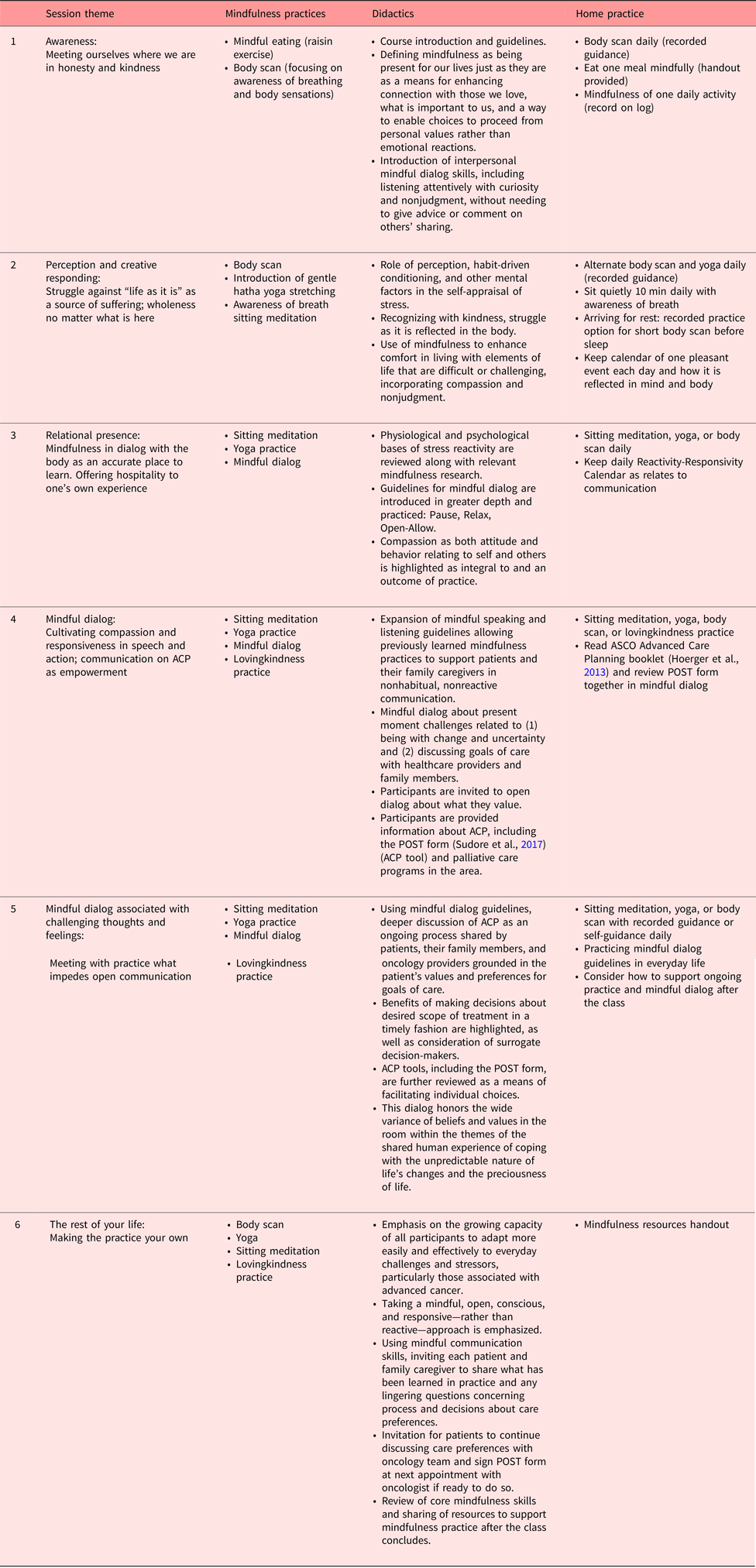
Two groups of six to seven dyads each participated in six weekly two-hour MODEL Care sessions, 12 total hours, over a six-week period. Participants were also provided instructions for recommended home practice between sessions. Table 1 outlines the core topics, mindfulness practices, didactic components, and home mindfulness practices for each MODEL Care session. The course combined methods from traditional Mindfulness-Based Stress Reduction programs (Santorelli & Kabat-Zinn, Reference Santorelli and Kabat-Zinn2013) (i.e., body scan, sitting meditation, hatha yoga [modified as necessary for each participant], and compassion meditation) with mindful speaking and mindful listening practices (Kramer, Reference Kramer2007) to cultivate patient and caregiver capacity for self-regulation in response to emotional stimuli and to foster enhanced ease with communication about sensitive topics. Information on ACP was provided and discussed in session 4 and included the American Society of Clinical Oncology's Advanced Cancer Care Planning: A Decision-Making Guide for Patients and Families Facing Serious Illness booklet and the Indiana POST form. Sessions were led by a facilitator with extensive training in mindfulness teaching and practice methods (author K.B.-C.).
MODEL Care intervention summary

All sessions were two hours and included provision of compact discs with audiorecordings of guided meditations of body scan, sitting meditation, gentle hatha yoga, and compassion (lovingkindness) meditation practices created by the facilitator for home practice.
ACP, advanced care planning.
Study assessment
Interviews
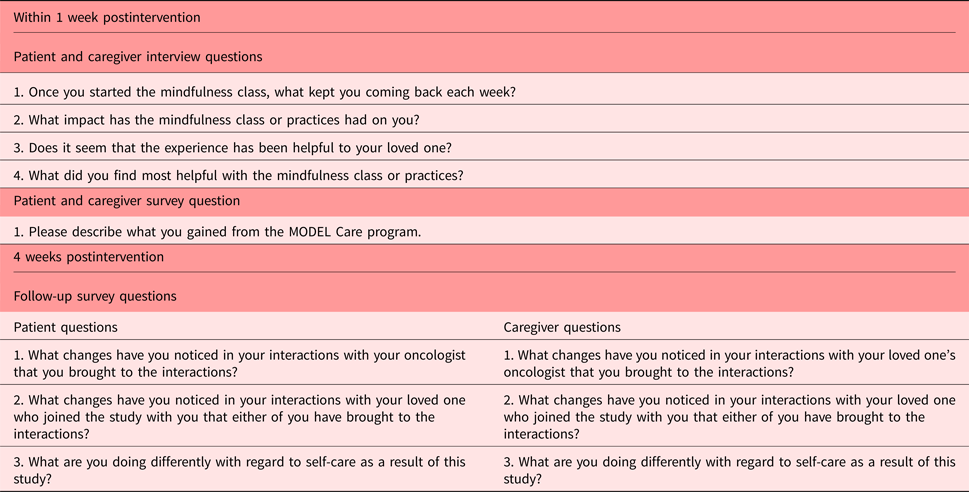
Patients and caregivers completed separate audio-recorded semistructured interviews exploring the impact of participation within one week of completing the six-week MODEL Care, intervention (Table 2). All interview recordings were transcribed and qualitatively analyzed.
Qualitative interview and open-ended survey questions

Surveys
Patients and caregivers completed two postintervention surveys within one and four weeks postintervention that included both quantitative and qualitative questions. Each survey included one or more open-ended questions designed to elicit patient and caregiver feedback of what they gained from participation in the MODEL Care intervention (Table 2). Patient and caregiver written responses were included in the data set and qualitatively analyzed. Quantitative outcomes are reported elsewhere (Johns et al., Reference Johns2014).
Data analysis
Interview transcripts were analyzed by two members of the research team (A.H.C. and J.K.B.) using immersion/crystallization methods described by Borkan (Reference Borkan, Crabtree and Miller1999). Immersion/crystallization facilitates the development of new knowledge in areas previously underexplored with a focus on discovery. This method enabled the research team to gain a deeper appreciation and understanding of the possible associations between mindfulness practices, coping with advanced cancer, and communicating about the future (i.e., ACP)—all areas where there has been a paucity of research.
The researchers first engaged in deep immersion in the texts through separate iterative close readings and ongoing reflective “crystallization” of findings. Emergent themes were then used to guide the identification and organization of text exemplifying the impact of MODEL Care on patients’ and caregivers’ personal barriers to ACP. Next, codes were applied to these grouped passages using constant comparative methods to continuously review and evaluate similarities and differences within and across coded categories (Glaser & Strauss, Reference Glaser and Strauss1967). Negative cases were intentionally culled and carefully examined to avoid analytic bias (Taylor & Bogdan, Reference Taylor and Bogdan1998). The codebook evolved through the coding process, and codes were added, modified, or deleted as new data were analyzed. In the third phase, coded content was categorized into broader conceptual themes. Preliminary themes were continuously compared with the coded text to ensure the final themes were mutually exclusive and exhaustive.
Responses to one open-ended question collected 1 week postintervention and three open-ended questions collected 4 weeks postintervention (Table 2) were also analyzed using the same process of immersion/crystallization. Notably, the thematic categories identified in the open-ended survey responses were identical to the themes identified in the interview transcripts. No differences were found between the themes identified in the interview and survey responses collected 1 week postintervention and the survey responses collected 4 weeks postintervention.
The study was conducted at an academic medical center in the United States. Study procedures were approved by the Indiana University Institutional Review Board and Scientific Review Committee of the National Cancer Institute–designated cancer center where participants were enrolled. Written informed consent was obtained from all participants. The study is registered with ClinicalTrials.gov (NCT02367508).
Results
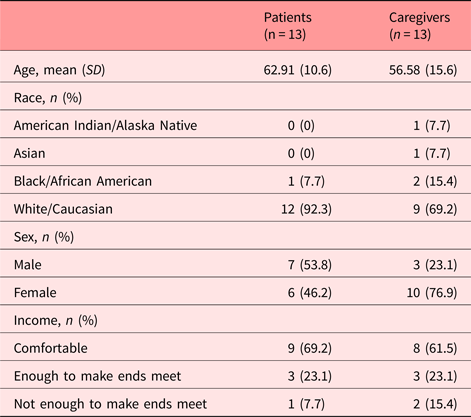
Sixty-eight patients were approached during the study enrollment period; 44 agreed to be assessed for eligibility and 22 were eligible to participate. In total, 13 patient/caregiver dyads were enrolled. Reasons for refusal included lack of interest (n = 5) and inability to attend the six MODEL Care sessions (n = 4). As shown in Table 3, a slight majority of enrolled patients (53.8%) were male and the majority of caregivers (76.9%) were female. The majority of patients (92.3%) and caregivers (69.2%) were Caucasian. Of the 13 enrolled patients, five had metastatic melanoma, three had lung cancer, two had leiomyosarcoma, and one each had pancreatic cancer, salivary ductal gland cancer, or anaplastic astrocytoma. Patients were diagnosed with metastatic cancer a mean of 20.9 months prior to enrollment (SD = 21.4 months; range, 1–76 months). Thirty percent of both patients and caregivers had a college degree, and 69% of patients and 62% of caregivers rated themselves as financially “comfortable” (Table 3).
Participant demographics

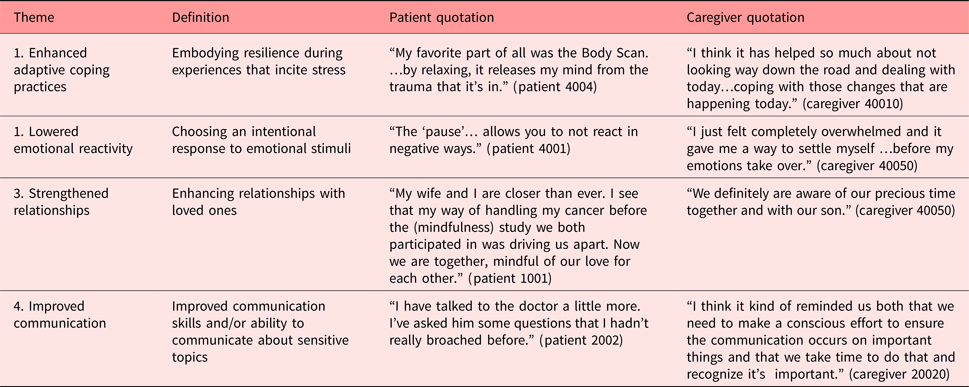
One of the 13 patient-caregiver dyads dropped out after the first session because of a lack of interest. A total of 12 patients and 12 caregivers completed the MODEL Care intervention. Patients attended an average of 4.3 of the six sessions; family caregivers attended an average of 4.2 sessions. The majority of those who missed completed a brief make-up session by phone with the mindfulness facilitator. One patient died shortly after the last intervention session. The majority of patients and caregivers responded to all of the open-ended survey questions; 20 participants completed qualitative interviews. As shown in Table 4, four salient themes were identified. Patients and caregivers reported that the intervention (1) enhanced adaptive coping practices, (2) lowered emotional reactivity, (3) strengthened their relationship with each other, and (4) improved their communication, including communication about their disease.
Interview and survey themes

Theme 1: enhanced adaptive coping practices
The MODEL Care sessions provided instruction in multiple mindfulness practices designed to enhance the ability of patients and caregivers to cope with the challenges of living with advanced cancer. Practices included the body scan, breath awareness, sitting meditation, gentle yoga, and mindful dialog. These facilitated patient and caregiver mindful awareness of the present, self-compassion, nonjudgment, and the ability to acknowledge, reflect on, and discuss difficult experiences and topics with greater ease.
After completing the MODEL Care sessions, patients and caregivers reported that the mindfulness practices were effective in helping them to cope with the overall “trauma” of cancer (patient 4004). One patient shared, “I have an imaginary tool box of…things I can do, which help me to feel good despite the reality of…pain or negative emotion…” (patient 1001). Patients reported that the mindfulness practice of present-centered awareness enabled them to “live better in the moment rather than worrying about the future” (patient 1003), and to approach the challenges they faced with increased “relaxation” (patient 4004) and “appreciation” (patient 2002). Patients reported using the mindfulness practice of lovingkindness, which facilitates compassion for self and others (The Center for Contemplative Mind in Society; Zeng et al., Reference Zeng2015) to cope with their new and altered sense of self. One patient described embracing “the importance of loving yourself and generating acceptance for the new person I've become as my skills, stamina, and mental abilities diminish” (patient 4001). Patients also reported that mindfulness practices helped them to respond to the negative physical aspects of their disease and treatment (patient 2002). Patients shared that the practices enabled them to experience greater ease with the symptoms of their disease (patient 4005), allowing them to “meet the pain differently so it doesn't consume me” (patient 4001).
Caregivers noted changes in their loved one's ability to cope with their disease following the mindfulness sessions. One caregiver shared “My friend seems to be much calmer regarding his diagnosis and fear of death [following the MODEL Care sessions]” (caregiver 10030). Another caregiver observed a change in both the patient's attitude and ability to manage physical pain after participating in the mindfulness intervention: “[MODEL Care] really made her a much more positive person…it's helped her get through the pain issues she's had in her shoulder while she's had her radiation” (caregiver 40040).
Caregivers also shared their own experiences of suffering (caregiver 10010), stress (caregiver 40050) and the responsibility for making life-altering decisions (caregiver 30020) as they cared for loved ones facing cancer. As with patients, caregivers found the mindfulness practices helped promote their ability to cope with these ongoing challenges. Caregivers found “peace” (caregiver 30010) and an increased ability to “cope with the stress of cancer” (caregiver 40050) by using mindful sitting meditation to more fully “live in the moment” (caregiver 40020). Mindfulness practices such as present-centered awareness enabled caregivers to shift their perspective from future-oriented concerns to a focus on the present: “So, I'm now living in the present, I'm enjoying the present…I can think about the future, yes, but…I'm not going to dwell too much on it” (caregiver 10010). Patients commented on the changes that they noticed in their caregivers’ ability to cope. For example, one patient observed, “I noticed that her attitude has been more positive since this course” (patient 1001). Another stated: “He's [caregiver] trying to be less impatient” (patient 2002).
Caregivers also used the mindfulness practices to help patients cope with their disease, noting in this context that mindfulness “gives me power in things that used to make me feel powerless” (caregiver 40050). For example, one caregiver reported, “That's probably…where I'm getting the rewards. My heightened awareness is helping [the patient] feel better…It may not heal him physically, but it can heal him emotionally” (caregiver 10010). Patients also noted changes in their caregivers’ abilities to help them cope: “She's much more compassionate to what I'm feeling. Sometimes my emotions are right on top, and she deals with that a whole lot better than she used to” (patient 1003).
Theme 2: lowered emotional reactivity
Both patients and caregivers commented on the emotional challenge of living with the symptoms and circumstances of advanced cancer. In the words of one patient, “It's not easy to accept the fact that you're going to die soon” (patient 4004). Patients and caregivers each reported decreased reactivity to emotional stimuli following the MODEL Care mindfulness sessions.
Patients described experiencing fear (patient 1001) and anxiety (patient 4003) in response to their disease and treatments. The MODEL Care sessions included training in practices such as “pausing” and “taking a breath” that were specifically intended to enable participants to respond intentionally rather than automatically to emotional stimuli. Patients reported that these mindfulness practices supported them in responding to emotional provocations: “The pause…allows me to not react in negative ways, but to think about, ‘How can I better deal with the negative circumstance?’ when one comes up” (patient 4001). Another patient commented that the mindfulness practices learned during the MODEL Care sessions facilitated increased self-awareness of difficult emotions and promoted a positive response to these stimuli: “My oncologist felt that this brought emotions to the surface that I had repressed over the last 2 years, allowing me to address these issues in a more healthy and positive manner” (patient 4003).
Caregivers similarly noted that mindfulness practice helped them to respond thoughtfully rather than react impulsively to circumstances that incited uncomfortable emotions. For example, caregivers commented that the “pause” helped “keep my anxiety in check” (caregiver 10030), enabling them to notice and “set aside” (caregiver 20020) their impulse to react to negative experiences by “slowing down, taking time for the moment, and…not reacting as fast as maybe I would before” (caregiver 40010). Moreover, mindfulness practice enabled caregivers to regroup before responding to emotional triggers: “It gave me a way to settle myself more…before my emotions take over” (caregiver 40050).
Theme 3: strengthened relationships
Both patients and caregivers participating in the MODEL Care intervention reported a positive change in their relationship with each other postintervention. Patients reported that the shared experience brought them closer to their caregiver, who was frequently their spouse. For example, patients stated, “Now we are together, mindful of our love for each other” (patient 1001) or noted that they were “closer to each other” (patient 4004) or that “[we] feel a connection” (patient 2002). One patient reported that “we've gotten along better since we started this, it's really helped the relationship, especially dealing with the cancer” (patient 4005).
Patients credited the mindfulness sessions with helping to develop those stronger relationships. They commented on the benefits of spending time together practicing mindfulness: “We've been more in sync than we ever have been, and I think the class really helped a lot with that” (patient 1001). Patients also referenced specific techniques taught during the mindfulness sessions, such as the lovingkindness practice: “My husband and I did that together, and I think we could really feel a connection” (patient 2002). In commenting on the mindful dialog practices, another patient stated, “My way of handling cancer before the [mindfulness] study was driving us apart” (patient 1001).
Similar to patients, caregivers commented on the impact of the MODEL Care intervention on their relationship with the patient, remarking that it was “bringing us closer in these times of hardship” (caregiver 10010). Caregivers mentioned “spending more time together” with their loved one (caregiver 40040) as a positive benefit, along with an increased appreciation for the time they had together: “Let's say that [patient] is doing something that I normally would have considered trivial or not important. After the training, I realized how important it is to spend time with him, so I embrace whatever he is doing, and we started doing things together” (caregiver 10010). Caregivers also identified new abilities they had developed during the program, such as being “able to help each other in moments of stress” (caregiver 10010) and having “more of an understanding and consideration in what each of us is experiencing” (caregiver 10020). Caregivers described personal changes the program had facilitated that enabled improved relationships, such as being “more peaceful and easier to get along with” (caregiver 10020).
Theme 4: improved communication
Patients and caregivers both reported an improved ability to communicate with each other, clinicians, and others facing similar circumstances. Patients commented on their enhanced ability to “listen better” (patient 2002) and “listen more” (patient 4005) to their caregivers—abilities cultivated through the mindful dialogue practices. Patients and caregivers also found that the MODEL Care sessions improved their ability to communicate with others about their disease. For example, both patients and caregivers described an improved ability to communicate with the oncologist. Patients noted being able to ask their oncologist sensitive questions they had previously avoided: “I asked him about my life expectancy, and at a later time, he talked about it. It was never discussed before this study” (patient 2002). Caregivers also expressed greater ease when communicating with the oncologist about sensitive topics: “[I have a] sense…that I can ask difficult questions” (caregiver 10010). Patients and caregivers noted increased comfort talking about their disease postintervention and a heightened ability to be in touch with their experiences with cancer, including their fears and emotions.
Discussion
Patients with advanced cancer face challenging physical and psychological experiences as they navigate a terminal disease and accompanying treatments. Emotional responses to these threatening conditions (Mesters et al., Reference Mesters1997; Schickedanz et al., Reference Schickedanz2009; Simon et al., Reference Simon2015) can prevent patients from making important decisions about care that could affect both their quality of life and quality of death, as well as their caregiver's experience of life and bereavement (Tschirhart et al., Reference Tschirhart, Du and Kelley2014; Wright et al., Reference Wright2008). ACP empowers patients to approach current and future care and treatment decisions with informed and thoughtful deliberation grounded in their personal values, life priorities, and preferences while they are still able to speak for themselves and before urgent crises arise. Existing ACP interventions (Gundersen Health System, 2016; Regents of the University of California, 2012; The Conversation Project, 2016) support individuals in considering and clarifying their wishes for care; however, these approaches lack the inclusion of components that substantially modify patient or caregiver emotional discomfort and avoidance. Current interventions designed to support the psychological, spiritual, or existential wellbeing of patients with advanced cancer, such as Managing Cancer And Living Meaningfully (An et al., Reference An2017; Lo et al., Reference Lo2014, Reference Lo2015, Reference Lo2016; Nissim et al., Reference Nissim2012) and meaning-centered group psychotherapy (Breitbart, Reference Breitbart2002; Breitbart et al., Reference Breitbart2010, Reference Breitbart2015), include neither mindful meditation or mindfulness communication practices as intervention components nor focus specifically on ACP. One of the innovative features of MODEL Care is the focus on cultivating adaptive coping through mindfulness to support openness to EOL conversations and ACP. The MODEL Care intervention brought together patients and their caregivers for shared experiential training in mindfulness and mindful communication practices, both presented within an explicit context of fostering contemplation and discussion about ACP. The sessions were designed to facilitate a common understanding of mindfulness practices and benefits within each patient/caregiver dyad and to enhance participant capacity to incorporate mindfulness and mindful communication practices into their everyday lives. Daily practice supported emotional self-regulation and fostered effective communication about sensitive topics, including future care. Patients and caregivers reported improved capacity to cope with the psychological discomfort of their disease, enhanced ability to respond intentionally and adaptively to emotional stimuli, strengthened relationships with each other, and improved skills and comfort with communicating about difficult topics—all important capacities for fostering engagement in ACP. Although mediator analysis was not conducted in this pilot study, there is emerging evidence that mindfulness meditation causes neuroplastic changes in brain regions that regulate attention (prefrontal cortex), emotion (amygdala), and self-awareness (posterior cingulate cortex) (Tang et al., Reference Tang, Hölzel and Posner2015). Mindfulness meditation facilitates self-regulation of attention, emotion, and self-awareness by fostering attention to the present moment, coupled with acceptance and nonreactive awareness of internal and external experiences (Baer, Reference Baer2003; Bishop et al, Reference Bishop2004). Therefore, mindfulness practice may reduce maladaptive reactions to the emotional and physical triggers that may lead to cancer-related avoidant coping, such as avoidance of ACP.
Our study is not without limitations. The nonrandomized, single-arm design with no control condition limits our ability to conclude that improvements noted for patients and their family caregivers were due to the MODEL Care intervention. We cannot rule out that the benefits participants reported receiving could be due to the attention received from a skilled facilitator and from peers in their MODEL Care group. The small sample size of 13 patient and family caregiver dyads also limits the strength of our conclusions. Participants were all English speaking, most were Caucasian, and most reported having a comfortable income, limiting generalizability of findings to other groups. Finally, all patients were referred to the study by their oncology team and were willing to enroll in a mindfulness-based intervention, creating the possibility of selection bias.
Future research could build on the findings of this pilot to explore the relationship among mindfulness practice, ability to communicate mindfully about advanced disease care preferences, ease with which patients and caregivers engage in these sensitive conversations, and concordance between expressed care preferences and treatments received at the EOL. Assessing the efficacy of MODEL Care in a randomized controlled trial compared with usual care, wait-list control, or an active intervention such as ACP decision support would answer a variety of research questions depending on the design chosen. Moreover, a randomized trial would ensure greater internal validity than was possible in the quasi-experimental pilot from which these qualitative data were drawn. Future quantitative research should include mediator analysis to test theoretically based constructs, such as self-regulation as a hypothesized mediator of the effects of MODEL Care on ACP. Despite limitations, the results of this pilot suggest that mindfulness-based interventions such as MODEL Care could play an important role in improving and expanding ACP uptake by enhancing the ability of patients and families to consider and discuss emotionally challenging topics, such as EOL preparations.
Acknowledgments
Boundless gratitude is offered in recognition of the work of Gregory Kramer in developing Insight Dialogue (Kramer, Reference Kramer2007) and Phyllis Hicks, Florence Meleo-Meyer, and Gregory Kramer in articulating Insight Dialogue in Interpersonal Mindfulness Practice as the cornerstone of this intervention. The authors also thank Anne Hudson, Dr. Jay Summers, and Nila Nealy for their skill in conducting rich qualitative interviews for this study. Dr. Ray Maietta, Jeff Petruzzelli, and Dr. Lucinda Hudson from ResearchTalk, Inc., provided invaluable assistance with the qualitative analysis. Finally, this work would have been impossible without our oncology partners who referred the 26 brave men and women who generously volunteered their time to participate in this study.
Funding
This project was funded by the Walther Cancer Foundation (0113.02). Mentoring support was provided to Dr. Shelley Johns by Dr. Victoria Champion through the National Cancer Institute of the National Institutes of Health (#K05CA175048). The content is solely the responsibility of the authors and does not necessarily represent the official views of the Walther Cancer Foundation or the National Institutes of Health.