Introduction
The genus Aeschynanthus Jack has around 160 species from Sri Lanka and India through southern China and Southeast Asia to New Guinea and the Solomon Islands (Middleton, Reference Middleton2016). The species in continental Southeast Asia are relatively well known following a series of revisions by Middleton (Reference Middleton2007, Reference Middleton2009, Reference Middleton2016), but those from the rest of Malesia are still rather poorly known.
When a living collection from Vietnam that was grown on in the Royal Botanic Garden Edinburgh eventually flowered, it was found not to be a species accounted for in Middleton (Reference Middleton2009), nor a species that could be matched to any other in the genus. It is described here as new.
Species Description
Aeschynanthus scottii D.J.Middleton & H.J.Atkins, sp. nov.
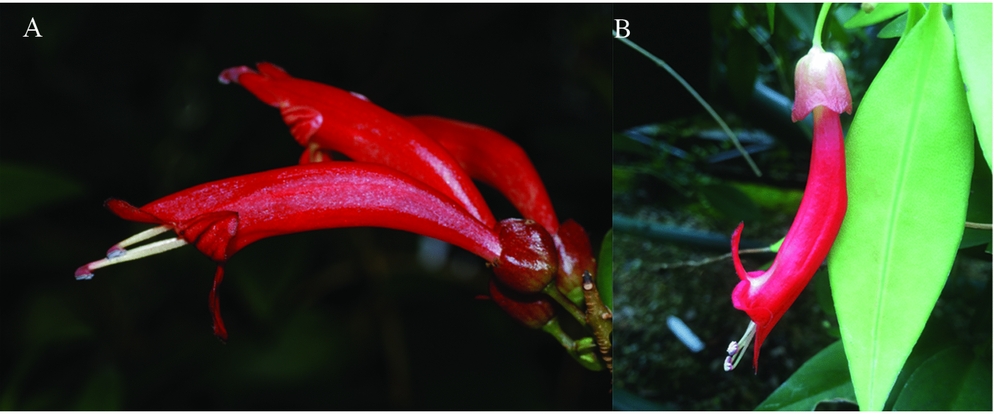
Similar to Aeschynanthus pulcher (Blume) G.Don but differing in the shorter campanulate calyx (tubular in A. pulcher) and the lack of bubble cells on the seed. – Type: Originally from Vietnam, Lam Dong, Lac Duong District, Xa Lac Commune, Langbiang Mountain, evergreen warm temperate forest, 2140 m, 12°02′50′′N, 108°26′26′′E, 30 viii 2001, South Vietnam First Darwin Expedition 52, grown on at RBGE as accession 20010634A, vouchered as Middleton 5285 and selected as type (holo E). Fig. 1.
Aeschynanthus scottii D.J.Middleton & H.J.Atkins. Living collection 20010634A, from which the holotype was made, at the Royal Botanic Garden Edinburgh. A, Flowers from the side; B, flower and leaf. (Photographs: A, David J. Middleton; B, Hannah Atkins.)
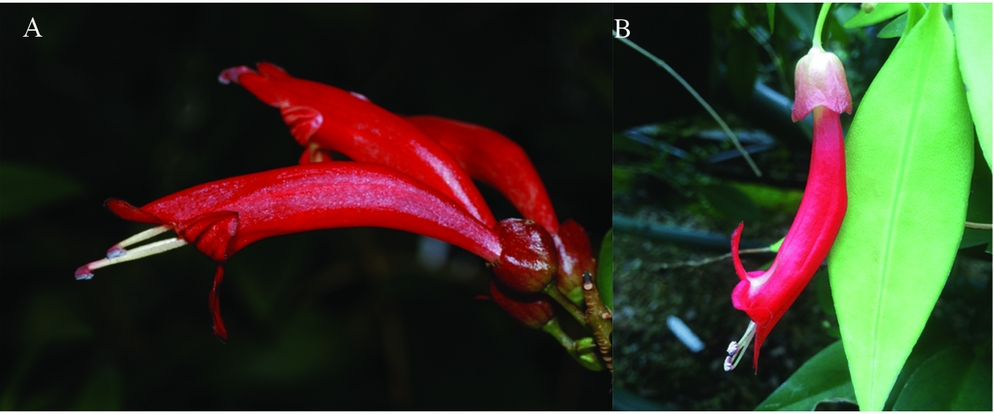
Epiphytic subshrub, stems green, tinged purplish above, rooting at each node. Leaves opposite; petioles 0.2–1 cm long, mostly glabrous but with very few hairs towards apex, purplish; blade coriaceous, ovate, (1.2–)2.7–6.2 × (0.4–)0.8–2.3 cm, 2.7–4 times as long as wide, base rounded to obtuse, apex acute to acuminate, ultimate tip rounded, reducing in size towards branch apices and particularly small when subtending inflorescences, venation obscure, glabrous throughout except very few hairs at very base of blade on margin, mid green above, paler beneath. Inflorescences single- or pair-flowered, axes glabrous; peduncle purplish, 9–11 mm long, glabrous; bracts c.4 × 2 mm, green, ovate; pedicels pale green, c.5 mm long. Calyx campanulate, c.10 mm long, very pale green, tinged reddish, particularly at apices of lobes, more or less glabrous externally with one or two hairs at apices of lobes, lobes broad-triangular, c.2 × 5 mm, apex rounded, glabrous internally. Corolla 50–55 mm long, narrow funnelform, very narrow at base and then widening gradually to mouth from c.15 mm from base, slightly arcuate, very pale green to white at base, red above with pale orange and dark red stripes on lower three lobes inside; upper lobes c.5 × 4 mm, somewhat oblong, not spreading or reflexed except slightly at margin, apex rounded, sinus between upper lobes 2 mm deep; lateral lobes oblong, spreading, 9–9.5 × 6.5–7 mm, apex rounded or obtuse; lower lobe oblong, spreading, 9–9.5 × 6.5–7 mm, apex rounded or obtuse, corolla glabrous outside except for minute glandular hairs fringing lobes, most densely so around edge of upper lobes, inside with scattering of small, glandular hairs around mouth. Stamens barely exserted; filaments cream with a scattering of short glandular hairs, c.21 mm long, inserted at c.38 mm from corolla base; anthers oblong, purplish, posticous pair c.2 × 1 mm, anticous pair marginally smaller; pollen light grey; staminode 3 mm long, cream. Disc 1.5–1.8 mm high, fleshy, glabrous, not lobed, light green. Pistil 6–20 mm long (only poorly developed pistils seen), glabrous at base with a scattering of sessile glands apically; stigma capitate (on immature specimen), c.0.2 mm across. Capsule linear, c.38 cm long. Seed grain 1.1 × 0.3 mm, papillose, bubble cells absent; apical appendage filiform, c.7 mm long; hilar appendage filiform, c.7 mm long; appendages not papillose.
Distribution. Vietnam (Lam Dong).
Habitat and ecology. Evergreen warm temperate forest at c.2140 m.
Etymology. Named after Stephen M. Scott, formerly the principal horticulturalist caring for the Gesneriaceae collections at the Royal Botanic Garden Edinburgh, and later also a Gesneriaceae taxonomist.
Provisional IUCN conservation assessment. Data Deficient (DD). This species is known only from the type collection, and its distribution and population size are unknown.
Additional specimens examined. Vietnam. Lam Dong: Lac Duong District, Xa Lac Commune, Langbiang Mountain, evergreen warm temperate forest, 2140 m, 12°02′50′′N, 108 26′26′′E, 30 viii 2001, South Vietnam First Darwin Expedition 52, grown on at RBGE as accession 20010634A, vouchered as Atkins 80 (E).
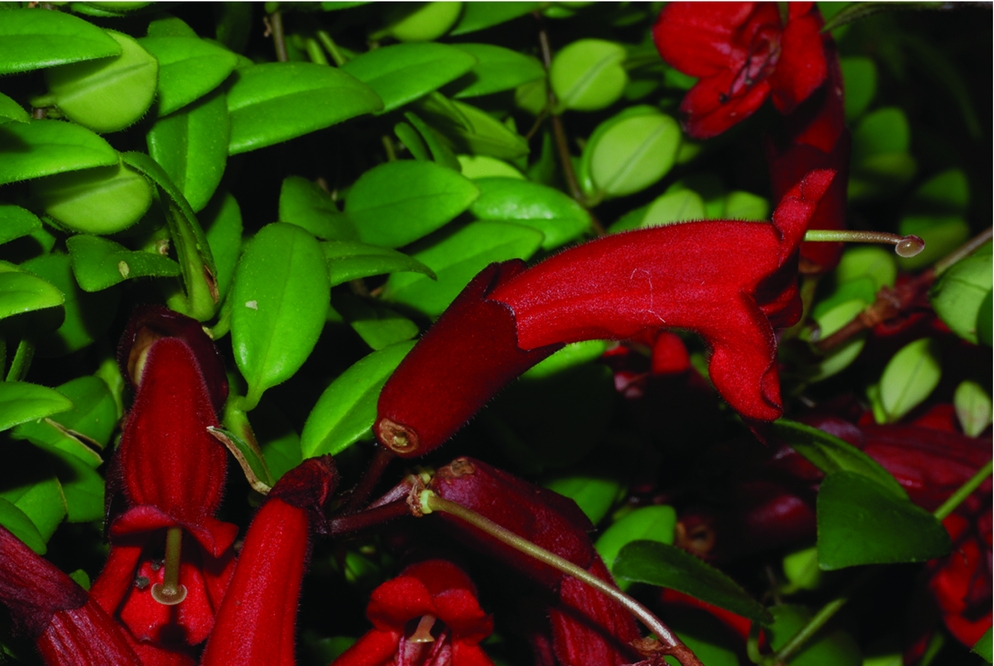
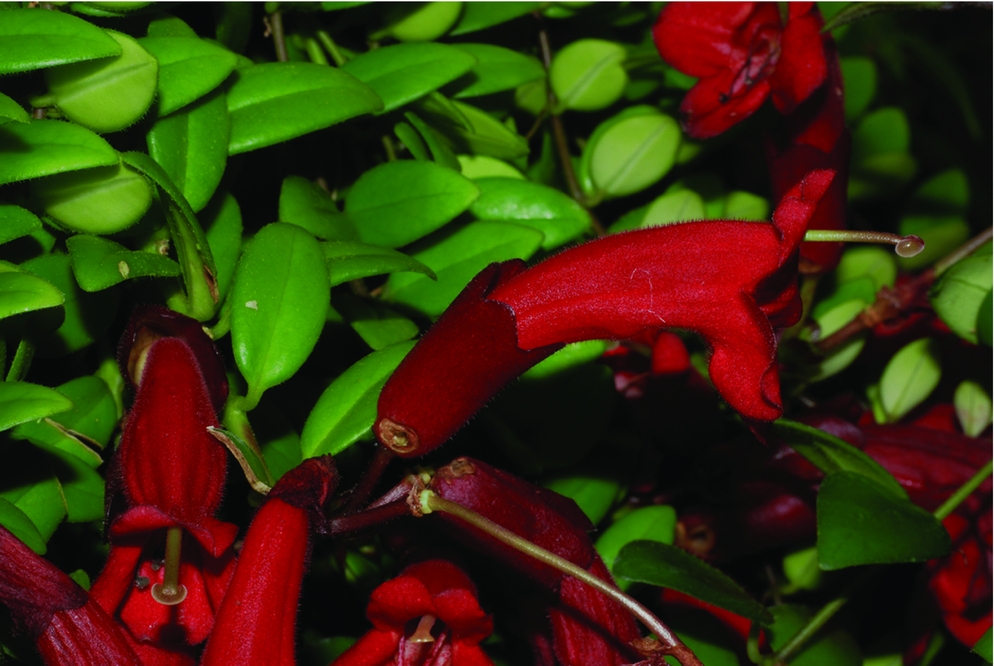
The affinities of this species are rather obscure. In general appearance, it would appear to be most similar to species in the Aeschynanthus pulcher (Blume) G.Don (Fig. 2) alliance of species. The length of the seed appendages as well as the lack of papillae also suggest a link to the Aeschynanthus pulcher group. However, the Aeschynanthus pulcher group of species all have a large collection of so-called bubble cells at the base of the hilar appendage, although this is reported to be absent from species also believed to be closely related to Aeschynanthus pulcher, such as Aeschynanthus tricolor Hook. from Borneo (Mendum et al., Reference Mendum, Lassnig, Weber and Christie2001). These species were previously included in Aeschynanthus sect. Aeschynanthus, but it should be noted that Denduangboripant et al. (Reference Denduangboripant, Mendum and Cronk2001) found that phylogenetic relationships within the genus did not correspond well to the sectional classification. Middleton (Reference Middleton2016) therefore abandoned the sectional classification altogether, pending a revision of the system.
Aeschynanthus pulcher (Blume) G.Don. Living collection 20002055A at the Royal Botanic Garden Edinburgh. (Photograph: David J. Middleton.)
In the key to the species of Aeschynanthus in Cambodia, Laos and Vietnam based on flowering material presented in Middleton (Reference Middleton2009), Aeschynanthus scottii would key to couplet 15 with A. pulcher. It can be distinguished from Aeschynanthus pulcher by the characters given in the diagnosis above. In the key based on fruiting material, it would key out as Aeschynanthus superbus C.B.Clarke, but that is a very different species with large bracts in the inflorescence and calyx lobes divided to the base.
Acknowledgements
We should like to thank Nathan Kelso and Sadie Barber for excellent care of the living collections at the Royal Botanic Garden Edinburgh. RBGE is supported by the Scottish Government's Rural and Environmental Science and Analytical Services Division.