Introduction
The singing experiences of boys are often interrupted by adolescence. These interruptions permeate boyhood across cultures and nations, within and outside school settings. They have been documented since the formalisation of singing instruction in school music programmes (Harrison & Welch, Reference HARRISON and WELCH2012). Music educators often seek to prevent the interruptions, or to at least provide opportunities for student reengagement with music at a later time. The interruptions can be traced to both intrinsic factors including the voice change and identity development, and extrinsic factors including societal and peer influence. Though pervasive, discontinuance of male singing during adolescence is not universal; indeed, many boys continue singing with great artistic satisfaction and personal enjoyment. Research suggests, however, that once their singing is interrupted during early adolescence, very few return to singing as older adolescents or young adults (Ashley, Reference ASHLEY2008).
The examination of these phenomena has, in recent years, been furthered by a growing interest in narrative analysis. Researchers no longer ask if boys withdraw from vocal-choral music programmes during adolescence. Instead, researchers are asking boys to explain their perceptions about why they choose to continue or discontinue school-based singing activity. The aggregate implications from many such studies could point toward curricular and pedagogical reforms necessary for vocal-choral music education. These implications could address current concerns about the relevance of school-based large performing ensembles (Allsup & Benedict, Reference ALLSUP and BENEDICT2008; Williams, Reference WILLIAMS2011; Allsup, Reference ALLSUP2012).
The adolescent male voice change, motivation and identity development
The anatomical process of male adolescent voice change has been well documented since the late 1970s (see Cooksey, Reference COOKSEY, Thurman and Welch2000). The implications for concurrent vocal pedagogy are less clear, and many teachers either avoid differentiating instruction or are unsure of how to best meet the vocal and related psychological needs of these boys (Freer, Reference FREER2009a; Harrison & Welch, Reference HARRISON and WELCH2012; Ashley, Reference ASHLEY2013). Narrative studies about boys and singing suggest that boys understand neither the physiological process of voice change nor the phonational and musical effects of the changes (Ashley, Reference ASHLEY2008, Reference ASHLEY2009; Freer, Reference FREER2009b). Other studies note adolescent boys’ preference for socially oriented, action-based singing environments and the negative effect on motivation when these activities are reduced (Freer, Reference FREER2009a; Ashley, Reference ASHLEY2010; Lucas, Reference LUCAS2011). A host of recent and related narrative studies collectively indicates that adolescent boys’ motivation for continued singing activity results from their self-perceptions of musical autonomy and vocal skill within a network of peer social support (Harrison, Reference HARRISON2010; Sweet, Reference SWEET2010; Elorriaga, Reference ELORRIAGA2011; Abrahams, Reference ABRAHAMS, Harrison and Welch2012; Collins, Reference COLLINS2012; Freer, Reference FREER2012; Legg, Reference LEGG2013; Bennetts, Reference BENNETTS2013).
Motivation theorists are increasingly focused on the question of how people develop conceptions of their potential future identities. It is thought that these hypothesised identities influence attitudes and behaviours as individuals seek to realise or avoid them. One of the most prominent identity development frameworks is Possible Selves (Markus & Nurius, Reference MARKUS and NURIUS1986). The Possible Selves construct draws on century-old antecedents for its conceptions of hoped-for selves, feared selves and expected selves (Oyserman & James, Reference OYSERMAN and DESTIN2010). Research about Possible Selves suggests that adolescent boys in particular need to feel that a possible self is both proximal and attainable for there to be any motivational effect (Packard & Conway, Reference PACKARD and CONWAY2006; Freer, Reference FREER2010; Munro Reference MUNRO2011).
Theorists have recently positioned Possible Selves within the larger model of Identity-Based Motivation Theory (Oyserman & Destin, Reference OYSERMAN and DESTIN2010). This model posits that identities are multiple, fluid and constructed within specific contexts as subjectively interpreted by the individual. Adolescents, like people in general, prefer to engage in behaviours that are identity-congruent as opposed to those that are identity-incongruent (Elmore & Oyserman, Reference ELMORE and OYSERMAN2012). People are motivated to persevere when challenges and difficulties align with a congruent identity. Alternatively, people are inclined to disengage from challenging or difficult situations that require identity-incongruent behaviours (Oyserman & James, Reference OYSERMAN, JAMES, Schwartz, Luyckx and Vivian2011).
Identity-Based Motivation Theory suggests that context-specific identities are dynamically constructed from social cues. Contextual identities can be enacted, suspended and re-enacted according to any number of circumstances (Oyserman et al., Reference OYSERMAN, ELMORE, Leary and Tangney2012). These factors include gender, age, peer influence, stereotypes and the presence of role models (Raider-Roth et al., Reference RAIDER-ROTH, ALBERT, BIRCANN-BARKEY, GIDSEG and MURRAY2008; Shepard et al., Reference SHEPARD, NICPON, HALEY, LIND and MING LIU2011; Frazier, Reference FRAZIER2012; Henry & Cliffordson, Reference HENRY and CLIFFORDSON2013; Miranda, Reference MIRANDA2013; Way et al., Reference WAY, HERNANDEZ, ROGERS and HUGHES2013). Research confirms the strong relationship between musical skill and identity development during the school years and subsequent reengagement in musical activity during the adult years (Creech et al., Reference CREECH, HALLAM, VARVARIGOU, GAUNT, MCQUEEN and PINCAS2013; Paparo, Reference PAPARO2013).
Other research has explored how adolescents, and adolescent boys in particular, develop conceptions of their future possible selves. These studies suggest that the development of possible selves is developmental and sequential, with six stages that progress from conception of an envisioned future self to realisation of that future self (see Hock et al., Reference HOCK, DESHLER, SCHUMAKER, Kerpelman and Dunkel2006; Freer, Reference FREER2009b). The six stages and descriptions are:
1. Discovering personal strengths, weaknesses and affinities.
2. Thinking about how peers and older people build on similar characteristics.
3. Imagining a potential future self that incorporates personal strengths, weaknesses and affinities.
4. Reflecting on the present status of these characteristics and how they might need reinforcement in order to achieve the potential future self.
5. Growing the skills and actively creating the conditions necessary to achieve the potential future self.
6. Performing and realising the envisioned self.
Given this sequence of stages in the development of possible selves during adolescence, it may be that teachers who understand and reinforce a boy's musical identities before and during his adolescent voice change may influence both his present and future involvement in singing activity. The purposes of the analysis related here were to: (1) identify the reasons boys provide for their participation in singing activity, (2) explore how the boys’ reasons indicate the development of possible selves according to the six stages outlined above, and (3) identify how teachers might then be guided toward providing specific support at specific points in a boy's musical development.
Aims and procedures
This article is a report of four individual studies conducted during a time span of six months. The studies were originally planned for presentation with individual reports. The initial data analysis procedures for the four studies revealed more similarities than differences. The decision was made to analyse the data collectively and present a combined report. Contextual information and any divergent findings are detailed in the following pages.
The four studies were developed to examine self-reports of adolescent boys about the intrinsic and extrinsic factors leading toward the continuance or interruption of their school-based singing activity, with particular attention to how their comments reflect the six stages of Possible Self development (Hock et al., Reference HOCK, DESHLER, SCHUMAKER, Kerpelman and Dunkel2006). The studies were inspired by Kennedy's (Reference KENNEDY2002) study of male choral singers in United States schools and followed a design suggested by Freer (Reference FREER2006) to include participants who currently sang, had previously sung or who had never sung in choirs.
University faculty members in the four countries of England, Ireland, Greece and Spain were contacted by the researcher, provided with a description of the research and asked to recommend schools for participation. Six schools were recommended: two in Greece and Spain and one each in England and Ireland. The schools’ vocal music teachers were each asked to recommend a minimum of 12 boys for participation. Teachers in Greece and Ireland recommended more than the minimum number of 12 participants, and teachers in the Spanish schools recommended fewer. All boys recommended by teachers were invited to participate. Equal numbers of participants from each location were not required given that the four studies were originally designed to be independent rather than collective.
Teachers were asked to select student participants from three groups: consistent and current singers, those who had withdrawn from school singing, and those who had never sung in school or a choir. Teachers were requested to select equal numbers of students from the three groups, but only the set of boys from the English school was evenly proportioned. Teachers from the other schools initially selected participants according to the request for three equally sized representative groups, but interview data revealed that the boys categorized themselves differently than their teachers. In total, 56% of boys in the combined studies self-identified as consistent and current singers, 26% self-identified as having withdrawn from school singing and 18% reported they had never sung in school or a choir.
The researcher conducted all interviews in person and on site. Interviews ranged in duration from 22 to 43 minutes and totalled 2723 minutes, or 45.4 hours. A total of 85 boys from ages 12–18 were interviewed. Seventy-seven of the boys were interviewed individually while scheduling constraints prompted the remaining eight to be interviewed in pairs. Because of the possibility of peer influence, narrative excerpts from the paired interviews are not quoted in this report.
Interviews followed the active interview approach of Holstein and Gubrium (Reference HOLSTEIN and GUBRIUM1995) in which an initial series of questions promotes the natural flow of conversation. It is the researcher's responsibility to ensure that the desired topics are addressed during the conversation. Though most students were fluent in English at age-appropriate levels, translators were present at the locations in Greece and Spain and later assisted in the English translation of student comments spoken in other languages. Interview transcription was prioritised for participants who occasionally used languages other than English; this was done to facilitate member checking of the transcripts. Interviews in these two countries were held over spans of three days each, and students were provided onsite opportunities to edit the transcripts. A total of 52 participants were interviewed in Greece and Spain; 28 spoke partially in a language other than English. Of these, 23 participants elected to review their interview transcripts, with 13 making corrections in consultation with the translator(s). The 57 participants who spoke only in English were offered the opportunity to review their transcripts via email. Eight of these participants reviewed their transcripts, with two making corrections.
Interviews were recorded and the researcher maintained a log of field notes. HyperTRANSCRIBE™ and HyperRESEARCH™ software facilitated transcription, coding and analysis of all interview data. Analysis utilised a Grounded Theory approach (Glaser, Reference GLASER2002; Charmaz, Reference CHARMAZ2006), beginning with open coding, then selective coding and subsequent theoretical sampling and theoretical coding (Glaser, Reference GLASER1978). Two graduate students at the researcher's home institution replicated the open coding. The Kappa coefficient (where values between 0.61 and 0.80 indicate substantial agreement) for interrater reliability at this stage was κ = 0.83 (Cohen, Reference COHEN1960). The researcher independently conducted the selective and theoretical coding.
Contexts
The English School. The private Catholic school, located in the centre of a large city, houses one of the most prominent Cathedral choirs in the country. This school was, then, quite different from the others in this report. Even with this distinction, the data presented in this report are included because the comments of the English boys about voice change and choral/singing identity were similar to those from the other countries. The English boys further discussed their experiences in the cathedral choir setting, and that data will be presented in a separate report. Twelve boys aged 12–16 were interviewed in a small conference room. They were evenly balanced, at four boys each, between those who had never sung in choir, those who had withdrawn and those who sang consistently.
The Greek Schools. There were two participating public secondary schools in Greece, located in separate urban centres. These two schools were labelled ‘music secondary schools’ where students received the same academic curriculum as at other secondary schools but with additional course hours in music. Admission to the school was gained through a lottery system rather than a performance-based audition. A total of 35 boys were interviewed, representing ages 12–18. Interviews took place in various locations within the schools. One boy emailed additional comments.
Twenty-six of the boys (74%) were singing in school ensembles at the time of the study. All boys ages 12–15 sang in mandatory chorus classes with similarly aged girls; repertoire represented Western classical and Greek traditional music. Both participating schools had auditioned upper school choirs that performed Western classical music. In one school, the upper school choir was a treble ensemble not open to boys by decision of the teacher. In the other school, the upper school choir was theoretically open to both boys and girls, but no boys were actively enrolled. All but one of this study's upper school boys sang in their school's Byzantine ensemble. School-based Byzantine ensembles are nearly all-male, un-auditioned ensembles focused on traditional chant-like singing. No boy interviewed for this study viewed the Byzantine ensemble as a choral group.
The Irish School. Twenty-one boys aged 13–17 were interviewed in a music classroom of an urban public school. School choral singing occurred in a training choir for young adolescents and in the lower secondary school choir. Choirs met daily during lunch break and were not part of the graded curriculum. Repertoire ranged from unison treble singing in the younger choir to a varied range of classical, ‘trad’ (traditional Irish music), popular and Broadway-style literature for the upper secondary school choir. Seven of the boys had never sung in a choral ensemble, six had withdrawn and eight were currently enrolled in one of the two choirs.
The Spanish Schools. Seventeen boys were interviewed from two public schools in a suburban town. Choral music was popular amongst students at the lower secondary school, where it was a course offered during the school day and open to both boys and girls. The high school choral director did not allow boys to join the high school chorus. The boys were aged 12–17. The 10 boys in lower secondary (ages 12–15) were currently singing in choirs, and the seven boys in upper secondary (ages 15–17) had either withdrawn from choral singing or had never sung in a choral ensemble.
Analysis: Topics and interpretations
The processes of open and selective coding removed comments about particular teachers and school-specific contextual situations, resulting in a data set that could be analysed by topic (Georgakopoulou, Reference GEORGAKOPOULOU2006; Sools, Reference SOOLS2012). This process revealed congruence in both the topical content and the relative proportion of viewpoints across the data set. The prevalence and content of topics were consistent amongst the four country-based cohorts of boys, with the exception of the Greek boys’ discussion of Byzantine singing, as described later.
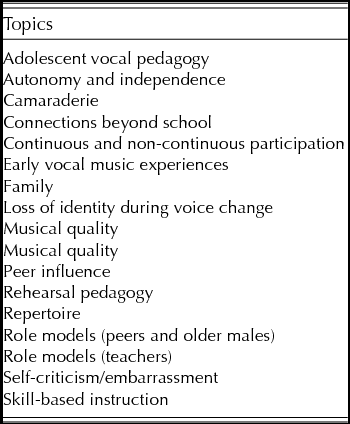
Transcript analysis facilitated the classification of narrative data by 39 emergent codes that were subsequently organised by topics (Table 1). Previous narrative research with a small number of adolescent boys (n = 3) identified topics associated with the development of possible selves through vocal-choral music experiences (Freer, Reference FREER2009b). Each topic identified in the earlier study was found in this larger data set. Three unique topics emerged from the data considered here: self-criticism/embarrassment, loss of identity during voice change and connections beyond school. The 17 topics revealed by data analysis are listed alphabetically in Table 1.
Alphabetical list of topics

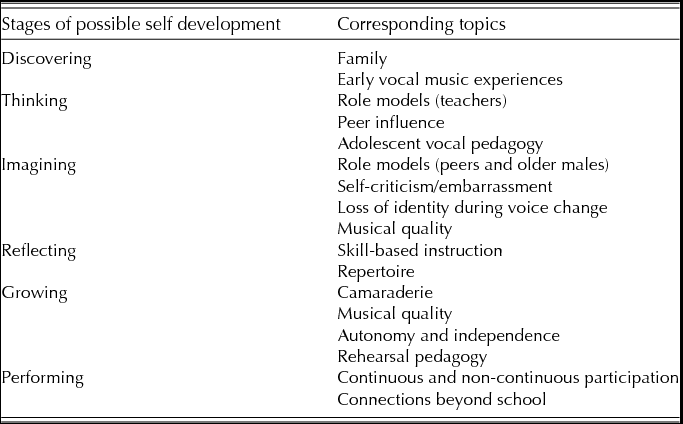
The following presentation of data is ordered according to analysis of how the 17 topics correspond with the six stages of Possible Self development outlined in the ‘Adolescent male voice change, motivation and identity development’ section above. The stages and the corresponding topics from the data are listed in Table 2. The stages of ‘discovering’, ‘thinking’, and ‘imagining’ are characterised by a person's thoughts about a potential future possible self (conceptualisation). The stages of ‘reflecting’, ‘growing’, and ‘performing’ are characterised by a person's steps toward achieving that potential self (realisation).
Stages of Possible Self Development and Corresponding Topics
Discovering
In this initial stage of contextual identity development, individuals seek to identify current strengths, interests and skill areas. The boys in these studies spoke of how their family members and early school music experiences affected their self-perceived musical selves.
Family and early vocal music experiences. The boys in these studies generally recognised the influence of family members on their affinities and choices. For instance, Jeremy (England) mentioned that he eagerly anticipated singing with his step-father at an upcoming wedding, and James (Spain) spoke of desiring to learn guitar after seeing his father practise guitar at home. Eoin (Ireland) was inspired to join the choir because of his older brother's involvement in singing, but it was his father who provided the critical support:
He's always been a big voice behind me, even when I know he would like me to do something different. He supports my choices. I don't know if he really gets how much music means to me, how important it is to me, but he supports my choice to be in choir.
For Stelios (Greece), joining a community children's choir when he was 7 years of age helped him discover what he likes about singing: ‘When I sing, I feel beautiful. I feel free. I make an art. I create something. It is part of me.’
Thinking
The second stage in the conceptualisation phase is highlighted by a transition to thinking about potential interests and activities. These boys spoke of how their interest in singing was affected by peers, teachers and self-perceptions of their singing ability during the process of voice change. Nearly every boy who sang continuously could name specific role models who had influenced his musical interest. Boys who had withdrawn or who had never participated in singing activity lacked identification with role models.
Role models (teachers). The influence of teachers extended beyond pedagogy to their behaviours and attitudes toward boys. Eighty-eight per cent of boys indicated that the gender of the teacher did not matter. But, a teacher's handling of boys with changing voices was important. Younger boys watched to see how older boys were treated, and then made decisions about their interest in singing. Boys often reported preferential treatment toward girls, particularly with regard to behavioural issues. As Mark (Ireland) stated, ‘after a while it became ‘here we go again’ and I started hating chorus class.’ This perceived inequity led many boys to the observation that their teachers disliked the sound of their voices. Mark continued:
At my primary school we had a choir and I was there. I liked singing. But when I came to this school I was going through voice change and my teacher said ‘you cannot sing in my choir!’ She isolated me behind all the other students. A few boys and the girls were singing but I was silent in the back row with some of my friends who also couldn't sing. Now I don't like my voice. I think it's bad, very bad.
Konstantinos (Greece) referred to chorus teachers as ‘not-so-friendly toward boys’ and Agis (Greece) said that the only way to get a good grade was to lip synch so that he would not ‘ruin the chorus with his voice’. Michael (Spain) said ‘the teacher here doesn't really want boys in the choir because their voice change means they won't be perfect – and she wants everything about the sound to be perfect.’ On the other hand, Anestis (Greece) spoke of his community choir conductor's positive interaction with boys:
I like going to that choir. I know that I will spent my time doing something good and have fun. I like it because I learn things about my changing voice and because we are all working together – teacher, friends and singing. The teacher must try hard to listen to what every boy has to say, to be a role model as an adult and as a musician.
Other boys, like Evan (Ireland), sympathised with teachers:
Guys are usually very good singers when they are little. They work hard at singing, the teacher works with them, and then their voice breaks and they don't know what to do after that. It's weird, isn't it? It must be frustrating for the teachers to have to start all over.
Adolescent vocal development. Boys who knew that the voice change was a gradual, identifiable process were less likely to draw negative conclusions about their vocal quality than boys who lacked basic knowledge. All boys who reported having received information about the process of voice change stated that they did so from male teachers. Even when the information was non-specific, boys such as Dimitrios (Greece) appeared grateful for any guidance at all:
I was trying to sing but I only had about three notes within my range. It was terrible. And I actually went back to my primary school music teacher for help. He told me that in like one or two years, the change will be complete. I was glad to hear that. I thought my voice would be lost forever, that I had done something wrong. He explained the real process.
Every one of the 16 boys who considered themselves to be ‘unsuccessful’ singers indicated that they would have been interested to learn about the anatomical process of voice change and its result on singing. Victor (Spain) withdrew from singing during the voice change:
A lot of boys think it's a big mystery. This is the problem. Maybe this knowledge could help, because a boy could understand that singing in a choir would be good for his voice.
Percy (England) agreed:
If boys were taught to use their voice instead just saying ‘get louder, sing higher, get quieter, do this, do that’, it would help a lot. Most boys who quit choir were never taught how to do that stuff and they’ll probably never sing again. Sometimes it's like the performance is more important than the person.
Peer influence. The boys in these studies reported broad agreement that singing is one of many school-related activities that appeal to different types of boys. These boys were generally resolute in stating that to sing or not sing was their decision alone. Only two boys indicated that peer pressure led them to withdraw from singing activity in school. When asked why their singing decisions were not negatively impacted by peers, boys responded that they were ‘too mature to just follow the crowd’ (Hector, Spain); motivated by television programmes such as Glee and country-specific versions of singing competitions like Idol, The Voice and X-Factor; and influenced by proactive educational programmes designed to bolster autonomy and independence during adolescence (in place at the schools in Spain, Ireland and Greece). Negative peer pressure existed, but it was not the definitive factor in the decisions of these boys not to sing.
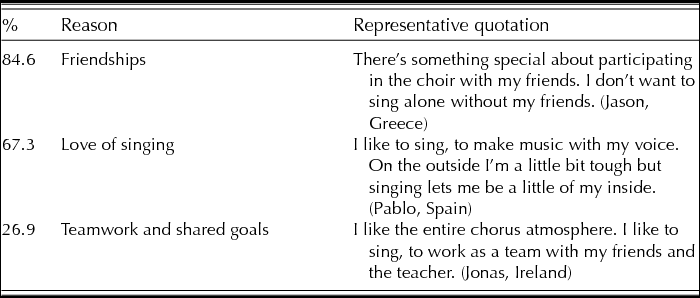
Boys did speak directly of positive peer influence as a reason for singing activity in school. Antonio (Spain) mentioned ‘without the interest of my friends I probably would not have joined the choir’, and Dara (Ireland) related ‘I first joined the choir because of encouragement from friends. I had a few friends in the choir and they all said, you should do it, because it was cool.’ Philip (England) characterised the influence differently: ‘I don't know if it's so much peer pressure, but it's more about inertia, a desire to be with a group of people you like and who like you.’ As shown in Table 3, a strong majority of boys who sang continuously indicated that personal friendships provided the primary motivation for group singing.
Continuous Singers: Why Do I Sing?
Notes: n = 48. Per cents exceed 100 because boys often gave more than one answer.
Imagining
The final stage of the conceptualisation phase is the imagining of possible selves, accompanied by identification with areas of strength and interest, and disassociation with areas of perceived weakness or disinterest. This stage often precedes the transition to high school. Boys in these studies emphasised several ideas associated with future-oriented imagining, including identification with older male role models, critical self-awareness and how childhood singing might influence subsequent musical participation.
Role models (peers and older males). Almost without exception, the younger boys in these studies emphasised the importance of a choral experience characterised by teamwork and collaboration with friends. High school choral singers similarly reported that they initially joined with their friends, but the motivational emphasis eventually turned toward healthy competitiveness and the development of personal musical/vocal skills.
An interview with Axel, an Irish boy in lower secondary, was interrupted by the sounds of a rehearsal for West Side Story in an adjacent room. Axel was intrigued by the sounds of older boys singing, and he asked to sit in on the rehearsal for a few minutes. The conversation resumed, and Axel commented:
It seemed really, I dunno, masculine, I guess. Some fellas sitting on the table, and the way that they sang . . . man, if I was able to sing like that, I’d be very proud of my voice. One fella, his voice was so strong and he really stood out for me because he was able to sing smoothly and perfectly, and his voice was powerful. Everybody seemed like friends, like they were having a good time. I think I’d like to be one of them someday.
Of the boys who had withdrawn from singing activity, none could remember having a male vocal role model. In contrast, 86% of the consistent singers reported having a specific, identifiable male role model for singing. These were most often fathers and/or older brothers, followed closely in frequency by aspirational peers who were four to five years older. Younger boys most often looked up to these aspirational peers for examples of ‘overall person’, ‘confidence’, ‘strength’, and ‘manliness’. When older boys spoke of their aspirational peers, they also referenced confidence, but inferred that the confidence resulted from a work ethic that developed qualities of mastery, knowledge and overall musicianship. A Greek high school boy named Thanos was identified as a role model by all other boys interviewed from that school. All lower secondary boys referenced his confident personality, and all high school boys referenced the quality of his singing. Thanos reported that he was surprised to learn he was a role model, particularly because he was consciously trying to emulate the confidence he had earlier seen in his older brother. Thanos advised that ‘students need role models who understand their ideas about music, this is very important. Younger boys need older boy singers to look up to.’
Role models also provided strategies for achieving goals. For instance, David (England) drew on his brother's experience when he outlined an elaborately detailed plan for balancing music, sports and academic pursuits during his future years as a university student.
A recurring issue raised by more than half of the boys from England, Ireland and Greece was the potential for male singers to be perceived as ‘gay’, ‘faggots’ or ‘queers’. Spanish boys did not raise this issue. This issue did not appear to impact the singing participation of lower secondary boys, but those interviewed for these studies said it did factor in the decision to continue or withdraw from singing activity at the point of transition to high school. Once enrolled in high school singing activity, boys seemed determined to withstand any taunting from peers. Several boys referred to the positive television role model of the gay character Kurt (Glee), while others reported specific support from their parents. Three boys from the England and Ireland cohorts reported choir-related, sexuality-focused verbal bullying and physical harassment. All three gave permission for the researcher to inform their school administrators as per ethical guidelines agreed upon prior to the studies. One of the Irish boys put it this way:
Yes, I’ve been bullied. In many cases, being part of the chorus means you’re more feminine, or you have different thoughts about singing, about boys and girls, about everything. I don't really care what they say. Sorry, but I don't give a shit about what the others say. I go to the chorus because it doesn't matter there.
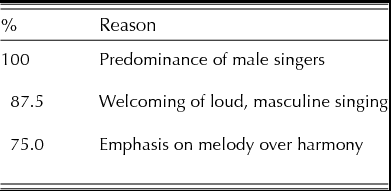
Despite these comments, all but one of the boys who raised the issue of sexuality reported that the overriding problem was a common perception of choral singing as a feminine activity. For these boys, the feminine/masculine subjectivities were the primary concern, with sexual labels used as the default words for name-calling and harassment. The role of masculinity was highlighted in the reasons given by Greek high school boys who chose to participate in their school's Byzantine Ensemble rather than the classically oriented choral ensembles (Table 4).
Greek HS Boys: Why Do I Prefer Byzantine Ensemble over Choir?
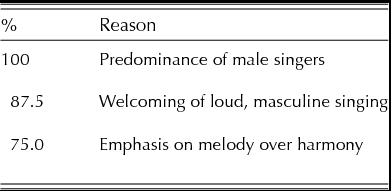
Note: n = 16.
Self-criticism/embarrassment. The transition from lower secondary to upper secondary school occurs at the same time that many boys experience the peak stages of the voice change process. Some boys viewed their voice as damaged and decided not to reengage in singing during high school. Nick (Spain) commented that his voice would be ‘destroyed’ if he sang while it changed, and Max (Greece) spoke of singing in the bathroom so only he could hear the result.
Loss of identity during voice change. Many boys in these studies, representing all country-based cohorts, referred to a sense of loss when speaking about their voice change. Boys like Frederick (Ireland) said that an early onset of voice change was ‘disadvantaging’. Frederick related:
Sometimes in my room I just sing a little song. I used to be quite good, but now I’m not. I’m sad, because I kind of liked singing high notes when I was good. Everybody said I was good. Then, when I got to year six and my voice started cracking, my teacher took my part away when I couldn't sing the high notes. I even had it learnt by heart. So, music became something I wasn't good at anymore.
Gabriel (Greece) said ‘My voice change was like torture. I had the most precious thing taken from me. My soprano voice.’ Michalis (Greece) agreed:
I was singing at school when my voice changed. I could sing solo and everybody liked it. Now I don't want anyone to hear me, even at home. Not even my parents or friends. So when I want to sing I sing silently.
One English boy, Steven, related that he had ‘loved my high voice very much’ and later took flute lessons so that he could play the notes that had been ‘taken away’ from him. Ruaidhri (Ireland) commented:
I think boys should be encouraged to embrace their new voice, to celebrate their individuality. Of course, though, they need to know about their voice change and why it's happening and what they can do that they couldn't do before. If boys have a bad experience during this time, they’ll just quit. It happens all the time at this school. Those who struggle just quit.
Musical quality. Many boys attributed their attrition from choral music to low levels of musical quality in choral performance and repertoire. Sometimes this resulted from perceptions that boys with changing voices hindered the musical product. David (England) found his choir with changing voices to be ‘irritating and annoying’, while others like Chris (Spain) found fault with teachers who don't choose music that fits the boys’ ranges. Chris said:
When you have to sing the F and the G above middle C and those are hard, the teacher says we can do it playback. That means we should mouth the words and not sing. So, for the good of the class, we don't sing. We should have music that fits our voices, not music for little boys and girls with high voices.
Daniel (England) said that when there aren't notes for boys like him to sing, he and his friends will just ‘sit there and look at the dirt on the floor’. Other boys spoke specifically to repertoire, with Donncha (Ireland) commenting that some younger boys are embarrassed when they have to sing ‘happy-go-lucky songs like ‘Walking on Sunshine’ while the high school choir singers are doing, actually, really intense stuff’. Falvers (Ireland) spoke to the need for high musical standards, saying ‘I don't like when something is unfinished or unsure. I don't like that’. Peter (Spain) reiterated:
It's all about the musical quality. Guys just want to be good at what they do, and they’ll keep singing if they’re good at it and proud of their choir.
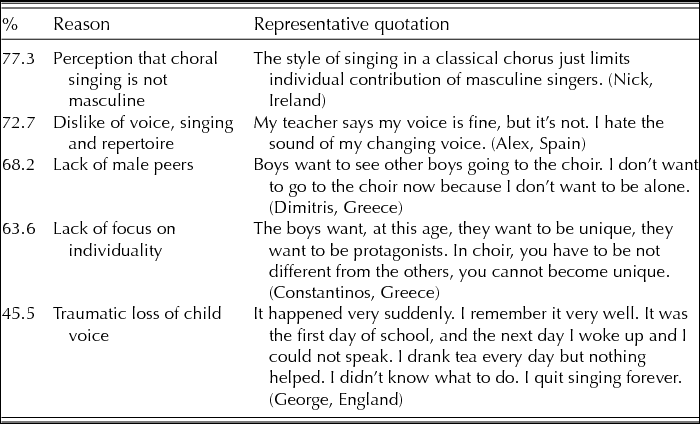
Boys most frequently withdrew from choral singing at the point of transition from lower secondary school to upper secondary school. The most frequent reasons given by those who withdrew are presented in Table 5.
Why Did I Withdraw from Choir?
Notes: n = 22. Per cents exceed 100 because boys often gave more than one answer.
Reflecting
With this stage, individuals begin to plan for the realisation of possible future selves. This is often accompanied by the identification of possible selves that are easily achievable, those that are not, and what obstacles may need to be overcome toward the realisation of a hoped-for possible self. This stage often follows the transition to high school. The boys in these studies spoke clearly of their perception that teachers often emphasised the quality of choral performance at the expense of individual singing skill development, potentially creating obstacles toward the realisation of singing goals.
Skill-based instruction. Participants in these studies made strong statements about their desire for better singing skills, with many like Victor (Spain) initially joining choir ‘for improving my voice’. Many boys of all ages and from all four countries expressed a desire for singing instruction to be separated from choral performance, especially during the time of voice change. Fernando (Spain) said ‘Just because boys want to learn to sing doesn't mean they want to sing onstage in a choir’, and Antony (England) referred to the intertwining of personal identity and singing as he commented ‘teachers should help boys use their body's natural instrument [voice] because boys find it easier to play artificial instruments like piano and violin’ that can be physically manipulated and independently practiced.
Repertoire. Antony followed these suggestions by referencing the additional challenges posed by repertoire:
I think voice is a hard thing to master, so when you combine that with songs nobody likes, boys like me just give up. I mean, really, how many obstacles do you expect me to deal with at once? I just want to learn how to sing the melody line well. Or, to create harmonies myself. It's also harder to read the scores, so you have an unfamiliar sounding part, and unfamiliar looking part, and a voice you don't know how to work. It's next to impossible.
Other boys agreed:
I think it helps boys when they can sing music they relate to more instead of being completely isolated to classical music. They have to sing with a new voice and sing songs they only hear in school. Yeah. Can't we just learn to sing? (Nasos, Greece)
If you could get a guy interested by singing the music he liked, he’d be much more likely to carry on singing music that he wouldn't have enjoyed earlier. Start with songs that people would actually like. (Lynch, England)
Growing
This stage is characterised by the development of action plans to achieve a hoped-for possible self. The boys in this stage were all high school students who had successfully self-identified as singers throughout their adolescence. They relied heavily on their peers for support while simultaneously seeking to express autonomy through the articulation of evidence-based opinions about musical quality and instruction.
Autonomy, independence and camaraderie. Even the boys who continued to sing frequently stated that they disliked the autocratic format of choirs. Ciaran (Ireland) preferred to sing in a band with his friends because he disliked ‘someone else being in charge of my singing’. David (England) said ‘Nobody pays attention to the singers in choir. They only notice the conductor. We’re anonymous in the choir. But, I’m not anonymous on the rowing team, so that's why I prefer sporting activities’. Kevin (Ireland) agreed: ‘If teachers could help boys be unique in choir, unique with their voices, they would participate more, I believe.’ Several of the older boys said that they were ‘very close’ with their fellow male choral singers, drawing upon them for feedback and support while learning and performing. Others, like Oliver (Greece), said that they would join a vocal ensemble of some kind if they could be certain it would include others like them. Looking toward the future, Oliver said: ‘If I still like rap by the age of 26 then I will want to start a rap group. Men who feel insecure about their singing might like to join this type of choir to get together, to meet each other.’
Musical quality and rehearsal pedagogy. Older boys placed a premium on the quality of their singing performances, whether in independent ensembles/bands or in choirs. According to Panagiotis (Greece):
The musicianship is the most important thing. It is more important right now than friends, than what people may think. I do this because I want to do it and because it has very high standards of musicianship.
Other boys valued the musical capabilities of their newly changed voices. Alejandro (Spain) liked being able to ‘mix voices, low and high’ and Alex (England) agreed, saying ‘I like singing tenor because we have to support the others with our beautiful sound. The tenors are powerful and sing with energy, not like our old soprano voices which were very light’. Evan (Ireland) commented, ‘I enjoy the sense of achievement you get when it just sounds so perfect from maybe 80 or 100 people singing at the same time; it's kind of amazing’.
For these boys, the development of a future possible self involving choral music was related to their conceptions of the time that would be spent in rehearsals. Desirable rehearsals would be need to be ‘helpful’, ‘energetic’, ‘fast’, ‘cooperative’, ‘involving’ and ‘focused on us more than our mistakes’. As Minos (Greece) stated:
If you say to a boy or man singer in rehearsal ‘what you did is wrong’ he won't do this again. He’ll lose his patience. But if you say, ‘ok, that was good but try to do this and that to make it better,’ then you make him more confident, and make him believe that he can do sing better. That's the most important thing.
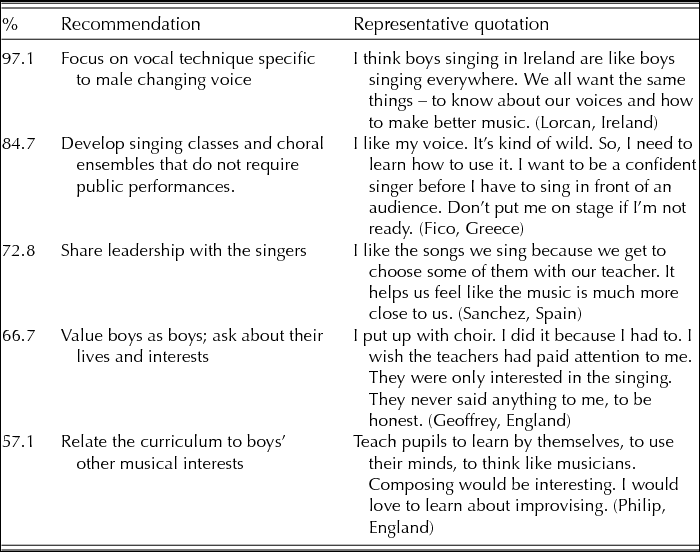
The boys who had sung continuously (n = 48) made several recommendations for choral teachers, with the most frequent summarised in Table 6.
Boys’ Recommendations to Choral Teachers
Performing
This final stage is one of monitoring progress toward the development of a hoped-for possible self. The boys in these studies who were in this stage were all preparing to finish high school and journey toward adulthood.
Connections beyond school. Many of the boys who had sung continuously since childhood envisioned choral singing as part of their lives as young adult men. Adon (Greece) had sung in school choirs until his voice changed and community choirs since that time. He used the example of other boys to guide his development as a singer and role model:
Chorus helped me find parts of my character. It was the beginning of learning how to improve myself. I learned mostly by watching other boys. Now my brother watches me!
John (England) added:
Having friends of different ages in the choir helps you to feel a little bit more confident and I now sing in many choirs beyond school. The best thing about singing is that you can do it anywhere with anyone.
When asked what he would miss about choir when he graduated, Aitor (Spain) answered, ‘Being with people that you have love for, enjoy meeting up with, and having as your friends.’
Continuous and non-continuous participation. These boys broadly emphasised the development of vocal skills so that they could sing whenever and wherever they wished. Daniel (England) emphasised:
I don't see myself continuing with singing when I graduate to university studies, but certainly for enjoyment and social contacts in the future. I’m hoping to go into medicine and that's really stressful and competitive. I’ve used choral music at school as a way to improve myself, to help with stress relief. I’ll need that in the future. Choral music gives you something else to do. It's an hour a day where life is just about singing.
Conclusions and implications
The European boys in these studies indicated that the interruption in singing most frequently occurs at the point of transition from junior to senior high school. This is similar to previous studies of boys in the United States, except that school systems in the United States often prescribe an additional transition from primary (elementary) to lower secondary (junior high/middle school). Boys in these studies did not indicate that they withdrew from choral singing because they transitioned between schools, but because they did not hold the domain of ‘singer’ or ‘choral singer’ to be one of their possible or desired future selves. When viewed according to the stages of Possible Selves development, the interruption aligns not only with transitions between schools but with transition from the stage of ‘imagining’ to the stage of ‘reflecting’. In this sense, the transitions can be seen as developmental, providing educators with opportunities to reinforce the development of positive possible selves across stages rather than attributing singing interruptions merely to the structures and designs of schooling. This shifts the view of transition toward a longitudinal process that boys experience regardless of the school in which they are enrolled.
Based on these interviews, three factors appear to determine boys’ attitudes toward choral music and their continued participation in singing activities. The first is the teacher, specifically the teacher's personality and interest in adolescent males, the employment of appropriate pedagogical techniques for boys with changing voices, and an educational philosophy that compels the instruction of young men across all phases of vocal and identity development. The second factor is the predominance of high levels of musicianship on the part of the teacher and in the singing experiences of boys. Strong musicianship builds the satisfaction and pride necessary for boys’ development of positive musical identity. The third factor is the social environment experienced by boys before and during adolescence. These boys suggest that they rely on robust levels of peer support and the positive influence of older male role models. As with previous research, these studies indicate that many boys initially engage in singing activity because of their friends, and that they will continue if their friends continue singing.
This research suggests that boys’ experiences are specific to individual teachers and schools rather than influenced more broadly by culture, nationality or language. Pedagogical implications can be drawn from the observation that the boys’ progress through the stages of Possible Selves development was generally correlated with their ages. The first three stages (developing, thinking, imagining) occurred during the lower secondary years (approximately ages 11–14); the transition from ‘imagining’ to ‘reflecting’ occurred at the transition to high school; and the final three stages (reflecting, growing, performing) occurred during the high school years. In broader terms, lower secondary-aged boys are developmentally ready to envision future possible selves related to singing and choral music. The realisation of a future possible ‘singing self’ occurs during high school with the autonomy that accompanies later adolescence (Freer, Reference FREER2010).
The comments of these boys reinforce findings from other research indicating that the interruption in singing activity most often occurs at the transition between lower secondary (junior high school) and upper secondary (high school), just as most boys experience the peak of voice change (Cooksey, Reference COOKSEY, Thurman and Welch2000; Harrison, Reference HARRISON2010; Elorriaga, Reference ELORRIAGA2011). And the interruption is often concurrent with the developmental readiness to make decisions about how their strengths, affinities and weaknesses will affect choices of friends, activities, and academic pursuits (Freer, Reference FREER2012).
Teachers might consider planning their support of boys with changing voices according to the themes raised within the progressive stages of Possible Selves development. For instance, a boy nearing the end of lower secondary (junior high school) – in the stage of ‘imagining’ a future singing self – needs older role models, protection from embarrassment about the voice change, reassurance about the singing voice that is yet to emerge from the voice change process, and a focus on musical quality at every turn. The topics associated with each stage could provide a guide for teacher support of boys and singing at different points in time.
The comments of these boys provide a window into the thinking of adolescent males about their developing identities as singers and choral participants. The data suggest that the development of musical identity is related to the typical timing of the voice change. Additional research is needed to determine how boys who withdrew from school choral singing might return to the activity, and what factors in the development of possible selves might facilitate these boys’ reengagement with singing activity at a later point during adulthood.
Patrick K. Freer is Professor of music education in the School of Music at Georgia State University, USA. He is presently Academic Editor of Music Educators Journal.