‘Zomia’ and process geographies
For several decades, geographers and other social theorists have challenged traditional notions of space, arguing that human geography is dynamically transformed through historical processes. In the first place, there is ongoing interest in the ‘production of space’, a concept proposed by the sociologist Henri Lefebvre and developed by geographers such as Neil Smith.Footnote 1 Anchored by materialist approaches to human society, these studies demonstrate how political and economic activities produce the geographical spaces and their representations in which we operate. A second French tradition – the Annaliste (particularly Braudelian) approach – continues to inspire inquiry into the cultural and economic ties that shape world regions.Footnote 2 For historians, these are noteworthy because both approaches seek to historicize geographical studies while offering critical spatial analysis, and it is no wonder that both underpin efforts to understand Asia’s past. Lefebvre has informed Manu Goswami’s superb work on South Asia, while the Braudelian approach has left a major impact on Southeast and South Asian studies. More recently, it has inspired Wim Van Spengen’s fascinating reconstructions of the Inner Asian/South Asian borderlands.Footnote 3 And both traditions underpin the ambitious proposals for ‘Zomia’ studies.
First defined by Willem van Schendel, Zomia is an alternative world region, bringing together spaces and peoples marginalized in mainstream academia. As with Jean Michaud’s ‘Southeast Asian Massif’, Zomia encompasses the transnational highland peoples of eastern India, mainland Southeast Asia, south-west China, and the high plateaus and ranges of the Himalaya.Footnote 4 Because these areas cross traditional Asian studies regions (Central, East, South, and Southeast Asia), the concept is designed to challenge institutionalized regional studies configurations. Such a proposal is exciting, although the creation of a new region, if implemented without nuance, may lead to simplifications mirroring past Orientalist writing about South or East Asian civilizations. Van Schendel offers several options to avoid this trap, including employing methodologies built upon Lefebvre’s original insights: if, as some contend, geographical spaces are neither fixed nor historically stable but are provisional outcomes of social action and conflict, then we must combine history and geography to recapture the dynamism of spatial production.Footnote 5
In this spirit, this article reconstructs trade flows across several sectors of Zomia. Instead of beginning with Zomia and seeking ways of delineating its common attributes, however, the article employs what Arjun Appadurai calls process geography. Writing in opposition to the use of ‘trait geographies’, which emphasize language, culture, or other attributes affixed to a people or a space, Appadurai endorses
an architecture for area studies that is based on process geographies and sees significant areas of human organization as precipitates of various kinds of action, interaction, and motion – trade, travel, pilgrimage, warfare, proselytisation, colonisation, exile, and the like. These geographies are necessarily large scale and shifting … Put more simply, the large regions that dominate our current maps for area studies are not permanent geographical facts. They are problematic heuristic devices for the study of global geographic and cultural processes. Regions are best viewed as initial contexts for themes that generate variable geographies, rather than as fixed geographies marked by pregiven themes.Footnote 6
In his original critique, van Schendel envisions Zomia as just such a heuristic device designed to challenge the intellectual underpinnings and institutions for Asian area studies and to open the door for process geographies. He notes how global processes cut across traditional spatial categories, causing many to question inherited geographical scales, including the post-war inspired division of eastern Eurasia into the regions and disciplines of Asian studies. The institutionalization of these regions has produced scholarship capable of investigating certain preconceived geographical scales, including civilizations (East or South Asia), nations or empires (China, India), or regions (mainland Southeast Asia). But if geographical scales – the spatial configurations of power, culture, and economy – are not fixed, and are instead produced through historical processes, then the inherited scholarly traditions and institutions are ‘ill suited to deal with human activities spilling over’ the boundaries of civilization, state, and region.Footnote 7
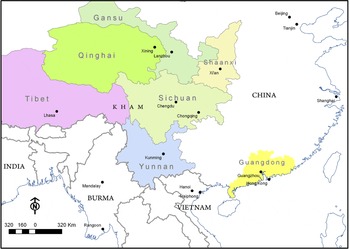
One way to deal with spillover is to analyse things and people in motion, although this is a major undertaking because people on the move might not record their motion; or their records may reside in different places. To make this topic manageable, I focus on nineteenth- and twentieth-century trade ties that linked the Zomian communities in Kham (south-east Tibet) with China’s Sichuan and Yunnan provinces and mainland Southeast Asia (Figure 1). It is impossible, however, to overlook these areas’ links to the greater Himalayan region and India, to north-west China’s Qinghai and Gansu, and to distant Shanghai and Hong Kong; thus, these connections will be mentioned as well. In practice, then, this is an initial effort to evaluate trade flows among areas traditionally labelled East, Inner, South, and Southeast Asia.Footnote 8
States, provinces, and cities mentioned in the text. Sources: ESRI Data & Maps [CD-ROM], (2009). Redlands, CA: Environmental Systems Research Institute. Available: Wellesley College Library. CHGIS Data [CD-ROM], version 1.0. (2002). Cambridge, MA: Harvard Yenching Institute.

Since this article is an exploration into process geographies, it does not fully survey communities in the Zomian regions mentioned. Kham, for example, has a complex social and political history. Considered one of Tibet’s historical provinces, its administration has, for at least three centuries, often been divided among Tibet and the Chinese provinces of Yunnan and Sichuan. Local Tibetans, often called Khampas, share many connections with central Tibet, but also developed unique political and cultural practices, including, as Matthew Kapstein writes, local political entities enjoying ‘a high degree of autonomy’.Footnote 9 In fact, the idea of autonomy seems to contribute to Khampas’ narratives of self-identification.Footnote 10 While my larger project will explore the intricate connections between mobility (broadly construed), on the one hand, and long-term social and cultural change in trading towns and their adjacent Zomian highlands, on the other, this article focuses on the foundations of the trade itself – the trading networks – and provides only an initial analysis of impacts on local societies in Kham and elsewhere.
An investigation of nineteenth- and early twentieth-century trade requires more than an investigation into individual peddlers. Those involved included merchants, officials, lamas, and hereditary leaders hailing from Kham, Tibet, Shaanxi, Sichuan, Yunnan, France, and South Asia. These people represented states (Tibet; imperial China and, after 1912, its successor regimes), local polities or administrative sectors (Kham’s Chala region, Sichuan Province), collectives based on home province or ethnicity, and commercial firms. Thus, the movement of goods relied on networks of political and economic power linking human beings across space and allowing them to influence commercial changes throughout broad expanses. In other words, these networks allowed the powerful to ‘act at a distance’.Footnote 11
The concept of acting at a distance comes from network theorists who, like those studying the production of space, probe global capitalism’s development by evaluating how individuals and groups create and maintain relationships of power across different geographical scales, whether local, regional, or global.Footnote 12 An advantage of network theory is its catholic coverage of institutions, whether political, religious, or commercial. For instance, we need not privilege the imperial Qing state (1636–1912) or its ‘republican’ Chinese successors (1912–49), although we must acknowledge their power. Nor must we focus exclusively on businesses, whether international or local. Instead, we can evaluate traders within the context of their fluid, intertwined networks.
The emphasis on networks has several advantages. It avoids any tendency to create Zomia as a new world region, complete with its own simplified trait geographies and unconnected to developments in the world around it. It also begins to unveil the mechanisms that humans built for interaction – between highland and lowland, inland and maritime, Tibetan and Chinese. The focus on networks, moreover, reveals alternative approaches that both complement and challenge James C. Scott’s conclusions in his new book on Zomia, The art of not being governed. While Scott emphasizes both the role of trade in Zomian communities and interactions with powerful states, his analysis concentrates on the important issues of local autonomy and agency. For him, Zomia represents a region in which states had little power before 1945; it was, in fact, a place where cultures and lifestyles were designed to resist states: ‘Virtually everything about [Zomian] people’s livelihoods, social organization, ideologies, and (more controversially) even their largely oral cultures, can be read as strategic positionings designed to keep the state at arm’s length.’Footnote 13 It was not, we are told, until the late twentieth century that states gained the technologies (of transportation, communication, etc.) to control mobile, highland peoples. They could then ‘monetize the people, lands, and resources of the periphery so that they become … auditable contributors to the gross national product’.Footnote 14 In many ways, therefore, the highland people of Zomia were ‘relatively free’ and, even when they accepted tributary status or changed their cultural practices to imitate lowland (state-making) groups, Scott implies that this was an instrumentalist (and therefore rational?) choice that did not contradict the overall goal of resistance nor the control that Zomian communities had over their destinies.Footnote 15 This argument suggests that the one great turning point for Zomia’s people arrived in the mid twentieth century, and that the beginning of the end for institutions of freedom and cultures of resistance was the building of nation-states in Southeast Asia and communist China.
There is much to learn from these conclusions, but there is also room for alternative interpretations. Until the 1950s, most areas of Zomia were not governed by modern nation-states but were, as Scott notes, subject to the indirect rule of empires such as Qing China, Kon-baung Burma, Britain, and France. Nevertheless, networks of state and commercial power did snake through the highland regions, however tentatively, and local peoples had to take notice. This was true in the mining areas of eighteenth-century China and Vietnam, as well as in the grasslands, trade markets, and border customs stations that were linked through the twentieth-century trade networks discussed here. From early times, merchants from many backgrounds developed institutions to buy, sell, and transport resources across the rough lands and long distances of Zomia. This was often accomplished in collusion with political representatives and local elites, meaning that, even in eras before the arrival of nation-states, commerce helped bolster powerful social, political, and religious hierarchies, whether local, Chinese, or Tibetan. In placing networks at the centre of this story, then, we can begin to analyse how vectors of power entered Zomia, even before 1945, meaning that the rise of the nation-state (while still vastly important) cannot be viewed as the signal historical moment.
The study of trade flows also allows us to cross the artificial conceptual boundaries of the Asian studies regions. It is possible to trace the emergence of networks that linked together peoples and places, creating a trans-frontier economic space that might be called Zomia, although this may be a misnomer because the space comprised highlands and valley even as its constitution changed in response to regional and global contingencies. In particular, this article demonstrates how merchants, including those from peripheral (‘Zomian’?) communities in north-west Yunnan with a background in the Kham trade, innovated to create new networks linking Inner Asia’s Kham highlands to East Asian metropolises and to South and Southeast Asian ports.
In order to construct and maintain commercial ties, traders innovated and adapted. One category of adaptation included acculturation and the development of institutions to facilitate cross-cultural contacts. Another type included the development and implementation of new business practices that allowed men from communities of Zomia to flourish in the colonial ports of Burma, Indochina, India, and Hong Kong – where they and their firms could develop an interface with the globe. Processes of acculturation and adaptation were complex and multidirectional, but they reveal that Zomia was not just a place shaped by cultural refusal or the avoidance of external institutions of power, whether state or commercial. Local peoples had to reckon with states and commercial networks, and such reckoning meant acquiring new practices, whether language acquisition or other changes. The incentives for such change included the desire to access, rather than avoid, networks of power and wealth.
Finally, the emphasis on trade flows and networks demonstrates how process geography can be a tool for recovering spatial relationships and geographical representations that became hidden in the post-war era. The Yunnan merchants who built businesses across China, Southeast Asia, and Tibet arranged their activities, networks, and even lifestyles around movement through spaces that included Mandalay, Hong Kong, Lhasa, and even India and Europe. Those movements, however, proved to be fundamentally at odds with other powerful historico-spatial trends, including new visions of national space emphasizing China’s boundedness, and they were destroyed after 1949, when the creation and enforcement of national boundaries temporarily triumphed.
A brief history of trans-Zomia trade
For centuries, the people of Zomia traded at various geographical scales. Most exchanges took place over short distances: highlanders traded forest or animal products with valley-dwellers to gain grain, tools, and cloth. Long-distance exchanges were also driven by ecological differences. Perhaps the best documented has been Inner Asian exchanges of horses and animal products for East Asian textiles and teas.Footnote 16 However, extensive exchanges between south-west China, Southeast Asia, and south China also date to ancient times. Yunnan’s Dali kingdom (937–1253) exported horses first to Vietnam and later to its eastern neighbour, Song China.Footnote 17 This represented a pattern in which inland areas, specializing in forest, animal, and metal products, engaged with south China’s and Southeast Asia’s maritime economies, which provided textiles and tea.
Tibetan regions, including Kham, were intimately involved in early trade. In the seventh century CE, traders were already moving gold and musk along routes linking Lhasa with both East and South Asia.Footnote 18 From the thirteenth century, Shaanxi and Muslim Chinese (Hui) merchants became deeply involved in the Tibet trade. As the Mongol Yuan court forged ties between Lhasa and Beijing, for instance, Shaanxi merchants built on these connections to trade in tea, wool, musk, cloth, and medicines.Footnote 19 As important as these commercial ties were, however, the volume of goods was relatively small when compared to later times.
By the beginning of the eighteenth century, quantitative and qualitative changes to long-distance trade had emerged. Denser merchant and state networks were built into highland areas in order to facilitate sustained and high-volume transportation of bulk goods. Responding to increasing demand among growing migrant communities in Yunnan, for instance, Han and Hui merchants imported tremendous amounts of raw cotton, purchased at markets in Burma’s and Siam’s territories.Footnote 20 As commerce grew in early modern Eurasia so did the demand for copper cash, which was fuelled by economic activity throughout the South China Sea. At this point, south-east Yunnan mines increased output, and Vietnamese merchants came to purchase copper at the Vietnam–China border.Footnote 21 When Japan limited copper exports in 1715, bronze coins became increasingly dear as cash shortages plagued the South China Sea trading world.Footnote 22 Demand for copper cash drove both northern Vietnam’s Trinh rulers and the Qing into the Sino-Southeast Asian borderlands, where veins of copper ran from north-east Yunnan’s hills to those of northern Vietnam. The Qing and Trinh promoted mining, which attracted tens of thousands of Chinese miners to the Zomian highlands.Footnote 23 Mining in Yunnan and northern Vietnam helped fuel commercial growth throughout eastern Eurasia but it also provoked profoundly localized and lasting demographic, political, and economic changes in the mining areas.Footnote 24
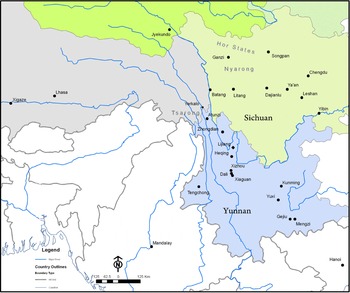
The highlands of Inner Asia experienced similar trends toward state- and merchant-led penetration. The early Qing government continued to promote tea–horse exchanges and allowed private merchants to participate. By the beginning of the eighteenth century, Sichuan’s private markets had begun to outsell the official tea–horse markets further north. This did not signal state withdrawal from commerce, however. In response to the Dalai Lama’s request, the Kangxi emperor designated Dajianlu (also known as Tachienlu, Dar-rtse-mdo, Kangding) an official trade market in 1696, and merchants from all over China came to deal in tea, which the Qing state managed through a permit system (Figure 2). Based on the number of permits issued, the trade between Chinese and Tibetan merchants in Kham rapidly increased.Footnote 25
Kham regions and towns mentioned in the text. Sources: ESRI Data & Maps [CD-ROM], (2009). Redlands, CA: Environmental Systems Research Institute. Available: Wellesley College Library. CHGIS Data [CD-ROM], version 1.0. (2002). Cambridge, MA: Harvard Yenching Institute.

In the eighteenth century, moreover, the Qing state extended its control over Kham’s rGyal-rong kingdoms through a series of military campaigns in the 1740s and 1770s (the Jinchuan wars).Footnote 26 In the troops’ wake marched merchants, many of whom operated out of Dajianlu. From this time forward, Dajianlu was one of several trade markets that were central to the Tibet–China trade, and Shaanxi, Hui, Sichuanese, and Yunnanese merchants all moved in to establish long-lasting commercial institutions.Footnote 27 These eighteenth-century trends were reflected in nineteenth-century practices; one example is the Kham town of Litang (Lithang). Located at an altitude over 13,000 feet, Litang’s climate could not sustain agriculture, and its people imported grains from lower-altitude areas. Such localized exchanges were nothing new, but Litang also became involved in long-distance trade networks. The pastures around Litang provided fodder for sheep, its wild lands sheltered deer, and its rivers produced gold dust. As sustained commerce emerged, Litang was drawn into networks that brought its commodities to distance places: by the nineteenth century, great flocks of Litang sheep, destined for dinner tables in Chengdu, were driven out of the highlands each August. The women of Chongqing purchased toilet powders made with Litang deer antler; and Litang gold was brought to Dajianlu before being shipped into China.Footnote 28
If the eighteenth century witnessed an increasing penetration of state and merchant networks, the nineteenth and twentieth centuries saw another broad transition. European conquests in Burma and Vietnam, as well as the expansion of European influence in South Asia and China, brought new opportunities to link with international markets. Caravan firms, which had managed the trans-Zomia trade, responded by increasing their geographical scales of operation, bringing their representatives, organizations, and goods into the markets of east China, Southeast Asia, and India. Thus, tin from the Yunnan uplands, wool from eastern Tibet’s Kham and Amdo (Qinghai), and musk from the Sichuan–Tibetan highlands were increasingly shipped to Asia’s ports, often for export abroad.
As East and Inner Asia became more deeply enmeshed in global trade networks, the routes from Tibet to Gansu became key trade highways for wool. From the 1880s through to the 1930s, trade flourished as first Mongols, Tibetans, and Chinese (both Hui and Han) and later Europeans, Americans, and Japanese organized the purchasing and shipping of wool from the Inner Asian grasslands through Gansu or Sichuan to Tianjin, where wool was exported abroad.Footnote 29 At the same time, Chinese and foreign firms invested in south-east Yunnan’s tin mines. Tin ore was mined by local furnace companies (luhao) and then taken by mule or human porter to Gejiu. There, both French and Chinese firms purchased tin and, after the opening of the Hanoi–Kunming railway in 1910, shipped it by rail to Haiphong, where it was loaded on steamers bound for Hong Kong and sold on the international market. Major companies, including Jardine Matheson and Mitsui, handled the sales in Hong Kong.Footnote 30
During the same period, Kham began to trade with the world: its wool and musk were exported to British India,Footnote 31 Southeast Asia, Shanghai and Hong Kong, and beyond. While French firms sent representatives to Shanghai and even to Yunnan to purchase musk, Yunnanese firms were transformed to operate on geographical scales that took their representatives throughout China and other Asian regions. The best known of these firms was Xizhou’s Yongchangxiang, which was started as a partnership in 1903 by Yan Zizhen (allegedly an ethnic Bai or minjia), Yan’s relative Yang Hongchun, and Peng Yongchang, a Jiangxi native who had met Yan in Sichuan. Initially, the partnership operated on a relatively small geographical scale, exporting Yunnan tea to Kham, importing textiles from Sichuan, and buying Tibetan mushrooms and musk to sell in Yunnan. As capital and business increased, Yan parted with Yang and Peng, developed new partnerships, and established branches in Burma and India. His companies imported foreign textiles and exported musk, raw silk, tea, and bear paw to Southeast and South Asia.Footnote 32 Such a story was not unique, and Yongchangxiang was only one of a number of pre-war Yunnan businesses that operated across international (and areas studies) boundaries. Their emergence demonstrates how firms with origins in the trans-Zomia caravan trade could be built into complex international companies. The rest of the article places this transition into historical context.
Trade routes and goods
Inner Asia’s Tibetan lands were linked to south-west China’s Sichuan and Yunnan provinces through a number of routes. The most important went through Songpan and Dajianlu, although Atunzi (Deqin, Deqên) was another town that saw valuable trade goods transported to Yunnan’s Lijiang and Dali trade markets.Footnote 33 As on the northern routes that led from Tibet through Xining, Lanzhou, and Xi’an, wool was a significant trade item, but more important goods for these southern routes included opium, which has been explored by numerous authors,Footnote 34 pack animals, tea, musk, silver, and medicinal products. Since many commodities were shipped via pony, mule, donkey, or yak, the raising and selling of pack animals was central to the operation of these trade networks. Many ponies and mules were raised in Kham and Amdo before being shipped to markets in Dali or even further south; ponies were also raised in Sichuan and Yunnan, their sale being central to large fairs in places such as Lijiang.Footnote 35
For centuries tea was the most crucial commodity linking Tibet to China. It was imported into all regions of Tibet, and much of it came from Sichuan’s Yazhou (Ya’an) region, although some came from southern Yunnan as well. Yazhou ‘brick tea’ (zhuancha) consisted of tea leaves along with the stems and branches of tea bushes and other plants. These ingredients were chopped, dried, and then steamed before being packaged into twenty-pound bricks.Footnote 36 Although technically a green tea (because steaming arrested the oxidation process), brick tea was recognized as a unique product for Kham and Tibet. Dajianlu was a major trade market for brick tea and, by the nineteenth century, the volumes of tea traded there were large. Various estimates placed annual amounts at over 10 million lb.Footnote 37
A second important trade item was musk, which was exported from the Kham highlands to China and the world. Musk is taken from the glands (‘pods’) of the male musk deer. Long considered an ingredient for perfumes in Europe, it is still valued in China and Korea as a treatment for the cardiovascular system – so much so that over-hunting threatens most musk deer species.Footnote 38 While there are multiple species of musk deer, it is the Black and Himalayan musk deer (Moschus fuscus; M. chrysogaster) that are found in Yunnan, Kham, and Tibet.Footnote 39 And it was Kham musk (often called ‘Tonkin musk’) that came to be prized by Europeans.Footnote 40 As a global trade in perfumes expanded in the 1840s, Europeans gained access to Tonkin musk via Guangzhou.Footnote 41 Almost eighty years later, in 1919, Austin Clements estimated Dajianlu’s musk trade to be the largest in the world, and the main consumers, in addition to Chinese, were Americans, Europeans, and Japanese.Footnote 42
The supply of musk to world markets linked numerous people to global processes. Hunters from among Tibetans in Yerkalo or the Nung (Lou-tsé to French missionaries) in Tsarong district sold their musk pods locally for silver (probably imported from India). At Yerkalo in the mid nineteenth century, for instance, a hunter could sell an ounce of musk to traders for 1.33 ounces of silver. The traders could move to the larger markets and gain significant profits, selling an ounce of musk at Batang (Bathang) or Atunzi for 2.2 ounces of silver; at Dajianlu, one ounce of musk earned 3 ounces of silver. By the 1910s, when Clements studied the Dajianlu market, the cost of an ounce of musk had risen to 11–14 ounces of silver. These rising prices produced changes in the musk trade as Han Chinese increasingly moved into Kham to hunt for musk deer. Some hunters came to be represented by agents who dealt in large quantities: Clements learned of a Tibetan agent with over 1,800 pods to sell.Footnote 43 In Dajianlu, the musk pods were trimmed and prepared for the Chinese and foreign markets. ‘Preparation’ often included making the pod heavier (to increase the selling price) by injecting anything from barley grains to pulverized beef.
From Dajianlu, musk entered the global markets either via Chengdu and Chongqing to Shanghai (where, in the 1890s, at least one foreign firm annually purchased US$150,000-worth) or through Atunzi, where a French company stationed a Monsieur Perrone as its agent. From Atunzi, the musk was presumably shipped abroad via Vietnam or Burma.Footnote 44 The volume of the musk trade can be estimated based on a few pieces of evidence. In 1893, the Imperial Maritime Customs Returns for Chongqing reported over 4,500 lb of musk transported out of Sichuan; the value of this trade was 478,192 haiguan taels, which, based on an estimated exchange rate of US$1.15 per tael, was the equivalent of almost US$550,000.Footnote 45 In the 1910s, Clements estimated that approximately 2,660 lb of musk were exported from Dajianlu each year, the drop in volume being explained by the region’s post-Qing instability.
If tea was a Chinese product shipped into Tibet, and musk was a Kham product exported globally, then silver was a crucial item that linked South Asia to these trade networks. Tibet exported large quantities of silver to China, and much of it seems to have come from British India. The French missionaries in Tibet spoke of large quantities of Indian rupee shipments,Footnote 46 which Gill, writing in 1880, confirmed: ‘These rupees come in thousands all through Tibet, [Lhasa], and on to the frontiers of China, where the merchants, who eagerly buy them up, are, by melting them down, able to gain a slight percentage.’Footnote 47 Rockhill also emphasized the Indian connection, arguing that annual surpluses of about £34,125-worth of silver resulted from trade imbalances between Tibet and India, although Gill’s comments suggest that Tibetan and Chinese merchants were engaged in arbitrage. This silver found its way to Dajianlu in exchange for tea imports, and Dajianlu’s eight forges then melted down the rupees and cast them into Sichuan-style jiuba ingots.Footnote 48
While other goods were exported from Kham, perhaps the most interesting, after musk and silver, were ingredients for traditional Chinese medicine, including deer antler in velvet, beimu (a small white bulb dug in Litang’s forests), and chongcao, which was particularly valued in Guangdong. Coales explained chongcao (‘insect grass’) as ‘a dried caterpillar about 2 inches long, which has been killed by a fungus of about the same length growing out of one of its segments. It is supposed to be an excellent restorative to weak constitutions.’Footnote 49 The volumes of these products could be relatively high. In 1904, Hosie estimated that Dajianlu annually exported over a ton of chongcao and over six tons of beimu.Footnote 50
For every ounce of chongcao that found its way out of Litang and across the great expanses to Guangdong’s markets, there were numerous transactions, involving many people and their trade networks. So who produced and traded the goods? It is impossible to reconstruct the activities of all involved, particularly primary producers. However, it is possible to reconstruct the transport and trade networks, which included merchants and their firms, monks and their monasteries, brokers and their practices, and states and their officials.
Merchants, monks, brokers, and officials
It is unsurprising that Han and Hui merchant networks were important to the operation of trade throughout Zomia. As bulk trade in copper, grain, cotton, and other goods developed in the eighteenth century, Han and Hui merchants expanded their caravan routes and developed increasingly sophisticated business institutions. The most important early Han institutions were merchant guilds (huiguan), which brought men from the same province or locale together in new places. Guilds provided aid in purchasing and selling, organizing caravans, and assessing local markets. For men who moved bulk goods over vast distances by mule or horse, such institutions were valuable, and these institutions were arguably one reason why Chinese dominated Sino-Southeast Asian trade routes in early modern times.Footnote 51
The guild was not, however, the only crucial institution. By the early nineteenth century at the latest, large-scale family firms (shanghao) emerged in south-west China. The earliest in Yunnan were founded by men from the major caravan towns such as Heqing, Dali, and Tengchong; an interesting parallel is found further east, in Guangxi Province, where the early firms emerged from the Vietnam trade.Footnote 52 In other words, long-distance trade spurred on the creation of complex commercial organizations in the nineteenth century, and this trend continued into the twentieth century. The Kham trade provides an excellent case for understanding the increasing scale of merchant firms, many of which emerged from borderland communities that were not dominated by Han Chinese. While Han and Hui traders could be found throughout Kham, there were also powerful Tibetan merchants, as well as men from communities whose ethnic affiliations were more ambiguous. This is particularly true for the merchants of Xizhou, who thought of themselves as Han but spoke a Tibeto-Burman Bai dialect as their first language and were recognized by outsiders as minjia, a non-Han people of north-west Yunnan whose descendents have largely been classified as ‘Bai’ by the Chinese state.Footnote 53
Of the Han merchants who plied the Tibet and Kham trade, the Shaanxi (laoshaan) men may have been the most ubiquitous. William Rockhill and Eric Teichmen, Westerners who spoke Chinese and understood the nuances of China and Tibet, frequently reported on Shaanxi traders. Shaanxi families could be found living in Ganzi (Garze), where they controlled the local flour trade, or they might wander the grasslands, dressed as Tibetans, a tactic that may have helped them to do business with nomads.Footnote 54 The most powerful Shaanxi firms dominated the tea trade, owning the tea-packing establishments (chafang) in Yazhou and establishing branches in crucial trade towns throughout Kham. The tea firms not only controlled the manufacture of brick tea but also managed the transportation and selling of tea as far as Dajianlu, where the tea was sold to Tibetan merchants.Footnote 55
Muslim Chinese were also deeply involved in the Kham trade, although, by the later nineteenth century, Hui firms seem to have been better networked through Chengdu, Songpan, and the northern routes to Qinghai and Gansu. Yang Bokang’s Qichang firm, for instance, handled musk trade from Kham to Chengdu.Footnote 56 Ma Zeru, who managed the main office for the Hui-run Yuanxinchang firm, recalled how his firm engaged in trade throughout Yunnan and Southeast Asia, but noted that it was north-west Yunnan’s Lijiang and Xizhou merchants who handled musk purchases in Dajianlu.Footnote 57
Lijiang and Xizhou merchants (along with Heqing merchants) had a tradition of leading mule trains into Kham and Tibet. The geographic scale of their nineteenth-century trade tended to be, by later standards, relatively small. Most caravans carried tea or textiles north from Dali to Zhongdian or Atunzi, where they would sell to Tibetan traders.Footnote 58 By the late nineteenth century, they and other merchants began to extend their networks even further, establishing permanent agents in the trade markets of Dajianlu, Jyekundo, Litang, Batang, and Ganzi.Footnote 59 In the twentieth century, a number of firms would develop the abilities to operate on even greater geographical scales, including in Lhasa.
The Shaanxi and Yunnan firms that emerged in the late nineteenth century were not the only powerful trade institutions. Tibetan Buddhist monasteries possessed considerable power to manage trade. Monasteries controlled agricultural production, which provided goods and revenue. Because of their control of goods and their relatively large populations, they were also the sites for markets. In Kham, monasteries housed hundreds or even thousands of monks and, like the fortified residences (dzong) of local hereditary elites, monasteries attracted merchants.Footnote 60
Litang’s monastery, for example, dominated the export of gold dust. Gold washers working Litang’s streams produced about 2,000 ounces of gold per annum, all of which was purchased by the monastery and sent to Dajianlu for export. In addition to controlling the gold trade, the monks also worked closely with firms importing tea and exporting sheep.Footnote 61 The link between Chinese firms and monasteries was not unique to Litang. In Batang, there were two firms acting as commercial agents for the local monastery.Footnote 62 Such connections represented crucial networking for each group. Chinese firms gained access to locally produced goods and to credit in a region without banks. The monasteries extended their interests beyond local landholding and moneylending, using their partners to monopolize access to outside markets, thus limiting local herdsmen’s and gold-washers’ access to export avenues. They also used the firms to purchase imports in Dajianlu that could be sold in Kham. In Litang and Batang, therefore, most local peoples did not have the economic agency that Scott envisions for other Zomian communities. Instead, commerce enriched an established religio-political hierarchy. According to Hosie, ‘As at Litang, the [Batang] trade is almost entirely in the hands of the lamas, who … dictate their terms to the lay population. The lamaseries are gigantic trade concerns, and their practical monopoly accounts to a great extent for their wealth’.Footnote 63
While the Kham monasteries such as Litang and Batang developed networks with Chinese firms to help them extend their commercial power, Lhasa-based monasteries and lay merchants acted across longer distances. Monasteries sent monks to Dajianlu to act as purchasing agents, and Tibetan companies, about which little is known, also stationed permanent agents in Dajianlu.Footnote 64 The agents organized purchases of tea and other goods that were then shipped to Lhasa or Shigatze. Thus, Lhasa-based merchants developed far-reaching networks – and not just to Kham: in 1891–92, Rockhill encountered Lhasa merchants and their wives selling cloth, saffron, and medicines at the Kumbum monastery fair near Xining.Footnote 65
In building networks to Xining and Dajianlu, Lhasa merchants leveraged their connections to India, but they also relied on Khampa brokers whose lifestyles and livelihoods depended on cross-cultural negotiating skills. During a careful investigation into Dajianlu’s commerce, Coales found that
A merchant, say at Lhasa, wishing to purchase tea and silk, assembles a caravan of ponies and mules and lades them with Tibetan goods, such as woolen cloth, rugs, incense, foreign sundries from India, and gold and silver in bullion or coin. He proceeds to [Dajianlu] … Here he puts up at one of the [dzong] or [guozhuang]. These are the houses of the local Tibetan gentry, who undertake to entertain the merchants on condition of being their go-betweens and interpreters in dealing with the Chinese.Footnote 66
The guozhang were crucial for merchants from all backgrounds. These innkeepers were brokers, interpreters, and creditors. They not only brought buyers and sellers together, taking a 4% commission for their troubles, but also arranged for packaging and transport of tea for Tibetan merchants.Footnote 67
The role of the broker was both culturally and economically central to the operation of the Dajianlu trade, and his or her function (many guozhuang were women) mirrors that of intermediaries on China’s other trade frontiers. In his study of wool, Millward noted how Han merchants ‘function on the frontier only with the assistance of innkeepers who know the local people and customs’.Footnote 68 In Xining and various towns in Gansu, there were entire families called xiejia who, like the guozhuang, were commercial liaisons who linked Han and Hui merchants with Mongol and Tibetan producers. They provided interpreting services that translated multiple business cultures, a crucial set of skills passed down from generation to generation.Footnote 69 In Lijiang, the long-term resident Peter Goullart was befriended by a female innkeeper whose work with Tibetan merchants required more than just providing a business venue. She organized collective meals, brought in Khampa entertainers, and made her clients – who were referred to her by a son in Lhasa – comfortable for stays that lasted one or two months.Footnote 70 She was, like all brokers, indispensable to the ongoing operation of trade networks.
While merchants and brokers created trade networks, states were important actors, too. To understand state roles requires some knowledge of Kham’s political geography. The Qing extended its power into the area during the eighteenth century, but its soldiers and influence were concentrated in the trading towns.Footnote 71 As a result, political power was multilayered. While Qing officials and troops operated out of the major towns, local hereditary rulers (called ‘native officials’ or tusi by the Qing) and monasteries held power elsewhere. In Dajianlu, for instance, there were Qing officials and soldiers appointed by the Sichuan provincial administration. There was also the powerful Chala Jyelbo, a hereditary Khampa ruler who was recognized as the Mingzheng tusi. In other places, Lhasa’s Dalai Lama regime exercised its influence. At Litang, for instance, there were Qing officials and soldiers, as well as a local tusi, but Lhasa maintained a level of influence through its appointment of monastic leaders, who also happened to control local trade.Footnote 72
This array of religious and lay officials, with their multiple connections to Kham, Lhasa, and Beijing, made an impact on trade in a number of different ways. At Dajianlu, both Qing officials and the local tusi benefited from the tea trade. Qing officials lined their pockets with tax monies earned from tea imports. The Chala Jyelbo, meanwhile, taxed tea exports to Tibet. But officials did more than tax commerce; some participated in it. Qing participation was linked to state control of transport labour and animals through the ula system, which allowed officials to demand pack animals and porters to move goods. Officials could make money either trading goods using subjects’ ula pack animals or by over-reporting the numbers of animals used on official journeys and pocketing surplus expense money.Footnote 73
The Lhasa government represented another layer of state involvement in trade. Its officials could also demand ula, and, like the Qing, they financed a system of lodging houses on the routes into Kham. Along these routes travelled at least two annual government caravans, designed to purchase Sichuan silks.Footnote 74 The caravan trade thus financed state activity, and Lhasa’s support for it continued into the post-Qing period when Tibet operated under de facto independence. In the post-war period, the focus shifted to Indian routes and, up until 1951, Tibetan merchants exported millions of pounds of wool through India to the United States. After Chinese troops entered Tibet, the trade was terminated because of US regulations against trading with communist nations.Footnote 75
An analysis of Kham trade reveals how trade networks were often linked to state power. Merchants sought alliances with monastic officials, some of whom were, like those in Litang, appointed from Lhasa. Other officials, whether Qing or Tibetan, used their offices as well as the infrastructure of protected routes and government lodging houses to engage in trade themselves. The Qing state regulated and benefited from the tea trade, and the Lhasa government arranged caravans to China or India, depending on the political situation. Throughout the late nineteenth century and the first half of the twentieth century, state power in the Kham borderlands – whether exercised by local elites or emanating from China or Tibet – remained multilayered, contested, and incomplete. Yet the movement of goods, the building of merchant networks, and the exercise of power were still influenced by states, and this, in turn, was linked to cultural developments.
In 1891, Rockhill arrived in Batang to find the Khampa deba (hereditary ruler) speaking Chinese with a Sichuanese accent, and Khampa men about town wearing the queue, a hairstyle required of Qing China’s male subjects.Footnote 76 The acquisition of new languages or changes in personal appearance and everyday practice were common in Kham, yet they were also complex and multidirectional. While local elites adopted some Chinese and Qing practices, Chinese also learned Tibetan ways: Sichuanese peddlers, for example, became ‘thoroughly Tibetanized, in manners, in dress, and moreover in religion’, and, according to Rockhill, the local Qing lieutenant stationed in Ganzi ‘conformed to the local religious observances – using a rosary, burning juniper boughs, dipping his finger in his wine or tea cup before drinking’.Footnote 77 In Zhongdian, a local Tibetan family now traces its ancestors back to Shaanxi’s Muslim communities, suggesting that some of the family’s forebears migrated to engage in the tea trade, and gradually abandoned Islamic practices.Footnote 78 The merchants who plied the grasslands searching out Tibetan customers adopted the language and dress of local nomads without losing their skills in Chinese or their identification as laoshaan. And the guozhuang families developed entire lifestyles around mediating between different merchant communities. One way to explain such hybridity is to recognize that hierarchies of power encouraged these developments. The Qing state’s and Chinese merchants’ prominence encouraged local Tibetan elites to learn Chinese or wear the queue. Since political and economic power was multilayered, however, Lhasa and local Khampa elites were also power-holders in their own right – engaging in trade, providing credit through monasteries, and selling musk and gold. Outsiders therefore adjusted to accommodate their ways, implying that, although cultural development in Zomia might involve state-resisting tactics, as Scott argues, the highlands were not always places in which culture or political organization was shaped by refusal. Locals and migrants had to reckon with states and commercial networks, and such reckoning sometimes meant acquiring new practices that allowed them to integrate into those networks.
The ‘upscaling’ of Yunnan firms
The period from the late nineteenth century to the middle of the twentieth century brought important changes to communities of Kham, south-west China, and Southeast Asia. At the turn of the twentieth century, the British sought to extend power into Tibet, and Qing resistance led to modern state-building efforts in Kham and Lhasa. Several years later, in 1911–12, the imperial government fell, sparking long-term confrontations over Tibet even as the Dalai Lama regime developed a de facto independent government. The Second World War, meanwhile, brought a new urgency to exploiting routes linking south-west China to Burma and Tibet (the Burma Road was built at this time). While the political upheavals are well known, the revolutionary commercial transformations are only now being explored.Footnote 79 In the face of dramatic change, Yunnan-based caravan operators established an increasing number of more specialized firms. Some of the most powerful emerged from north-west and south-west Yunnan, particularly the Heqing, Xizhou, and Tengchong areas, although there were remarkable firms from other regions, notably Ma Qixiang’s Xingshunhe, with its roots in the Yuxi Muslim community.Footnote 80 This article focuses on the Heqing, Xizhou, and Tengchong firms as they increased their geographical reach. In the process, these merchants built more complex businesses centred on south-west China but linking Kham, India, Southeast Asia, and China’s great ports in networks of production, transportation, and consumption.
Like other Yunnan firms, Yongchangxiang had its origins in the regional caravan trade, though its founders, the Yan family, also invested in real estate. The earliest extant family contracts reveal eighteenth-century investments in buildings and land in the Xizhou and Dali areas.Footnote 81 By the 1940s, however, their commercial and real estate empire included silk filatures in Sichuan, a tin refinery in Guangzhou, tin mining claims in Gejiu, and branch operations in Tibet, Burma, Hong Kong, Shanghai, and elsewhere.Footnote 82 In tracking Yongchangxiang’s (and other firms’) expansion, we can turn to corporate documents for clues as to how they built and maintained their business networks.
Far from limiting their cooperation to relatives or fellow merchants from the same hometown, the firms often sought out diverse business partners, a practice that many have denied was a part of Chinese business culture until quite recent times.Footnote 83 In moving into Mandalay for instance, Yongchangxiang, which was run by men who spoke Bai as their first language, was aided by Chinese-speaking Han traders from Tengchong.Footnote 84 Particularly important to Yongchangxiang were partnerships with the successful Tengchong firm Rongheng (Moh Heng). In the 1930s, the two firms collaborated to create and manage the Yunnan-Burma Raw Silk Company (Dian-Mian shengsi gongsi), with filatures in Sichuan and a transport and marketing network that transported the silk through Yunnan to Rangoon.Footnote 85 Yongchangxiang also established other partnerships that allowed it operate in Shanghai and Hong Kong.Footnote 86 In order to operate on larger geographical scales, then, Yongchangxiang’s leaders sought capital and partners from far beyond north-west Yunnan, the place of its origins.
New communications technology helped Yunnan firms to maintain contact with branches around China and beyond. Like Yongchangxiang, the Tengchong firm Rongheng had, by the 1940s, established branch offices in Tibet, Mandalay, Shanghai, and Hong Kong. The international post office system and telegraph lines kept them in contact with each other. Letters and telegrams were frequently exchanged between the central office and the Lhasa branch (which handled the Tibet trade), the Sichuan branches (which oversaw silk production), and the Burma branches (which handled imports and exports). These communications, moreover, were systematically numbered, allowing the company’s manager, Wang Youxi, to track rapid changes in areas of interest to the firm: cotton textile pricing, raw silk purchasing, and Tibetan politics. Once the Burma Road was built, moreover, he could also monitor shipments from Burma, which now came via Rongheng’s motor vehicle pool as well as by pack animal.Footnote 87
Like Rongheng, Yongchangxiang developed sophisticated reporting procedures that allowed its branches to communicate with the central office by mail and telegraph. For Yongchangxiang, the communications revolution was not limited to distance-defeating technologies of transmission; it also included changes in the contents of communication. The firm’s first accountant, Su Yongjiu, had, like many top north-western businessmen, been apprenticed in a Heqing firm. At the time, Heqing firms were known for developing new accounting and communications procedures. These innovations, which were diffused to other areas when men such as Su were hired away, helped Yongchangxiang keep closer track of cash flow, profits and losses, and commodities.Footnote 88 Such practices allowed Yongchangxiang’s general manager, Yan Xiecheng, to oversee silk production in Sichuan and to manage shipments of Gejiu tin to his Guangzhou refining factory.Footnote 89 In order to act at greater distances than ever before, the firms used traditional practices of placing representatives (often family members) in far-flung hubs, but they also adapted to create new types of partnerships and to use new communications technologies.
While new technologies, partnerships, and the ability to ‘act at a distance’ represented important transformations of the caravan firms, some things did not change. Many firms continued to profit from the Kham trade, and this still required the use of pack trains. Throughout the 1930s and into the wartime and post-war periods, the Heqing firm of Hengshenggong maintained branches at Atunzi and Dajianlu. These branches frequently shipped goods via Lijiang to Kunming and beyond. To do so, they contracted with individual caravan companies and their leaders (ma guotou). Judging from eight extant contracts from the 1940s, Hengshenggong did business with a number of caravan companies, some of them run by men with Chinese names, some by men with Tibetan names.Footnote 90 As with Yongchangxiang and Rongheng, ethnicity did not seem to be a barrier to cooperation in business.
While the firms that developed from the Yunnan caravan trade concerns made their merchant-owners wealthy, it is less clear how Tibetan businesses fared. From 1904 onwards, Tibet and Kham experienced frequent political upheavals, and monasteries in particular were placed under pressure. The British invasion of Tibet (1903–04) sparked violent Qing state-building initiatives in its Inner Asian frontier regions.Footnote 91 In Kham regions where tusi held power, the Qing replaced them with Han officials. In regions where Tibetan Buddhist monastic authority was strong, the Qing banned monastic participation in government affairs; monasteries suspected of anti-Qing activities were stripped of their lands.Footnote 92 These developments were only the beginning of ongoing struggles between Khampas, various Chinese states, and Lhasa. Once the Qing fell in 1912, the struggles over who controlled the former imperial territories continued, with occasional fighting breaking out between Chinese and Tibetan troops.
How did these changes affect commercial networks? Some argued that the political instability changed the economic balance of power in Kham in favour of Chinese.Footnote 93 The transformation of the Yunnan companies certainly reinforces the view that China-based merchants (though not necessarily ethnic Chinese) were developing the institutions and geographical reach to gain greater control over the Kham economy. Other observers disagreed. Although the Qing removed hereditary Khampa leaders from power in 1905, in some cases the former tusi succeeded in trade. Merchants from the Hor states around Ganzi, for instance, took control of the Lhasa tea trade.Footnote 94 Even as the Yunnan firms expanded their networks into Kham, Coales found them providing new opportunities for Khampas and Tibetans, who now had outside firms competing to do business with them.Footnote 95 Meanwhile, Lhasa-based merchants continued to benefit from the India trade. This was particularly true during China’s anti-Japan war (1937–45), when eastern China’s ports and, later, Burma, came under Japanese control, providing merchants and the Tibetan government with unique opportunities to invest in the India–China trade.Footnote 96 While there is not yet an easy answer to how the fluid politics and emerging international markets affected Khampa and Tibetan merchants in the twentieth century, it is possible to begin to propose some conclusions about trade networks and their impacts on Zomian communities.
Inclusion, exclusion, and the promise of process geographies
From the eighteenth century until the 1940s, merchants and states created the means to routinely conduct business in parts of ‘Zomia’, including Kham. Recreating this past as a narrative of networks reveals a number of insights. First, the movement of goods and people across Kham and the commodification of its resources is not a simple story of exploitation, nor can it be understood only in terms of Zomian agency and freedom. Second, trade networks, constructed by merchants and states, connected Kham to East Asian metropolises, such as Hong Kong and Shanghai, and to Southeast Asian ports, such as Haiphong and Rangoon. In examining the flows of goods and people, as well as the expanding scales on which merchants operated, we can see the production of a space that might be called Zomia (though it could also be called something else). Third, the creation of these networks demonstrated the power of states and merchants to ‘act at a distance’ in Kham; thus, we must be careful in how we portray the relationship between Zomia’s highlanders and the valley states and peoples that surrounded them.
The movement of goods and people across Kham is not a simple story of exploitation, whether of indigenous peoples by Qing officials and Han or of Chinese and Tibetans by European imperialists. This is not to say that power and exploitation were absent; however, the people who built networks of trade emerged from a variety of backgrounds. They were Qing or Tibetan officials, relying on their office and control over ula. They were Khampa hereditary elites with broad powers to impose trade taxes or the connections to build trade empires. They were Han Chinese and minjia traders, who drew from knowledge of caravan routes to transform the scale on which their operations worked. To do so, they incorporated new technologies of communication, re-engineered their firms to take advantage of improved accounting practices, and developed new partnerships. Most peripherally of all, though still crucial, they were European companies, established in Shanghai, Hong Kong, Rangoon, and Haiphong, representing the growing global demand for wool, musk, and tin.
The creation of trade networks therefore included an interesting range of participants. Of course, to focus on those who were included begs the question of exclusion. Earlier histories of China’s borderlands focused on how Han economic penetration impoverished indigenous peoples. The easy answer to exclusion was local (non-Chinese) peoples. Recent work, including Millward’s on Qinghai and Gansu, acknowledges much truth in the easy answer, but questions its simplicity and universality.Footnote 97 Zhou Zhisheng reinforces Millward’s scepticism by revealing how non-Han merchants from Yunnan’s north-western towns created firms that participated in the expanding long-distance trade.Footnote 98 Scott goes further in suggesting that highland peoples manipulated trade relations for themselves. In tracing the origins of Yongchangxiang, this article tentatively confirms Zhou’s findings and demonstrates that firms formed by men who spoke Chinese as a second language cooperated with Han firms in their mutual efforts to extend the scale and profitability of their business empires. It also reveals that Khampa merchants, Tibetan caravan companies, and brokers who specialized in cross-cultural deals found niches in the twentieth-century transformations. Nevertheless, it is still unclear how certain merchants, especially those from Xizhou, self-identified, suggesting that future studies must adopt more sophisticated approaches to identity.
The story of exclusion, moreover, requires significant attention beyond this article’s scope, but there are some tentative points to be made. Litang’s monastery, which controlled the local gold trade, prevented prospectors from mining gold, which may have led to more profits and autonomy for miners. The policies channelled prospectors into gold-washing, resulting in small-scale, scattered operations, which were controlled to maximize the monastery’s profit. Similarly, merchants who plied remote regions often established monopsonies, buying cheaply the goods that might be sold dear in market towns. Those who lived far from trade routes had fewer options for selling their products. Nineteenth-century observers recognized this: Rockhill learned from French missionaries that Yunnanese merchants exploited the Lisu groups with whom they traded.Footnote 99 The practices of usury and monopsony were, in fact, well-established Han processes for gaining advantage over borderlands peoples.Footnote 100 In the case of Kham, the exploitative practices of ula were an additional method for creating boundaries of inclusion and exclusion. Those with contacts in the markets, access to capital, or coercive power over transport labour might enrich themselves by using others to gather musk or to transport profitable goods. Many were excluded from such practices, and their exclusion demonstrates a lack of control over their place in expanding commerce dominated by merchant networks, local elites, and state representatives from Tibet or China.
The excluded were not entirely powerless, however. As Scott would predict, local peoples sometimes refused ula extractions. Rockhill noticed that Tibetans often refused ula to Qing officials, but stopped short of claiming that this was some sort of triumph. In fact, he concluded that ula services were still quite oppressive.Footnote 101 Organized banditry was another response to exclusion. Although the Tibetan and Chinese states stationed troops along trade routes, they could not control all territories. The lands around Batang, for instance, were particularly notorious for their brigands.Footnote 102 Teichman also found the grasslands north of Ganzi to be an uncontrolled region, where predation on trade caravans became part of life.Footnote 103
These brief accounts suggest that Zomia included peoples who resisted states, plundered trade routes, and organized themselves in ways to enhance their autonomy. But people also adopted new practices out of a desire to participate in, not shun or hijack, networks of power or wealth. From the eighteenth century through to the early twentieth century, power in Zomia was not exercised through the institutions of modern nation-states but empires and local regimes were able to extend their limited reach into certain areas. In Kham, the Qing and Tibetan states provided moderately safe trade routes, and those who benefited included local elites, such as the Khampa rulers of Chala or the monastic leaders in Litang. Even in eras before the arrival of nation-states, it is therefore difficult to separate political power from economic or cultural transformations. This explains why some locals began to adhere to certain Chinese and Qing practices: speaking Chinese, adopting the queue, or, in the case of monasteries, seeking Chinese merchant-partners. These changes suggest that networks, whether state or commercial, influenced behaviour, and thus we also find Chinese adopting Tibetan ways. The hybridity found throughout Kham can be explained, in part, as responses to the multilayered networks of power that were constructed throughout these regions – a pattern replicated elsewhere.
In the Sino-Southeast Asian borderlands, for instance, Tai and highlanders acculturated to Han Chinese ways just as Akha, Hani, and Kachin highlanders adapted Tai practices. The most compelling explanation for this lies in their efforts to maximize opportunities to integrate themselves into changing political and commercial situations controlled by others. In other words, people adopted the practices of others because those practices proved beneficial; they were beneficial because others had power and wealth. Such an understanding of acculturation relies on arguments introduced by John Shepherd for eighteenth-century Taiwan, but it is also compelling for assessing the complex and multidirectional cultural changes elsewhere, including the areas (and changes) charted by Edmund Leach in his classic Political systems of highland Burma.Footnote 104 Zomia was not always a place in which culture or political organization was shaped by refusal.
In emphasizing the production of new spatial connections, rather than stressing static trait geographies, this article implicitly engages other works employing process geography. In recent reviews of Indian Ocean and Southeast Asian studies, both Clare Anderson and Markus Vink have lauded work ‘in which regions can be conceptualized as both dynamic and interconnected’.Footnote 105 The advantages of doing so are revealed in studies such as Eric Tagliacozzo’s Secret trades, porous borders, which examines the dynamics of colonial state-building in response to the mobile, waterborne peoples and commodities of insular Southeast Asia. According to Tagliacozzo, we cannot understand how the colonial states demarcated borders or developed new technologies for frontier control without examining how they conceived of mobile people and smuggling ‘along a three-thousand-kilometer stretch of land and sea in colonial Southeast Asia’.Footnote 106 For colonial regimes in Batavia and Singapore, the act of conceiving and then demarcating the frontier was a contingent – not a premeditated – process. Premeditation was impossible because local peoples helped define the evolving geographies of state and technologies of control through their efforts at evasion.
Tagliacozzo’s work demands investigation into how states and other institutions both conceive of space and develop responses to dynamic networks of mobile, connected populations. In other words, it demonstrates the importance of applying process geography methods across a wide span of geographical scales and time periods, and his insights provide a possible next step for studies of Zomia and other dynamic regions: to explore the histories of how nation-state space was imagined and then, through contingent policies, enforced in ways that engulfed, perhaps only temporarily, the networks of alternative geographies.
It is easy to speculate that, in the late 1940s, Yan Xiecheng of Yongchangxiang and Wang Youxi of Rongheng imagined their future to lie in the colonial ports where their jointly funded Yunnan-Burma Raw Silk Company exported its products. For these men, the geographical scales of operation and kinship included south-west China, Southeast Asia, India, and, of course, Kham. But their activities, networks, and even lifestyles (Yan sent his son to Europe in 1934 and built a villa on the shores of Erhai Lake with materials imported from India via Tibet!) were simultaneously at odds with a different type of ‘production of space’, namely the imagined geography of the nation being created by Chinese urban elites.Footnote 107 From the 1890s onwards, Chinese reformers and revolutionaries used new media outlets to create and then imbue with emotion the imagined geography of an embattled China. As British and French interests threatened Tibet and Yunnan, newspaper accounts recast these peripheral lands as integral to the national body. In fact, the metaphors of the past – which identified these places as ‘wastelands’ – were replaced in the 1900s by more intimate images: China was a traditional courtyard house threatened by bandits or a body afflicted with illness. Borderland places such as Tibet were the courtyard walls, which needed strengthening to keep the bandits out.Footnote 108 These intimate metaphors were designed to help Chinese readers imagine frontiers as integral to their own lives, but they also served to create powerful discourses of a China that must be defended and, perhaps, walled off from the outside world.Footnote 109
During the complex machinations of the Chinese Revolution, anti-colonial and nation-building efforts in Southeast Asia, and the Cold War and its conflicts in Southeast Asia, the new revolutionary China sought, at times, to do just that, and the merchant networks that had connected south-west China to Kham, Southeast Asia, and India were destroyed. These political changes, combined with the rise of national geography, helped – until quite recently – to erase even the perception of pre-existing institutions for linking these regions. This was true for Chinese and for others, and the post-war intellectual world built the institutional and conceptual barriers that would structure contemporary Area Studies, which worked to erase the existence of Zomia.