Infants are born with a bias to track and fixate face-like stimuli (Johnson et al. Reference Johnson, Dziurawiec, Ellis and Morton1991; Valenza et al. Reference Valenza, Simion, Cassia and Umilta1996). Innate perceptual propensities guide learning and ensure that the developing brain receives preferential input from the social environment (Johnson Reference Johnson2001). Newborns are also predisposed to express emotional states by facial expressions and vocalizations (Izard Reference Izard1994). During short face-to-face interactions, infant and mother attune to each other's affective expressions. Synchronized interactions between maternal and infant affective states are crucial for the infant's social development (Feldman et al. Reference Feldman, Greenbaum and Yirmiya1999). An inborn tendency to imitate affective expressions enables infants to re-experience (Adolphs et al. Reference Adolphs, Damasio, Tranel, Cooper and Damasio2000) emotional states of caregivers, learn about the association of these states with the satisfaction of needs, and develop conditioned “place preference” to them.
Cerebellar abnormalities in autism are associated with deficits in orienting to visual cues (Harris et al. Reference Harris, Courchesne, Townsend, Carper and Lord1999; Townsend et al. Reference Townsend, Courchesne, Singer-Harris, Covington, Westerfield, Lyden, Lowry and Press1999). Deficits in orienting toward human stimuli may represent the primary manifestation of the pathological process in autism (Maestro et al. Reference Maestro, Muratori, Cavallaro, Peo, Stern, Golse and Palacio-Espaca2002), causing social deficits by depriving infants of opportunities to learn about the significance of caregiver's emotional expressions. Lack of imitative interaction – possibly secondary to deficits in tendencies to preferentially perceive facial features – contributes to autistic development, as suggested by observations that systematic exposure to imitative interaction later in life can improve social deficits in autism (Escalona et al. Reference Escalona, Field, Nadel and Lundy2002; Field et al. Reference Field, Sanders and Nadel2001).
Given that social recognition depends on oxytocin receptor activation in the medial amygdala (Ferguson et al. Reference Ferguson, Young and Insel2002), lack of oxytocin or disorder of the amygdala may impair learning of the significance of caregiver's expressions. In autism, oxytocin precursor peptide is processed abnormally (Green et al. Reference Green, Fein, Modahl, Feinstein, Waterhouse and Morris2001), preventing the age-dependent increase in oxytocin plasma concentrations (Modahl et al. Reference Modahl, Green, Fein, Waterhouse, Feinstein, Morris and Levin1998). Although some studies report the amygdala is disinhibited or larger in autism, which Crespi & Badcock (C&B) suggest indicates heightened activation in response to direct gaze – leading in turn to fear and gaze avoidance; others found no amygdala enlargement (Aylward et al. Reference Aylward, Minshew, Goldstein, Honeycutt, Augustine, Yates, Barta and Pearlson1999) or enlargement that is proportional to overall increases of cerebral volume (Sparks et al. Reference Sparks, Friedman, Shaw, Aylward, Echelard, Artru, Maravilla, Giedd, Munson, Dawson and Dager2002). It would be premature to generally implicate amygdala hyperactivity in autism, given also that amygdala lesions inflicted in monkeys after birth produce an autism-like pattern of social deficits (Machado & Bachevalier Reference Machado and Bachevalier2003; Schultz & Klin Reference Schultz and Klin2002).
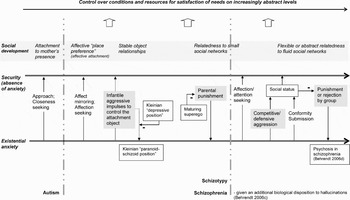
Infants who develop autism may be less endowed – due to constitutional deficits – with primary anxiety, which expresses itself in distress vocalisations that elicit affective synchronisation with the mother. Autistic individuals were often perceived as placid during infanthood. Primary anxiety goes on to develop into complex social behaviours designed to elicit acceptance and a sense of inclusion from significant others or social groups (see Fig. 1). Midline cerebral cortices, which are implicated in regulation of anxiety, show lower baseline activity in autism and therefore less deactivation during distracting cognitive tasks (Kennedy et al. Reference Kennedy, Redcay and Courchesne2006). If adaptive anxiety-related behaviours fail to achieve their interpersonal or social objective, overt anxiety re-emerges. Positive symptoms in schizophrenia imply increased anxiety; indeed, stronger positive symptoms were associated with increased midline cerebral activity at rest and greater task-induced deactivation (Garrity et al. Reference Garrity, Pearlson, McKiernan, Lloyd, Kiehl and Calhoun2007).
In the absence of a caregiver or affective synchronisation with the caregiver, existential anxiety manifests in distress vocalisations. Learning to manipulate the caregiver's affective states, thus reducing one's own anxiety, is a foundational step in social development disturbed in autism. Schizophrenics have learned that inclusion in social networks – while potentially exposing them to others' aggression – reduces anxiety; however, underdeveloped social approach behaviour later necessitates psychotic resolution of anxiety. See also Rosenfeld (Reference Rosenfeld1965).

Interpersonal relationships and social networks not only help to overcome primary anxiety, but they also expose to intraspecific aggression, which is woven into social phenomena (Behrendt Reference Behrendt2006a; Reference Behrendt2006c; Lorenz Reference Lorenz1963/2002). For schizophrenics, human relatedness is fraught with terror; they cannot overcome their fear of others because of early-life experiences (Behrendt Reference Behrendt2006d; Gabbard Reference Gabbard1990). Superego is a metaphor for internalised parental punishment, which importantly contributes to children's socialisation. Schizophrenics show higher sensitivity to threat and punishment (Scholten et al. Reference Scholten, van Honk, Aleman and Kahn2006) and develop a severe and persecutory superego. The clinical picture of schizophrenia “often reflects some of the most brutal morality,” attributable to an archaic superego “in which the primal identification (incorporated figure of the mother) holds forth only the promise of condemnation, abandonment and consequent death” (Rosenfeld Reference Rosenfeld1965, p. 66). Cognitive skills based on left frontal cortices are required for socially adaptive expression of intraspecific aggression and affiliative approach, thus balancing fear and withdrawal impulses mediated by the right hemisphere. Relative left-hemisphere dysfunction in schizophrenia may undermine cognitive capacities at the service of social approach functions and engender a predominance of right-hemisphere-based social withdrawal functions (Demaree et al. Reference Demaree, Everhart, Youngstrom and Harrison2005) (see Fig. 1).
Reduction in “mentalistic cognition” (“theory-of-mind” deficit) is not specific to autism (Pennington & Ozonoff Reference Pennington and Ozonoff1996; Rowe et al. Reference Rowe, Bullock, Polkey and Morris2001) and may not lie at its pathogenetic core. Perception of others' mental states is important in social behaviour, but theory-of-mind skills develop secondarily to infants' automatic tendencies to observe and respond to human affective expressions (Tager-Flusberg et al. Reference Tager-Flusberg, Joseph and Folstein2001). Although others' glances remain insignificant to autistic individuals – and others' stares may continue to be highly aversive – schizophrenics are more concerned about social rejection implicit in others' glances. Their “obsession with the gaze of others as directed toward oneself” may not evidence general “hyperdevelopment of gaze” but manifests deep-seated social fears. Schizophrenics' capacity to be “acutely tuned to the subtlest unintentional cues” (Nesse 2004, p. 62, cited in the target article) unfolds on a higher developmental level than autistic “literal-mindedness” (sect. 6.3.1).
Persecutory delusions – rather than being instances of “hyper-mentalistic cognition” – can be conceptualised economically as maladaptive defences against these fears. Enhanced amygdala responses to face stimuli (Russell et al. Reference Russell, Reynaud, Kucharska-Pietura, Ecker, Benson, Zelaya, Giampietro, Brammer, David and Phillips2007; Surguladze et al. Reference Surguladze, Russell, Kucharska-Pietura, Travis, Giampietro, David and Phillips2006) or verbal hallucinatory experiences in acute paranoid states reflect attention to environmental aspects that remain meaningless to autistic individuals. Increased top-down control and impaired bottom-up processing in cortical language areas (Sumich et al. Reference Sumich, Chitnis, Fannon, O'Ceallaigh, Doku, Faldrowicz and Sharma2005) mediate attention to hallucinatory voices while disrupting sensory constraints (Behrendt Reference Behrendt2006b; Reference Behrendt and Fallio2006e). Attributing verbal hallucinations to “hyperdevelopment in aspects of mentalistic cognition” (target article's Fig. 2 caption) serves those who look for “contrasting patterns of hyperdevelopment and underdevelopment in psychosis and autism” (sect. 6.3.1, para. 4). Cognitivist notions, however, that hallucinations involve “misattribution of agency” or that delusions of control imply an “impaired ability to self-monitor” intended actions (sects. 6.3.1–6.3.3) only confuse matters (Behrendt Reference Behrendt1998; Reference Behrendt2005).