INTRODUCTION
Between 2005 and 2010, the Organization for Islamic Cooperation (OIC) advanced a series of resolutions — entitled “Combating the Defamation of Religions” — in the United Nations (UN) General Assembly (GA). These resolutions called for a ban on the defamation of religion: blasphemy or general insults to religions or religious communities. Even though the GA passed them each year, the resolutions generated significant debate; criticism of the resolutions strengthened over time with many European and North American states — most notably the United States — opposing their passage. By 2011, the OIC announced it would change the focus of the resolution to minimize the emphasis on defamation, indicating the efforts to craft an international ban on religious defamation had ended, or at least stalled (Shea Reference Shea2011).
The resolutions had the potential to alter political and religious freedoms around the world. Limitations on religious defamation and blasphemy — in countries as varied as Algeria, Greece, and Poland — constitute restrictions on expression that could offend some or all religious groups (Pew Forum on Religion and Public Life 2011b; Prud'homme Reference Prud'homme2010). Proponents of anti-defamation laws argue that limitations on religious defamation help to protect the integrity of religious communities and minimize inter-religious strife (The Globe and Mail 2006). Some observers and activists, however, argue that enacting legal restrictions on religious defamation undermines freedom of religion and expression; such laws allow governments to criminalize a vast array of political and religious activities they deem potentially defamatory (Edwards Reference Edwards2008; Marshall Reference Marshall2009; Marshall and Shea Reference Marshall and Shea2011; Prud'homme Reference Prud'homme2010; Schriefer Reference Schriefer2010; United States Commission on International Religious Freedom 2010). The religious defamation resolutions would create an international version of such laws. Many human rights activists and governments opposed the resolutions' passage for this reason; for example, United States Secretary of State Clinton has publicly opposed their passage, and the U.S. State Department officially classified the resolutions as of significant concern to the United States (Wan Reference Wan2009).Footnote 1
The resolutions were also connected to normative debates among scholars and policymakers concerning freedoms of speech and religion. Religious freedom — as it is usually envisioned — involves the freedom of individuals to choose and practice religion at will, while limits on religious defamation are intended to prevent individuals from insulting religious traditions and communities (Farr Reference Farr2008; Grim and Finke Reference Grim and Finke2011; Shah Reference Shah2012). The resolutions therefore arguably limit individual rights in favor of communitarian ones, and are consequently of great interest for their potential effects on international human rights norms (Shea Reference Shea2011).Footnote 2
Beyond their normative significance, the resolutions are interesting due to the puzzling nature of support for their passage. While the OIC formulated the resolutions and some opposition to them revolves around apparent clashes between Western and Islamic values, almost half of the votes in support have been from non-Muslim states. Moreover, the majority-Muslim states most actively involved in advocating for the resolutions are Egypt and Pakistan, not more immanently Islamic states like Iran and Saudi Arabia. Why, considering the genesis of these resolutions in a Muslim international organization, have so many non-Muslim states supported them? What relation do the resolutions have to the domestic practices of their many non-democratic backers? And how does religion matter in contention over this issue, if at all?
Common explanations only partially explain support for the resolutions. While concerns over religious defamation have been intense among Muslim societies in recent years, the numerous non-Muslim states voting for the resolutions indicate the dynamics driving their passage extend beyond majority-Muslim countries. Likewise, although solidarity among developing countries explains some of the resolutions' support, the resolutions deal specifically with a religious issue — as opposed to attempts to rectify perceived crimes of developed countries, as with resolutions relating to racism or economic development — so the religious element of their support must be explained.
I draw on recent work on UN voting and religion and politics to explain both the non-Muslim and religious aspects of support for the resolutions. Domestic politics can affect states' behavior in international organizations, and states sometimes use international agreements for domestic political gain.Footnote 3 This dynamic extends to religious issues. Non-democratic regimes — both Muslim and non-Muslim — have adopted numerous restrictions on religious practice that shore up support for the regimes from religious groups and minimize the threat religious opposition poses. These restrictions on religion can increase the political salience of religious issues, however, giving leaders an incentive to use religious appeals for political gain. This is especially the case in non-democratic regimes that restrict religion, as the closed nature of these regimes intensifies the political effects of restrictions on religion. When contentious international religious issues resonate in the domestic sphere, non-democratic regimes with extensive religious restrictions may exploit the issue to strengthen their domestic standing.
This dynamic helps to explain some of the puzzling aspects of the religious defamation resolutions. Religious groups throughout the world are concerned over religious defamation, and the resolutions give non-democratic regimes that restrict domestic religious practice a chance to both signal their support for a religious cause and increase the legitimacy of their restrictions on political and religious activity. Non-democratic states that restrict religion are thus more likely to support the resolutions than democratic states or states with low restrictions on religion. The salience of defamation concerns among Muslims and developing country solidarity also explain some support, but the effects of domestic restrictions on religion cannot be reduced to these factors.
I demonstrate this through a mixed-method study. This includes a quantitative analysis of voting on the religious defamation resolutions in the UN — with a logit model to analyze the relationship between government restrictions on religion and states' support for the resolutions — and case studies on the nature and effects of religious restrictions in two countries that supported the resolutions, Pakistan and Belarus. The tests reveal that non-democratic states with higher restrictions on religion are more likely to support the resolutions, and this support is connected to attempts to maintain domestic power; Muslim population size and solidarity also affect support.
The article contributes to both theoretical and policy debates on the effects of religion on politics. By analyzing a contemporary religious issue that has drawn the attention of international actors, it adds to the growing literature on religion and politics; it also highlights the way that religious beliefs and state institutions interact to affect states' foreign policies. In addition to this, the study extends work on the nature of UN voting and normative contestation, providing a novel explanation for state support of religiously-contentious resolutions. Finally, it can assist policymakers attempting to formulate responses to these resolutions and other divisive issues related to religious defamation.
I define religion as a “system of beliefs and practices oriented towards the sacred or supernatural” (Smith Reference Smith and Smith1996, 5). A “religious group” is an organized pressure group whose contention is based on their religious beliefs, and a “religious issue” is an issue — which may not be inherently related to religion — that has become politicized among religious groups. “Religious contention” is political activity by religious groups concerning a religious issue. The focus of this article is on a particular religious issue — religious defamation — and state policies surrounding it, rather than religion itself or the process through which issues become politicized among religious groups. I use “religious defamation,” rather than specific types of defamation — such as “blasphemy” or “hate speech” — to follow the resolutions' approach to this issue.
The article proceeds in four parts. First, I discuss the political effects of government restrictions on religion and how this influences support for the religious defamation resolutions. I then present the research design, followed by the findings and their implications. Finally, I discuss conclusions and further steps for research.
THE EFFECTS OF DOMESTIC RELIGIOUS RESTRICTIONS ON UNGA VOTING
I argue that religion can influence states' support for the religious defamation resolutions through the effects of government restrictions on religion. Government restrictions on religion heighten the political salience of religion and make it more likely states will use domestic and international appeals to religion to increase support and control dissent. The religious defamation resolutions — which are connected to a contentious international religious issue — give states an opportunity to signal their distaste for insults to religion and desire for a ban on defamation. Religious contention in response to religious defamation concerns is likely to translate into state support for the resolutions in non-democratic states that have extensive restrictions on religion.
Religious Restrictions and Religious Politics
I draw from works on religion and politics that emphasize the interaction between religious beliefs and state institutions (Fox and Sandler Reference Fox and Sandler2004; Gill Reference Gill2008; Hassner Reference Hassner2011; Nexon Reference Nexon2009; Philpott Reference Philpott2000; Toft, Philpott, and Shah Reference Toft, Philpott and Shah2011). Religious contention is important, but its effects on politics often arise from the interaction between religious beliefs and the institutions in which religious groups operate; specifically, I follow several studies that highlight the nature and effects of government restrictions on religion (Fox Reference Fox2008; Grim and Finke Reference Grim and Finke2011; Philpott Reference Philpott2007; Toft, Philpott, and Shah Reference Toft, Philpott and Shah2011). When more extensive restrictions on religion are in place, religious contention is more likely to result in changes to state behavior. This domestic dynamic can affect states' foreign policies — pushing them to take action in line with domestic religious contention — when contentious international religious issues arise.
Government restrictions on religion involve state attempts to support a particular religious tradition or community, while restricting the practice of some or all religious communities. These restrictions take a variety of forms, including harassment of communities, limitations on the ability to preach or convert, and official provisions for an official religion (Fox, Reference Fox2008; Grim and Finke Reference Grim and Finke2011; Pew Forum on Religion and Public Life 2012). Some restrictions on religion represent a widely-shared religious tradition, such as state support for the Orthodox Church in Greece or limitations on non-Muslim practice in the Maldives. Many restrictions, however, were intended to prevent religious groups from challenging the state while gaining support through the championing of religious values (Gill Reference Gill2008; Grim and Finke Reference Grim and Finke2011). This can be seen in both Malaysia and Pakistan's increased ties to Islam over time, which the states implemented in response to increasingly powerful religious groups in those countries (Nasr Reference Nasr2001).
Restrictions on religion have two general effects on states' politics. First, they heighten the political salience of religion. Religious restrictions tie the state to religion, giving an official imprimatur to religious arguments; for example, Saudi championing of the conservative Salafist tradition has enabled numerous opposition figures to challenge the regime on religious grounds (Blum Reference Blum and Shaffer2006; Piscatori Reference Piscatori and Piscatori1983). They also intensify social conflict relating to religion, by exacerbating the grievances of religious minorities and strengthening extremist elements of the favored tradition (Grim and Finke Reference Grim and Finke2011). In Sri Lanka, state support for the majority Buddhist Sinhalese contributed to the rise of both extremist Sinhalese movements and a protracted uprising by the minority Hindu Tamils. Religious restrictions also make it more likely that religious beliefs will motivate elites (Nexon Reference Nexon2009); this can be seen in the case of Zia ul-Haq, Pakistan's military leader in the 1970s and 1980s who came out of a Pakistani military culture that was closely tied to Islam and implemented numerous pro-Islamic policies while in power.
Second, religious restrictions make religion a more desirable political tool. Due to the heightened salience of religion in restrictive states, leaders who champion religious issues can gain the support of powerful religious groups. For example, while geopolitics likely drove Russia's opposition to intervention in civil unrest in Syria, the professed concern for the state of Syrian Christians under a post-Assad regime helped to cement Russian President Putin's support among the country's powerful Orthodox Church (Barry Reference Barry2012). Moreover, since religious policies often take the form of heightened restrictions on religion, states can justify repressing opposition groups on religious grounds. This can be seen in the Mugabe regime in Zimbabwe arresting opposition members in the Anglican Church on the basis of a purported leadership dispute in the church (Unites State Department of State 2012).
It should be noted that these effects are not present in all states that restrict religion. Some democracies restrict religion, but this usually involves historical church-state ties or attempts to limit religious expression among some communities. Moreover, not all non-democracies that restrict religion will display this behavior. Some states such as China, Cuba, and Eritrea impose religious restrictions as part of broader repression of political opposition. The political effects of religious restrictions are thus tied to a particular set of non-democratic states, those that support a certain religious community rather than repress all religious groups.
These domestic dynamics can affect states' foreign policies when they encounter an international religious issue. Religious politics will not constantly affect a state's behavior, and most of their foreign policies will be based on geopolitical or economic interests. But when an issue arises in the international arena that is religiously contentious, states will face greater pressure from religious groups to respond (Philpott Reference Philpott2000). Non-democratic states with extensive religious restrictions will be most likely to act in such instances, as the heightened salience of religion and political effectiveness of religious appeals mean they will both face greater pressure to act and have more to gain politically by doing so.
Restrictions on Religion and the Religious Defamation Resolutions
The religious defamation resolutions are part of one such religiously contentious international issue: the proper response to insults to religion. Concerns over religious defamation have been prominent among Muslims in recent years. Several incidents indicate the vitriol surrounding this issue, such as the 2005–2006 protests over the Danish Muhammad cartoons and deadly violence in Pakistan over its blasphemy laws in 2010–2011 (Hassner Reference Hassner2011; Perlez Reference Perlez2011). Moreover, anger over religious defamation often takes on an anti-Western tone, as seen in the deadly September 2012 protests over an anti-Islam film (Kirkpatrick and Myers Reference Kirkpatrick and Myers2012). Of course, defamation concerns are not limited to Muslim countries; anti-defamation laws exist in several non-Muslim countries, such as Greece and Poland (Prud'homme Reference Prud'homme2010).
The religious defamation resolutions are a means through which states can support an international limit on insults to religion. UNGA votes can represent states' preferences as expressed in an international forum (Gartzke Reference Gartzke1998; Voeten Reference Voeten2000). Voting on resolutions signals to both domestic and international audiences the issues a state finds important and indicates the state's preferred means of addressing the issue (Voeten Reference Voeten2005). Voting in support of the religious defamation resolutions, then, allows states to indicate their opposition to religious defamation and their support for a ban on defamation.
Not all states, however, will support the resolutions, even in the face of defamation-related religious contention. In democracies, the open political system helps to defuse contention and may make the public less inclined to limit expression through anti-defamation laws, so states will not be as compelled to support the resolutions (Toft, Philpott, and Shah Reference Toft, Philpott and Shah2011). Additionally, in non-democratic states without significant restrictions on religion, the state will not be as closely tied to religion and would thus be more able to ignore pressure from religious groups to take action on an international religious issue.
Support for the resolutions is likely to be strongest among non-democratic states that restrict religion, due to the political effects of restrictions on religion. Religious issues, like religious defamation, are more salient for such states, so their policymakers will pay greater attention to things like the religious defamation resolutions. Voting in support of the resolutions allows them to “champion” a religious issue, deflecting or coopting powerful religious groups in society. The international ban on religious defamation also provides legitimacy for the state's domestic restrictions on religion. Because these political effects of religious restrictions are strongest among non-democracies, non-democracies that restrict religion will be the most likely to support the resolutions.
HYPOTHESES AND ALTERNATIVE EXPLANATIONS
States with extensive restrictions on religion are more likely to support the resolutions than those without religious restrictions; this relationship will be stronger among non-democracies than democracies. Developing country solidarity and the salience of defamation concerns among Muslims also motivate support for the resolutions, though; states that tend to support solidarity-related resolutions and states with significant Muslim populations will vote in support as well. Yet, religious restrictions still have an effect on support even when these other factors are taken into account.
HYPOTHESIS 1:
States with greater restrictions on religion are more likely to support the resolutions than those without such restrictions
HYPOTHESIS 1A:
Non-democratic states with greater restrictions on religion are more likely to support the resolutions than democratic states or states without religious restrictions.
HYPOTHESIS 2:
States that tend to support solidarity-related resolutions, and states with large Muslim populations are also likely to support the resolutions; these factors do not account for the effects of religious restrictions, however.
These are distinct from alternative explanations. Some may point exclusively to Muslim societies to explain the resolutions, not the political effects of religious restrictions.Footnote 4 Likewise, support for the resolutions may be just an instance of developing country solidarity with little connection to religious restrictions (Iida Reference Iida1988; Kim and Russett Reference Kim and Russett1996; Potrafke Reference Potrafke2009; Voeten Reference Voeten2004). Or support may arise from social religious unrest, not state policies toward religion. Support could also be part of general non-democratic practices, rather than the specific effects of religious restrictions, so non-democracies — not religiously-restrictive non-democracies — will be likely to support the resolutions (Hagan Reference Hagan1989; Moon Reference Moon1985; Voeten Reference Voeten2000). Regional norms concerning human rights could explain support with the United States, Canada, and the European Union being least likely to support the resolutions (Boockmann and Dreher Reference Boockmann and Dreher2011). Ties to the United States may also matter, due to United States opposition to the resolutions; states that receive more aid from the United States might be less likely to support the resolutions (Wang Reference Wang1999).
RESEARCH DESIGN
I test this through a mixed-methods study. The first part of the study is a quantitative analysis of the relationship between religious restrictions and support for the resolutions. The second is a pair of case studies examining religious restrictions and international behavior in Belarus and Pakistan.
Data and Dependent Variable
I use an original dataset on UN member states' votes on the “Combating the Defamation of Religions” resolutions from 2007–2010. Data for UNGA votes on the religious defamation resolutions run from 2005 through 2010, but the explanatory variable covers 2007 through 2010 so I include only those years in the study.Footnote 5
The dependent variable, Support, is a dichotomous measure of whether a state supported the resolution. 1 = indicates the state voted in support, while 0 = indicates the state opposed or abstained from the vote. I exclude votes in which a state did not participate.Footnote 6
Explanatory Variable
The explanatory variable is the GRI, which comes from the Pew Research Center's Forum on Religion and Public Life's (Pew Forum) “Global Restrictions on Religion” project (2012). The index runs from 0 to 10, with higher values indicating greater government restrictions.Footnote 7 I also use an interaction between GRI and Nondemocracy — see below — as an alternative explanatory variable.
The “Global Restrictions on Religion” project is a multi-year global study of government restrictions on religion and social hostilities involving religion, which codes data on religious freedom into two cross-national indexes, GRI and a Social Hostility Index (SHI). Data come from reports by the United States government, the UN, and non-governmental organizations. The methodology follows the Pew Research Center's rigorous standards; the average inter-rater reliability score was greater than 0.8, and the scale reliability coefficients for GRI and SHI were both greater than 0.9 (Pew Forum on Religion and Public Life 2012). Also, several methodological studies and empirical applications have corroborated the validity of the dataset (Driessen Reference Driessen2010; Grim and Finke Reference Grim and Finke2011; Grim and Wike Reference Grim and Wike2010).
GRI is made up of 20 variables, each ranging from 0 to 1, that address various aspects of government restrictions on religion; the index is the sum of the questions set to a 0 to 10 scale. SHI is the sum of 13 variables set to a 0 to 10 scale. This includes indicators of crimes “motivated by religious hatred or bias,” religious tensions, and terrorism or war involving religion.
One potential issue with GRI is that for some states high GRI scores reflect broad restrictions on all groups deemed a political threat, rather than specific restrictions on religious groups. I address this through a variable from GRI that assesses the level of state favoritism toward religious groups. States with high GRI scores but low levels on this variable would likely be those repressing religious groups as a threat to the state, since they are imposing numerous restrictions on religion but not providing support to religious groups. This variable codes states as a 1 if it is in the “high” category of GRI but has a low score on GRI.Q.20.
Control Variables
I include SHI as a control variable to assess whether levels of social unrest relating to religion affect a state's voting behavior. Another control variable measures the percentage of a country's population that is Muslim (Muslim Population) — to indicate religious defamation-related concerns among Muslims — based on Pew Forum on Religion and Public Life (2011a) data.
I address regime type through Democracy, a dichotomous measure of regime type from Cheibub, Gandhi, and Vreeland's (Reference Cheibub, Gandhi and Vreeland2009) Democracy and Dictatorship Revisited (DD) dataset. DD data cover more countries than Polity, as Polity excludes countries based on population; using DD data includes numerous small countries' votes that would be missing from an analysis with Polity data.Footnote 8 Also, I use Nondemocracy — coded as 1 if Democracy is 0 — in the interaction variable discussed above.
I address the effects of aid dependence on the United States (Aid) through a measure of the total amount of aid the United States gave to a country in 2005; this is the beginning of the time period in which the UNGA voted on the resolutions, and thus represents the aid relationship that would influence state decisions over the next few years.Footnote 9 And I address regional norms concerning human rights through a dichotomous variable (European Union/United States/Canada) with states coded as 1 if a state falls into this category.
Finally, I incorporate solidarity among developing countries through an index of states' votes on three recent resolutions that reflect this solidarity: resolutions on racism, the “New International Economic Order,” and international trade. This variable (Solidarity) runs from 0 to 10, and measures the proportion of a state's votes on these resolutions in which they supported, opposed, or abstained.Footnote 10
Methods
I use a logit model with standard errors clustered by country.Footnote 11 I include dummy variables for 2007, 2008, and 2009 to serve as fixed effects in the four-year pooled data. Model 1 uses GRI and all control variables, and Model 2 adds the interaction variable between GRI and Nondemocracy. Models 3 and 4 stratify the observations by regime type; Model 3 includes only non-democracies, and Model 4 includes only democracies.
The article also presents the substantive effects of the independent variable on support for the religious defamation resolutions as the predicted average marginal effect of GRI on Support, with all other variables held at their mean value; I run this for both Model 1 (all observations) and Model 2 (excluding democracies). I calculate the effect of Solidarity and Muslim Population from Model 1 as well, in order to compare the effects of GRI on support for the resolutions.
I also run numerous robustness checks, which are alternate versions of Model 1. Separate robustness checks include GDP, religious fractionalization, a majority Muslim variable in place of Muslim Population, the alternate versions of Democracy, an additive version of Solidarity, Polity scores in place of Democracy, and a dummy variable for the Middle East. Others remove SHI, remove Solidarity, exclude countries coded under Political Threat, use ordered logit and multinomial logit with the alternate ordinal support variable, and include missing countries as abstentions.
Qualitative Analysis
I combine this with two case studies to take advantage of the value of mixed-methods studies, namely case studies' ability to test whether the mechanisms posited to explain regression analyses' correlations are valid (Collier, Brady, and Seawright, Reference Collier, Brady, Seawright, Brady and Collier2004; George and Bennett Reference George and Bennett2005; Laitin Reference Laitin, Katznelson and Milner2002; Lieberman Reference Lieberman2005; Mahoney and Goertz Reference Mahoney and Goertz2006). The study mirrors Lieberman's (Reference Lieberman2005) “model-testing small-n analysis” approach by choosing cases that are well-predicted by the model. I select states with significant religious restrictions that voted for the resolutions but vary on the percentage of the population that is Muslim: Pakistan and Belarus. Varying Muslim Population demonstrates that support for the resolutions is not confined to Muslim countries, while highlighting the role religious restrictions play in the country demonstrates that developing country solidarity alone cannot explain support. The two cases involve a discussion of the nature of restrictions on religion, their role in domestic repression, and their connection to support for international efforts involving religious defamation and other religiously-contentious episodes.
FINDINGS
Quantitative Findings
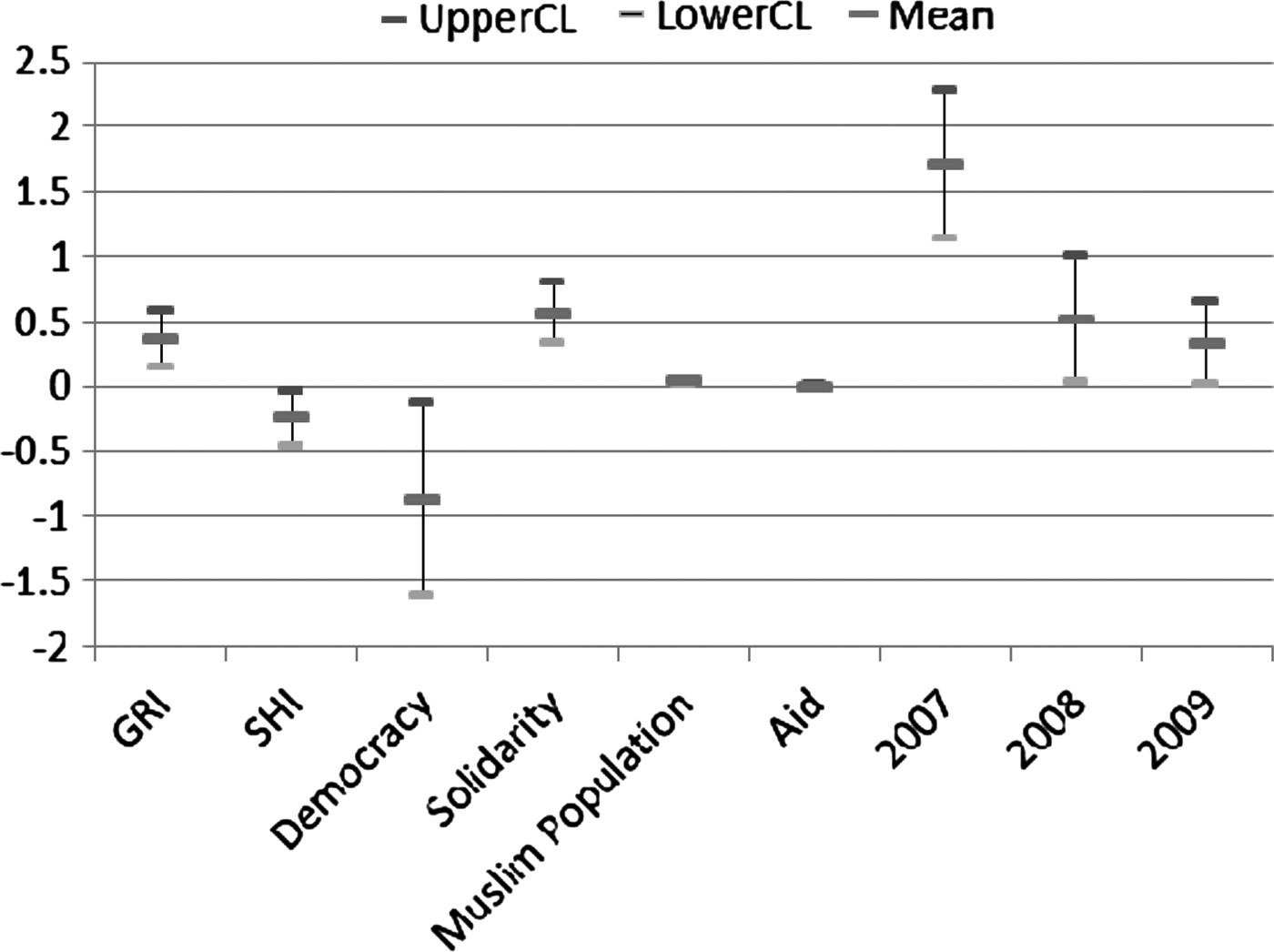
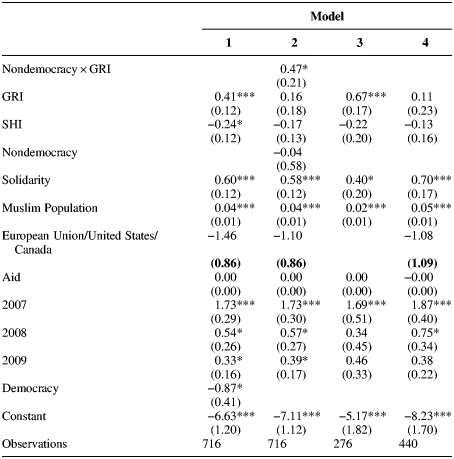
GRI is highly significant and has a positive effect on Support in Models 1 and 3. In Model 2, the interaction variable is significant and positive, while neither GRI nor Nondemocracy are significant alone. And GRI is not significant in Model 4. The significance of the interaction variable — and the lack of significance of both components — in Model 2 suggests it is the interaction of these two variables that affects support for the resolutions; the significance of GRI in Model 3 (which excluded democracies), however, also indicates that GRI affects support even among non-democracies.Footnote 12 In addition to GRI, Solidarity was highly significant and positive in all models, while Muslim Population and Democracy were also significant. SHI was significant in Model 1, but not Models 2 or 3 (Figure 1 and Table 1).
Coefficient and Confidence Intervals of Variables in Model 1 (This presents results from an alternate model excluding European Union/United States/Canada due to its large confidence interval).

GRI and support for the religious defamation resolutions, 2007–2010a
Robust standard errors in parentheses.
a Model 3 excludes democracies, and Model 4 excludes non-democracies.
***p < 0.001, **p < 0.01, *p < 0.05.
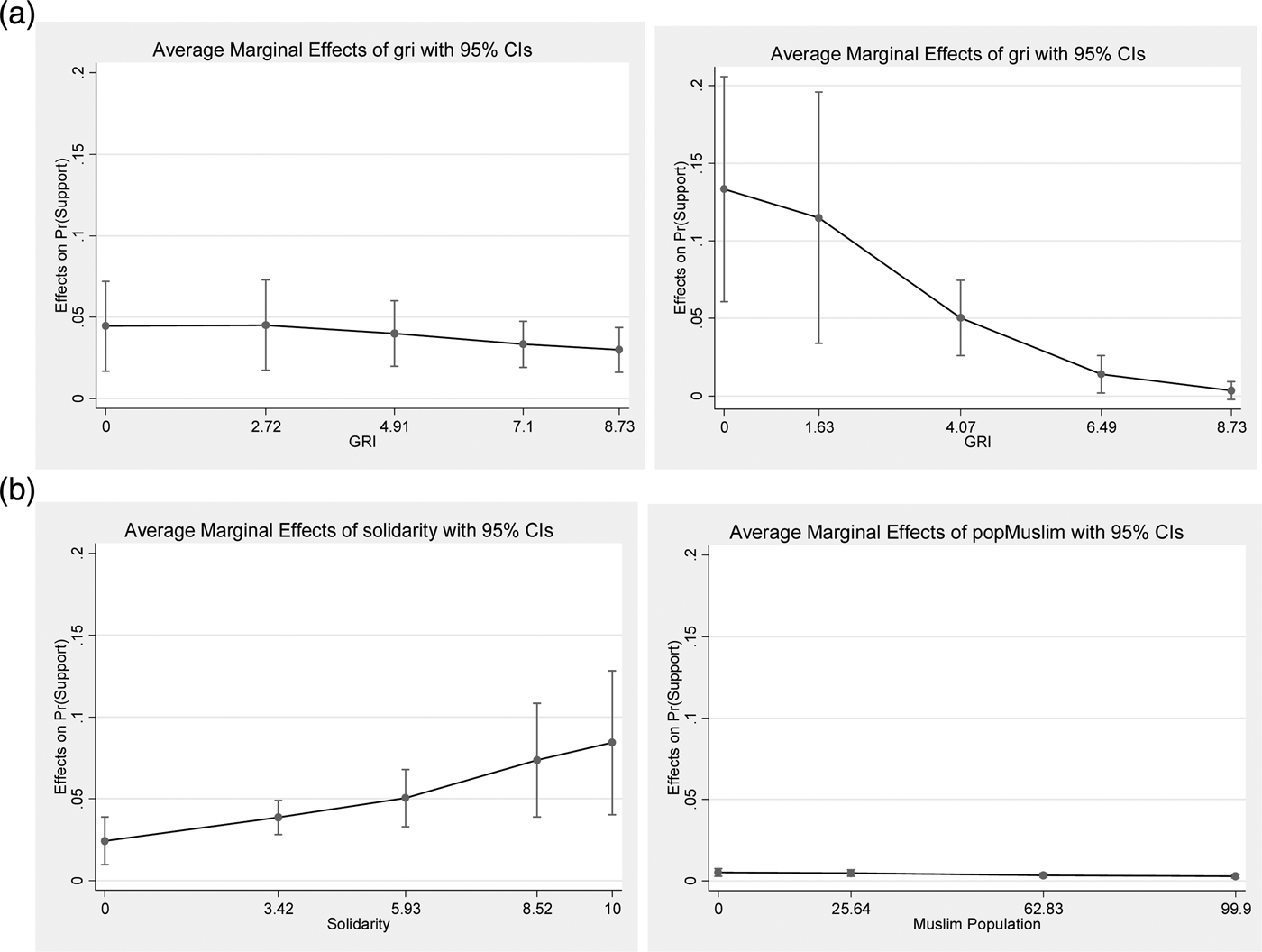
The average marginal effects of the independent variable on Support demonstrate the significant, but nuanced, effect GRI has on support for the religious defamation resolutions when compared with the effects of other significant variables. GRI increased the likelihood of a state supporting the resolution across its range of values, although the effect's significance decreased as GRI increased; this was stronger among only non-democracies. Moreover, the substantive effect of GRI was equivalent to that of both Solidarity and Muslim Population. (Figure 2)
Effect of GRI (from Models 1 and 3) and Solidarity, and Muslim Population (from Model 1) on probability of support for the religious defamation resolutions. (a) Effect of GRI on probability of support for the religious defamation resolutions, Model 1 (all observations) and Model 3(including only non-democracies). (b) Effect of Solidarity and Muslim Population on probability of support for the religious defamation resolutions, Model 1.
GRI was also significant in all robustness checks. Solidarity and Muslim Population remained significant in all robustness checks, but Democracy and SHI were not significant in several robustness checks. Of the alternative control variables, only majority Muslim, Polity scores, and the alternative solidarity measure were significant.
Qualitative Analysis
The cases of Pakistan and Belarus reveal that government restrictions on religion served in part to increase the non-democratic states' control over society. They also indicate that these domestic dynamics correspond to the states' international actions on human rights and religion-related issues. Moreover, developing country solidarity plays a role in the states' international actions, while Muslim beliefs certainly matter but are not the only determinant of support for the resolutions, given Belarus' Orthodox Christian population.
Pakistan
Pakistan, one of the strongest supporters of the religious defamation resolutions, has enacted numerous restrictions on religious practice in the context of a non-democratic political system. The country's official religion is Islam and all laws must be in accordance with the religion (United States Department of State 2012). This legal role for Islam, and restrictions on blasphemy, have resulted in numerous instances of speech and religious practice deemed counter to Islam being punished (Prud'homme Reference Prud'homme2010; United States Department of State 2012). Moreover, although Pakistan is currently ruled by democratically-elected civilian leaders, its democratic nature is shaky due to the strong role of the military in the country's politics and the instability of the political process (Haqqani Reference Haqqani2005).
Many of the government's restrictions on religion arise from attempts to maintain state power. Pakistani leaders have long used Islam to increase national cohesion and gain support from the populace; this includes both rhetorical appeals and support for Islamist militants in Kashmir. And while some Pakistani leaders have sincerely attempted to increase the role of Islam in the country — such as Zia ul-Haq — other appeals to religion arose from political calculations, like the leftist Zulfikar ali Bhutto's outreach to Islamist groups and implementation of blasphemy restrictions (Haqqani Reference Haqqani2005). The government has also at times failed to take action in the face of abuses against religious minorities — many tied to blasphemy-related anger — to avoid upsetting domestic audiences (United States Department of State 2012).
These domestic religious restrictions affect Pakistan's foreign policies. Pakistan has tied its foreign policies — especially its tensions with India — to Islam, and under Bhutto attempted to establish solidarity with other Muslim countries through international appeals (Tahir-Khelli Reference Tahir-Khelli and Dawisha1983). Regimes' desire to increase domestic support, as well as gain international prestige, drove some of these efforts (Haqqani Reference Haqqani2005; Tahir-Khelli Reference Tahir-Khelli and Dawisha1983). This is apparent in recent tensions between the United States and Pakistan over United States counter-terrorism operations, which have sparked significant religious and nationalist anger in Pakistan (Siddiqa Reference Siddiqa2011). And some Pakistani state actions have arisen directly from its blasphemy restrictions, such as its short-lived blocking of Twitter in response to domestic anger over cartoons of the prophet Muhammad on the site (Boone Reference Boone2012). Pakistan's support for the religious defamation resolutions is thus likely an extension of its domestic restrictions on religion, although it also reflects some solidarity and the salience of religious defamation-related concerns in Muslim countries.
Belarus
Belarus is another strong supporter of the religious defamation resolutions, co-sponsoring several of them in the GA. This country displays political effects of religious restrictions that are similar to Pakistan, even though its population is majority Orthodox Christian. Belarus's non-democratic regime has extensively limited political expression and the media (Dynok Reference Dynok2012). The government has also imposed significant restrictions on religious practice in favor of the majority Orthodox Church, such as active support for the Orthodox Church and limitations on the ability of Protestant groups to operate (United States Department of State 2012). Moreover, the government has targeted several Protestant groups, especially ones it suspects of ties to foreign actors (United States Department of State 2012). While the government does not officially ban the defamation of religion, it prohibits “subversive activities” by foreign groups — including religious ones — which includes acts the government believes could “incite” religious tensions (United States Department of State 2012).
The government's religion-related policies are part of its attempts to maintain control of society. The country's restrictions on religion are connected to broader repression of press freedoms and other activities (Dynok Reference Dynok2012; United State Department of State 2012; BBC Monitoring World Media 2007). Moreover, at times the Belarusian government has explicitly used religious justifications when repressing critics. For example, government officials described an opposition party as a “destructive sect” in 2009; it also imprisoned a Christian activist who documented government abuses for “illegal religious activity” (BBC Monitoring Kiev Unit 2009; BosNewsLife News Agency 2006).
Belarus' support for the religious defamation resolutions are tied to its domestic restrictions on religion, as well as broader international appeals to solidarity. Belarus' non-democratic nature has led to tensions with the United States and Europe, which prompted Belarus to develop closer ties with Russia (Dynok Reference Dynok2012; Schwirtz Reference Schwirtz2012). Belarus has also joined Russia, China, Cuba, and Venezuela — among others — in opposing UN action on the unrest in Syria (UN General Assembly 2012). This suggests that developing country solidarity drives Belarus' UN actions, as part of its close ties to Russia and desire to legitimate its domestic political practices. And, indeed, some have claimed Belarus' support for the religious defamation resolutions is connected to broader attempts to counter human rights norms in international forums (Schriefer Reference Schriefer2009). It is thus likely that Belarus' support for the religious defamation resolutions is motivated by both developing country solidarity and attempts to justify its domestic restrictions on religion.
IMPLICATIONS
The findings support the hypothesized role of government restrictions on state support for the religious defamation resolutions. In the quantitative study, non-democratic states that restrict religion are more likely to support the resolutions; moreover, the case studies indicate that domestic restrictions play a role in maintaining the states' power, and are connected to international actions on contentious issues. This suggests that the interaction between non-democratic states' political calculations and religious contention over defamation — in the context of close ties between religion and state — contribute to support for the resolutions.
Although they were not this article's focus, the findings also highlight the importance of defamation concerns among Muslims and developing country solidarity. States that tended to support solidarity-related issues voted for the religious defamation resolutions, indicating religious issues may combine with broader developing country solidarity in political debates. Similarly, countries with larger Muslim populations were more likely to support the resolutions, so concern over religious defamation among Muslims also affected states' voting behavior. Yet, religious restrictions affect levels of support even in the presence of large Muslim populations or developing country solidarity. Of the 10 countries that introduced the resolutions for debate in the UN — all of which ranked high on Solidarity — only two had low government restrictions on religion. Likewise, while most Muslim states both supported the resolutions and have high restrictions on religion, the only Muslim states that did not support the resolutions in all six years in which they were debated had low religious restrictions.Footnote 13
The substantive significance of GRI and the case studies provides some nuance to the role of restrictions on religion.Footnote 14 Although GRI had consistently positive effects on Support, states with moderate and high GRI scores were more likely to support the resolutions than those with very high scores. This seems counterintuitive, but is in line with my claim about the effect of religious restrictions; support for the resolutions — which constitutes international action on a religiously contentious issue — arises in part from states with close ties to religion attempting to gain support from domestic audiences and increase their power vis-à-vis society. States with greater fears of societal unrest would be more likely to vote for the resolutions — to gain support from religious groups and provide cover for controlling opposition — while the incentive to do so would be present, but less intense, in relatively secure states. States with very high GRI scores — like Eritrea and Saudi Arabia — are often relatively stable in terms of regime survivability. Those with moderate to high scores, in contrast, include many states that have less control over society, such as Nigeria.Footnote 15
There are a few caveats to these findings. First, the substantive significance of GRI is not overwhelming, and Solidarity and Muslim Population are consistently significant in the models; this article's focus on religious restrictions thus does not suggest it is the only factor that matters. Second, the time period is relatively short. This is due to the years GRI covers (2007 through 2010) and the years in which the UNGA debated the religious defamation resolutions (2005 to 2010); comparison to other religiously-salient resolutions may thus be useful. Third, these findings are not meant to suggest that political actions related to religion are always cynical calculations, rather than sincere beliefs. Instead, they indicate that both religious beliefs and their institutional context matter in religious politics. Finally, this article does not deal with the issue of religious defamation itself, either its normative implications or the means through which it has become politicized. These questions are beyond the scope of the study, and my findings can complement broader studies of this issue, such as those of Hassner (Reference Hassner2011), Marshall and Shea (Reference Marshall and Shea2011), and others.
CONCLUSION
States support resolutions in the UNGA for myriad reasons; one motivation — even on a single resolution — is unlikely to hold for all countries. Yet, government restrictions on religion were a consistent influence on state support for the religious defamation resolutions between 2007 and 2010; non-democracies that restrict domestic religious practices were more likely to support the resolution, suggesting that the political benefits of voting for the resolutions combined with principled opposition to religious defamation to promote their passage. The international effects of religious restrictions thus played an important role in support for the resolutions, alongside more commonly-accepted explanations like developing country solidarity and the salience of religious defamation concerns among Muslims.
These findings contribute to the study of religion and international relations. Religious beliefs matter in international politics, and the apparent influence of religion cannot be reduced to material interests or non-religious beliefs. Yet, emphasizing religious beliefs alone will be insufficient, as political calculations in the face of religious contention often drive states' international behavior. Specifically, many Muslim states' illiberal international behavior is due to the interaction between religious contention and these states' extensive ties to religion, not the nature of Islamic beliefs. Studies of religion and politics that emphasize the interaction between ideas and institutions seem the most effective in understanding religion's effects on international relations (Brathwaite and Bramsen Reference Brathwaite and Bramsen2011; Driessen Reference Driessen2010; Fox and Sandal Reference Fox, Sandal and James2010; Gill Reference Gill2008; Grim and Finke Reference Grim and Finke2011; Hassner Reference Hassner2011; Henne Reference Henne2012; Kuru Reference Kuru2008; Nexon Reference Nexon2009; Philpott Reference Philpott2000; Toft, Philpott, and Shah Reference Toft, Philpott and Shah2011). Moreover, this suggests that a move toward analyzing the conditions under which religion affects international relations — rather than demonstrating its relevance — would be useful for the field (Bellin Reference Bellin2008). Also, the indication that it is relatively weak states in which domestic religious politics affect international behavior fits with some other works of religion and international affairs — such as Hassner's (Reference Hassner2011) study of the Danish cartoon controversy — as well as more general analyses of the effects of weak non-democratic regime types on foreign policy (Goemans Reference Goemans2000; Vreeland Reference Vreeland2008; Weeks Reference Weeks2008).
The findings also provide insights into debates over the determinants of UN voting. The significance of non-democratic regimes' restrictions on religion and developing country solidarity are in line with many existing studies of UN voting that emphasize these factors (Hagan Reference Hagan1989; Iida Reference Iida1988; Kim and Russett Reference Kim and Russett1996; Moon Reference Moon1985; Voeten Reference Voeten2000). Yet, the means through which a state justifies its rule — in addition to its regime type — is also an important area of study (Potrafke Reference Potrafke2009). Other factors — such as United States aid — were less important in this case, but that does not necessarily mean they are irrelevant in voting on other resolutions.
Although the article did not focus on the effects of the resolutions on international norms, the findings can provide some insight into the nature of normative debates in the international system. Contestation over norms in international arenas — such as the issue of religious defamation — is not necessarily the result of clashing beliefs systems. Instead, strategic calculations on the part of leaders in response to domestic political conditions may affect the nature of states' attitudes on the issues. That is not to say that beliefs do not matter at all, as the impetus for religious policies is often the political salience of religion and the end result may be a transformed normative framework that influences state actions (Finnemore and Sikkink Reference Finnemore and Sikkink1998). Instead, changing beliefs are channeled through state institutions to affect international relations. These findings thus support those studies that emphasize the interaction between international norms and state-level political decisions (Busby Reference Busby2007; Johnston Reference Johnston2005; Zurn and Checkel Reference Zurn and Checkel2005).
The study also presents policy implications for those — such as the United States — who oppose restrictions on religious defamation. Attempts to prevent the resolutions' passage should not involve developing a “moderate Islam” or negotiations with the OIC. Instead, policymakers should focus on the non-democratic conditions in many states that lead to support for the resolutions and uphold liberal norms of free speech and religious freedom in international forums.
Finally, while attempts to pass the religious defamation resolutions appear to have ceased after 2010, the underlying dynamics that drove their passage will persist. As the deadly 2012 protests against an anti-Islam film made in the United States demonstrates, unrest over religious defamation remains immediately relevant in contemporary politics; indeed, some calls to ban blasphemy internationally arose following these incidents (Klapper Reference Klapper2012). Defamation-related anger, and other religious issues, provides a plethora of opportunities for leaders in states that restrict religion to manipulate domestic and international religious opinion in an attempt to maintain their power. The debates over “Combating the Defamation of Religions” are thus not likely to be the last case of domestic restrictions on religion affecting international relations.