Introduction
Frontotemporal lobar degeneration (FTLD) is the second most common cause of early-onset dementia after Alzheimer's disease (AD; Neary, Reference Neary1999). FTLD includes three clinical subtypes: frontotemporal dementia (bvFTD or behavioral variant FTD) characterized by a progressive deterioration of behavior and personality, as well as semantic dementia (SD) and progressive non-fluent aphasia variants of progressive aphasia (PA; Neary et al., Reference Neary1998). The broader FTLD spectrum also includes FTD with motor neuron disease (FTD/MND) and parkinsonian syndromes such as progressive supranuclear palsy (PSP) and corticobasal degeneration (CBD). While CBD requires a pathological diagnosis, the purely clinical entity is termed corticobasal syndrome (CBS).
Researches in western countries frequently report a strong family history in FTLD patients. In a community-based study by the Cambridge group, almost one-third of the participants (29%) with FTLD had a positive family history (Ratnavalli et al., Reference Ratnavalli, Brayne, Dawson and Hodges2002). In a nationwide survey in the Netherlands, 38% of FTLD patients had one or more first-degree relatives with dementia before the age of 80 years, compared with 15% of the control participants (Stevens et al., Reference Stevens1998). In a hospital-based study by the Manchester group (Snowden et al., Reference Snowden, Neary and Mann1996), a family history was seen in all subtypes of FTLD and 50 % of their bvFTD cases had a positive family history, similar to the findings in a Swedish series (Gustafson, Reference Gustafson1987). On the other hand, there are only few studies on heredity in Asian FTLD patients. In the two clinic-based studies from Japan, family history was either absent (Ikeda et al., Reference Ikeda, Ishikawa and Tanabe2004) or reported in less than 5% of FTLD patients (Wada-Isoe et al., Reference Wada-Isoe2012). In a study from India, only 8.3% of bvFTD patients had a first-degree relative affected with a FTLD spectrum disorder (Ghosh et al., Reference Ghosh, Dutt, Ghosh, Bhargava and Rao2013). The authors of the study also suggested that there could be distinctive behavioral patterns in Asian patients with bvFTD. Most patients in that study showed florid behavioral symptoms even in the early stages.
As advances in genetics and molecular pathology usher in clinical trials with biologically driven, disease-specific therapies for individual FTLD subtypes, it becomes essential to ensure that cross-cultural clinical and genetic differences in FTLD and its related disorders are clearly recognized. With this in mind, the present study aims to look at the family history in the different FTLD spectrum disorders in Asian countries.
Methods
Patients were recruited for the study from consecutive outpatients who attended the following Asian centers between January 2010 and December 2012: (1) Cognitive Neurology Unit, Department of Neurology, Apollo Gleneagles Hospitals (India), (2) Hasan Sadikin Hospital, Faculty of Medicine, Padjadjaran University (Indonesia), (3) Department of Neuropsychiatry, Faculty of Life Science, Kumamoto University Hospital (Japan), (4) St. Lukes Medical Center (Philippines), and (5) Taipei Veterans General Hospital and Cardinal Tien Hospital (Taiwan). All patients were examined by senior neurologists or psychiatrists and were assessed by a combination of careful medical history, laboratory testing, morphological imaging of brain such as magnetic resonance imaging (MRI) or computed tomography (CT), and functional imaging such as single photon emission computed tomography (SPECT), whenever possible. In some patients with severe behavioral symptoms, it was difficult to perform functional imaging without sedation. Patients were diagnosed with FTLD (bvFTD, SD, PA), FTD/MND, PSP, and CBS according to recognized diagnostic criteria (Brooks, Reference Brooks1994; Litvan et al., Reference Litvan1996; Neary et al., Reference Neary1998; Boeve et al., Reference Boeve, Lang and Litvan2003). The National Institute of Neurological and Communicative Disorders and Stroke and the Alzheimer's Disease and Related Disorders Association (NINCDS/ADRDA) criteria (McKhann et al., Reference McKhann1984) were used to diagnose Alzheimer's disease. Only those patients who had reliable informants such as their spouses, were included in this study.
Each pedigree was investigated across five generations (first- and second-degree relatives) for any affected family member. Data obtained from interviewing patients and family members were used to make detailed family trees. The affected family members were categorized according to appropriate diagnostic criteria into one of the following disorders: bvFTD, SD, PA, FTD/MND, PSP, CBS, MND, Parkinson's disease, and other dementias. Age at onset and a medical history, whenever possible, were also obtained. When a family had more than one affected member, only a single proband was included to avoid overestimation.
All procedures followed the Clinical Study Guidelines of Ethics Committee of Kumamoto University Hospital, Apollo Gleneagles Hospitals, Taipei Veterans General Hospital, National Yang-Ming University Hospital, Hasan Sadikin Hospital, St. Lukes Medical Center, and Cardinal Tien Hospital, and were approved by the respective internal review boards. A complete description of the study procedures was provided to the patients and their caregivers and written informed consent was obtained from them.
Results
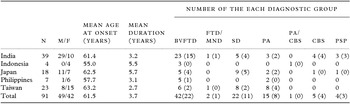
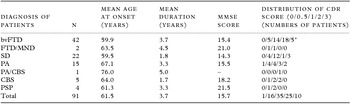
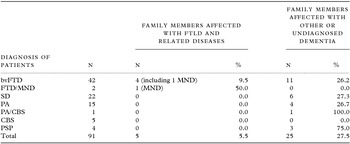
Ninety-one patients were recruited from the five institutes. Demographic data are shown in Table 1. Forty-two patients had a diagnosis of bvFTD, two patients had FTD/MND, 22 had SD, 15 had PA, one had PA/CBS, five had CBS, and four patients had PSP. One of the patients was clinically diagnosed as FTD/MND, who showed FTLD-TDP pathology by brain biopsy. This patient and two others were found to have the C9ORF72 mutation by genetic testing. The Mini-Mental State Examination (MMSE) scores, Clinical Dementia Rating (CDR) scores, average age at onset, and duration of illness at presentation are summarized in Table 2. The MMSE scores were not available in 13 patients because of their severe behavioral and/or language disturbances, while in four patients CDR scores were not recorded. Sixty-six patients had information of all of their first-degree relatives. They include 35 patients with bvFTD, 14 with SD, seven with PA, one with PA/CBS overlap syndrome, five with CBS and four with PSP. Data on family history in the different FTLD spectrum disorders are shown in Table 3. Family history of any FTLD spectrum disorder was found in 5.5% of all patients, 9.5% of those with bvFTD, 50% of those with FTD/MND (out of only two patients), but in none of those with SD, PA, PA/CBS, CBS, and PSP. Among the four probands with bvFTD and positive family history, two also had family history of bvFTD, one had family history of PA, and one had family history of MND.
Demographic data for the 91 patients with frontotemporal lobar degeneration spectrum disorders

Notes: The numbers within brackets denote the number of male patients.
bvFTD = behavioural variant frontotemporal dementia; FTD/MND = frontotemporal dementia with motor neuron disease; SD = semantic dementia; PA = progressive non-fluent aphasia; PA/CBS = progressive non-fluent dementia and corticobasal syndrome overlap; CBS = corticobasal syndrome; PSP = progressive supranuclear palsy.
Age, duration, MMSE scores, and CDR scores by diagnostic group

Notes: Numeral shows the number of patients in each CDR score.
Data of 13 cases in MMSE and 4 cases in CDR were could not available.
MMSE = Mini-Mental State Examination; CDR = Clinical Dementia Rating; bvFTD = behavioural variant frontotemporal dementia; FTD/MND = frontotemporal dementia with motor neuron disease; SD = semantic dementia; PA = progressive non-fluent aphasia; PA/CBS = progressive non-fluent dementia and corticobasal syndrome overlap; CBS = corticobasal syndrome; PSP = progressive supranuclear palsy.
Family history data in each diagnostic group

Notes: FTLD and related diseases included FTLD spectrum disorders and MND. One patient with MND among four affecting family members in bvFTD group: one affected family member with MND in the FTD/MND group.
bvFTD = behavioural variant frontotemporal dementia; FTD/MND = frontotemporal dementia with motor neuron disease; SD = semantic dementia; PA = progressive non-fluent aphasia; PA/CBS = progressive non-fluent dementia and corticobasal syndrome overlap; CBS = corticobasal syndrome; PSP = progressive supranuclear palsy.
One bvFTD proband had three family members with FTD, including first-degree relatives, although neither pathological nor genetic data were available for any of them. Each of the other probands with bvFTD had only one other family member with a FTLD spectrum disorder. One of two probands with FTD/MND had one family member with MND. Family history of other dementias including AD and undiagnosed dementias was found in 27.5% of all patients, 26.2% of bvFTD, 27.3% of SD, 50% of PA, 75% of PSP, and in the only patient with PA/CBS overlap, but in none with FTD/MND or CBS.
Discussion
To date, family history in FTLD, reported mostly from western European and North American populations, has been seen in up to 40% of patients, with roughly 10% of patients showing an autosomal dominant inheritance pattern (Goldman et al., Reference Goldman2005; Reference Goldman, Adamson, Karydas, Miller and Hutton2007; van Swieten and Rosso, Reference van Swieten and Rosso2008). Relevant data from Asia are sparse (Ikeda et al., Reference Ikeda, Ishikawa and Tanabe2004; Ghosh et al., Reference Ghosh, Dutt, Ghosh, Bhargava and Rao2013). Our study is one of the largest reports of FTLD in an Asian population. A positive family history of FTLD spectrum disorders was found in 5.5% of our patients. Together with the previous Asian studies, our findings, therefore, support the infrequent occurrence of family history in Asian FTLD patients. It might be due to genetic differences between western and Asian populations.
In our patients, only one proband with bvFTD showed a clear autosomal dominant inheritance pattern, whereas none of the SD patients gave a family history of any FTLD spectrum disorder. Goldman et al. (Reference Goldman2005) reported autosomal dominant inheritance in 18.2% of their patients with bvFTD and 1.9% of their SD patients, while Rohrer et al. (Reference Rohrer2009) described this inheritance pattern in 20% of their bvFTD patients but not in their SD patients. Goldman et al. (Reference Goldman2005) also showed that familial aggregation, in which there were three or more affected family members, occurred in 8.1% of bvFTD patients but not in SD patients, and that 18.2% of bvFTD patients and 15.1% of SD patients had a single affected first-degree relative. In our study, most of the bvFTD patients had sporadic disease and only 2.4% of patients had a single affected relative. Therefore, in Asia, the occurrence of familial FTLD is undoubtedly lower than that in the western countries.
In recent years, various genetic abnormalities in microtubule-associated protein tau (MAPT), progranulin (GRN), and C9ORF72 have been associated with familial FTLD. In Asia, MAPT mutations have been reported in familial SD (Ishizuka et al., Reference Ishizuka, Nakamura, Ichiba and Sano2011), although typically in low frequency (Wada-Isoe et al., Reference Wada-Isoe2012). These results suggest that genetic factors for the development of FTLD may have a less important role in the Asian population. Rohrer et al. (Reference Rohrer2009) demonstrated that 186 out of the 225 FTLD patients in their study had no mutations in known genes such as MAPT, GRN, valosin-containing protein (VCP), TARDP, chromatin modifying protein 2B (CHMP2B), and fused in sarcoma (FUS), and did not show strong family history. Unknown genetic defects may be associated with the development of many sporadic FTLD cases.
There are several limitations in the current study. First, although diagnosis of each proband was based on comprehensive examination including brain imaging, and followed recognized consensus criteria, the information regarding family histories were obtained by semi-structured interviews of the proband and family members. It was thereby difficult to confirm the diagnosis in many deceased or distant family members. Second, for most of our patients the diagnosis was based on clinical criteria and was not confirmed by definite pathological or genetic tests. However, going by the number of patients with FTLD spectrum disorders recruited for this study, this may be the largest research to date focusing on the family history of these disorders in Asia. This could, therefore, form the basis for future neurogenetic research in Asian countries.
Conclusion
Previous epidemiological studies have suggested that familial FTLD was rare in Asian countries. The current study, by focusing on family history in FTLD patients, demonstrated that, unlike patients from western countries, few Asian FTLD patients have a positive family history of dementia. Future research could explore possible reasons underlying these differences.
Conflict of interest
None.
Description of author's roles
R. Fukuhara participated in the study design, analyzed the data, and wrote the paper. A. Ghosh, J. Fuh, J. Dominguez, and P. A. Ong carried out clinical assessment, collected the data, and edited and revised the paper. A. Dutt and Y. Liu carried out clinical assessment and collected data. H. Tanaka carried out clinical assessment, collected the data, and assisted the analyses. M. Ikeda participated in the study design, and editing and revising the paper. All of the authors contributed to and approved the manuscript.
Acknowledgments
This research was administered as a part of the scientific research conducted by the Ministry of Education, Culture, Sports, Science and Technology of Japan for M.I. (Grant No. 23591718).