Introduction
According to the theory of embodied music cognition, as elaborated by Leman (Reference LEMAN2007, Reference LEMAN2016), the body has a fundamental role in musical sense-making and understanding. Arguably, the body and body movement can therefore enhance the process of music learning. This resonates with findings in other educational domains such as mathematics (e.g. Nathan & Walkington, Reference NATHAN and WALKINGTON2017) or second-language learning (Goldin-Meadows et al., Reference GOLDIN-MEADOW, KIM and SINGER1999; Macedonia & Knösche, Reference MACEDONIA and KNÖSCHE2011).
Prior to the emergence of the embodied music cognition paradigm, famous pedagogues such as Orff (Reference ORFF, KEETMAN and KELLER1950) , Dalcroze (Reference DALCROZE1921), and Gordon (Reference GORDON2003) acknowledged the idea that embodying musical features through engaging in sensory-motor experiences with music is a powerful way of musical learning: body movement allows to reproduce, in real time, the energy, speed, articulation and melodic contour of the music to which it is aligned (Dalcroze, Reference DALCROZE1921). While methods such as Orff and Dalcroze use different qualities of body movement in the interaction with music, they mainly start with discrete movement (i.e. a motion in space preceded and followed by short, periodic interruptions), such as walking and clapping; Gordon (Reference GORDON2006) suggests “continuous fluid motion” (i.e. moving in a smooth and uninterrupted manner) as a starting point in movement-based music learning process. However, despite the rich experience and practical knowledge such music educational approaches provide, they are seldom informed, and even scarcely confirmed, by empirical research findings (Young, Reference YOUNG2016).
To shed light on why and how the body plays a role in music sense-making and learning, we conducted a prior study, comparing a verbal versus movement-based approach (Fortuna & Nijs, Reference FORTUNA and NIJS2020). Results showed that the children involved in movement-based interactions with music display an increased focus on musical parameters and on the temporal organisation of the piece. However, results did not yet inform as to whether different qualities of movement may influence the process of music sense-making. Considering the relation between different timing mechanisms and different types of movement (Braun Janzen et al., Reference BRAUN JANZEN, THOMPSON and RANVAUD2014a, Reference BRAUN JANZEN, THOMPSON, AMMIRANTE and RANVAUD2014b), we wanted to investigate whether training based on discrete versus continuous movement in alignment to music may affect the way children attribute meaning to music. To address this question, we set up a study in which two groups of children (aged 9–10) engaged in different kinds of educational activities, based on moving with discrete versus continuous movements to different pieces of music. Considering different studies on children’s visual representation of music (Barrett, Reference BARRETT2000; Fung & Gromko, Reference FUNG and GROMKO2001; Reybrouck et al., Reference REYBROUCK, VERSCHAFFEL and LAUWERIER2009; Carroll, Reference CARROLL2017), as a pre- and post-test, children were invited to move freely to a piece of music, then to draw a visual representation of the piece and taking into account that diverse variables in drawing such as children’s feeling, graphic or motor skills could affect the creative process (Jolley, Reference JOLLEY2010), children were asked to explain verbally the link with the music (see also: Barrett, Reference BARRETT2000).
With this study, we want to contribute to the music educational community, providing insights about the influence of varied qualities of body movements aligned to the music on children’s sense-making of the piece. Furthermore, the methodological approach used, based on the engagement of varied sensory modalities such as moving, visualising and conceptualising, may give interesting insight on how to promote a holistic approach to music experience to foster a deepening process of musical sense-making.
Background
A main assumption of an embodied approach to music cognition is that the coupling of action and perception in interaction with physical environment constitutes the roots of human cognition (Godøy, Reference GODØY, Godøy and Leman2010; Leman Reference LEMAN2007, Lesaffre et al., Reference LESAFFRE, MAES and LEMAN2017). Accordingly, musical sense-making is the outcome of a process of enactment, that is the interpretation of sound patterns (dynamic, pitch, structure) in terms of movements (energy, tempo, direction) and corresponding emotional states (Leman, Reference LEMAN2016). This theoretical conception aligns with neuron mirror studies which found that the premotor area of the brain is involved, both when observing action and when listening to action-related sound (Lahav, Saltzman, & Schlaug, Reference LAHAV, SALTZMAN and SCHLAUG2007).
Within the framework of embodied music cognition, a growing body of studies highlights the influence of movement on music perception. For example, body movement while listening can disambiguate a rhythm stimulus without accent beats (Philips-Silver & Trainor, Reference PHILLIPS-SILVER and TRAINOR2005, Reference PHILLIPS-SILVER and TRAINOR2007) or influence the perception of the metre (Naveda & Leman, Reference NAVEDA and LEMAN2009), while moving to the beat may strengthen the perception of timing (Manning & Schutz, Reference MANNING and SCHUTZ2013). These findings seem to be confirmed by the neuroscientific study of Grahn and Brett (Reference GRAHN and BRETT2007) according to which the basal ganglia and supplementary motor area (SMA) may process both the movement production and beat perception. Despite extensive research on movement and music perception, the way in which varied qualities of movement may influence music processing is still under-investigated (but see, for example, Maes & Leman, Reference MAES and LEMAN2013).
Interestingly, recent studies have highlighted that sensory-motor synchronisation to music is grounded in two different processes, based on continuous or discontinuous movements (Braun Jantzen et al., Reference BRAUN JANZEN, THOMPSON and RANVAUD2014a, Reference BRAUN JANZEN, THOMPSON, AMMIRANTE and RANVAUD2014b; Loras et al., Reference LORÅS, SIGMUNDSSON, TALCOTT, ÖHBERG and STENSDOTTER2012). On the one hand, the timing of discrete rhythmic movement such as finger tapping, clapping or staccato bowing, seems to rely on an event-based timing mechanism (beat, pulse), all of which involve a clock-like mechanism in which salient reference points make the process of timing explicit. On the other hand, the timing of continuous, smooth, sustained movements such as circle drawing or smooth bowing, seems to be based on emergent timing in which there are no salient visual, tactile or kinesthetic events along the movement trajectory to provide a reference point. As a consequence, the regularity of timing emerges from the movement trajectory or through a control of the dynamics of movement (Torre & Balasubramaniam, Reference TORRE and BALASUBRAMANIAM2009; Zelaznik et al., Reference ZELAZNIK, SPENCER, IVRY, BARIA, BLOOM, DOLANSKY, JUSTICE, PATTERSON and WHETTER2005).
The aforementioned studies concerning event-based timing and emergent timing are in line with Leman’s distinction (Reference LEMAN2016) which introduces two kinds of body alignment to music, namely: phase and inter-phase alignment. Phase alignment entails the synchronisation of movements to salient time markers of musical rhythm. For example, clapping or stamping on the beat, or meter of the music, concerns a phase alignment in which the main focus of attention is on the timing of the piece. This means that the temporal discrete patterns perceived in the music (i.e. pulse, beat, meter) are mirrored by discrete movements. Inter-phase alignment entails the mirroring of what occurs in between the discrete-time markers. In this case, the continuous flow of movement can be aligned to the melody, dynamics or phrase of the music, such as when, for example, making a continuous curve with the arm to describe a melodic contour.
Based on the above, it might be argued that, when listeners are guided to perform an intentional interaction with music through specific patterns of movement, their attention may be directed to those elements of the sound that resonate with their movements (Acitores, Reference ACITORES, Clarke and Clarke2011; Clarke, Reference CLARKE2005). Accordingly, it may be argued that a specific kind of body movement aligned with different qualities and features of sound (melody, rhythm, dynamics, structure) may shape auditory perception, affect cue selection and consequently shape musical sense-making. Indeed, according to the sensorimotor contingency theory of O’Regan et al. (Reference O’REGAN, MYIN, NOË and Carsetti2004), bodily actions filter the stimuli that give rise to our perceptions (bodiliness), and lead to an attuning to those elements of the sound that resonate with the performed gesture (grabbiness) leaving the other elements in the background.
Research question
The general question we asked ourselves is whether the use of different types of responsive body movement while listening to music may lead to different ways of attributing meaning to music. Taking into account the results of our previous study (Fortuna & Nijs, Reference FORTUNA and NIJS2020), indicating that musical sense-making differs with regard to timing when engaging in different types of learning activities (movement vs. verbal description), we further refined our general research question based on the literature about different timing mechanisms (event-based vs. emergent) and their relationship to body movement (discrete vs. continuous):
Do discrete vs. continuous body movement-based interactions with the music influence the way children interpret the music through visual representations (drawings) and by verbally explaining their drawing?
We hypothesised that musical sense-making would differ according to the type of movement used in a series of learning activities. As such, we expected that, according to the intervention children engaged in, the drawings would differ in the way they display and highlight different aspects of the music. In particular, we expected to find more discrete elements in the drawings of the group of children that engaged in activities based on discrete movements, and more continuous elements in the drawings of the group of children that engaged in activities based on continuous movement.
Methodology
Participants
This study involved 34 children (aged 9–10) of two classrooms (IV and V grades) from a primary school located in the centre of Italy. From the questionnaires filled out by the children, it emerged that none of the children received formal music education prior to the study, such as instrumental music lessons. They were not acquainted with traditional music notation nor attending a musical course out of the school. Moreover, outside the school hours, the children were used to listen to music for about 3 or 4 hours a week, while doing their homework or in the car with their parents.
Design and procedure of the study
This study adopted a quasi-experimental pre-and post-test design and involved two interventions, differing regarding the approach adopted in the learning activities (see Table 1).
Design of the study

O1: pre-test: free movement, drawing and verbal explanation of a musical excerpt.
O2: post-test: free movement, drawing and verbal explanation of a musical excerpt.
Xa: intervention a: discrete movement on nine different pieces of music or excerpts.
Xb: intervention b: continuous movement on nine different pieces of music or excerpts
Prior to the study, the head of the school and the children’s parents were informed by a letter containing a brief description of the study, a declaration about the respect for ethical codes and a consent form to be signed. The study was approved by the Ethics Committee of the Faculty of Arts and Philosophy of Ghent University
Two weeks before the actual experiment, the researcher organised two music lessons with each class, focused on listening and exploring body movement aligned to the music. This phase was organised to allow acquaintance between the teacher/researcher and the children and to improve the children’s confidence with music listening and body movement.
The actual study encompassed five consecutive days. The sessions were held in a classroom setting, with each group, consisting of six children (see Table 1).
The first and fifth sessions consisted of a pre-test and a post-test in which the children were invited to accomplish the following tasks:
-
i. Move: to show what they hear in the music, twice, with free body movements.
-
ii. Draw: to make a visual representation of the piece on a paper sheet, so that a peer could understand how the music sounds. This was done while listening to the music. As the music started, the children were invited to start the task and continue as long as the music went on. The piece of music was played twice so the children had enough time to visually represent the music.
-
iii. Explain: to write three adjectives describing the music at the back of the drawing, and – in a short unstructured interview – verbally explain the relationship between the visual representation and the music. During the interview, the music was played again to help the children recalling the link between the drawing and the music, by pointing through his finger on the correspondence between drawing and music (Kerchner, Reference KERCHNER2000).
In between the pre- and post-test, children from each group participated in daily sessions, encompassing different musical activities. In these activities, children were asked to show with their body what they were hearing in the music excerpts they were presented with (“show what you hear”, see also: Wedin, Reference WEDIN2015). According to the experimental group they were assigned to, children were invited to move with different qualities of body movement on a set of musical excerpts:
-
Group A: discrete movement
-
Group B: continuous movement
Discrete movements entail an event in space preceded and followed by a short period without motion (i.e. zero velocity) (Braun Janzen et al., Reference BRAUN JANZEN, THOMPSON, AMMIRANTE and RANVAUD2014b), which leads to detach each movement from its previous and following movement (Reybrouck, Reference REYBROUCK2015). An example is walking or clapping, consequently, it may result in impulsive or reiterative gestures (Godøy, Reference GODØY2006). Continuous movements entails smooth uninterrupted movements, for example drawing a circle in the air (Braun Janzen et al., Reference BRAUN JANZEN, THOMPSON and RANVAUD2014a).
To invoke these movement qualities in response to the music, children in each experimental group were scaffolded to use either discrete (Group A) or continuous (Group B) movements, through metaphors and images suggested by the researcher (e.g. imagine painting the music with detached dots vs. sustained gliding brushstrokes). To not determine the children’s movements, modelling specific movements was avoided, as was giving explicit instructions to use discrete or continuous gestures. Moreover, the teacher explicitly invited using the movements induced by these metaphors and images in response to the music, to avoid children just performing these movements without focusing on the music.
Each daily session encompassed two phases:
-
Exploration of movements:
-
Exploring the quality of movement assigned to their group, with different body parts (e.g. arms, legs, and whole body), time (e.g. slow, fast) and space (e.g. direct, indirect) (Laban, Reference LABAN1971). First, specific stimuli such as voice effects, glissando or pulse, were used to evoke the movements specific to the group (continuous vs. discrete). Second, in the same way, specific musical excerpts composed by various kinds of staccato versus continuous electronic sounds (Burton & Kudo, Reference BURTON and KUDO2000) were introduced.
-
-
Bodily description of the pieces:
-
showing with body movements what they were hearing in the music (twice for each of the three pieces), either with discrete (group A) or continuous movements (Group B)
-
In order to guide the quality of their movement in the description phase, different scenarios were proposed:
-
Day 1: Imagine doing something (with arms):
-
moving arms and hands, for example, as if painting the music with detached dots versus sustained gliding brushstrokes
-
-
Day 2: Imagine being somewhere (with arms and legs):
-
moving arms or legs on the music, as if being in different environments which would affect the flow of their movements. For instance, they were invited of moving their arms waving a scarf in the air, imagining it was the wind moving on the music versus stamping their feet on the floor according to what they were hearing of the music
-
-
Day 3: Imagine being someone (with the whole body):
-
moving their body imagining of imitating the movement of the wind, the gesture of a painter versus the movement of a robot, a jumping animal.
-
Musical stimuli
The musical stimuli for the pre and post-test were the 6th to 7th variations from sonata opus 5 number 12, by Arcangelo Corelli entitled Follia, a work, which is composed of 24 variations on the musical theme of “La folia”, thought to be of Portuguese origin, and often used in musical compositions (Figure 1) .
The piece was played on violin and cello, live recorded for this study by two professional musicians affiliated to the Conservatory of Frosinone (Italy). This excerpt of music was chosen for the following reasons:
-
the 6th variation is composed of a continuous and lyrical melody played in the high register by the violin and, an accompaniment of rhythmic staccato chords, which recall the theme of La Folia, performed by the cello.
-
in the 7th variation, the parts are reversed. The violin performs the rhythmic staccato chords and the cello the continuous and lyrical melody.
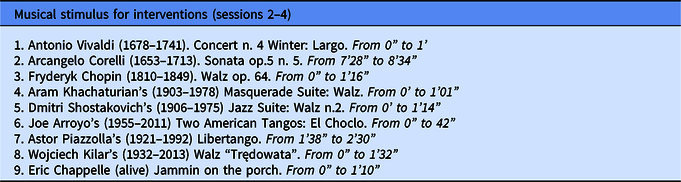
The musical stimulus for the interventions encompassed nine pieces or excerpts of music (length: 1 min), selected from classical and popular repertoire (see Table 2), because of their lyrical continuous and smooth melody and the rhythmic staccato accompaniment.
Pieces selected for pre- and post-tests and interventions

Data collection
In this study, data were collected in two phases. First, qualitative data were gathered to explore the nuances of phenomenon (e.g. body movements, children’s drawings, interviews). Next, these data were quantified based on a set of classifications (categories, graphic elements, polarity of arousal, voices) to explain the relationships found in the qualitative analyses (see Creswell, Reference CRESWELL2012).
Data analysis
Movements
In this study, to address the research question regarding the musical sense-making as reflected in the visual representation of the music, we focus on the children’s drawings and verbal explanations. However, to verify whether the intervention (continuous vs. discrete) invoked a learning effect on the children’s responses to the music, and as such may have impacted the visual representation of the music, we conducted a preliminary qualitative analysis of the movements, focusing on the main gestures of the children in response to the music.
First all movements of the children were categorised based on a bottom-up analysis, using open coding . Next, the categories were clustered into a smaller set of main categories.
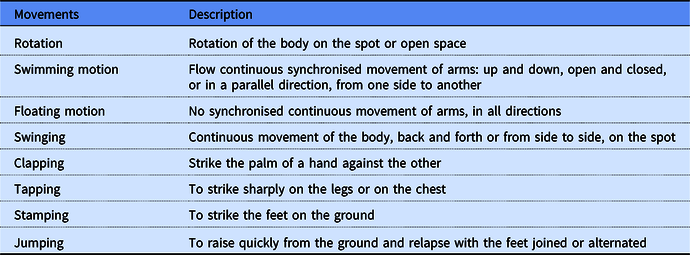
In Table 3, the main categories of children’s movements are described.
Scheme of the main categories of children’s movements

Drawings
Because a visual representation is a dynamic and constructive act, rooted in the primordial, expressive gestures of the human body (Merleau-Ponty, Reference MERLEAU-PONTY1962), the process of drawing and its finished product may be complementary in giving meaning to the drawings (Dewey, 1958/Reference DEWEY1934)
Therefore, our analysis aimed at gaining insights on both the process of drawing, and its final product, in relation to the music. To do so, the analysis encompassed three phases: (1) analysing the graphic elements in the final product (drawing) and relating them to the music, (2–3) analysing the gestures used in the process of drawing.
Phase 1 – A first qualitative analysis of the drawings was partially based on the MSC analysis of Elkoshi (Reference ELKOSHI2002, Reference ELKOSHI2019). Visual aspects of the drawings were analysed based on Material Analysis (M), focusing on the morphological aspects of the drawings (e.g., elements, classes, and genres), followed by a Structural Analysis (S), focusing on the relationship between the elements in the drawings (e.g., location on the page, proportions, thickness of stroke and colour). Next, based on the children’s verbal accounts of the drawings, visual elements were categorised using Conceptual analysis (C), which probed to define the meaning of the drawing.
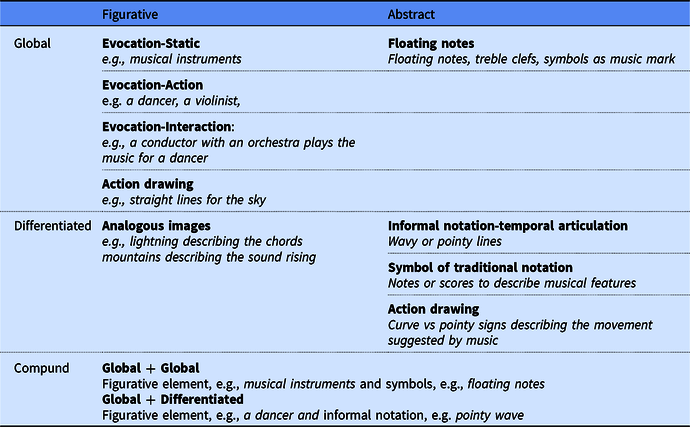
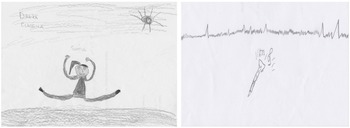
Based on the above analysis, all the drawings were then categorised into two main categories: global vs. differentiated, according to a categorisation scheme adopted either in previous studies (Fortuna & Nijs, 2020; Reybrouck et al., Reference REYBROUCK, VERSCHAFFEL and LAUWERIER2009; Verschaffel et al., Reference VERSCHAFFEL, REYBROUCK, JANSSENS and VAN DOOREN2010). Global refers to, for example, action scenes, landscapes and objects that suggest an overall meaning of the music. Differentiated refers to capturing one or more musical features, such as tempo, pitch, dynamic, timbre and repetitions as developed in their temporal unfolding (Figure 2).
A complementary category, named compound, was added to group the drawings in which these two main categories were combined. In addition, each main category was further organised in corresponding sub-categories, slightly adapted from the work of Reybrouck et al. (Reference REYBROUCK, VERSCHAFFEL and LAUWERIER2009) and Verschaffel et al. (Reference VERSCHAFFEL, REYBROUCK, JANSSENS and VAN DOOREN2010).
The global category was divided into the following sub-categories of pictorial ways of representing the music: evoking a static scene such as a landscape (evocative-static), active scene such as a dancer (evocative-active), interactive scene, describing the interaction between elements, such as the hunter chasing the wolf (evocative-interactive). In addition, the sub-category named floating note was added when musical symbols such as musical notes or staves are used to denote the presence of music without any reference to musical parameters.
The differentiated category was sub-categorised into analogous images (a pictorial image describing one or more parameters e.g. a mountain slope to describe a sound rising), informal notation-temporal articulation (e.g., shapes or pointed lines going up and down (explanation) or symbol of traditional notation, to describe one or more parameters unfolding over time.
In Table 4, the different categories and sub-categories are summarised.
Scheme of the main categories and sub-categories of children’ drawings

Dynamic marks (action drawing) and their corresponding gesture

In addition to the above-mentioned categorisation schemes, in the current study, we added an additional sub-category, namely action drawing (Matthews, Reference MATTHEWS2003). This is a loose form of sketching that attempts to capture the quality of movement of an event or object. It aligns with Nicolaidis’ gesture drawing, which entails drawing what an object is doing instead of drawing what it looks like or is (Nicolaidis, Reference NICOLAIDES1941)
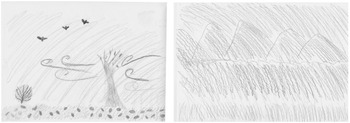
As action drawing is guided by the feeling of movement, it is performed rapidly with straight, curved or circular lines, in order to mirror (in a small space) the quality of movement of the object to be represented (Cuttings, Reference CUTTING2002). According to Matthew (Reference MATTHEWS2003), children’s drawings may be focused either on the shape of objects (configurative drawing) and on its dynamic and movement in space and time (dynamic drawing). In the latter, the patterns of movement used to draw share the same features with pattern of movement seen or experienced. The sub-category of action drawing may be included in the global versus differentiated category (see Figure 3), attempting to describe the impressions or associations suggested by the music, e.g. the wind moving (global-action drawing) or the sound raising and failing (differentiated – action drawing).
First two bars of the 6th and 7th variation from Sonata Follia of Arcangelo Corelli.

Example of Global (left) and Differentiated (right) drawings.

Example of Action drawings: curved lines to represent the wind (left), scribbly made with discrete straight marks to represent the movement of the sound (right).

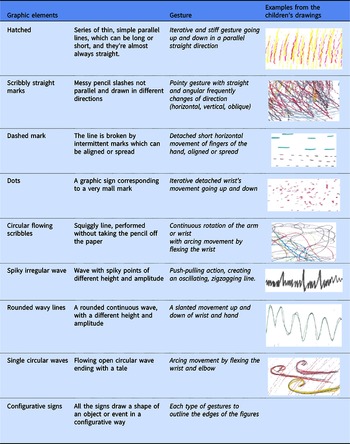
Phase 2 - To further refine the analysis and considering the literature about action drawing, all graphic elements and corresponding gestures were identified and coded in each drawing. Among these graphic elements, those used to fill in the shapes were not considered. Moreover, based on the distinction between configurative and dynamic drawings (Matthews, Reference MATTHEWS2003), all the graphic elements used to outline an real object or event were categorised as “configurative”, while the other graphic elements trying to describe the movement were categorised as “dynamic” and classified according to their shape, and the corresponding gesture, as is shown in Table 5.
These sub-categories were defined by the authors, taking into account the patterns of gestural drawing identified by Matthews (Reference MATTHEWS2003) and Nicolaides (Reference NICOLAIDES1941/60), as well as patterns of graphic elements described by the literature of teaching art. In addition, the studies on Bouba Kiki effects (Gomez et al., Reference GOMEZ, IBORRA, DE CORDOBA, JUÁREZ-RAMOS, ARTACHO and RUBIO2013) according to which visual shapes (e.g., round or spiky) are associated with corresponding sounds, contributed to define the above sub-categories.
Phase 3 – After identifying different graphic elements in the drawings, their occurrence in the drawings was counted and added up for each group, respectively, for the pre-test and the post-test. The same was done for the total number of global and differentiated elements.
Verbal analysis
A preliminary exploratory analysis using the annotation software Elan (2018) was performed to understand the general meaning of the data. This was done at two levels: arousal and voices.
“Arousal” denotes a state of feeling that involves bodily reactivity or general bodily changes associated with brain activation, such as alertness and wakefulness (Mehrabian & Russell, Reference MEHRABIAN and RUSSELL1974; Lim & Park, Reference LIM and PARK2019). As a consequence, it is an important element of musical sense-making due to the level of arousal potential to determine the aesthetic response to music (Reybrouck et al., Reference REYBROUCK, PODLIPNIAK and WELCH2020). For example, studies found that expressive body movement while listening (Maes & Leman, Reference MAES and LEMAN2013) or tapping while listening (Lim & Park, Reference LIM and PARK2019) may influence the activation of low or high arousal.
“Voice” denotes the place of a musical pattern (e.g. melody) within the hierarchical structure of the music, often related to the function of the melody (e.g. main melody vs. accompaniment) and to a specific register (e.g., the span of pitches used by a single line in a musical composition).
Many previous studies underline that untrained listeners tend to focus their attention on the melody in the upper register, keeping the accompaniment into the background (Deliege, Reference DELIÈGE2001; Dowling, Reference DOWLING1991; Wolpert, Reference WOLPERT1990; Zenatti, Reference ZENATTI1985). Accordingly, it is relevant to investigate whether varied quality of body movement may influence the voices gathered by the children.
First Level - Different kinds of arousal attributed to the music
Both on the back of their drawings and during the interview, children were invited to explain the link between their drawing and the music. In doing so, they provided varied or opposite adjectives (“the music is calm”) or explanations (“I draw this landscape to describe the music which was calm and relaxing”). To investigate whether the children’s adjectives and explanations indicated the same kind of arousal (e.g. “the music is calm”) or, instead, a polarity of arousal (e.g. “the music is relaxing, but then it get agitated”) along the piece, a deepened inspection of the children’ words and phrases was performed. In order to address this expressive attribution, the adjectives used by the children were categorised following the model applied by Mehrabian (Reference MEHRABIAN1996) and Mehrabian & Russell (Reference MEHRABIAN and RUSSELL1974), Russell & Mehrabian (Reference RUSSELL and MEHRABIAN1977) in which the different levels of activation range from a lower level, such as sleep, inactivity, boredom and relaxation, to a higher level of activation such as bodily tension, strenuous exercise, wakefulness and energy. Following the aforementioned polarity, all attributions and phrases referred to the arousal of the two Folia variations were first collected from the interviews and the back of the drawing of each child. Next, after a recursive reading, the adjectives and attributions of each child were categorised as high arousal (e.g., vivace, movimentata, forte, agitata, energica) or low arousal (e.g., tranquilla calma, dolce, rilassante). Finally, it was analysed whether each participant attributed to the same level of arousal or polarity of arousal to the two variations, in pre and post-test.
Accordingly, the analysis was based on three kinds of description:
-
1. Attribution of the same level of arousal to the two variations of the piece (e.g. the variations are experienced as calm).
-
2. Attribution of polarity of arousal to the two variations of the piece (e.g. the variations are experienced as both calm next energetic).
-
3. No attribution of arousal to the two variations of the piece.
Second Level - Voices of the piece described in the drawings
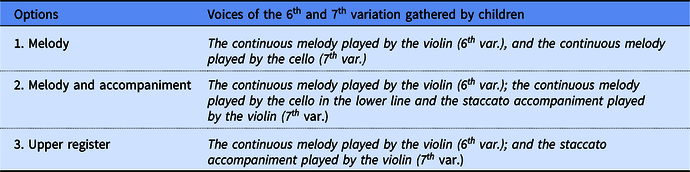
The next level of verbal analysis aimed at gaining insight about which voice (i.e. melody or accompaniment) of the piece was consciously described by the children. In the current study, the melody switches from the upper to lower register, with a change of timbre (from violin to cello). In order to investigate whether the children focused their attention (1) on the melody, independently of the change of register and timbre (from violin to cello), (2) both on melody and accompaniment or (3) only on the upper register with the same timbre (violin), independently of change from melody to accompaniment, different options were analysed, shown in Table 6.
Voices of the melody described by the children

In order to understand which part of the piece “higher, lower or both”, the children described in their drawings, the followings procedures were followed:
-
I. During the interview, while the child listened to the piece again, it was asked to indicate with the finger the parts of the drawing corresponding with the ongoing of the piece.
-
II. The researcher sang an excerpt of the two parts of the piece and asked which of the two was represented on the drawing.
Results
Movements
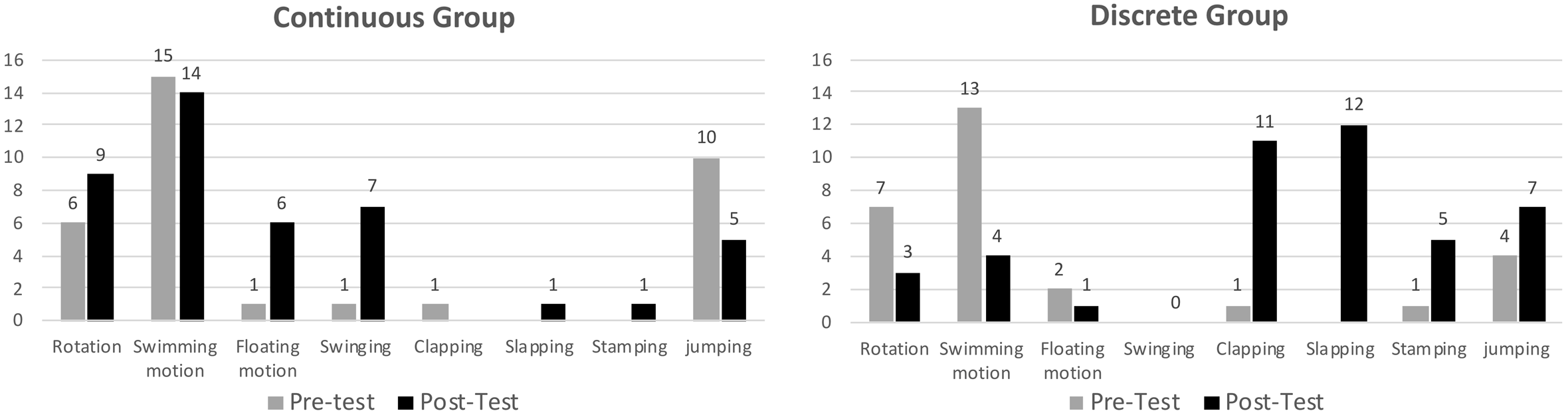
The preliminary analysis of the movement responses to Folia in the pre- and post-test showed that children in both groups mainly used continuous movements in the pre-test (see Figure 4). However, Discrete group changed their movement responses from mainly continuous movements in the pre-test to more discrete movements in the post-test. This means that the intervention had an effect on the way they move to the music, indicating that indeed a learning affect occurred. The Continuous group kept on using continuous movements, however, with a more elaborated movement vocabulary in the post-test.
Frequencies of the main categories of children’s movements from pre-test to post-test in the Discrete and Continuous groups.

Drawings
To investigate whether different types of body movement in the interaction with music may affect the way children attribute meaning to music and visually represent it, the occurrence of the main categories, namely global versus differentiated, and corresponding sub-categories were analysed in the children’s drawings from pre to post-test in both groups. According to the previous literature (Verschaffel et al., Reference VERSCHAFFEL, REYBROUCK, JANSSENS and VAN DOOREN2010), all compound drawings (global/differentiated), containing at least one “differentiated” element were counted as “differentiated” representation.
In addition, the occurrence of dynamic signs used by the children in their action drawings was calculated in both groups in pre- and post-test.
Main categories
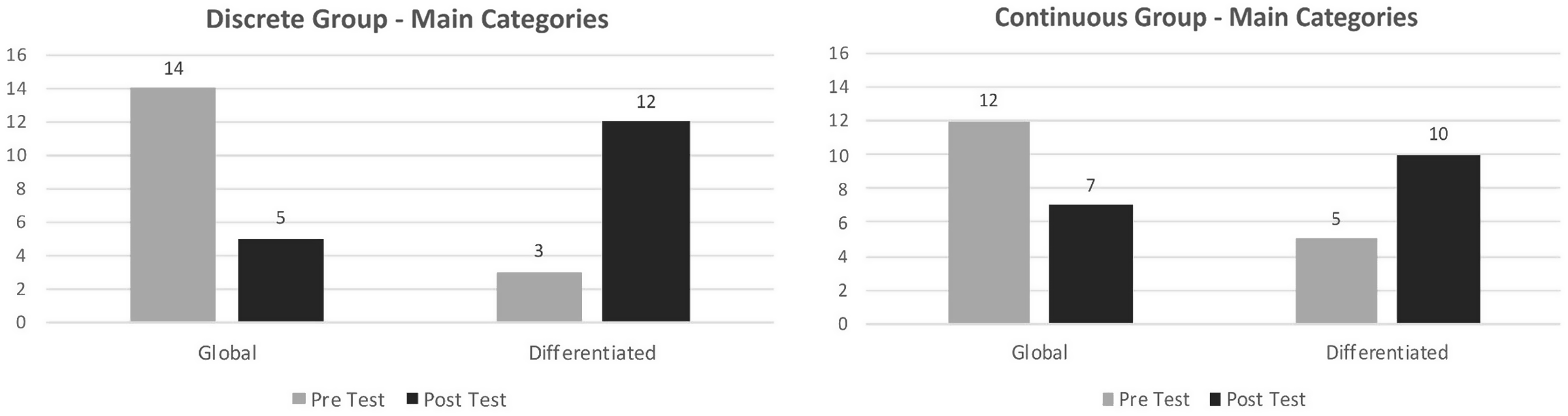
The drawings of both groups were increasingly differentiated from pre- to post-test (see Figure 5). In the Discrete group, the differentiated drawings increased from 3 (17.6%) to 12 (70.6%) while the global drawings decreased from 14 (82.3%) to 5 (29.4%). In the Continuous group, the differentiated drawings changed from 5 (29.4%) to 10 (58.8%) while the global drawings decreased from 12 (70.6%) to 7 (41%).
Frequencies of the main categories from pre-test to post-test in the Discrete and Continuous groups.

This means that children in both groups tend to make less pictorial drawings (depicting for example situations and objects), and try to describe one of the musical dimensions (e.g. articulation, dynamics, pitch, melodic directionality) (Fortuna & Nijs, Reference FORTUNA and NIJS2020 ).
Sub-Categories
The occurrences of the sub-categories show for both groups from pre- to post-test an increase of Differentiated-Action drawings (from 1 to 4 in Discrete group; from 3 to 4 in Continuous group),
Analogous image drawings (from 0 to 3 in Discrete group, from 1 to 2 in Continuous group) and Differentiated Compound (Global+Action Drawings) (from 1 to 3 in Discrete group, from 1 to 4 in Continuous group) (see Figure 6).
Frequencies of sub-categories in pre-test and post-test in the Discrete and Continuous groups.

The increase in differentiated sub-categories confirms the previous result (more differentiated drawings), but also indicate that children use more abstract signs to describe the quality of the movement in the music.
Dynamic signs of action drawings from pre to post-test
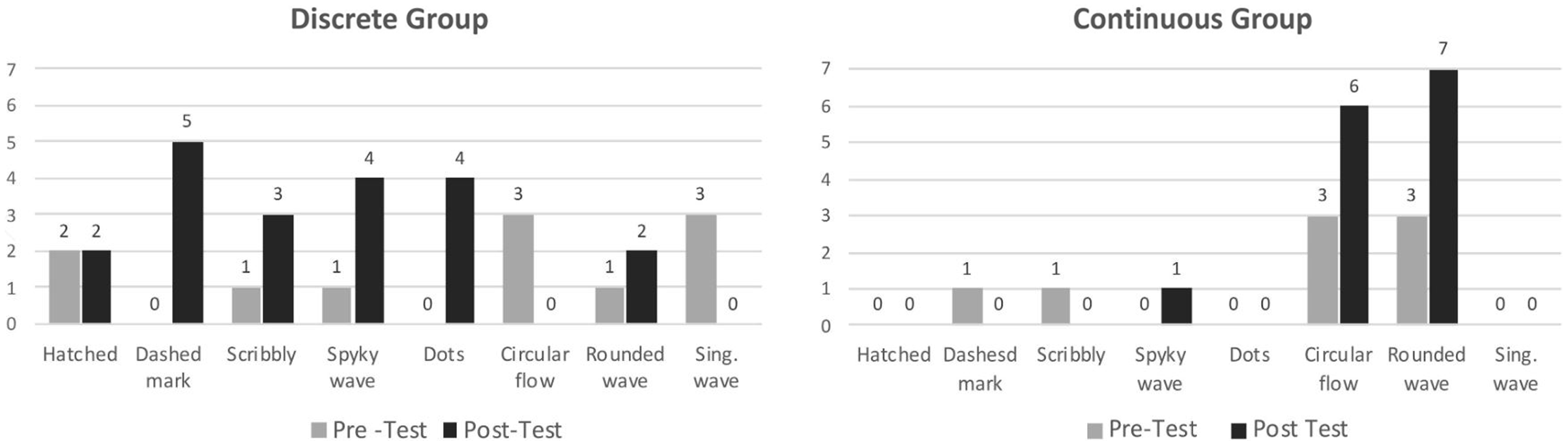
In the Discrete group, drawings displayed an increase of discrete graphic elements such as dashed marks (from 0 to 5), scribbly straight marks (from 1 to 3), spiky waves (from 1 to 4) and dots (from 0 to 4); and a corresponding decrease of continuous graphic elements (from 7 to 2). Conversely, the Continuous group increased the use of continuous flow graphic elements as circular flow (from 3 to 6) and rounded waves (from 3 to 7).
As shown in Figure 7 below, both groups in post-test focus on specific type of dynamic graphic elements, respectively, discrete versus continuous.
Frequencies of dynamic signs of action drawing from pre-test to post-test in Discrete and Continuous groups.

Verbal explanations
In order to investigate whether changes in the children’s sense-making were reflected in the verbal explanations of the visual representation, and their link with the music, the levels of arousal and the described voices were identified from pre- to post-test in both groups.
With regard to arousal, the Continuous group remained stable in indicating the same arousal of the piece in pre- and post-test. The Discrete group’s verbal description displayed more arousal-polarities in the post-test, moving from score 9 in pre-test to 15 in post-test (See Table 7).
Overview of the levels of arousal described by the groups in pre- and post-test

With regard to the verbal reference to the different voices, the Continuous group, both in pre- and post-test, focused on the melody. In the Discrete group, 6 of 17 participants widened their attention in the post-test, focusing on the combination of melody and accompaniment. Both in pre- and post-test, none of the children described only the upper register of the 6th and 7th variation (see Table 8).
Frequencies of the lines of the piece described by groups in pre- and post-test

Discussion
The main purpose of this study was to investigate in which way and to what extent discrete versus continuous movement-based interactions with music may influence children’s musical sense-making. To do so, children’s visual representations and their verbal explanation were used to interpret what children hear in the music.
The results of the visual analysis showed that the drawings of the children in both groups were more differentiated in the post-test, thereby confirming the results of our previous study (Fortuna & Nijs, Reference FORTUNA and NIJS2020). Clearly, this points to the importance of integrating movement in children’s music listening activities, to develop more sophisticated listening skills. This aligns with the Dalcroze approach to music learning, according to which one can learn to discriminate between even the subtlest nuances in all the expressive qualities of sound, through practice using bodily involvement (Juntunen, Reference JUNTUNEN, Abril and Gault2016).
Interestingly, and contrary to our expectations, the Discrete group seemed to move slightly more towards differentiated drawings than the Continuous group. It could be argued that the Discrete group focused slightly more on the musical features of the piece, which would seem to be confirmed by the data gathered from the children’s verbal reports (see further). This finding points at the necessity of aligning movement to the music within the overall temporal framework as presented by the music, thereby emphasising the importance of appealing to the other (next to alignment) basic mechanisms of musical sense-making, namely entrainment and prediction (Leman, Reference LEMAN2016). Consequently, the design of movement-based music listening activities needs to address all basic mechanisms of the enactment process (see also Nijs & Bremmer, Reference NIJS, BREMMER, Ilari and Young2019).
In addition to the common tendency of both groups to make a greater number of differentiated drawings from pre- to post-test, the visual analysis yielded other significant findings. Indeed, from pre- to post-test, all participants increasingly used action drawings to describe the music with dynamic elements. The interviews with the children revealed that the action drawings were used to describe the movement of the music as it was experienced in space and time. This means that the process of enactment through sensory-motor engagement with the music may influence the children’s sense-making as reflected in their process of visualisation. These results resonate with the analyses of Matthews (Reference MATTHEWS2003) and Athey (Reference ATHEY1990), who show that children tend to transfer, into their drawing and painting, action schemes that were previously experienced in other contexts. According to these studies, patterns of movements explored in different settings tend to share the same characteristics with movement patterns performed in different domains, although they may require a slight adaptation of the gesture, due to the different opportunities and constraints of movement offered by the medium (e.g., arcing movement in the air, holding a scarf, and arcing movement, on the paper, holding a brush). In line with these findings, our study indicates that the process of the children’s drawings seemed to be grounded in their bodily interaction with the music (continuous or discrete gesture), which is subsequently translated into the visual domain (a drawing gesture within the limited space of the paper). This seems to be further confirmed by the changes that occurred in the quality of the graphical elements after the interventions. The Continuous group used more continuous graphic elements (e.g. circular scribbles and rounded waves) in their drawings in the post-test, while the Discrete group switched to mainly using discrete signs (e.g., hatched, dashed mark, scribbly, spiky waves and dots) that are based on discrete gestures (see Table 5). This transfer from moving to drawing also aligns with Nicolaides’ considerations in his book the “Natural Way to Draw” (1941/60), according to which the gesture drawings represent what things are doing (1941:15). Although the drawing at the end of the process may be meaningless, the shapes seem to reflect the way the gesture embodied the movement of the music. In this way, the act of drawing may be considered a pre-reflective mode of symbolising an embodied experience (Chaplin, Reference CHAPLIN2005).
The findings of this study are partially in line with Bamberger’s study (Reference BAMBERGER and Strauss1982) that identified a child’s rhythm scribbles as mimicking a clapping action, and therefore as a first stage of the child’s development trajectory in invented notations. According to such a “stage” perspective, each stage is replaced by the following stage, developing from sensory-motor skills towards a broader range of procedural and abstract skills (Hargreaves & Galton, Reference HARGREAVES, GALTON, Reimer and Smith1992; Trehub, Reference TREHUB2003). Conversely, we emphasise the role of the sensory-motor engagement in all stages of the process of sense-making. Therefore, rather than conceiving the graphical mimicking of a bodily action as typical for a given developmental stage, as in Bamberger’s assumption, we suggest that such visual representation of the music should be considered an integral part of an embodied process of musical sense-making through the interaction with the music while drawing.
Given that the quality of gestures appears to have been transferred from the body movements while listening to the dynamicity of drawing, it is worthy to shed light on whether and to what extent varied qualities of body movement influenced the attribution of the arousal given by the children. The Continuous group remained consistent in attributing the same arousal from pre- to post-test, while most of the children of the Discrete group (from 9 in pre-test to 15 in post-test) moved towards the identification of an arousal-polarity along the piece (e.g., the first part is relaxed, but the second part becomes increasingly energic). It is likely that the accompanying line of the loud staccato chords played by the violin in the upper register, resulted in the sound being globally perceived as more energetic. Despite the claim, by the majority of participants, of having described only the melodic line, the indication of an arousal-polarity shows evidence that, although in global and subsidiary awareness (Polanyi, Reference POLANYI1969), they recognised a change in the global sound between the two variations.
Furthermore, our findings suggest that all participants in the Continuous group both in pre- and post-test mainly grasped the melody of the piece (e.g., first option) as the salient cue for the description of the music, rather than the other voices. The children, seemingly, recognised the melodic profile as invariant, despite the change of timbre and register, confirming the gestalt principles of similarity (Reybrouck, Reference REYBROUCK2009; Deliege, Reference DELIÈGE2001), and good continuation in melodic schema formation (Deutsch, Reference DEUTSCH and Deutsch1982; Dowling & Harwood, Reference DOWLING, HARWOOD, Dowling and Harwood1986; Sloboda, Reference SLOBODA1985). In this way, the children focused on the melody as a figure leaving the accompaniment in the background, in accordance with studies on children’s perception by Teplov (Reference TEPLOV1966), Zenatti (Reference ZENATTI1985) and Madsen and Geringer (Reference MADSEN and GERINGER1990). This tendency is less evident in the drawings and verbal descriptions of the Discrete group, due to the fact that 6 out of 17 children broadened the salient cues of their perception both on the melody and accompaniment (e.g. from a child’s interview: I described mainly the fast melody, but in the second part I described also strong notes like forks of lightning Pa Pa Pa).
These results may stem from the different interactions with the music, which may have affected attention to the elements of the piece. Indeed, as is shown by several studies (Zachopoulou et al., Reference ZACHOPOULOU, TSAPAKIDOU and DERRI2004; Su & Pöppel, Reference SU and PÖPPEL2012; Manning & Schutz, Reference MANNING and SCHUTZ2013), movement can steer attention towards different cues in the music. In this study, the process of entrainment and synchronisation of discrete movement seems to facilitate the alignment to the beat and meter, while continuous movements allow the beat to be disregarded and focus on to be directed on other aspects of the two variations (Leman, Reference LEMAN2016; Braun Jansen et al., Reference BRAUN JANZEN, THOMPSON, AMMIRANTE and RANVAUD2014b).
Limitations of the study
Despite the interesting findings, some limitations of this study must be taken into account. The modest sample size of participants did not allow statistical analysis, and the findings cannot be generalised. Also, the children performed their body movements in group, during the sessions. Through participation in the movement and mutual observation, children may have been inclined to imitate the gestures of their peers, instead of individually exploring movements to the music.
Finally, taking into account that despite the two meetings that were set up to stimulate their confidence in moving while listening, children may have had different levels of confidence in moving their bodies to the music. More interventions distributed over time may reduce the possible effect of this.
Based on the above considerations, further research is needed to gain deeper insight into the significance of different qualities of body movement on the process of visual representation.
Conclusion
Our study suggests that different types of bodily involvement with music can affect children’s process of musical sense-making, when visually representing the music in a drawing. The results indicate that different qualities of body movements provoke attuning perception to those elements of the music that aligned with the performed gestures, leaving other elements in the background. In this way, this study provides empirical support for the practical approaches such as Dalcroze’s Eurhythmics or Orff’s approach. At the same time, results indicate that the experienced patterns of movement are reflected in the way of drawing. Indeed, through action drawing children integrate more dynamic elements in their visual representations of the music. The sensory-motor root of the visual representation prompts a deeper understanding of the children’s drawings of the music taking into account the product, together with the quality of gesture employed by the children in the process of drawing.
From a music education perspective, our findings can be interpreted as forming two perspectives:
First, from the perspective of the learner, our findings suggest that the use of movement is an important way to support the development of musical sense-making. In addition, it indicates that it is not just about moving to the music, but about how to move to the music. This pleads for a differentiated use of body movements while listening in educational setting. Such differentiation may lead to a more encompassing, and as such, deeper understanding of the music.
Second, from the perspective of the teacher, our findings suggest that the integration of drawing and verbally explaining the drawing, is a viable way of making the learners musical sense-making visible, and, as such, to teachers to adapt their teaching to each child’s understanding of the music.
To conclude, we believe that our findings may inspire teachers and educators to acknowledge the importance of integrating movement and drawing activities to develop a holistic approach to music education, in which listening, moving, drawing and talking are implemented in an integrated manner.
Acknowledgements
The authors thank the violinist Alessio Gizzi and cellist Aurora Macci for recording the musical stimulus of Corelli. The staff of the primary school “Badia” in Ceccano (Italy), and the researcher assistant Sabrina Vernaroli.
Author contributions
Both authors contributed to the design of the study and the writing of the article. SF designed the lessons, conducted the study and analysed the data.