INTRODUCTION
I was sitting with Hawa, in front of the house that she and her husband shared with the two fishermen who worked in their boat: Ishmael and Kumba. Whilst Hawa and I chatted, I was aware, from the corner of my eye, of Ishmael strolling back and forth around the house, immersed in a long, animated telephone conversation.
This was a common scene in Tissana on Sundays. For most of the week, telephone credit was a costly resource, to be eked out frugally across functional, staccato conversations. At the weekend, however, all that changed, as the telephone company ran an offer in which a small amount of credit could buy a full day's worth of uninterrupted airtime. In a town of migrants, this was a precious opportunity for people to connect with the friends and relatives whom they had left behind in distant parts of the country.
Hearing him repeating the same excited greetings and requests for news, it was clear that, at the other end of the line, the phone was being passed around between various members of Ishmael's family and former neighbours. After some time, Ishmael followed suit, handing his phone to Hawa: ‘My sister wants to greet you!’ Hawa was a couple of minutes into her small-talk niceties, with this woman she had never met, when a flash of panic crossed Ishmael's face. He rushed over to her and mouthed the words, ‘Tell her I'm in Tombo!’ Hawa didn't flinch. Nodding silently, she followed his instructions, ‘Yes, we are all here in Tombo, fishing … We are all very well here in Tombo.’
Afterwards, I asked why he did not want her to know where he was. ‘It was my sister.’
I must have looked confused because, after a moment's hesitation, he elaborated. ‘If they know where I am, they'll all come and find me!’
‘Does this mean that she's going to go to Tombo now to find you?’
‘Yes. Maybe.’
This anecdote hints at a deep tension, which ran as an undercurrent through many aspects of life on Tissana's wharf: a bustling, though impoverished, fishing town on Sierra Leone's southern coast. On the one hand, there could be no doubting the depth of complexity and sincere affection that characterize family relationships here (as anywhere else). Yet there was also a palpable sense in which people were mistrustful of the material obligations that arise, inevitably, from any close social bond. This article explores those tensions through the stories of several young men who, at different points over the past sixty years, chose to abandon their family homes in farming regions, to begin a new life, among strangers, on the sea.
Throughout the 1990s and early 2000s, Sierra Leone was torn apart by a wave of devastating ‘rebel’ violence. The autopsy of this civil war revealed a seam of resentment amongst the region's poorest young farmers, the depths of which appear to have been underestimated in earlier ethnographic accounts. When anthropologists began listening to the ex-combatants, the narratives they heard consistently painted a much more brutal image of village life than we had previously been used to encountering. Again and again, former soldiers claimed they had been driven from their village – and into one or other of the rebel factions – because they were routinely exploited by wealthier neighbours, who abused customary rules of kinship, marriage and fostering in what essentially amounted to patterns of indentured labour (Richards Reference Richards2004; Reference Richards2005; Peters and Richards Reference Peters and Richards1998; Peters Reference Peters, Knörr and Filho2010; Humphreys and Weinstein Reference Humphreys and Weinstein2004; Reference Humphreys2006). From the earliest colonial times, indentured farmers had often opted to escape their family homes by moving to the city or seeking new livelihoods in the oases of youth that grew up in the diamond mining and gold mining regions (Dorjahn and Fyfe Reference Dorjahn and Fyfe1962). Some of the subtlest post-war research traces how, as the region's economy collapsed, fighting came to be understood as a viable form of migrant labour by the large pool of young men who saw no place for themselves in the village – and ever fewer alternatives elsewhere (Utas Reference Utas2003; Reference Utas and Hart2008; Hoffman Reference Hoffman2007). The current article adds texture to this post-war discussion by reminding us that, even at the height of Sierra Leone's implosion, not every young man who found village life intolerable was sucked into one or other of the military factions. Some became fishermen instead.
By adopting a multi-generational biographical perspective, stretching back over a period of six decades,Footnote 1 the stories recounted in this paper allow us to glimpse how long-resented patterns of hierarchy have continued to be reproduced at a household level, even while successive waves of young men have struggled to subvert or eschew them. In their pioneering multi-generational research in Europe, Bertaux and Thompson found that the family – even more than religion, education or politics – is ‘the main channel for the transmission of … social values and aspirations, fears, world views, domestic skills [and] taken-for-granted ways of behaving’ (Reference Bertaux, Thompson, Bertaux and Thompson2009: 1). What makes this transmission rather problematic in the Sierra Leonean context is that, for many people, ‘the family’ also happens to be the most salient site of social and economic exploitation in their experience (Utas Reference Utas2003: 135; Bledsoe Reference Bledsoe1990).
This thread of tension within Tissana's social life offers an interesting perspective on one of the most familiar narratives in economic anthropology. It is something of an anthropological cliché to suggest that market-based economies corrode social bonds. Across the postcolonial world, there is a rich literature describing members of recently subsistence economies responding with profound moral ambivalence to their increasing exposure to market-based systems of reckoning value and mobilizing labour. Historically, ethnographers often interpreted their informants' unease as a natural response to the innate moral ‘vacuity’ of market relations (Luetchford Reference Luetchford and Carrier2012; Taussig Reference Taussig1980). If there was one thing Polanyi (Reference Polanyi1944), Marx (Reference Marx and McLellan2000) and Simmel (Reference Simmel1978) all agreed on, it was that, whereas other forms of exchange served to bind people together in ongoing reciprocal relationships, the anonymous character of money made it possible for people to engage in trade without ever becoming socially or morally entangled with one another. ‘One of the most shatteringly simple ideas of all time,’ Paul Bohannan once famously wrote, ‘[money] creates its own revolution’ (Reference Bohannan1959: 503). Since the 1980s, repeated moves have been made to complicate this set of rather moralized binaries, which had become hackneyed through overuse (Bloch and Parry Reference Bloch, Parry, Bloch and Parry1989; Browne Reference Browne, Browne and Milgram2009). Ethnographers elsewhere in West Africa have stressed that – far from going hand in hand with ‘individualism’, as Western models tend to assume – the circulation of cash is in many cases inseparable from the production of social relations (Van der Geest Reference Van der Geest1997; Cornwall Reference Cornwall2002; Barber Reference Barber and Guyer1995).
Less often acknowledged is the possibility that, for some people, in some contexts, severing social relations might be exactly what they want, and that therein lies the greatest appeal of an economic life characterized by market transactions. As Simmel himself noted, economic ‘alienation’ is not entirely without its attractions: ‘In as much as interests are focused on money … the individual will develop the tendency and feeling of independent importance in relation to the social whole … since he is free to take up business relations and co-operation wherever he likes' (Simmel Reference Simmel1978: 343, 404). For the ‘village runaways’ I knew in Tissana, the greatest appeal of commercial fishing was that – as unattached strangers, working in an economy regulated by cash rather than by ‘familial’ obligations – their adoptive home appeared to offer a level of personal ‘freedom’ that would have been unthinkable within the patron–client strictures of their own family village. However, as we see in the final section of this article, the promise of ‘freedom’ is rarely more than fleetingly realized. Many of the most vulnerable newcomers to Tissana find themselves rapidly drawn back into new forms of extractive ‘paternal care’.
THE CONTEXT
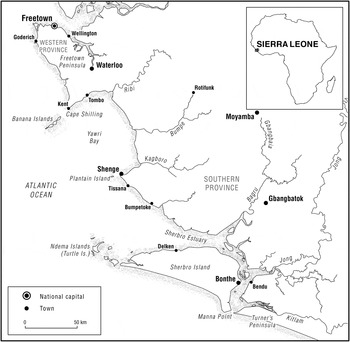
The past few decades have been a period of dramatic social and economic change along Sierra Leone's coast. Although the marine economy had been steadily intensifying over a much longer period, fishing towns only really mushroomed after the late 1960s, when migratory Ghanaian fishermen visited this coast, bringing with them vastly more efficient fishing technologies than had previously been known in the region. According to the United Nations Food and Agriculture Organization, Sierra Leone's population depends for 64 per cent of its dietary protein on fish (Laurenti Reference Laurenti2008: 64), and Tissana's wharf sits at the centre of the country's richest, most navigable fishing grounds (see Figure 1). Within forty years, this remote fisher-farmer village burgeoned into a bustling frontier economy, of commercial fishing, fish processing and trade. Almost every woman in Tissana works, to a greater or lesser extent, as a fish processor: buying fresh fish on the wharf and smoking it to sell on to their trader-customers, who converge here each week from market towns across the country. Fish dried in Tissana's smoke houses eventually find their way to household cooking pots in every corner of Sierra Leone, from Freetown's crowded slums to the remotest forest village.
Map of Yawri Bay and the Sherbro Estuary.

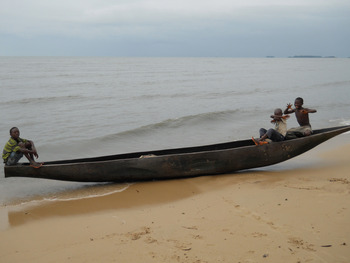
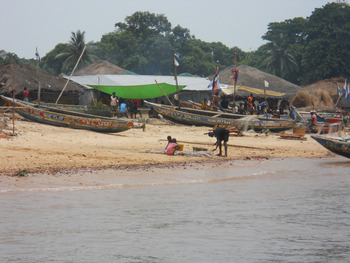
Most working-aged men are sea-going fishermen. Some work independently, paddling out into Yawri Bay in dugout canoes (see Figure 2), the style of which has barely changed in over a century (Aldridge Reference Aldridge1901). However, the wharf is dominated by brightly painted plank-built vessels, modelled after the Ghanaian style and manned by crews of anything from four to twenty men. The very largest boats on Tissana's wharf represent an investment of around 35,000 Leones (£6,000 to £7,000). With nets that sometimes reach a kilometre in length, these are impressive pieces of property by any standard – but particularly so when one considers the general level of poverty in a town like Tissana. Even in the smallest crew boat (see Figure 3), there can be a fairly complex hierarchy of labour, with different men working on quite different terms, depending partly on their level of skill and partly on the kind of relationship they have with their boss.
A dugout canoe, of the kind Sherbro fishermen have been using on this coastline for centuries.

Small crew boats (yele boats), nowadays the most common model of fishing vessel in southern Sierra Leone. Although much more modest in size, their design was inspired by the impressive twelve-man crew boats brought by Ghanaian fishermen to these shores in the late 1960s.

Almost everyone I knew in Tissana had close family ties in one of the subsistence villages in the town's hinterland, and an intimate knowledge of life there. In one direction, a maze-like tangle of swamps and tributary rivers spread east around the Kagboro Inlet. Then, westward, across the wide mouth of the Sherbro Estuary, lies the slender sandy archipelago of Ndema Chiefdom (see Figure 1). Unreachable by road and untouched by mobile phone coverage, these communities were often represented by my neighbours as a stark counterpoint to their sense of Tissana as a place of increasing openness and cosmopolitanism. It will become evident towards the end of this article that the cultural divide between these two spaces is rarely as sharp as the discourse in Tissana claims. Nonetheless, I begin my ethnographic discussion by exploring this popular caricature of subsistence villages as spaces of ‘backwardness’ – where poverty is extreme, where one still encounters barely disguised forms of domestic slavery, and where ‘cannibalism’, witchcraft and other covert forms of violence are an imminent threat.
FAMILIAL CARE AND BONDED LABOUR IN TISSANA'S AGRARIAN HINTERLAND
I was planning to travel with my friend Buema to visit her mother's village, Moyibo, in one of the poorest, least accessible corners of Inner Kagboro. The day before leaving, my neighbour, Pa Lunsar, told me something of what I could expect to see there. The image he painted – of the extortionate relationship between land-owning elders and the labourers who enable them to manage their large farms – reproduced a pattern with which I was familiar from ethnographic accounts of rural Sierra Leone, in which elders set bride wealth at levels almost impossible for poorer young men to pay. The regular fining of poor, unmarried men for adultery (or ‘woman trouble’) maintains them in a perpetual state of dependency, often obliged to work their entire lives for the relatively wealthy polygamous men who take them to court (Ferme Reference Ferme2001: 81):
Wiser men, they use that trick. He may have five, eight, nine women, and maybe he doesn't have any boys to work for him on his farm. So, if a boy falls in love with his wife, he'll say to the boy, ‘The only thing you can do is work for me.’ And the boy will do it. Whenever [the landholder] has work, the young man will come.
When you go to Moyibo, you'll see it. (Pa Lunsar, elder)
Pa Lunsar's parting prediction proved uncannily accurate: on the very first day we arrived in Moyibo, Buema and I walked straight into a ‘woman trouble’ case that was being heard on the veranda of the chief's house, overlooking the muddy banks of Kagboro River. A middle-aged husband had summoned Baki, a handsome young man from his village, accusing him of having flirted with his teenage wife. Baki admitted to being in love with the married woman and, although no one was suggesting that the two young people had actually touched one another, the elders agreed that he should be fined 300,000 Leones (£50): a sum that, as everyone present must have realized, Baki had no hope whatsoever of being able to afford. Baki now had a choice. He could either stay in his village, slogging on the farm of his love's husband until such distant time as his debt was considered paid; or, as many have chosen to do before him, he could leave home for the uncertain prospects of life in an unfamiliar town, such as Tissana.
Even Ba Kpana – who was, by most people's reckoning, the oldest living resident of the Kagboro Coast – had first arrived here as an exhausted, isolated young man, fleeing a family home where he no longer felt safe. Like many subsequent migrants to the towns around Tissana, Ba Kpana had grown up on one of the tiny low-lying islands of the Ndema archipelago. Over sixty years had passed since he had first made that long, lonely canoe voyage in the 1940s, but now, sitting on his veranda with myself and my guardian, Jacob, he had no difficulty conjuring up the dramatic events that had prompted his younger self to flee his ancestral village.
Kpana's father had died when he was a boy, and left him to live with his uncle. It was his uncle who had found a wife for Kpana and who had paid the dowry on his behalf. After they were married, the couple continued to live in their patron's large household, as – or so Kpana phrased it to me – his ‘children’ (apuma). The paternal relationship was not nearly as benign as that term might imply, however, as he explains in more detail here:
Even though we were full-grown, we were there under ‘parental care’. You and your wife are just labourers [noh haa mpanth]; just workers under your parents [ba hi] … That's why they find a wife for you. They choose the woman and pay the dowry, and then you both work for them. You will work and work and work and you will not earn money. If they see any money with you – even one cent – they'll beat you and call you a thief.
Throughout this conversation, no one made any insulting reference to slavery (wohnoh), but the connection would have been obvious to anyone listening. Domestic slavery was officially outlawed in Sierra Leone only in 1928, following a period of several centuries in which it had been integral to the ways in which families, marriages, farms and villages were organized. If ever I asked people about this history, the most common response was to claim that: ‘In Ndema [or upriver], they still have that style today.’ From my own standpoint, in Tissana, it was impossible to judge the extent to which my neighbours were exaggerating when they suggested nothing had changed in the remotest corners of Sherbroland. Certainly, it has been suggested often enough by ethnographers working in farming villages elsewhere in the region that, when domestic slavery was formally abolished, the same models for mobilizing social power did not disappear so much as become reframed within expanded categories of kinship, clientship and patronage (Ferme Reference Ferme2001; Richards Reference Richards2005; Knörr and Filho Reference Knörr, Filho, Knörr and Filho2010; Fanthorpe Reference Fanthorpe2006; Peters Reference Peters, Knörr and Filho2010).
Even in Tissana, in contexts where it seems to sail a little too close to the truth, likening a person to a ‘slave’ remains one of the cruellest insults available, in either the Krio or the Sherbro language. For example, as we grew to know one another better, Jacob would often confide his mounting frustrations about his lifelong client relationship with his ‘uncle’, the former politician who owned the once-grand compound in which we all lived and that Jacob worked hard to maintain. He had never been paid for this work and, after long years spent waiting in vain to be rewarded for his loyalty, he was losing patience. Increasingly, Jacob viewed his relationship with his uncle as one of exploitation, but he could see no way of extricating himself from it. So, when one of my fellow lodgers made the mistake of publicly calling Jacob a ‘slave’ (wohnoh) in the heat of an argument, the slur was simply too offensive to be tolerated. With the Paramount Chief's consultation and full approval, the lodger – a policeman stationed in Tissana from elsewhere in Sierra Leone – was evicted the very next day, along with his entire family.
Although they are separated by some sixty years, Baki's, Jacob's and Kpana's stories all point to the subtle ways in which idioms of paternal care, familial love and labour exploitation are apt to bleed into one another within the political economy of Sherbro villages. This complex cocktail of affection, loyalty and resentment goes some way to explaining why, despite the extreme conditions he and his wife were living under in Ndema, Kpana insists he never chose to leave his patron. Rather, his position as a dependent member of that household suddenly became untenable when one of his uncle's sons died and Kpana fell under suspicion:
My uncle summoned me and said, ‘Look … my wife is cooking for us and I don't know what intentions she has for you [she may poison you] … Go! Go and hide yourself!’ I didn't stop. I went straight to my canoe and paddled all night, until I reached Kagboro. When I got here, the Ndema people who were here already introduced me [to the Paramount Chief] as their guest.
Ba Kpana's story resonated strongly with Jacob, whose father had run away from his own village in Ndema in the 1970s, and – according to family history – under a similar threat of imminent danger: ‘He found his cousin's canoe … abandoned, all covered in blood. He grew very afraid! He just paddled, paddled, paddled, all the way to Kagboro, in the dark. He never went back there, until he died.’
Nowadays, there is a weekly pampa (passenger canoe) that links Ndema and Kagboro, but at the time when these two young fishermen each made their night-time getaway there had been almost no direct communication between the two chiefdoms. ‘When we were young, we did not know that such a place as Ndema existed,’ Mr Dupot, a middle-aged schoolteacher had once told me. Yet Ba Kpana's account makes it clear that, when he arrived in the 1940s, he had met a community of other Ndema émigrés already established on this foreign shore; these were part of a steady trickle of young men, all of whom had been so desperate to escape close family relationships they had come to view as hostile that they were prepared to risk a long journey into the complete unknown.
Sometimes, Ndema men would arrive, paddling. But they seemed to come from a very, very distant place, with their strange [dialect of] Sherbro. Sometimes young men will be killed for ‘woman trouble’. And most of these Ndema boys who are coming here, it is for this … Even now, they are coming. (Mr Dupot, Shenge)
By narrating their departure from home as a flight from mortal danger, émigrés emphasize that they would not have left under any normal circumstances. Growing up in such tightly integrated communities, it is a radical move to sever the familial ties that, up to that point, have been the very basis of their personhood. Yet the stories I heard among male migrants in Tissana were familiar. Narratives of ‘running away from home’ reappear in so many guises throughout Sierra Leone's ethno-historical record that they seem to occupy a central place in constructions of rural masculinity (Utas Reference Utas and Hart2008). For many decades, ethnographers have been reporting that the poorest men have been leaving their villages, hoping to escape the harsh labour and sexual constraints that characterized their lives there, and going in search of the promise of the ‘freedom’ and social mobility of cities and diamond-mining towns (Dorjahn and Fyfe Reference Dorjahn and Fyfe1962; Little Reference Little1967; Ferme Reference Ferme2001).
The theme of ‘intergenerational’Footnote 2 tensions between male youths and landholding elders has been revisited in the past decade with added urgency, as one of the most commonly cited threads in attempts to explain the otherwise baffling brutality that ravaged the country throughout the 1990s. In the post-war years, it has become common to argue that frustrated young fighters were driven out of their homes, and into one or other of the armed factions, by their anger at the ways in which local landholders were able to control their labour (Richards Reference Richards and Moore1996; Reference Richards2005; Peters Reference Peters, Knörr and Filho2010; Keen Reference Keen2003; Fanthorpe Reference Fanthorpe2006; Knörr and Filho Reference Knörr, Filho, Knörr and Filho2010). The accounts that these authors gathered among one-time rebel fighters bear striking resemblances to the stories I encountered among émigré fishermen, circulating around themes of poverty, forced labour and ‘woman trouble’.
One of the most intriguing things about the high level of migration into Tissana is that, along the Upper Guinea coast, ‘strangers’ have long been structured as the archetype of poverty and vulnerability – closely associated, in fact, to the historical figure of the domestic slave (Dorjahn and Fyfe Reference Dorjahn and Fyfe1962; D'Azevedo Reference D'Azevedo1962a; Reference D'Azevedo1962b). In farming villages, access to land is usually controlled by a few key members of important local lineages: those people, in short, who are able to claim the longest ancestral roots in the region. In subsistence economies, this structures newcomers in a precarious state of dependency: wholly reliant for their subsistence upon the goodwill of the landlord and ‘father figure’ who agrees to grant them access to land. And, as we have seen, wherever one encounters idioms of ‘parental care’ to describe a relationship between two adults, it suggests a situation in which patrons have the potential (at least) to exert extraordinary control over their dependants’ lives. Hardly surprising, then, that young men might feel wary about leaving even the most difficult circumstances in their family homes, if the alternative they imagine for themselves is a life in which being a ‘stranger’ only guarantees rapid reintegration into new kinship structures – once more under ‘parental care’ but, this time, even more vulnerable to exploitation than before.
SEEKING ‘FREEDOM’ ON THE SEA
However, if we rejoin Kpana's story now, we can see that, even back in the 1940s, such historically grounded models of patrimonial power were already becoming less relevant in Sierra Leone's fledging commercial fishing economy. Although the household power structures he encountered in Tissana were very similar to those he left behind in Ndema, Kpana's experience of integration into the social fabric of his adoptive home was not characterized by a move into new forms of dependency. On the contrary: as a stranger, in possession of his own canoe yet unburdened by webs of family debts and obligations, he experienced a new kind of independence. ‘For me, here, life was better, because I was not under parental care. I could fish for myself!’ For the first time in his life, Kpana was able to sell his own catch to his own customers and do as he pleased with his small profit.
Earlier generations of anthropologists tended to represent ‘the market’ as an inherently ‘heartless’ force, ‘disinfested of intrusive moral imperatives’ (Thompson Reference Thompson1971: 89–90; Taussig Reference Taussig1980). More recent ethnography has emphasized that, on the contrary, even the most archetypically capitalist institutions have a profoundly moral core, and not only in the sense that supply chains (Tsing Reference Tsing2013) and industrial labour regimes (Sanchez Reference Sanchez2012; Rajak Reference Rajak2011) often depend on personalized relationships of the kind we usually associate with ‘gift’ economies. More importantly in the context of this discussion, the very concept of a ‘free market’ can, in some circumstances, become an ideological aspiration, typically entangled with ideals about individual freedom, personal expression and the potential (at least) for social mobility (Browne Reference Browne, Browne and Milgram2009; Carrier Reference Carrier1997). Whatever we might think of the real-world consequences of economic liberalism, its ideological potential is visible in many contemporary development initiatives: for example, those that aim to ‘empower’ poor people through credit-lending projects in which ‘adapting to the market has been presented as an ethical imperative’ (Elyachar Reference Elyachar2005: 9; Dolan and Scott Reference Scott2009).
Seeking freedom ‘in the moment’
Following in Kpana's wake, a steady stream of young Ndema men continue to paddle, by canoe, across the Sherbro Estuary to settle on the Kagboro coast. And, as in Kpana's times, the newest arrivals revel in the freedom that comes from their unattached status. Arriving equipped with their own canoes and fishing tackle, yet removed from the webs of dependency and family obligation that had characterized their lives at home, these young fishermen are able to enjoy a novel experience of independence: selling their catch to whomsoever they please; spending (or indeed wasting) their small amounts of cash exactly as they like. As one of the women in my compound put it, wryly: ‘Ha! Those Ndema fishermen – they enjoyFootnote 3 their catch-oh! If they catch plenty one day, the next day they'll just blow [relax]! They won't go to sea again till they run out of fish.’
The Krio verb ‘to enjoy’ is a loaded one, and tends to be used in Tissana to imply overtones of immaturity, selfishness or lack of foresight. Those connotations become more explicit here, as Buema jokingly explains why she would never want her relationship with her Ndema boyfriend, Abdul, to crystalize into anything more than a casual romance:
Argh, that man! You see how he bluffs [swaggers]! When he gets a good catch, he just kicks back and bluffs! You see how he walks. He struts! He bounces! He eats fine fish. He enjoys himself till all his fish is gone. Only then, he goes back to sea. [Local] Tissana men are different. Tissana men work! They'd even sell their fine fish and eat those cheap-cheap ones, just to make money. (Buema, Tissana)
Buema had a point. I would often bump into Abdul strolling unhurriedly around town; the two of us were conspicuous, in the busy throng of Tissana's economy, because of the unreasonable amount of leisure time we appeared to have. And, while I spent much of my time guiltily feigning busyness, Abdul did nothing of the kind. If ever I asked what he was doing, he would reply, with a twinkle in his eye: ‘Nothing!’
Their neighbours, more established on this coast, regarded such an apparently wilful lack of interest in accumulating material profit with something between admiration and frustration. The Ndema migrants' conspicuous disinterest in accumulating material wealth might be viewed as one element in a broader ‘runaway mentality’ with which they approach their adoptive life in Tissana. If dominant notions of economic responsibility typically require people to manage their resources carefully and plan for their future, Day et al. (Reference Day, Papataxiarchis, Stewart, Day, Papataxiarchis and Stewart1999) observed that marginal groups, living on the edges of society, often take exactly the opposite approach: opting instead to live defiantly ‘in the moment’, even when to do so may come at a cost to their already tenuous material security. By eschewing institutions such as the household, which ‘organize long-term social reproduction and, simultaneously, produce hierarchical relationships', the argument goes that marginal people's aspirations to freedom and autonomy come to be ‘defined precisely by their monetary characteristics – which refuse to be caught in any framework outside their fleeting performance’ (Day et al. Reference Day, Papataxiarchis, Stewart, Day, Papataxiarchis and Stewart1999: 2).
Applying this argument to another ‘frontier’ economy – this time a Malagasy sapphire-mining town – Andrew Walsh reasons that, by visibly ‘daring’ to consume their earnings on fleeting pleasures, young miners are enacting a public performance of defiance against a world in which they otherwise have negligible power: ‘establishing for themselves and, in some cases, for others around them, their mastery of those things that might master them’Footnote 4 (Walsh Reference Walsh2003: 292). In fishing economies, like mining ones, earnings arrive in unpredictable bursts – and here, too, fishermen often present themselves as incapable of, or resistant to, saving for their uncertain future (cf. Astuti Reference Astuti, Day, Papataxiarchis and Stewart1999).
[A single man] will make a lot of money and spend it! But the women don't. Women are thinking about the problems of educating their children. Medical problems are there … so women … are very, very careful. But men just burn their money! They think, ‘Tomorrow, I'll go to sea and get a good catch.’ But the women see this money needs to be controlled. (Ben, boat owner)
As a life-long resident of Tissana and the head of a large, complex household, Jacob's experience of the town was completely different from that of the seemingly carefree newcomer Abdul. With a network of relatives spread widely throughout the entire town, Jacob was a well-known and well-respected figure. However, none of this ‘prestige’ gave him any particular comfort when faced with the constant barrage of demands made upon him each day by his extended family. The following excerpt from my field notes gives some impression of his situation:
Jacob's great aunt came to the back veranda looking for him. A couple of moments later, as I walked towards my room, I heard an urgent whisper: ‘Ssss! Jenny! Lock this door. Lock this door, please!’ Jacob was pressed against the wall, around the front of the house, ‘Problems, problems, problems! Is Mi Yoki there? She's coming to ask me for money …’
‘Well,’ he told me later, after the coast was clear, ‘that's what we're like here. They know I have nothing, but they find a reason to ask … [My cousin] left today, to go to her niece's initiation ceremony. You see that? More problems! … She knocked on my door saying, “OK, I'm going …!,” so I just had to dig into that money and give her something. That's how we are here. The only reason you'd say goodbye to someone is to make them give you money.’
So many of his neighbours felt entitled to make these kinds of small daily claims upon him that Jacob experienced his life as a constant losing battle to retain some limited control over his scant material resources. He would have sympathized, then, with Ishmael, who we met in the introductory paragraphs of this article giving a false address to his sister. Not being in the position to employ any such radical evasion technique, Jacob nonetheless invested much of his energy in the – ultimately futile – work of attempting to avoid his many suppliants.
So, far from exhibiting any disdain for money per se, people in Tissana were wary of the ways in which even the slightest perceived accumulation of material wealth was apt to transform itself rapidly into sticky webs of material demands from relatives and neighbours. When young fishermen opt to relax and ‘enjoy their catch’, rather than investing in building relationships and planning for the future, this is a deeply ambivalent assertion of independence: at once a claim to autonomy and an abandonment of social responsibility. However, it is worth reiterating here the fact that many newcomers in Tissana had left their family villages behind specifically to escape kinship relationships they had experienced as profoundly exploitative. In the short term at least, Abdul's deliberate avoidance of family commitments, and his defiantly relaxed labour rhythm, could hardly have stood in starker contrast to the patterns of patrimonial obligation that had shaped his labour back home under ‘parental care’.
In an economy this tight, however, economic ‘freedom’ is a short-lived aspiration. Even a seemingly autonomous canoe fisherman such as Abdul will sooner or later be hit by some expense – whether medical costs, court fees or a damaged canoe – that he could not hope to manage without turning for help to someone who is more prosperous. As I discuss in detail elsewhere, long-term survival in Tissana requires people to invest a huge amount of creative energy nurturing the webs of relationships that provide their only viable security net, while simultaneously struggling to escape entanglement in other, less appealing, social bonds (Diggins Reference Diggins2014). Before long, migrants invariably marry local women, develop customer relationships, take loans that need to be repaid, and generally find themselves re-embedded in lattices of responsibility and obligation. What we will see in the following section, however, is that not all migrants are similarly empowered to negotiate the process of their social integration.
THE TENACITY OF EXPLOITATIVE POWER RELATIONS
As we are beginning to see, successive waves of rural migrants have entered the fishing economy, seeking an alternative to the stifling ‘parental care’ and the half-remembered history of domestic slavery that continue to shape the lives of many young people in rural areas. However, if one looks more closely at the individual life stories of the most vulnerable people in Tissana's economy, it becomes evident that this ideology of economic ‘freedom’ is profoundly contested. While historical models of patronage and dependency have been challenged by the material conditions of this fluid maritime economy, they certainly have not disappeared completely. The same syntax of power I described as operating in the village – in which ‘parental care’, affection and labour exploitation very often appear as different facets of the same relationship – persists in Tissana as one taken-for-granted model through which more vulnerable people are integrated into the town's social fabric.
To illustrate this tension, let me introduce the stories of two fishermen, Cho and Abu, whose experiences epitomize the risks faced by migrants from inland regions. Both men came to Tissana in the late 1990s from small farming villages. Unlike the canoe fishermen discussed above, they both arrived on the coast with no friends, no material resources, and no knowledge of the sea. In other respects, though, as we will see, their experience of integration followed two quite radically different paths.
Abu's story
Abu had grown up near Port Loko, by public transport a full day's travel from Kagboro Chiefdom. When he was fifteen years old, however, his stepmother suggested sending him to live with her brother, a fisherman who owned a boat in Tissana. Abu described how, when he first arrived on the coast to live with his new guardian, ‘I just took that Pa as my daddy, no more. And he took me now, like his child.’ From the start, however, there was a clear difference between Abu's treatment within the household and that of ‘the Pa's’ own birth children. Whereas the other boys went to school, Abu spent his days working on the family boat. Speaking to me twenty years later, he vividly recalled how frightening and isolating those first months had been for him: a young farming boy, suddenly thrust into a life on the sea:
You know what people are like. If you send them your son, he's not their son. They don't feel sorry for him. He used to tie a rope around my waist – I was small! – he'd tie a rope around my waist and throw me in the water and say, ‘Dive!’ If I didn't dive, he'd take the rope and beat me with it, to force me to learn to swim! At that time, my daddy wasn't here, my mama wasn't here; my family were all far away.
Abu remained living in his foster father's home, and working on his boat, for many years. Long after he had become a full-grown adult and skilful fisherman in his own right, both ‘the Pa’ and his fellow crewmen continued to treat Abu as a junior within the boat. ‘They saw me as a boy, no more. But I worked! Ah, I worked well! They used me, that's all, just to show that power there; to say I was just a boy.’
Then, just as I described taking place in the more ‘traditional’ subsistence villages of this region, Abu's subordinate relationship with his foster father was cemented when the older man found a wife for him and paid the dowry on his behalf. Now heavily indebted – and still being ‘cared for’ as a foster child rather than earning any money of his own – Abu was unable to contemplate moving to another boat.
It's something like mental slavery. It's not slavery, but it seems like slavery. Once you're married now, he can treat you how he likes in that boat there. He can treat you any way he wants. How are you going to leave that boat? You have to pay him, is that not so?
It happens in Africa here. Right now, as we are sitting here, it's happening. This is Africa-oh!
Abu's quote reveals to us again something of Tissana's ‘frontier’ mentality, ‘in which local and global imaginaries meet and, eventually, merge’ (De Boeck Reference De Boeck2001: 559). On the one hand, we saw in the previous section that the folk imaginary – albeit a distant and perhaps distorted one – of a hinterland in which ‘slaves’ occupy the lowest and most denigrated rung on the social ladder continues to inform the ways in which people on this coast contemplate and negotiate their own unequal power relationships. However, in his throwaway comment ‘This is Africa!’, Abu is also drawing comparisons in a completely different direction. Despite the continuing force of inherited models of reckoning power, the people I knew in Tissana were highly conscious of the existence – or, at the very least, the possibility – of other, quite different ways of organizing wealth, power and obligation.
If, as Keith Hart has claimed, ‘economic anthropology at its best has always been the search for an alternative to capitalism’ (Hart Reference Hart and Carrier2012: 179), the fisherfolk of Yawri Bay are engaged in a parallel search of their own: in their case for an alternative to the economic model of patronage. As Ira Bashkow has argued beautifully in a Papua New Guinean context:
One of anthropology's most cherished promises is to show us our lives afresh through the defamiliarizing insight afforded by cross-cultural comparison. Usually it is we who are doing the comparing, but in principle we should be open to the insight that is gained by the others when they are drawing the comparisons themselves. (Bashkow Reference Bashkow2006: 1)
Just as previous generations of anthropologists turned to Africa for evidence of working economic systems more ‘moral’ than our own (Bohannan Reference Bohannan1959), my neighbours in Tissana often referred to their own constructed ‘others’ as a foil against which to contemplate the virtues and vices they saw in their own economy. Here is Abu again, for example, describing his relationship with the foster father-cum-boss who – even years after their relationship finally disintegrated – he was still referring to as ‘the Pa’:
I worked for the Pa for eighteen years! Eighteen years! Now, with you white people, if somebody worked for you for eighteen years, you have to pay them, is that not so? But we now, we don't pay.
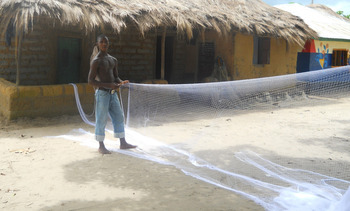
Abu did, eventually, manage to extricate himself from his eighteen-year dependency relationship with his foster father, but it was not easy. He had made himself a small fishing net, and – whenever he was not working in ‘the Pa's’ boat – he had gone alone to fish for mullet, directly from the beach. Gradually, secretly, over the course of three years, he managed to save enough money to buy enough thread and cork to make a full-sized fishing net of his own (usually men make fishing nets in the open; see Figure 4).
I strained-oh! I'd hide! To not let him know that I wanted to make a boat for myself. Because … it was he who controlled me. Whatever he wanted to do to me, he could do! At that time, I was small-small. All I had was an idea, a dream. So I hid. This is where I kept the net. In this house, here … I made it inside my bedroom. Finally, after three years, I pulled it outside, and everyone saw it! Now, there is a grudge there. Yes. He has a grudge against me. Because he just wanted me to work for him … I know [how to fish] and I have decided to get my own boat: to work for my own family.
However, if Abu's experience reveals the extreme lengths some young men are prepared to go to in order to break free of the stifling patronage economy, Cho's story gives us some insight into the dangerous isolation experienced by poor young migrants at the other end of the spectrum: attempting to navigate the stark insecurity of Tissana's open labour market, alone.
A fisherman weaving his net. Unlike Abu, who wove his first fishing net in the secrecy of his bedroom, fishermen usually weave in public spaces. This is an important skill. Once a man can effectively weave and repair fishing nets, he is no longer considered a neophyte in the coastal economy.

Cho's story
Cho had moved to the coast from a Sherbro-speaking village so small and isolated it has since disappeared entirely, abandoned by all the people who once lived there. In his home village, life for Cho had been tough: ‘I worked under my father. Ah, the work was just too much! Strain, I strained, no more!’ When he found himself the focus of targeted aggression over a case of ‘woman trouble’, he decided, finally, that it was time to leave home. However, after arriving in Tissana with no knowledge of fishing, nor any friends or relatives to help him navigate the unfamiliar world, he had struggled in his adoptive home.
As a novice to the fishing industry, Cho found work as a ‘job-man’. Working by the day or by the week for any captain prepared to give them work, these floating labourers are always on the fringes of any crew, and are treated as such. Cho spent years shifting between different fishing boats, always treated as the most low-skilled, low-paid, least respected man in the boat. Yet, for all the hardship he endured, there was one important respect in which Cho considered his life to have improved dramatically since moving to the coast:
Here, I am free. Anything that I want to do now, I'm free. Sometimes, if you're working with someone, he may try to work-work-work-work you and you will not get any benefit from him. But you can leave! I don't have anybody telling me, ‘Don't do this, don't do this …’ So [for that] I thank God. When I wanted to leave a boat, no problem. I went to a different boat.
It would be difficult to overstate the importance – or the novelty – of this kind of freedom for a young man arriving directly from a farming village. If boat owners want to demonstrate that they treat their crewmen ‘fairly’, the first thing they are likely to emphasize is that the men are free to leave at any moment.
This is common for fishermen! Eh! Fishermen can tell you everyday; he'd say, he has ninety-nine boats. You, the boat owner, have only got one, but a fisherman has ninety-nine. As he leaves you today and goes over there, they'd take him! If he left that boat tomorrow, and went over yonder, they'd take him! (Abas, boat owner)
For all his undeniable vulnerability, Cho's ‘outsiderness’ stands him in sharp contrast to the kind of family-bonded labour in which Abu found himself embroiled from the moment he arrived in Tissana. Yet the very ‘freedoms’ that village émigrés crave smuggle their own potentials for exploitation. Given the rate of migration from remoter regions, the unskilled labour of neophyte fishermen, such as Cho, is never in short supply. ‘Since the men are plenty and the boats are few, if you have a boat – in fact, immediately you start constructing a boat – you see them coming around looking for work’ (Ben, boat owner). Although Abu's ‘Pa’ had been frustrated about losing the skilled fisherman he had trained from childhood, Cho's experience suggests that boat owners are fairly indifferent to the high turnover of unskilled crewmen in their boats:
There are some bosses who embrace their fishermen – who … take care of them … Because if you've got a person [dependant], that's how it should be: if he has a problem, it's you who has that problem. Yes. But sometimes, even if his fisherman is sick, the boss doesn't care! That sickness can [fester] for a long time, and the boss just doesn't care. Even up to the last, and they die.
Cho's testimony draws us back to a now-familiar tension. However relieved he might have been to escape the suffocating insularity of his home village, Cho had lived his entire life in a world structured by the basic moral principle of patrimonial kinship: that patrons have a fundamental duty of material care towards the people who work ‘under’ them. It was disorienting – and justifiably frightening – to find this safety net removed.
CONCLUSIONS
Not only in West Africa but across the globe, fisherfolk are often associated with stereotypes of independence and unpredictability (Schoembucher Reference Schoembucher1988: 213; Acheson Reference Acheson1981; Seeley Reference Seeley2009). This article has introduced Sierra Leone's commercial fishing economy through the narratives of several young men who arrived here from hinterland regions, hoping to escape the stifling patrimonial authority of those tight-knit agrarian communities. Their stories provide an interesting counterpoint to the recent literature that has sought to understand Sierra Leone's brutal civil war as a ‘slave revolt’: a generation of voiceless young tenant farmers railing against their experience of indentured labour (Richards Reference Richards2005: 580).
The 1990s were an exceptional time in Sierra Leone: the young runaways I knew in Tissana are perhaps more representative of the kinds of decisions young farmers have historically made when they find village life intolerable. Rather than turning to violence, they had simply left home. Immersed for the first time in a diverse, multi-ethnic peer group, newcomers relish the vibrancy, camaraderie and open flirtation that characterize social life on Tissana's wharf, far from the watchful gaze of village elders. This is a world in which marriages are typically informal and unstable; friends, lovers and customers are apt to leave town with little warning; even children move between households with surprising frequency. Migrants must learn to navigate a social landscape that can be as slippery as the ocean upon which it depends for its sustenance. Yet I am not the first ethnographer to note that, despite all the potential insecurity of their new life surrounded by strangers, for many rural migrants into frontier towns, the greatest appeal of their adoptive home is precisely this metropolitan promise: of a life liberated from stifling kinship structures (Beuving Reference Beuving2010: 243; Walsh Reference Walsh2003).
James Scott has suggested that many of the world's nomadic peoples, whose mobile lives skirt the fringes of national territories, could meaningfully be described as ‘maroon communities’: runaways who had ‘at one time or another, elected, as a political choice, to take their distance from the state’ (Scott Reference Scott2009: 8). The men discussed in this article, who ‘ran away’ to become migratory fishermen in Yawri Bay, did so from communities in which they had already been living beyond the effective reach of the state. The most salient and problematic political forces in their lives operated at a much more local level: in the fraught micro-politics of individual households, lineages, villages and farms. Nonetheless, I want to suggest that there are elements of conscious ‘political’ resistance in these young runaways’ livelihood decisions. Their high levels of mobility, their determination to live ‘in the moment’, and the considerable energy they invest in working to avoid becoming morally entangled with potentially demanding relatives – all these strategies can be read as attempts to escape being drawn back into stifling webs of debt, obligation and dependency of the kind that characterized their lives under ‘parental care’ in their family villages.
On one level, this has been an article about economic change, and about the risks people take in order to transform their lives. Yet perhaps the most striking finding that emerges, when we juxtapose the stories of three generations of ‘economic runaways’, is the remarkable degree of structural continuity between Ba Kpana's experience of ‘parental care’ in the 1940s and Baki's, Jacob's and Abu's experiences sixty years later. Most people I knew shared the ideal that Tissana is the kind of town in which a person ought to be able to aspire to economic ‘freedom’. In reality, though, this kind of personal autonomy is rarely more than fleetingly realized. As fluid and cosmopolitan as the town might appear on a first encounter, the old moral model of patronage and dependency continues to run as an ambivalent thread through people's social and economic relationships. Tissana's most vulnerable residents live so close to the edge of subsistence that, however much they might dread the possibility of falling into the ‘mental slavery’ of indebted labour, the alternative – of attempting to manage with no patron at all – can be an even more frightening proposition.
ACKNOWLEDGEMENTS
This article is based on research carried out as part of an ESRC-funded doctoral studentship. I am grateful to James Fairhead, Dinah Rajak and Elizabeth Mills for their comments on earlier drafts of this paper, as well as to the anonymous reviewers of the Society for Economic Anthropology's Schneider Graduate Essay Prize, and of Africa. I hope I have done justice to their insightful comments here.