Implications
The growth and health of the piglet in the immediate post-weaning period are critical for the lifetime performance of the pig and therefore profitability of the pig unit. Zinc oxide (ZnO) is the most common and effective in-feed antimicrobial for pigs in the weaner phase of production although its mode of action is still not fully understood. It has proven health and growth benefits post weaning, which includes increasing feed intake. However, when newly weaned piglets are provided with a choice of two feeds, with and without ZnO supplementation, they strongly reject the ZnO supplemented feed that is most likely to be due to taste. Therefore, piglets, when provided with a choice, are unable to recognise and so choose a pharmacologically beneficial food in the immediate post-weaning period due to the unpalatability of this food.
Introduction
Weaning is a critical period for the young piglet which is moved from the lactation environment into weaner accommodation, mixed with unfamiliar individuals and provided with water and nutrients in unfamiliar forms. Sow-directed feeding events (sucking) are replaced post weaning with ad libitum access to feed and water. The voluntary feed intake (VFI) of an unfamiliar food, by the undirected piglet, is invariably low in the immediate post-weaning period (Pluske and Williams, Reference Pluske and Williams1996). Low VFI compromises small intestine function and maturation. In addition, the source of nutrients for the young pig has switched from a highly digestible, liquid milk-based diet to a less digestible, solid cereal-based diet, for which it lacks the necessary digestive competence (Vente-Spreeuwenberg et al., Reference Vente-Spreeuwenberg, Verdonk, Bakker, Baynen and Verstegen2004). This results in poor digestion and absorption of nutrients and increases the availability of substrates to the gut microbiota, notably enteropathogens (Broom et al., Reference Broom, Miller, Kerr and Knapp2006). Reduced nutrient availability combined with disturbance to the gut ecosystem and function leads to poor growth and predisposes the piglet to scouring, that is, post-weaning diarrhoea syndrome (PWDS).
Research into food choice for weaned piglets has been limited to foods differing in crude protein (CP) content (Bradford and Gous, Reference Bradford and Gous1992; Dalby et al., Reference Dalby, Forbes, Varley and Jagger1995) or specific amino acids such as threonine (Ettle and Roth, Reference Ettle and Roth2005). These experiments have established the ability of the pig to discriminate between different foods (Forbes and Kyriazakis, Reference Forbes and Kyriazakis1995). Dalby et al. (Reference Dalby, Forbes, Varley and Jagger1995) showed that the piglet is so well able to distinguish between protein levels that it is capable of regulating protein intake during growth when offered a choice of foods differing in protein content. Lawlor et al. (Reference Lawlor, Lynch, Caffrey and O’Doherty2003) concluded that weaned piglets quickly learn the nutritional benefits of different foods and will choose between complete foods to meet their individual needs. However, there has been no research to date in weaned piglet selection of two foods differing in the level of ZnO supplementation.
ZnO is a salt of zinc that is commonly added to nursery piglet diets at pharmacological levels (2500 to 3100 mg/kg; Poulsen, Reference Poulsen1995). The efficacy of ZnO addition in combating PWDS and hence improving the performance of weaned piglets is well known (Poulsen, Reference Poulsen1995; Carlson et al., Reference Carlson, Hill and Link1999; Miller and Slade, Reference Miller and Slade2006). Recent study by Miller and Slade (Reference Miller and Slade2006) concluded that ZnO inclusion in feed benefited the newly weaned pig by improving gut structure and piglet performance compared to pigs fed unsupplemented diets. The addition of pharmacological levels of ZnO in commercial weaner diets far exceeds the nutritional requirement of the piglet (Jondreville et al., Reference Jondreville, Revy and Dourmad2003), although the bioavailability of zinc from ZnO is much lower than from other sources that may explain piglet tolerance for high levels of ZnO (Hahn and Baker, Reference Hahn and Baker1993). Case and Carlson (Reference Case and Carlson2002) established that dietary zinc above 500 mg/kg resulted in the excess being excreted in the faeces. It is anecdotally recognised in the pig industry that supplementing feed with pharmacological levels of ZnO may adversely affect food palatability and depress food consumption (McDonald et al., Reference McDonald, Edwards, Greenhalgh and Morgan1995). That said, when no choice is offered, increased feed intake is frequently reported in pigs fed diets high in ZnO compared to those fed unsupplemented diets (Ragland et al., Reference Ragland, Schneider, Amas and Hill2006).
Earlier research at our facility (Pig Development Centre (PDC), University of Leeds) on the performance of 28-day weaned piglets fed diets unsupplemented or supplemented with 3100 mg/kg ZnO firmly established that piglets fed supplemented diets had increased feed intake, superior growth and were healthier than piglets fed the unsupplemented diet (Miller and Slade, Reference Miller and Slade2006). The aim of the present experiment was to compliment the Miller and Slade (2006) study by testing the hypothesis that weaned piglets would, in response to its associated benefits, display a preference for a food containing high levels of ZnO when provided with a choice between the two foods. The following experiment that studied the feeding behaviour, performance and incidence of diarrhoea of weaned piglets offered a choice of two foods with or without pharmacological concentrations of ZnO when reared at the same facility (PDC, Leeds) and under the same conditions as described by Miller and Slade (Reference Miller and Slade2006).
Material and methods
A total of 60 crossbred piglets (Large White × Landrace) were studied over an experimental period of 13 days to examine their response to a choice of foods varying in ZnO content. Piglets came from 15 litters in total and creep feed was offered without ZnO supplementation 14 days before weaning. Piglets were weaned at a mean weight of 7.8 kg ± 0.14 (s.e.m.) and 27.8 ± 0.11 days of age into eight mixed sex groups of seven or eight piglets per pen. Groups were balanced for litter origin, weaning weight and sex in order to equalise physical and social variation between groups. Piglets were housed in fully slatted weaner pens (1.7 m2) where ventilation and temperature were controlled with a gradually reducing temperature from 30°C to 24°C over the 2 weeks. Water was provided ad libitum from two drinkers at the back of each pen.
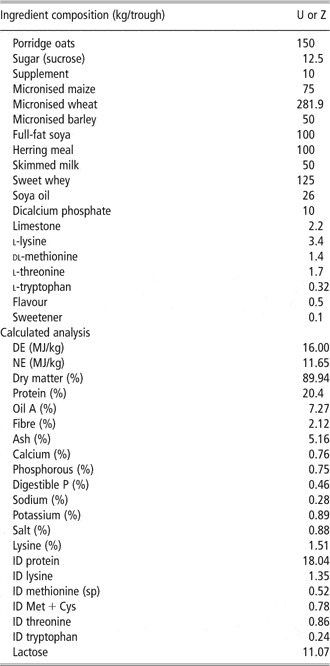
Piglets were offered ad libitum access to a choice of two experimental foods from the day of weaning (d0) for 13 days. Piglets were not provided with an unnecessary training period (Dalby et al., Reference Dalby, Forbes, Varley and Jagger1995) to facilitate the study of the piglet immediately post weaning. Diet composition is presented in Table 1. The control food remained unsupplemented (U), whereas the supplemented food (Z) contained a pharmacological level of 3100 mg/kg ZnO. Each of the two foods was offered in two adjacent troughs per pen, four troughs in total. The four troughs were positioned along the front of each pen, within Leeds University’s Feeding Behaviour System (LUFBS). Piglet feeding behaviour at the troughs was constantly monitored by LUFBS, a multi-spaced recording system for feeding behaviour, in each pen. Piglets were identified at the trough by LUFBS using a transponder tag in each piglet’s ear. The time of each visit and visit duration were recorded for each individual at each trough. After 7 days the food positions were switched to ensure that any food selection was not due to trough position preference (Ferguson et al., Reference Ferguson, Nelson and Gous1999; Wolter et al., Reference Wolter, Ellis, Curtis, Parr and Webel2000). Within pen, the intake of each food was recorded daily by manual weigh-back less food wastage and the troughs topped up as required.
Composition of piglet feed

ID = ileal digestible; DE = digestible energy; NE =net energy; Met = methionine; Cys = cysteine.
The diet composition presented is the same for both foods (U and Z). The supplemented food (Z) contained 3.1 g zinc oxide per kilogram feed. The foods were fed from the day of weaning until the experiment ends at day 13.
Individual piglet latency time to start eating immediately post weaning was extracted from feeding behaviour data generated by LUFBS. The latency to first meal was defined as the interval between the start of the experiment and the first eating episode of >0.5 min. In addition, it was also possible to record the latency time to each of the two foods. The food which was eaten for 0.5 min first or ‘soonest’ after the start of the experiment was noted as first choice for each piglet and the latency time taken to make that choice was recorded.
Piglet live weight was recorded at weaning and 7 and 13 days thereafter. Faecal scores (1 to 4) were recorded daily on a pen basis. This subjective score evaluated faecal consistency, where 1 = firm and 4 = watery, liquid consistency (Wellock et al., Reference Wellock, Fortomaris, Houdijk and Kyriazakis2006). Individual piglets observed with a faecal score of three or above were recorded as Y (scourers) and healthy piglets, remaining free of post-weaning scour observations, were classed as N (no scour). In accordance with normal farm practice, scourers (Y pigs) received a single intramuscular injection of Baytril® 5% (Bayer plc, Animal Health, Newbury, UK) at a rate of 0.05 ml/kg bodyweight to combat the diarrhoea.
LUFBS data were used to calculate daily feeding time per animal and per food (min). The proportion of feeding time per food (%) was also calculated. Feed intake data were analysed with pen as the experimental unit. Individual piglet feeding behaviour data within pen were analysed with pig as the experimental unit. Data were checked for normal distribution using an Anderson–Darling normality test before analysis. Feed intake and pig performance data had a normal distribution. Feeding behaviour (min) and latency data did not have a normal distribution and were log transformed to normalise the data before analysis. Both proportional feed intake and feeding behaviour data were not normally distributed and so were transformed by arcsine square root that normalised the data before analysis. After analysis, any data that had been transformed was then reverse transformed as appropriate before presentation in the results. These means were reported with a 95% CI, rather than the standard error, as this is more appropriate in describing variation of non-normal distributions (Houdijk et al., Reference Houdijk, Kyriazakis, Jackson, Huntley and Coop2000). Significance was declared at P ⩽0.05 and trends at P ⩽0.10.
Food choice was first analysed using a binomial test of SPSS 16 (Hosoi et al., Reference Hosoi, Rittenhouse, Swift and Richards1995). Latency data to first choice and choice feeding behaviour within the first 24 h was analysed using the general linear model (GLM) procedures of SPSS 16 with feeding times per animal nested within pen to take account for non-independence of grouped animals. Feed intake and feeding behaviour data were analysed both as absolute values, that is, weight (kg) or meal length (min) and also as the calculated proportions of these. Preference for a food was defined as being significantly different from 50% of the total feed intake or feeding time. This represents equal feeding of each food and therefore no preference (Roth et al., Reference Roth, Meindl and Ettle2006). Pen feed intake data were analysed using a repeated measures GLM in SPSS 16 with intake of the supplemented food compared to 50% intake for each week and analysed with pen as the experimental unit. Individual piglet choice was analysed by comparing feeding behaviour (time) of the supplemented food and 50% on a weekly basis with pig as the experimental unit. These were also analysed using a repeated measures GLM in SPSS 16 with pig nested within pen to take account of non-independence of grouped animals.
Results
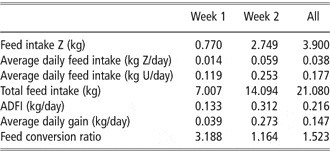
Table 2 shows the performance of the animals during the whole experimental period. Piglet performance was low, resulting in poor growth rates (average daily gain (ADG)) and modest average daily feed intakes recorded in both weeks of the experiment. The intake of the unsupplemented food far exceeded the intake of the ZnO supplemented food in both weeks. Feed conversion ratio was very inefficient in week 1, although this had improved markedly by week 2.
Average individual piglet performance data

U = unsupplemented; Z = ZnO supplemented (3100 mg/kg); ADFI = average daily feed intake.
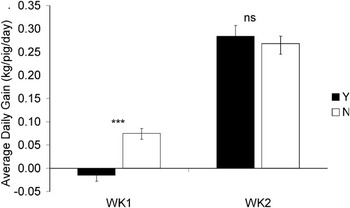
In all, 22 piglets, 37% of those on experiment, were recorded as scourers during the first 7 days of the experiment. Piglets were classed as scourers (Y) after one observation of scour incidence (and then treated accordingly). Healthy piglets with no observation of post-weaning diarrhoea were recorded as N. Y piglets were treated (successfully) for scour as per normal farm practice but remained in the scourers category (Y) for the remainder of the experiment. In week 1, scouring piglets grew more slowly than non-scouring (healthy) piglets (P < 0.001). ADG was actually negative for scouring piglets during this period. They re-established positive growth by week 2 having recovered from post-weaning diarrhoea and there was no difference at this stage between the growth rates of these piglets and their healthy contemporaries. The ADG figures of scouring and healthy piglets are show in Figure 1. On a pen basis, average faecal score per pen was 2.41 and 2.44 in weeks 1 and 2, respectively (data not shown) where 1 = firm and 4 = watery, liquid consistency (Wellock et al., Reference Wellock, Fortomaris, Houdijk and Kyriazakis2006).
Average daily gain (ADG) in weeks 1 and 2 post weaning of piglets classed by scour incidence. Piglets were classed as scourers (Y) after one observation of scour incidence (and then treated accordingly). Healthy piglets with no observation of post-weaning diarrhoea were recorded as N. ADG per week was analysed using a Univariate GLM in SPSS16 with piglet as the experimental unit, nested within pen; *** difference between Y and N pigs in week 1 (P<0.001).

Piglet feeding behaviour data over the first 24 h were analysed to examine how quickly the animals made their food selection. One piglet’s data were removed from this analysis as its ear-tag transponder was not registering at the LUFBS antennas. The pig’s transponder was replaced the following day. There was no difference between the number of pigs selecting each food immediately after pen entry with 27 pigs selecting the unsupplemented food and 32 selecting the ZnO supplemented food. In addition, no difference was found (P = 0.113) in how quickly they made this choice; where U = 228.6 (147.5 to 354.3; 95% CI) min (3 h 48 m) and Z = 358.9 (252.1 to 510.8) min (5 h 59 m). Choice feeding times and proportions per food by individuals over the first 24 h post weaning showed a significant difference (P < 0.001) between the selection made and 50% (no preference) with a clear preference for the unsupplemented food even at this early stage (P < 0.001). Piglets spent only 36.3% (32.2 to 40.5) of their feeding time at supplemented food (data not shown).
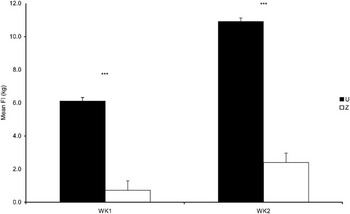
Weekly feed intake was measured on a pen basis and showed a clear preference for unsupplemented food over supplemented (P < 0.001; Figure 2) in both weeks. As expected, significantly more feed was consumed in the second week than the first (P < 0.001). There was a tendency (P = 0.086) for the proportions of the two foods eaten to differ between weeks with piglets consuming 8.9% (5.1 to 13.6) and 15.7% (8.9 to 23.9) of the supplemented food in weeks 1 and 2 respectively.
Weekly pen feed consumption per food (kg). All data were analysed by repeated measures GLM in SPSS 16. U = unsupplemented; Z = ZnO supplemented (3100 mg/kg); GLM = general linear model; ***difference between ingested amounts if the two feeds is different from 50% at P < 0.001.

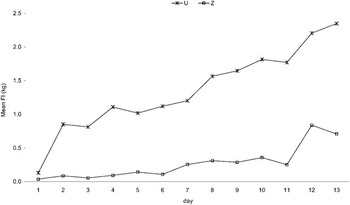
Daily feed intake is presented in Figure 3 illustrating the increase in feed intake throughout the experiment. Piglet preference for the unsupplemented food remained unaffected when feed position was swapped on day 7 of the experiment. Intake of the supplemented feed increased on days 12 and 13 in two pens, when the unsupplemented feed supply ran out. In the absence of choice, piglets consumed the ZnO supplemented feed and overall feed intake (U + Z) was not affected during this period.
Daily pen feed intake per food (kg). U = unsupplemented; Z = ZnO supplemented (3100 mg/kg).

Two outliers were noted when checking individual feeding behaviour data for normality, and were removed from this analysis due to their very low feed intake in week 1 of both foods. Mean food selections, per week by individual animals, are presented in Table 3. Less than a quarter of total feeding behaviour was directed towards the supplemented food in either week of the experiment. Indeed, this food choice by individuals was significantly different (P < 0.001) from 50% in both weeks, as minutes and proportionally, showing the strong preference for the unsupplemented food and the aversion to the supplemented food. The amount of time spent eating each of the foods increased from weeks 1 to 2 (P < 0.05) both in time and proportionally.
Back-transformed means (95% CI) of individual food selections: proportional and absolute feeding behaviour

U = unsupplemented; Z = ZnO supplemented (3100 mg/kg); GLM = general linear model.
All data were analysed by repeated measures GLM in SPSS 16.
Data are means (lower − upper 95% CI).
aFeeding times were significantly different in week 2 than week 1 (P < 0.05).
bFeeding proportions were significantly different in week 2 than week 1 (P < 0.05).
*Difference between either time spent at each of two foods or proportions of this time spent is different from 50% at P < 0.001.
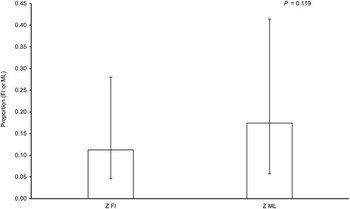
Proportional feed intake and feeding time measures of unsupplemented and supplemented foods on a pen basis were analysed for each week. There was no interaction between week and measure. There was no difference (P = 0.119; Figure 4) between the proportion of supplemented food eaten and the amount of feeding time at supplemented food that indicates agreement between the two measures (Figure 4). There was also no difference between the two measures for unsupplemented food (P = 0.137; data not shown). The mean rate of eating (ROE) for the entire experimental period was 7.7 g/min for the unsupplemented food and 4.4 g/min for the supplemented food.
Back-transformed means (95% CI) of average proportions of supplemented food (Z = 3100 mg ZnO/kg) throughout the experiment, measured as feed intake (FI) and meal length (ML). All data were analysed by repeated measures general linear model (GLM) in SPSS 16. Data are means (lower − upper 95% CI).

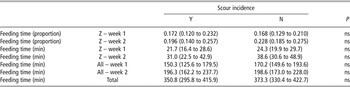
Feeding behaviour data of scouring v. non-scouring piglets for both weeks of the experiment is shown in Table 4. There was no interaction between week and scour and therefore the analysis looks only at the main effects. Feeding times (P < 0.001) and feeding time proportion (P < 0.05) for supplemented food increased from weeks 1 to 2. However, in both weeks there were no differences between Y and N piglets in the proportion of time spent eating the supplemented food. Further, in week 2, there were no differences between the feeding behaviours of the scourers (now recovered and healthy) or healthy pigs, both proportional and in absolute time directed towards the ZnO supplemented feed. There were also no differences in total feeding behaviours (of both feeds) within each week and overall for Y and N piglets.
Back-transformed means (95% CI) of the effect of PWDS on supplemented and total food selection: proportional and absolute feeding behaviour by scour incidence

Z = ZnO supplemented (3100 mg/kg); Y = scouring piglets (n = 21); N = healthy piglets free from scour (n = 37); ns = non-significant; GLM = general linear model.
All data were analysed by repeated measures GLM in SPSS 16.
Data are means (lower − upper 95% CI).
Discussion
Weaner piglets strongly preferred feed without pharmacological ZnO inclusion, disagreeing with our original hypothesis, and it is clear from our results that the palatability of the feed was reduced by ZnO. In this experiment – texture, freshness and nutrient balance (apart from ZnO) were equalised between the two foods. Pharmacological addition of ZnO is not known to affect olfaction and so piglet choice is most likely to be due to taste distinction between the two foods. Indeed, the results of the first meal showed that the piglets had no preference between the foods indicating that these had to be tasted to make their decision. After olfaction, taste of a food is one of the first sources of information the animal has to assess a potential food source. Unpleasant or bitter flavours may register as a possible hazard, such as an oversupply of nutrients (Jondreville et al., Reference Jondreville, Revy and Dourmad2003) and/or possible toxicity. A toxin is anything that causes a negative disturbance in metabolism (Forbes and Kyriazakis, Reference Forbes and Kyriazakis1995) and hence something that an animal would inherently avoid. Forbes and Kyriazakis (Reference Forbes and Kyriazakis1995) stated that a bitter-tasting food would initially be rejected as a potential hazard and Kyriazakis and Emmans (Reference Kyriazakis and Emmans1992) showed aversion to unpalatable factors such as glucosinolates. They stated that the unpalatability of the food disrupted the physiological need of the pig to select foods that would satisfy a CP requirement. Literature is limited on the taste of zinc to pigs, although ZnO supplemented feed was reported as tasting ‘slightly bitter’ when sampled by our authors and as ‘distinctively different’ when compared to unsupplemented food. Pertinently, Nofre et al. (Reference Nofre, Glaser, Tinti and Wanner2002) stated that human and piglet taste reactions are relatively similar thus suggesting that pigs are also likely to agree with humans and would find the taste of zinc unpleasant at pharmacological concentrations. Baldwin (Reference Baldwin1976) stated that young pigs had a heightened taste sensitivity compared with older pigs which may also further explain the negative response of our piglets to ZnO due to taste. Laying hens showed a ‘rapid reduction’ in food intake when offered high zinc supplemented foods (Gentle et al., Reference Gentle, Dewar, Wight and Dick1982).
Observations of feeding behaviour in the first 24 h post weaning indicated that there was no difference in first choice or latency to that choice between the two foods. This showed that piglets readily sampled either of the foods before making their first selection. However, analysis of meal length data over this whole 24-h period clearly shows the significant differences between the feeding times for the two foods in this early stage, indicating that the aversion to the supplemented food was very rapid and therefore likely to be a reaction to the organoleptic properties of the feed rather than any post-ingestive consequences.
Despite this aversion, a consistent, if nominal, amount of the supplemented food continued to be eaten throughout the experimental period. This is unlikely to be a selection to meet a nutritional need, as both feeds contained 100 mg/kg Zn as ZnSO4 which would have been more than sufficient to satisfy their nutritional requirement. Indeed, the nutritional requirement of zinc for piglets (up to 20 kg) is 80 mg/kg diet (NRC, 1998). The small amount consumed of the less favoured food could instead be explained by what Forbes (Reference Forbes2007) defined as regular or ‘continuous’ sampling of all foods available to an animal. Arsenos et al. (Reference Arsenos, Emmans and Kyriazakis2000) suggested that this would allow them to regularly assess the foods on offer, a behaviour which is advantageous and considered essential to an animal in both domestic and wild environments (Kyriazakis and Emmans, Reference Kyriazakis and Emmans1992).
This continuous sampling behaviour could also explain why the change in food positions at day 7 did not affect feed selection. The daily sampling of the foods would have informed the animals of the swap and generated a rapid adaptation to the alteration. Total daily feed intake remained normal despite the change in food position, indicating that the piglets could easily detect the difference between the foods individually, hence respond rapidly to the new position of the foods. Pigs are frequently noted to show a preference for one trough over another, justifying the need for the food position swap in this choice experiment. In support of this, Wolter et al. (Reference Wolter, Ellis, Curtis, Parr and Webel2000) reported significant differences in feeding activity between troughs, independent of diet, an effect consistently noted in our own earlier studies (unpublished). Housing features such as resting, drinking and defecation areas are known to influence pig preference for a feeding position (Wolter et al., Reference Wolter, Ellis, Curtis, Parr and Webel2000). Earlier studies on choice feeding conducted at our facility (unpublished) showed that piglets failed to change rapidly their trough preference. In these studies they showed a reduction in feed intake immediately following the food location exchange, which would have been visually apparent in Figure 3 had this been the case in this experiment. This has also been observed in hens (Steinruck et al., Reference Steinruck, Kirchgessner and Roth1990) which showed negative choice following a food position move. Owen et al. (Reference Owen, Knabe, Burgoon and Gregg1994) considered such practice to be ‘deliberately confusing animals’ and which was not representative of commercial practice. In this study, results indicate that pigs clearly distinguished between the two foods and so immediately adjusted to the changed position, further supporting the conclusion that these pigs expressed a strong food preference irrespective of trough position.
Feeding behaviour was measured as feed intake per pen and feeding times per individual animal in this experiment. Individual eating time has been reported as an acknowledged measure of feeding behaviour, although it does not necessarily reflect actual feed intake (Dybkjaer et al., Reference Dybkjaer, Jacobsen, Togersen and Poulsen2006). In this study, the mean ROE for the entire experimental period was faster for the unsupplemented food than the supplemented food although for either food there was no difference between proportional feeding time at the troughs or measured feed intake of the food showing agreement between the two feeding measures. However, it could be expected that an unpalatable food (such as supplemented food) would be eaten more slowly (Forbes, Reference Forbes2007). Berridge et al. (Reference Berridge, Grill and Norgren1981) stated that increasing the palatability of a food increased the rate of eating in rats, although Dybkjaer et al. (Reference Dybkjaer, Jacobsen, Togersen and Poulsen2006) studied piglets for the first 2 days of post weaning, fed exclusively either ZnO supplemented (3100 mg/kg food) or unsupplemented diets and found no difference in the feed intake or feeding times between diets.
Piglet growth in this experiment was low but comparable to that of weaner piglets fed a non-ZnO supplemented diet (0.161 kg/pig per day) at our pig research facility (Miller et al., Reference Miller, Toplis and Slade2009). ZnO has many positive benefits to the piglet including the effect of reducing the incidence of scour (Dybkjaer et al., Reference Dybkjaer, Jacobsen, Togersen and Poulsen2006). Not surprisingly therefore, low ZnO supplemented food intake may have had little or no effect on the incidence of scour. Weanling diets should contain >2000 mg/kg ZnO for piglets to experience a pharmacological effect (Hill et al., Reference Hill, Mahan, Carter, Cromwell, Ewan, Harrold, Lewis, Miller, Shurson and Veum2001). As the supplemented food contained 3100 mg/kg ZnO, piglets would have needed to consume (approximately) a ratio of  Z to
 U in order to create a high enough intake of ZnO to have a pharmacological effect. Although piglets did consume a small amount of the supplemented food in both weeks in ‘continuous’ sampling behaviour, this did not begin to approach the
 intake required to achieve a performance benefit. There was a significant increase in the proportion of feeding behaviour towards the supplemented food from weeks 1 to 2 from 16.6% to 21.8%, which could be an indication of ‘self-medication’. However, as previously acknowledged, this would be insufficient to produce a prophylactic effect and was most probably due to the increase in intake of the supplemented feed in the last 2 days of the experiment. It is clear that pigs were unable to self-medicate to prevent PWDS and did not eat sufficient supplemented food to facilitate improved health and performance at post weaning.
Although food selection research has shown that pigs are able to discriminate between nutritionally different foods and can select foods appropriately to meet individual nutritional requirements (Kyriazakis et al., Reference Kyriazakis, Emmans and Whittemore1990; Roth et al., Reference Roth, Meindl and Ettle2006), there has been little research into food selection by pigs to promote a medical or pharmacological advantage, a phenomenon sometimes referred to as ‘self-medication’. In our study, naïve weaned piglets did not select the advantageous food, possibly due to unpleasant organoleptic properties associated with high levels of ZnO inclusion in the food. It is unlikely that potential selection of a pharmacologically supplemented food would be instinctive and so, in the absence of any cues through maternal or social influences, an animal would learn the properties of such a food through trial and error (Dalby et al., Reference Dalby, Forbes, Varley and Jagger1995). However, in our experiment, weaners received nothing in the way of pre-conditioning or training to prepare for a choice experiment and at no time during the experiment ate sufficient supplemented feed to produce a beneficial effect. It is possible that, given the opportunity to recognise the benefits associated with the consumption of the ZnO supplemented food via a training period; pigs may show quite different preferences to those reported in this experiment. A training period allows pigs to experience foods individually and wait for the post-ingestive consequences and has been shown to be effective in other studies (Kyriazakis et al., Reference Kyriazakis, Emmans and Whittemore1990).
Piglets are social feeders (Appleby et al., Reference Appleby, Pajor and Fraser1991) and can be influenced by the social dynamics and behaviour of other individuals within the pen. Morgan et al. (Reference Morgan, Kyriazakis, Lawrence, Chirnside and Fullam2003) studied growing pigs and looked at the effect of a pre-trained (experienced) individual within a pen of naïve pigs. These authors concluded that diet selection could be positively influenced by inclusion of an experienced individual within the group. Morgan et al. (Reference Morgan, Kyriazakis, Lawrence, Chirnside and Fullam2003) stated that the presence of an experienced individual could be advantageous in overcoming the reaction of naïve pigs to a food source with unpleasant organoleptic qualities and could remove the need for a pre-choice acclimatisation period. Whether this methodology could be used in our study in a pen of newly weaned piglets to influence diet selection towards the ZnO supplemented food is unknown. Although in earlier study by Morgan et al. (Reference Morgan, Lawrence, Chirnside and Deans2001) investigating weaner pigs paired from creep (experienced) or no creep (naïve) backgrounds, a learning effect was reported, which positively influenced the feeding behaviour of the naïve piglet. Hence, information transfer between pen-mates about food choices could potentially shorten the learning period of weaned piglets (Forbes and Kyriazakis, Reference Forbes and Kyriazakis1995).
Several researchers have expressed scepticism over selection abilities of animals; although published literature on diet selection in pigs is limited to selection for a particular physiological requirement rather than pharmacological benefits. Lawlor et al. (Reference Lawlor, Lynch, Caffrey and O’Doherty2003) stated that discrimination between foods may be limited and that selecting exactly to meet requirements may be beyond the capabilities of the pig. Owen et al. (Reference Owen, Knabe, Burgoon and Gregg1994) concluded an inability of piglets to select a lysine intake to optimise performance. Kyriazakis and Emmans (Reference Kyriazakis and Emmans1992) reported a rejection of foods containing rapeseed meal even to the extent that it overpowered a physiological need of the pig to meet a protein requirement. This has some similarities to our study in that pigs appear to have rejected the supplemented food due to one factor (taste) and that this overt characteristic of the food overrode the less immediately tangible benefits associated with consumption of a ZnO supplemented food.
On the last 2 days of the experiment, the feed intake of the piglets was higher than expected and consequently limited the availability of unsupplemented food to pigs in some pens. This led to the increased consumption of the ZnO supplemented feed. This is likely to be the reason for the increased feeding behaviour towards the supplemented feed in week 2 and also the trend for ZnO feed intake to be higher during this period. Although unfortunate, this response indicates the piglets’ readiness to eat the ZnO supplemented feed when no other choice was provided. Ragland et al. (Reference Ragland, Schneider, Amas and Hill2006) report on the efficacy of ZnO at pharmacological levels in the absence of choice. Hence, great caution must be exercised in extrapolation of choice responses to single feed situations. Forbes (Reference Forbes2007) stated that a preferred food would not necessarily result in increased feed intake when given exclusively and vice versa in our situation. Blair and Fitzsimons (Reference Blair and Fitzsimons1970) reported that when growing pigs were offered a very unpalatable food in the absence of choice, a ‘normal’ rate of eating was rapidly re-established once the absence of adverse consequences had been realised. Our pigs, given a choice, appeared to avoid ZnO supplementation, but when unsupplemented food was unavailable they are ready to eat supplemented food. In published experiments, with no choice, similar piglets have a greater feed intake of ZnO supplemented food than unsupplemented diets fed exclusively (Hahn and Baker, Reference Hahn and Baker1993; Broom et al., Reference Broom, Miller, Kerr and Knapp2006). Thus, although this experiment shows the clear aversion to ZnO when also provided with a preferred food, we must be aware that this feeding behaviour does not necessarily translate to a single food situation in the absence of choice.
This study shows the rejection of ZnO supplemented feed in a choice fed situation by weaner piglets. Despite the well-researched medical advantages of ZnO supplementation, it is clear that without prior experience the piglet will not select the supplemented food due to its unpleasant taste. Although the primary objective of this experiment was an investigation into piglet selection for a ZnO supplemented food rather than a detailed investigation on self-medication, it has provided a good platform from which to consider further investigation into this area. Such as, if the PWDS had not been treated with Baytril®, but allowed to run its course naturally, there would have been more time and also a greater severity of infection which would have given a better chance of seeing a self-medication result. In this experiment, piglets did not eat sufficient supplemented food for it to be able to show its beneficial effects. Further investigation into this area is warranted.