In March of 1743 the venerable minister and colonial historian Thomas Prince worriedly surveyed the religious landscape. For three years, he and other elite Boston clergy had championed the revivals in New England, believing that they would buttress Congregationalist influence over an increasingly heterogeneous society. But reports across the colonies suggested the wave of intense religious interest was devolving into chaos. In New Haven, the Reverend Mr. Philemon Robbins had gathered “a small Number of People in a private House, [and] baptiz'd a Child” because he believed their pastor “Mr. Noyes is unconverted, and so, no minister.”Footnote 1 From South Carolina came word that the layman Hugh Bryan nearly drowned himself, believing that the Holy Spirit had commanded him “to go and take him a Rod . . . and smite the Waters of the River, which should thereby be divided, so as he might go over, on dry Ground.”Footnote 2 Even Boston was touched by turmoil when radical itinerant James Davenport ignored ministerial prohibitions and preached on the common.Footnote 3 These stories convinced a growing proportion of established ministers that the revival was destroying the social order they had thought it would preserve. But Prince had not yet given up hope. He was convinced that these excesses were outliers of a much larger, and calmer, work of God. The solution, he believed, was better reporting. The facts of the revival, once gathered and published, would silence revival critics, renew the faithful, quiet the over-exuberant, and ultimately serve “the Glory of our Redeemer,” and aid in “the Increase of his Triumphs.”Footnote 4 Prince's efforts produced a weekly paper published for two years as the Christian History: one of the most important artifacts of the so-called “Great Awakening.”
The Christian History, long a staple in historical studies of colonial revivalism, has only grown in importance since Jon Butler provocatively declared the “Great Awakening” to be the “interpretive fiction” of nineteenth-century clergy.Footnote 5 Subsequent scholarly attention has focused how this event, real or not, was constructed by historical actors; for example, Susan O'Brien's seminal essay charted how written communication created a transatlantic religious network and fostered revival activity. Some studies highlight the central importance of personal correspondence in this process. John Fea's analysis of Eleazar Wheelock's correspondence network highlights the importance of personal letters, which spread word of revival activity well before they appeared in publications like the Christian History. It follows that other ministers had correspondence networks that functioned in similar ways—indeed such local intelligence probably convinced Prince of the viability of his project. But Fea also shows the limitations of informal correspondence: the descriptions in letters were short and without substantial interpretive framing (focusing instead on basic factual information). They also rarely circulated beyond the writer's kinship and professional networks.Footnote 6 Thus, it fell to Prince's newspaper especially to flesh out the details of the revivals (in “narratives” rather than brief “reports”), to define precisely what made the Awakening “great,” to chart future expectations, to explain away anomalies that emerged within this broader purview, and then to communicate this information beyond the limited personal and professional networks of revival participants.Footnote 7 The reigning synthesis to emerge from these studies, codified by Frank Lambert, is that the Great Awakening was a contemporaneous creation of the participants themselves. In other words, the mid-eighteenth century religious awakenings were “great” because ministers like Prince shaped isolated revival events into a coherent narrative, which spread further religious activity throughout the British Empire. The Great Awakening was “invented” primarily in the sense that it was discovered and promoted.Footnote 8
Though the Christian History was important to the construction of the Great Awakening as we understand it today, neither its text nor its historical context have been analyzed systematically. And without such investigation, it is too easy to treat its contents as neutral “facts,” rather than as part of a literary creation. All historians craft narratives to explain and contextualize disparate events; but Prince and the contributors of revival narratives had theological and political designs that went beyond simply organizing disparate facts of contemporaneous religious activity. The Christian History must be critically evaluated in light of Prince's intentions, by the responses it evoked, and the social dynamics between editors, authors, and readers—including outside commentators who were hostile to the project.
A close reading and analysis of the Christian History in its historical context complicates common assumptions about precisely what Prince created, the processes involved in that creation, and the results of the publication. Nearly all revival supporters shared some parts of Prince's narrative; his newspaper simply codified the belief that the cluster of revival activity was part of a unified work of God, unprecedented in the history of British Christianity, and accompanied by empirically-demonstrable effects. But Prince wedded three additional assumptions about the character of the Awakening held by a much smaller faction of elite revival supporters, centered primarily in Boston: that this God-directed event was ecumenical (rather than sectarian) and would thus result in the reunification of British Protestantism, that the increase in religion would strengthen the Congregationalist establishment (rather than destroy it), and that revived religion would reflect (rather than challenge) the mores of respectable British society. For Prince these characteristics were inseparable from the revival's existence, and his newspaper was predicated on his finding evidence for this type of revival after 1743.
The fact that he was able to insert this ideology into the Christian History despite its rarity on the ground highlights the disproportionate influence elite Boston revivalists held over that narrative; yet this process, like all attempts at contemporaneous history, was negotiated—shaped by the available source materials, competing narratives, and uncooperative historical actors.Footnote 9 Like other aspects of colonial life, religion was shaped by a complex three-dimensional hierarchy of social, political, and religious power of which Boston was the geographical center. Elite urban revivalists considered ministers in the hinterlands to be allies, capable of producing evidence of true revival, but assumed it would fit the template they had already created. Even Jonathan Edwards (whose intellect made him as attractive a candidate as any to lead the revival movement) was, from a Boston perspective, a junior partner in need of guidance. It was Prince who decided what constituted legitimate revival news, the theological extracts and historical precedents that framed them, and the methods of presentation. But Prince could not conjure revival narratives ex-nihilo; he was forced to rely on what sources were available. And it was the most radical forms of New Light revivalism that was surging in popularity when he started the paper.
Placing these contingencies and conflicts at the center of the story brings to the forefront the complex relationships between four key factions—groups that were defined not only by their assessment of the current revival activity, but also their attitudes to the established social order. Two groups, designated “radicals,” opposed the existing Congregationalist establishment, but had little else in common. New Light radicals saw part of God's reviving work as disrupting hierarchies: lifting up the lowly and humbling the proud. They believed, at the very least, that “unconverted” ministers should be condemned and abandoned; some went even further to assert that the present revival justified the disruption—even dissolution—of the established social order. They pursued their religious work single-mindedly, without reference either to its effect on the Congregationalist establishment or to the norms of cultured British subjects. Radical anti-revivalists, composed of Anglicans and other religious outsiders, mercilessly mocked New Light claims of a present revival, but they reveled in their antics (for motivations both spiritual and secular); radical revivalist excesses, they believed, disrupted the plans of established revivalists like Prince, and the broader cultural authority of Congregationalism.
This twofold challenge from radicals, in turn, split the Congregationalist establishment. Boston revivalists like Prince believed God's work was orderly and hierarchical and, therefore, that authentic revival would reinforce the established order. They rejected the most radical New Light itinerants, but then tried to appropriate the excitement the revival generated. But others in the establishment believed that the broader revival movement was too corrupted by enthusiasm and disorder to be the work of God. Though this low estimation of recent revivalism was similar to radical anti-revivalists, they were not allies—quite the opposite. The goal of establishment antirevivalists was identical to Prince: the preservation of the existing social order. But unlike Boston revivalists, they concluded it would only be preserved if the entire premise of a “Great Awakening” was rejected. Each group attempted to achieve identical goals by opposite means. This fact helps explain some of the most puzzling dimensions of religious life in Boston in the 1740s. That the antirevivalist Charles Chauncy and revival supporter Thomas Foxcroft managed to co-pastor the First Church suggests a different dynamic at work in Boston than in the Connecticut Valley.Footnote 10
Social power amplified the influence of Boston revivalists beyond their numbers, but this power had limits. And so, despite Prince's best efforts, the differences between his ideal and the realities on the ground became ever more evident. His narrative of an unprecedented revival—what he believed would be a force for Protestant ecumenism—only added fuel to local disputes and schisms. It ironically divided the Congregationalist establishment further and helped turn a generation of urban elites against revivalism.
I. From Boston Catholicks to Boston Revivalists
The Boston revivalists were part of a “catholick” block of ministers that dominated the Congregationalist establishment since the early eighteenth century. They first gained a foothold in 1699, when a group of powerful merchants rebelled against the leadership of Increase and Cotton Mather by founding the Brattle Street Church and calling Benjamin Colman (then living in the London) as its minister. Over the next two decades, a new generation of ministers who served in Boston's most important churches, including Joseph Sewell, Thomas Foxcroft, and John Webb, joined Colman. When Prince's wig-coiffed figure returned from London in 1717 to become a minister at the Old South Church and the confidant of Judge Samuel Sewall, the catholick revolution was complete. Together they served as chaplains to the colonial assembly, preached election sermons, wrote histories, ministered to powerful families, and, in short, dominated the social and religious life of Boston.Footnote 11
The transition of power was not simply a new set of personnel; the catholicks also championed the modernization of Puritan theology that had wide-ranging implications for the future of colonial Congregationalism. Colman and Prince especially embodied this new type of minister. Both were Massachusetts-born Harvard graduates, but lived in London for several years—Colman's London ordination in particular generated controversy. During their travels, they adopted a moderate form of enlightenment philosophy, newly emerging scientific ideas, and (in Prince's case) an attention to modern fashion. Broadly speaking, their ecumenicity and penchant for both sentiment and reason had striking similarities to English Latitudinarians.Footnote 12 This exhibited itself in two theological innovations. First, they substituted the strict “Relation of Experiences” of traditional Puritan ecclesiology with looser requirements for full participation in the life of the church.Footnote 13 Second, reflecting their embrace of moderate Enlightenment philosophy and science, they downplayed expectations of divine prodigies and supernatural interruptions. Of course God continued to control the natural world and could use those events to communicate with humanity (the divine person acts “as the First Cause makes the Earth to tremble,” Prince argued).Footnote 14 But they drew the line at “spectral evidence” used during the Salem Witch trials; catholicks categorized such beliefs with “enthusiasm”—an aberrant form of supernaturalism incompatible with respectable Protestantism. Their modifications to the Puritanism of their forebears helped consolidate catholick social power both by forging connections with genteel society in London and by undermining the potential religious authority that challenges might achieve through miraculous claims.Footnote 15
But the Boston catholicks would not maintain their social power by resting on their laurels; the colonial world was changing and their accommodations ironically made their authority more tenuous. Forced religious toleration after the Glorious Revolution undermined the existing Puritan hegemony while Anglicization simultaneously made the established church more acceptable in New England. The catholick theology they developed in this new milieu edged closer to the sacramentalism of mainstream Anglicanism and their ecumenical orientation at least theoretically lessened the social stigma of joining the empire's established church. Since Anglicans had intrinsically stronger ties to British capital and politics than dissenting Londoners, catholicks feared that the Congregationalist establishment might lose its competitive advantage.Footnote 16 They were also concerned with developments on the other end of the social spectrum. New England's integration into British commercial networks brought a growing underclass of “strangers” to its sea ports. Profoundly alienated from Puritan social structures, these slaves, sailors, and migrant workers often broke their mores with impunity.Footnote 17 Threatened from above and below, it was no wonder that Congregationalist ministers feared their irrelevance.
The Boston catholicks saw revivalism as the solution to both of these challenges. Revivalism centered on conversion—an experience they traced back to their Puritan forebears, and which might serve as a boundary marker from a mere cultural Anglicanism. But it also offered an avenue to cooperate with other faith communions (as their merchant congregants desired and official toleration required) without compromising their core identity as Congregationalists. In fact, they envisioned a new unified British church that placed conversion, and thus themselves, at the center.Footnote 18 They also believed that revival would reach society's strangers—cleansing them of their socially disruptive sins and integrating them into the religious establishment. A revival began as an act of God on individual believers, but as it spread, it would reconstitute society into an organic, unified entity—from top to bottom. An extraordinary, even supernatural, visitation of the spirit of God would revive and reunite colonial society and the British Empire.Footnote 19
Boston catholicks-turned-revivalists began to actively promote this revival in the mid-1730s, but they were quickly confronted by an ongoing difficulty: most revivalists were more enthusiastic and less tolerant than they had anticipated. Prince and Colman were excited to hear of Jonathan Edwards's revivals; they actively promoted his Faithful Narrative in 1736 and 1737, giving the relatively unknown Edwards entry to the social circles of dissenting Londoners.Footnote 20 All agreed that his writings were worthy of publication, yet they were deeply concerned with Edwards's penchant for overly sensational, nearly enthusiastic, personal testimonies and his insinuation that those who opposed the revival were in danger of committing the unpardonable sin. In fact, the London publisher of Edwards's 1741 Distinguishing Marks insisted that three letters from Colman be appended as a preface because they “represent the same work of God in Boston as more calm and rational.”Footnote 21
George Whitefield posed a similar problem for Boston revivalists. As a broadly Calvinist Anglican priest, he initially appeared to be the perfect man to lead the non-dogmatic, urbane revival they believed would unify British Protestantism.Footnote 22 His unusual methods and some emotional outbursts during his meetings in Boston raised some eyebrows, but Prince insisted that it was the content of his sermons (“Doctrine . . . plainly that of the Reformers”) not his theatrics that piqued listeners' interest.Footnote 23 Other Boston revivalists rallied to Whitefield's defense and the revival continued after his departure. This, combined with a growing number of reports in his correspondence, became the basis for Prince's hope that a larger movement of God was afoot.Footnote 24 He reported that crowds continued to flock to the Brattle Street Church to hear the “venerable Dr. Colman,” seemingly “as if Mr. Whitefield was there,” suggesting a particular celebrity was incidental to the revival.Footnote 25 Unfortunately, nagging questions about Whitefield resurfaced when they read his insults of their colonial colleges, his insinuations that they tolerated unconverted ministers, and his exhortations that laypeople take leadership in the revival. According to Harry Stout, Whitefield (perhaps inadvertently) promoted an “‘awakening’ [that] was as much an awakening against the established churches as it was for them.”Footnote 26 The parade of itinerants that followed Whitefield further eroded support of the revival among the establishment. When Gilbert Tennent the most respectable of these itinerants arrived in Boston in December, Prince admitted, “He did not indeed at first come up to my Expectation” because of his unusual methods. Only after a private conference, which convinced Prince he was “a Man of considerable Parts and Learning,” did Boston revivalists lend tentative support.Footnote 27
There were three reasons that the Boston revivalists tolerated these imperfect itinerants. First, itinerants were necessary for sparking an intercolonial, and hopefully international, revival. It was difficult to deny their role in spurring an unusual interest in religious things. Second, their methods, though “unusual,” avoided the excesses of outright enthusiasm. “I don't remember any crying out or falling down or fainting, either under Mr. Whitefield's or Mr. Tennent's Ministry,” Prince later wrote in the Christian History, “I never saw one either in Town or Country, in what some wrongly call a Vision, Trance or Revelation. And where those few instances have happened in some Places, appeared but a little while and vanished.”Footnote 28 But most important were the results they achieved, especially with the difficult lower classes. The “very Face of the Town seem'd to be strangely altered,” Prince claimed of the revival in Boston following Whitefield's visit, as taverns stood empty, private religious societies flourished, and “Even the Negroes & Boys in the Streets surprizingly left their usual Rudeness.”Footnote 29
But as the revival became increasingly radical in late 1741 and throughout the following year, former revival advocates began withdrawing their support, especially when the antics of Whitefield's protégés became front page news.Footnote 30 The revival in Boston collapsed when Whitefield's most prominent radical associate, James Davenport, insisted on visiting the city. Colman and Prince tried to dissuade him, first with printed sermons,Footnote 31 then a private conference upon his arrival, and ultimately a declaration that barred him from their pulpits in July 1742. Their published “Declaration” generously granted that “he appear'd to us to be a Man truly pious,” but concluded his acting upon “sudden Impulses,” his insistence that he was “called of God to demand . . . an Account of [people's] regenerate State,” and his imprudence in “singing thro' the Streets and High-Ways . . . [and] encouraging private Brethren to pray and exhort” were “Errors and Disorders”: evidence that he was “deeply tinctur'd with a Spirit of Enthusiasm.”Footnote 32 Charles Chauncy, who would become the most prominent Congregationalist critic of the revival project, responded to Davenport separately, though with criticisms no stronger than the other pastoral Declaration and without any perceptible damage to his relationship to the Boston revivalists.Footnote 33
The Boston revivalists' rebuke of Davenport was unavoidable, but it also opened the floodgates of criticism against the broader revival movement they were trying to encourage. One letter from “a country pastor” expressed his approval that Boston's ministers had officially rebuked Davenport. He had “long labored under the Character of an Opposer of the Work, for not Owning Mr. Whitefield and other Itinerants,” but now believed this declaration “entirely justifies my Conduct.” At issue was not revivalism per se (he insisted “I always believed, and always taught and therefore always wished that all the Conversions they tell about, might prove real”), but whether the present revival was authentic.Footnote 34 Unless supporters could muster enough evidence of positive effects to justify the disruption it caused, the revival would be abandoned.
II. Early Problems with the Christian History
Thomas Prince and his son, Thomas Prince, Jr., started the Christian History in March 1743 to address the growing crisis in revivalism by bolstering Boston revivalists' unique vision of a Great Awakening.Footnote 35 In contrast to radical revivalists who attacked revival critics, Prince insisted that the Christian History maintain a dignified and irenic ecumenism. The first issue of the Christian History, printed March 7, 1743, gave specific instructions on composing revival narratives. Most importantly, he insisted that writers “studiously [avoid] Personal Reflections and angry Controversy, but relat[e] plain & certain Facts and subscrib[e] their Names; Since to a nameless Relation of Matters of Fact, no wise Man can give any Credit.”Footnote 36 To a Boston revivalist, such controversy-seeking was part of the enthusiastic disorder that threatened their authority. Opposition to the revival would be overcome only with unassailable facts, straightforwardly reported.
To successfully construct a Great Awakening that would produce further revivals, the Christian History had to succeed on three fronts, which shaped the proposed content of the paper. At the most fundamental level, they needed to gather evidence that a revival of religion existed. Prince thus intended the paper to be the official organ of current revival news in New England. Prince's announcement specified its contents, first and foremost, as “Authentick Accounts from Ministers and other credible Persons of the Revival of Religion in the several Parts of New England” focusing on increases in conversions and morality.Footnote 37 Second, in order to justify the disruption caused by itinerants like Whitefield, Prince needed to construct the revival as an extraordinary movement of God that spanned the British Empire. To this end, Prince planned to supplement New England reports with revival accounts from England and Scotland, and “Extracts of Written Letters” from throughout the British Empire from “credible Persons.” Finally, Prince needed to minimize the significance of the enthusiasm that plagued the present revival activity in New England. Extracts of older printed material from revered forebears were designed simultaneously to discourage radicals from excess and to persuade conservatives that enthusiasm had regularly accompanied the authentic work of God. In other words, he wanted to prove that the positive aspects of the revival movement were unprecedented, but the disorders that accompanied it were not.Footnote 38
As the title of the periodical suggests, Prince modeled the Christian History on the similarly titled Histories published in London and Glasgow. In both cases, these magazines began by reprinting revival news from other locales—London's Weekly History used reports from the American colonies and the Glasgow Weekly History using extracts from its now-established London cousin. These reprints primed the pump, but were quickly displaced by the flow of local news. Prince began his newspaper in a similar manner; the first six issues of the Christian History were devoted to a Scottish revival narrative written six months earlier by the minister James Robe. But unlike its predecessors, local news was slow to follow; only Prince's comments in the footnotes drawing New England parallels to Scottish events suggested this was a Boston newspaper.Footnote 39 His repeated requests for contributions made clear that reprinting foreign news was by necessity rather than design. Requests became more insistent over time, as one footnote imploring “all other Ministers, where Religion is revived, wou'd like wise apply themselves to write exact Journals of the Rise and Progress of this Work, among their People; for a standing Testimony to the Glory of God.”Footnote 40 Regardless, Prince used Robe's reports to good effect. The reports of enthusiastic behavior in Scotland reinforced his message that the recent disruptions were not particular to New England; it was a natural, but fleeting, phenomena caused by weak physical constitutions exposed to God's authentic work.Footnote 41
Prince's difficulty in finding local news to print was capitalized upon almost immediately by radical antirevivalists. Chief critic was Thomas Fleet, the brash editor of the Boston Evening Post, who became Prince's nemesis in the public debates over revivalism. Fleet had many motivations to attack Prince's revival project. He was an Anglican outsider to the Congregationalist establishment and a relative newcomer to the printing and newspaper business that was dominated by two of Prince, Sr.'s parishioners.Footnote 42 On April 4, less than a month into the project, Fleet published correspondence to challenge Prince's argument that the present enthusiasm was incidental to the revival. The correspondent reminded readers that respectable eyewitnesses of the “Camizars” or French Prophets (who became the most notorious example of eighteenth century enthusiasm) used evidence nearly identical to Prince's when they initially declared them to be “Orthodox—tending to Piety—and had been the Means of converting many Souls.” Just as this earlier movement went terribly wrong, so the disorders associated with the current batch of itinerants foretold a similar fate.Footnote 43
Prince stayed true to his irenic principles and ignored Fleet's opening salvo, but pressure was mounting to find evidence for the substantial benefits of the current revival. Unfortunately, he had no printable revival news from the colonies for all of April and May. When Prince exhausted Robe's narrative by April 16, he proposed to begin a history of the founding “of our original Settlement, with the Principles, Spirit and Power of Religion among the primitive Planters,” followed by an account of the declension of religion in subsequent generations, before turning to present revival activity. Prince justified this detour with the need “to prepare the Way, for the less knowing Reader, who ought to be considered as well as the more knowing.”Footnote 44 And to be sure, he had planned from the outset to publish “Historical and Doctrinal” works “In Intervals of fresh Occurrences” of revival news. However his actions during this time suggest increasing desperation to find material: for that very week he expanded his efforts to attain narratives by sending printed circular letters to prominent ministers. On one extant copy, he wrote in the margin that the guidelines were only suggestions; editors without material could not be choosy.Footnote 45 Prince's “history,” a series of reprinted extracts from published sermons, ran two issues before he interrupted it—breaking-news style—with a trickle of new revival intelligence from England and Scotland. Surely he would have done the same for news closer to home. Yet, by the end of May, three months and thirteen issues after its inception, the Christian History had yet to print news of any kind from New England.Footnote 46
It was not a lack of colonial revival news that explains its absence from the Christian History—quite the opposite. In timing that must have greatly discouraged Prince, James Davenport had chosen March 6, 1743—the day after the Christian History's inaugural issue—to stage his notorious New London spectacle became the nadir of respectable revivalism. Davenport organized a book burning of venerable Puritan standbys, followed by a second public burning of luxury items, during which he contributed his own trousers to the flames. These events were almost universally deplored; even Edwards and other ministers in the Connecticut Valley who had previously withheld condemnation of Davenport now publicly censured him.Footnote 47 But because Prince was committed to constructing an irenic revival that was free of enthusiasm, he ignored Davenport's spectacle; ironically the Christian History was the only Boston newspaper not publishing current revival news.
There is nothing to suggest that a primitive delivery infrastructure in the colonies caused this dearth of revival narratives. Prince preserved the original date of all published materials and no narrative composed specifically for the Christian History was written before August 1743.Footnote 48 In fact, the median lag-time between composition and publication of this material was only eight weeks; some narratives were printed only a week after their composition. A more probable cause was that the only available revival news at this time was that which Prince would rather forget.
The Christian History's refusal to comment on the radical revivalism of the time, though understandable, left the interpretation of these events to religious outsiders like Fleet. Whitefield came under increasing criticism, not only because radical itinerants like Davenport were directly connected to him, but also for controversies related to his current work in Scotland and to alleged financial improprieties at his Georgia orphan house. Critics noted that the Christian History remained silent on these issues as well. (After reprinting criticisms of Whitefield, Fleet provocatively asked “What will our Ch—an Hi—ry say to these Things?”)Footnote 49 Prince, Jr. responded as best he could under the irenic constraints of the paper, “desert[ing] the Christian History of New-England to another Paper” to report on “fresh and joyful Occurrences” in Scotland, which indirectly defended Whitfield.Footnote 50 But he also wrote a letter to The Boston Gazette that claimed Fleet's selective quotations misled his readers into believing the publication as an attack on Whitefield.Footnote 51 Fleet gleefully responded with a frontal attack at the soft spot of the Christian History. Fleet printed only “a few Extracts,” he explained, because he was leaving “the flighty Part of it to be published in the C—n H—y.” Even these “would certainly please your Admirers much better than disjointed Scraps of old Election Sermons of an hundred Years standing; which relate no more to your Party Business than the Story of Tobit and his Dog, or Bell and the Dragon.” “It seems to me, Master Tommy,” Fleet taunted, that “it's high Time you had done re-printing Mr. Robe's Narrative,” and “have some little Regard to Prudence and Honesty, and not consume half a Year . . . in re-printing Books . . . and so make your Subscribers pay Sixteen Shillings instead of Three or Four Shillings that the Books themselves might be bought for.”Footnote 52 Prince made no response; for what could he say without fresh news to report?
III. Creating the Missing “Great Awakening”
Prince would have expected criticisms of the revival project from Anglicans like Fleet; far more alarming was the growing discontent within the Congregationalist fold. Concerns over the radical turn in the revival movement had grown so strong that it had consumed the discussion at the annual Massachusetts ministerial association meeting in 1743. The conference, sometimes characterized as “a group of seventy New England antirevivalists,” was in fact a general meeting of Congregationalist ministers in the area, and was attended by a number of Boston revivalists, with Prince, Sr. serving as the conference scribe.Footnote 53 The conference produced a “Testimony . . . Against several Errors and Disorders in the Land” that tried to formulate a defense of established Congregationalism that would be acceptable to a broad swath of ministers. It targeted two common enemies: enthusiastic radical revivalists (in terms nearly identical to Boston ministers' condemnation of Davenport) and radical antirevivalists like Fleet (who “take Occasion to reproach the Work of the Divine Spirit, in the Heart of the Children of God”).Footnote 54 But two other points, essentially matters of emphasis, created controversy. First, the testimony took a hard line against itinerancy, concluding that the disruptions it caused outweighed its benefits.Footnote 55 Second, it questioned (and because of the recent enthusiasm, ultimately rejected) the premise that recent revival activity was an unprecedented, unified, and beneficial event.Footnote 56 This meant that a majority of ministers at the conference rejected the Christian History's narrative, but revival supporters could hardly blame them. Prince's failure to print a single revival narrative in the Christian History suggested that the past six months were best characterized as a period of radical excess.
Rather than complain about the conclusions of the first conference, Prince redoubled his efforts to gather evidence. It was to that positive end that he and Colman called for a second convention, to convene after Harvard's commencement. The printed announcement in The Boston Gazette was simple and non-combative.Footnote 57 Both the setting and timing were significant; Harvard was hardly a hotbed of radical revivalism, but it was a convenient time to gather ministers outside the Boston area. Their strategy then, like the narrative project in the Christian History, was to orchestrate representation from as wide a geographic area as possible. This not only increased the odds of finding positive and moderate revival news, but also served the ends of their narrative project—proving that God was at work in an unusually broad scope. In fact, Prince set his sights on the farthest-flung invitees for whom physical attendance was impractical. To these he requested that they “send their Attestations, and communicate their Thoughts seasonably in Writing.”Footnote 58 Prince was using the first conference to spur the silent majority he still believed existed—ministers who led quiet revivals that produced empirically measurable moral influence on society.
As Prince waited for the second conference in early July, he shifted tactics in the Christian History to address the growing impatience for reporting on the “present revival.” He abruptly finished a detailed history of earlier religious decay in New England and rushed through a previously promised summary of early revivalism in a single issue. He made no mention of the first convention, but the timing of this change (Prince promised to publish more on these topics later with materials already on hand) suggests it contributed to the decision.Footnote 59 On June 11 he promised to begin reporting “The more surprizing and more extensive Revivals of it in the present Day,” perhaps believing that he would receive narratives in advance of the second conference. But when nothing arrived, Prince's “present work,” like a nested doll, revealed yet another precursor to contemporaneous news: revival activity that began immediately after the New England earthquake of October 29, 1727. On a practical level, beginning the “present” revival so early allowed him to continue using historical material in the absence of current news. But pushing the revival ten years before Whitefield's arrival also helped diminish the controversial itinerant's centrality and diluted the present radicalism as a temporary aberration in a sustained work of God.Footnote 60
Meanwhile Prince leveraged the controversy to beg for new material in the pages of The Boston Gazette. “More particular Accounts . . . concerning the Subjects of the late extraordinary Appearances of Terror & Joy that have occasion'd much Dispute and Contention,” he noted, would “have an happy Tendency to silence clamorous Tongues, satisfy doubting Minds,” and to reconcile the various interpretations of recent revival activity. “Particular Accounts” was the operative phrase; Prince asked anyone favoring the second conference send “authentick Accounts” containing specific evidence “of the Number of Men, Women, Children, Indians and Negroes, and Persons of infamous Characters, as profane Swearers, Thieves, Cheats, Liars, Slanderers, Drunkards and Tavern-Haunters, Adulterers and Fornicators, and the like” including “how many of each Sort have been struck or in Terror, & how many have relieved Joy; what Fruits of Piety have been most conspicuous in ‘em; what peculiar Temptations they have met with to try their Graces; and how many Instances of Apostasy are found.” Footnote 61 Prince was seeking empirical evidence that the revival's benefits to the community outweighed the admitted disruptions.
Responses to this request were not immediately forthcoming however, and by July 2 Prince was forced to admit that he was still waiting “for a sufficient Number of fresh Accounts [to] come to our Hands” and reprinted a seventeenth-century sermon by John Corbet.Footnote 62 Meanwhile, Fleet opened the pages of the Boston Evening Post to a parade of writers who mocked Prince's request, suggesting, for example, that names be listed under specific sins in his statistical accounting to insure that the converted are sufficiently evil to be categorized as being of “Infamous Character.”Footnote 63 Colman saved Prince further embarrassment by sending the Christian History a second-hand letter regarding some promising work among Indians in Stockbridge, though he worried whether “it may be lawful thus to publish it” since neither the author nor recipient knew he was doing so. Still, the letter constituted the paper's first colonial revival news, after reprinting material for nearly four months and nineteen issues. Hopefully, the conference would supply a wealth of additional material.Footnote 64
The second conference, “An Assembly of Pastors of the Churches in New-England,” began promisingly on July 7, 1743. About ninety ministers attended the first day of deliberations—twenty more than the first conference—including the colony's most important ministers: Colman, Prince, Joseph Sewell, William Cooper, and Nathaniel Eells (the only name attached to the report of the first convention). In addition, Prince brought letters representing twenty-eight ministers unable to attend, but “bearing their Testimony to this remarkable Work of GOD in the Land.”Footnote 65 However, the initial appearance of solid support for Prince's project slowly crumbled into ambiguity. An ominous sign appeared almost immediately when Benjamin Colman, despite having called the conference with Thomas Prince, declined the moderator's position for unspecified reasons. Then, five and a half hours of “Inquiries, Declarations, Discourses,” and “Debates,” produced only an amorphous affirmation that differed little from the original conference announcement. Although many agreed that a “Great Awakening” existed, its character was sharply contested.Footnote 66 The selection of a committee to draft the convention's attestation seems to have produced further disagreement (radicals like Nathaniel Leonard and Nathaniel Rogers, who had been a party to some of the most controversial episodes of 1743, joined the respectable Prince, Sewall, and Cooper).Footnote 67 Though the committee was “Voted in the affirmative, Generally,” about twenty ministers did not return the following day.
The published attestation, a broad, somewhat vacuous affirmation of a great awakening, reflected significant disagreement between establishment and radical supporters. True, the “happy Revival of Religion in many Parts of the Land” figured prominently in the title of the Testimony, but it was tellingly modified by the word “late,” allowing ambiguity in interpretation as to whether the revival had recently ended or was continuing into the present. And though declaring the source of the revival as “an uncommon divine Influence,” it clarified this was not “judging or censuring such of our Brethren as cannot at present see Things in the same Light with us.”Footnote 68 The declaration had two main points of departure from the first testimony. First, it cited behavior many believed to be enthusiastic as evidence for the revival, including “the Degree of Operation, both in a Way of Terror and in a Way of Consolation; attended in many with unusual bodily Effects.”Footnote 69 Second, the declaration gave ambiguous approval to itinerancy. Though its explicit prohibitions aligned with the first testimony (both lay preaching “which is very contrary to the gospel order,” and allowing “raw and indiscreet young Candidates” to rush “into particular Places, and preaching publickly or privately”), there was no consensus on what should be allowed, let alone encouraged. Conservatives in the hinterlands (often plagued by New Light radicals) wanted strict controls on itinerancy that gave local ministers the right to veto any travelling minister.Footnote 70 Radical revivalists on the drafting committee supported itinerancy as a tool to undermine Congregationalist ministers whom they believed were unorthodox—typically in communities without another denomination or church.Footnote 71 Boston revivalists were split on the issue. Prince sided with radicals on itinerancy, but for reasons born of his cosmopolitan sensibility and his experiences in London.Footnote 72 On principle, a variety of religious opinions should be allowed in a single geographic location (and thus unregulated itinerancy), so long as it did not disrupt the social order. The final compromise ambiguously exhorted ministers “not [to] invade the Province of others, and in ordinary Cases preach in another's Parish without his Knowledge, and against his Consent,” while encouraging ministers to “shew their Regard to the spiritual Welfare of their People, by suffering them to partake of the Gifts and Graces of able, sound and zealous Preachers of the Word.” The statement was hardly a bold approbation of itinerancy, but it did allow roving revivalists to preach without explicit permission from the established minister in extraordinary circumstances. But it left unspecified the means to determine these “exceptional” cases; like so much of this attestation, its application was open to interpretation.Footnote 73
Even with this textual ambiguity, the attestation could not garner unanimous consent. In the end, less than half the original ninety participants could sign it without reservation. Twenty-two ministers refused to sign altogether and twenty-four signed only with qualification. Some simply placed the phrase “to the substance” after their name. Among these was Prince, who later explained that he and others were concerned that the itinerancy article “was in Danger of being construed and perverted to the great Infringement of Christian and Humane Liberty of Conscience.”Footnote 74 But fifteen (or almost two-thirds) of these who took exception, signed separately under a strongly worded disclaimer that “Ministers, and others, intruding into other Ministers Parishes without their Consent,” was a “great Disorder we apprehend not sufficiently testify'd against, therein.”Footnote 75 This second group included Colman and Eells. Apart from the issue of itinerancy, the practical recommendations of the second Testimony differed little from the first. Participants asserted there was a Great Awakening, but they could not agree on what it was.Footnote 76
It thus fell to the Christian History to construct a more unified version of the second convention and ultimately of the revival movement as a whole. Although it faithfully reproduced the textual content of the “Testimony and Advice” printed by the second convention, Prince's clever editing also improved upon it. First, when calculating “the Number of Pastors subscribing and attesting to a remarkable Revival of Religion,” he included ministers who sent attestations but were not able to attend the convention.Footnote 77 It was technically true that 114 ministers had agreed to an amorphous assertion that there had been some sort of revival; however since half of these had not subscribed to the published statement, it was an insubstantial signification. Second, he reorganized the names of those who signed the document according to geographic location, beginning in Boston and moving outward to more distant districts. This emphasized the social standing of key revival supporters, many of whom were listed after the caveat to itinerancy at the end of the original document. A geographic organization also emphasized that the participating ministers were themselves grounded in particular parishes—properly established and installed. In the Christian History, Colman and other important Boston ministers appeared first among the signers; their strenuous objections, however, were relegated to a footnote.
The Christian History's report of the conference proceedings was contested almost immediately. Despite the pains of the organizers to gather as many ministerial supporters as possible, one writer observed that attesters constituted only one third of ministers in Massachusetts and one quarter of ministers in New England. And despite Prince's highlighting prominent revival supporters, critics noted these represented only “about 7 or 8” of the forty most senior ministers, “And of them 3 have subscribed only to the Substance.” In contrast, “many very young Ministers . . . and several that have been among the most active and successful Instruments of the Errors and Disorders that are here so solemnly condemned are warned against” formed a far larger block of signatures.Footnote 78 A second correspondent argued that the numerous caveats to signatures and the fact that many of the written attestations “are very much like the Language of the chief Opposers” suggested the exercise signified nothing substantial. He ended his critique by mockingly suggesting that “if the Author of the Christian History shall think fit to insert the above written in his next . . . the Writer promises seasonably to furnish him with some further Paragraphs with his Name at length and the Place of his Abode.”Footnote 79
Prince responded the best he could by appending a clarification at the end of the attestation in the Christian History. He reiterated those few ministers who complained of enthusiastic behavior noted that it dissipated quickly. He admitted that itinerancy was controversial, but justified it in enlightenment terms—in defense of freedom of individual conscience (giving no single minister a monopoly over a particular geographical area), rather than the radical justifications, which argued that ministers who did not support the revival were unconverted.Footnote 80 The following week he responded to the charge that signatures were primarily taken from young and inexperienced ministers. Though he did not dispute the low percentage of signatories to the second attestation, he believed that, given more time, they would be augmented with further attestations “which we shall faithfully communicate.” However, this evidence never arrived.Footnote 81
Substantial or not, the second ministerial conference was a turning point for the Christian History. It provided revival news from New England—enough material to fill seven issues—and brought in the narratives Prince's numerous requests had not generated.Footnote 82 Unfortunately for Prince, the accounts he received created even more complications for the narrative he was attempting to construct.
IV. Difficulties in Constructing a Great Awakening
Prince printed his first revival narrative August 27, 1743: an account by the minister Joseph Park, from Charlestown, Rhode Island. The narrative had many attractive features. It told of numerous conversions, particularly among “Indians, and . . . Negroes” and included precise figures for each. It also gave evidence that the revival continued to the present.Footnote 83 Unfortunately for Prince's designs, this inaugural narrative also credited James Davenport and lay-exhorting for the revival's success, and characterized enthusiastic behavior as the work of the Holy Spirit.Footnote 84 Prince attempted to mitigate this apparent endorsement of enthusiasm with a series of extracts.Footnote 85 They reiterated that enthusiasm was found in past revivals,Footnote 86 that outbursts could accompany the ministrations of highly respectable and educated ministers,Footnote 87 and that such behavior might manifest itself even in the nobility as in the case of “a Gentleman of Wealth and Figure, I think . . . he was a Knight Baronet,” who “fell down as Dead in his Pew . . . in great Distress of Soul.”Footnote 88 Enthusiasm was the evidence neither of a revival being counterfeit nor of unmediated supernatural inspiration; rather it was an ephemeral evidence of God's working on weak constitutions—phenomena that would evaporate once conviction blossomed into faith and reconciliation with the creator. But this did not satisfy revival critics. “It remains no longer a Doubt; among judicious and unprejudiced Men, that the Design and Tendency of that Paper [the Christian History] is, to maintain and propagate a Spirit of Disorder, Enthusiasm and Separation in the Land,” one critic stated baldly. The conclusion was obvious
to any one who reads Mr. Park's Letter in the Christian History, No. 26. which, it must be remark'd, was sent at the Desire of the Publisher, and openly avows many of the Disorders complain'd of among us, as singing of Hymns thro' the Streets, illiterate Men's Exhorting publickly, even in the Presence of the Minister, &c. and magnifies the Preaching of Tennant and Davenport, as the great Instruments of carrying on the glorious Work, notwithstanding Mr. Prince was one of the Ministers that declared against Mr. Davenport as . . . not fit to preach in their Pulpits.Footnote 89
Prince had no substantial response to these criticisms; so he used a second narrative to change the subject. Written by Henry Messinger and Elias Haven (ministers of the First and Second churches in Wrentham) it exhibited the revival's stabilizing influence. Other benefits included “a very uncommon Attentiveness upon the Word” and a visible increase in public morality. The town's youth—always a group of concern to ministers regardless of their views of revivalism—instituted a two-year moratorium on “Frolicking and merry Meetings . . . generally and voluntarily.” Moreover, the revival produced these results without the “Trances, Visions, Revelations or the like” that had troubled other locales. They were also free of “the Appearances of [a] censorious Spirit in the Subjects of the blessed Work” and “have not had a single Instance, who hath pretended to authoritative Exhorting.” Happily, the revival continued into the present.Footnote 90
The second narrative appears to have silenced the Christian History's critics for the better part of September. Prince then printed two other accounts from Jonathan Dickinson and John Cotton, which fit the ideals of respectable revivalism (in fact they were among the most conservative narratives in the paper). But they also exemplified a second reoccurring problem: both admitted that these revivals ended in 1742, before the Christian History even began. The next narrative by Jonathan Edwards, printed after an eleven week run of Scottish revival news, also reported a decline in the Spirit's work as 1743 approached and some disconcerting enthusiastic behavior. If the conference attendees agreed there was a “late” revival of religion, its continuance was an open question.
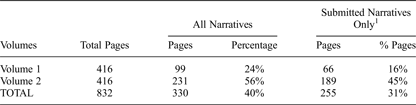
But the bigger challenge for Prince continued to be getting the narratives themselves. Of the remaining five narratives in the first volume only one was sent directly to the Christian History for publication and this narrative, written by John Porter, suffered similar ideological deficiencies as Edwards's contribution. Fortunately, the newspaper had two supplemental sources of narratives. As a prominent Boston minister, Prince, Sr. had an extensive network of correspondents throughout the colonies. Four of the ten narratives found in the first volume were sent to Prince directly or another correspondent without any indication that they were intended for publication. Prince ended the first volume with a narrative written by Peter Thacher and sent over a year before the newspaper existed.Footnote 91 A second source of creative acquisitions came from the papers of deceased ministers. In December of 1743 revival supporters were saddened by the death of William Cooper, a prominent minister and powerful revival ally in Boston who had promised Prince a narrative.Footnote 92 (Reporting this news in the Christian History, Prince again pleaded that “Other Ministers who are willing to give us Accounts, to hasten them, for the further Glory of the divine Power and Grace and Entertainment of the Pious.”)Footnote 93 Fortunately Cooper's estate made good on his debt; Prince found three narratives among his papers, constituting almost another third of the narratives printed in the first volume, and were among the most conservative.Footnote 94 The use of private correspondence in colonial newspapers was common practice; but it highlights the difficulty Prince faced when seeking collaborators. All told, only about one third of the total narratives have any indication they were written explicitly for publication. He constructed a fictive coalition of incognizant parties.
V. Analyzing Prince's Great Awakening
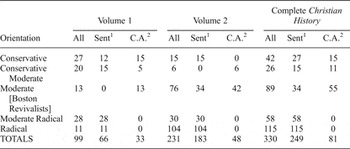
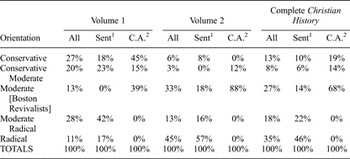
By the end of the first volume, it was clear that Prince's ideal was only one of many (often contradictory) definitions of an authentic revival. This continued over the full run of twenty-four narratives. Though both revival opponents and the most radical revivalists like Andrew Croswell were ignored, the entire spectrum between these excluded voices was found in the pages of the Christian History. There was a wide divergence of opinion on several disputed issues: how to judge a “true” revival, ecclesiology, tolerance for itinerants (and why they should be tolerated), the source of religious authority, and interpreting enthusiastic behavior.
Conservative ministers who supported the establishment emphasized continuity with the past.Footnote 95 They held an older ecclesiastical schema of past Puritans, but focused more on social stability and morality than conversions and personal experience. Narratives from the conservative side of the spectrum told of an old-style awakening and emphasized moral improvement rather than religious experiences to support their claims of revival. “God hath in a most wonderful Manner [poured] out . . . his spirit upon many Towns in this County,” wrote Samuel Allis, citing the “evident and apparent Alteration in the Lives, Conversation and Tempers of Men.”Footnote 96 James Allen agreed “There has been a very distinguishing and remarkable Work of God going on in the Land. . . . For what but the God that formed it, can so impress the Mind with a Sense of Sorrow of Heart . . . Who but the GOD of Grace can make the Drunkard temperate, and the prodigal Son, a sober and serious Man, &c?”Footnote 97 John Seccomb asserted that a “great number of both young and old are outwardly reformed; and a considerable Number who in a Judgment of Charity may be said to be savingly converted,” but pointed exclusively to their “Lives and Conversations for two or three years past are in the main as becometh the Gospel” as his evidence. Moreover, the revival was caused by a change in the hearts and minds of his parishioners, rather than any innovation on Seccomb's part. Thus, “some of the same Sermons they had heard some Time before (being sometimes necessitated to preach such) appear'd to be quite new, and better than ever they heard before, and I could hardly make them believe they had ever heard them before.”Footnote 98 Conversions were slow and orderly. There were “no instances . . . of such sudden Conversions as I have heard of elsewhere,” wrote Jonathan Dickinson, “but our new Converts were all for a considerable Time under a Law Work.”Footnote 99 These and other conservative revivalists almost exclusively emphasized observable moral reform.
Some conservatives admitted to enthusiastic disorders, but emphasized their success in quashing such behavior. “As to visions, we had enough of them,” confessed John White, “until such Time as in a Lecture Sermon I declared my Sentiments concerning them; as so far as I can understand there has never been one since. Our Congregation has been disturbed and interrupted by Outcries, but I laboured to suppress them.”Footnote 100 “As to Disorders among us, we are free from Separations and from Trances and Visions,” proclaimed John Cotton, “though at first there was one or two that was something Visionary, but I haven't heard any Thing of that Nature this twelve Month.” Seccomb claimed “None have cried out under the Word but once, and then but five or six.”Footnote 101
Itinerancy and lay-leadership were largely absent from conservative narratives; rather the local minister was the dominant leader of the revival. Cotton labored against these practices: “We allow not of Lay-Exhorters; and indeed there has been very little of public Exhortations in this County.”Footnote 102 Likewise he excluded itinerants; the revival “hath not been carried on violently, nor by Strangers . . . this religious Concern began a Year before Mr. Whitefield's coming to the Country.”Footnote 103 Even Henry Messinger and Elias Haven, who were moderate on many points, insisted, “this general Awakening was not from the Influence of traveling Ministers (tho' we are satisfied God has made Use of some of them in the revival of Religion in many Places).”Footnote 104 John White agreed. “Properly speaking, we have had but one Itinerant Preacher with us,” he reported. Though a number of neighboring ministers “have occasionally preached to our Congregation and have been greatly assisting in promoting this good Work.” Perhaps because of the absence of these controversial elements, conservatives reported little conflict between pro- and anti-revival forces. “Little has been said about New Lights,” continued White, “and as little about Opposers, the mentioning of which is irritating, and tends to widen the Breach and foment Divisions, Contentions and Separations.”Footnote 105 Conservative revivals, while heartfelt and even intensely so, were local, evidenced by moral reform, and by-and-large free of significant controversy.
In contrast, the more radical revivalists—most of whom embraced Prince's project—maintained a Calvinist theology of conversion, but advocated substantial changes: in ecclesiology, in revival methodology, and in their positive interpretation of enthusiastic behavior. George Griswold joined Joseph Parks in crediting Davenport with sparking the revival in Lyme. Though compelled to criticize Davenport's latest excesses, he minimized many of his most disruptive acts. The radical itinerant's accusation that a local minister was unconverted split the church; Griswold's narrative interpreted the incident as a simple misunderstanding that was quickly resolved.Footnote 106 Jonathan Parsons was similarly tentative when criticizing Davenport. He emphasized the embattled minister's success in converting Indians, while admitting he went too far in encouraging lay preaching, in emphasizing the significance of “impressions,” and in his judging “as I suppose Mr. Davenport did some ministers.”Footnote 107 Radical revival narratives treated Davenport as a well meaning, highly effective, but occasionally mistaken, man of God. Radicals also endorsed other controversial itinerants and their practices. For instance, contributor David Hall itinerated in parishes against the wishes of its minister.Footnote 108 Jonathan Parsons raised the ire of conservatives by setting up a separatist church in another minister's parish.Footnote 109 Nathaniel Leonard invited the radical separatist Andrew Croswell to preach, which contributed to a church split in Plymouth.Footnote 110
While conservatives had no tolerance for outcries and other enthusiastic behavior, radicals debated whether any controls were acceptable. “I have tho't since,” Jonathan Parsons mused, “whither I did not do wrong in endeavoring to restrain [those who were crying out] . . . yet I am free to confess that I mistook my Duty in taking so much Pains to prevent Out-cries in the Assembly.”Footnote 111 Josiah Crocker reported during one service “By and by some began to cry out both above and below in awful Distress and Anguish of Soul.” But rather than trying to maintain order, he simply “raised his Voice that he might be heard above their outcries; but the Distress and Out-cry spreading and increasing his Voice was at length so drowned that he could not be heard.” To those who would dismiss this as “a wild Scene of Enthusiasm; give me Leave to ask . . . . If true Religion is not to be found in these Things, where shall we find any Religion save the Religion of Nature?”Footnote 112 The most radical revivalists tolerated behavior that moderates treated as pure enthusiasm. Crocker told of “two, as I remember, for a few Hours whilst under Convictions of Sin and Wrath, were so over-power'd as to lose the free Exercise of Reason; yet is this so anti-scriptural as to warrant us to conclude the Persons were not under the Convictions of the Holy Spirit?”Footnote 113 In fact, he went so far as to blame doctrinal errors of young converts on their not having the “Words to cloath their Ideas of spiritual and divine Truths which they had been taught by the Holy Spirit.”Footnote 114
These same radicals were most adamant that the charges of enthusiasm were unfounded—demonstrating they had a different definition of the term than conservative and moderate revivalists. “Some had Fits, some fainted; and it was observable that God made use of the Concern in some to create a Concern in others . . . Cryings out at the preaching of the Word were frequent,”Footnote 115 wrote George Griswold. Yet he later claimed little “Enthusiasm & Extravagancy,” which he characterized as a proclivity “to forsake the written Word of God to follow Impulses and Impressions.” Of these he claimed not to “know of any.”Footnote 116 Jonathan Parsons asserted accusations of enthusiasm stemmed from disagreements on points of little significance. Many good people disagree “in some circumstantial Things; why should others . . . be censured as Enthusiasts, being lead about by diabolical Delusions . . . merely because there are some Things in their conduct which we don't so well like?”Footnote 117 Josiah Crocker argued any report of enthusiasm was a misrepresentation by opponents of the revival.Footnote 118
The Boston revivalists found themselves in the middle. As orthodox Congregationalists, Prince and others were pleased with the renewal of Calvinism against the encroaching Arminian and secular heterodoxies, but as ecumenists they were concerned that overly sectarian theological pronouncements would undermine their cultivation of broad cooperation—especially with “Old Lights” suspicious of the current revival. As pietists they were pleased with the increase of authentic religious feeling and action, but as part of the Boston elite, they limited the appropriate fruit of this piety to an increase in morality—rejecting the radical view that supernatural manifestations might evidence God's work. As ecumenists they were quick to cooperate with a variety of revivalists from other denominations, but as head of the Congregationalist establishment they were opposed to laypeople rejecting their duly installed, but supposedly “unconverted,” ministers. As Puritans, they were pleased with the role that revival played in purifying their congregations, but as “catholick” Congregationalists, they wanted to maintain an open communion table and the halfway covenant; this, in turn, reinforced the instrumentality of the church—against radical claims that it was a purified group of believers who experienced God on their own.
The divergence of voices found in the Christian History, despite the complications it created for Prince's ideal narrative, suggests that he exercised significant restraint in modifying materials he received. But this, of course, does not mean that these narratives accurately reflected the full reality on the ground or the possible interpretations of those events. Neither did Prince's intentions of accuracy prevent his influence over the narratives, most notably through the ways he structured his requests for materials. These dynamics could be subtle and complex, but fortunately we have at least one revival event with sufficient outside sources through which to trace the effects of the Christian History on a narrative it printed. The revival in Plymouth, under the auspices of Nathaniel Leonard's church, inspired at least five separate reports. The first account published in June 1742, an excerpt of a private letter of unknown origin, raised concerns about enthusiastic excesses and ecclesiastical divisions. The most complete account was penned in the memoirs of Josiah Cotton, a Plymouth magistrate. This was supplemented by another account, probably penned by Cotton, in the family papers. Two other accounts were written by Leonard: one in the Plymouth church records and a final narrative for the Christian History. All the narratives corroborated many basic facts about the revival. The radical itinerant Andrew Croswell came to Plymouth in the winter of 1742; he preached for several weeks in Leonard's pulpit and was a key figure in the event. The culmination of his efforts was a controversial all-night meeting on Saturday, February 13, during which members of the congregation became deeply agitated. Everyone also agreed that these events had a lasting influence on the church and broader community. It also contributed to a church split in the town.
But there were significant differences between the narratives as well. The first report, published in the South Carolina Gazette, recounted a scene dominated by enthusiasm. By this account, the recently departed Croswell had “charmed the whole Town” such that they abandoned their secular work for three weeks. The meetings themselves were “an entire Bedlam,” filled with “Foaming or Fainting, Laughing or Crying.” Like Davenport, there was also “singing Processions of hundreds . . . with no Uniformity or set rules.” Uneducated lay persons were allowed to exhort, including “A big-bellied Woman” who “straddled into the Pulpit to assist C—-ll, and was inspired with so much useful Matter, as took her up half an Hour to deliver it.” Meanwhile “L—-d the proper Teacher fell in with the Rant,” claiming he himself had only been recently converted (and requesting “Prayers for his unconverted Wife”) and allowing his eight year old son to “deliver a Word of Exhortation to the People.” No benefits were recorded; Croswell had spurred nothing but unadulterated enthusiasm.Footnote 119
The accounts either written or collected by Josiah Cotton reflected a similar interpretation of Croswell's work. Cotton was a pious establishmentarian deeply interested in reviving religion, but the enthusiastic excess and disruption of the existing social order poisoned the events. Of greatest concern to Cotton was the long meeting on February 13. Croswell's preaching resulted in members of the congregation crying out so loud it “was heard to the shipyard near a quarter of a mile.” Adult men “some above forty years of age” were “on the floor of the meeting house, in strong convulsions & most violent bodily agitations,” while “the pulpit was full of women & children,” including “two or three negro boys.” This African-American participation in the services seems to have been a social inversion that was particularly troubling to Cotton. And indeed, his accounts show the extent to which slaves, women, and children used Croswell's theological discourse for their own prophetic and egalitarian ends. It provided rhetorical space for one “negro” pulpit-occupier to boldly order the congregation (the narrative called it “screaming out”) to “come away to the Lord Jesus; why will you stay—if you don't come, you will be damned.” Another “negro boy, at the same time, got up to the top of the pulpit, & cried out over & over, ‘you grey headed sinners, come away to the Lord Jesus Christ, you are in a few steps of hell,’ &c.” The illegitimacy of this inversion was confirmed in the author's mind by the fact that several of these prophets were later “legally convicted of stealing fish.” Whether the charges were legitimate is impossible to know, but the mere accusation made Leonard's allowances unconscionable.Footnote 120
Leonard's version of events could not have been more different. The first draft of Leonard's narrative was written in the records of the Plymouth Church. This was somewhat of a departure from their historic purpose: recording significant church meetings, the founding of other churches, issues of congregational discipline, and membership statistics. The first indication of unusual religious activity was in an entry imprecisely dated “March 1741/2,” but based on its location in the records, it was written after June 1742 (after the publication of the first critical report). It sketched a narrative that began not with Croswell's arrival, but a visit by Gilbert Tennent a year earlier “to great Acceptance” and “which . . . greatly awakened this People.” A series of itinerants followed with entire days spent “in Prayer Singing & Preaching.” The results were definite: “all Sorts of pple & Men Women & Children were much awaken'd & some (we Believe) were converted.” A second entry, dated January 1742, excitedly recounted Croswell's visit to Plymouth. “Taverns were much Reformed” and “great Additions were made to the Ch[urc]h of Such as we hope will be Saved.” But not everyone approved of the recent turn of events. “A violent Opposition presently arose & prevailed” so that a number of congregants withdrew “into a distinct Society.” Ultimately Leonard gave his blessing for nine of these to form their own church. Leonard also reported his suspending from communion two recently converted slaves, Nero and Boston, for unnamed “Scandalous Offenses.” A final entry from May 1744, recorded the conciliatory letter Leonard sent to the new congregation, again giving his blessing to their new communion and “Praying that the God of all Grace may Enrich them with all Spiritual Blessings & give them a Pastor after his own heart.”Footnote 121
On November 23, 1744, Leonard responded to Prince's call for revival narratives and turned to his church records for source material. The five-page narrative followed his church record's narrative outline and appropriated large portions of the text word-for-word. But he also made efforts to conform the material to the Christian History's specified ideal. The new account began with a description of Plymouth upon his arrival twenty years prior: in a state moral decline. Intemperance prevailed and the reforms of town officials could not curtail it. For years the church implored in prayer and fasting “that God would pour out his Spirit upon us, especially on the rising Generation.” This description may have been accurate, but church records did not reflect this stark assessment; they recorded some disciplinary actions over intemperance, but no special times of prayer and fasting. In fact, an entry from July 1736 happily reported adding forty-one members and “Bless[ed] God for this Increase.” When recounting more recent revival activity, he muted the triumphalism of the raw church records. Reporting Tennent's ministrations, he replaced the original “great” acceptance with “general,” and to his original evaluation that “God greatly awakened this People,” he added the proviso “as we have Reason to believe.” He still credited Croswell with bringing the Gospel “in Power,” and reported the controversial February 13 meeting during which “Hundreds of souls were . . . crying out in the utmost Concern” as others “rejoycing in the Lord, in the sweet Sense of his redeeming Love and Grace.” But he added a postscript to clarify that he made no claim to know “infallibly the State of their Souls which is God's Prerogative” only that “the Alteration in the Frame and Temper of their Minds, which they discovered in Words and Behaviour was admirable.” Reference to the “violent Opposition” to the work remained, but he admitted that “this present Life is a State of Imperfection,” that “some Circumstances” had caused offense, and that he supported the new church. Leonard concluded the narrative with two pages of new material outlining the results of the revival. Though some converts had backslid, most remained firm in the faith. Longstanding believers claimed their faith was enriched by the revival and the morality of Plymouth remained “much reformed,” though declension hovered as a future possibility.Footnote 122
The most striking characteristic of Leonard's narrative, however, was its deviation from Price's guidelines, despite his clear attempts to comply. Its largely conciliatory tone simply could not hide his many radical assumptions: especially his approval of Croswell's ministry. Moreover his desire to mute censoriousness and minimize enthusiasm as Prince desired meant he had to strip out most of the details of the account, leaving vague attestations to revival without the empirical data that was to be the whole point of the Christian History. Leonard seemed cognizant of this fact and apologized that “I have not been Particular . . . in giving Examples of Conversion” as Prince requested. His excuse was that they would have been “the same in Substance, which is so often described in these Papers.” We can only assume that he made no mention of the slave converts in which Prince had particular interest, because they were under church discipline. Indeed, it was these sorts of omissions that were most controversial. Upon reading Leonard's narrative, Cotton complained, “he Informs the Publick of Mr Crosswell's Arrival . . . But unhappily forgot to give an Acct.” of the various enthusiasms that accompanied it—“only that offence was taken” and worse, “a violent Opposition to a Work of Grace.”Footnote 123 The biggest influence over Leonard's narrative, then, appears to be Prince's relentless optimism. Enthusiastic behavior and ecclesiastical disruption might be errors, but by Prince's schema there was no need to address and renounce them in the narrative any more than one should make an accounting of the chaff associated with a harvest. Thus Leonard made the minimum changes required to avoid overtly dishonest statements, but ignored many features of the revival that, for Prince and other Boston revivalists, would have relegated the movement to enthusiasm.
The most striking feature of Cotton's description of the Plymouth revival, in contrast, was its similarity to the ideology of Boston revivalists. Cotton was no partisan agitator; rather he was a prototypical conservative: pious and desirous of revival, but deeply suspicious of any and all innovations that radical (and even moderate) revivalists pioneered. Well informed of religious intelligence from Boston, he immediately saw parallels between Croswell and Davenport, whom, he noted, had been soundly repudiated by the Boston establishment. He showed no animosity toward Leonard personally; he blamed the excesses on itinerants and lay preachers. Cotton blamed Leonard for opening his pulpit to them and, more importantly, neglecting his ministerial duty to publically censure their errors. Cotton recorded several appeals to Leonard: in one case to “call a Church Meeting” to discuss controversial aspects of the revival “so that people may Unite & charitably join with One Another in that which is Our chief Glory & Interest, the Service of God,” and then a “Proposal for a Fast, of which I thought there was more occasion than a Thanksgiving,” in the hope “that Gods Work may be carried on Successfully with Decency & in order according to ye. Direction in his Word.” Both overtures were refused. He even acknowledged an increase in religious activity “than in former Years.” The problem was that two-thirds of this activity was “Delusion & Dissimulation; And the Other Third is so Intermingled with Enthusiasm that a Body can hardly tell what to Make of a great deal of it.” Indeed, there is no doubt that the Boston revivalists would have agreed with Cotton had they known the full story, especially since they had already explicitly and unanimously condemned these behaviors in Davenport.Footnote 124 What divided Cotton and Prince was not ideology as much as knowledge of the true conditions in Plymouth.
The irony then was that the newspaper that was supposed to convince skeptics like Cotton that a real revival was at work only confirmed their doubts. Cotton objected to the present revival activity for reasons nearly indistinguishable from the Boston revivalists' condemnation of Davenport: substantial and repeated patterns of enthusiasm and evidence that it was subverting the existing social order. To this, he added itinerancy, primarily because, based on his experiences in Plymouth, it had only served to promote the other two. Yet despite these shared values, Cotton saw himself as being on the opposite side of the Christian History: “a Weekly Paper unhappily Calculated to Promote Enthusiasm.” How could he conclude otherwise when he read Leonard's account with his full knowledge of the events that transpired? Such inaccurate reports only served to foster further division and ultimately to harm the authentic work of God.Footnote 125
VI. The End of the Christian History's Great Awakening
The revival that radical correspondents were describing was quite different from what the Boston revivalists were promoting; why then were they included in the Christian History? The answer is found in Prince's ongoing struggle to find material, especially revival narratives, which often influenced the content more than his editorial designs. Despite Prince's intention to collect current news, the paper never outgrew its dependence on re-published material to fill its pages; over two-thirds of issues had at least some recycled material and a surprising forty-six percent of issues had no new information whatsoever.Footnote 126 Despite Prince's intention to collect intelligence of God's working in the British North American colonies, forty-four percent of issues had no present colonial news (including revival narratives) in them.Footnote 127 Less than half of the issues contained the revival narratives that were supposed to be the papers' mainstay.Footnote 128
Total Revival Narratives in the Christian History
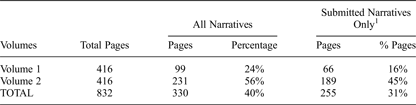
1 This excludes “creative acquisitions”: narratives by Jonathan Dickinson, William Shurtleff, James Allen, Samuel Allis, and Peter Thacher in Volume 1, and the narrative written by Thomas Prince, and a second Thacher narrative in Volume 2.
Prince's “creative acquisitions” of revival narratives addressed this problem in the second volume as well; in fact the most creative acquisition of all was the revival narrative penned by Prince himself. It was the second-longest narrative (consuming forty-two pages or almost six issues) and served as the capstone of the final volume. Indeed, the paucity of material emerges in stark relief when excluding these creative acquisitions. Despite his many requests, Prince only received enough revival narratives to fill sixteen percent of the first volume and forty-five percent of the second volume, or less than a third of the total pages of the publication.Footnote 129 (Not surprisingly, the second volume was also littered with requests for contributions.)Footnote 130
But the crux of Prince's problem was the type of revival narrative he received. Ranking the narratives from conservative to radical and then analyzing their origins shows a preponderance of radical narratives that only increased over time. All told, conservative and moderate material made up twenty-one and twenty-seven percent of the Christian History's narratives, respectively. Fifty-three percent of all narrative materials in the publication fell on the radical side of the spectrum. Excluding Prince's creative acquisitions (overwhelmingly oriented to a moderate or conservative perspective), the total of radical-leaning revival narratives increases to sixty-nine percent of narratives.Footnote 131 Moreover, radical representation increased in proportion over time; excluding Prince's acquired material, they comprised seventy-three percent of the second volume. In contrast, the conservative side of the coalition was waning over time; two conservative ministers (John Cotton and James Allen) had rejected the Great Awakening project altogether by 1745.Footnote 132 Despite initial hopes to the contrary, Prince reported a revival whose later turn was characterized by enthusiasm and excess. He filled the final six issues with his own narrative—fulfilling his obligation to subscribers and framing the collection with content that perfectly reflected his theological proclivities—and then ceased publication.
Revival Narratives (Pages) in the Christian History by Theological Orientation

1 This excludes “creative acquisitions”: narratives by Jonathan Dickinson, William Shurtleff, James Allen, Samuel Allis, and Peter Thacher in Volume 1, and the narrative written by Thomas Prince, and a second Thacher narrative in Volume 2.
2 This includes only the “creative acquisitions” listed in note 1.
Percent of Revival Narratives in the Christian History by Theological Orientation

1 This excludes “creative acquisitions”: narratives by Jonathan Dickinson, William Shurtleff, James Allen, Samuel Allis, and Peter Thacher in Volume 1, and the narrative written by Thomas Prince, and a second Thacher narrative in Volume 2.
2 This includes only the “creative acquisitions” listed in note 1.
In the absence of a core set of theological beliefs or established practices, Prince tried to construct the Great Awakening using rhetorical habits and ministerial networks. Thus the revival was a unified event only inasmuch as supporters spoke about it in similar terms. Prince grounded the meaning of this shared vocabulary in the usage of well-respected ministers, despite the fact that revival supporters on the radical fringe—those producing the only current religious activity he could chronicle—used substantially different definitions for terms like enthusiasm and censoriousness. Likewise Prince conceived the revival as a ministerial network with himself and other prominent Boston ministers at the center. The Boston revivalists believed that they led the current revival and thus were the ultimate arbiters in separating the wheat of God's sovereign work from the chaff of enthusiasm. And as leaders of the Congregational establishment, their sanction connected the present revival movement to the revivals promoted by earlier divines. What Prince did not realize initially was that defining a movement through such associations ran both ways. The Christian History's attempts at building a broad evangelical unity meant they drew not only from the pure springs of primitive Puritanism and the conservative revivalism of respectable ministers, but also from the brackish waters of young itinerants and radical enthusiasts—associations that ultimately poisoned the entire enterprise. Prince successfully constructed the Great Awakening as a unified event, but he failed to purify it from what he believed were the excesses of its radical participants. Despite the designs of the Christian History, radicals ultimately defined the movement. Contemporaneous events provided Prince only with material that confirmed the radical nature of the revival. The paper's negative associations with enthusiasm outweighed its unassailable evidence of revival, leaving no choice but to cease publication.
Prince's project, and ultimately its failure, suggests that the creation of the Great Awakening was not only a collaborative effort, but also a contested one. Attitudes toward enthusiasm—a theological continuum with Old Light proto-Unitarians like Charles Chauncy on one end and New Light radicals like Davenport on the other and Jonathan Edwards in the middle—does not capture the full range of opinions about revivalism or interpretations about its ultimate ends. It also obscures the influence of social power in the ensuing debates and the important role of Boston revivalists in the Great Awakening project. Likewise it distorts the concerns of many revival opponents over maintaining the social order—more so when they are grouped with radical antirevivalists like Thomas Fleet since their opposition stemmed from opposite designs: to undermine the Congregationalist establishment in Fleet's case and to preserve it in the case of internal critics.
The failure of the Christian History also reminds us of the limits of promotional material—that revival “reporting” did not mechanically produce the revival activity of a type Prince desired. Prince's inability to find current revival news worth printing from the North American colonies was the persistent thorn in his side; in the end, none of the materials he printed—international revival news, old sermons, past revival narratives, and carefully selected colonial news—were able to stimulate further conservative and moderate revival activity as he had hoped. Indeed, Prince, Jr. admitted in correspondence to the Scottish revival journal, The Christian Monthly History that he ceased publication because of “the scarcity of suitable materials.”Footnote 133 His phrase is telling, indicating not only a numerical lack, but also a deficiency in quality. Support for the paper from respectable society, never strong, had completely dried up by 1745. Not one pro-revival minister in Boston, except Prince himself, submitted a revival narrative for publication. Only ten of the 114 ministers who pledged support of the revival ever sent narratives. Prince, Jr. died shortly after the end of the Christian History and most moderate revival supporters in New England shifted to other projects.
The supreme irony of the Christian History is that it was most successful in creating opposition to the narrative it was trying to promote. As a vehicle for contemporaneous reporting and promoting of moderate revivalism, the newspaper was a short-lived failure. Its brief existence—captured in the amber of the printed word—was quickly challenged by outsiders and ultimately abandoned by supporters. The seams in the project were obvious enough that they polarized Congregationalism—further alienating conservatives from revivalism while emboldening radicals. It became fodder for religious outsiders to mock New England's establishment. After the project was abandoned, the centrifugal force of revivalism insured that subsequent revivals would remain isolated and unconnected local events, predominantly among the lower orders or in the hinterlands.
It would take a new form of revivalism—one fully wedded to the practices and constructs of the nineteenth century market—to penetrate the respectable urbane churches that had once nurtured the movement.Footnote 134 In the context of this other “Great Awakening,” a new generation of revivalists discovered Prince's narrative project. The passage of time had obscured the discrepancies that were obvious in the 1740s and the competing interpretations that better accounted for the facts on the ground. And with the innovations of radicals no longer seeming so threatening—in fact being the status quo of many respectable evangelicals—the complex debates (between conservative, moderate, and radical revivalists, conservative and liberal-leaning anti-revivalists, and radical outside critics like Thomas Fleet) collapsed easily into a two-party dispute between pro- and anti-revivalist forces. Prince finally achieved his dream of creating a Great Awakening, even if he was not alive to see it.