INTRODUCTION
The Mediterranean Sea, this ‘miniature ocean' (Béthoux et al., Reference Béthoux, Gentili, Morin, Nicolas, Pierre and Ruiz-Pino1999) although it covers only 0.82% of the whole oceanic surface, hosts about 8% of the known species, showing an exceptionally high biodiversity (Bianchi & Morri, Reference Bianchi and Morri2000; ESF, Reference Philippart2007). Due to the relatively recent colonization, the Mediterranean Sea seems to be more vulnerable and prone to the arrival of new species, compared to other ecosystems with a more ancient evolutionary history, limited space and higher antagonism between species.
In particular, the eastern Mediterranean biocenoses seem to be at an initial stage of maturation, after the rough hydro-geological changes which took place about 9000–7000 years ago between the Aegean and Black Seas, which led to the so-called ‘sapropel formation' and to the disappearing of many species. This phenomenon, with a periodicity of about 21,000 years (Rohling & Hilgen, Reference Rohling and Hilgen1991), seems to be partly responsible for the lower biodiversity observed in the eastern Mediterranean, and the consequent availability of ecological niches. The western Mediterranean, on the contrary, was not subjected to so large upsets after the end of the Messinian and appears more mature, hosting biocenoses richer in species. Due to the high diversity of habitats and its geographical position, the Mediterranean is characterized furthermore by a temperate climate and by species occurring both in temperate and in subtropical regions.
Global climate change is now ‘unequivocal' (IPCC, 2007), while the effect of climate warming can be seen on the biodiversity of oceanic and coastal areas, sea level, hydrological circulation, vertical movements and up-wellings. Each of them could have consequences on the marine ecosystem at various degrees (trophic relations, productivity, reproduction, biodiversity, etc), all inevitably related to social, economic and cultural aspects of the involved areas. Even though organisms have adapted to different climatic conditions during their evolution, the rapidity of currently observed phenomena is alarming (Root et al., Reference Root, Price, Hall, Schneider, Rosenzweig and Pounds2003). The ability of the marine environment to respond to the climatic changes depends also on other changes induced directly by man (such as overfishing; Daskalov et al., Reference Daskalov, Grishin, Rodionov and Mihneva2007).
Following the climatic changes registered during the last 30 years (IPCC, 2007; Nykjaer, Reference Nykjaer2009), occurrence of non-native marine organisms mostly of tropical and sub-tropical origin has increased in the Mediterranean, the so-called ‘Mediterranean tropicalization’ (Bianchi, Reference Bianchi2007). According to Bianchi (Reference Bianchi2007), it results from the combination of four factors: Atlantic influx, increase of Indo-Pacific immigrants, introduction of species for economic purposes (aquaculture) and seawater warming, all contributing to the establishment and diffusion of thermophilic species in the whole Mediterranean. The acceleration of the phenomenon has been documented in all the European marine ecosystems, but it is more pronounced in the Mediterranean (EEA, 2007; Zenetos et al., Reference Zenetos, Meric, Verlaque, Galli, Boudouresque, Giangrande, Çinar and Bilecenoglu2008) and even more in the eastern Mediterranean (Raitsos et al., Reference Raitsos, Beaugrand, Georgopoulos, Zenetos, Pancucci-Papadopoulou, Theocharis and Papathanassiou2010). This can be related to the adaptation time of alien organisms to their new habitat, coupled to the increased interest of the scientific community.
It is, however, undeniable that Indo-Pacific biota records are continuously increasing along Hellenic coasts. Greece, for its geographical position and morphological characteristics, represents the gateway for dispersion of Red Sea and Black Sea alien species into the rest of the Mediterranean. Among Hellenic Seas, the coastal area of the Dodecanese Islands is the most subjected to alien introductions (Pancucci-Papadopoulou et al., Reference Pancucci-Papadopoulou, Kevrekidis, Corsini-Foka, Simboura, Papathanassiou and Zenetos2005), since it represents the natural pathway of expansion of Levantine water masses and it is furthermore along the route of the intense maritime traffic. The significant increase observed in the rate of introduction in the south Aegean could be related to the sampling depth, as it is known that settlement of alien species is favoured in shallow areas with warm waters and the attention of Hellenic scientists has only recently been turned to very shallow coastal benthos.
The aims of the present study are: (a) to summarize the current state of knowledge on alien species entering the south-eastern Aegean Sea; (b) to investigate whether long-term analysis of new alien species arrivals in the area can be related to climate trends; and (c) to discuss the potential impact of selected alien species on the native ecosystem.
MATERIALS AND METHODS
Study area
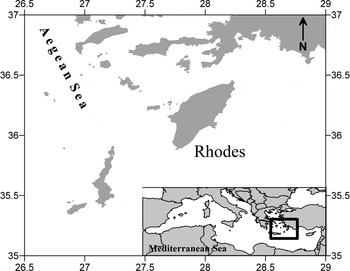
Our attention focuses on the Dodecanese Islands (Figure 1), as it is the Hellenic area closest to the coast of Asia Minor, and one of the best studied areas, from a biological point of view, since the 1920s (Bianchi & Morri, Reference Bianchi and Morri1983 and references therein), before the massive alien species entering. The Rhodes gyre, south-east of the island and the Asia Minor Current (AMC) are the major hydrological features nearby, significantly affecting the area. Important changes in the south Aegean water mass characteristics have considerably influenced the thermohaline circulation of the eastern Mediterranean, termed the Eastern Mediterranean Transient (EMT) (Theocharis et al., Reference Theocharis, Nittis, Kontoyiannis, Papageorgiou and Balopoulos1999).
Study area: Dodecanese Islands, eastern Mediterranean.

Alien species data
The list of species was compiled following the latest checklist of Hellenic aquatic alien species (Zenetos et al., Reference Zenetos, Pancucci-Papadopoulou, Zogaris, Papastergiadou, Vardakas, Aligizaki and Economou2009; ICES/IOC/IMO, 2010). Comprehensive information for each species, including distribution maps and photographs for most of them are stored in the ELNAIS (Ellenic Network of Aquatic Invasive Species) website (https://services.ath.hcmr.gr/), archived in the Hellenic Centre for Marine Research (HCMR). Data used in this study cover all major taxa, namely phytoplankton, zooplankton, phytobenthos, zoobenthos and fish. Based on the aim (b) of the present study—to investigate relations between climate trends and new alien species arrivals in the area—only the warm/tropical species (87 out of 90) entered up to 2009 were used for biological considerations, while the temperate/cold species (3) were removed. Moreover, only species entered in the area up to 2008 were used to assess the relationship between their arrival and temperature variations. In order to check if changes in ecosystem have occurred or could be foreseen, four of the so-called ‘worst invasive species’ in the Mediterranean, with documented impact on biodiversity and socioeconomics (Streftaris & Zenetos, Reference Streftaris and Zenetos2006) were selected; published and unpublished information as well as authors' personal observations were used to discuss their potential impact on the ecosystem of the studied area.
The term ‘alien’ is used in the text, following the well known Executive Order 13112 of February 3 1999, which defined ‘alien’ species as ‘any species, including its seeds, eggs, spores, or other biological material capable of propagating that species, that is not native’ to the particular ecosystem in which it is found, whereas CIESM consider as aliens ‘those species that have only one or few reliable records with no evidence of self-sustaining populations’. ‘Non-native’, ‘non-indigenous’ and ‘exotic’ are here considered as synonyms.
Temperature data
Three different sources of temperature data were used for the purpose of this study, i.e. satellite, in situ and modelled. The Advanced Very High Resolution Radiometer (AVHRR) sea surface temperature (SST) product was ordered from the NASA PO.DAAC. Monthly SST means at 4 × 4 km2 resolution were analysed for the period January 1985 to 2007. In order to avoid the solar radiation bias (the diurnal fluctuation in SST) that can occur during the day-time from surface heating (Raitsos et al., Reference Raitsos, Lavender, Pradhan, Tyrrell, Reid and Edwards2006), the night-time SST products were used. The SST data were spatially averaged for the study area of Dodecanese (Figure 1). The study area from where the alien species and SST data have been analysed is approximately 60,000 km2.
Northern hemisphere temperature (NHT) anomalies were obtained for 1850 to 2007 and were expressed as anomalies relative to the 1961–1990 reference period means (Brohan et al., Reference Brohan, Kennedy, Harris, Tett and Jones2006; Jones et al., Reference Jones, Parker, Osborn and Briffa2008). NHT data were produced by the Climatic Research Unit (CRU) and Hadley Centre (Jones et al., Reference Jones, Parker, Osborn and Briffa2008) and are freely available for research purposes.
In situ seawater temperatures were measured with laboratory thermometers in the master tank of the Public Aquarium of the Hydrobiological Station located at Rhodes Island along with the routine monitoring of physical parameters occurring in the captivity environment. The Aquarium water (open circulation system, total volume 70,000 l) was pumped from a 3 m depth well to the master tank, through an 80 m underground pipe. A total of 2208 samples were collected between 1985 and 2000, with a mean of 138 samples/year. It was observed that the Aquarium temperatures during summer months were usually lower, compared with measurements performed directly in the field, whereas during the rest of the seasons this difference was not obvious. This was due to the cooling of the water during its time permanence in the underground pipe and in the master tank, the summer months. This effect probably explains the slightly lower annual mean values of the Aquarium temperatures compared with satellite ones (see Results). This effect could be expected in open system aquaria; however this issue does not affect the main scope of the analysis, which is to confirm the increasing trend of the marine temperature in the study area.
Data analysis
Pearson correlation (r) analysis was used to examine the relationships between the data. Two statistical methods were used to assess abrupt changes/shifts in both alien species and temperature data. These two methods are the regime shift detector (Rodionov, Reference Rodionov2004) and the cumulative sums. The first one is based on a regime shift index (RSI) combined with a sequential t-test (Rodionov, Reference Rodionov2004). The absolute value of RSI represents the magnitude of the shift(s) while its sign specifies change in direction of mean between regimes (see Rodionov, Reference Rodionov2004 for more information). Using an automatic sequential algorithm, confirms regime shifts by accounting for statistically significant differences between the means in consecutive segments of a time-series (Rodionov, Reference Rodionov2004). The second method, cumulative sum, was applied to summarize the major change in both datasets (alien and temperature), and to examine if potential changes paralleled each other. This method emphasizes major changes, as well as highlights changes in local mean values along the time-series and smoothes high frequency variability. Successive positive anomalies produce an increasing slope whereas successive negative anomalies a decreasing slope. Both of the methods are repeatedly used to test for significant changes in a time-series of both biotic and abiotic datasets (e.g. see McQuatters-Gollop et al., Reference McQuatters-Gollop, Mee, Raitsos and Shapiro2008).
RESULTS
Alien species in the Dodecanese
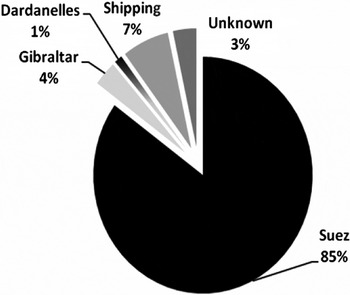
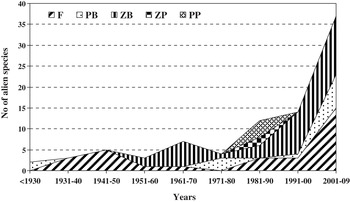
Of the 202 marine alien species currently known from Greek Seas (Zenetos et al., Reference Zenetos, Pancucci-Papadopoulou, Zogaris, Papastergiadou, Vardakas, Aligizaki and Economou2009; ICES/IOC/IMO, 2010), 87 (43%) originating from warm/tropical waters occur along the Dodecanese coasts: 6 species introduced by shipping, 3 by unknown vector, 1 via the Dardanelles, 3 via Gibraltar and 74 via the Suez Canal (Figure 2). The first two aliens were found in Rhodes Island in 1894, namely the seagrass Halophila stipulacea Forsskål, 1775 (Fritsch, Reference Fritsch1895) and the macroalga Hypnea cornuta (Kützing) J. Agardh, 1851 (Reinbold, Reference Reinbold1898). Almost 40 years later (1930s) 3 Indo-Pacific fish species were recorded in the area, followed by the other 5 during the 1940s. Thus, the corridor was open to fish, starting changes in native communities and fishery activities. During the 1950s the first benthic invertebrate was recorded. After almost a century of ‘smooth' colonization, the introduction rate of Indo-Pacific species increased during the 1980s, with the arrival of 12 new aliens (Figure 3). Since then the introduction of alien species in the area assumed the character of invasion, with the addition of 14 new species (12 of Indo-Pacific origin) during the 1990s and 37 from 2001 to 2009, most of them establishing thriving populations. With regard to the groups, zoobenthos (41%) and fish (36%) are dominant, followed by phytobenthos (16%) and plankton (phytoplankton 5% and zooplankton 2%). The percentage increase showed from 1980 and after (Figure 3) can be seen in all groups, as alien phytoplankton and zooplankton were absent until 1979, while fish, zoobenthos and phytobenthos increased by 110%, 200% and 233% respectively.
Pathways of introduction of alien species in the study area.

Temporal trend of introduction of alien species in the study area (F, fish; PB, phytobenthos; ZB, zoobenthos; ZP, zooplankton; PP, phytoplankton).

Aliens species and climate warming
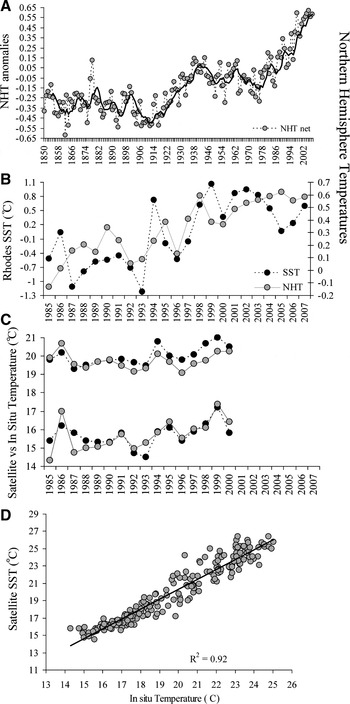
The first attempt was to assess whether there is a warming signal in the study area, as well as to identify if this signal is due to a regional phenomenon or whether it is part of a wider trend that the northern hemisphere is going through. First, NHT anomalies were analysed in order to observe the temperature anomaly trend during the last 180 years (Jones et al., Reference Jones, Parker, Osborn and Briffa2008). As it is well known (Jones et al., Reference Jones, Parker, Osborn and Briffa2008), the northern hemisphere has gone through some dramatic changes during the last 160 years, where a sudden temperature rise occurred around 1915 and a second one after 1980 (Figure 4A). One of the most important pieces of information obtained from this plot is that the temperature rise during the last 30 years is the warmest period at least during the last 160 years. In order to assess if there is a warming signal in the study area and if this signal parallels the global trends, the regional satellite derived SST against NHT were plotted since 1985 (Figure 4B). From this plot, it can be clearly seen that the south-eastern Aegean Sea is going through a substantial warming and particularly after the mid-1990s. This shift has been observed in every part of the Aegean and Ionian Seas and has been characterized as an abrupt temperature shift that remained stable after 1998 (Raitsos et al., Reference Raitsos, Beaugrand, Georgopoulos, Zenetos, Pancucci-Papadopoulou, Theocharis and Papathanassiou2010). Based on the satellite derived SST means, the Dodecanese temperature difference between the two decades (pre shift (1985–1997) and post shift (1998–2007)) is 0.85°C. The temperature warming parallels the temperatures of the northern hemisphere visually and statistically (monthly means: r = 0.413, P = 0.0001, and annual means: r = 0.687, P = 0.00001). In addition, it was used as a valuable in situ seawater temperature time-series dataset (1985–2000), in order to examine the validity of the satellite signal but also to provide unique (for the eastern Mediterranean) in situ temperature data (Figure 4C). Both annual and minimum temperature means (important for alien species survival) were significantly correlated (r = 0.662, P = 0.005, and r = 0.763, P = 0.001 respectively). In Figure 4D this relationship is strengthened and confirmed when the comparison is performed on monthly data (N = 198, r = 0.96, P < 0.00001). Based on the fact that the satellite SST derives from the spatial mean of the whole study area (where the alien species have been collected from), whereas the in situ ones were collected from the northern part of Rhodes Island, the correlation is significant. In addition to that, the above relationships reveal that the very regional in situ water temperature is representative of the surrounding areas. Overall, based on satellite, modelled and in situ datasets, it can be clearly seen that the study area has gone through a substantial warming, which parallels the global climate trends.
Long-term relationships between global and regional temperatures: (A) northern hemisphere temperature (NHT) anomalies (1850–2007). The solid black line corresponds to the 5-years mean; (B) satellite derived sea surface temperature (SST) (1985–2007) for the south-eastern Aegean Sea (Rhodes Island) against NHT; (C) relationships between in situ and satellite temperatures for both annual and minimum values means (• SST data, • in situ temperature data); (D) monthly means of satellite SST against the in situ ones (1987–2000).

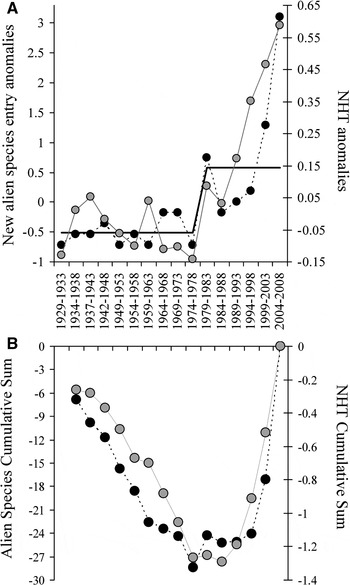
In order to examine if global warming has influenced the arrival of new alien species rate, the NHT against the local alien species data is plotted (Figure 5A). The 80 years (1929–2008) period showed that the alien species sampled from the south-eastern Aegean Sea parallels the warming trend of the northern hemisphere (r = 0.858, P = 0.001). The 5-years mean of both datasets are shown, as this was found to be the best compromise between over-averaging and gaps in the alien species dataset. The period 1929 until 1980 is a period of a stable neutral trend in both temperature and alien species arrivals. From the 1980s till present a continuous paralleled increase can be observed (Figures 4A & 5A). The rapid change in alien species is confirmed by the regime shift detection algorithm, that shows the rate of new entries changed suddenly and that this abrupt change is statistically significant (RSI: 0.743, P = 0.0394). Finally, the cumulative sum (Figure 5B) confirms that the rapid change in alien species data corresponded with the rapid change in temperature. In the first period (1929–1979) the successive negative anomalies of both datasets produced a decreasing slope, while the second period (1980–present) is characterized clearly by successive positive anomalies that produced an abrupt increasing slope. Correlation coefficients and statistics are not suitable on cumulative sums.
Relationships between new alien species entries and global temperatures (northern hemisphere temperature (NHT)). Shifts in temperature and alien species are revealed by automatic sequential algorithm and cumulative sums method. (A) Long-term 5-years averaged alien species against NHT anomalies (1929–2008). The solid black line represents the statistically significant shift for alien species; (B) cumulative sums between alien species and NHT (•, alien species; •, NHT data).

To conclude, 90 alien species (44.5% of the total recorded from Greece) exist in the Dodecanese (87 of them having warm/tropical origin), proving the importance of the study area as a crossroad for alien species expansion. Satellite remotely sensed data clearly showed that the Dodecanese waters have gone through an important warming of 0.85°C. In addition, the satellite signal shows that the warmth is validated and confirmed by in situ measurements of SST (based on 16 years comparison, from 1985 to 2000; Figure 4c). The significant relationship between the local (Dodecanese) water temperature and the northern hemispheric one proves that this warming signal is not a regional phenomenon, but a part of global warming and climate change trends. Finally, it is shown that the new alien species arrivals parallel the warming trends of the NHT at a significant level. Especially the cumulative sums plot indicates clearly that the decreasing pattern of temperature is followed by the alien species (1929–1978), whereas after the 1980s an abrupt increase can be seen in both datasets. However, a correlation between local temperature (satellite and in situ aquarium one) and new alien species entries was not performed due to the lack of enough annual arrivals of alien species between 1985 (the year that both satellite and in situ data start becoming available) and 2003 (the year that massive introduction started). That is why, the NHT dataset (5-years means) was used for such correlation as it was available since 1929 along with the alien species data.
DISCUSSION
Alien species in the Dodecanese
The global rate of new aquatic invasions, as well as their impacts, has increased in recent years, driving efforts to understand the causes of such a phenomenon. The ever-increasing arrival of non-indigenous marine organisms is evident in the whole Mediterranean Sea, while it is undergoing dramatic changes in its species composition (Zibrowius, Reference Zibrowius1992, Reference Zibrowius and Briand2002). The frequent introduction of alien species is thought to have insidious and even irreversible consequences.
Even though ballast waters, fouling, aquaculture, accidental introduction etc play a significant role, the main pathway of alien species' spreading remains the Suez Canal. Despite impediments such as the canal's length, shallowness, current regime, temperature and salinity differences, hundreds of species of Indo-Pacific origin have traversed the canal and settled in the eastern Mediterranean by its opening, forming thriving populations (Galil & Zenetos, Reference Galil, Zenetos, Leppäkoski, Olenin and Gollasch2002). Concerns on future development of the phenomenon are even increasing, as at the same time the Canal is changing after repeated works leading to its widening and deepening. However, it has to be mentioned that the most important factor for an alien species survival is not how wide the Canal is and how easy it is to find a gateway, but to succeed to survive; thus, the physical regime is the one that may enable a species to survive, adapt and expand. Furthermore, the Canal salinity is decreasing (Galil, Reference Galil2008), while that of the eastern Mediterranean is increasing (Theocharis, Reference Theocharis and Briand2009). Thus, while earlier introductions were limited to euryhaline and littoral species, in the near future it can be foreseen that the last barriers will collapse and deepwater species will enter the eastern Mediterranean. This is confirmed by the recent findings of two deepwater Erythrean molluscs off the Levantine coasts (Galil, Reference Galil, Gollasch, Galil and Cohen2006).
In Greece, in a few years the number of new aliens quickly rose from 128 (Pancucci-Papadopoulou et al., Reference Pancucci-Papadopoulou, Kevrekidis, Corsini-Foka, Simboura, Papathanassiou and Zenetos2005, not all groups considered) to 155 species up to 2007 (Pancucci-Papadopoulou et al., Reference Pancucci-Papadopoulou, Zenetos, Corsini-Foka and Politou2006, available information on all groups considered), while alien species amount to 202 in the latest updates (Zenetos et al., Reference Zenetos, Pancucci-Papadopoulou, Zogaris, Papastergiadou, Vardakas, Aligizaki and Economou2009; ICES/IOC/IMO, 2010), and new records are continually added to the list (Pancucci-Papadopoulou et al., Reference Pancucci-Papadopoulou, Corsini-Foka and Naletaki2010). The marine area under study (Dodecanese Islands) belongs to the ‘Lessepsian Province' (Por, Reference Por1978): it presents a sub-tropical character, suitable for introduction and establishment of thermophilic species. This justifies the presence in the region of a very high percentage of warm/tropical species (87 out of 90, or 96.6%) when compared with the total aliens present in Greek waters (158 out of 202 or 78% according to the last update (ICES/IOC/IMO, 2010)). The geographical distribution of alien species clearly reflects the main hydrographical features in the three major subareas of Hellenic waters (south and north Aegean and Ionian Seas) and shows that with the exception of those brought by shipping, the percentage of alien species in the north Aegean is still rather low (Pancucci-Papadopoulou et al., Reference Pancucci-Papadopoulou, Kevrekidis, Corsini-Foka, Simboura, Papathanassiou and Zenetos2005). This indicates that some natural ‘frontiers’ still exist and may prevent the invasion/establishment of undesirable species, such as colder temperatures (input of Black Sea and intense upwelling).
Underlining the importance of alien species as a source of disturbance, Boudouresque & Verlaque (Reference Boudouresque and Verlaque2002) anticipated the idea that they can be equated to a ‘biological pollution’ and proposed the term ‘biopollution', a concept further widened and defined by Elliot (Reference Elliot2003). Attempting to show the different impact of other sources of pollution versus biopollution, Pancucci-Papadopoulou et al. (Reference Pancucci-Papadopoulou, Simboura and Argyrou2009a) applied the biopollution level (BPL) index proposed by Olenin et al. (Reference Olenin, Minchin and Daunys2007) on data from the two major Greek Gulfs (namely Saronikos and Thermaikos), affected by anthropic pressure and high levels of pollution (ecological quality poor to good and moderate to good respectively) and Rhodes Island (no pollution sources, high ecological quality). Results showed that biopollution was higher in Rhodes, while its values decreased northward.
Furthermore, even though all the major groups of organisms are involved, the increase of alien fish and benthic organisms in the last 30 years is impressive. From 1980 to date, 29 new invertebrates (zooplankton and zoobenthos) and 21 fish species result to have been introduced in the area. More than 300 fish species have been listed along the coasts of the Dodecanese Islands, including 32 aliens (about 10% of the total ichthyofauna diversity) (Corsini-Foka, Reference Corsini-Foka2009, Reference Corsini-Foka, Golani and Appelbaum-Golani2010). Most of them (28) are of Indo-Pacific or Red Sea origin, 3 of Atlantic and 1 is considered as circumtropical. Between 2008 and 2009, 20 experimental boat seining carried out up to 30 m of depth along the coasts of Rhodes (ICES/IOC/IMO, 2010) on sandy–muddy bottoms with Posidonia oceanica (L.) Delile and sandy bottoms, revealed a total of 74 fish species, 10 of which were of Indo-Pacific origin (13.5%), a percentage very close to that referred to by Mavruk & Avsar (Reference Mavruk and Avsar2008) for the eastern Mediterranean. Alien fish accounted for 8% of the total biomass, 3% being Lagocephalus sceleratus (Gmelin, 1788).
Invasive fish dominate in the trawl catches of the Levantine coast, representing 50–90% of the fish biomass (Goren & Galil, Reference Goren and Galil2005), and have gradually assumed economic importance in the south-eastern Mediterranean fishery (Gücü et al., Reference Gücü, Bingel, Avsar and Uysal1994; Torcu & Mater, Reference Torcu and Mater2000; Golani et al., Reference Golani, Orsi-Relini, Massutì, Quignard and Briand2002; Bilecenoglu, Reference Bilecenoglu, Golani and Appelbaum-Golani2010; Golani, Reference Golani, Golani and Appelbaum-Golani2010), while other invaders are considered a ‘nuisance or an economic burden' (Goren & Galil, Reference Goren and Galil2005). The success of fish invasions in the Mediterranean could be attributed to various factors, like ability of adaptation to the new ecosystem, overcoming environmental impediments (temperature, salinity and currents), ability to occupy available and diversified niches, life history strategies and food habits (Golani, Reference Golani1998; Mavruk & Avsar, Reference Mavruk and Avsar2008).
In contradiction to the total of alien invertebrates in Greece, where molluscs are the leading group (Zenetos et al., Reference Zenetos, Pancucci-Papadopoulou, Zogaris, Papastergiadou, Vardakas, Aligizaki and Economou2009), in the study area crustaceans are dominant (44%), followed by molluscs (34%), polychaetes (16%) and echinoderms (6%) (Pancucci-Papadopoulou et al., Reference Pancucci-Papadopoulou, Corsini-Foka and Raitsos2009b). This could be explained by the different vector of introduction. Indeed, the exclusive occurrence of many alien molluscs in or near major harbours (Zenetos et al., Reference Zenetos, Pancucci-Papadopoulou, Zogaris, Papastergiadou, Vardakas, Aligizaki and Economou2009) leads to the assumption that shipping plays a more significant role in their transport in other Greek areas. Moreover, 14 out of 16 alien crustaceans in the Dodecanese are of Indo-Pacific origin (about 86%), which is in good agreement with results reported along the southern Aegean coast of Turkey (Yokes et al., Reference Yokes, Karhan, Okus, Yüksek, Aslan-Yilmaz, Yilmaz, Demirel, Demir and Galil2007).
Alien species and climate warming
Climate warming affects in various ways both terrestrial and aquatic ecosystems, acting in synergy with biological invasions (Occhipinti-Ambrogi, Reference Occhipinti-Ambrogi2007). However, effects seem to be different between the western and eastern Mediterranean. In the western Mediterranean climate warming seems to affect the limits of the biogeographical regions, since movements of native thermophilic populations from the south to the north have been observed (Bianchi & Morri, Reference Bianchi and Morri1994; Morri & Bianchi, Reference Morri, Bianchi, Faranda, Guglielmo and Spezie2001). Increase of jellyfish and consequent decrease of other planktonic species could be attributed to anomalous increases of the seawater temperature (Molinero et al., Reference Molinero, Ibanez, Nival, Buecher and Souissi2005). Establishment of subtropical fish species, such as Thalassoma pavo (Linnaeus, 1758) in the Ligurian Sea (Vacchi et al., Reference Vacchi, Morri, Modena, La Mesa and Bianchi2001), one of the colder areas of the Mediterranean (Béthoux et al., Reference Béthoux, Gentili, Raunet and Tailliez1990; Astraldi et al., Reference Astraldi, Bianchi, Gasparini and Morri1995) and in the northern Adriatic (Dulčić, Reference Dulčić2004), as well as increasing number of thermophilic species in the Adriatic Sea over the last 30 years, where fish and zooplanktonic species previously considered rare became common (Dulčić & Grbec, Reference Dulčić and Grbec2000; Kamburska & Fonda-Umani, Reference Kamburska and Fonda-Umani2006) were correlated to the increase of temperature and to the variations of salinity observed in the area after 1988 (Russo et al., Reference Russo, Rabitti and Bastianini2002).
The majority of aliens in the eastern Mediterranean are tropical species of Indo-Pacific origin that entered through the Suez Canal, whereas aquaculture and shipping are the main means of introduction in the western Mediterranean. To date, the Indo-Pacific biota is mostly confined to the eastern Mediterranean, and it was believed that it would remain east of Sicily (Por, Reference Por1990). However, recent findings of Fistularia commersonii Rüppell, 1838 and molluscs up to the westernmost part of the Mediterranean (Boudouresque, Reference Boudouresque, Sandlund, Schei and Viken1999; Gofas & Zenetos, Reference Gofas and Zenetos2003; Golani et al., 2006 updated Reference Golani, Orsi-Relini, Massutì and Quignard2009; Sarà et al., Reference Sarà, Romano and Mazzola2008) indicate that the spreading of aliens in the whole Mediterranean is ineluctable and strictly correlated to seawater warming. Similarly, the appearance of six fish species in the Adriatic was correlated to the increase of water temperatures (Dulčić & Grbec, Reference Dulčić and Grbec2000; Dulčić & Lipej, Reference Dulčić and Lipej2002).
The main focus of the present study was to show the potential synergism between global and local climate warming and alien species spreading in the easternmost area of the Mediterranean. Our results clearly show that increase in alien species number significantly parallels a substantial warming starting at the beginning of the 1980s and accelerating by the end of the 1990s.
Relations between establishment of marine alien species and rise in SST were suggested already in the 1950s, when the abrupt increase in abundance of alien fish in the Levantine Sea was ascribed to a rise of 1–1.5°C in the Levantine SST during the winter of 1955 (Galil, Reference Galil, Gollasch, Galil and Cohen2006). In the 1960s, Ben Tuvia (Reference Ben Tuvia1966) asserted that the thermophilic aliens require ‘temperatures high enough for the reproductive processes and development of eggs, and minimum winter temperatures above their lethal limits’ to establish populations in the Mediterranean. Por (Reference Por1990) predicted that the distribution of lessepsian immigrants ‘will certainly expand or shrink according to the climatic evolution in the area’ and that ‘immigrants will expand further west if the climate warms up further’. According to Dukes & Mooney (Reference Dukes and Mooney1999), global change could favour the introduction of invasive alien species, so that the impacts of invasions on ecosystems would be exacerbated. Similarly, the significant increase in the number of Indo-Pacific aliens in the eastern Mediterranean has been correlated to a more extensive inflow of the warm-water Asia Minor Current (Galil & Kevrekidis, Reference Galil and Kevrekidis2002; Yokes & Galil, Reference Yokes and Galil2004; Pancucci-Papadopoulou et al., Reference Pancucci-Papadopoulou, Kevrekidis, Corsini-Foka, Simboura, Papathanassiou and Zenetos2005).
In the study area maximum summer temperatures range between tropical values and minimum temperature values exceed lower lethal temperature limits of tropical species (Mavruk & Avsar, Reference Mavruk and Avsar2008). The coldest month of the study area is February, showing an increase in temperature of 0.8°C after the temperature shift at the end of the 1990s. It was shown, that the new alien species entries parallel the northern hemispheric warming trends at a significant level. However, as mentioned before a relationship between local temperatures and alien species arrivals was not reported. Raitsos et al. (Reference Raitsos, Beaugrand, Georgopoulos, Zenetos, Pancucci-Papadopoulou, Theocharis and Papathanassiou2010) reported a clear correlation between local (satellite based) temperature and alien species at an annual base; however they used a much larger area of study and thus greater number of alien species data. In the Dodecanese case, the number of alien species after 1985 was not enough to show such a relationship.
The increasing trend of winter minimum values observed in the last decades (Figure 4C) could provide suitable conditions for the biological functions of tropical organisms. Indeed, the competition for open space on the substrate is heavily influenced by the timing of recruitment, which is highly dependent on temperature. Changes in seasonal temperature patterns may favour the settlement of invasive species, resulting in the prevention of the recruitment of native species (Occhipinti-Ambrogi, Reference Occhipinti-Ambrogi2007).
The salinity of the eastern Mediterranean is increasing, a situation that further enables the settlement of warm/tropical Erythrean species. A sudden increase in salinity was mainly caused by a substantial long-term decrease in precipitation over the entire eastern Mediterranean Sea and an intensification of winds over the Aegean Sea (1988–1993), which resulted in increased evaporation. In addition, the salinity rise in the Aegean Sea was the result of reinforced salt transport from 1987 to 1994 into the Aegean through the eastern Cretan Arc Straits (Theocharis et al., Reference Theocharis, Nittis, Kontoyiannis, Papageorgiou and Balopoulos1999). This effect of atmospheric and oceanographic forcing was also embedded on the long-term trend of salinity increase due to runoff control of major rivers (i.e. the Nile and Black Sea rivers) (Béthoux et al., Reference Béthoux, Gentili, Raunet and Tailliez1990). This hyper-salinity event triggered the well-known and unique transition event named the eastern Mediterranean transient (EMT).
Changes in ecosystem functioning
Tropical alien species entering the eastern Mediterranean after the opening of the Suez Canal have caused severe changes, with fast expanding invaders competing with local species. This can have a major impact on the ecosystem as many sudden changes in faunal community diversity and structure are attributed to this competition. Most studies assume that invaders affect negatively native biota, while a few others contend that aliens in coastal waters seem to play a beneficial role in ecosystem functioning. Some invasions have been reported as increasing the number of species present at the local/regional level (Sax & Gaines, Reference Sax and Gaines2003), or are considered complementary to natives in their patterns of resource use (Olenin & Leppäkoski, Reference Olenin and Leppäkoski1999; Reise et al., Reference Reise, Olenin and Thieltges2006). Beneficial effects on benthic biomass production have also been reported (Armonies & Reise, Reference Armonies and Reise1998; Daunys et al., Reference Daunys, Zemlys, Olenin, Zaiko and Ferrarin2006). The effect of climate change and invasive species have been implicated in the decline and even collapse of several marine ecosystems (Occhipinti-Ambrogi, Reference Occhipinti-Ambrogi2007 and references therein), while the environmental status of the receiving area seems to be a fundamental prerequisite for the colonization success of an alien species (Occhipinti-Ambrogi & Savini, Reference Occhipinti-Ambrogi and Savini2003).
Synergism of stressors, such as climate change, anthropogenic impact and aliens' invasion may have unexpected and irreversible consequences on native communities and economically valuable human activities such as fisheries (Harris & Tyrrell, Reference Harris and Tyrrell2001; Occhipinti-Ambrogi & Savini, Reference Occhipinti-Ambrogi and Savini2003; Occhipinti-Ambrogi, Reference Occhipinti-Ambrogi2007).
Although there is not sufficient documentation to assess the real impact of aliens on native species, due to their very recent and fast expansion, there are many instances of ecosystem changes in the study area. Four invasive species living along the Dodecanese coasts, all of them included in the list of ‘100 worst invasive species’ (Streftaris & Zenetos, Reference Streftaris and Zenetos2006) were chosen as case studies and their potential impact on the ecosystem are presented below.
Fistularia commersonii (Rüppell, 1838): the blue cornetfish, Fistularia commersonii, is considered one of the most successful invasive fish species in the Mediterranean Sea (Streftaris & Zenetos, Reference Streftaris and Zenetos2006). It presented a unique fast expansion not only along the Levantine coasts and up to the Aegean Sea, but also westward, reaching the eastern coasts of the Iberian Peninsula in a few years (Golani et al., 2006 updated Reference Golani, Orsi-Relini, Massutì and Quignard2009) and showing the ability to cross from the east to the west four decreasing winter isotherms (Bianchi, Reference Bianchi2007). It was first recorded in the Mediterranean Sea along the coast of Israel (Golani, Reference Golani2000) and successively along the coasts of Turkey (Bilecenoglu et al., Reference Bilecenoglu, Taskavak and Kunt2002). Since its first appearance in the south-eastern Aegean Sea in 2001 (Corsini et al., Reference Corsini, Kondilatos and Economidis2002), it has successfully invaded sandy–muddy bottoms and Posidonia oceanica meadows around Rhodes Island (Kalogirou et al., Reference Kalogirou, Corsini, Kondilatos and Wennhage2007) up to 50 m depth. Juvenile specimens have been observed in shallow waters on sandy bottom with Cymodocea nodosa (Ucria) Aschers meadows, which may be considered as a nursery ground of the species in the area (M. Corsini, personal observations). Despite the genetic bottleneck determined in its Mediterranean population (Golani et al., Reference Golani, Azzurro, Corsini-Foka, Falautano, Andaloro and Bernardi2007), the species reproduces and grows very rapidly, reaching large sizes. As observed in Corsini-Foka & Economidis (Reference Corsini-Foka and Economidis2007), the low fishing pressure and limited predation leave F. commersonii free to form large populations. It is an active piscivorous species (up to 96% of the stomach content; Kalogirou et al., Reference Kalogirou, Corsini, Kondilatos and Wennhage2007) with various foraging tactics (Takeuchi, Reference Takeuchi2009) and changes in foraging behaviour according to its body size (Kalogirou et al., Reference Kalogirou, Corsini, Kondilatos and Wennhage2007). It is regularly present in Dodecanese fishery activities (boat seining and fishing nets), frequently in noticeable biomass, but discarded as not commercially valued. The blue cornetfish may have serious economic and ecological impacts, since in the south-eastern Aegean waters it feeds mainly on several commercially important small native fish, particularly Spicara smaris (Linnaeus, 1758), Mullus spp. and Boops boops (Linnaeus, 1758), but also on a large number of gobiids and labrids (Kalogirou et al., Reference Kalogirou, Corsini, Kondilatos and Wennhage2007) as also observed in Lebanese waters (Bariche et al., Reference Bariche, Alwan, El-Assi and Zurayk2009).
Strombus (Conomurex) persicus Swainson, 1821: this gastropod, which in a few years became one of the most important components of the epibenthic fauna of the eastern Mediterranean, was first sighted in 1978 (Nicolay & Romagna-Manoja, Reference Nicolay and Romagna-Manoja1983) from south-western Turkey. It rapidly expanded its range to include Israel, Rhodes (Verhecken, Reference Verhecken1984), Cyprus, Lebanon, southern Turkey and the Peloponnese (Greece) (Zenetos et al., 2003 update Reference Zenetos, Russo, Templado and Gofas2005), establishing thriving populations locally invasive on shallow sandy bottoms (up to 20 m deep; Curini-Galletti, Reference Curini-Galletti1988). The study of population dynamics in Turkey (Mutlu & Betil Ergev, Reference Mutlu and Ergev2006) showed that the intra-annual density depended on salinity levels, while inter-annual density was correlated with bottom water temperature. Moreover, specimens showed spring emergences and winter burial and sheltering (disappearance). Studies on the biology of the species along the Syrian coasts showed that it produces as high as 58% of the total community respiration and 75% in total biomass (reaching up to 93%; Kucheruk & Basin, Reference Kucheruk and Basin1999). Larvae are planktotrophic, thus ensuring long-distance dispersal. All Strombus species are herbivorous, feeding on algae. After long-term observations in Turkey, a decrease in the density of the Rhodophycea Jania rubens (Linnaeus) J.V. Lamouroux was related to the potential grazing of the gastropod, as the alga was found in the stomach content of juveniles and subadults of S. persicus (Mutlu, Reference Mutlu2004). Jania rubens normally supports a rich fauna of native species, which could face a decrease in abundance and number of species following the algal decline. In the Dodecanese, S. persicus has been observed in huge numbers on sandy bottoms without vegetation (HCMR, Reference Corsini-Foka and Pancucci Papadopoulou2010), thus it could be argued that adults feed on detritus and plankton. On the other hand, the species is currently exploited by the local fishermen, commercially appreciated in the local market and widely consumed, suggesting a potential commercial source in the future throughout the Mediterranean Sea.
Caulerpa racemosa (Forsskål) C. Agardh var. cylindracea (Sonder) Verlaque, Huisman et Boudouresque (Verlaque et al., Reference Verlaque, Durand, Huisman, Boudouresque and Le Parco2003): first sighted in the Mediterranean in 1991 (Libya; Nizamuddin, Reference Nizamuddin1991), the identity and origin of this alga remained obscure for one decade (Klein & Verlaque, Reference Klein and Verlaque2008). Species belonging to the Caulerpa complex represent an important threat to the biodiversity of benthic coastal systems (Boudouresque & Verlaque, Reference Boudouresque and Verlaque2002) and are considered particularly invasive since they have high vegetative growth, a wide tolerance to stress and are unaffected by nutrient and light limitation (Ceccherelli & Cinelli, Reference Ceccherelli and Cinelli1999; Piazzi & Cinelli, Reference Piazzi and Cinelli1999; Streftaris & Zenetos, Reference Streftaris and Zenetos2006). Rising of seawater temperature seems to be one of the reasons for the success of Caulerpa spp. in the Mediterranean (Raniello et al., Reference Raniello, Lorenti, Brunet and Buia2004; Ruitton et al., Reference Ruitton, Javel, Culioli, Meinesz, Pergent and Verlaque2005). In particular, Caulerpa racemosa var. cylindracea, one of the 9 most invasive species listed in the Mediterranean (Boudouresque & Verlaque, Reference Boudouresque and Verlaque2002), has rapidly and successfully invaded wide areas of the basin, forming permanent populations and strongly interfering with native species (Piazzi et al., Reference Piazzi, Ceccherelli and Cinelli2001, Reference Piazzi, Meinesz, Verlaque, Akcali, Antolic, Argyrou, Balata, Ballesteros, Calvo, Cinelli, Cirik, Cossu, D'Archino, Djellouli, Javel, Lanfranco, Misfud, Pala, Panayotidis, Peirano, Pergent, Petrocelli, Ruitton, Zuljevic and Ceccherelli2005; Ruitton et al., Reference Ruitton, Javel, Culioli, Meinesz, Pergent and Verlaque2005). Caulerpa racemosa is able to overgrow other macroalgal species, reaching virtually 100% cover in invaded areas (Piazzi et al., Reference Piazzi, Ceccherelli and Cinelli2001; Balata et al., Reference Balata, Piazzi and Cinelli2004). This spatial dominance can modify the structure and composition of native ecosystems, leading to habitat homogenization and to a higher abundance of few opportunistic species in invaded areas (Piazzi & Balata, Reference Piazzi and Balata2008). Contrasting results have emerged when the impact on other native seagrasses was investigated, as a positive influence was found on the Zostera noltii Hornemann shoots (Ceccherelli & Campo, Reference Ceccherelli and Campo2002). Similarly, the impact on zoobenthos in Cyprus (Argyrou et al., Reference Argyrou, Demetropoulos and Hadjichristophorou1999) revealed decrease in abundance of gastropods and crustaceans, but increase in abundance of polychaetes, bivalves and echinoderms. Experimental studies (Piazzi et al., Reference Piazzi, Ceccherelli and Cinelli2001; Piazzi & Cinelli, Reference Piazzi and Cinelli2003; Balata et al., Reference Balata, Piazzi and Cinelli2004) have shown that C. racemosa var. cylindracea invasions have a great impact on dead mattes of Posidonia oceanica and rocky bottoms, but no colonization has been observed on dense meadows of P. oceanica (Piazzi & Cinelli, Reference Piazzi and Cinelli1999, Reference Piazzi and Cinelli2003; Ceccherelli et al., Reference Ceccherelli, Piazzi and Cinelli2000; Piazzi et al., Reference Piazzi, Ceccherelli and Cinelli2001, Reference Piazzi, Meinesz, Verlaque, Akcali, Antolic, Argyrou, Balata, Ballesteros, Calvo, Cinelli, Cirik, Cossu, D'Archino, Djellouli, Javel, Lanfranco, Misfud, Pala, Panayotidis, Peirano, Pergent, Petrocelli, Ruitton, Zuljevic and Ceccherelli2005; Ruitton et al., Reference Ruitton, Javel, Culioli, Meinesz, Pergent and Verlaque2005). This would conform to the long established belief that ‘a healthy pristine community represents a natural impediment to bioinvasion’ (Elton Reference Elton1958; Occhipinti-Ambrogi & Savini, Reference Occhipinti-Ambrogi and Savini2003), although C. racemosa is able to settle even in healthy meadows to start their regression (Montefalcone et al., Reference Montefalcone, Albertelli, Morri and Bianchi2010).
It has been recently observed (Casu et al., Reference Casu, Ceccherelli, Sechi, Rumolo and Sarà2008) that C. racemosa detritus was a significant food source for several detritivorous species, but further experimental work will be needed to investigate the possible indirect effects of C. racemosa on the detritivorous species through the accumulation in detritus of secondary metabolites with a potential allelopathic effect (Casu et al., Reference Casu, Ceccherelli, Sechi, Rumolo and Sarà2008). Since its first observation in 1993 (Panayotidis & Montesanto, Reference Panayotidis and Montesanto1994) its expansion along all Greek coasts has been extremely rapid, with a strong invasive behaviour on all kinds of substrata up to a depth of 40 m, in both polluted and unpolluted areas (Panayotidis & Montesanto, Reference Panayotidis, Montesanto, Boudouresque, Gravez, Meinesz and Palluy1998; Tsirika & Haritonidis, Reference Tsirika and Haritonidis2005), often exhibiting high abundances near ports and fishing harbours. In the study area C. racemosa was first observed in 2003 (Salomidi et al., Reference Salomidi, Pancucci-Papadopoulou, Hatiris and Panayotidis2003), but only sporadically until 2009. In July 2009, however, the species was very abundant all along the south-east coasts of Rhodes Island, reaching 30% of the total phytal coverage (HCMR, Reference Corsini-Foka and Pancucci Papadopoulou2010). This fast spreading is alarming, due to the invasive behaviour of the species, and its already mentioned severe impact not only on the native algal and/or macrophytic communities but also on human activities (Schaffelke et al., Reference Schaffelke, Smith and Hewitt2006). Its direct impact on the native biota has not yet been documented, either in the eastern Mediterranean basin (Çinar et al., Reference Çinar, Bilecenoglu, Öztürk, Katagan and Aysel2005) or on the Greek coasts (Tsiamis et al., Reference Tsiamis, Montesanto, Panayotidis, Katsaros and Verlaque2010). Nevertheless, there are several cases where losses of biodiversity and alterations of communities are rather evident, especially in stressed ecosystems as well as in rather deep sandy bottoms (Tsiamis et al., Reference Tsiamis, Montesanto, Panayotidis, Katsaros and Verlaque2010). It is obvious that modifications of the basic ecological characteristics of the native benthic ecosystems result in negative sequences on human activities, such as fisheries and tourism (Klein & Verlaque, Reference Klein and Verlaque2008). Thus, even with contrasting results, changing in structure of ecosystem due to C. racemosa impact is unequivocal and radical alterations of the structure and function of native ecosystems represent a very serious ecological problem for the Mediterranean.
Lagocephalus sceleratus (Gmelin, 1789): only recently first sighted in the Mediterranean Sea (2003; Akyol et al., Reference Akyol, Ünal, Ceyhan and Bilecenoglu2005), the large-sized invasive species Lagocephalus sceleratus, rapidly spread along the Levantine coasts (Bilecenoglu et al., Reference Bilecenoglu, Kaya and Akalin2006) and the south Aegean, especially the Dodecanese Islands (Corsini et al., Reference Corsini, Margies, Kondilatos and Economidis2006), invading in just a few years sandy, sandy–muddy and rocky bottoms all around the Aegean, mainly after a population explosion observed in 2007 (Corsini-Foka & Economidis, Reference Corsini-Foka and Economidis2007; Peristeraki, Reference Peristeraki2007; Corsini-Foka, Reference Corsini-Foka, Golani and Appelbaum-Golani2010). The counter-clockwise circulation in the Levantine basin (Ben Rais Lasram et al., Reference Ben Rais Lasram, Tomasini, Guilhaumon, Romdhane, Do Chi and Mouillot2008), the evolution of the EMT (Theocharis et al., Reference Theocharis, Klein, Nittis and Roether2002) and the increase of the Aegean seawater temperature (Raitsos et al., Reference Raitsos, Beaugrand, Georgopoulos, Zenetos, Pancucci-Papadopoulou, Theocharis and Papathanassiou2010) could have contributed to the enhancement of the introduction, establishment and quick propagation of L. sceleratus, favouring the dispersion of its pelagic eggs and larvae (Golani et al., 2006 updated Reference Golani, Orsi-Relini, Massutì and Quignard2009). As underlined by Corsini-Foka (Reference Corsini-Foka, Golani and Appelbaum-Golani2010), the silverstripe blaasop showed an exceptional ability to occupy all the Aegean coastal waters between the isotherm of 16.25°C and 15°C and to enter also the region limited by the isotherm of 14°C (Bianchi, Reference Bianchi2007). The population explosion of the species during summer 2007 may be associated with the anomalous high temperature events observed in that period throughout Greece and the consequent production of unusual deeper warm water conditions, similarly to those observed for Rhodes Island (Corsini-Foka, Reference Corsini-Foka, Golani and Appelbaum-Golani2010). Migration to deeper and warmer waters may also be considered for the possible establishment of immigrants in various Mediterranean areas, as assessed by Mavruk & Avsar (Reference Mavruk and Avsar2008). Furthermore, its feeding strategy (Corsini-Foka et al., Reference Corsini-Foka, Margies, Kondilatos and Economidis2010), its anti-predator adaptations, such as inflation of the body and toxicity (Golani et al., Reference Golani, Orsi-Relini, Massutì and Quignard2006 updated Reference Golani, Orsi-Relini, Massutì and Quignard2009), the absence of confamilial and interspecific competitors and predators in the invaded coastal habitats and food availability (Corsini-Foka, Reference Corsini-Foka, Golani and Appelbaum-Golani2010), probable high fecundity and high survival of eggs (due to toxicity and unpalatability) have to be considered as factors contributing to the successful invasion and abundance of the silverstripe blaasop in the area. Following the current European legislative requirements (EU Regulation 853/2004/EC, 2004a; EU Regulation 854/2004/EC, 2004b), the species has been declared as not marketable by Greek authorities, because it may be a source of food poisoning (Bentur et al., Reference Bentur, Ashkar, Lurie, Levy, Azzam, Litmanovich, Golik, Gurevych, Golani and Eisenman2008; Eisenman et al., Reference Eisenman, Rusetski, Sharivker, Yona and Golani2008) due to the high content of tetrodotoxin (TTX) in its tissues, in particular gonads and liver (Bentur et al., Reference Bentur, Ashkar, Lurie, Levy, Azzam, Litmanovich, Golik, Gurevych, Golani and Eisenman2008; Katikou et al., Reference Katikou, Georgantelis, Sinouris, Petsi and Fotaras2009).
Besides the serious danger for public health, an impact on biodiversity can also be foreseen, as the species has occupied all shallow coastal waters of the area. From an ecological point of view, a rearrangement of the food chain is to be expected, due to the large consumption of native invertebrates (mainly cephalopods and crustaceans) and fish. Being the species regularly present in coastal fishery of the studied area, a negative socio-economic impact of L. sceleratus is also evident: (1) a large number of hauls are not productive in their whole since a large quantity of the biomass is represented by L. sceleratus and has to be discarded, with consequent loss of working hours, fuels, etc; and (2) native commercially important stocks of invertebrates (mainly cuttlefish and octopus) are subjected to intense predation, thus a loss in resources is day by day evident, resulting in higher market prices.
CONCLUSIONS
The study area of the south-eastern Aegean (Dodecanese Islands) is a crossroad for alien species between the eastern and western Mediterranean Sea. The introduction and establishment rate of alien species in the south-eastern Mediterranean is rapidly expanding. In this study it is clearly shown, that the Dodecanese waters are subject to intense warming, particularly after the temperature shift in 1998; this was confirmed by both in situ and satellite datasets. This warming appeared to be part of global trends rather than a regional phenomenon. Analysis of data since 1929 revealed that new alien species arrivals paralleled significantly the temperatures of the northern hemisphere. Persistence of the warming trend may provide the thermophilic aliens with a distinct advantage over the native Mediterranean biota. Thus, if the present characteristics of the south Aegean hydrography persist, a strong modification of the composition and structure of the local biota is ineluctable. The gradual tropicalization of the Mediterranean and the higher resistance to natural changes of tropical compared to native species, together with the fast rate of entrance during the last decades, lead us to believe that alien tropical species, now mostly affecting the eastern basin, will gradually colonize the rest of the Mediterranean.
ACKNOWLEDGEMENTS
We wish to thank the Dodecanese Prefecture Authority for partially funding this research. Moreover, we are grateful to all colleagues of the Hellenic Centre for Marine Research who actively contributed in carrying out the project. Also, we are especially indebted to Professor M. Karydis and Dr A. Sioulas for providing substantial contributions and support.