INTRODUCTION
Chagas' disease is caused by the protozoan parasite Trypanosoma cruzi and is a major health problem in Latin America, where an estimated 11 million people are infected and an additional 35 million are at risk of infection (Dias et al. Reference Dias, Silveira and Schofield2002). Although the T. cruzi vector reduction has been successful in some areas of Latin America, effective control measures are lacking in most regions of endemicity (Dias, Reference Dias2007). During the acute phase of Chagas' disease, the parasite has the ability to infect a wide variety of tissues including organs from the gastrointestinal tract, heart and central nervous system. In addition, previous data demonstrated that, in the chronic phase, the parasite is still present in the infected tissues (Jones et al. Reference Jones, Colley, Tostes, Lopes, Vnencak-Jones and Mccurley1993; Vago et al. Reference Vago, Macedo, Adad, Reis and Correa-Oliveira1996; da Silveira et al. Reference Da Silveira, Arantes, Vago, Lemos, Adad, Correa-Oliveira and D'avila Reis2005). Since early reports of digestive tract alterations in chagasic patients, megacolon and megaesophagus have been described as the main lesions (Koberle, Reference Koberle1968; Adad et al. Reference Adad, Andrade, Lopes and Chapadeiro1991, Reference Adad, Cancado, Etchebehere, Teixeira, Gomes, Chapadeiro and Lopes2001). In these organs, the majority of nerve cell bodies are confined to the neuronal ganglia of submucosal and myenteric plexuses and constitute the intrinsic component of the ENS (Furness and Costa, Reference Furness and Costa1980). Chagasic megacolon conducts the patient to a morbidity condition once that the region of rectum-sigmoid dilates more than any part of the bowel and is usually affected by complications such as faecal impaction and sigmoid volvulus (Koberle, Reference Koberle1968; Oliveira et al. Reference Oliveira, Lette, Ostermayer, Almeida and Moreira1997). The lesions caused by T. cruzi result in a reduction in the number of enteric neurons, which may lead to organ denervation and dilatation (Koberle, Reference Koberle1968; Tafuri, Reference Tafuri1970, Reference Tafuri1971; Adad et al. Reference Adad, Cancado, Etchebehere, Teixeira, Gomes, Chapadeiro and Lopes2001).
Actually, regeneration process studies have been used to elucidate some aspects of the pathologies involved in the denervation process (Anderson et al. Reference Anderson, Merhege, Morin, Bolognani and Perrone-Bizzozero2003; McPhail et al. Reference McPhail, Fernandes, Chan, Vanderluit and Tetzlaff2004; Yamada et al. Reference Yamada, Terayama, Bando, Kasai and Yoshida2006). GAP-43 is an integral membrane protein, commonly used as a marker of differentiating neurons. It is expressed at elevated levels by developing or regenerating neurons (Skene et al. Reference Skene, Jacobson, Snipes, Mcguire, Norden and Freeman1986; Basi et al. Reference Basi, Jacobson, Virag, Schilling and Skene1987). GAP-43 is present in the enteric neurons and nerve fibres even in the mature human intestine. The expression of this protein in the mature intestine fits with the idea of plasticity of the ENS and indicates the special nature of enteric neurons (Vento and Soinila, Reference Vento and Soinila1999). The exact mechanism of the neural damage is not clearly understood. Furthermore, the pathophysiological mechanism by which the neuronal destruction causes visceral dilation has been the subject of much discussion. Since the main characteristic of chagasic megacolon is neuronal destruction, our hypothesis is that GAP-43 expression in the ENS neurons may be involved in the megacolon installation. Additionally, we evaluated both affected and non-affected areas of the colon from chagasic patients with megacolon with the objective of investigating whether the alterations that occur in the chagasic megacolon are restricted to the dilated area or whether they involve the whole organ.
In this study we demonstrated the immunoreactivity in cell bodies investigating the relation between the neuronal regeneration marker GAP-43 and specific neuronal marker HuC/HuD in the nervous plexuses. HuC/HuD is a pan-neuronal marker employed in neuronal body detection and several in vivo and in vitro experiments indicate an important role of neuron-specific Hu proteins in neuronal differentiation (Wakamatsu and Weston, Reference Wakamatsu and Weston1997; Anderson et al. Reference Anderson, Sengupta, Morin, Neve, Valenzuela and Perrone-Bizzozero2001). We believe that this study would then allow more detailed assessment of changes in the neuronal plasticity of ENS in chagasic megacolon development that can contribute to the understanding of the chagasic megacolon pathology.
MATERIALS AND METHODS
Patients and tissue collection
Colon tissue samples were collected from 18 patients. These patients were classified in 2 groups: non-infected individuals (n=6) and chagasic patients with megacolon (n=12). Samples from patients with megacolon had a non-dilated portion and a dilated portion. These portions were randomly found in the colon and were very similar between patients. For that reason, we analysed them, classifying chagasic patients with megacolon into 2 groups: non-dilated portion and dilated portion from chagasic patients with megacolon. Reasons for tissue resection were colon complications caused by Chagas' disease or colon carcinoma in non-infected individuals. All tissues were collected with the patient's consent, and the collection and use were approved by the Human Ethics Committee of the Universidade Federal de Minas Gerais (ETIC no 127/03).
Colon samples were collected in phosphate-buffered saline (PBS). These were fixed overnight at 4°C in 2% formaldehyde plus 0·2% picric acid in 0·1 m sodium phosphate buffer (pH 7·0). The next day, tissue was cleared of fixative with dimethylsulfoxide (DMSO) with up to 6×10 min washes followed by 3×10 min washes in PBS. The tissues were then placed in PBS-sucrose-azide (PBS containing 0·1% sodium azide and 30% sucrose as a cryoprotectant) and stored at 4°C. The following day, small segments of tissue were transferred to a mixture of PBS-sucrose-azide and OCT compound (Tissue Tek, Elkhart, IN, USA) in a ratio of 1:1 for a further 24 h before being embedded in 100% OCT. Sections of 12 μm thickness were cut and collected on microscope slides and left to dry for 1 h at room temperature.
Immunohistochemical investigation
Double-staining immunohistochemistry was conducted combining the HuC/HuD antibody (pan-neuronal marker) (1:2000, DAKO, CA, USA) with GAP-43 antibody (neuronal regeneration marker) (1:1000, Molecular Probes, OR, USA) in the nervous plexuses (submucosal and myenteric plexuses). Sections were first incubated in 10% normal horse serum (NHS) plus 1% Triton X-100 for 30 min. Incubation with primary antibodies was carried out for 24 h at 4°C with diluted antiserum containing 10% NHS. Double-labelling was achieved using a combination of HuC/HuD and neuronal active peptides or neuronal marker antibodies. Following incubation in primary antiserum, preparations were rinsed in PBS (3×10 min) and then incubated for 1 h at room temperature with secondary antibodies (1:400, Alexa 594 nm, Mobitec, Germany) (1:1000, Alexa 647 nm, Mobitec, Germany). Further 3×10 min washes in PBS were made before tissue was mounted in DAKO fluorescence mounting medium (DAKO, California, USA). Negative controls were performed on slides without the primary antibody.
Nervous plexus quantification procedures
Anti-HuC/HuD was used to determine the total number of neuronal cell bodies in the nervous plexuses of the human colon. In each tissue sample, double-stained sections for HuC/HuD and GAP-43 were performed. Sections through ganglia were selected randomly, in a meander-like fashion, until a total of 10 neuronal ganglia were analysed in each ganglionated plexus (submucosal and myenteric plexuses). Single optical section images on the same focus plane were created in the ganglia by applying 2 different excitation wave-lengths. The filter settings were 594 nm excitation and 647 nm. A 40X oil immersion objective lens (numerical aperture 1·3) was used, the zoom factor was set to 1·0 in all scanning sessions. Preparations were analysed using a Bio-Rad MRC1024 confocal scanning laser imaging system microscope (Bio-Rad, CA, US). Images were processed using CorelDraw (Corel Corporation, Dublin, Ireland) and Corel Photo-Paint software (Corel Corporation). For counting of reactive neurons, HuC/HuD and GAP-43 markers, the pictures were merged. Stained neurons were outlined with 2 different marker pens. Thereafter, all neurons on the sheet marked with 1 or 2 colours were counted.
Statistics
Statistical analysis among the different groups was performed by one-way ANOVA. Differences were considered statistically significant at P<0·05.
RESULTS
Quantification of immunoreactive neurons in nervous plexuses of the colon
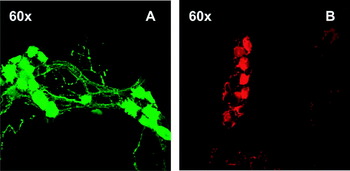
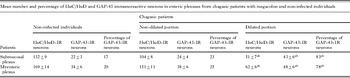
With the HuC/HuD antibody, the architectures of the neuronal plexuses were clearly visible in the sections (Fig. 1). The neuronal count analyses demonstrated that there were no statistical differences between the number of HuC/HuD-IR neuronal bodies in non-infected individuals and in the non-dilated portion from chagasic patients with megacolon. However, the dilated portion from chagasic patients with megacolon presented a decreased number of neuronal bodies when compared with the 2 others groups. Other statistical differences were not observed. Details of the neuronal cell counts are shown in Table 1.
Demonstration of the architecture of the neuronal plexuses in the colon from chagasic patients with megacolon by the use of HuC/HuD antibody. Individual neuronal bodies and neuronal ganglia are easily observed in the myenteric plexus (A) and in the submucosal plexus (B).

Mean number, standard derivation and percentage of HuC/HuD and GAP-43 immunoreactive neurons in the enteric plexuses from chagasic patients with megacolon and non-infected individuals

a Statistically significant differences observed between this group and non-infected individuals.
b Statistically significant differences observed between this group and non-dilated portion from chagasic patients with megacolon (P<0·05).
Evaluation of GAP-43 in the enteric plexuses of the colon
We analysed the proportional number of neurons in both submucosal and myenteric plexuses that express GAP-43 in the colon from chagasic patients with megacolon and non-infected individuals. In the submucosal plexus, the statistical analyses demonstrated only a small number of neurons expressing GAP-43 in non-infected individuals as in the non-dilated portions from chagasic patients with megacolon. However, in the dilated portion from chagasic patients with megacolon, we observed an increased number of neurons that express the neuronal regenerate protein GAP-43.
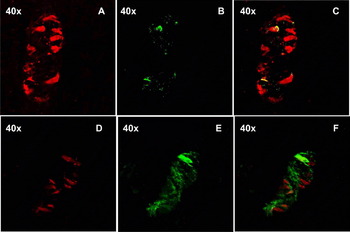
In the same way, the statistical analyses of the myenteric plexus of the colon from non-infected individuals and non-dilated portion from chagasic patients with megacolon demonstrated just a small number of neurons expressing GAP-43. On the other hand, the statistical data showed that neurons in the dilated portion from chagasic patients with megacolon presented a high density of GAP-43 (Fig. 2). Details of the GAP-43 analyses in the enteric plexuses are shown in Table 1.
Exhibition of the neuronal ganglia double-labelled with HuC/HuD (red) and GAP-43 (green) in a non-infected individual (A, B and C) and in the dilated portion of a chagasic patient with megacolon (D, E and F). The non-infected individual presents more neuronal bodies (A) when compared with the chagasic patient (D). However, non-infected individuals show a decreased expression of GAP-43 (B) in relation to the chagasic patient with megacolon (E). Merged pictures demonstrate the neuronal plasticity in the ganglia (C and F).

DISCUSSION
This is the first study to evaluate the neuronal plasticity of the ENS in the colon of chagasic patients by the expression of GAP-43. This protein is the best neuronal plasticity marker available to human gut nerves (Vento and Soinila, Reference Vento and Soinila1999). Our group believe that evaluation of neuronal regeneration is imperative because not only the neuronal destruction, as previously demonstrated (Adad et al. Reference Adad, Cancado, Etchebehere, Teixeira, Gomes, Chapadeiro and Lopes2001), but also neuronal plasticity from the ENS, will influence megacolon development. The results of this work indicated that the dilated portion of the colon from chagasic patients with megacolon presented an improved neuronal regeneration in both nervous plexuses when compared with the non-dilated portion of chagasic patients with megacolon and non-infected individuals. It is reasonable to hypothesize that the increased expression of GAP-43 by the neurons in the dilated portion may have as one of its causes the intense neuronal loss that occurs in this region. As neurons cannot replicate, they probably will augment their fibre regeneration and extend their processes to affected areas in an attempt to maintain the physiological function of the organ. Thus, neurons will expand their neurites and neuronal fibres to embrace the area where the destroyed neurons operated. Through this hypothesis, we presume that the increased neuronal plasticity by the ENS neurons is responsible for delayed development of chagasic megacolon.
The literature has previously described that patients with chagasic megacolon present intense inflammation in the colon even during the chronic phase (Adad, Reference Adad, Cancado, Etchebehere, Teixeira, Gomes, Chapadeiro and Lopes2001; Corbett et al. Reference Corbett, Ribeiro, Prianti, Habr-Gama, Okumura and Gama-Rodrigues2001; da Silveira et al.Reference Da Silveira, D'avila Reis, De Oliveira, Neto, Luquetti, Poole, Correa-Oliveira and Furness2007a, Reference Da Silveira, Lemos, Adad, Correa-Oliveira, Furness and D'avila Reisb). Previous studies demonstrated that the dilated portion from chagasic patients with megacolon presented a high degree of inflammation and neuronal alterations compared with the non-dilated portion of the same patients (da Silveira et al. Reference Da Silveira, D'avila Reis, De Oliveira, Neto, Luquetti, Poole, Correa-Oliveira and Furness2007a, Reference Da Silveira, Freitas, De Oliveira, Neto, Luquetti, Furness, Correa-Oliveira and D'avila Reis2008). The inflammatory process is followed by secretion of cytokines from the immune cells, glial cells and muscle cells (Theodorou et al. Reference Theodorou, Fioramonti and Bueno1996; Reinshagen et al. Reference Reinshagen, Von Boyen, Adler and Steinkamp2002). Some of these cytokines are neurotrophins like NGF and GDNF that act directly in neurons that, with the neuronal destruction stimulus, may contribute to the increase in neuronal regeneration intensity (von Boyen et al. Reference Von Boyen, Steinkamp, Reinshagen, Schafer, Adler and Kirsch2006).
In this work, we also investigated whether megacolon alterations occur only in the dilated area or if these alterations affect all the organ, even the non-dilated area. Our findings indicate that megacolon alteration, like denervation, occurs just in the dilated portion of the colon while the non-dilated portion of the organ remains unaltered. It is accepted that T. cruzi is responsible for the onset of the denervation process (Koberle, Reference Koberle1968). The organ dilatation usually occurs in the rectum-sigmoid portion and the T. cruzi kDNA is found just in this portion when the whole organ from chagasic patients is analysed (Dr A. L. Ferreira Aguiar, personal communication). Consequently, we believe that the parasite has some kind of trophism in the rectum-sigmoid portion, that would contribute to organ dilatation or even contribute to stimulate the neuronal regeneration process.
The parasite presence may, partially, explain the inflammatory process and the neuronal destruction. We believe that this would defend the hypothesis that the neuronal regeneration process arises intensely in this region. The results of our work can explain some questions, but at the same time raises others. There is a great diversity of neurons in the human ENS and this fact raises the query of whether the increased expression of the neuronal plasticity marker GAP-43 occurs in all neuronal classes or if there are some responsible subpopulations in this augmented neuronal plasticity in the affected region of the colon. Our previous studies demonstrated that there is selective neuronal destruction in the neuronal plexuses of the dilated portion from chagasic patients with megacolon (da Silveira et al. Reference Da Silveira, D'avila Reis, De Oliveira, Neto, Luquetti, Poole, Correa-Oliveira and Furness2007a). Now it is really important to clarify whether all neuronal types have the same regeneration capacity, and whether chagasic patients without megacolon present with an increased expression of GAP-43. We consider that this work not only answered some old questions, but also opened up a big research area in the field of chagasic mega syndromes. We believe that further studies designed to evaluate neuronal regeneration in different developmental stages of megacolon will be able to elucidate these and further questions.
This work was supported by funds from CNPq (Conselho Nacional de Desenvolvimento Científico e Tecnológico) Ministério da Ciência e Tecnologia, Brazil.