INTRODUCTION
It is generally acknowledged that incidental learning, or the “picking up” (Hulstijn, Reference Hulstijn and Robinson2001, p. 349) of new words while performing a meaning-focused task, is an essential component of second language (L2) vocabulary development (Webb & Nation, Reference Webb and Nation2017). Even though research has shown that more explicit approaches to learning vocabulary lead to more sizeable gains (e.g., Laufer, Reference Laufer, Foster-Cohen, Garcia-Mayo and Cenoz2005), it can, by itself, not account for the enormous amount of words that learners need to acquire to adequately use or understand the L2. From corpus research, we know that learners need to know on average 3,000 to 4,000 word families to adequately understand TV programs (Webb & Rodgers, Reference Webb and Rodgers2009) and up to 8,000 word families to understand written input (Nation, Reference Nation2006). Therefore, providing learners with opportunities for incidental learning seems crucial to foster L2 learners’ lexical development.
Previous studies have mainly looked at reading as a source of input for incidental vocabulary learning (e.g., Pellicer-Sánchez, Reference Pellicer-Sánchez2016; Rott, Reference Rott1999). In their analyses of previous research, Laufer and Rozovski-Roitblat (Reference Laufer and Rozovski-Roitblat2015) reported low to modest gains of one to seven words picked up incidentally while reading. These gains include the learning of different aspects of word knowledge such as receptive or productive knowledge of form and meaning. Other studies have looked into the role of assisted reading, that is, reading while listening (e.g., Webb & Chang, Reference Webb and Chang2015) and reported greater incidental gains in the assisted reading groups than in reading only groups.
Recently, studies have started to explore the role of viewing audio-visual input as a way to expand vocabulary knowledge incidentally. This source of input can be considered a very important one given its overall availability and accessibility (Webb, 2015). There is growing evidence that viewing full-length TV episodes (Peters & Webb, Reference Peters and Webb2018; Rodgers & Webb, Reference Rodgers and Webb2019) but also short-length video clips (Montero Perez, Peters, Clarebout, & Desmet, 2014; Sydorenko, Reference Sydorenko2010; Winke, Gass, & Sydorenko, Reference Winke, Gass and Sydorenko2010) results in beginning stages of word learning. However, little is known about the role of individual differences in the acquisition of new words from audio-visual input. Given the importance of incidental learning for L2 learners’ vocabulary development, it is key to understand how individual differences may impact this type of learning. Therefore, the present study explores the impact of a documentary on incidental vocabulary learning and investigates to what extent incidental learning is influenced by participants’ vocabulary knowledge as well as their working memory.
This study also presents a number of methodological innovations: First, it is based on individual testing sessions in which both interview data, paper-and-pencil tests, and lexical decision data were collected to tap into different aspects of word knowledge. Tests at different levels of sensitivity are crucial because learning gains after incidental exposure may be low and several types of tests are needed to detect partial learning (Nation & Webb, Reference Nation and Webb2011). Second, the video used in this study was manipulated to include pseudowords. Using pseudowords enables us to control for learners’ prior knowledge and to avoid testing effects from pretest to posttest.
LITERATURE REVIEW
VOCABULARY LEARNING FROM VIEWING VIDEO
There is evidence that vocabulary can be learned from exposure to TV or video. The majority of studies have, however, not focused on the potential of viewing as such but rather on how gains from audio-visual input can be boosted by adding different types of subtitling in the L1 or L2 (e.g., Montero Perez et al., 2014; Peters, Heynen, & Puimège, Reference Peters, Heynen and Puimège2016; Winke et al., Reference Winke, Gass and Sydorenko2010). Two exceptions are the studies of Peters and Webb (Reference Peters and Webb2018) and Rodgers and Webb (Reference Rodgers and Webb2019). Rodgers and Webb (Reference Rodgers and Webb2019) investigated incidental vocabulary learning after viewing 10 episodes of a TV series (7 h in total). They reported learning gains of approximately six words from pretest to posttest after viewing a TV series. Yet, they argued that results might underestimate the actual learning gains because the majority of the participants had not yet mastered the 2K words and posttests only included words of frequency bands higher than 3K.
Peters and Webb (Reference Peters and Webb2018) conducted two experiments on the effect of viewing a full-length, 1-hour documentary on incidental vocabulary learning. To measure word learning at different levels of sensitivity, they conducted two experiments in a pretest-posttest design. The first experiment measured participants’ form recognition and meaning recall (i.e., ability to provide the meaning for the L2 word). The second experiment focused on meaning recognition, that is, choosing the correct meaning among four options. Results of both experiments revealed the learning of approximately four words after viewing a full-length TV episode. In addition, their study revealed that learners’ prior vocabulary knowledge, the frequency of occurrence of the target words (TWs) in the video as well as cognateness positively influence incidental learning from viewing. Findings of the aforementioned studies are in line with results of studies on short-length clips and the role of captions (e.g., Montero Perez et al., 2014; Sydorenko, Reference Sydorenko2010; Winke et al., 2010). These studies reported small but detectable incidental learning between pretest and posttest for learners who watched the video without captions.
Together, results suggest that incidental learning takes place from audio-visual input. Yet, previous research also revealed a number of issues in measuring learning gains from audio-visual input that can, to some extent, be linked to the use of real TWs. Even though real TWs increase the ecological validity of the study, they also require tests to control for prior knowledge and affect the type of posttest measures that can be used to estimate learning. In addition, by using real words, we cannot avoid testing effects from pretest to posttest. In Peters and Webb (Reference Peters and Webb2018), for instance, the immediate form recognition data were considered invalid due to testing effects. That is why studies on incidental learning from reading have often used pseudowords (e.g., Pellicer-Sánchez, Reference Pellicer-Sánchez2016) to rule out prior knowledge effects.
Another concern is that studies on audio-visual input are exclusively based on the use of explicit tests of form and meaning. We did not find studies that have used other types of measurements such as, for instance, lexical decision data or interviews to reveal partial knowledge. A study in which the preceding parameters are taken into account could further refine our understanding of incidental learning from viewing video.
VOCABULARY KNOWLEDGE
There is a growing body of studies on the role of prior vocabulary knowledge for different aspects of L2 proficiency. Studies have shown that we need sufficient vocabulary knowledge to successfully cope with the vocabulary demands of written and spoken input. To adequately understand TV series, we would need 3,000 to 4,000 word families (e.g., Webb & Rodgers, Reference Webb and Rodgers2009). Knowledge of 2,000 to 3,000 word families would be needed to cope with the demands of informal narratives (van Zeeland & Schmitt, Reference van Zeeland and Schmitt2012) and figures of 4,000 to 8,000 word families have been put forward for understanding written text (Nation, Reference Nation2006).
To estimate L2 learners’ vocabulary knowledge, different types of tests are available (for an overview, see for instance, https://www.lextutor.ca/tests/). What these tests have in common is that they are based on frequency lists and include a selection of items per frequency band (e.g., the 1,000 to 2,000 most frequent words). Results are used to give an indication of the amount of words for which participants demonstrate some knowledge, such as recognizing the correct definition of a word among different options, that is, receptive vocabulary knowledge.
Previous research has suggested that participants’ scores on such vocabulary knowledge tests are linked to overall language proficiency (Milton, Wade, & Hopkins, Reference Milton, Wade, Hopkins, Chacón-Beltrán, Abello-Contesse and Torreblanca-López2010). Vocabulary knowledge also plays an important role in comprehending written (e.g., Laufer & Aviad-Levitzky, Reference Laufer and Aviad-Levitzky2017) and spoken input (e.g., Staehr, Reference Staehr2009). Staehr (Reference Staehr2009) found that advanced-level participants’ vocabulary knowledge correlated significantly with their scores on a standardized listening test. This indicates that participants with more vocabulary knowledge are more likely to understand the listening input than participants with a smaller vocabulary size. This finding is consistent with a more recent study of Matthews (Reference Matthews2018) who used an aural vocabulary knowledge test to study the relationship between vocabulary and listening comprehension. As in Staehr’s study, vocabulary knowledge was found to explain approximately half of the variance in the listening scores.
Even though vocabulary knowledge is frequently measured to take into account learner differences, few studies have investigated whether more vocabulary knowledge also leads to more sizeable vocabulary gains after incidental exposure. Given the importance of vocabulary knowledge for adequate listening and reading comprehension, it might also impact learning while listening or reading. In their study on incidental vocabulary learning through reading, Horst, Cobb, and Meara (Reference Horst, Cobb and Meara1998) reported a positive, albeit weak, relationship between learners’ vocabulary knowledge and vocabulary gains. Webb and Chang (Reference Webb and Chang2015) found that participants with more prior vocabulary knowledge also had larger vocabulary gains through reading-while-listening. Several studies on the effectiveness of captions or L1 subtitles have reported positive relations between learners’ receptive vocabulary knowledge and the amount of words learned through viewing video (e.g., Montero Perez, Peters, & Desmet, 2018; Peters et al., Reference Peters, Heynen and Puimège2016). Peters and Webb (Reference Peters and Webb2018) also found a positive relation between word learning from viewing and prior vocabulary knowledge. Rodgers (Reference Rodgers2013), however, did not find a significant relation between vocabulary knowledge and word learning while viewing a TV series. More research seems therefore warranted to clarify the role of vocabulary knowledge in picking up new words while viewing video.
WORKING MEMORY
A substantial number of studies have investigated variables that may account for differential success in L2 learning (see Robinson, Reference Robinson2001). One of those variables is working memory, which can be broadly defined as “our ability to briefly maintain and also operate on a limited amount of information in our mind while completing some mentally demanding tasks” (Wen, Borges Mota, & McNeill, Reference Wen, Borges Mota and McNeill2015). In this respect, the multicomponential model put forward by Baddeley and Hitch (Reference Baddeley, Hitch and Bower1974) can be considered one of the most influential frameworks. Their initial model consisted of three components: (a) the central executive, which regulates attention; (b) the phonological loop, which is responsible for the storage and manipulation of speech; and (c) the visuo-spatial sketchpad, which holds visual and spatial information. Later, a fourth component was added, namely the episodic buffer (Baddeley, Reference Baddeley2000), which stores and integrates visual, spatial, and verbal information and connects information with long-term memory.
The most frequently studied components of working memory in SLA research are the phonological short-term memory (PSTM) and the central executive, both of which are limited in capacity. PSTM as well as the central executive have been found to correlate with, for instance, greater listening performance (Brunfaut & Révész, Reference Brunfaut and Révész2015), the noticing of recasts during L2 interaction (Mackey & Sachs, Reference Mackey and Sachs2012), and L2 fluency development (O’Brien, Segalowitz, Freed, & Collentine, 2007). PSTM is typically assessed by means of forward digit-span or nonword span tasks that measure learners’ ability to recall, respectively, increasing series of numbers or words for a brief period. The central executive is typically assessed by means of complex tasks that do not only require storage but also manipulation of the stored information. Commonly used verbal complex working memory measures are the reading or listening span tasks (Daneman & Carpenter, Reference Daneman and Carpenter1980) in which learners are asked to recall the last words of increasingly longer series of words or sentences. A nonverbal task is the operation-span task (Turner & Engle, Reference Turner and Engle1989), which requires learners to judge if simple equations are correct and to recall the words that appear after the equation (see Materials section).
The role of working memory under incidental second language learning conditions has been addressed in a limited number of studies, but these have all focused on the learning of grammar regularities of artificial or semiartificial languages. Tagarelli, Borges Mota, and Rebuschat (2015), for instance, studied the role of working memory in an incidental and intentional learning condition in which learners were confronted with input in a semiartificial language. Findings of their study suggest that working memory may influence learning in the intentional condition but only for grammatical items in the grammatical judgment task. No significant relationship was found in the incidental group. Other studies did report significant correlations between working memory and incidental learning. Sanz, Lin, Lado, Stafford, and Bowden (Reference Sanz, Lin, Lado, Stafford and Bowden2014) compared the role of working memory in two conditions, which differ in the presence or absence of a grammar lesson before being exposed to input-based practice and explicit feedback. They found that working memory was predictive of learning gains when no explicit instruction was provided before meaning-focused input. Interestingly, the role of working memory appeared at the level of the delayed written interpretation test. These studies tend to suggest that working memory may play a role in incidental grammar learning. Yet, we are not aware of studies that have investigated the role of working memory for incidental vocabulary learning.
There is, however, evidence that working memory is linked to explicit L2 vocabulary learning. PSTM has been shown to correlate with beginning learners’ acquisition of new words in contexts in which learners were intentionally trying to commit new words to memory (e.g., Cheung, Reference Cheung1996; Papagno & Vallar, Reference Papagno and Vallar1992; Speciale, Ellis, & Bywater, Reference Speciale, Ellis and Bywater2004). Kormos and Sáfár (Reference Kormos and Sáfár2008) found that PSTM, which was measured by means of a nonword span task, did not correlate with the components of a proficiency test (i.e., reading, writing, speaking, listening, and use of language) for beginning learners whereas general working memory capacity, as measured by means of a backward digit-span task, did correlate with different parts of L2 proficiency including reading, speaking, and listening but also use of language (vocabulary and grammar). The authors conclude that PSTM and general working memory capacity have to be seen as different constructs which influence L2 outcomes in different ways. Martin and Ellis (Reference Martin and Ellis2012) have likewise identified working memory, which refers to storage and manipulation, and PSTM, which refers to storage alone, as separate albeit related constructs that make an individual contribution to L2 learning. They investigated their impact on vocabulary and grammar learning in an artificial language. Participants were asked to learn a set of words (singular forms) before being exposed to sentences containing those same words in plural forms without receiving explicit instruction on those form. Results revealed that PSTM correlated significantly with vocabulary production and comprehension. Only vocabulary production was found to correlate with working memory. Together, these findings suggest that explicit vocabulary learning is influenced by working memory.
One of the few studies in the domain of L2 word learning that included a measure of working memory (i.e., an operation-span task) as a covariate in the analyses is the study of Elgort, Candry, Boutorwick, Eyckmans, and Brysbaert (Reference Elgort, Candry, Boutorwick, Eyckmans and Brysbaert2018). Participants were exposed to English sentences containing novel words with either meaning-focused (i.e., try to derive the meaning of a word from context) or form-focused elaboration (writing down the word). Overall, results suggest that participants’ complex working memory correlated positively with their knowledge of word form (in both conditions) and that faster reaction times were found for participants with higher operation-span scores.
In sum, these findings suggest that working memory plays a role in vocabulary learning. Yet, it remains unclear to what extent working memory influences vocabulary learning in more naturalistic language settings, such as the picking up of new words while watching video. This is, however, crucial because exposure to input both inside and outside the classroom is one of the determinant factors of L2 proficiency and language development (Peters, Reference Peters2018).
RESEARCH QUESTIONS AND HYPOTHESES
The present study explores high-intermediate learners’ incidental learning of new words through exposure in audio-visual input. While a number of studies have addressed the acquisition of new words through audio-visual input, it is unclear what the pick-up rate of new words is when all aspects of prior knowledge are controlled for by using pseudowords and when different types of measurement techniques are used. In addition, this study aims to shed light on the role of two potentially moderating factors in the process of incidental acquisition from audio-visual input: learners’ prior vocabulary knowledge and their working memory.
The following research questions were addressed by this study:
(a) Is there an effect of watching audio-visual input on the learning of new vocabulary by high-intermediate learners of French as a foreign language? And if so, which aspects of word knowledge can learners acquire from watching a documentary?
(b) Is incidental vocabulary learning from audio-visual input moderated by participants’ L2 vocabulary knowledge and their working memory?
In this study, incidental learning is defined as the acquisition of new words (or aspects of those words) while performing a meaning-focused task, that is viewing a video, with the aim of understanding the content (Webb & Nation, Reference Webb and Nation2017). From a methodological perspective (see Hulstijn, Reference Hulstijn and Robinson2001 for a discussion), this means that incidental learning is operationalized by not telling students that vocabulary tests will follow the viewing activity or that the study focuses on word learning (Bisson, van Heuven, Tunney, & Conklin, Reference Bisson, van Heuven, Tunney and Conklin2014). Learners were, however, forewarned about a comprehension task to make sure that they would take the task seriously and watch attentively (Winke et al., Reference Winke, Gass and Sydorenko2010).
To address the first question, the performance of participants who viewed the video was compared to the performance of a control group who only took the tests, on four surprise vocabulary tests at different levels of sensitivity (Nation & Webb, Reference Nation and Webb2011): a time-pressured spoken lexical decision task, a form recognition test, a meaning recall test, and a meaning recognition test (in that order). Given the previous research described in the literature review, it was hypothesized that viewing video would have a positive effect on word learning. Drawing on previous incidental learning studies in which different aspects of word knowledge were tested, we expected to find higher gains on the form recognition and meaning recognition test than on the meaning recall test (Montero Perez et al., Reference Montero Perez, Peters, Clarebout and Desmet2014). The effect of audio-visual input on time-pressured spoken recognition has, to our knowledge, not been researched before. However, we also predict a significant effect of the treatment on this aspect tested.
To address the second question, a frequency-based vocabulary knowledge test measuring participants’ receptive knowledge of the 10,000 most frequent word families in French (Batista & Horst, Reference Batista and Horst2016) was administered. Working memory was measured by means of three span tasks and refers to participants capacity to store information in memory (PSTM) as well as to store and manipulate the information (complex working memory). As to the effect of vocabulary knowledge, we expect to find a positive relation between participants’ scores on a receptive vocabulary knowledge test and their uptake from audio-visual input. As to the effect of working memory on incidental vocabulary learning, only tentative predictions can be put forward. Drawing on findings in incidental grammar learning studies, we expect to find a positive relationship between working memory and incidental vocabulary learning.
METHOD
PARTICIPANTS
Sixty-three L2 learners of French participated in the study: 41 participants in the experimental group and 22 in the control groupFootnote 1 (i.e., who only took the tests). All were recruited through their electronic university learning platform. Data from two bilingual students were excluded. The age of the remaining 61 participants (15 male, 46 female) ranged from 18 to 21 years old. All participants were native speakers of Dutch and were first- or second-year students of French languages and literature at a Flemish University. Participants can be considered higher-intermediate to advanced learners of French based on their scores on the receptive vocabulary knowledge test (see Results section), which can be used as a proxy for general language proficiency (Milton et al., Reference Milton, Wade, Hopkins, Chacón-Beltrán, Abello-Contesse and Torreblanca-López2010). Participants in the experimental group received a gift certificate of 15 euros in exchange for participation. Participants in the control group were not reimbursed.
VIDEO
We selected an authentic French documentary. The first part of the clip presented the success of the French economist and author Thomas Piketty in the United States. The second part focused on a day in the life of Christine Lagarde, director of the International Monetary Fund.
To be able to control for a number of variables, we decided to manipulate the soundtrack. Only the passages that contained voiceover in the original clip (approximately 80% of the video) were manipulated. We did not manipulate the interview passages where Christine Lagarde or Thomas Piketty were talking. First, the soundtrack was adapted to make sure that 95% of the words used in the video belonged to the 3,000 most frequent word families, without proper nouns, and that 98% of the words pertained to the 5,000 most frequent word families, as determined by Lextutor (Cobb, n.d.). These percentages are considered appropriate to obtain adequate comprehension as suggested by prior research (Laufer & Ravenhorst-Kalovski, Reference Laufer and Ravenhorst-Kalovski2010). Webb and Rodgers (Reference Webb and Rodgers2009) argued that a coverage of 95% would also be needed to foster incidental learning. Second, the soundtrack was adapted to include pseudowords, which were used as the TWs for incidental learning. In addition, by controlling the vocabulary used in the clip, we can more accurately estimate the amount of incidental learning that took place while viewing and avoid that the presence of other difficult words would interfere with the learning of the TWs (Pellicer-Sánchez, Reference Pellicer-Sánchez2016) or that learning would occur of other words, which were not included in posttests.
The adapted version of the soundtrack was recorded by two journalists who are native speakers of French. A professional broadcasting house added the soundtrack to the original images. Participants viewed the video without subtitles or captions. After watching the video (25 minutes), they saw most of the voiceover excerpts in the video a second time to have a total exposure of 45 minutes.Footnote 2 The interview sections were only shown once, but this did not impact the overall storyline.
TARGET WORDS
To ensure that participants had no prior (partial) knowledge of the 15 TWs, we opted for pseudowords. To create the pseudoword targets, we used the French Lexicon Project pseudoword lists (Ferrand et al., Reference Ferrand, New, Brysbaert, Keuleers, Bonin, Méot, Augustinova and Pallier2010) but adapted the selected words to have them better aligned with the morphological criteria of French. All pseudowords were piloted with 20 near-native and native speakers who were asked to rate the naturalness of the pseudowords or to suggest improvements where necessary. The final selection of TWs is shown in Figure 1.
Target pseudowords, part of speech, and frequency of occurrence in the video.

While pseudowords are commonly used in vocabulary acquisition research from reading, we are not aware of studies that have used pseudowords in vocabulary research with audio-visual input. This is not unexpected because the manipulation of the soundtrack to include pseudowords is a difficult and expensive task. Yet, pseudowords present a number of advantages. First, we do not need to pretest learners’ knowledge on the TWs, which means that we can avoid a testing effect from pretest to posttest. Second, we can be sure that there was no exposure to the TWs between immediate and delayed sessions. In addition, pseudowords enable us to rule out the potential effect of (undetectable) partial knowledge, which may refine our understanding of incidental learning at different levels of sensitivity.
The contexts in which the TWs appeared were also controlled for contextual constraint, that is the degree to which the context enables learners to infer the meaning of the unknown pseudoword (e.g., Elgort, Perfetti, Rickles, & Stafura, Reference Elgort, Perfetti, Rickles and Stafura2015). Contextual constraint was tested in two ways with a group of participants who were comparable to the participants in the actual experiment. First, a group of 10 students was asked to complete a paper-and-pencil gap-fill test with the missing real words, which were listed on the test. Second, another group of 10 students was asked to read all sentences in which the pseudowords appeared and to derive the meaning of the pseudoword. Participants obtained maximum scores on both tests, which indicates that contexts were informative for word meaning inferences.
Given the multimodal character of audio-visual input, word learning can also take place through the available images (Rodgers, Reference Rodgers2018). To take into account the role of imagery, we made sure that images for the selected TWs could be considered supportive of the meaning. For instance, when the TW “vicouvre” (a conference) is used in the video, we see hundreds of people sitting in a room listening to Christine Lagarde who gives a presentation. Visuals are considered supportive because they provide clues to derive the meaning. Yet, they are not overtly explicit in the sense that they do not exclusively depict the meaning of the TW in the images. Participants could thus use both contextual and visual clues when watching the video to derive the meaning of the pseudowords.
The TWs were evenly distributed throughout the video. This also meant that only one TW at a time appeared in a sentence and that there was at least one sentence between a sentence containing a TW and the next sentence with a TW. The lexical coverage analyses indicated that 98% coverage could be obtained with knowledge of the 5K words, which means that the TWs represented less than 2% of the entire video.
VOCABULARY KNOWLEDGE TEST
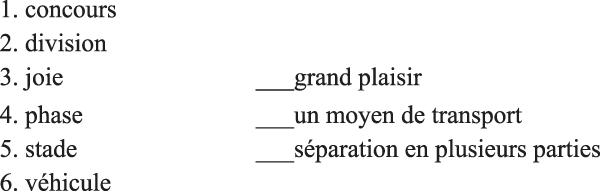
Participants’ prior vocabulary knowledge was tested with the French version of the vocabulary levels test (Test de la taille du vocabulaire, TTV) developed by Batista and Horst (Reference Batista and Horst2016). The test measures receptive knowledge of 120 items pertaining to four different frequency bands: 0 to 2,000 most frequent words (30 items), 2,000 to 3,000 most frequent words (30 items), 3,000 to 5,000 most frequent words (30 items), and 5,000 to 10,000 most frequent words (30 items). The test contains 10 word clusters per frequency band. For each cluster, three out of six words have to be matched with a simple definition that is entirely made up of words pertaining to the same frequency level (see Figure 2 for an example). Based on a pilot test with five native speakers, we decided to adapt three definitions that were used in the original test. The adapted definitions take into account the frequency requirements. The Cronbach’s alpha was .83 (N = 61 ).
Example of word cluster for the 2,000–3,000 word frequency band in the TTV.

WORKING MEMORY TESTS
Three measures of working memory were used in this study: a forward digit-span, a backward digit-span, and an operation-span task. Nonverbal tasks were used to “avoid the problems arising from including an overt language component” (Juffs & Harrington, Reference Juffs and Harrington2011, pp. 142‒143). Nonverbal tasks have been frequently used in L2 research (for an overview, see Juffs & Harrington, Reference Juffs and Harrington2011). We used a forward digit-span task to assess storage capacity in the PSTM. The test used in this study consisted of eight digit spans going from three to nine digits. Each span consisted of two sets, as shown in Figure 3. If students correctly recalled the digits of at least one set, they could go to the next span.
Two spans, each containing two sets of numbers in the forward digit-span task.

The backward digit-span requires both storage of information as well as manipulation of that information and can be considered a complex working memory task.Footnote 3 In a backward digit-span task, participants have to recall increasing sets of digits in the exact reverse order. The test consisted of eight spans going from two to eight digits with two sets per span. The stimuli of the forward and backward digit-span task were recorded in e-prime to make sure that the presentation duration and time between digit presentation was exactly the same for each participant. Participants’ score on each of the digit span tests equals the sum of the sets for which they could repeat the sequence correctly.
We also administered an operation-span task (Turner & Engle, Reference Turner and Engle1989), which is a complex, language independent span test that measures working memory capacity. This test was found to correlate with L2 vocabulary learning in previous research (Elgort et al., 2018). Because participants were all native speakers of Dutch, they took the Dutch version of the ospan (De Neys, d’Ydewalle, Schaeken, & Vos, 2002). In the task, participants were asked to solve mathematical equations and to recall the word that was matched with each equation. After an unspecified number of equations, participants were asked to write down the words, in the exact order in which they appeared. The test consists of 15 sets of two to six words. Participants’ span score (60 = maximum) equals the sum of correctly recalled words of sets for which all words were recalled in the exact order. The equations were presented on PC. Participants wrote down the words on an answer sheet.
Example of an equation and paired word:
IS (9:3) + 2 = 5 (Yes or No) – Book
All working memory tests were administered during a one-to-one session with the researcher (see Procedures section).
VOCABULARY POSTTESTS
Participants’ knowledge of the 15 pseudowords was measured by means of four unannounced vocabulary posttests that were administered in the following order: a timed spoken lexical decision task, a form recognition test, a meaning recall test, and a meaning recognition test. When administering tests at different levels of sensitivity, it is crucial to carefully sequence the tests to avoid a learning effect from one test to anotherFootnote 4 (see also Nation and Webb, Reference Nation and Webb2011 and Webb, Reference Webb2007 on test sequencing).
We first administered a spoken lexical decision task (LDT) under time pressure. This task was used to assess participants’ accuracy of spoken word recognition of the 15 TWs as well as their speed of lexical access. All stimuli (i.e., the 15 target pseudowords, 15 distractor pseudowords, and 30 known words) were presented in spoken form only. Participants were asked to indicate whether they had heard the word before (i.e., prior to hearing it in the LDT). They were asked to answer as fast and accurately as possible. Stimuli were presented in E-prime.
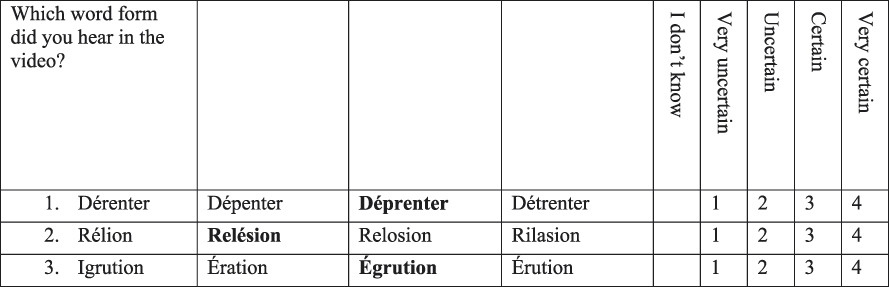
The multiple-choice form recognition test, similar to the format used in Webb (Reference Webb2007) and Pellicer-Sánchez (Reference Pellicer-Sánchez2017), assessed participants’ ability to recognize the correct form of the 15 TWs among four options (the correct answer and three distractors) and an “I don’t know option” (see Figure 4). Items were presented in spoken and written form. The participant was asked to check the right answer or indicate the “I don’t know option.” For each item, participants were also asked to indicate how certain they were of their answer on a 4-point scale with 1 being very uncertain and 4 very certain.
Form recognition test (correct answer in bold).

To control for a potential effect of the spoken LDT on the form recognition test, a control group (see Control Group section) was included who only took the tests, as was also the case in Peters and Webb (Reference Peters and Webb2018).
To assess participants’ meaning recall of the 15 target pseudowords, we asked them to say everything they knew about the meaning of the TWs during a short interview (Pigada & Schmitt, Reference Pigada and Schmitt2006). Each TW was presented in isolation on a A4-sized card and was also presented in spoken form.
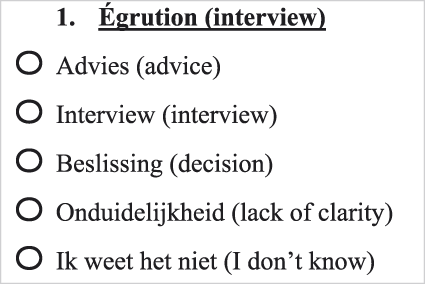
The paper-and-pencil meaning recognition test assessed participants’ ability to recognize the meaning of the target pseudoword among four options (the correct answer and three distractors) and an “I don’t know option.” All distractors were linked to the content of the video, which meant that participants could not guess the right answer by thinking about which word could have appeared in the video.
Example item on meaning recognition test.

The form and meaning tests are based on test formats that have been extensively used in vocabulary intervention studies (see Nation & Webb, Reference Nation and Webb2011 for a discussion). The form recognition test as well as the meaning recognition test were also administered one week later to participants in the experimental group. The spoken LDT could not be operationalized as a delayed test because of the instruction: “have you heard this word before?” Because learners would recognize the test, they would have clicked yes for each word. The immediate meaning recall test revealed a floor effect and was therefore not administered as a delayed test.
CONTROL GROUP
As argued by Nation and Webb (Reference Nation and Webb2011), studies on incidental vocabulary learning that use real words as TWs need a control group who only takes the tests (e.g., pretests and posttests). The control group gives information about learning gains from pretest to posttest and between immediate posttests, which are not due to the treatment. It can also provide information on learning that occurs outside the experiment. In an incidental vocabulary learning study with pseudowords, however, such a control group is generally not deemed necessary because we do not need to control for prior knowledge of the target items (= pseudowords). Yet, a control group was added in the present study because we used multiple immediate vocabulary posttests. Even though test sequencing was carefully controlled for, a control group makes it possible to verify whether there were test effects from one immediate posttest to another. More particularly, the control group made it possible to verify whether the spoken LDT had an influence on the form recognition test. The control group was thus included for methodological reasons only and did not watch the video.
PROCEDURES
Participants in the experimental group were tested in two one-to-one sessions. All were held over a 2-week period. During the first session, which took 90 minutes, participants watched the video (45 minutes). Next, they signed the consent form and were asked to answer a few short comprehension questions. Participants then took the time-pressured spoken LDT. Next, they completed a backgroundFootnote 5 questionnaire followed by the form recognition test, the meaning recall test, and the meaning recognition test. Approximately 30 minutes were needed to complete the posttests. The first sessions of all participants were organized within a 1-week period.
During the second session (60 minutes), which was organized exactly 1 week after the first session (based on the timing of participants’ first session), participants completed the following tests (in that order): vocabulary knowledge, forward digit-span, form recognition test, backward digit-span, meaning recognition test, and ospan. At the end of the second session, participants received a gift certificate of 15 euro for their participation in the two sessions. One week later, participants were debriefed and informed about the research questions of the study.
Participants in the control group were tested over two sessions. During the first group session (20 minutes), they completed the vocabulary knowledge test. During the second (individual) session (15 minutes), they took the spoken LDT, followed by a background questionnaire, a form recognition test, and a meaning recognition test. Immediately after the second session, they were debriefed.
SCORING AND ANALYSES
The lexical decision, form recognition, and meaning recognition tests were scored binomially with 0 for an incorrect response and 1 for a correct response. Answers to the meaning recall tests were first transcribed. Our initial aim was to use partial knowledge scoring as proposed by Pigada and Schmitt (Reference Pigada and Schmitt2006). Yet, because our dataset did not yield partial knowledge gains, we opted for a 0 (completely unknown) – 1 (correct translation or definition) coding.
To answer research question 1, Mann-Whitney U-tests were used because the data were not normally distributed. To answer research question 2, generalized estimating equations (GEE) analyses were computed to perform repeated measures logistic regression analyses (Peng et al., 2002). A GEE analysis is a semiparametric test that can be used when the assumption of homogeneity of variance is violated. The outcome on the posttest was dichotomous (0 or 1) and there was no multicollinearity between the predictor variables. The repeated measures are the 15 TWs that were measured for each participant. A separate analysis was computed per posttest. This type of analysis enables us to include participant-related information (their vocabulary knowledge and their working memory scores) as well as information about the TWs (e.g., their frequency in the clip). Because the TWs had different frequencies of occurrence, ranging from 3 to 6, we decided to include this TW-related characteristic as a predictor in the statistical analyses to control for this difference. Yet, it should be stressed that our aim is not to investigate the role of frequency of occurrence, but rather to take this parameter into account in our analyses because it was not held constant for all words.
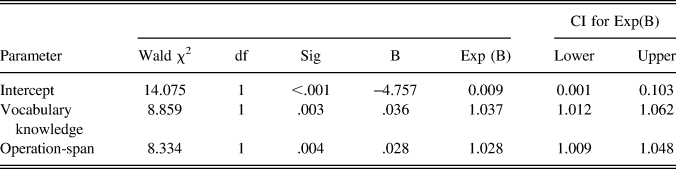
A GEE analysis was computed for each vocabulary posttest with the following predictors entered as main effects in the model: vocabulary knowledge, forward digit-span, backward digit-span, ospan, and frequency of TW in the clip. Next, nonsignificant parameters were removed and the model was refit. We also verified whether there were interaction effects, yet this was not the case. We calculated the odds ratio, exp(B), or exponential parameter estimate to predict the odds of a correct response on the posttest for a given predictor.
RESULTS
PARTICIPANT CHARACTERISTICS
Vocabulary Knowledge
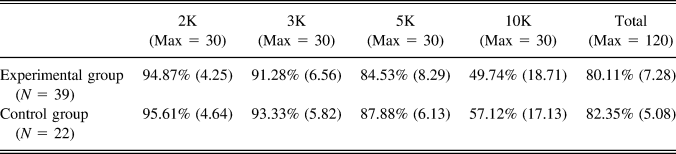
As far as participants’ vocabulary knowledge is concerned, the results in Table 1 show that students mastered the 3K level with scores higher than 90%. They also demonstrated adequate knowledge of the 5K level with an average score higher than 80%. These results indicate that their proficiency level was in accordance with the materials used in this study. A comparison of their scores on the different frequency bands reveals that participants’ scores decrease as words become less frequent. Participants’ total score on the test will be included as participant-related variable in the GEE analyses. A Mann-Whitney U-test indicated that the difference between the control and the experimental group was not significant (U = 328.5, p = .132).
Mean scores and standard deviations (in brackets) on the vocabulary knowledge test in percentages

Working Memory Battery
The descriptives of the three working memory testsFootnote 6 are reported in Table 2. These scores will be included as participant-related variables to answer research question 2.
Descriptive statistics for the three working memory tests (experimental group only)

RESEARCH QUESTION 1
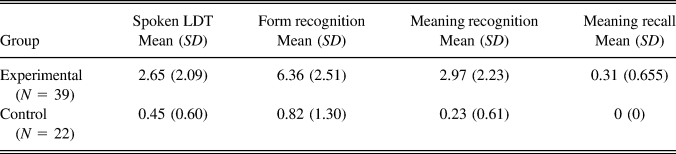
The descriptive statistics for the immediate vocabulary posttests are shown in Table 3.
Mean scores and standard deviations on the immediate vocabulary posttests (maximum score = 15).

Note: Two participants reported that they did not take the tests that they had to perform individually (the spoken LDT and the meaning recognition test) seriously. Their data were therefore removed from the dataset. Scores of these tests are based on 37 participants.
Mann-Whitney U-tests revealed that the experimental group significantly outperformed the control group on the spoken LDT (U = 102,5, z = −4,95, p <.001, r = −.64), the form recognition test (U = 19, z = −6.21, p <.001, r = −.80), and the meaning recognition test (U = 93,5, z = −5.15, p <.001, r = −.71). The score of the control group on the meaning recall test was 0, which is why no further analyses were performed. From these figures, we can conclude that viewing the documentary had a significant impact on word learning. In what follows, we discuss the findings of the experimental group in greater detail.
Participants in the experimental group had the highest score on the form recognition test, followed by the meaning recognition test and the spoken LDT. Because the accuracy of responses on the LDT was low, reaction times were not analyzed any further. The scores on the meaning recall test revealed a floor effect.
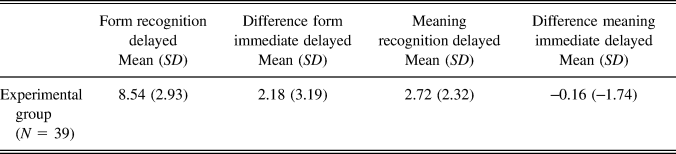
Table 4 displays the scores on the delayed tests as well as the difference between the immediate and delayed tests. The descriptives of the delayed form recognition test reveal an increase in the scores between immediate and delayed sessions, which indicates that participants could recognize more words on the delayed test than on the immediate test. Because we used pseudowords, participants could not look up the words at home or encounter them in other contexts. The increase thus indicates that there was a testing effect that seems due to the fact that learners had to engage with the TW form in the immediate meaning recall and meaning recognition tests.
Mean scores and standard deviations on the delayed posttests (maximum score = 15) and mean differences in scores between immediate and delayed posttests

Note: The control group did not take the delayed tests. Because only data of the meaning recognition test are used in this study and testing effects were not expected or found on this test, this is not considered problematic.
For the delayed meaning recognition test, a small decrease of 0.16 words was found between immediate and delayed tests but a Wilcoxon Signed Ranks test indicated that this difference was not significant (Z = ‒.405, p = .685).
RESEARCH QUESTION 2
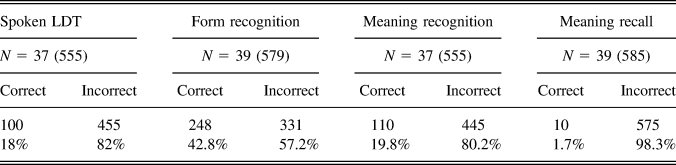
To look into the relationship between incidental vocabulary learning from viewing and participants’ prior vocabulary knowledge and their working memory, a series of GEE analyses were computed (one per posttest). GEE analyses are based on observations instead of mean scores. The descriptives included in Table 5 for the immediate tests and Table 6 for the delayed tests thus represent the amount and percentage of correct and incorrect answers on the different tests.
Number and percentage of correct and incorrect responses (observations) on the immediate vocabulary posttests in the experimental group

Notes: For six participants, one of the TWs was missing in the form recognition test. Two participants reported that they did not take the tests that they had to perform individually (the spoken LDT and the meaning recognition test) seriously. Their data were therefore removed from the dataset.
Number and percentage of correct and incorrect responses (observations) on the delayed vocabulary posttests

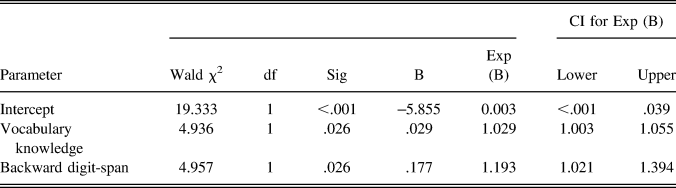
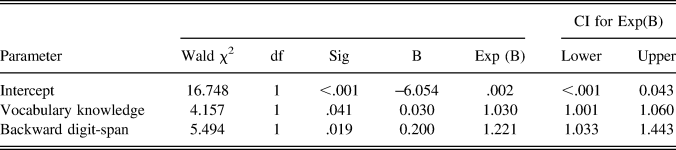
The analysis of the spoken LDT (see Table 7), which was run for 555 observations, revealed that two parameters contributed significantly to the model: vocabulary knowledge and backward digit-span. As far as the backward digit-span is concerned, for one additional correctly recalled digit span, the odds of a correct response are 19.3 % higher. For two increases, the learner has (Exp2*B = 1.425) 42.5% more odds of a correct response on the spoken LDT. With regard to the role of vocabulary knowledge, results suggest that with one more word known on the vocabulary knowledge test, participants had 2.9 more odds to have a correct response. With 10 more words known, the odds (Exp10*B = 1.336) of a correct response are 33.6% higher.
GEE analysis for immediate spoken LDT

As shown in Table 8, the analysis for form recognition, which was based on 579 observations, revealed that participants’ vocabulary knowledge and their ospan scores significantly contributed to the model. These findings indicate that the odds of a correct response are 3.7% higher with one more item known on the vocabulary knowledge test. When knowing 10 more words, the odds are 43% higher (Exp10*B = 1.433) to have a correct response. Similarly, participants’ ospan score predicts word learning. With one additional correct span on the ospan, the odds of recognizing an item’s form are 2.8% higher. The odds are 15% higher with five additional correct responses (Exp5*B = 1.150).
GEE analysis for immediate form recognition

The GEE analysis for the meaning recognition test (see Table 9), which was run for 555 observations, revealed that vocabulary size and backward digit span contributed significantly to the model. For an increase of one word known on the vocabulary knowledge test, the odds of having a correct response are 3% higher. An increase of 10 more words known results in 35% more odds (Exp10*B = 1.349) to have a correct score on the meaning recognition test. For the backward digit-span, we found that the odds are 22.1% higher with one extra correct response on the backward span test. The odds increase up to 49.2% (Exp2*B = 1.492) with two extra sets known on the span test. The meaning recall test revealed a floor effect and was therefore not included in further analyses.
GEE analysis for immediate meaning recognition

For the delayed form recognition test, we did not find significant effects of our predictors, which seems to confirm our hypothesis that these scores are due to a testing effect.
For meaning recognition (585 observations), only frequency contributed significantly to the model (see Table 10). With one extra occurrence of the TW in the clip, the odds of a correct response are 16% higher. With two extra occurrences, the odds of a correct response are 35.3% higher (Exp2*B = 1.353).
GEE analysis for delayed meaning recognition

DISCUSSION
This study set out to investigate incidental learning from watching audio-visual input and whether this process is influenced by participants’ vocabulary knowledge as well as their working memory. Our results suggest that watching audio-visual input has a significant effect on different aspects of word learning. It was also found that vocabulary knowledge is significantly and positively related to word learning from video as measured by immediate vocabulary posttests. Complex working memory also contributed to participants’ scores on the immediate posttests. PSTM did not affect incidental vocabulary learning from watching video.
IS THERE AN EFFECT OF WATCHING AUDIO-VISUAL INPUT ON THE LEARNING OF NEW VOCABULARY?
A comparison between a control group and an experimental group indicates that audio-visual input has an effect on the learning of new words. More particularly, results indicate that watching audio-visual input resulted in learning gains at different levels of sensitivity, as measured immediately after viewing the video.
With regard to the acquisition of word form, results reveal that participants were able to recognize the form of a selection of TWs after initial exposure to those words in the video. However, the results of the spoken LDT, in which learners were asked to indicate whether they had heard the word before by tapping yes or no, are low with, on average, two words recognized. Because participants were asked to respond as accurately and as fast as possible, this type of time-pressured test was probably too challenging. It is possible that the presence of time pressure, which is used to tap into tacit knowledge, negatively impacted the accuracy scores. Results of the form recognition test, in which learners were asked to choose the correct form among four options (presented in spoken and written form) revealed that learners were able to select the correct form for, on average, six words. Participants thus showed knowledge of word form of about 43% of the TWs after viewing the video. As indicated by Peters and Webb (Reference Peters and Webb2018), a form recognition test is very sensitive to possible pretest effects that affect the validity of the test. By using pseudowords (and thus avoiding a pretest), this study is able to shed light on the role of audio-visual input for initial learning such as the recognition of word forms on both spoken and written tests.
Knowledge of word meaning was assessed by means of a meaning recognition and a meaning recall test. Results revealed absolute gains of 2.97 words on the meaning recognition test. The gains found in our study are slightly lower than the gains found in Peters and Webb (Reference Peters and Webb2018) where approximately four words were learned. The meaning recall test turned out to be the most difficult aspect of word knowledge with an average of .31 words learned, which indicates that there was a floor effect. This finding is, however, not surprising. Brown, Waring, and Dunkaewbua (Reference Brown, Waring and Donkaewbua2008) suggested that more than 20 encounters (even 50 or 100) would be needed for learners to be able to recall the meaning of a word after incidental exposure from listening. In addition, this study used pseudowords, which means that learners could not rely on any type of partial knowledge. Similarly, word-related factors such as cognateness, which were found to have an enormous impact on meaning recall from viewing (Peters & Webb, Reference Peters and Webb2018), could not stimulate learning in this study.
In sum, this study reveals that watching audio-visual input leads to knowledge of word form and meaning, with the first aspect of knowledge acquired more easily than the latter. Even though these gains seem small, they provide encouraging evidence that viewing larger amounts of video in, for instance, extensive viewing programs, could lead to more sizeable lexical gains. This is in line with Webb (2015) who argued that the real value of TV and video for lexical development lies in its overall accessibility and its potential to provide learners with large amounts of L2 input and authentic language use.
IS INCIDENTAL VOCABULARY LEARNING FROM AUDIO-VISUAL INPUT MODERATED BY PARTICIPANTS’ VOCABULARY KNOWLEDGE AND THEIR WORKING MEMORY?
The Role of Vocabulary Knowledge
Our results revealed that vocabulary size played a significant role in vocabulary learning from viewing regardless of the aspect of word knowledge tested (spoken LDT, form recognition, and meaning recognition) immediately after viewing the video. As revealed by the GEE analyses, the odds of a correct response increase 3% with one extra word known on the vocabulary knowledge test and increase between 33.6 and 43% for 10 more words known, with the strongest effect of vocabulary knowledge on the form recognition test. The results of this study are congruent with previous studies on the role of prior vocabulary knowledge for incidental learning and where similar percentages were reported (Peters & Webb, Reference Peters and Webb2018).
It is not surprising that participants with more vocabulary knowledge also seem to benefit more from input in terms of words picked up while watching audio-visual input. This could be explained by the fact that knowing more words contributes to participants’ lexical coverage of the input. More coverage means that learners know more words in the input and can thus more easily notice unknown words. In addition, they can use their knowledge to derive meaning from context.
Vocabulary knowledge did not affect participants’ scores on the delayed form and meaning recognition tests. As indicated in the Results section, we hypothesized that the delayed form recognition test shows a testing effect. The fact that vocabulary knowledge does not contribute significantly to a correct score seems to confirm the hypothesis that scores on the delayed form test are due to other predictors than on the immediate form recognition test, namely participants’ active engagement with the word forms during the meaning recall and meaning recognition immediate posttests. Retention of word meaning was not influenced by vocabulary knowledge either. Our analyses revealed that only frequency contributed to retention of word meaning, that is, the more a word occurred, the higher the odds of a correct score on the delayed meaning recognition test. This suggests that retention is no longer influenced by vocabulary knowledge but rather by the frequency of occurrence of the word in the clip.
The Role of Working Memory
The second research question also examined the extent to which working memory is related to incidental vocabulary learning from audio-visual input. Results reveal that individual differences in working memory predict the pick up of new words from video. Yet, this finding only holds true for complex working memory, as measured by means of a backward digit-span and an ospan task. PSTM did not significantly predict posttest scores. An important factor that can account for this finding is the proficiency level of the participants in the present study, who were all higher-intermediate learners, and their corresponding available lexical representations. In a study by Masoura and Gathercole (Reference Masoura and Gathercole2005), it was found that PSTM becomes less important as learners become more familiar with the phonological structures of the target language. Their results indicated that learners seemed to rely on their existing lexical knowledge rather than their PSTM. This might explain why this study did not reveal a significant contribution of PSTM, while other studies including beginning-level or lower-intermediate learners did.
Findings indicate that participants with higher scores on the complex working memory tests were more likely to have higher scores on the immediate form recognition and meaning recognition tests. Complex working memory tasks that tap into participants’ capacity to store and manipulate information in memory have been found to be predictive of “a greater ability to focus, divide, and switch attention among various task demands” (Révész, Reference Révész2012, p. 123), which may also explain why participants were more successful on the vocabulary tests. Higher complex working memory may help learners to allocate their attentional resources in the input, which may not only result in the noticing of word forms but also in further processing such as inferring the meaning of a word. The latter can indeed be described as a complex task: Learners are expected to hold information in phonological memory while carrying out an additional manipulation, that is, using the contextual information to derive the meaning of the word. It was therefore not unexpected that this type of word knowledge would be moderated by complex working memory that taps into both the storage and manipulation of information.
Our findings differ, however, from research on incidental grammar learning in that we found significant relations at the level of the immediate tests, rather than at the level of the delayed tests. Two explanations may account for this finding. First, our delayed measures may have been influenced by a testing effect, which probably had an impact on the predictive value of our variables. Second, vocabulary learning consists in learning items rather than grammatical regularities. The acquisition of these regularities may require different types of processing to further abstract the regularities and apply them to different utterances (Martin & Ellis, Reference Martin and Ellis2012). This may explain why certain patterns could only emerge at the delayed level for incidental grammar learning.
LIMITATIONS
This study is inevitably characterized by a number of limitations. First, the data in this study are based on higher-intermediate learners who have already developed sufficient vocabulary knowledge to deal with authentic L2 input. Different patterns may emerge for beginning or (low-)intermediate learners. Second, even though we tried to control for prior knowledge by using pseudowords, we could not control for testing effects from immediate to delayed posttest. If we want to look at retention over time, we could consider administering only delayed tests. Yet, because this study focused on incidental learning after initial exposure to the TWs, immediate tests to track initial learning gains were prioritized (Hulstijn, Reference Hulstijn and Robinson2001). Third, we used a lexical decision task to measure spoken word recognition. Yet, scores on this test were low, which is why reaction times could not be interpreted any further. In addition, it is possible that time pressure negatively affected the accuracy. More research with different types of timed or untimed tests is therefore needed to reveal the role of audio-visual input for spoken word recognition. Finally, in a study on audio-visual or multimodal input where multiple input sources are combined, that is, a pictorial and auditory trace, learning gains may occur through the auditory input or through a combination of auditory and visual traces. Eye-tracking data could shed light on the role of pictorial input in the vocabulary learning process, yet this was not the aim of this study.
CONCLUDING REMARKS
This study was the first to investigate the role of vocabulary knowledge and working memory for incidental vocabulary learning from audio-visual input. The video included pseudowords to accurately measure learning gains. As can be seen from the results on the different posttests, participants appeared to benefit from the viewing activity to pick up new words. By including four types of posttests measuring different aspects of form and meaning, we were able to tap into different aspects of word knowledge. Even though gains are relatively small, they reveal that audio-visual input triggers the installation of early form-meaning connections. This study therefore provides additional evidence that watching audio-visual input can be considered an important activity for L2 lexical development, as suggested by Webb (2015). In addition, our study shows that both vocabulary knowledge as well as complex working memory make independent and significant contributions to incidental learning from video as measured by immediate recognition tests. More research with other proficiency groups is warranted to further refine our understanding of the potential of audio-visual input for L2 learning as well as how individual differences may influence this process.
SUPPLEMENTARY MATERIAL
To view supplementary material for this article, please visit https://doi.org/10.1017/S0272263119000706