Introduction
Neonicotinoids are a class of synthetic insecticides that are used in veterinary medicine (Merck Manuals Reference Merck2015), in home garden treatments (Craddock et al. Reference Craddock, Huang, Turner, Quirós-Alcalá and Payne-Sturges2019), and as a crop protectant (Simon-Delso et al. Reference Simon-Delso, Amaral-Rogers, Belzunces, Bonmatin, Chagnon and Downs2015; United States Geological Survey 2018; Craddock et al. Reference Craddock, Huang, Turner, Quirós-Alcalá and Payne-Sturges2019). Neonicotinoids represent more than 25% of the global insecticide market (Bass et al. Reference Bass, Denholm, Williamson and Nauen2015) and, although hundreds of neonicotinoids have been formulated (Simon-Delso et al. Reference Simon-Delso, Amaral-Rogers, Belzunces, Bonmatin, Chagnon and Downs2015), 85% of worldwide sales in 2014 are represented by clothianidin, thiamethoxam, and imidacloprid (Bass et al. Reference Bass, Denholm, Williamson and Nauen2015). In fact, clothianidin has been one of the principal active ingredients in the treatment of maize, cotton, and soybean seeds in North America since 2003 (Douglas and Tooker 2017). As a systemic, water-soluble insecticide, the chemical is readily absorbed by plants, taken up by the roots, and translocated to the foliage (Simon-Delso et al. Reference Simon-Delso, Amaral-Rogers, Belzunces, Bonmatin, Chagnon and Downs2015). After application, residual neonicotinoids can persist in the environment for up to several years (DeCant Reference Decant2010; Bonmatin et al. Reference Bonmatin, Giorio, Girolami, Goulson, Kreutzweiser and Krupke2015; Simon-Delso et al. Reference Simon-Delso, Amaral-Rogers, Belzunces, Bonmatin, Chagnon and Downs2015). For species with high sensitivity to neonicotinoids, such as insects and aquatic invertebrates (Sánchez-Bayo et al. Reference Sánchez-Bayo, Goka and Hayasaka2016), environmental persistence increases the likelihood of the chemical binding to the nicotinic acetylcholine receptors in the brain and of time-cumulative toxicity occurring (i.e., accumulating with the duration and frequency of exposure, in comparison to bioaccumulative chemicals; Bonmatin et al. Reference Bonmatin, Giorio, Girolami, Goulson, Kreutzweiser and Krupke2015; Sánchez-Bayo et al. Reference Sánchez-Bayo, Goka and Hayasaka2016). Therefore, exposure early in life may magnify detrimental effects, and it is important to assess how early exposure across concentration gradient impacts development.
Neonicotinoid application may impact insect-development timing and body size, and these effects could carry over to influence reproductive output. Exposure to sublethal levels of imidacloprid, for example, has been associated with accelerated development in the cotton bollworm, Helicoverpa armigera (Lepidoptera: Noctuidae) (Ahmad et al. Reference Ahmad, Ansari and Ahmand2013). Monarch butterfly caterpillars (Danaus plexippus) (Lepidoptera: Nymphalidae) fed swamp milkweed (Asclepias incarnata) (Apocynaceae) treated with a five-part-per-billion aqueous solution of clothianidin had a shorter body length, but not a lower mass, at the first- and second-instar stages (Pecenka and Lundgren Reference Pecenka and Lundgren2015). In adult cabbage butterflies (Pieris brassicae) (Lepidoptera: Pieridae), exposure up to 200 parts per billion of imidacloprid also resulted in reduced forewing length (Whitehorn et al. Reference Whitehorn, Norville, Gilburn and Goulson2018). Exposure to neonicotinoid insecticides is also known to negatively impact fecundity in a number of insects, including red mason bees, Osmia spp. (Hymenoptera: Megachilidae) (Sandrock et al. Reference Sandrock, Tnaadini, Lorenzo, Biesmeijer, Potts and Neumann2014a), honeybees (Hymenoptera: Apidae) (Sandrock et al. Reference Sandrock, Tanadini, Tanadini, Fauser-Misslin, Potts and Neumann2014b), and bumblebees, Bombus terrestris (Hymenoptera: Apidae) (Laycock et al. Reference Laycock, Lenthall, Barratt and Cresswell2012, Reference Laycock, Cotterell, Wheller and Cresswell2014). However, oral administration of imidacloprid at a field-realistic rate did not affect oocyte development in monarch butterflies (James Reference James2019). Although the direct mechanism driving reduced fecundity is unknown, the negative effects on development may carry over to impact reproductive output (Williams et al. Reference Williams, Troxler, Retschnig, Roth, Yañez and Shutler2015; Baron et al. Reference Baron, Raine and Brown2017). If neonicotinoids speed up the timing of moulting (Ahmad et al. Reference Ahmad, Ansari and Ahmand2013) and reduce individual size (Pecenka and Lundgren Reference Pecenka and Lundgren2015; Whitehorn et al. Reference Whitehorn, Norville, Gilburn and Goulson2018), a smaller maternal size could correspond with reduced egg size and mass and a lower number of eggs produced (Oberhauser Reference Oberhauser1997; García-Barros Reference García-Barros2000). Therefore, it is important to understand whether neonicotinoid exposure could influence development and subsequent reproductive output.
Monarch butterflies are an iconic species facing severe declines (Thogmartin et al. Reference Thogmartin, López-Hoffman, Rohweder, Diffendorfer, Drum and Semmens2017b), in part because of their dependence on milkweed (Asclepias spp.) during early caterpillar development (Oberhauser Reference Oberhauser2004). Documented population declines of more than 80% (Thogmartin et al. Reference Thogmartin, Wiederholt, Oberhauser, Dunn, Diffendorfer and Altizer2017a) have been attributed to a variety of causes, including exposure to insecticides (Thogmartin et al. Reference Thogmartin, López-Hoffman, Rohweder, Diffendorfer, Drum and Semmens2017b; Wilcox et al. Reference Wilcox, Flockhart, Newman and Norris2019). Prophylactic applications have the potential to increase crop yield (Goulson Reference Goulson2013) but may harm nontarget species. Monarch butterflies rely on milkweed as an obligate host plant (Oberhauser Reference Oberhauser2004) and readily use milkweed in agricultural landscapes (Pitman et al. Reference Pitman, Flockhart and Norris2018). Female monarch butterflies lay up to 400 eggs on a plant during the breeding season (Zalucki and Rochester Reference Zalucki and Rochester2014) and, once hatched, first-instar caterpillars consume the nearby foliage, increasing the potential for exposure to insecticides. After five successive moults, caterpillars form chrysalids and emerge as butterflies after 8–15 days (Oberhauser Reference Oberhauser2004). Despite dependence on agricultural milkweed, few studies have quantified the potential risk imposed from neonicotinoids at field-relevant concentrations and the potential contribution of this class of insecticides to overall monarch declines (Pecenka and Lundgren Reference Pecenka and Lundgren2015; James Reference James2019).
We conducted a controlled laboratory experiment to assess how exposure to the neonicotinoid insecticide clothianidin during rearing influences monarch development and subsequent adult female reproductive output. Monarch caterpillars were reared on milkweed grown in soil treated with a field-relevant low or high concentration of clothianidin or a zero-concentration control group. Morphological measurements and mass were recorded during development, and after pupation, pairs of adult butterflies were mated to quantify female reproductive output (i.e., egg size and the total number of eggs laid). Given evidence that neonicotinoids affect monarch caterpillar development (Pecenka and Lundgren Reference Pecenka and Lundgren2015), we hypothesised that clothianidin would negatively impact caterpillar size, and we predicted that individuals exposed to clothianidin would have a shorter body length, smaller body width, smaller body volume, and lower mass compared to controls. We also hypothesised that female reproductive output would be negatively affected by clothianidin because neonicotinoids have been shown to impact fecundity in other invertebrate species (Laycock et al. Reference Laycock, Lenthall, Barratt and Cresswell2012, Reference Laycock, Cotterell, Wheller and Cresswell2014; Sandrock et al. Reference Sandrock, Tnaadini, Lorenzo, Biesmeijer, Potts and Neumann2014a, Reference Sandrock, Tanadini, Tanadini, Fauser-Misslin, Potts and Neumann2014b; although see James Reference James2019). Therefore, we predicted that this would result in a smaller egg size and mass, as well as fewer eggs being deposited.
Methods
Clothianidin treatment, milkweed growth, and chemical analysis
A clothianidin standard (purity 99.9%; MDL # MFCD06200753, Sigma-Aldrich, St. Louis, Missouri, United States of America) was used to make stock solutions that were then diluted with distilled water to dose commercial soil (LA4 Sunshine Loosefill, Sungro Horticulture, Massachusetts, United States of America) at concentrations of 15 ng/g of soil (hereafter “low dose”) and 25 ng/g of soil (hereafter “high dose”). The two treatment levels were chosen to represent field-realistic values recorded in Ontario, Canada and are established standard sublethal doses (Chan et al. Reference Chan, Prosser, Rodríguez-Gill and Raine2019).
Swamp milkweed (Asclepias incarnata) was grown from seed in soil from either the low-dose or high-dose treatments or from a control (no clothianidin). A total of 256 milkweed plants per treatment were grown at a density of four plants per 1.68-L pot (total 64 pots per treatment) in environmental chambers at the University of Guelph Phytotron (University of Guelph, Guelph, Ontario, Canada). Temperature was maintained at 29 °C during the day and 23 °C at night, with a light intensity of 11 914–16 280 lx (18 hours light : 6 hours dark), and 60% relative humidity, based on conditions outlined in Flockhart et al. (Reference Flockhart, Martin and Norris2012). Plants were watered daily with reverse-osmosis water and fertilised weekly with Plant-Prod Solutions fertiliser 17:5:17 NPK (Master Plant-Prod Inc., Brampton, Ontario, Canada). Amblyseius swirskii (Mesostigmata: Phytoseiidae) was introduced as a biocontrol (Bioline AgroSciences Swirskiline Biocontrol Agent and Biobest Swirskii-Breeding-System; Bioline AgroSciences, Oxnard, California, United States of America) to reduce the impact of thrips (Thysanoptera) (Flockhart et al. Reference Flockhart, Martin and Norris2012).
To examine temporal variation in clothianidin concentrations throughout the experiment, a minimum 15 g of soil (sensitivity ± 1.0 g; MyWeigh iBalance i500; HBI Technologies Canada, Vancouver, British Columbia, Canada) was collected for analysis in sterile polypropylene centrifuge tubes (VWR High-Performance Centrifuge Tubes, CAT # 89039-656; VWR International LLC, Mississauga, Ontario, Canada) when the soil was dosed, 14 days after dosing, 18 days after dosing when monarch eggs were transferred to the treatment leaves (see below), and 32 days after dosing when monarchs pupated. A single leaf was randomly selected from each milkweed plant at 18 and 32 days after the soil was dosed. These leaves were then combined to reach a minimum mass of 2.0 g required for clothianidin detection and stored in sterile polypropylene centrifuge tubes. To determine if clothianidin was metabolised before metamorphosis, a subset of fifth-instar caterpillars was randomly selected and combined (
 ${\overline x}$
= 2.4 caterpillars per sample tube) to reach the minimum mass required for analysis. At the completion of the experiment, adult monarch butterflies were combined (
 ${\overline x}$
= 5.2 butterflies per sample tube) and submitted for clothianidin analysis. Before analysis for clothianidin concentration, all samples were stored at –20 ºC at the University of Guelph Agriculture and Food Laboratory. Analysis was done using the QuEChERS (quick, easy, cheap, effective, rugged, and safe) method, which is appropriate for samples with high water content (Perestrelo et al. Reference Perestrelo, Silva, Porto-Figueira, Pereira, Silva, Medina and Câmara2019). In brief, a sample of the soil or tissue was extracted and placed in a solution of 1% acetic acid in acetonitrile with anhydrous sodium and magnesium sulphate. The precipitate is then diluted with methanol and 0.1 mol ammonium acetate. High-performance liquid chromatography/electrospray ionisation–tandem mass spectrometry and gas chromatography–tandem mass spectrometry were used to assess concentration (Canadian Food Inspection Agency 2008; Wang and Daniel Reference Wang and Daniel2009), which was returned in parts per billion (1 ppb = 1 ng/g; Boguski Reference Boguski2006). The limit of quantification is the lowest concentration that can be accurately quantified, whereas the limit of detection is the lowest concentration that can be distinguished from the assay background and therefore has a higher degree of error. The limit of quantification and limit of detection depend on the sample type (soil: limit of quantification/limit of detection 20 ppb/7 ppb; leaf: 30 ppb/10 ppb; monarch tissue: 2 ppb/0.7 ppb).
Monarch capture and rearing
Caterpillars and butterflies used during the experiments were reared from eggs laid by wild monarchs obtained from properties in Long Point, Ontario, Canada (42.58° N, 80.43° W; ♂ n = 2, ♀ n = 4) and the Guelph Lake Conservation Area, Guelph, Ontario (43.61° N, 80.26° W; ♂ n = 1, ♀ n = 5) that were not treated with clothianidin or any other neonicotinoid. Butterflies were held in coin envelopes (6.35 cm × 10.8 cm) inside an animal carrier kept at ambient temperature and lined with a damp cloth to maintain humidity to avoid drying of the wings and limit mortality during transport to the University of Guelph. Upon arrival, butterflies were weighed (Denver Instrument PI-602 scale; Denver Instrument, Bohemia, New York, United States of America) to the nearest 0.01 g and hand-fed a 10% honey–water solution daily until satiation. All monarchs were tagged with a small, uniquely numbered, adhesive sticker (approximately 0.65 cm) on the left hindwing near the abdomen that allowed us to visually identify individuals and to monitor body condition. Breeding took place in large mesh enclosures (60 cm height × 60 cm depth × 60 cm width) inside an incubator set at temperatures fluctuating between 29 °C and 23 °C with a light intensity of 11 914–16 280 lx (18 hours light : 6 hours dark) and 60% relative humidity to simulate natural conditions common during summer breeding. Each enclosure was outfitted with untreated milkweed (i.e., not exposed to clothianidin) and an artificial nectar source (i.e., sucrose water), changed daily, until all eggs were collected and the reproductive monarchs were released.
We removed 201 eggs (n = 67 per treatment) by gently rubbing the eggs off the milkweed leaf with a fine-tipped paintbrush onto a damp cloth before adhering them to the milkweed leaf using residual latex. Leaves with eggs were placed in large plastic containers, enclosed using a finely perforated mosquito netting (Bulk Mosquito Netting, CAT # 09A04.73, Lee Valley, Ottawa, Ontario, Canada), and cleaned daily. Caterpillars were fed experimental milkweed (i.e., control, 15 ng/g, or 25 ng/g clothianidin) ad libitum to minimise risk of nutritional stress from food limitation. Light cycle and temperature mimicked ambient conditions during the early breeding season in Guelph, Ontario (43.5° N, 80.2° W; 16 hours light : 8 hours dark; Flockhart et al. Reference Flockhart, Martin and Norris2012) at 28 °C during the day, 22 °C at night, and 60% relative humidity to reduce the risk of monarchs entering reproductive diapause (Goehring and Oberhauser Reference Goehring and Oberhauser2002; Flockhart et al. Reference Flockhart, Martin and Norris2012).
Given observed differences in the size of caterpillars reared on milkweed grown in clothianidin-treated soil, we collected body measurements at three timepoints at instar stages that could be reliably identified. Using digital calipers to the nearest 0.01 mm, we recorded body length measurements at the first, third, and fifth instars and body width measurements at the third and fifth instars. Previous methods to measure body volume involved haemolymph extraction (Lin et al. Reference Lin, Slate, Paetsch, Dorfmann and Trimmer2011). As a nonlethal measure of body volume, we calculated the volume of a cylinder (V = π × r 2 × h) to estimate the body volume of the third and fifth instars, where r is half the body width and h is the body length. Monarch caterpillars were randomly sampled for clothianidin analysis (see the section, Clothianidin treatment, milkweed growth, and chemical analysis, this paper), and in the fifth instar, we recorded the mass to the nearest 0.1 g for 117 caterpillars (control: n = 41; low dose: n = 41; high dose: n = 35). Early death was recorded for 9 caterpillars (control: n = 1; low dose: n = 2; high dose: n = 6) between 18 and 26 June 2018. Chrysalids were transferred to mesh enclosures (120 cm × 120 cm × 120 cm; Popadome Plant Dome, CAT # XC515, Lee Valley, Ottawa, Ontario, Canada) within two days of pupation until eclosion, after which adult monarchs were fed ad libitum a sucrose solution from dishes placed at the bottom of the enclosures (Flockhart et al. Reference Flockhart, Martin and Norris2012). All monarchs were measured and weighed in captivity and examined for Ophryocystis elektroscirrha parasites (Neogregarinorida: Ophryocystidae) by applying clear tape to the abdomen and analysing tape for spores under a microscope at 400 × (Altizer and Oberhauser Reference Altizer and Oberhauser1999). Individuals that tested positive for O. elektroscirrha were removed from the study and euthanised due to the potential for developmental deformities (control: n = 4; high dose: n = 1). All procedures were conducted under the Ontario Ministry for Natural Resources Wildlife Scientific Collectors Permit (#1090000).
Assessing reproductive output
To assess the influence of clothianidin exposure on adult female monarch butterfly reproductive output, a subset of female monarchs reared from caterpillars was provided untreated milkweed as substrate for oviposition in mesh enclosures (40.6 cm × 63.5 cm) and fed a 10% honey–water solution. Virgin reproductive pairs (control: n = 7; low dose: n = 8; high dose: n = 7) were selected because prior matings can reduce the size of subsequent spermatophores being transferred (Oberhauser Reference Oberhauser1988). Once mated, males were removed, and females remained in the enclosures to complete oviposition. We removed female monarchs when they died or after egg deposition had ceased for a maximum of seven days (Oberhauser Reference Oberhauser1997). For all females, we counted the number of eggs deposited, and we stored dead female butterflies for approximately two weeks until we could count the number of mature oocytes remaining in the ovarioles (Oberhauser Reference Oberhauser1997). Due to the small size of the eggs, we calculated the average mass in groups of 10 to the nearest ± 0.001 mg (XP26 Micro Balance; Mettler-Toledo Inc., Mississauga, Ontario, Canada) and measured the height and width to the nearest 0.01 mm using handheld digital calipers. Damaged eggs were included in the total count of the number of eggs deposited but were not measured. The small size of monarch eggs did not permit digital measurement, so we followed the procedures outlined in García-Barros (Reference García-Barros2000) to calculate the egg size, despite deviations from spherical shape potentially inducing slight measurement errors. Therefore, the cubic root of the volume of an ellipsoid,
 $${\rm{Egg \;size }} = {\rm{ }}{(0.5236 \times {d^2} \times h)^{1/3}},$$
was used to estimate monarch egg size, where d equals egg diameter and h equals egg height (García-Barros Reference García-Barros2000).
Statistical analyses
Outliers, potentially as a result of measurement or transcription error, were identified using the outliers package in R, version 3.4.1(R Core Team 2015b) and were removed from analysis. Four outliers were identified for body length (control: n = 1; low dose: n = 2; high dose: n = 1) and two for body width (control: n = 2). To test for the effect of clothianidin on caterpillar body length, body width, and body volume, we applied series of generalised linear mixed models using the nlme package in R, version 3.4.1 (Bolker et al. Reference Bolker, Brooks, Clark, Geange, Poulsen, Stevens and White2009; R Core Team 2015b). The models included instar stage (first, third, fifth for length, and third and fifth for width and volume), treatment (i.e., control, low dose, and high dose), the interaction between stage and treatment as fixed effects, and individual identity as a random effect. We then separately ran a post-hoc Tukey honestly significant difference using the stats package (R Core Team 2015a) to determine if there was a difference in caterpillar body length, body width, and body volume between treatments for each instar. Lastly, we used a general linear model to test whether treatment affected the mass, because only fifth-instar caterpillars were measured for mass.
A general linear model was used to assess whether the clothianidin treatment affected adult monarch butterfly size. Forewing length was square-root transformed to improve the normality of the distribution and was included as a response variable to estimate body size (Miller Reference Miller1977, Reference Miller1991). Date of eclosion, mass, and sex were also included as predictors. We also used a generalised linear model with Poisson distribution and log link function to determine whether treatment affected the total number of eggs laid. The total number of eggs laid was included as the response variable, with treatment, forewing length, mass, and age as predictors. Age of the male monarch in the mated pair was included as a proxy for spermatophore size and the amount of resources transferred to the female during mating that may contribute to egg production (Oberhauser Reference Oberhauser1997).
We applied a series of generalised linear mixed models to determine if early clothianidin exposure affected the size of eggs. We used the average egg size and mass as response variables in separate models, with treatment and total number of eggs laid as fixed effects. To account for potential differences in resource investment by older and larger female monarch butterflies (Oberhauser Reference Oberhauser1997), we included age, mass, and forewing length as fixed effects, as well as the age of the male monarch in the mated pair to account for the male contribution to the overall resource budget (Oberhauser Reference Oberhauser1997). Female identity was included as a random effect. For all models, each possible combination of parameters was tested in a separate model, as well as in a null model that included only the intercept. Akaike’s information criterion (AIC) or an AIC corrected for small sample sizes (AICc) was then used to rank models, and those with a ΔAIC or ΔAICc equalling or less than two were considered to have support (Burnham and Anderson Reference Burnham and Anderson2002). Support for a model was also provided by the log likelihood and Akaike weights (ωi).
Results
Analysis of clothianidin
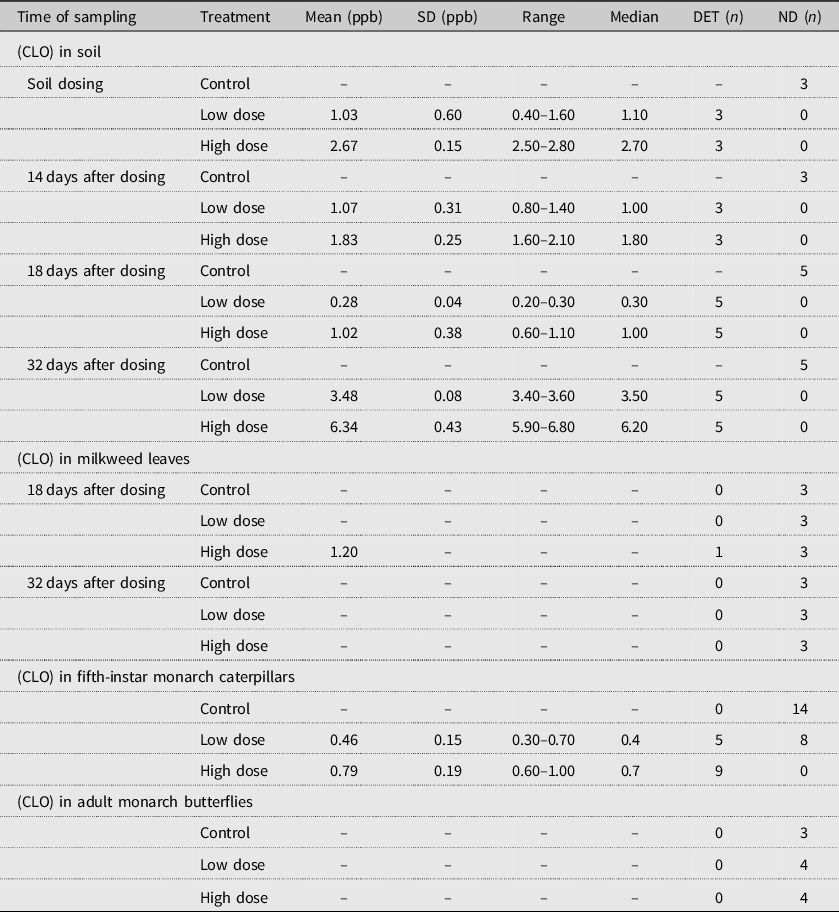
We did not detect clothianidin in the soil for the control group at any of the timepoints (Table 1). Clothianidin was detected in the soil for both treatments and was higher in the high-dose treatment than in the low-dose treatment, but overall the concentration in the soil was lower than at dosing. The concentration of the low-dose treatment (15 ng/g) in soil varied throughout the experiment, whereas the concentration of the high-dose treatment (25 ng/g) decreased continually and then peaked at 32 days after dosing (Table 1). We detected no clothianidin in the milkweed leaves, except for a single sample at 18 days after dosing in the high-dose treatment group (Table 1).
Concentration of the neonicotinoid clothianidin (parts per billion; ppb) in soil, swamp milkweed (Asclepias incarnata), fifth-instar caterpillars, and adult monarch butterflies (Danaus plexippus) for insecticide applications in control, 15 ng/g (low dose), and 25 ng/g (high dose) treatments. For samples with clothianidin detected (DET (n)), the mean in parts per billion (ppb), standard deviation (SD), range, and median are provided. The number of samples where no clothianidin detected (ND (n)) is provided because summary statistics could not be calculated (–).

Clothianidin was not detected in fifth-instar monarch caterpillars raised on control milkweed. However, in contrast to milkweed leaves from treatment groups, clothianidin was detected in caterpillars from the treatment groups, with levels lower than one part per billion (Table 1). As expected, clothianidin levels were higher in caterpillars from the high-dose group compared to those in the low-dose group (Table 1). No clothianidin was detected in the tissue of the adult monarch butterflies, regardless of treatment (Table 1).
Monarch caterpillar development
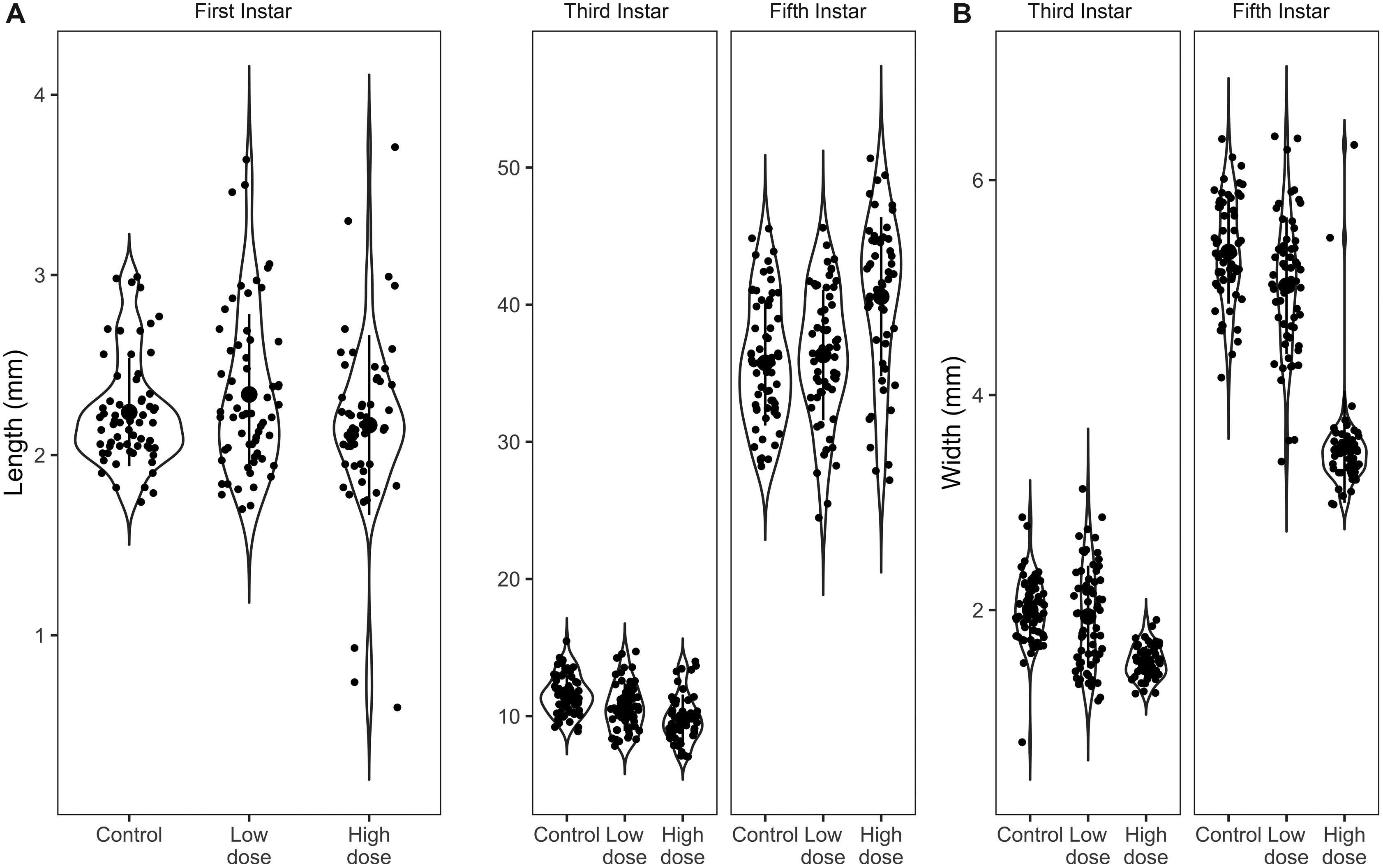
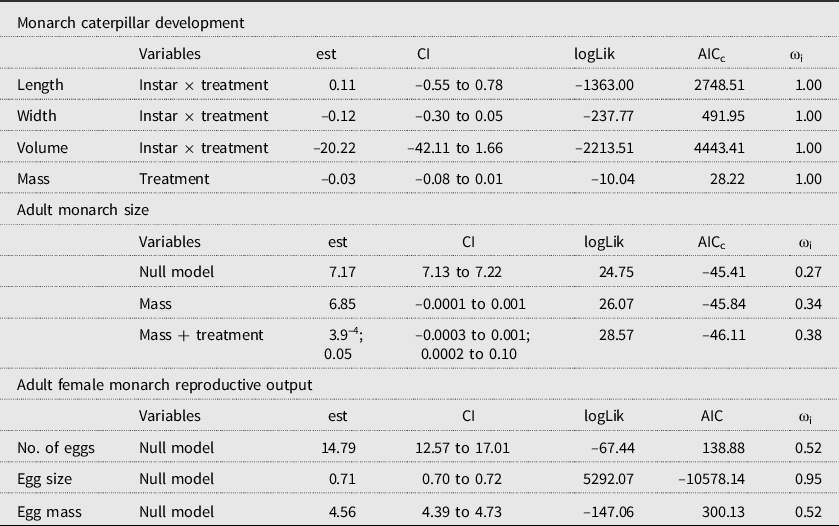
The only model that provided support to predict variation in caterpillar body length (measured in first, third, fifth instars) included an interaction between instar stage and treatment (ωi = 1.00; Table 2; Supplemental material, Table S1). At the first instar, body length was similar between treatments (control: 2.2 mm ± 0.3 standard deviation, low dose: 2.3 mm ± 0.4 standard deviation, high dose: 2.1 mm ± 0.5 standard deviation; Supplemental material, Tables S1 and S2). At the third instar, the body length of caterpillars from the high-dose treatment (9.8 mm ± 1.8 standard deviation) was shorter than that of caterpillars from other groups (Fig. 1A; Supplemental material, Tables S1 and S2), whereas the body length of caterpillars from the low-dose treatment (10.7 mm ± 1.7 standard deviation) was shorter than that of caterpillars from controls (control: 11.6 mm ± 1.4 standard deviation; Fig. 1A; Supplemental material, Tables S1 and S2). In contrast, at the fifth instar, caterpillars from the high-dose treatment (40.6 mm ± 5.8 standard deviation) were longer relative to caterpillars from the control group (35.8 mm ± 4.6 standard deviation) and from the low-dose treatment (36.3 mm ± 4.8 standard deviation; Fig. 1A; Supplemental material, Tables S1 and S2).
Effects of exposure to neonicotinoid clothianidin treatments at 0 ng/g in the soil (control), 15 ng/g (low dose), and 25 ng/g (high dose) on body length and width of monarch caterpillars (Danaus plexippus). A, Body length (mm) of first, third, and fifth instars; B, body width (mm) of third and fifth instars. Violin plots show the distribution of the raw data, including outliers, and are presented with median (•) and range of observations (whiskers).

Top models for caterpillar development and adult butterfly reproductive output for monarchs (Danaus plexippus) reared on swamp milkweed (Asclepias incarnata) grown in control (no insecticide), 15 ng/g (low dose), and 25 ng/g (high dose) soil. Model estimates (est) and upper and lower 95% confidence intervals (CI) are indicated, as well as Akaike’s information criterion (AIC) or the corrected AICc for small sample sizes, log likelihood (logLik), and Akaike weights. Variables included as fixed effects in the top models include instar, treatment, mass of both male and female monarchs (mass), male age (ageM), and female age (ageF).

Similarly, the only model that predicted variation in caterpillar body width (measured only for third and fifth instars) included an interaction between instar stage and treatment (ωi = 1.00; Table 2; Supplemental material, Table S1). At the third-instar stage, the body width of caterpillars from the high-dose treatment (1.5 mm ± 0.2 standard deviation) was narrower than that of caterpillars in the control (2.0 mm ± 0.3 standard deviation) and the low-dose treatment (1.9 mm ± 0.5 standard deviation; Fig. 1B; Supplemental material, Tables S1 and S3). No difference was found in width between third instars in the control and low-dose treatments (Fig. 1B; Supplemental material, Tables S1 and S3). At the fifth instar, caterpillars from the high-dose treatment (3.5 mm ± 0.5 standard deviation; Fig. 1B; Supplemental material, Tables S1 and S3) were narrower than caterpillars from other groups, whereas caterpillars from the low-dose treatment (5.0 mm ± 0.6 standard deviation; Fig. 1B) were narrower than caterpillars from the control group (5.3 mm ± 0.5 standard deviation; Fig. 1B; Supplemental material, Tables S1 and S3).
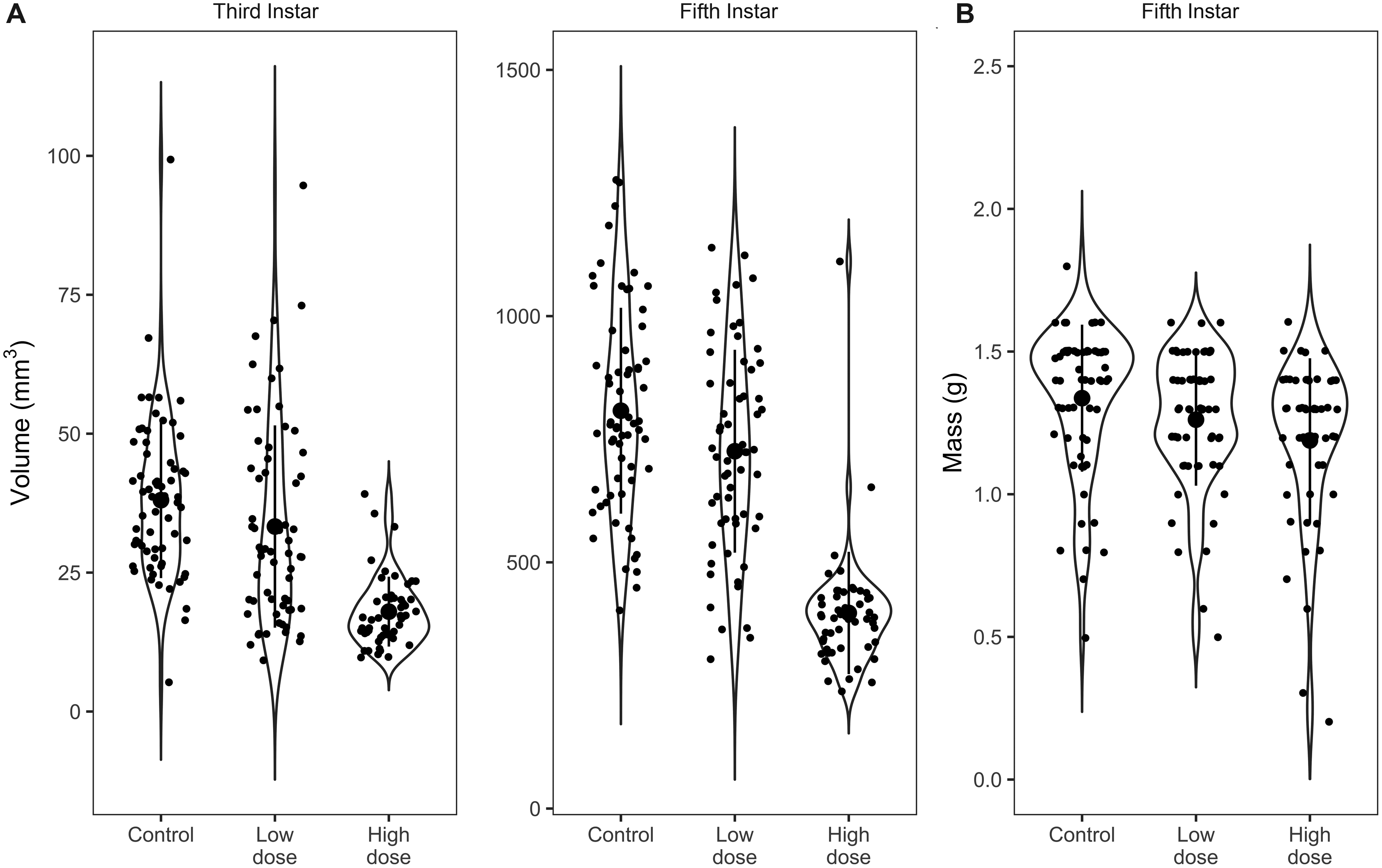
A single model predicted the variation in caterpillar body volume (calculated only for third and fifth instars) and included an interaction between instar stage and treatment (ωi = 1.00; Table 2; Supplemental material, Table S1). At the third-instar stage, body volume of caterpillars from the high-dose treatment (high dose: 18.0 mm3 ± 6.3 standard deviation) was less than that of the controls (control: 38.0 mm3 ± 14.0 standard deviation) and the low-dose treatment (low dose: 33.3 mm3 ± 18.2 standard deviation; Fig. 2A; Supplemental material, Tables S1 and S4). No difference was found between the body volume of caterpillars from the low-dose treatment and the control groups (Fig. 2A; Supplemental material, Tables S1 and S4). At the fifth instar, body volume of caterpillars from the high-dose treatment (397.2 mm3 ± 124.2 standard deviation) was, on average, less than half that of other groups (Fig. 2A; Supplemental material, Tables S1 and S4), and caterpillars from the low-dose treatment (725.6 mm3 ± 205.9 standard deviation) had smaller body volume than the controls (807.9 mm3 ± 209.1 standard deviation; Fig. 2A; Supplemental material, Tables S1 and S4).
Effects of exposure to treatments of the neonicotinoid, clothianidin, at 0 ng/g in the soil (control; CO), 15 ng/g (low dose), and 25 ng/g (high dose) on body volume and mass of monarch caterpillars (Danaus plexippus). A, Body volume (mm3) at the third and fifth instars; B, body mass (g) at the fifth instar. Violin plots show the distribution of the raw data, including outliers, and are presented with median (•) and range of observations (whiskers).

The only model that predicted mass of the fifth-instar caterpillars included treatment (ωi = 1.00; Table 2; Supplemental material, Table S1). Fifth-instar caterpillars exposed to milkweed grown in a high concentration of clothianidin (1.2 g ± 0.3 standard deviation) had a lower mass than did fifth instars exposed to milkweed grown in a low concentration of clothianidin (1.3 g ± 0.2 standard deviation) and controls (1.3 g ± 0.3 standard deviation; Fig. 2B; Supplemental material, Table S1). Mass was not measured for first or third instars.
Monarch butterfly adult length and reproductive output
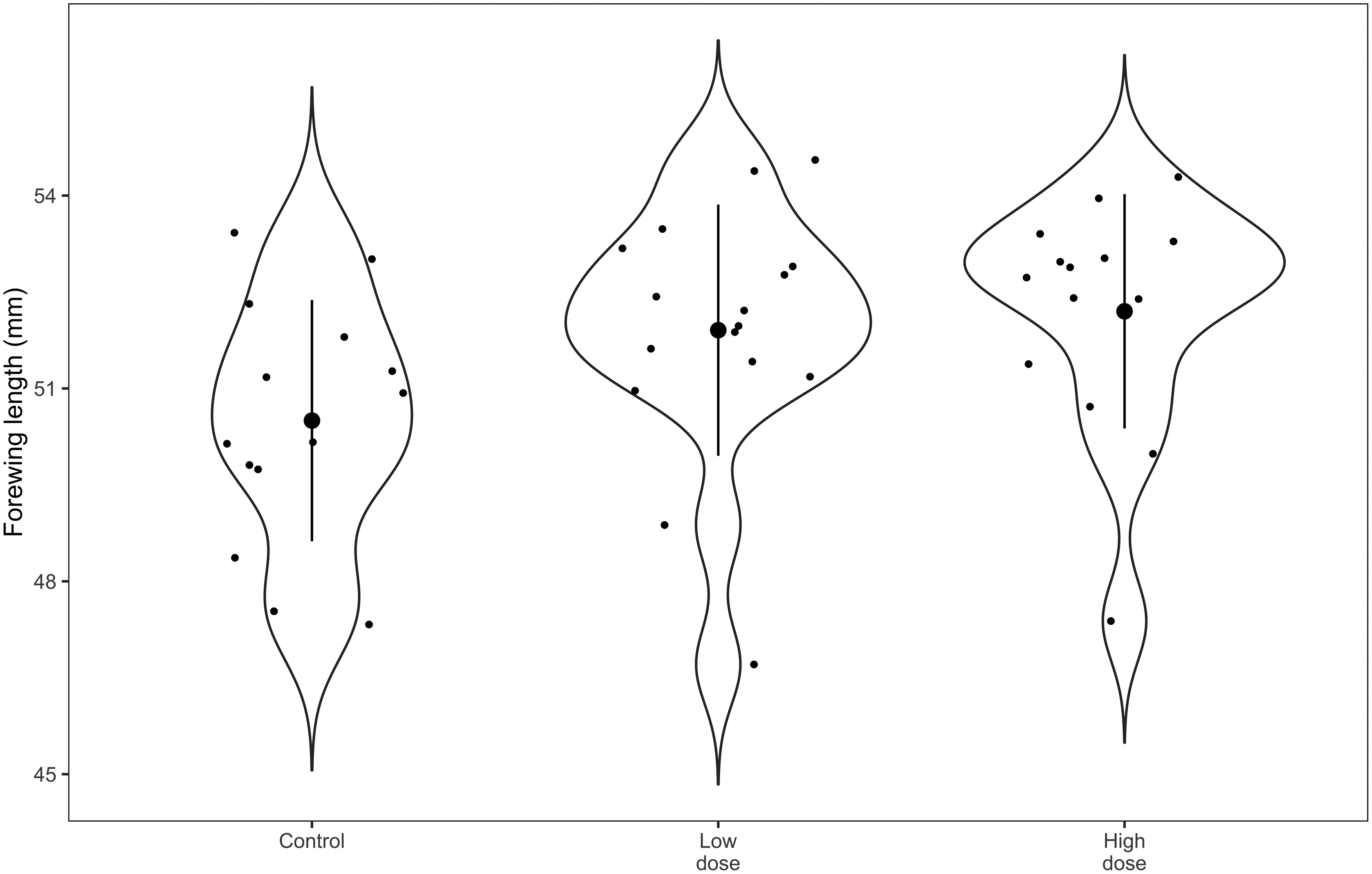
One of the three top models (ΔAICc ≤ 2) that predict adult monarch forewing length (Fig. 3) was the null model (ωi = 0.27; Table 2). The remaining two models included clothianidin treatment and monarch butterfly mass, both of which were positively correlated with forewing length (Table 2).
Forewing length (mm) by treatment for adult monarch butterflies (Danaus plexippus) reared exposed to the neonicotinoid, clothianidin, at 0 ng/g in the soil (control), 15 ng/g (low dose), and 25 ng/g (high dose). Violin plots show the distribution of the raw data, including outliers, and are presented with median (•) and range of observations (whiskers).

We did not find evidence that clothianidin affected female reproductive output. Three models (ΔAIC ≤ 2) explained the variation in the number of eggs laid, with the top model being the null model (ωi = 0.52; Table 2). The top-ranked model to predict egg size and egg mass was the null model (ωi = 0.95 and ωi = 0.52, respectively; Table 2).
Discussion
Our study demonstrates that early exposure to clothianidin at field-realistic concentrations can have a complex effect on monarch caterpillar size. We found both positive and negative effects on caterpillar body length that depended on instar stage but clear negative impacts on both the body width and volume of third and fifth instars, as well as on the mass of fifth instars. The effects of clothianidin on early caterpillar development could potentially be the result of a stress response that influences development. Neonicotinoid exposure can lead to an upregulation of the cellular stress response system (Ayyanath et al. Reference Ayyanath, Cutler, Scott-Dupree, Prithivirai, Kandasamy and Prithivirai2014), but it is unclear whether this could have a downstream effect on the juvenile hormone and the enzyme responsible for its degradation, juvenile hormone esterase. Although evidence exists for a potential relationship between other stressors and juvenile hormone esterase expression (Schelling and Jones Reference Schelling and Jones1996), this has not been experimentally confirmed for neonicotinoids. Therefore, measuring the concurrent response of juvenile hormone and juvenile hormone esterase expression during development in insects could provide evidence for a cellular-level response to neonicotinoid-induced stress. Alternatively, it is possible that milkweed grown in neonicotinoid-treated soil is less palatable for consumption, although this is probably not likely, given that honeybees show a preference for neonicotinoid-treated food sources (Kessler et al. Reference Kessler, Tiedeken, Simcock, Derveau, Mitchell and Softley2015; Arce et al. Reference Arce, Rodrigues, Yu, Colgan, Wurm and Gill2018).
Although clothianidin was detected in caterpillar tissue, it was not found in adult monarch butterflies. Recent studies provide evidence that exposure to neonicotinoids during early caterpillar development can result in a decrease in the size of adult monarch butterflies (Kobiela and Snell-Rood Reference Kobiela and Snell-Rood2020; Olaya-Arenas et al. Reference Olaya-Arenas, Hauri, Scharf and Kaplan2020), but at low concentrations (i.e., approximately 15 ng/g) clothianidin has only a weak effect on monarch forewing length (Olaya-Arenas et al. Reference Olaya-Arenas, Hauri, Scharf and Kaplan2020). Olaya-Arenas et al. (Reference Olaya-Arenas, Hauri, Scharf and Kaplan2020) suggest that tolerance to clothianidin may be a result of evolution of toxin resistance, specifically to the cardenolides found in milkweed. However, in our study, adult monarchs exposed to clothianidin during development grew larger (i.e., forewing length) than controls did. Genetic variation may explain the differences in the size of adult monarch butterflies, with maternal line known to be a contributing factor influencing body size in monarchs exposed to neonicotinoids during development (Kobiela and Snell-Rood Reference Kobiela and Snell-Rood2020).
Despite the larger size of adult monarchs from the treatment groups relative to the controls, no effect of treatment on egg size and egg mass was found. Previous studies in honeybees suggest a reduced capacity to lay fertilised eggs (Sandrock et al. Reference Sandrock, Tanadini, Tanadini, Fauser-Misslin, Potts and Neumann2014b; Williams et al. Reference Williams, Troxler, Retschnig, Roth, Yañez and Shutler2015) and that this effect persists for a year after neonicotinoid exposure (Sandrock et al. Reference Sandrock, Tanadini, Tanadini, Fauser-Misslin, Potts and Neumann2014b). However, we did not find any impact of early exposure to field-realistic levels of clothianidin on the number of eggs laid that would suggest problems in egg production. Our results agree with James (Reference James2019), who found that orally administered imidacloprid did not affect oocyte production. This suggests that clothianidin may have minimal impact on adult monarch butterfly reproductive output. Alternatively, given that clothianidin was not detected in our samples and the levels detected in the soil were quite low, it is possible that exposure to higher concentrations of clothianidin could reduce reproductive output.
Neonicotinoids are highly water soluble, which could affect chemical absorption and translocation into plant tissue. The concentration of clothianidin detected at analysis was lower than that which was applied to the soil, ranging from 0.40 to 2.80 parts per billion (Table 1). The retention of clothianidin in soil depends on soil composition and is greatest with high levels of organic matter relative to sand and pumice (Mörtl et al. Reference Mörtl, Kereki, Daryas, Kláyik, Vehovszky, Gyri and Székács2016). Clothianidin also may have not absorbed into the soil at dosing. The soil used for potting milkweed contained a high concentration of sphagnum peat moss (60–70%) that reduces water drainage from the soil. Despite this, it is possible that the high water solubility of neonicotinoids and low sorption to surrounding organic matter (Bonmatin et al. Reference Bonmatin, Giorio, Girolami, Goulson, Kreutzweiser and Krupke2015) resulted in the leaching of the insecticide and a higher concentration at the bottom of the pots due to daily watering. Leaching of clothianidin also may have contributed to a lack of the chemical available for uptake to milkweed. Only a single sample of milkweed leaf had a detectable level of clothianidin, although the concentration was comparable to field studies assessing the concentration of clothianidin in milkweed (i.e.,
 ${\overline x}$
= 0.48–1.14 parts per billion; Pecenka and Lundgren Reference Pecenka and Lundgren2015; Olaya-Arenas and Kaplan Reference Olaya-Arenas and Kaplan2019). However, it is also possible that clothianidin was not distributed equally throughout the milkweed and may have accumulated in specific regions of the plant, as is the case with other neonicotinoids (Chamberlain et al. Reference Chamberlain, Tench, Williams and Bromilow1995; Bonmatin et al. Reference Bonmatin, Giorio, Girolami, Goulson, Kreutzweiser and Krupke2015). Therefore, it is important that we understand how to control leaching and how this process could affect uptake and translocation of clothianidin.
The concentration of clothianidin detected in monarch caterpillars (i.e., less than one part per billion) was far below field concentrations, and no insecticide was detected in adult monarch butterflies. Honeybees (Apis mellifera) metabolise neonicotinoid at a rate of 2.0 ng/day (Cresswell et al. Reference Cresswell, Robert, Florance and Smirnoff2014), with metabolism recently attributed to enzymes in the cytochrome P450 superfamily (Manjon et al. Reference Manjon, Troczka, Zaworra, Beadle, Randall and Hertlein2018). No studies to date investigate the metabolism of neonicotinoids in Lepidoptera, but our results suggest the potential metabolism of the insecticide during the caterpillar stage or the elimination of the chemical during metamorphosis. However, a few limitations to our study should be considered when extrapolating our results to field-realistic scenarios. First, the concentration of insecticide used to dose the soil (i.e., 15 and 25 ng/g) was near the mean detected in field, but by the time of planting, the concentration had fallen to approximately one part per billion (1 ppb = 1 ng/g; Boguski Reference Boguski2006). Although similar low concentrations have been detected in the field (Chan et al. Reference Chan, Prosser, Rodríguez-Gill and Raine2019), impacts of clothianidin on monarch life history may become more apparent at higher concentrations of the insecticide. Therefore, we suggest monitoring caterpillars on agricultural plots to determine the effect of clothianidin treatment in realistic environmental scenarios. It is also critical to understand whether clothianidin treatment impacts mortality under these conditions. Oviposition tendencies also differ between lab and field conditions, with adult female monarch butterflies known to lay fewer eggs in captivity compared to in the wild (Oberhauser Reference Oberhauser2004). This, in addition to the small sample size of reproductive pairs, may have reduced our ability to detect differences in reproductive output between treatments. However, a similar study investigating the sublethal effects of the neonicotinoid imidacloprid on 20 adult monarch butterfly pairs also found no effect on oogenesis (James Reference James2019). Therefore, although our laboratory experiment suggests that there are minimal long-term effects of clothianidin on monarch butterflies, further work is needed to understand the potential impacts to this at-risk species in field-realistic scenarios.
Conclusion
We showed that exposure to field-realistic concentrations of the neonicotinoid insecticide clothianidin impacts caterpillar development in a complex manner, resulting in smaller body width and volume in late instars. Therefore, we encourage investigation into the underlying mechanism driving the physiological changes. We did not, however, find evidence of an effect of clothianidin exposure on the reproductive output (i.e., egg size and the number of eggs deposited) of adult female monarch butterflies. This study contributes to the critical work assessing the impact of clothianidin on monarch butterflies and emphasises the importance of understanding how environmental contaminants impact fitness at different life stages in a multigenerational at-risk species. Overall, our results provide further insights for the development of species management plans and future research.
Acknowledgements
We thank Taylor Van Belleghem, Angela Demarse, and Samantha Knight for assistance with data collection, as well as a team of volunteers who helped run the experiments. We also thank Mike Mucci and Tannis Slimmon for guidance, technical support, and coordinating use of the University of Guelph Phytotron. Funding was provided by a Natural Sciences and Engineering Research Council (NSERC) Discovery Grant to D.R.N. and a grant from the Ontario Ministry of Ministry of Agriculture, Food and Rural Affairs (OMAFRA) to A.E.M.N and D.R.N. An NSERC Alexander Graham Bell Canada Graduate Scholarship (CGS D) and Ontario Graduate Scholarship provided support for A.A.E.W.
Supplemental material
To view supplemental material for this article, please visit https://doi.org/10.4039/tce.2021.5.